
Basics of Significance Testing
4TESTS OF SIGNIFICANCE: THE BASICS
SIGNIFICANCE TESTING
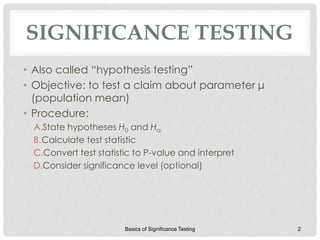
• Also called “hypothesis testing”
• Objective: to test a claim about parameter μ
(population mean)
• Procedure:
A.State hypotheses H0 and Ha
B.Calculate test statistic
C.Convert test statistic to P-value and interpret
D.Consider significance level (optional)
Basics of Significance Testing 2
HYPOTHESES
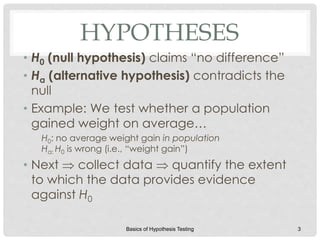
• H0 (null hypothesis) claims “no difference”
• Ha (alternative hypothesis) contradicts the
null
• Example: We test whether a population
gained weight on average…
H0: no average weight gain in population
Ha: H0 is wrong (i.e., “weight gain”)
• Next  collect data  quantify the extent
to which the data provides evidence
against H0
Basics of Hypothesis Testing 3
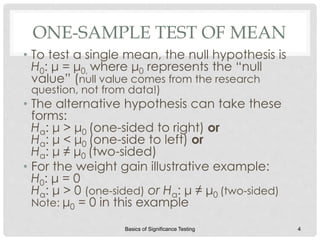
ONE-SAMPLE TEST OF MEAN
• To test a single mean, the null hypothesis is
H0: μ = μ0, where μ0 represents the “null
value” (null value comes from the research
question, not from data!)
• The alternative hypothesis can take these
forms:
Ha: μ > μ0 (one-sided to right) or
Ha: μ < μ0 (one-side to left) or
Ha: μ ≠ μ0 (two-sided)
• For the weight gain illustrative example:
H0: μ = 0
Ha: μ > 0 (one-sided) or Ha: μ ≠ μ0 (two-sided)
Note: μ0 = 0 in this example
Basics of Significance Testing 4
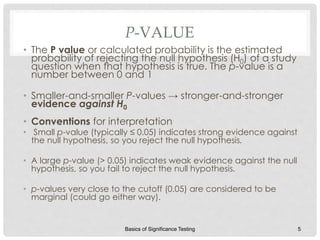
P-VALUE
• The P value or calculated probability is the estimated
probability of rejecting the null hypothesis (H0) of a study
question when that hypothesis is true. The p-value is a
number between 0 and 1
• Smaller-and-smaller P-values → stronger-and-stronger
evidence against H0
• Conventions for interpretation
• Small p-value (typically ≤ 0.05) indicates strong evidence against
the null hypothesis, so you reject the null hypothesis.
• A large p-value (> 0.05) indicates weak evidence against the null
hypothesis, so you fail to reject the null hypothesis.
• p-values very close to the cutoff (0.05) are considered to be
marginal (could go either way).
Basics of Significance Testing 5
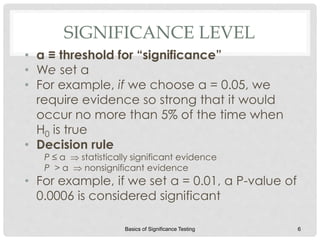
SIGNIFICANCE LEVEL
• α ≡ threshold for “significance”
• We set α
• For example, if we choose α = 0.05, we
require evidence so strong that it would
occur no more than 5% of the time when
H0 is true
• Decision rule
P ≤ α  statistically significant evidence
P > α  nonsignificant evidence
• For example, if we set α = 0.01, a P-value of
0.0006 is considered significant
Basics of Significance Testing 6
6/5/2014 Basics of Significance Testing 7
QUESTIONS?

Tests of Significance: The Basics Concepts

  • 1.
    Basics of SignificanceTesting 4TESTS OF SIGNIFICANCE: THE BASICS
  • 2.
    SIGNIFICANCE TESTING • Alsocalled “hypothesis testing” • Objective: to test a claim about parameter μ (population mean) • Procedure: A.State hypotheses H0 and Ha B.Calculate test statistic C.Convert test statistic to P-value and interpret D.Consider significance level (optional) Basics of Significance Testing 2
  • 3.
    HYPOTHESES • H0 (nullhypothesis) claims “no difference” • Ha (alternative hypothesis) contradicts the null • Example: We test whether a population gained weight on average… H0: no average weight gain in population Ha: H0 is wrong (i.e., “weight gain”) • Next  collect data  quantify the extent to which the data provides evidence against H0 Basics of Hypothesis Testing 3
  • 4.
    ONE-SAMPLE TEST OFMEAN • To test a single mean, the null hypothesis is H0: μ = μ0, where μ0 represents the “null value” (null value comes from the research question, not from data!) • The alternative hypothesis can take these forms: Ha: μ > μ0 (one-sided to right) or Ha: μ < μ0 (one-side to left) or Ha: μ ≠ μ0 (two-sided) • For the weight gain illustrative example: H0: μ = 0 Ha: μ > 0 (one-sided) or Ha: μ ≠ μ0 (two-sided) Note: μ0 = 0 in this example Basics of Significance Testing 4
  • 5.
    P-VALUE • The Pvalue or calculated probability is the estimated probability of rejecting the null hypothesis (H0) of a study question when that hypothesis is true. The p-value is a number between 0 and 1 • Smaller-and-smaller P-values → stronger-and-stronger evidence against H0 • Conventions for interpretation • Small p-value (typically ≤ 0.05) indicates strong evidence against the null hypothesis, so you reject the null hypothesis. • A large p-value (> 0.05) indicates weak evidence against the null hypothesis, so you fail to reject the null hypothesis. • p-values very close to the cutoff (0.05) are considered to be marginal (could go either way). Basics of Significance Testing 5
  • 6.
    SIGNIFICANCE LEVEL • α≡ threshold for “significance” • We set α • For example, if we choose α = 0.05, we require evidence so strong that it would occur no more than 5% of the time when H0 is true • Decision rule P ≤ α  statistically significant evidence P > α  nonsignificant evidence • For example, if we set α = 0.01, a P-value of 0.0006 is considered significant Basics of Significance Testing 6
  • 7.
    6/5/2014 Basics ofSignificance Testing 7 QUESTIONS?

Editor's Notes

  • #2 Thursday, June 5, 2014
  • #4 Thursday, June 5, 2014