1 
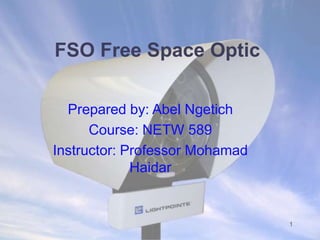
FSO Free Space Optic 
Prepared by: Abel Ngetich 
Course: NETW 589 
Instructor: Professor Mohamad 
Haidar
Introduction 
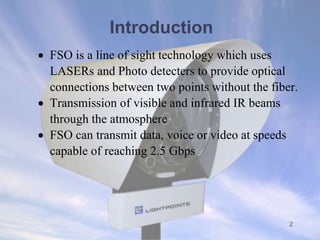
 FSO is a line of sight technology which uses 
LASERs and Photo detecters to provide optical 
connections between two points without the fiber. 
 Transmission of visible and infrared IR beams 
through the atmosphere 
 FSO can transmit data, voice or video at speeds 
capable of reaching 2.5 Gbps 
2
Continuation 
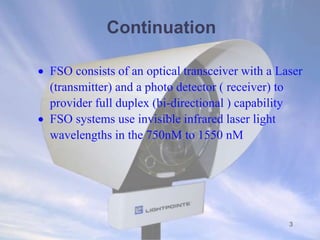
 FSO consists of an optical transceiver with a Laser 
(transmitter) and a photo detector ( receiver) to 
provider full duplex (bi-directional ) capability 
 FSO systems use invisible infrared laser light 
wavelengths in the 750nM to 1550 nM 
3
Campus Layout 
4
Advantages of FSO 
 Unregulated spectrum 
 Huge bandwidth 
 No strict laws 
 Optoelectronic technology 
 Less interference 
 Immunity to electromagnetic interference 
 Reusability 
 Low Power consumption 
5
Disadvantages of FSO 
 High launch represent eye hazard 
 Low power source requires light sensitive receivers 
 Alignment leads to more operation constraints 
 Signal scattering results in multipath impairment 
 Blockage lead to design challenges 
 Light interference negatively affects system 
performance 
 Scintillation 
6
7 
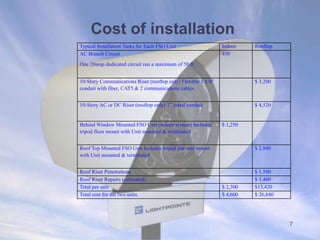
Cost of installation 
Typical Installation Tasks for Each FSO Unit Indoor Rooftop 
AC Branch Circuit 
One 20amp dedicated circuit run a maximum of 50 ft 
450 
10-Story Communications Riser (rooftop only) Flexible 1 1/4” 
conduit with fiber, CAT5 & 2 communications cables 
$ 3,200 
10-Story AC or DC Riser (rooftop only) 1” metal conduit $ 4,520 
Behind Window Mounted FSO Unit (indoor system) Includes 
tripod floor mount with Unit mounted & terminated 
$ 1,250 
Roof Top Mounted FSO Unit Includes tripod flat roof mount 
with Unit mounted & terminated. 
$ 2,800 
Roof Riser Penetrations $ 1,500 
Roof Riser Repairs (estimated) $ 1,400 
Total per unit $ 2,300 $13,420 
Total cost for the two units $ 4,600 $ 26,840
Are the cost opex or capex? 
• Opex is operational expenses such as wages, 
maintenance services, repairs, utilities and 
rent. 
• Capex refers to capital expenditures such as 
purchasing equipment and inventory 
 The cost of installation is more than the cost of 
maintenance of FSO. Therefore it is 
categorized as Capex cost 
8
Permit 
The following are some of the permits required 
by the jurisdiction within which FSO is to be 
installed. 
 Municipal or county council permit 
 Developmental permit 
 Environmental permit 
9
Continuation… 
• Installation and operation of FSO 
requires no FCC licensing or RF 
spectrum licensing . 
10
Data Security 
• In FSO an infrared beam slightly above the 
visible spectrum is used hence it is invisible to 
normal human eyes. 
• Any attempt to interrupt the beam is possible 
only near the receiver terminus as it passes in 
a line of sight which is invisible 
11
Conclusion 
FSO is recommendable to such 
environment such as university campus or 
connecting buildings in a city. It is less 
expensive and requires no spectrum 
licensing. It is more secure because it 
requires no security software. 
12
Reference 
Infrared Data Association http://www.irda.org 
http://www.atekcommunications.com/nationalfsoi 
nstallations.htm 
http://www.cablinginstall.com/articles/print/volum 
e-18/issue-3/features/free-space-optics.html 
http://www.freespaceoptic.org 
13

Fso free space optic

  • 1.
    1 FSO FreeSpace Optic Prepared by: Abel Ngetich Course: NETW 589 Instructor: Professor Mohamad Haidar
  • 2.
    Introduction  FSOis a line of sight technology which uses LASERs and Photo detecters to provide optical connections between two points without the fiber.  Transmission of visible and infrared IR beams through the atmosphere  FSO can transmit data, voice or video at speeds capable of reaching 2.5 Gbps 2
  • 3.
    Continuation  FSOconsists of an optical transceiver with a Laser (transmitter) and a photo detector ( receiver) to provider full duplex (bi-directional ) capability  FSO systems use invisible infrared laser light wavelengths in the 750nM to 1550 nM 3
  • 4.
  • 5.
    Advantages of FSO  Unregulated spectrum  Huge bandwidth  No strict laws  Optoelectronic technology  Less interference  Immunity to electromagnetic interference  Reusability  Low Power consumption 5
  • 6.
    Disadvantages of FSO  High launch represent eye hazard  Low power source requires light sensitive receivers  Alignment leads to more operation constraints  Signal scattering results in multipath impairment  Blockage lead to design challenges  Light interference negatively affects system performance  Scintillation 6
  • 7.
    7 Cost ofinstallation Typical Installation Tasks for Each FSO Unit Indoor Rooftop AC Branch Circuit One 20amp dedicated circuit run a maximum of 50 ft 450 10-Story Communications Riser (rooftop only) Flexible 1 1/4” conduit with fiber, CAT5 & 2 communications cables $ 3,200 10-Story AC or DC Riser (rooftop only) 1” metal conduit $ 4,520 Behind Window Mounted FSO Unit (indoor system) Includes tripod floor mount with Unit mounted & terminated $ 1,250 Roof Top Mounted FSO Unit Includes tripod flat roof mount with Unit mounted & terminated. $ 2,800 Roof Riser Penetrations $ 1,500 Roof Riser Repairs (estimated) $ 1,400 Total per unit $ 2,300 $13,420 Total cost for the two units $ 4,600 $ 26,840
  • 8.
    Are the costopex or capex? • Opex is operational expenses such as wages, maintenance services, repairs, utilities and rent. • Capex refers to capital expenditures such as purchasing equipment and inventory  The cost of installation is more than the cost of maintenance of FSO. Therefore it is categorized as Capex cost 8
  • 9.
    Permit The followingare some of the permits required by the jurisdiction within which FSO is to be installed.  Municipal or county council permit  Developmental permit  Environmental permit 9
  • 10.
    Continuation… • Installationand operation of FSO requires no FCC licensing or RF spectrum licensing . 10
  • 11.
    Data Security •In FSO an infrared beam slightly above the visible spectrum is used hence it is invisible to normal human eyes. • Any attempt to interrupt the beam is possible only near the receiver terminus as it passes in a line of sight which is invisible 11
  • 12.
    Conclusion FSO isrecommendable to such environment such as university campus or connecting buildings in a city. It is less expensive and requires no spectrum licensing. It is more secure because it requires no security software. 12
  • 13.
    Reference Infrared DataAssociation http://www.irda.org http://www.atekcommunications.com/nationalfsoi nstallations.htm http://www.cablinginstall.com/articles/print/volum e-18/issue-3/features/free-space-optics.html http://www.freespaceoptic.org 13