Free-Space Optics (FSO)
Point to Point Link Communications
Opening prompt interest
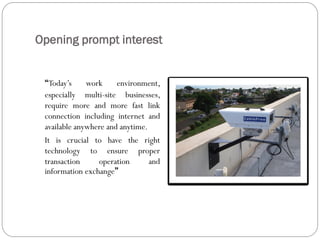
Today’s work environment,
especially multi-site businesses,
require more and more fast link
connection including internet and
available anywhere and anytime.
It is crucial to have the right
technology to ensure proper
transaction operation and
information exchange
Definition
 Free-Space Optics, in short FSO, is a wireless broadband
technology that uses modulated laser light in the infrared range to
transmit data, voice and video on point to point links.
 FSO works on range between 200 meters and 4 KMs in general.
The technology
 Free-Space Optics has been on the market for many years and
from its early development, its potential was uncontestable.
 But due to adverse atmospheric conditions, FSO was not very
reliable. Meanwhile, recent improvement in its link availability and
relatively cheaper cost is taking FSO to the next level.
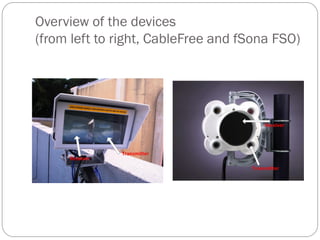
Overview of the devices
(from left to right, CableFree and fSona FSO)
Facts
 Various wired and wireless technologies (copper wire, Fiber
optics, satellite) provide efficiently connectivity .
 In some cases, due to the presence of major roads, natural
obstacles like rivers and mountains the fiber optics cable and other
wired links do not cover all areas.
Free-Space Optics links
 Free-Space Optics can be deployed to keep the provided
bandwidth to broadband customers as high as possible at relatively
cheaper cost in specific applications.
FSO and weather conditions
 As it is for any other wireless technology, FSO is affected mainly
by fog, then rain and scintillation.
 A good wireless link planning can overcome these challenges
efficiently.
FSO applications
 “Last mile” connectivity
 LAN extension
 Backhaul links
 Back-up for fiber optics links
Advantages of FSO
 High bandwidth beyond 1 Gbps
 Unlicensed wireless technology
 Rapid installation and easy maintenance
 No recurrent fees
 Very secure communication technology
 Carrier-class availability
 Low latency
Legal issues
 Free-Space Optics uses unlicensed band of frequencies in the near
infra red. Deployment does not require any license payment but
the product, due to its type, needs to be approved by the ARCT
(Agence de Régulation et de Contrôle des Télécommunications au
Burundi).
Environmental issues
 FSO presents no danger on the environment, but rather presents
advantages. FSO is also called fiber through air due to the
resemblance and high bandwidth capabilities up to 10 Gbps.
Safety use of equipments
 Laser eye safety standards set in different classes are used to
prevent any harm to the user of Free-Space Optics.
FSO Cost
 Based on CableFree equipments, FSO cost can vary from around
USD 6,300 for 100 Mbps, 200 meters link to USD 27,000 for a 1
Gbps, 2 KMs link.
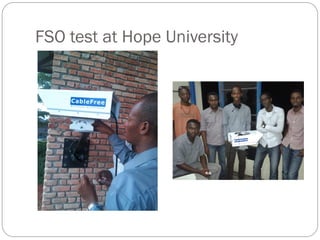
FSO test at Hope University
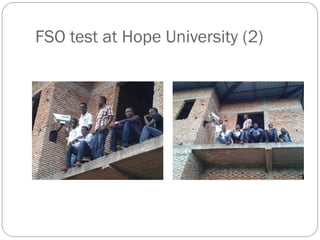
FSO test at Hope University (2)
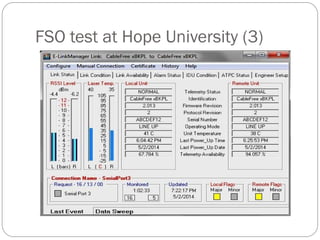
FSO test at Hope University (3)
Thank you!

FSO marketing in Burundi

  • 1.
    Free-Space Optics (FSO) Pointto Point Link Communications
  • 2.
    Opening prompt interest Today’swork environment, especially multi-site businesses, require more and more fast link connection including internet and available anywhere and anytime. It is crucial to have the right technology to ensure proper transaction operation and information exchange
  • 3.
    Definition  Free-Space Optics,in short FSO, is a wireless broadband technology that uses modulated laser light in the infrared range to transmit data, voice and video on point to point links.  FSO works on range between 200 meters and 4 KMs in general.
  • 4.
    The technology  Free-SpaceOptics has been on the market for many years and from its early development, its potential was uncontestable.  But due to adverse atmospheric conditions, FSO was not very reliable. Meanwhile, recent improvement in its link availability and relatively cheaper cost is taking FSO to the next level.
  • 5.
    Overview of thedevices (from left to right, CableFree and fSona FSO)
  • 6.
    Facts  Various wiredand wireless technologies (copper wire, Fiber optics, satellite) provide efficiently connectivity .  In some cases, due to the presence of major roads, natural obstacles like rivers and mountains the fiber optics cable and other wired links do not cover all areas.
  • 7.
    Free-Space Optics links Free-Space Optics can be deployed to keep the provided bandwidth to broadband customers as high as possible at relatively cheaper cost in specific applications.
  • 8.
    FSO and weatherconditions  As it is for any other wireless technology, FSO is affected mainly by fog, then rain and scintillation.  A good wireless link planning can overcome these challenges efficiently.
  • 9.
    FSO applications  “Lastmile” connectivity  LAN extension  Backhaul links  Back-up for fiber optics links
  • 10.
    Advantages of FSO High bandwidth beyond 1 Gbps  Unlicensed wireless technology  Rapid installation and easy maintenance  No recurrent fees  Very secure communication technology  Carrier-class availability  Low latency
  • 11.
    Legal issues  Free-SpaceOptics uses unlicensed band of frequencies in the near infra red. Deployment does not require any license payment but the product, due to its type, needs to be approved by the ARCT (Agence de Régulation et de Contrôle des Télécommunications au Burundi).
  • 12.
    Environmental issues  FSOpresents no danger on the environment, but rather presents advantages. FSO is also called fiber through air due to the resemblance and high bandwidth capabilities up to 10 Gbps.
  • 13.
    Safety use ofequipments  Laser eye safety standards set in different classes are used to prevent any harm to the user of Free-Space Optics.
  • 14.
    FSO Cost  Basedon CableFree equipments, FSO cost can vary from around USD 6,300 for 100 Mbps, 200 meters link to USD 27,000 for a 1 Gbps, 2 KMs link.
  • 15.
    FSO test atHope University
  • 16.
    FSO test atHope University (2)
  • 17.
    FSO test atHope University (3)
  • 18.