1
Fungus
A. Importance of fungi:
Some fungi are harmful and some are beneficial to us.
Harmful effect of fungi:
1. Cause disease in plant: Fungi are the major groups of pathogens causing many
severe diseases in plants. e.g. Blast disease of rice- Pyriculaia oryzae, Late blight
of potato- Phytophthora infestans.
2. Spoil food: Fungi destroy stored food stuffs, vegetables and fruits. Aspergillus
and Penicillium spoil stored food.
3. Spoil valuable things: Fungus grow on decompose cloths, leather, furniture and
buildings. e.g. Rhizopus grow on cloths and taint. Serpula lachrymans decompose
woods, thus affect furniture and equipments.
4. Cause human disease: Spores produced by fungi may cause asthma and
respiratory problems.
General characteristics of Fungi
2
Beneficial activities of fungi:
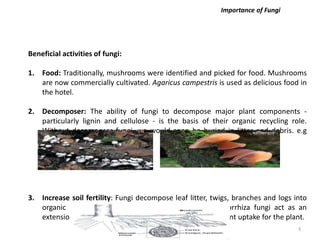
1. Food: Traditionally, mushrooms were identified and picked for food. Mushrooms
are now commercially cultivated. Agaricus campestris is used as delicious food in
the hotel.
2. Decomposer: The ability of fungi to decompose major plant components -
particularly lignin and cellulose - is the basis of their organic recycling role.
Without decomposer fungi, we would soon be buried in litter and debris. e.g
Auricularia auriculajudae.
3. Increase soil fertility: Fungi decompose leaf litter, twigs, branches and logs into
organic matter and recycle nutrients to the soil. Mycorrhiza fungi act as an
extension of the root system, resulting in improved nutrient uptake for the plant.
Importance of Fungi
3
4. Biocontrol agents: Penicillium, Trichoderma, Phoma etc. control plant
diseases.
5. Industrial use: yeast use in bread preparation, Aspergillus flavous produces
digestion enzyme, Penicillium produces antibiotic
4
B. Morphology:
1. Fungi are chlorophyll-less
2. Fungi are nucleated organisms.
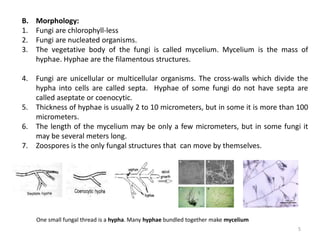
3. The vegetative body of the fungi is called mycelium. Mycelium is the mass of
hyphae. Hyphae are the filamentous structures.
4. Fungi are unicellular or multicellular organisms. The cross-walls which divide the
hypha into cells are called septa. Hyphae of some fungi do not have septa are
called aseptate or coenocytic.
5. Thickness of hyphae is usually 2 to 10 micrometers, but in some it is more than 100
micrometers.
6. The length of the mycelium may be only a few micrometers, but in some fungi it
may be several meters long.
7. Zoospores is the only fungal structures that can move by themselves.
One small fungal thread is a hypha. Many hyphae bundled together make mycelium
5
B. Modification of mycelium
Hyphae are modified in different ways:
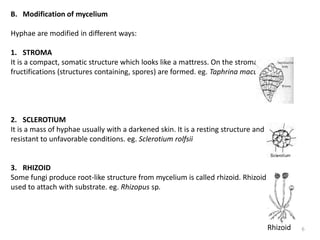
1. STROMA
It is a compact, somatic structure which looks like a mattress. On the stroma
fructifications (structures containing, spores) are formed. eg. Taphrina maculans
2. SCLEROTIUM
It is a mass of hyphae usually with a darkened skin. It is a resting structure and
resistant to unfavorable conditions. eg. Sclerotium rolfsii
3. RHIZOID
Some fungi produce root-like structure from mycelium is called rhizoid. Rhizoid are
used to attach with substrate. eg. Rhizopus sp.
Rhizoid 6
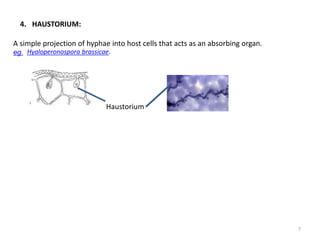
4. HAUSTORIUM:
A simple projection of hyphae into host cells that acts as an absorbing organ.
eg.
Haustorium
Hyaloperonospora brassicae.
7
C. Reproduction:
Fungi reproduce both 1. Asexually and 2.
Sexually
The asexual state is referred to as anamorph and the
sexual state is termed as teleomorph. Many fungi
can have both.
 Asexual reproduction:
Reproduction without nuclear fusion. Asexual
reproduction occurs under favorable condition and
is repeated several times in the life cycle.
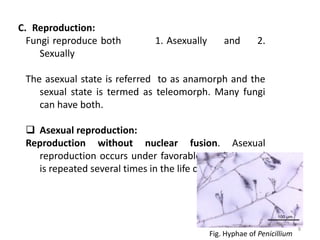
Fig. Hyphae of Penicillium
8
Different types of asexual reproduction are found in
fungi:
1. Fragmentation of hyphae:
I. Oidiospore/Arthrospore
II. Chlamydospore
2. Fission
3. Budding
4. Production of asexual spores
I. Production of Sporangiospore
a. Zoopsore
b. Aplanospore
II. Production of Condia
a. Loose
b. Asexual Fruiting body
i. Pycnidium
ii. Acervulus
iii. Sporodochium
iv. Synnema
9
1. Fragmentation of hyphae:
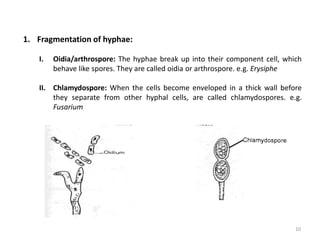
I. Oidia/arthrospore: The hyphae break up into their component cell, which
behave like spores. They are called oidia or arthrospore. e.g. Erysiphe
II. Chlamydospore: When the cells become enveloped in a thick wall before
they separate from other hyphal cells, are called chlamydospores. e.g.
Fusarium
10
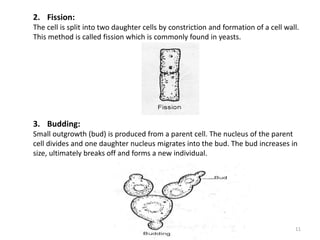
2. Fission:
The cell is split into two daughter cells by constriction and formation of a cell wall.
This method is called fission which is commonly found in yeasts.
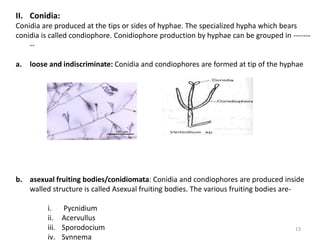
3. Budding:
Small outgrowth (bud) is produced from a parent cell. The nucleus of the parent
cell divides and one daughter nucleus migrates into the bud. The bud increases in
size, ultimately breaks off and forms a new individual.
11
4. Production of asxual spores:
Fungi produce two types of asexual spores- sporangiospore and conidia
I. Sporangium:
Sporangium is a sac-like structure and its entire contents are converted into one or
more spores which are called sporangiospores., e.g. Rhizopus
Sporangiospores
a. Zoospores: If the sporangiospores are motile
(swim), have one or two flagella.
Two types of flagella are found, one is whiplash and
another is tinsel flagellum.
b. Aplanospores: If the sporangiospores are non-
motile and have no flagella.
12
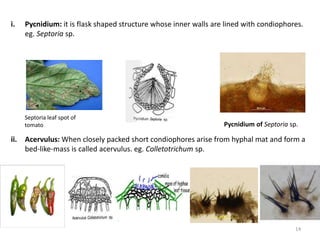
II. Conidia:
Conidia are produced at the tips or sides of hyphae. The specialized hypha which bears
conidia is called condiophore. Conidiophore production by hyphae can be grouped in -------
--
a. loose and indiscriminate: Conidia and condiophores are formed at tip of the hyphae
b. asexual fruiting bodies/conidiomata: Conidia and condiophores are produced inside
walled structure is called Asexual fruiting bodies. The various fruiting bodies are-
i. Pycnidium
ii. Acervullus
iii. Sporodocium
iv. Synnema
13
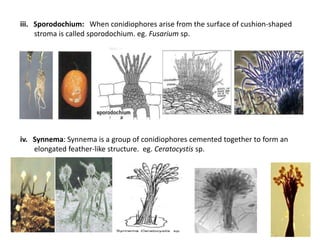
i. Pycnidium: it is flask shaped structure whose inner walls are lined with condiophores.
eg. Septoria sp.
ii. Acervulus: When closely packed short condiophores arise from hyphal mat and form a
bed-like-mass is called acervulus. eg. Colletotrichum sp.
14
Septoria leaf spot of
tomato Pycnidium of Septoria sp.
iii. Sporodochium: When conidiophores arise from the surface of cushion-shaped
stroma is called sporodochium. eg. Fusarium sp.
iv. Synnema: Synnema is a group of conidiophores cemented together to form an
elongated feather-like structure. eg. Ceratocystis sp.
15

General_characteristics_of_Fungi.pptx

  • 1.
  • 2.
    A. Importance offungi: Some fungi are harmful and some are beneficial to us. Harmful effect of fungi: 1. Cause disease in plant: Fungi are the major groups of pathogens causing many severe diseases in plants. e.g. Blast disease of rice- Pyriculaia oryzae, Late blight of potato- Phytophthora infestans. 2. Spoil food: Fungi destroy stored food stuffs, vegetables and fruits. Aspergillus and Penicillium spoil stored food. 3. Spoil valuable things: Fungus grow on decompose cloths, leather, furniture and buildings. e.g. Rhizopus grow on cloths and taint. Serpula lachrymans decompose woods, thus affect furniture and equipments. 4. Cause human disease: Spores produced by fungi may cause asthma and respiratory problems. General characteristics of Fungi 2
  • 3.
    Beneficial activities offungi: 1. Food: Traditionally, mushrooms were identified and picked for food. Mushrooms are now commercially cultivated. Agaricus campestris is used as delicious food in the hotel. 2. Decomposer: The ability of fungi to decompose major plant components - particularly lignin and cellulose - is the basis of their organic recycling role. Without decomposer fungi, we would soon be buried in litter and debris. e.g Auricularia auriculajudae. 3. Increase soil fertility: Fungi decompose leaf litter, twigs, branches and logs into organic matter and recycle nutrients to the soil. Mycorrhiza fungi act as an extension of the root system, resulting in improved nutrient uptake for the plant. Importance of Fungi 3
  • 4.
    4. Biocontrol agents:Penicillium, Trichoderma, Phoma etc. control plant diseases. 5. Industrial use: yeast use in bread preparation, Aspergillus flavous produces digestion enzyme, Penicillium produces antibiotic 4
  • 5.
    B. Morphology: 1. Fungiare chlorophyll-less 2. Fungi are nucleated organisms. 3. The vegetative body of the fungi is called mycelium. Mycelium is the mass of hyphae. Hyphae are the filamentous structures. 4. Fungi are unicellular or multicellular organisms. The cross-walls which divide the hypha into cells are called septa. Hyphae of some fungi do not have septa are called aseptate or coenocytic. 5. Thickness of hyphae is usually 2 to 10 micrometers, but in some it is more than 100 micrometers. 6. The length of the mycelium may be only a few micrometers, but in some fungi it may be several meters long. 7. Zoospores is the only fungal structures that can move by themselves. One small fungal thread is a hypha. Many hyphae bundled together make mycelium 5
  • 6.
    B. Modification ofmycelium Hyphae are modified in different ways: 1. STROMA It is a compact, somatic structure which looks like a mattress. On the stroma fructifications (structures containing, spores) are formed. eg. Taphrina maculans 2. SCLEROTIUM It is a mass of hyphae usually with a darkened skin. It is a resting structure and resistant to unfavorable conditions. eg. Sclerotium rolfsii 3. RHIZOID Some fungi produce root-like structure from mycelium is called rhizoid. Rhizoid are used to attach with substrate. eg. Rhizopus sp. Rhizoid 6
  • 7.
    4. HAUSTORIUM: A simpleprojection of hyphae into host cells that acts as an absorbing organ. eg. Haustorium Hyaloperonospora brassicae. 7
  • 8.
    C. Reproduction: Fungi reproduceboth 1. Asexually and 2. Sexually The asexual state is referred to as anamorph and the sexual state is termed as teleomorph. Many fungi can have both.  Asexual reproduction: Reproduction without nuclear fusion. Asexual reproduction occurs under favorable condition and is repeated several times in the life cycle. Fig. Hyphae of Penicillium 8
  • 9.
    Different types ofasexual reproduction are found in fungi: 1. Fragmentation of hyphae: I. Oidiospore/Arthrospore II. Chlamydospore 2. Fission 3. Budding 4. Production of asexual spores I. Production of Sporangiospore a. Zoopsore b. Aplanospore II. Production of Condia a. Loose b. Asexual Fruiting body i. Pycnidium ii. Acervulus iii. Sporodochium iv. Synnema 9
  • 10.
    1. Fragmentation ofhyphae: I. Oidia/arthrospore: The hyphae break up into their component cell, which behave like spores. They are called oidia or arthrospore. e.g. Erysiphe II. Chlamydospore: When the cells become enveloped in a thick wall before they separate from other hyphal cells, are called chlamydospores. e.g. Fusarium 10
  • 11.
    2. Fission: The cellis split into two daughter cells by constriction and formation of a cell wall. This method is called fission which is commonly found in yeasts. 3. Budding: Small outgrowth (bud) is produced from a parent cell. The nucleus of the parent cell divides and one daughter nucleus migrates into the bud. The bud increases in size, ultimately breaks off and forms a new individual. 11
  • 12.
    4. Production ofasxual spores: Fungi produce two types of asexual spores- sporangiospore and conidia I. Sporangium: Sporangium is a sac-like structure and its entire contents are converted into one or more spores which are called sporangiospores., e.g. Rhizopus Sporangiospores a. Zoospores: If the sporangiospores are motile (swim), have one or two flagella. Two types of flagella are found, one is whiplash and another is tinsel flagellum. b. Aplanospores: If the sporangiospores are non- motile and have no flagella. 12
  • 13.
    II. Conidia: Conidia areproduced at the tips or sides of hyphae. The specialized hypha which bears conidia is called condiophore. Conidiophore production by hyphae can be grouped in ------- -- a. loose and indiscriminate: Conidia and condiophores are formed at tip of the hyphae b. asexual fruiting bodies/conidiomata: Conidia and condiophores are produced inside walled structure is called Asexual fruiting bodies. The various fruiting bodies are- i. Pycnidium ii. Acervullus iii. Sporodocium iv. Synnema 13
  • 14.
    i. Pycnidium: itis flask shaped structure whose inner walls are lined with condiophores. eg. Septoria sp. ii. Acervulus: When closely packed short condiophores arise from hyphal mat and form a bed-like-mass is called acervulus. eg. Colletotrichum sp. 14 Septoria leaf spot of tomato Pycnidium of Septoria sp.
  • 15.
    iii. Sporodochium: Whenconidiophores arise from the surface of cushion-shaped stroma is called sporodochium. eg. Fusarium sp. iv. Synnema: Synnema is a group of conidiophores cemented together to form an elongated feather-like structure. eg. Ceratocystis sp. 15