STUDENT COURSE TEACHER
CHANDRA LEKHA. R Dr. S. PARTHASARATHY
ID. No. 2016021006 Asst. Prof., (Plant Pathology)
COLLEGE OF AGRICULTURAL TECHNOLOGY
Affiliated to Tamil Nadu Agricultural University, Coimbatore
Kullapuram, Via Vaigai dam, Theni-625 562
BLACK (STEM) RUST OF WHEAT
SIGNIFICANCE
• Wheat is the sixth most important crop.
• Grown yearly on 220.4 million hectares.
• Possess net worth more than 22 billion dollars.
• World trade in wheat is greater than for all other
crops combined.
• Losses upto 60 to 70%.
SIGNIFICANCE
• Major disease of wheat and, therefore a potential
threat to the world food supply.
• More than 5 billion dollars are lost due to cereal
rust each year.
• Wheat black stem rust was a serious problem in
ancient Greece and Rome.
• Robigalia festival – sacrificed red animals such as
dogs, foxes and cows to the rust god Robigo.
MILESTONES
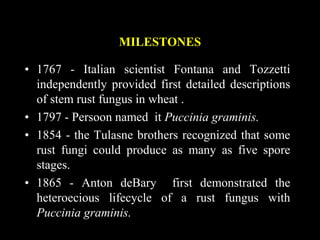
• 1767 - Italian scientist Fontana and Tozzetti
independently provided first detailed descriptions
of stem rust fungus in wheat .
• 1797 - Persoon named it Puccinia graminis.
• 1854 - the Tulasne brothers recognized that some
rust fungi could produce as many as five spore
stages.
• 1865 - Anton deBary first demonstrated the
heteroecious lifecycle of a rust fungus with
Puccinia graminis.
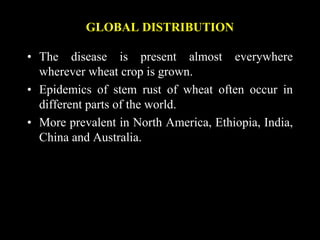
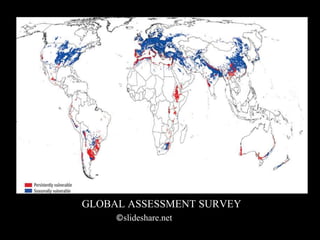
GLOBAL DISTRIBUTION
• The disease is present almost everywhere
wherever wheat crop is grown.
• Epidemics of stem rust of wheat often occur in
different parts of the world.
• More prevalent in North America, Ethiopia, India,
China and Australia.
GLOBAL ASSESSMENT SURVEY
©slideshare.net
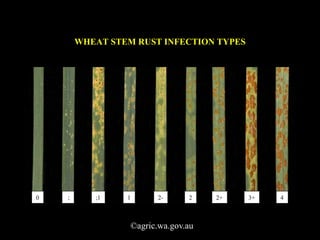
WHEAT STEM RUST INFECTION TYPES
©agric.wa.gov.au
SYMPTOMS
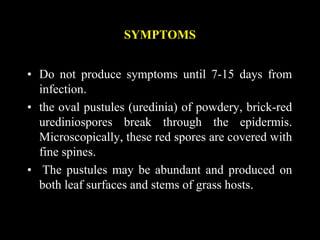
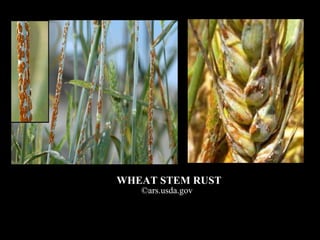
• Do not produce symptoms until 7-15 days from
infection.
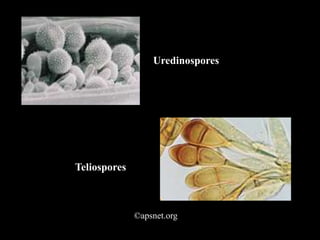
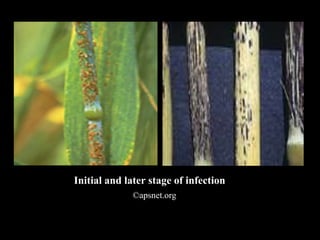
• the oval pustules (uredinia) of powdery, brick-red
urediniospores break through the epidermis.
Microscopically, these red spores are covered with
fine spines.
• The pustules may be abundant and produced on
both leaf surfaces and stems of grass hosts.
SYMPTOMS
• Later in the season, pustules (telia) of black
teliospores begin to appear in infected grass
species. Microscopically, teliospores are two
celled and thick walled.
• The stem become dry and cracked.
• The plant produces less or no grains.
WHEAT STEM RUST
©ars.usda.gov
Uredinospores
Teliospores
©apsnet.org
Initial and later stage of infection
©apsnet.org
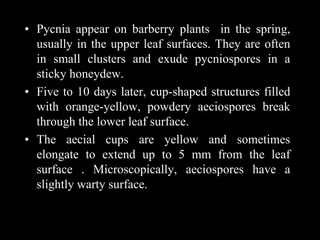
• Pycnia appear on barberry plants in the spring,
usually in the upper leaf surfaces. They are often
in small clusters and exude pycniospores in a
sticky honeydew.
• Five to 10 days later, cup-shaped structures filled
with orange-yellow, powdery aeciospores break
through the lower leaf surface.
• The aecial cups are yellow and sometimes
elongate to extend up to 5 mm from the leaf
surface . Microscopically, aeciospores have a
slightly warty surface.
©apsnet.org
Barberry plant Pycniospores Aeciospores
SYSTEMATIC CLASSIFICATION
• Domain : Eukarya
• Kingdom : Fungi
• Phylum : Basidiomycota
• Subphylum : Pucciniomycotina
• Class : Pucciniomycetes
• Order : Pucciniales
• Family : Pucciniaceae
• Genus : Puccinia
• Species : P. graminis f. sp. tritici
PATHOGEN CHARACTERS
• The pathogen is an obligate parasite.
• It cannot exists as saprophyte.
• In most rust fungi, only the teliospores are adapted
to survive apart from a living host plant for more
than few months under field conditions.
• Puccinia graminis is heteroecious and polycyclic.
STAGES OF THE PATHOGEN
• Puccinia graminis is macrocyclic, producing all
five spore stages
Stage 0 : Spermagonium
Stage 1 : Aecium
Stage 2 : Uredium
Stage 3 : Telium
Stage 4 : Basidium
HOSTS
• Wheat and barley.
• Common barberry (and some additional Berberis,
Mahoberberis and Mahonia spp.)
DISEASE CYCLE
©apsnet.org
EPIDEMIOLOGY
• Stem rust is favoured by hot days (25-30ºC/ 77-
86ºF), mild nights (15-20ºC/ 59-68ºF), and wet
leaves from rain or dew.
• It appears in the month of March in Northern
India. In Southern and Peninsular India it appears
very early in the 4th week of November.
• Both aeciospores and urediniospores require free
water for germination as do the other spore stages.
• Infections occur through stomata.
SURVIVAL OF PATHOGEN
• Stem rust can survive as teliospores during winter
when aeciospores are a major source of inoculum.
• It generally survives as mycelium or uredinia on
volunteer wheat during the non-wheat growing
season.
• Sporulating uredinia are active in tropical and
some subtropical areas throughout the winter.
• Occasional dormant mycelium may survive
beneath the snow pack in more northern temperate
regions.
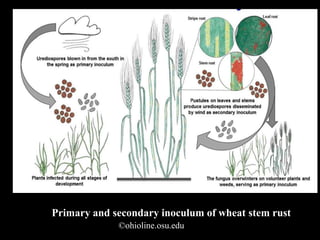
Primary and secondary inoculum of wheat stem rust
©ohioline.osu.edu
MODE OF SPREAD
• Primary spread - Urediniospores and aeciospores
are wind borne.
• Secondary spread - Rain is necessary for effective
deposition of uredinospore involved in regional
spore transport.
• Teliospores remain with the straw.
MANAGEMENT
• Adjustment of sowing dates.
• Growing short and long duration crops.
• Applications of balanced fertilizers to the crop.
• Eradication of barberry trees around the wheat
field.
MANAGEMENT
Cultivation of Rust Resistant Varieties:
• The cultivation of varieties immune to the rust
disease is an important means of combating the
disease. Some rust resistant varieties of wheat are
available in India. NP 710, NP 718 and NP 770
find favour with the farmers.
MANAGEMENT
• The newly bred hybrids NP 822, NP 823 and NP
825 have given good results. They possess high
degree of rust resistance. In addition they are high
yielders.
• Lerma Rojo, Safed Lerma, Choti Lerma and
Sonalika are highly resistant to all three rusts in
the field.
MANAGEMENT
Use of Fungicides Including Antibiotics:
• Practically no variety is resistant for a long period
due to emergence of new physiological races.
• Grewal and Dharam Vir (1959), Mathur et al
(1961) and Tandon et al (1968) recommended
Zineb and Maneb to control wheat rusts
effectively.
MANAGEMENT
• Srivastava, Rai and Aggarwal (1972)
recommended the use of Dithane Z-78 and
Dithane M-45. The latter controls the disease even
at lower conc. (1.5 lbs/acre) when applied with
sticker. The yield increased by 33.3% over the
control.
• A number of other chemicals like RH-124 and
Plantavax have as well given quite encouraging
results. Heagle and Key (1973) reported that
Ozone (O3) inhibits infection, hyphal growth and
uredospore formation of wheat stem rust fungus.
MANAGEMENT
• Application of paratoluene sulphonylamide to the
soil at the rate of one gram per square meter is
effective.
• Actidione has been recommended to be a useful
antibiotic as a fungicide for the control of rusts
plus zinc sulphate at fifteen days interval from the
first week of February are quite effective.
REFERENCES
Gupta, V.K., Paul, Y.S., and Sharma Sathish, K. 2012. Fungi
and Plant Diseases. Kalyani publishers, New Delhi.
https://www.biologydiscussion.com/plants/plant-diseases/stem-
rust-of-wheat-with-diagram/64306
https://www.apsnet.org/edcenter/intropp/lessons/fungi/Basidiom
ycetes/Pages/StemRust.aspx

Black stem rust of wheat

  • 1.
    STUDENT COURSE TEACHER CHANDRALEKHA. R Dr. S. PARTHASARATHY ID. No. 2016021006 Asst. Prof., (Plant Pathology) COLLEGE OF AGRICULTURAL TECHNOLOGY Affiliated to Tamil Nadu Agricultural University, Coimbatore Kullapuram, Via Vaigai dam, Theni-625 562 BLACK (STEM) RUST OF WHEAT
  • 2.
    SIGNIFICANCE • Wheat isthe sixth most important crop. • Grown yearly on 220.4 million hectares. • Possess net worth more than 22 billion dollars. • World trade in wheat is greater than for all other crops combined. • Losses upto 60 to 70%.
  • 3.
    SIGNIFICANCE • Major diseaseof wheat and, therefore a potential threat to the world food supply. • More than 5 billion dollars are lost due to cereal rust each year. • Wheat black stem rust was a serious problem in ancient Greece and Rome. • Robigalia festival – sacrificed red animals such as dogs, foxes and cows to the rust god Robigo.
  • 4.
    MILESTONES • 1767 -Italian scientist Fontana and Tozzetti independently provided first detailed descriptions of stem rust fungus in wheat . • 1797 - Persoon named it Puccinia graminis. • 1854 - the Tulasne brothers recognized that some rust fungi could produce as many as five spore stages. • 1865 - Anton deBary first demonstrated the heteroecious lifecycle of a rust fungus with Puccinia graminis.
  • 5.
    GLOBAL DISTRIBUTION • Thedisease is present almost everywhere wherever wheat crop is grown. • Epidemics of stem rust of wheat often occur in different parts of the world. • More prevalent in North America, Ethiopia, India, China and Australia.
  • 6.
  • 7.
    WHEAT STEM RUSTINFECTION TYPES ©agric.wa.gov.au
  • 8.
    SYMPTOMS • Do notproduce symptoms until 7-15 days from infection. • the oval pustules (uredinia) of powdery, brick-red urediniospores break through the epidermis. Microscopically, these red spores are covered with fine spines. • The pustules may be abundant and produced on both leaf surfaces and stems of grass hosts.
  • 9.
    SYMPTOMS • Later inthe season, pustules (telia) of black teliospores begin to appear in infected grass species. Microscopically, teliospores are two celled and thick walled. • The stem become dry and cracked. • The plant produces less or no grains.
  • 10.
  • 11.
  • 12.
    Initial and laterstage of infection ©apsnet.org
  • 13.
    • Pycnia appearon barberry plants in the spring, usually in the upper leaf surfaces. They are often in small clusters and exude pycniospores in a sticky honeydew. • Five to 10 days later, cup-shaped structures filled with orange-yellow, powdery aeciospores break through the lower leaf surface. • The aecial cups are yellow and sometimes elongate to extend up to 5 mm from the leaf surface . Microscopically, aeciospores have a slightly warty surface.
  • 14.
  • 15.
    SYSTEMATIC CLASSIFICATION • Domain: Eukarya • Kingdom : Fungi • Phylum : Basidiomycota • Subphylum : Pucciniomycotina • Class : Pucciniomycetes • Order : Pucciniales • Family : Pucciniaceae • Genus : Puccinia • Species : P. graminis f. sp. tritici
  • 16.
    PATHOGEN CHARACTERS • Thepathogen is an obligate parasite. • It cannot exists as saprophyte. • In most rust fungi, only the teliospores are adapted to survive apart from a living host plant for more than few months under field conditions. • Puccinia graminis is heteroecious and polycyclic.
  • 17.
    STAGES OF THEPATHOGEN • Puccinia graminis is macrocyclic, producing all five spore stages Stage 0 : Spermagonium Stage 1 : Aecium Stage 2 : Uredium Stage 3 : Telium Stage 4 : Basidium
  • 18.
    HOSTS • Wheat andbarley. • Common barberry (and some additional Berberis, Mahoberberis and Mahonia spp.)
  • 19.
  • 20.
    EPIDEMIOLOGY • Stem rustis favoured by hot days (25-30ºC/ 77- 86ºF), mild nights (15-20ºC/ 59-68ºF), and wet leaves from rain or dew. • It appears in the month of March in Northern India. In Southern and Peninsular India it appears very early in the 4th week of November. • Both aeciospores and urediniospores require free water for germination as do the other spore stages. • Infections occur through stomata.
  • 21.
    SURVIVAL OF PATHOGEN •Stem rust can survive as teliospores during winter when aeciospores are a major source of inoculum. • It generally survives as mycelium or uredinia on volunteer wheat during the non-wheat growing season. • Sporulating uredinia are active in tropical and some subtropical areas throughout the winter. • Occasional dormant mycelium may survive beneath the snow pack in more northern temperate regions.
  • 22.
    Primary and secondaryinoculum of wheat stem rust ©ohioline.osu.edu
  • 23.
    MODE OF SPREAD •Primary spread - Urediniospores and aeciospores are wind borne. • Secondary spread - Rain is necessary for effective deposition of uredinospore involved in regional spore transport. • Teliospores remain with the straw.
  • 24.
    MANAGEMENT • Adjustment ofsowing dates. • Growing short and long duration crops. • Applications of balanced fertilizers to the crop. • Eradication of barberry trees around the wheat field.
  • 25.
    MANAGEMENT Cultivation of RustResistant Varieties: • The cultivation of varieties immune to the rust disease is an important means of combating the disease. Some rust resistant varieties of wheat are available in India. NP 710, NP 718 and NP 770 find favour with the farmers.
  • 26.
    MANAGEMENT • The newlybred hybrids NP 822, NP 823 and NP 825 have given good results. They possess high degree of rust resistance. In addition they are high yielders. • Lerma Rojo, Safed Lerma, Choti Lerma and Sonalika are highly resistant to all three rusts in the field.
  • 27.
    MANAGEMENT Use of FungicidesIncluding Antibiotics: • Practically no variety is resistant for a long period due to emergence of new physiological races. • Grewal and Dharam Vir (1959), Mathur et al (1961) and Tandon et al (1968) recommended Zineb and Maneb to control wheat rusts effectively.
  • 28.
    MANAGEMENT • Srivastava, Raiand Aggarwal (1972) recommended the use of Dithane Z-78 and Dithane M-45. The latter controls the disease even at lower conc. (1.5 lbs/acre) when applied with sticker. The yield increased by 33.3% over the control. • A number of other chemicals like RH-124 and Plantavax have as well given quite encouraging results. Heagle and Key (1973) reported that Ozone (O3) inhibits infection, hyphal growth and uredospore formation of wheat stem rust fungus.
  • 29.
    MANAGEMENT • Application ofparatoluene sulphonylamide to the soil at the rate of one gram per square meter is effective. • Actidione has been recommended to be a useful antibiotic as a fungicide for the control of rusts plus zinc sulphate at fifteen days interval from the first week of February are quite effective.
  • 30.
    REFERENCES Gupta, V.K., Paul,Y.S., and Sharma Sathish, K. 2012. Fungi and Plant Diseases. Kalyani publishers, New Delhi. https://www.biologydiscussion.com/plants/plant-diseases/stem- rust-of-wheat-with-diagram/64306 https://www.apsnet.org/edcenter/intropp/lessons/fungi/Basidiom ycetes/Pages/StemRust.aspx