Melampsora
Basavaraj kodsa
pg16agr8100
Introduction
 Melampsora belongs to family Melampsoraceae which are
characterised by formation of sessile teliospores which are united
laterally and forming crusts or columns on the host.
 Important genera are melampsora, cronartium, urediniopsis,
coleopsorium.
 Melampsora contains 80 species and most of them are heterocious.
 Out of them 20 species known from India (Bilgrami et al., 1979)
 Melampsora lini is most important one
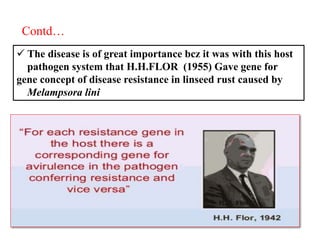
 The disease is of great importance bcz it was with this host
pathogen system that H.H.FLOR (1955) Gave gene for
gene concept of disease resistance in linseed rust caused by
Melampsora lini
Contd…
Economic importance
 Melampsora lini cause linseed rust prevalent in all countries
 The disease causes reduction in seed yield and oil content
 Occurs in America , Canada , Europe , South america ,
Africa , Australia , India
 80 % of loss in yield has been estimated in our country every
year
Kingdom: Fungi
Phylum : Basidiomycota
Class: Urediniomycetes
Subclass: Teliomycetidae
Order: Uredinales
Family: Melampsoraceae
Genus: Melampsora
Taxonomic position
Order: Uredinales
Family:Pucciniaceae
teleutospores are stalked and free
Uromyces
fabae
one cell
Phragmedium
more than two
Puccinia
two cells
Puccinia graminis
*uredospores,unicellular,binucleate double wall
and cup shaped.
*teleutospore,bicellular,binucleate haploid then
converted to uninucleate diploid after karyogamy
the apex of the spore is pointed.
.
Puccinia allii
*uredospore,unicellular,
binucleate, double wall and
globose.
teleutospore,binucleate,
bicellulae,haploid then converted
to diploid after karyogamy the
apex of the spore is flattend.
Family:Melampsoracae
teleutospores are sessile and united
together
Melampsora Lini
General characters of Melampsora
 It consists obligate biotrophes
 It gain entry through stomatal cells
or by direct penetration of epidermal
cells
 After entry primary and secondary
mycelia grows intercellularly giving
rise to haustoria
 Produces single celled, sessile
teliospores with a brown membrane ,
compacted into flat , dark coloured
groups produced either below the
cuticle or epidermis
 Urediniospores are intermixed with
capitate paraphyces and are produced
in erumpent uredinia.
Produce all 5 stages
• Stage 0 Spermagonia bearing spermatia(n) and receptive
hyphae(n)
• Stage 1 Aecia bearing aeciospores(n+n)
• Stage 2 Uredinia bearing uredinospores(n+n)
• Stage 3 Telia bearing teliospores (n+n→2n)
• Stage 4 Basidia bearing basidiospores(n)
Uredial stage
Uredia occurs on both surface of the leaves and aerial parts of plants.
Uredospores are orange colour , ovate , 15-25 x 13-18 micron size and are
echinulated
Capitate paraphyces are found abundunt in uredisori
Under favourable condition uredospores germinate within an hour causing
infection of the host
Telial stage
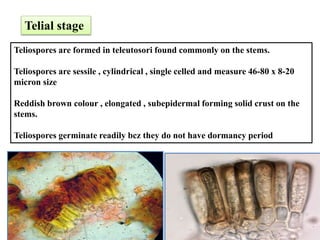
Teliospores are formed in teleutosori found commonly on the stems.
Teliospores are sessile , cylindrical , single celled and measure 46-80 x 8-20
micron size
Reddish brown colour , elongated , subepidermal forming solid crust on the
stems.
Teliospores germinate readily bcz they do not have dormancy period
Pycnial stage
Pycnia and aecia were not observed in
india untill 1940.
Prasad (1940) obtained their formation on
plants in experiemental cultures at shimla
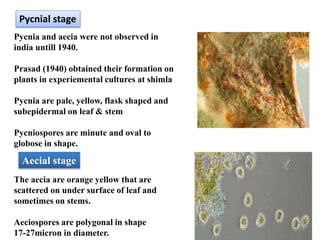
Pycnia are pale, yellow, flask shaped and
subepidermal on leaf & stem
Pycniospores are minute and oval to
globose in shape.
Aecial stage
The aecia are orange yellow that are
scattered on under surface of leaf and
sometimes on stems.
Aeciospores are polygonal in shape
17-27micron in diameter.
Life cycle of Melampsora lini
Puccinia
• Teliospores stalked
• Teliospores are bicelled
• Teliospores are free from
each other
• Capitate paraphyces
absent
• Includes 3000 sp. As
reported
Melampsora
• Teliospores are sessile
• Single celled
• Teloispores are in coloumn
touching one another
laterally
• Present
• More than 74 sp. reported
Plant resistant or tolerant clones, where available.
Removing and destroying diseased leaves from the ground may
help reduce infections.
Wide spacing between trees may create a less favorable
microclimate for spread and infection.
Chemical controls are ususally not warranted.
Management
melampsora

melampsora

  • 1.
  • 2.
    Introduction  Melampsora belongsto family Melampsoraceae which are characterised by formation of sessile teliospores which are united laterally and forming crusts or columns on the host.  Important genera are melampsora, cronartium, urediniopsis, coleopsorium.  Melampsora contains 80 species and most of them are heterocious.  Out of them 20 species known from India (Bilgrami et al., 1979)  Melampsora lini is most important one
  • 3.
     The diseaseis of great importance bcz it was with this host pathogen system that H.H.FLOR (1955) Gave gene for gene concept of disease resistance in linseed rust caused by Melampsora lini Contd…
  • 4.
    Economic importance  Melampsoralini cause linseed rust prevalent in all countries  The disease causes reduction in seed yield and oil content  Occurs in America , Canada , Europe , South america , Africa , Australia , India  80 % of loss in yield has been estimated in our country every year
  • 5.
    Kingdom: Fungi Phylum :Basidiomycota Class: Urediniomycetes Subclass: Teliomycetidae Order: Uredinales Family: Melampsoraceae Genus: Melampsora Taxonomic position
  • 6.
    Order: Uredinales Family:Pucciniaceae teleutospores arestalked and free Uromyces fabae one cell Phragmedium more than two Puccinia two cells Puccinia graminis *uredospores,unicellular,binucleate double wall and cup shaped. *teleutospore,bicellular,binucleate haploid then converted to uninucleate diploid after karyogamy the apex of the spore is pointed. . Puccinia allii *uredospore,unicellular, binucleate, double wall and globose. teleutospore,binucleate, bicellulae,haploid then converted to diploid after karyogamy the apex of the spore is flattend. Family:Melampsoracae teleutospores are sessile and united together Melampsora Lini
  • 7.
    General characters ofMelampsora  It consists obligate biotrophes  It gain entry through stomatal cells or by direct penetration of epidermal cells  After entry primary and secondary mycelia grows intercellularly giving rise to haustoria  Produces single celled, sessile teliospores with a brown membrane , compacted into flat , dark coloured groups produced either below the cuticle or epidermis  Urediniospores are intermixed with capitate paraphyces and are produced in erumpent uredinia.
  • 8.
    Produce all 5stages • Stage 0 Spermagonia bearing spermatia(n) and receptive hyphae(n) • Stage 1 Aecia bearing aeciospores(n+n) • Stage 2 Uredinia bearing uredinospores(n+n) • Stage 3 Telia bearing teliospores (n+n→2n) • Stage 4 Basidia bearing basidiospores(n)
  • 9.
    Uredial stage Uredia occurson both surface of the leaves and aerial parts of plants. Uredospores are orange colour , ovate , 15-25 x 13-18 micron size and are echinulated Capitate paraphyces are found abundunt in uredisori Under favourable condition uredospores germinate within an hour causing infection of the host
  • 10.
    Telial stage Teliospores areformed in teleutosori found commonly on the stems. Teliospores are sessile , cylindrical , single celled and measure 46-80 x 8-20 micron size Reddish brown colour , elongated , subepidermal forming solid crust on the stems. Teliospores germinate readily bcz they do not have dormancy period
  • 12.
    Pycnial stage Pycnia andaecia were not observed in india untill 1940. Prasad (1940) obtained their formation on plants in experiemental cultures at shimla Pycnia are pale, yellow, flask shaped and subepidermal on leaf & stem Pycniospores are minute and oval to globose in shape. Aecial stage The aecia are orange yellow that are scattered on under surface of leaf and sometimes on stems. Aeciospores are polygonal in shape 17-27micron in diameter.
  • 13.
    Life cycle ofMelampsora lini
  • 15.
    Puccinia • Teliospores stalked •Teliospores are bicelled • Teliospores are free from each other • Capitate paraphyces absent • Includes 3000 sp. As reported Melampsora • Teliospores are sessile • Single celled • Teloispores are in coloumn touching one another laterally • Present • More than 74 sp. reported
  • 16.
    Plant resistant ortolerant clones, where available. Removing and destroying diseased leaves from the ground may help reduce infections. Wide spacing between trees may create a less favorable microclimate for spread and infection. Chemical controls are ususally not warranted. Management

Editor's Notes

  • #4 The gene-for-gene relationship was discovered by the late Harold Henry Flor[1][2][3][4] who was working with rust (Melampsora lini) of flax (Linum usitatissimum). Flor showed that the inheritance of both resistance in the host and parasite ability to cause disease is controlled by pairs of matching genes. One is a plant gene called the resistance (R) gene. The other is a parasite gene called the avirulence (Avr) gene. Plants producing a specific R gene product are resistant towards a pathogen that produces the corresponding Avr gene product.[5] Gene-for-gene relationships are a widespread and very important aspect of plant disease resistance.