TOPIC:TERMS USED FOR EXPRESSING
PHENOTIPIC STUCTURE OF FUNGI
SUDDMITTED TO:
Dr. K C SAHU,
PROFFESOR,HOD
DEPT. PLANT
PATHOLOGY,OUAT.
PRESENTED BY :
P.HEMALATHA ,
MSc AG,
PLANT PAHTOLOGY,
5TH YEAR.
MYCOLOGY
DERIVED FROM TWO GREEK WORDS:
MYKES : Mushroom OR Fungus
LOGOS : Study
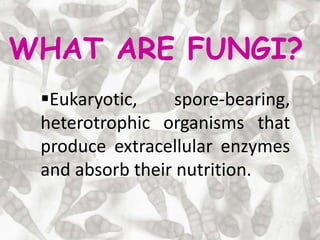
Eukaryotic, spore-bearing,
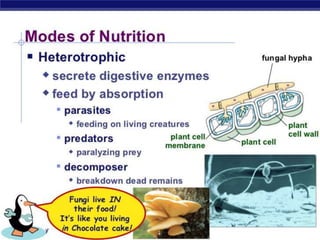
heterotrophic organisms that
produce extracellular enzymes
and absorb their nutrition.
WHAT ARE FUNGI?
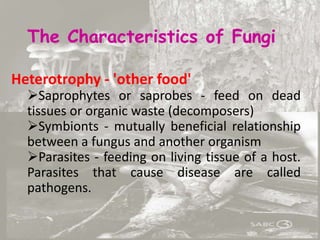
Heterotrophy - 'other food'
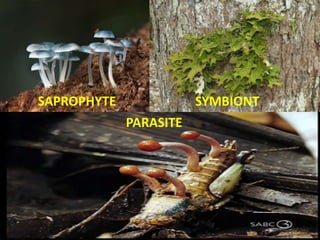
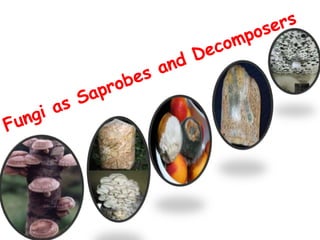
Saprophytes or saprobes - feed on dead
tissues or organic waste (decomposers)
Symbionts - mutually beneficial relationship
between a fungus and another organism
Parasites - feeding on living tissue of a host.
Parasites that cause disease are called
pathogens.
The Characteristics of Fungi
SAPROPHYTE SYMBIONT
PARASITE
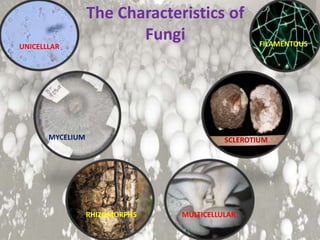
The Characteristics of
Fungi
UNICELLLAR FILAMENTOUS
MULTICELLULARRHIZOMORPHS
MYCELIUM SCLEROTIUM
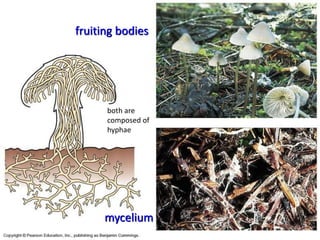
mycelium
fruiting bodies
both are
composed of
hyphae
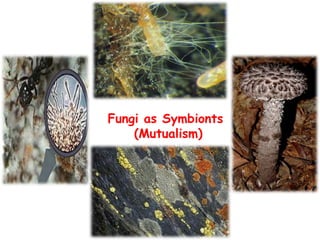
Fungi as Symbionts
(Mutualism)
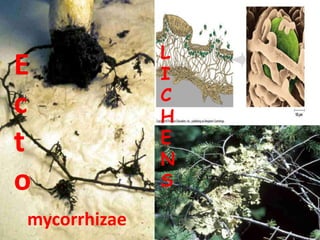
E
c
t
o
mycorrhizae
L
I
C
H
E
N
S
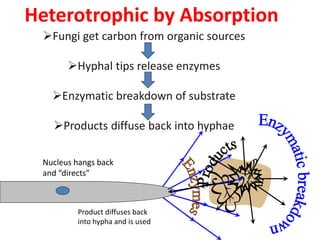
Heterotrophic by Absorption
Fungi get carbon from organic sources
Hyphal tips release enzymes
Enzymatic breakdown of substrate
Products diffuse back into hyphae
Product diffuses back
into hypha and is used
Nucleus hangs back
and “directs”
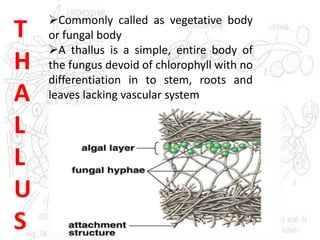
Commonly called as vegetative body
or fungal body
A thallus is a simple, entire body of
the fungus devoid of chlorophyll with no
differentiation in to stem, roots and
leaves lacking vascular system
T
H
A
L
L
U
S
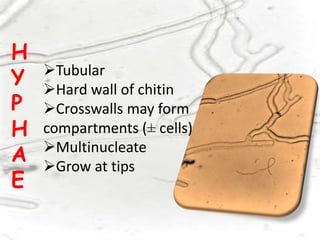
Tubular
Hard wall of chitin
Crosswalls may form
compartments (± cells)
Multinucleate
Grow at tips
H
Y
P
H
A
E
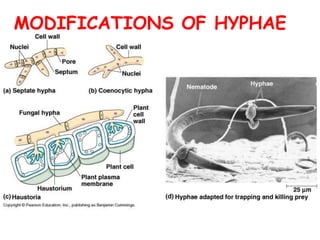
MODIFICATIONS OF HYPHAE
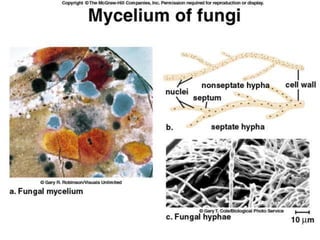
A net work of hyphae ( aggregation of
hyphae) constituting the filamentous
thallus of a fungus.
It may be colourless i.e., hyaline or
coloured due to presence of pigments in
cell wall.
The mycelium may be ectophytic or
endophytic.
M
Y
C
E
L
I
U
M
TYPES OF FUNGAL THALLI
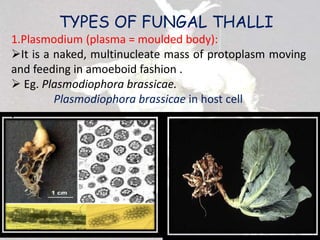
1.Plasmodium (plasma = moulded body):
It is a naked, multinucleate mass of protoplasm moving
and feeding in amoeboid fashion .
 Eg. Plasmodiophora brassicae.
Plasmodiophora brassicae in host cell
.
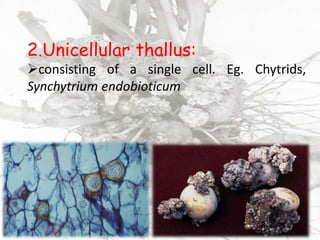
2.Unicellular thallus:
consisting of a single cell. Eg. Chytrids,
Synchytrium endobioticum
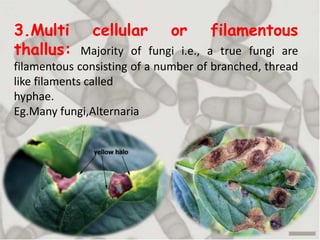
3.Multi cellular or filamentous
thallus: Majority of fungi i.e., a true fungi are
filamentous consisting of a number of branched, thread
like filaments called
hyphae.
Eg.Many fungi,Alternaria
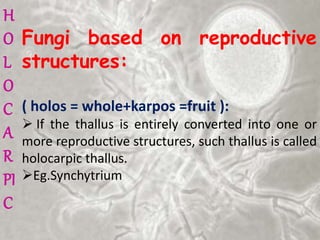
Fungi based on reproductive
structures:
( holos = whole+karpos =fruit ):
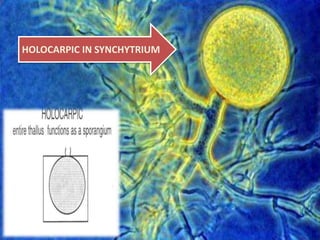
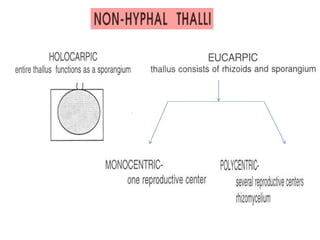
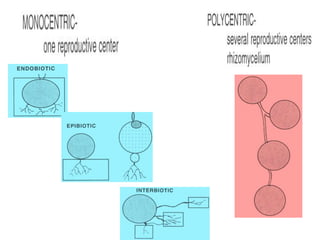
 If the thallus is entirely converted into one or
more reproductive structures, such thallus is called
holocarpic thallus.
Eg.Synchytrium
H
O
L
O
C
A
R
PI
C
HOLOCARPIC IN SYNCHYTRIUM
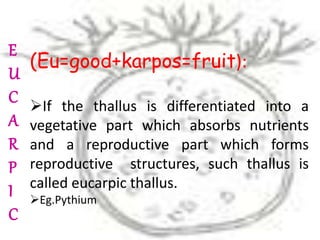
(Eu=good+karpos=fruit):
If the thallus is differentiated into a
vegetative part which absorbs nutrients
and a reproductive part which forms
reproductive structures, such thallus is
called eucarpic thallus.
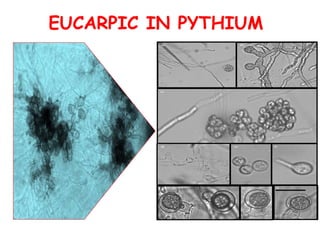
Eg.Pythium
E
U
C
A
R
P
I
C
EUCARPIC IN PYTHIUM
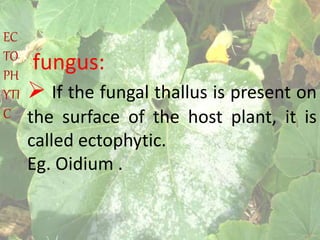
fungus:
 If the fungal thallus is present on
the surface of the host plant, it is
called ectophytic.
Eg. Oidium .
EC
TO
PH
YTI
C
E
C
T
O
P
H
Y
T
I
C
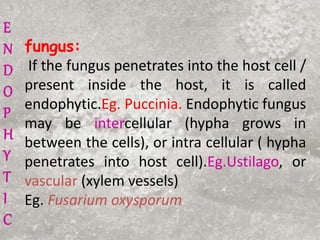
fungus:
If the fungus penetrates into the host cell /
present inside the host, it is called
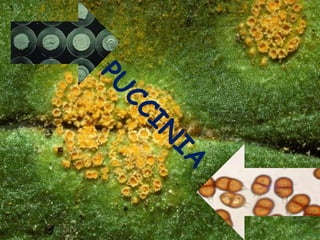
endophytic.Eg. Puccinia. Endophytic fungus
may be intercellular (hypha grows in
between the cells), or intra cellular ( hypha
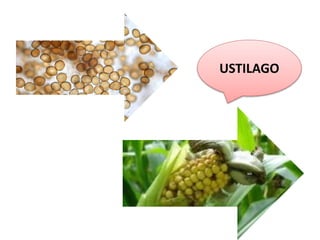
penetrates into host cell).Eg.Ustilago, or
vascular (xylem vessels)
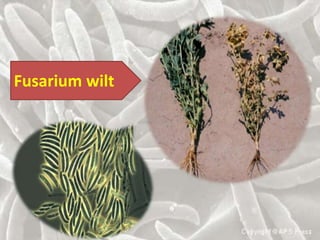
Eg. Fusarium oxysporum
E
N
D
O
P
H
Y
T
I
C
USTILAGO
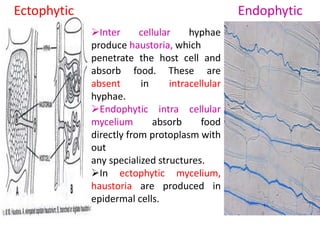
Inter cellular hyphae
produce haustoria, which
penetrate the host cell and
absorb food. These are
absent in intracellular
hyphae.
Endophytic intra cellular
mycelium absorb food
directly from protoplasm with
out
any specialized structures.
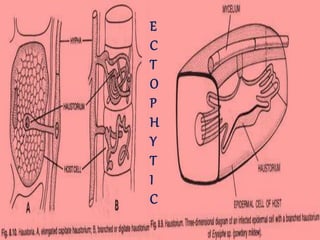
In ectophytic mycelium,
haustoria are produced in
epidermal cells.
EndophyticEctophytic
Fusarium wilt
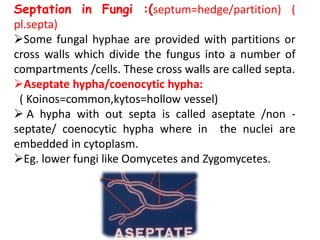
Septation in Fungi :(septum=hedge/partition) (
pl.septa)
Some fungal hyphae are provided with partitions or
cross walls which divide the fungus into a number of
compartments /cells. These cross walls are called septa.
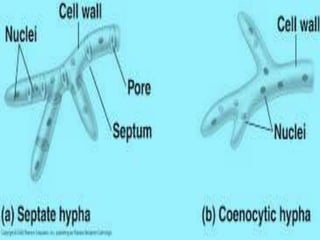
Aseptate hypha/coenocytic hypha:
( Koinos=common,kytos=hollow vessel)
 A hypha with out septa is called aseptate /non -
septate/ coenocytic hypha where in the nuclei are
embedded in cytoplasm.
Eg. lower fungi like Oomycetes and Zygomycetes.
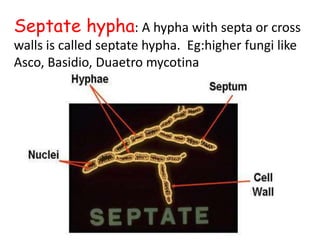
Septate hypha: A hypha with septa or cross
walls is called septate hypha. Eg:higher fungi like
Asco, Basidio, Duaetro mycotina
General types of septa:
1.Based on formation:
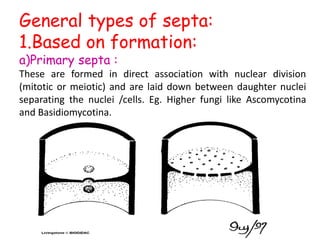
a)Primary septa :
These are formed in direct association with nuclear division
(mitotic or meiotic) and are laid down between daughter nuclei
separating the nuclei /cells. Eg. Higher fungi like Ascomycotina
and Basidiomycotina.
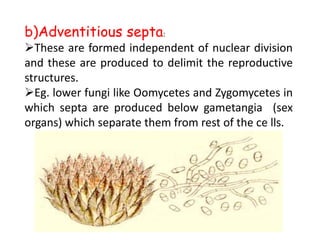
b)Adventitious septa:
These are formed independent of nuclear division
and these are produced to delimit the reproductive
structures.
Eg. lower fungi like Oomycetes and Zygomycetes in
which septa are produced below gametangia (sex
organs) which separate them from rest of the ce lls.
2.Based on construction:
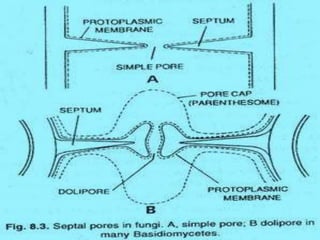
a) Simple septa:
It is most common which is a plate like, with or without
perforation.
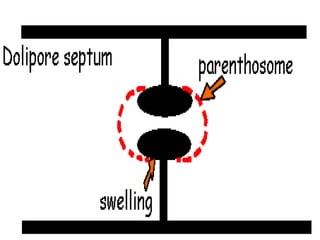
b) Complex septa:
A septum with a central pore surrounded by a barrel
shaped swelling of the septal wall and covered on both
sides by aperforated membrane termed the septal
pore cap or parenthosome. Eg. Dolipore septum in
Basidiomycotina.
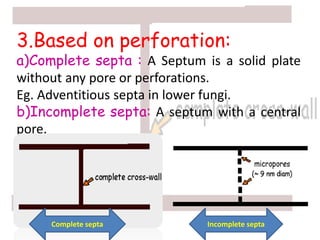
3.Based on perforation:
a)Complete septa : A Septum is a solid plate
without any pore or perforations.
Eg. Adventitious septa in lower fungi.
b)Incomplete septa: A septum with a central
pore.
Complete septa Incomplete septa
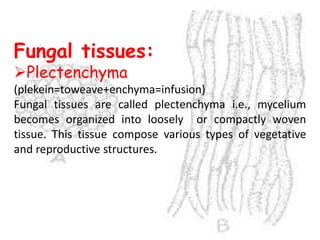
Fungal tissues:
Plectenchyma
(plekein=toweave+enchyma=infusion)
Fungal tissues are called plectenchyma i.e., mycelium
becomes organized into loosely or compactly woven
tissue. This tissue compose various types of vegetative
and reproductive structures.
Types of Plectenchyma:
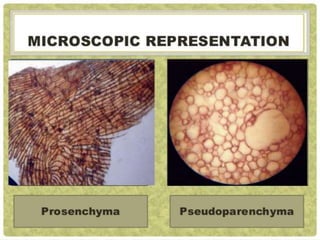
1.Prosenchyma: It is a loosely woven tissue. The component
hyphae retain their individuality which can be easily distinguishable
as hyphae and lie parallel to one another. Eg. Trauma in Agaricus.
2. Pseudoparenchyma :
It is compactly woven tissue. It consists of clo sely packed cells
which are isodiametric or oval in shape resembling parenchymatous
cells of plants and hence the name.
 The component hyphae loose their individuality and are not
distinguishable as hyphae.
Eg. Sclerotial bodies of Sclerotium and rhizomorph of
Armillariella.
MODIFICATION OF MYCELIUM
SPECIALISED SOMATIC
STRUCTURES
Purpose :
1. to obtain nourishment i. e., for nutrition .
2. to resist or tolerate unfavourable conditions for their survival i.e.,
over wintering, over summering.
3. for reproduction
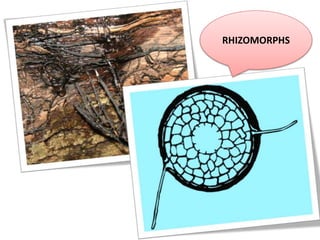
1.Rhizomorphs: ( rhiza=root, morph=shape)
 Thick strands of somatic hyphae in which the hyphae loose their
individuality and form complex tissues that are resistant to adverse
conditions and remain dormant until favourable conditions return.
The structure of growing tip of rhizomorphs res emble that of a root
tip, hence the name rhizomorph. Eg. Armillariella mellea.
RHIZOMORPHS
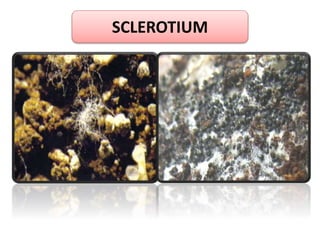
2. Sclerotium:
(skleron=hard) pl.sclerotia:
It is a hard, round ( looks like mustard seed)/
cylindrical or elongated (Claviceps ) dark coloured ( black
or brown) resting body fo rmed due to aggregation of
mycelium, the component hyphae loose their
individuality , resistant to unfavourable conditions and
remain dormant for a longer period of time and
germinate on the return of favourable conditions.
Eg. Sclerotium, Rhizoctonia.
SCLEROTIUM
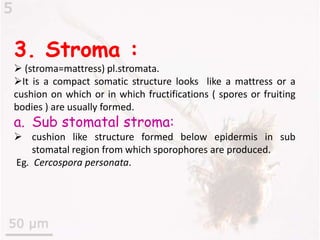
3. Stroma :
 (stroma=mattress) pl.stromata.
It is a compact somatic structure looks like a mattress or a
cushion on which or in which fructifications ( spores or fruiting
bodies ) are usually formed.
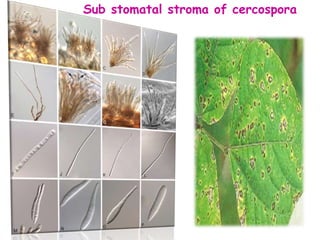
a. Sub stomatal stroma:
 cushion like structure formed below epidermis in sub
stomatal region from which sporophores are produced.
Eg. Cercospora personata.
Sub stomatal stroma of cercospora
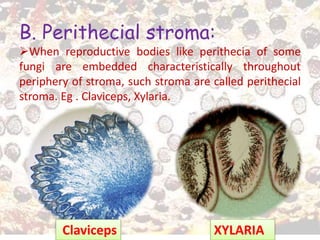
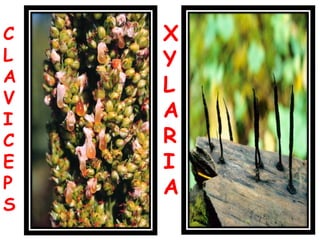
B. Perithecial stroma:
When reproductive bodies like perithecia of some
fungi are embedded characteristically throughout
periphery of stroma, such stroma are called perithecial
stroma. Eg . Claviceps, Xylaria.
Claviceps XYLARIA
C
L
A
V
I
C
E
P
S
X
Y
L
A
R
I
A
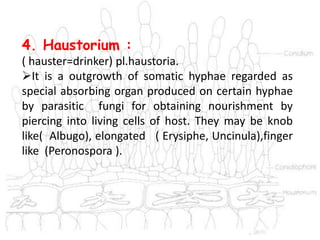
4. Haustorium :
( hauster=drinker) pl.haustoria.
It is a outgrowth of somatic hyphae regarded as
special absorbing organ produced on certain hyphae
by parasitic fungi for obtaining nourishment by
piercing into living cells of host. They may be knob
like( Albugo), elongated ( Erysiphe, Uncinula),finger
like (Peronospora ).
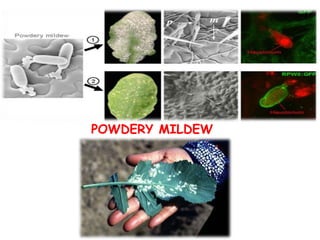
POWDERY MILDEW
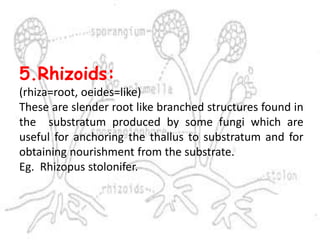
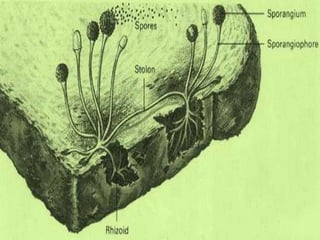
5.Rhizoids:
(rhiza=root, oeides=like)
These are slender root like branched structures found in
the substratum produced by some fungi which are
useful for anchoring the thallus to substratum and for
obtaining nourishment from the substrate.
Eg. Rhizopus stolonifer.
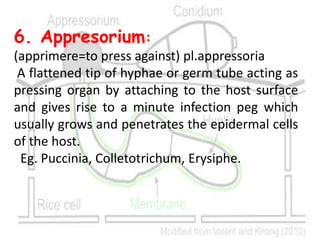
6. Appresorium:
(apprimere=to press against) pl.appressoria
A flattened tip of hyphae or germ tube acting as
pressing organ by attaching to the host surface
and gives rise to a minute infection peg which
usually grows and penetrates the epidermal cells
of the host.
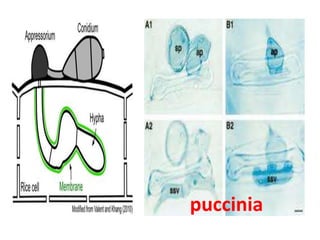
Eg. Puccinia, Colletotrichum, Erysiphe.
puccinia
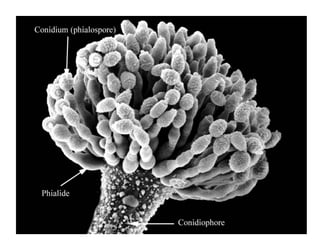
Conidia / Conidiospores :
( konis=dust ; oides=like )
Conidia are non -motile asex ual spores which may arise
directly from somatic hyphae or from specialized conidiogenous
cells ( a cell from which conidia are produced) or on
conidiophore ( hypha which bear conidia).
Conidia are produced freely on conidiophore ie.,at the tips or
sides of conidiophore or may be produced in specialized asexual
fruiting bodies
viz., pycnidium, acervulus, sporodochium and synne mata.
Asexual fruiting bodies:
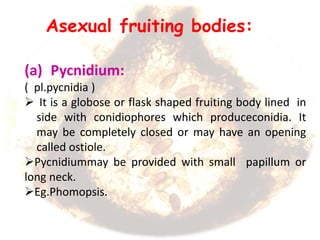
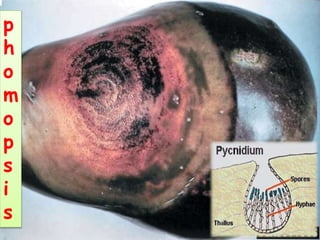
(a) Pycnidium:
( pl.pycnidia )
 It is a globose or flask shaped fruiting body lined in
side with conidiophores which produceconidia. It
may be completely closed or may have an opening
called ostiole.
Pycnidiummay be provided with small papillum or
long neck.
Eg.Phomopsis.
p
h
o
m
o
p
s
i
s
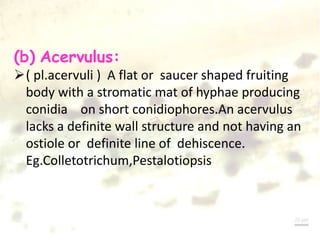
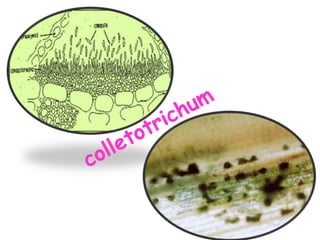
(b) Acervulus:
( pl.acervuli ) A flat or saucer shaped fruiting
body with a stromatic mat of hyphae producing
conidia on short conidiophores.An acervulus
lacks a definite wall structure and not having an
ostiole or definite line of dehiscence.
Eg.Colletotrichum,Pestalotiopsis
.
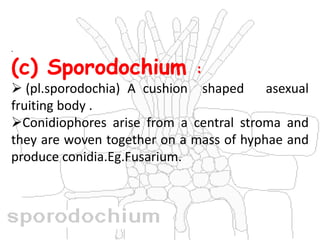
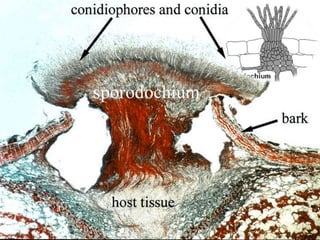
(c) Sporodochium :
 (pl.sporodochia) A cushion shaped asexual
fruiting body .
Conidiophores arise from a central stroma and
they are woven together on a mass of hyphae and
produce conidia.Eg.Fusarium.
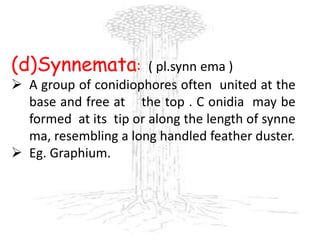
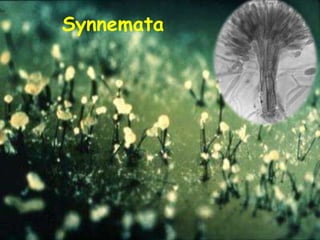
(d)Synnemata: ( pl.synn ema )
 A group of conidiophores often united at the
base and free at the top . C onidia may be
formed at its tip or along the length of synne
ma, resembling a long handled feather duster.
 Eg. Graphium.
Synnemata
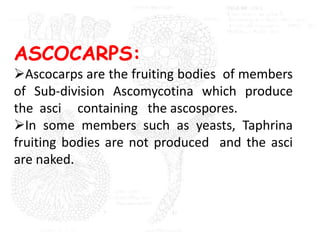
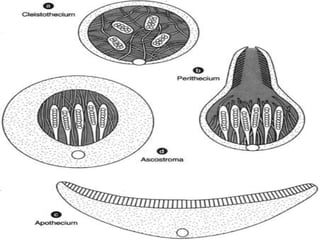
ASCOCARPS:
Ascocarps are the fruiting bodies of members
of Sub-division Ascomycotina which produce
the asci containing the ascospores.
In some members such as yeasts, Taphrina
fruiting bodies are not produced and the asci
are naked.
Types of ascocarps : 4 types.
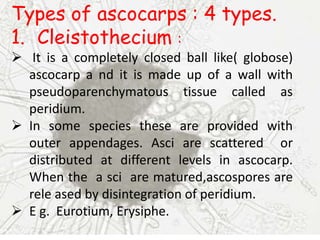
1. Cleistothecium :
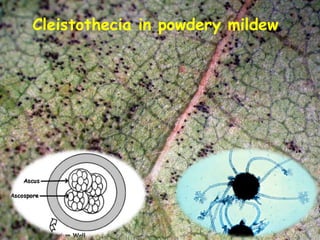
 It is a completely closed ball like( globose)
ascocarp a nd it is made up of a wall with
pseudoparenchymatous tissue called as
peridium.
 In some species these are provided with
outer appendages. Asci are scattered or
distributed at different levels in ascocarp.
When the a sci are matured,ascospores are
rele ased by disintegration of peridium.
 E g. Eurotium, Erysiphe.
Cleistothecia in powdery mildew
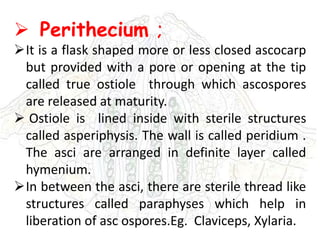
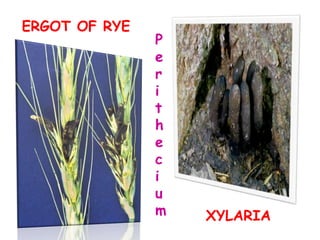
 Perithecium ;
It is a flask shaped more or less closed ascocarp
but provided with a pore or opening at the tip
called true ostiole through which ascospores
are released at maturity.
 Ostiole is lined inside with sterile structures
called asperiphysis. The wall is called peridium .
The asci are arranged in definite layer called
hymenium.
In between the asci, there are sterile thread like
structures called paraphyses which help in
liberation of asc ospores.Eg. Claviceps, Xylaria.
ERGOT OF RYE
XYLARIA
P
e
r
i
t
h
e
c
i
u
m
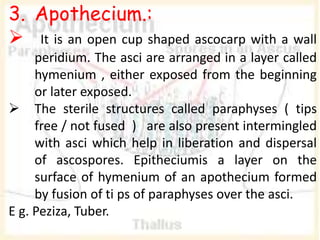
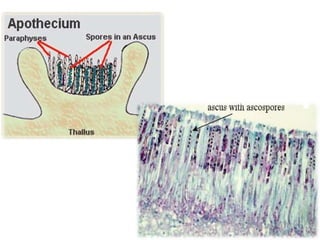
3. Apothecium.:
 It is an open cup shaped ascocarp with a wall
peridium. The asci are arranged in a layer called
hymenium , either exposed from the beginning
or later exposed.
 The sterile structures called paraphyses ( tips
free / not fused ) are also present intermingled
with asci which help in liberation and dispersal
of ascospores. Epitheciumis a layer on the
surface of hymenium of an apothecium formed
by fusion of ti ps of paraphyses over the asci.
E g. Peziza, Tuber.
4. Ascostromata:
 The asci are formed directly in cavities called
locules with in stroma. The stroma itself
serves as wall of ascostroma.
 Sterile structures called pseudoparaphyses
are present in ascostromata.Eg.Elsinoe If the
ascostromata is with a single locule ie., An
unilocular ascostroma which resembles
perithecium with pseudoparaphyses is
called as pseudothecium.
 E g.Venturia.
basic concepts of mycology

basic concepts of mycology

  • 2.
    TOPIC:TERMS USED FOREXPRESSING PHENOTIPIC STUCTURE OF FUNGI
  • 3.
    SUDDMITTED TO: Dr. KC SAHU, PROFFESOR,HOD DEPT. PLANT PATHOLOGY,OUAT. PRESENTED BY : P.HEMALATHA , MSc AG, PLANT PAHTOLOGY, 5TH YEAR.
  • 4.
    MYCOLOGY DERIVED FROM TWOGREEK WORDS: MYKES : Mushroom OR Fungus LOGOS : Study
  • 5.
    Eukaryotic, spore-bearing, heterotrophic organismsthat produce extracellular enzymes and absorb their nutrition. WHAT ARE FUNGI?
  • 6.
    Heterotrophy - 'otherfood' Saprophytes or saprobes - feed on dead tissues or organic waste (decomposers) Symbionts - mutually beneficial relationship between a fungus and another organism Parasites - feeding on living tissue of a host. Parasites that cause disease are called pathogens. The Characteristics of Fungi
  • 7.
  • 8.
    The Characteristics of Fungi UNICELLLARFILAMENTOUS MULTICELLULARRHIZOMORPHS MYCELIUM SCLEROTIUM
  • 9.
  • 11.
  • 12.
  • 14.
    Heterotrophic by Absorption Fungiget carbon from organic sources Hyphal tips release enzymes Enzymatic breakdown of substrate Products diffuse back into hyphae Product diffuses back into hypha and is used Nucleus hangs back and “directs”
  • 15.
    Commonly called asvegetative body or fungal body A thallus is a simple, entire body of the fungus devoid of chlorophyll with no differentiation in to stem, roots and leaves lacking vascular system T H A L L U S
  • 16.
    Tubular Hard wall ofchitin Crosswalls may form compartments (± cells) Multinucleate Grow at tips H Y P H A E
  • 17.
  • 18.
    A net workof hyphae ( aggregation of hyphae) constituting the filamentous thallus of a fungus. It may be colourless i.e., hyaline or coloured due to presence of pigments in cell wall. The mycelium may be ectophytic or endophytic. M Y C E L I U M
  • 20.
    TYPES OF FUNGALTHALLI 1.Plasmodium (plasma = moulded body): It is a naked, multinucleate mass of protoplasm moving and feeding in amoeboid fashion .  Eg. Plasmodiophora brassicae. Plasmodiophora brassicae in host cell .
  • 21.
    2.Unicellular thallus: consisting ofa single cell. Eg. Chytrids, Synchytrium endobioticum
  • 22.
    3.Multi cellular orfilamentous thallus: Majority of fungi i.e., a true fungi are filamentous consisting of a number of branched, thread like filaments called hyphae. Eg.Many fungi,Alternaria
  • 23.
    Fungi based onreproductive structures: ( holos = whole+karpos =fruit ):  If the thallus is entirely converted into one or more reproductive structures, such thallus is called holocarpic thallus. Eg.Synchytrium H O L O C A R PI C
  • 24.
  • 25.
    (Eu=good+karpos=fruit): If the thallusis differentiated into a vegetative part which absorbs nutrients and a reproductive part which forms reproductive structures, such thallus is called eucarpic thallus. Eg.Pythium E U C A R P I C
  • 26.
  • 27.
    fungus:  If thefungal thallus is present on the surface of the host plant, it is called ectophytic. Eg. Oidium . EC TO PH YTI C
  • 28.
  • 29.
    fungus: If the funguspenetrates into the host cell / present inside the host, it is called endophytic.Eg. Puccinia. Endophytic fungus may be intercellular (hypha grows in between the cells), or intra cellular ( hypha penetrates into host cell).Eg.Ustilago, or vascular (xylem vessels) Eg. Fusarium oxysporum E N D O P H Y T I C
  • 31.
  • 32.
    Inter cellular hyphae producehaustoria, which penetrate the host cell and absorb food. These are absent in intracellular hyphae. Endophytic intra cellular mycelium absorb food directly from protoplasm with out any specialized structures. In ectophytic mycelium, haustoria are produced in epidermal cells. EndophyticEctophytic
  • 33.
  • 36.
    Septation in Fungi:(septum=hedge/partition) ( pl.septa) Some fungal hyphae are provided with partitions or cross walls which divide the fungus into a number of compartments /cells. These cross walls are called septa. Aseptate hypha/coenocytic hypha: ( Koinos=common,kytos=hollow vessel)  A hypha with out septa is called aseptate /non - septate/ coenocytic hypha where in the nuclei are embedded in cytoplasm. Eg. lower fungi like Oomycetes and Zygomycetes.
  • 37.
    Septate hypha: Ahypha with septa or cross walls is called septate hypha. Eg:higher fungi like Asco, Basidio, Duaetro mycotina
  • 39.
    General types ofsepta: 1.Based on formation: a)Primary septa : These are formed in direct association with nuclear division (mitotic or meiotic) and are laid down between daughter nuclei separating the nuclei /cells. Eg. Higher fungi like Ascomycotina and Basidiomycotina.
  • 40.
    b)Adventitious septa: These areformed independent of nuclear division and these are produced to delimit the reproductive structures. Eg. lower fungi like Oomycetes and Zygomycetes in which septa are produced below gametangia (sex organs) which separate them from rest of the ce lls.
  • 41.
    2.Based on construction: a)Simple septa: It is most common which is a plate like, with or without perforation. b) Complex septa: A septum with a central pore surrounded by a barrel shaped swelling of the septal wall and covered on both sides by aperforated membrane termed the septal pore cap or parenthosome. Eg. Dolipore septum in Basidiomycotina.
  • 44.
    3.Based on perforation: a)Completesepta : A Septum is a solid plate without any pore or perforations. Eg. Adventitious septa in lower fungi. b)Incomplete septa: A septum with a central pore. Complete septa Incomplete septa
  • 45.
    Fungal tissues: Plectenchyma (plekein=toweave+enchyma=infusion) Fungal tissuesare called plectenchyma i.e., mycelium becomes organized into loosely or compactly woven tissue. This tissue compose various types of vegetative and reproductive structures.
  • 46.
    Types of Plectenchyma: 1.Prosenchyma:It is a loosely woven tissue. The component hyphae retain their individuality which can be easily distinguishable as hyphae and lie parallel to one another. Eg. Trauma in Agaricus. 2. Pseudoparenchyma : It is compactly woven tissue. It consists of clo sely packed cells which are isodiametric or oval in shape resembling parenchymatous cells of plants and hence the name.  The component hyphae loose their individuality and are not distinguishable as hyphae. Eg. Sclerotial bodies of Sclerotium and rhizomorph of Armillariella.
  • 48.
    MODIFICATION OF MYCELIUM SPECIALISEDSOMATIC STRUCTURES Purpose : 1. to obtain nourishment i. e., for nutrition . 2. to resist or tolerate unfavourable conditions for their survival i.e., over wintering, over summering. 3. for reproduction 1.Rhizomorphs: ( rhiza=root, morph=shape)  Thick strands of somatic hyphae in which the hyphae loose their individuality and form complex tissues that are resistant to adverse conditions and remain dormant until favourable conditions return. The structure of growing tip of rhizomorphs res emble that of a root tip, hence the name rhizomorph. Eg. Armillariella mellea.
  • 49.
  • 50.
    2. Sclerotium: (skleron=hard) pl.sclerotia: Itis a hard, round ( looks like mustard seed)/ cylindrical or elongated (Claviceps ) dark coloured ( black or brown) resting body fo rmed due to aggregation of mycelium, the component hyphae loose their individuality , resistant to unfavourable conditions and remain dormant for a longer period of time and germinate on the return of favourable conditions. Eg. Sclerotium, Rhizoctonia.
  • 51.
  • 52.
    3. Stroma : (stroma=mattress) pl.stromata. It is a compact somatic structure looks like a mattress or a cushion on which or in which fructifications ( spores or fruiting bodies ) are usually formed. a. Sub stomatal stroma:  cushion like structure formed below epidermis in sub stomatal region from which sporophores are produced. Eg. Cercospora personata.
  • 53.
    Sub stomatal stromaof cercospora
  • 54.
    B. Perithecial stroma: Whenreproductive bodies like perithecia of some fungi are embedded characteristically throughout periphery of stroma, such stroma are called perithecial stroma. Eg . Claviceps, Xylaria. Claviceps XYLARIA
  • 55.
  • 56.
    4. Haustorium : (hauster=drinker) pl.haustoria. It is a outgrowth of somatic hyphae regarded as special absorbing organ produced on certain hyphae by parasitic fungi for obtaining nourishment by piercing into living cells of host. They may be knob like( Albugo), elongated ( Erysiphe, Uncinula),finger like (Peronospora ).
  • 57.
  • 58.
    5.Rhizoids: (rhiza=root, oeides=like) These areslender root like branched structures found in the substratum produced by some fungi which are useful for anchoring the thallus to substratum and for obtaining nourishment from the substrate. Eg. Rhizopus stolonifer.
  • 60.
    6. Appresorium: (apprimere=to pressagainst) pl.appressoria A flattened tip of hyphae or germ tube acting as pressing organ by attaching to the host surface and gives rise to a minute infection peg which usually grows and penetrates the epidermal cells of the host. Eg. Puccinia, Colletotrichum, Erysiphe.
  • 61.
  • 62.
    Conidia / Conidiospores: ( konis=dust ; oides=like ) Conidia are non -motile asex ual spores which may arise directly from somatic hyphae or from specialized conidiogenous cells ( a cell from which conidia are produced) or on conidiophore ( hypha which bear conidia). Conidia are produced freely on conidiophore ie.,at the tips or sides of conidiophore or may be produced in specialized asexual fruiting bodies viz., pycnidium, acervulus, sporodochium and synne mata.
  • 64.
    Asexual fruiting bodies: (a)Pycnidium: ( pl.pycnidia )  It is a globose or flask shaped fruiting body lined in side with conidiophores which produceconidia. It may be completely closed or may have an opening called ostiole. Pycnidiummay be provided with small papillum or long neck. Eg.Phomopsis.
  • 65.
  • 66.
    (b) Acervulus: ( pl.acervuli) A flat or saucer shaped fruiting body with a stromatic mat of hyphae producing conidia on short conidiophores.An acervulus lacks a definite wall structure and not having an ostiole or definite line of dehiscence. Eg.Colletotrichum,Pestalotiopsis
  • 68.
    . (c) Sporodochium : (pl.sporodochia) A cushion shaped asexual fruiting body . Conidiophores arise from a central stroma and they are woven together on a mass of hyphae and produce conidia.Eg.Fusarium.
  • 70.
    (d)Synnemata: ( pl.synnema )  A group of conidiophores often united at the base and free at the top . C onidia may be formed at its tip or along the length of synne ma, resembling a long handled feather duster.  Eg. Graphium.
  • 71.
  • 72.
    ASCOCARPS: Ascocarps are thefruiting bodies of members of Sub-division Ascomycotina which produce the asci containing the ascospores. In some members such as yeasts, Taphrina fruiting bodies are not produced and the asci are naked.
  • 73.
    Types of ascocarps: 4 types. 1. Cleistothecium :  It is a completely closed ball like( globose) ascocarp a nd it is made up of a wall with pseudoparenchymatous tissue called as peridium.  In some species these are provided with outer appendages. Asci are scattered or distributed at different levels in ascocarp. When the a sci are matured,ascospores are rele ased by disintegration of peridium.  E g. Eurotium, Erysiphe.
  • 74.
  • 75.
     Perithecium ; Itis a flask shaped more or less closed ascocarp but provided with a pore or opening at the tip called true ostiole through which ascospores are released at maturity.  Ostiole is lined inside with sterile structures called asperiphysis. The wall is called peridium . The asci are arranged in definite layer called hymenium. In between the asci, there are sterile thread like structures called paraphyses which help in liberation of asc ospores.Eg. Claviceps, Xylaria.
  • 76.
  • 77.
    3. Apothecium.:  Itis an open cup shaped ascocarp with a wall peridium. The asci are arranged in a layer called hymenium , either exposed from the beginning or later exposed.  The sterile structures called paraphyses ( tips free / not fused ) are also present intermingled with asci which help in liberation and dispersal of ascospores. Epitheciumis a layer on the surface of hymenium of an apothecium formed by fusion of ti ps of paraphyses over the asci. E g. Peziza, Tuber.
  • 79.
    4. Ascostromata:  Theasci are formed directly in cavities called locules with in stroma. The stroma itself serves as wall of ascostroma.  Sterile structures called pseudoparaphyses are present in ascostromata.Eg.Elsinoe If the ascostromata is with a single locule ie., An unilocular ascostroma which resembles perithecium with pseudoparaphyses is called as pseudothecium.  E g.Venturia.