Automobile Engineering
Unit 2
Clutch and transmission
Ass. Prof. N S Surner
SRES SCOE, Kopargaon
Function Of A Gear Box
• Torque ratio between the engine and wheels
to be varied for rapid acceleration and for
climbing gradients.
• It provides means of reversal of vehicle
motion.
• Transmission can be disconnected from
engine by neutral position of gear box
Necessity Of Gear Box In An
Automobile
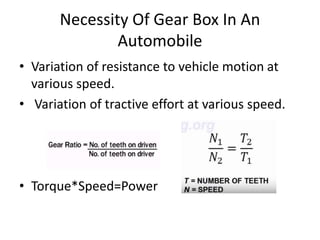
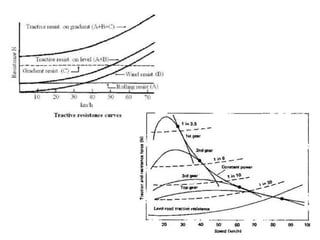
• Variation of resistance to vehicle motion at
various speed.
• Variation of tractive effort at various speed.
• Torque*Speed=Power
Total resistance to vehicle motion
i. Resistance due to wind :proportional to the
square of the vehicle speed
ii. Resistance due to gradient: Remains constant
at all speed. This is component of weight parallel
to road
iii. Miscelleneous: Type of the road, tyre friction
etc.
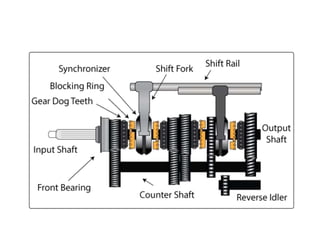
Types of Transmission
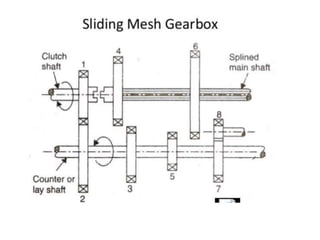
1. Sliding mesh gear box
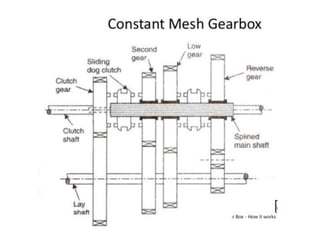
2. Constant mesh gear box with positive dog
clutch
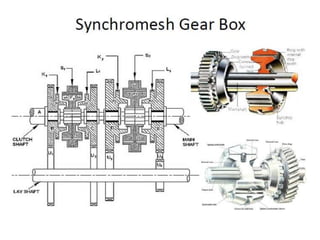
3. Constant mesh gear box with synchromesh
device.
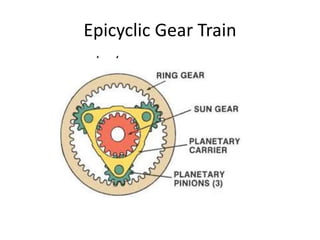
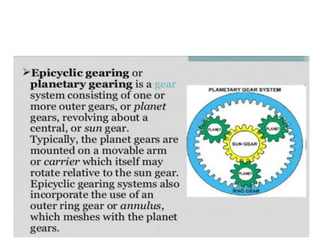
Epicyclic Gear Train
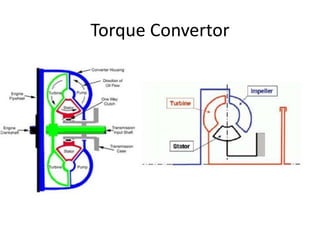
Torque Convertor
Basics of Transmission
• The job of the transmission is to change the
speed ratio between the engine and the
wheels of an automobile.
• The transmission uses a range of gears -- from
low to high -- to make more effective use of
the engine's torque as driving conditions
change. The gears can be engaged manually or
automatically.
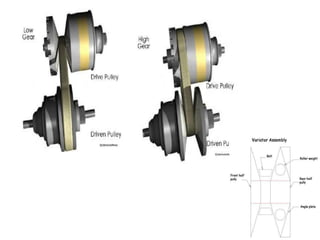
• A continuously variable transmission is also
known as a single-speed transmission, steeples
transmission , pulley transmission, in case of
motorcycles, a twist-and-go is an automatic
transmission that can change seamlessly through
a continuous range of effective gear ratios.
• This contrasts with other mechanical
transmissions that offer a fixed number of gear
ratios. The flexibility of a CVT allows the input
shaft to maintain a constant angular velocity
CVT Design
• Pulley based CVT
• Toroidal CVT
• Hydrostatic CVT
Benefits of CVT
• Provide engine torque in optimum condition
(road loads / drive shaft torque)
• No shift clonk
• Transmission ratio can be adjusted
continuously
• Improved fuel efficiency
• Better acceleration
• Eliminates gear hunting especially when going
up a hill.
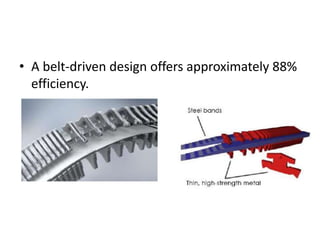
• A belt-driven design offers approximately 88%
efficiency.
Electronic transmission control
• Modern transmissions are hydraulically operated
with electronic controls. These controls provide:
• A better correlation between the engine and
transmission
• Improved shift timing control
• Improved shift quality control
• Ability to provide driver-selected economy or
performance operation
• Improved ability to determine proper
transmission operation
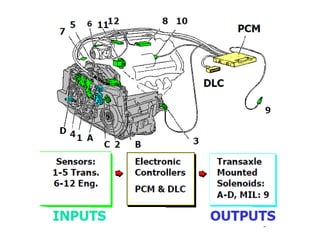
• An electronic control system has three major
portions:
1. The inputs provide needed information.
2. The controller processes information and
activates the outputs.
3. The outputs do the work.
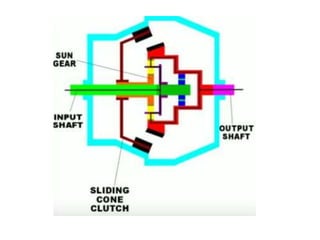
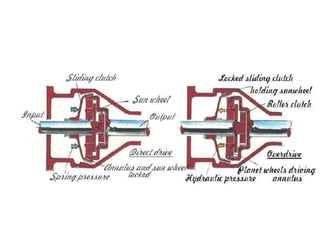
Overdrive
• This device helps the propeller shaft to rotate
faster than the engine in transmission.
• By its use engine revolutions can be reduced by
20-25% allowing high cruising at lower engine
revolution.
• An overdrive is usually fitted to the top or third
and top gear only.
• It can be operated manually or automatically.
• The overdrive unit consist of epicyclic gears when
fitted at rear of the gear box.
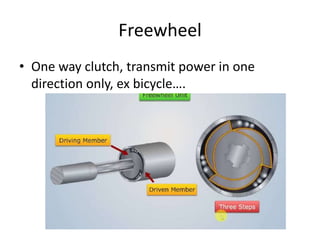
Freewheel
• One way clutch, transmit power in one
direction only, ex bicycle….
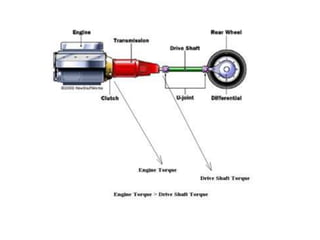
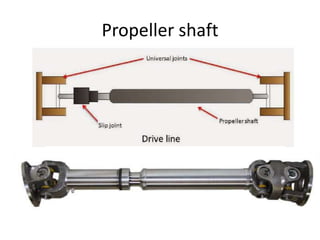
Propeller shaft
• Shaft
– Withstand torsional load
– Well balanced to avoid whirling at high speed
– Steel, Al or composite material
• Universal Joint
– Accounts up and down motion of the rear axle
– Cardon joints- high speed constant velocity joint with
the option of intermediate bearing ,limited slip devices
and crash feature
• Slip Joint
– Adjust the length of the propeller shaft
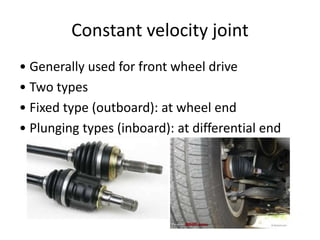
Constant velocity joint
• Generally used for front wheel drive
• Two types
• Fixed type (outboard): at wheel end
• Plunging types (inboard): at differential end
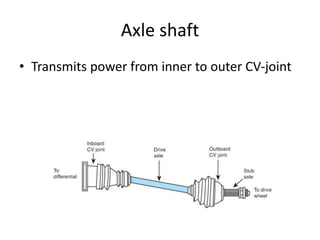
Axle shaft
• Transmits power from inner to outer CV-joint
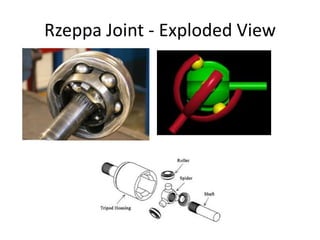
Rzeppa Joint - Exploded View
Final Drive
• Final drive is the last stage of power transfer from propeller
shaft to rear (or front if – automobile is front wheel driven)
axles and then to wheels. It turns the propeller shaft
motion at right angle to drive the rear axle.
• Consists of Bevel pinion and crown wheel or worm and
worm wheel arrangement
• Bevel gear=propeller shaft
• Crown wheel drive goes to the differential
• Three Types of the gears are used
• Straight Bevel Gears (uneven transfer of motion)
• Spiral bevel gears
• Hypoid bevel gears
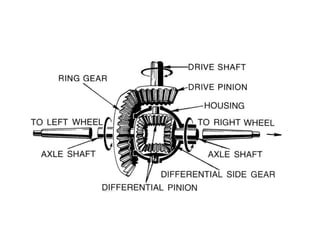
Differential
• Pinion Drive Gear: transfers power from the driveshaft to the ring
gear.
• Ring Gear: transfers power to the Differential case assembly.
• Side/spider gears: help both wheels to turn independently when
turning.
• Differential case assembly: holds the Ring gear and other
components that drive the rear axle.
• Rear drive axles: steel shafts that transfer torque from the
differential assembly to the drive wheels.
• Rear axle bearings: ball or roller bearings that fit between the axles
and the inside of the axle housing.
• Axle housing: metal body that encloses and supports parts of the
rear axle assembly.
Power flow
• Drive shaft spins the Pinion gear.
• Pinion gear turns the larger ring gear to
produce gear reduction.
• Ring gear attached to differential case, hence
it rotates with the ring gear.
• Differential case spins the sun gears which are
attached to the axles.
• Axles transfer the power to the wheels.
Function
• Transfers power from driveshaft to the
wheels.
• Provides final gear reduction.
• Splits amount of torque going to each wheel.
• Allow the wheels to rotate at different speeds
in turns.
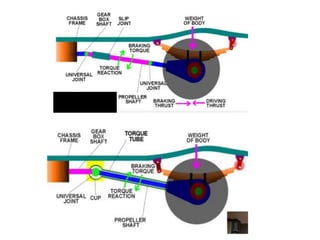
Hotchkiss Drive
• The Hotchkiss drive is a system of power
transmission
• Rear axle drive
• It was the dominant form of power
transmission for front-engine, rear-wheel
drive layout cars in the 20th century
• Requirement of mechanism to transfer driving
and braking efforts to chassis
Construction of Hotchkiss Drive
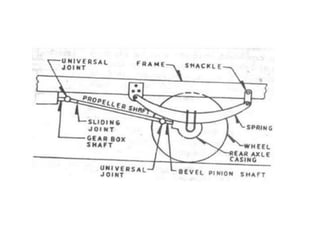
• Simplest and most widely used type of rear axle
drive .
• The spring besides taking weight of the body also
take the torque reaction , driving thrust and side
thrust.
• Propellar shaft is provied with two universal
joints also a sliding joint .
• The front end of the spring is fixed rigidly on the
frame while the rear end and is supported in the
shackle .
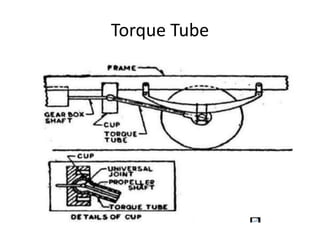
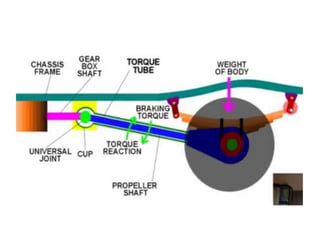
Torque Tube
Clutch and Gear

Clutch and Gear

  • 1.
    Automobile Engineering Unit 2 Clutchand transmission Ass. Prof. N S Surner SRES SCOE, Kopargaon
  • 2.
    Function Of AGear Box • Torque ratio between the engine and wheels to be varied for rapid acceleration and for climbing gradients. • It provides means of reversal of vehicle motion. • Transmission can be disconnected from engine by neutral position of gear box
  • 3.
    Necessity Of GearBox In An Automobile • Variation of resistance to vehicle motion at various speed. • Variation of tractive effort at various speed. • Torque*Speed=Power
  • 4.
    Total resistance tovehicle motion i. Resistance due to wind :proportional to the square of the vehicle speed ii. Resistance due to gradient: Remains constant at all speed. This is component of weight parallel to road iii. Miscelleneous: Type of the road, tyre friction etc.
  • 6.
    Types of Transmission 1.Sliding mesh gear box 2. Constant mesh gear box with positive dog clutch 3. Constant mesh gear box with synchromesh device.
  • 11.
  • 13.
  • 14.
    Basics of Transmission •The job of the transmission is to change the speed ratio between the engine and the wheels of an automobile. • The transmission uses a range of gears -- from low to high -- to make more effective use of the engine's torque as driving conditions change. The gears can be engaged manually or automatically.
  • 15.
    • A continuouslyvariable transmission is also known as a single-speed transmission, steeples transmission , pulley transmission, in case of motorcycles, a twist-and-go is an automatic transmission that can change seamlessly through a continuous range of effective gear ratios. • This contrasts with other mechanical transmissions that offer a fixed number of gear ratios. The flexibility of a CVT allows the input shaft to maintain a constant angular velocity
  • 17.
    CVT Design • Pulleybased CVT • Toroidal CVT • Hydrostatic CVT
  • 18.
    Benefits of CVT •Provide engine torque in optimum condition (road loads / drive shaft torque) • No shift clonk • Transmission ratio can be adjusted continuously • Improved fuel efficiency • Better acceleration • Eliminates gear hunting especially when going up a hill.
  • 20.
    • A belt-drivendesign offers approximately 88% efficiency.
  • 21.
    Electronic transmission control •Modern transmissions are hydraulically operated with electronic controls. These controls provide: • A better correlation between the engine and transmission • Improved shift timing control • Improved shift quality control • Ability to provide driver-selected economy or performance operation • Improved ability to determine proper transmission operation
  • 22.
    • An electroniccontrol system has three major portions: 1. The inputs provide needed information. 2. The controller processes information and activates the outputs. 3. The outputs do the work.
  • 24.
    Overdrive • This devicehelps the propeller shaft to rotate faster than the engine in transmission. • By its use engine revolutions can be reduced by 20-25% allowing high cruising at lower engine revolution. • An overdrive is usually fitted to the top or third and top gear only. • It can be operated manually or automatically. • The overdrive unit consist of epicyclic gears when fitted at rear of the gear box.
  • 27.
    Freewheel • One wayclutch, transmit power in one direction only, ex bicycle….
  • 28.
  • 29.
    • Shaft – Withstandtorsional load – Well balanced to avoid whirling at high speed – Steel, Al or composite material • Universal Joint – Accounts up and down motion of the rear axle – Cardon joints- high speed constant velocity joint with the option of intermediate bearing ,limited slip devices and crash feature • Slip Joint – Adjust the length of the propeller shaft
  • 30.
    Constant velocity joint •Generally used for front wheel drive • Two types • Fixed type (outboard): at wheel end • Plunging types (inboard): at differential end
  • 31.
    Axle shaft • Transmitspower from inner to outer CV-joint
  • 32.
    Rzeppa Joint -Exploded View
  • 33.
    Final Drive • Finaldrive is the last stage of power transfer from propeller shaft to rear (or front if – automobile is front wheel driven) axles and then to wheels. It turns the propeller shaft motion at right angle to drive the rear axle. • Consists of Bevel pinion and crown wheel or worm and worm wheel arrangement • Bevel gear=propeller shaft • Crown wheel drive goes to the differential • Three Types of the gears are used • Straight Bevel Gears (uneven transfer of motion) • Spiral bevel gears • Hypoid bevel gears
  • 34.
    Differential • Pinion DriveGear: transfers power from the driveshaft to the ring gear. • Ring Gear: transfers power to the Differential case assembly. • Side/spider gears: help both wheels to turn independently when turning. • Differential case assembly: holds the Ring gear and other components that drive the rear axle. • Rear drive axles: steel shafts that transfer torque from the differential assembly to the drive wheels. • Rear axle bearings: ball or roller bearings that fit between the axles and the inside of the axle housing. • Axle housing: metal body that encloses and supports parts of the rear axle assembly.
  • 36.
    Power flow • Driveshaft spins the Pinion gear. • Pinion gear turns the larger ring gear to produce gear reduction. • Ring gear attached to differential case, hence it rotates with the ring gear. • Differential case spins the sun gears which are attached to the axles. • Axles transfer the power to the wheels.
  • 37.
    Function • Transfers powerfrom driveshaft to the wheels. • Provides final gear reduction. • Splits amount of torque going to each wheel. • Allow the wheels to rotate at different speeds in turns.
  • 38.
    Hotchkiss Drive • TheHotchkiss drive is a system of power transmission • Rear axle drive • It was the dominant form of power transmission for front-engine, rear-wheel drive layout cars in the 20th century • Requirement of mechanism to transfer driving and braking efforts to chassis
  • 39.
    Construction of HotchkissDrive • Simplest and most widely used type of rear axle drive . • The spring besides taking weight of the body also take the torque reaction , driving thrust and side thrust. • Propellar shaft is provied with two universal joints also a sliding joint . • The front end of the spring is fixed rigidly on the frame while the rear end and is supported in the shackle .
  • 42.