Suman Deka, F-Batch, Roll no-108
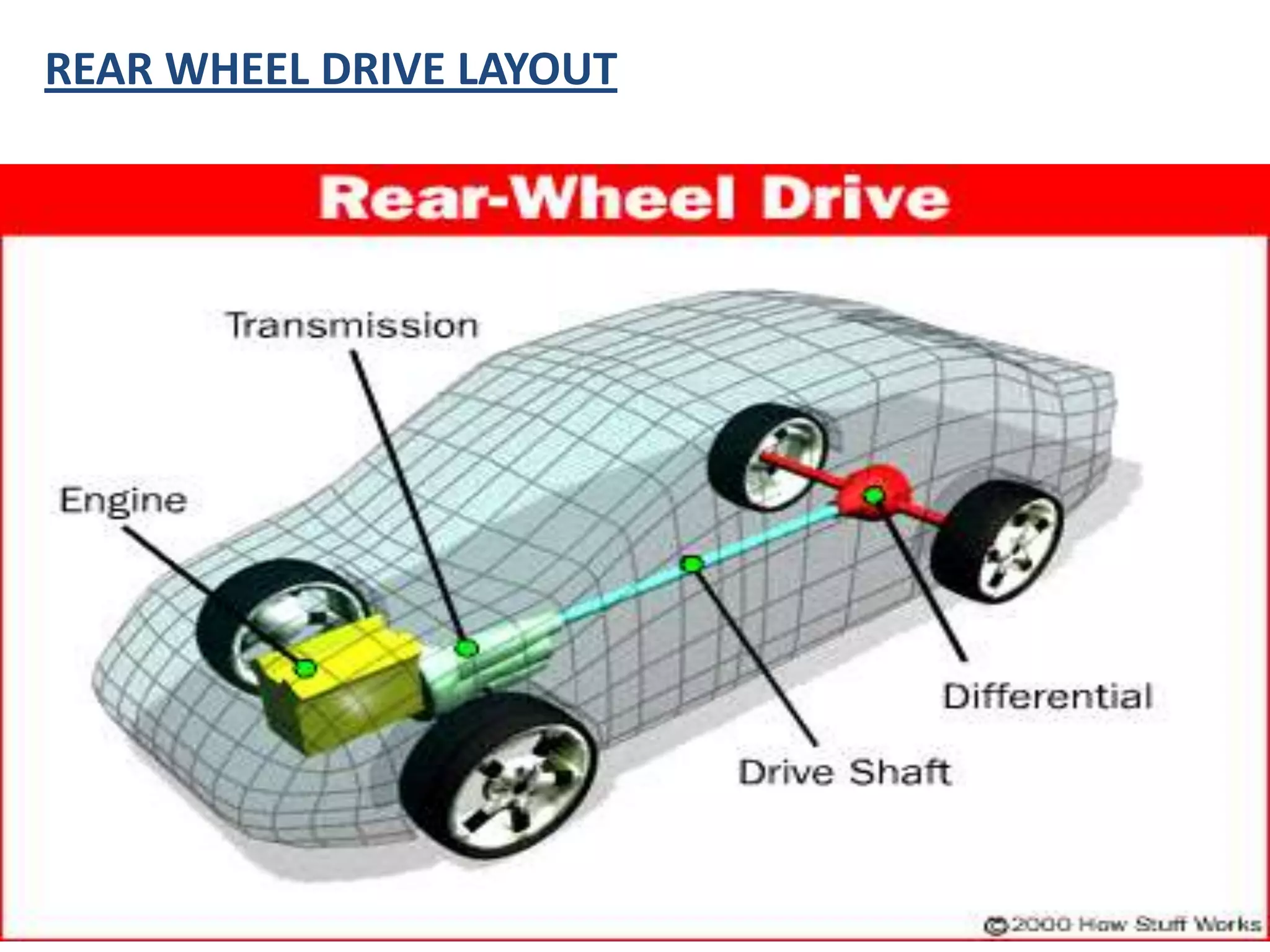
REAR WHEEL DRIVE LAYOUT
REAR AXLE
 A group of subassemblies or a separate unit of a
  motor-vehicle chassis (such as an automobile and
  tractor) that transmits torque from the propeller
  shaft or directly from the gear box to the
  propelling mechanism (wheels).
 In most motor vehicles the rear axle has a
  housing, tubes for the axle shafts, a final drive
  (including the differential with reduction gears),
  and the axle shafts. The final drive and axle shafts
  are part of the motor-vehicle transmission.
 Wheel brakes are mounted on the rear axle, as are
  the hubs for the wheels. The rear axle is joined to
  the frame or body of the motor vehicle by a
  suspension.
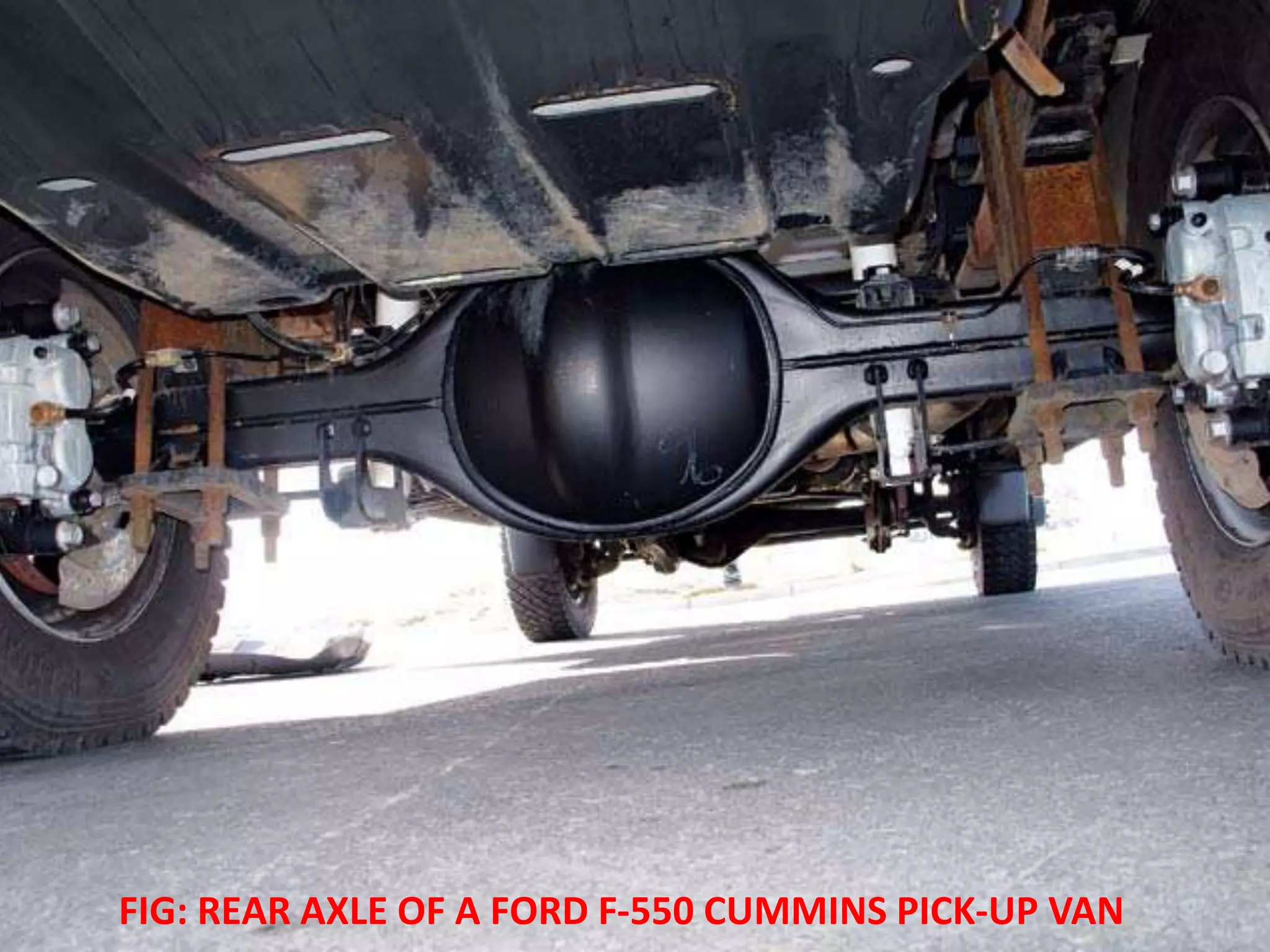
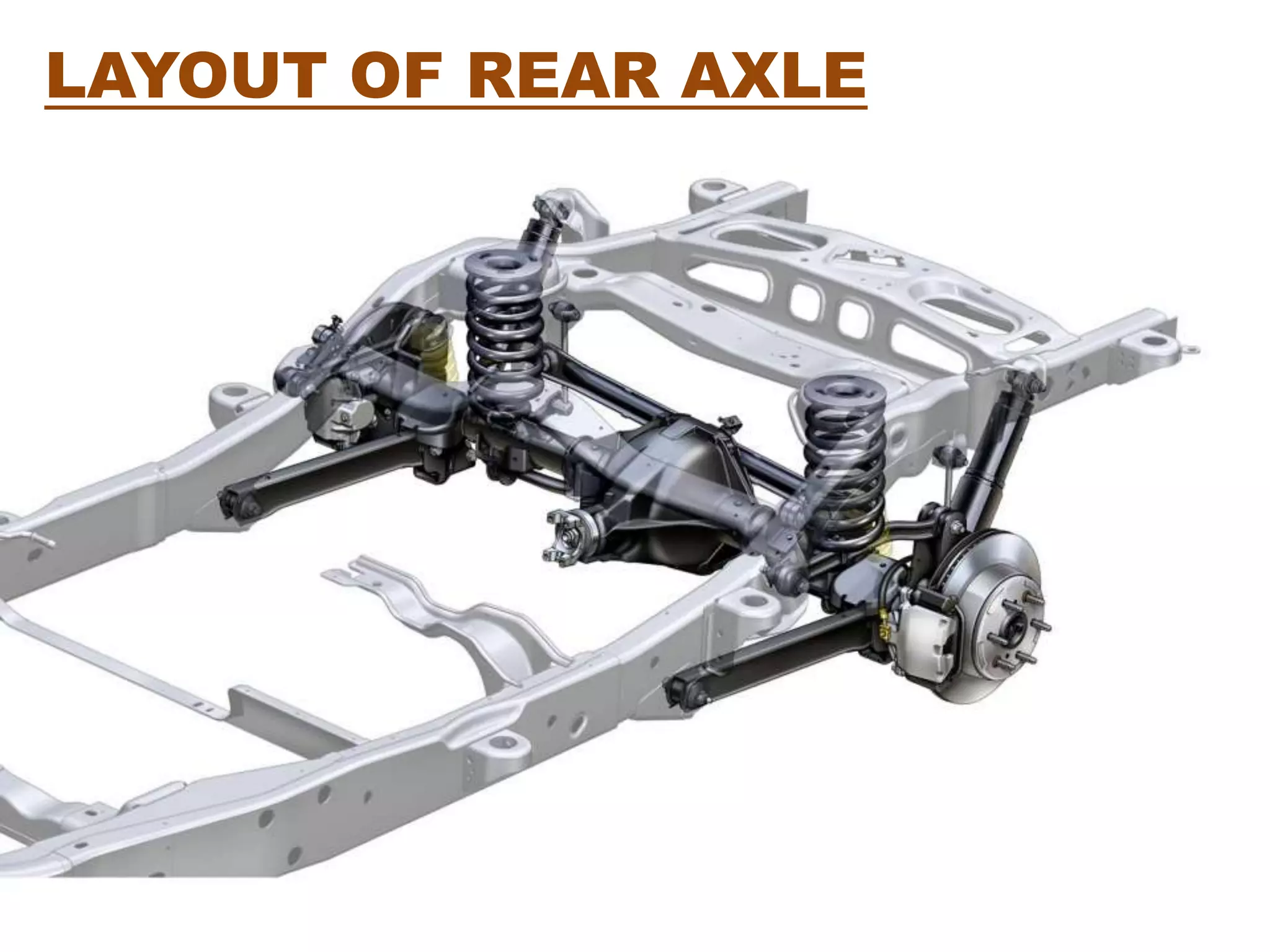
FIG: REAR AXLE OF A FORD F-550 CUMMINS PICK-UP VAN
LAYOUT OF REAR AXLE
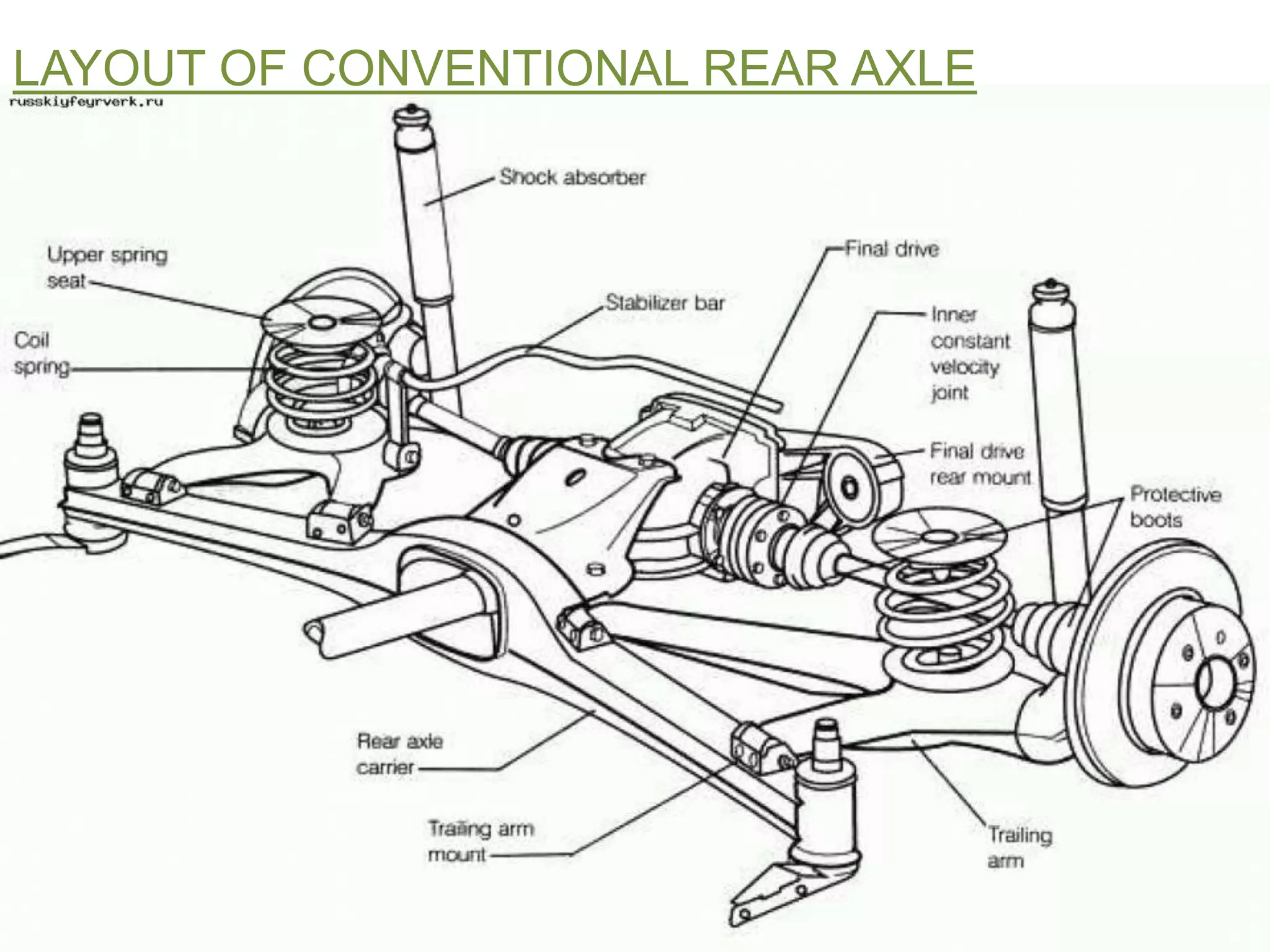
LAYOUT OF CONVENTIONAL REAR AXLE
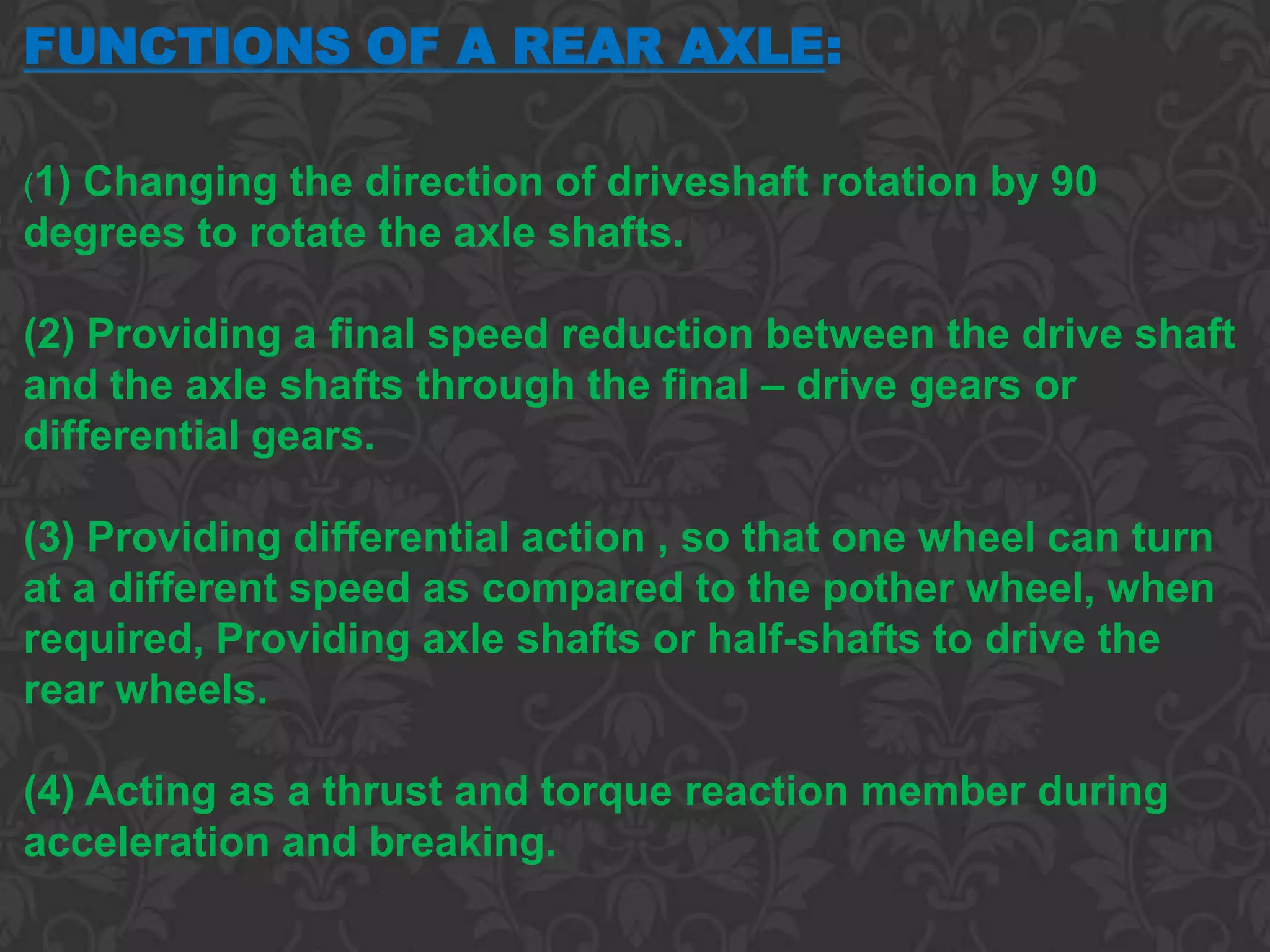
FUNCTIONS OF A REAR AXLE:

(1)
  Changing the direction of driveshaft rotation by 90
degrees to rotate the axle shafts.

(2) Providing a final speed reduction between the drive shaft
and the axle shafts through the final – drive gears or
differential gears.

(3) Providing differential action , so that one wheel can turn
at a different speed as compared to the pother wheel, when
required, Providing axle shafts or half-shafts to drive the
rear wheels.

(4) Acting as a thrust and torque reaction member during
acceleration and breaking.
FINAL DRIVE
       A final drive is that part of a power
transmission system between the drive shaft
and the differential. Its function is to change
the direction of the power transmitted
by the drive shaft through 90 degrees to the
driving axles.
       At the same time it provides a fixed
reduction between the speed of the drive shaft
and the axle driving the wheels, i.e. the car
moves at different speeds while the engine
runs at most efficient stage.
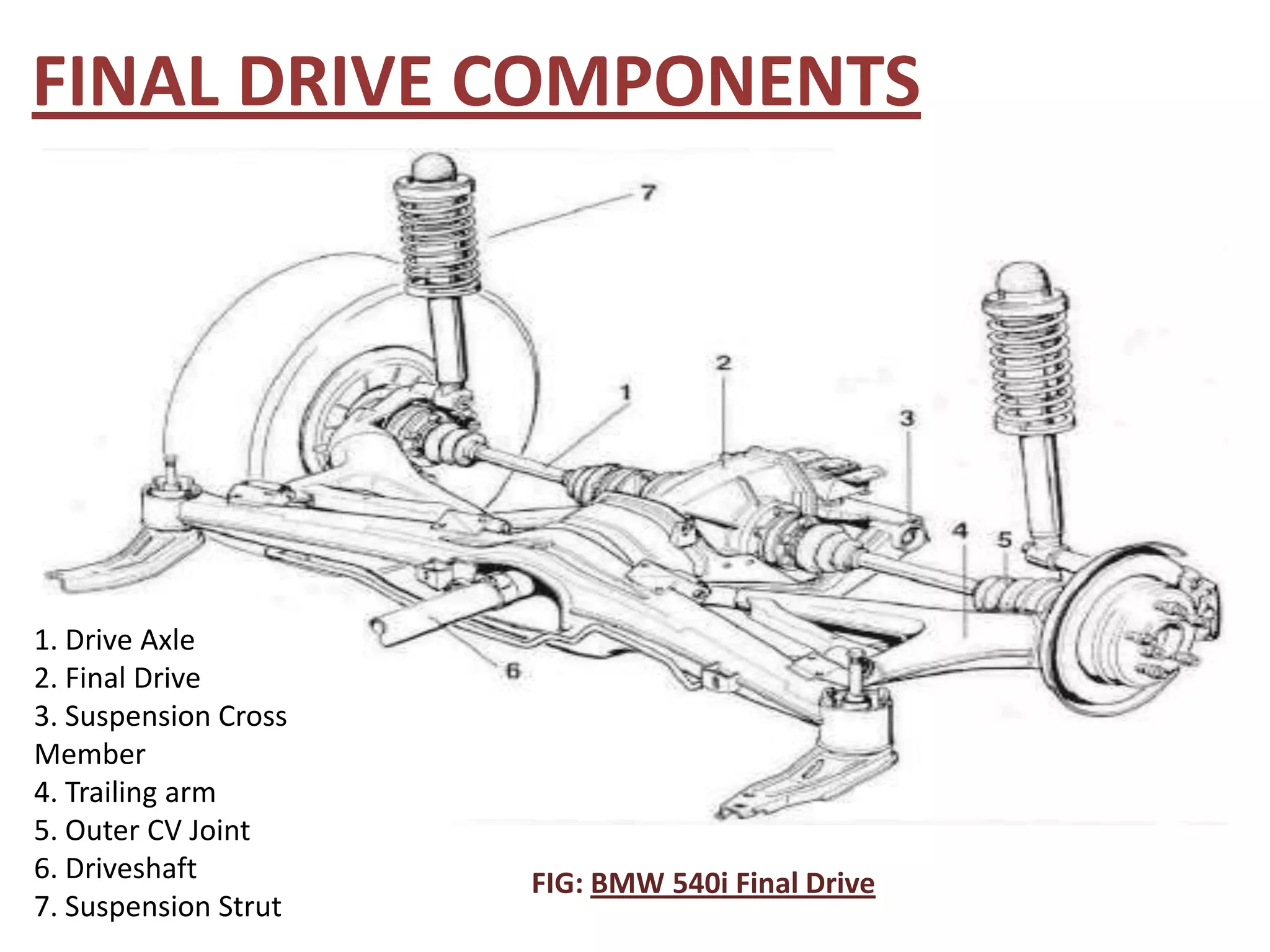
FINAL DRIVE COMPONENTS


1. Drive Axle
2. Final Drive
3. Suspension Cross
Member
4. Trailing arm
5. Outer CV Joint
6. Driveshaft         FIG: BMW 540i Final Drive
7. Suspension Strut
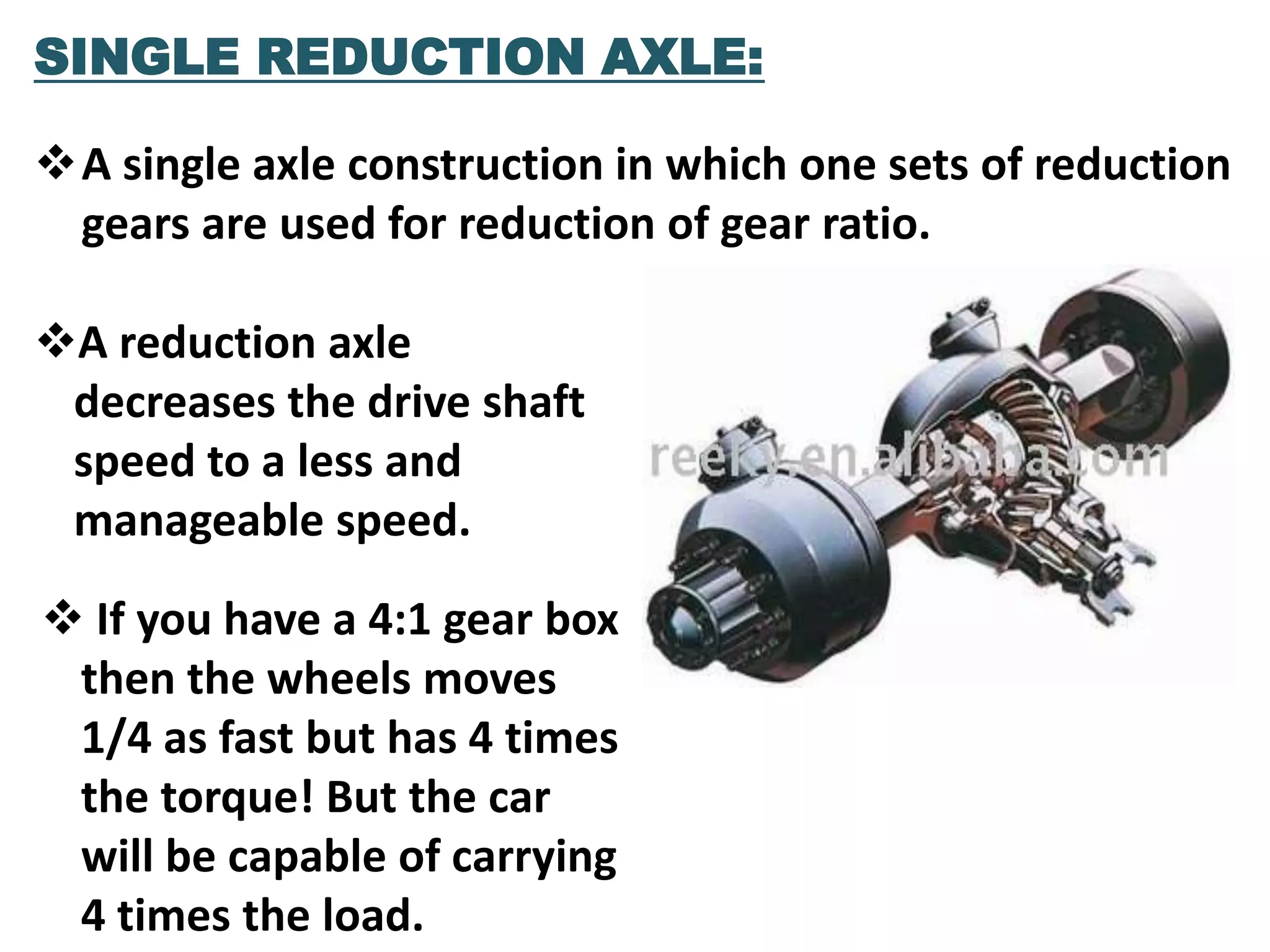
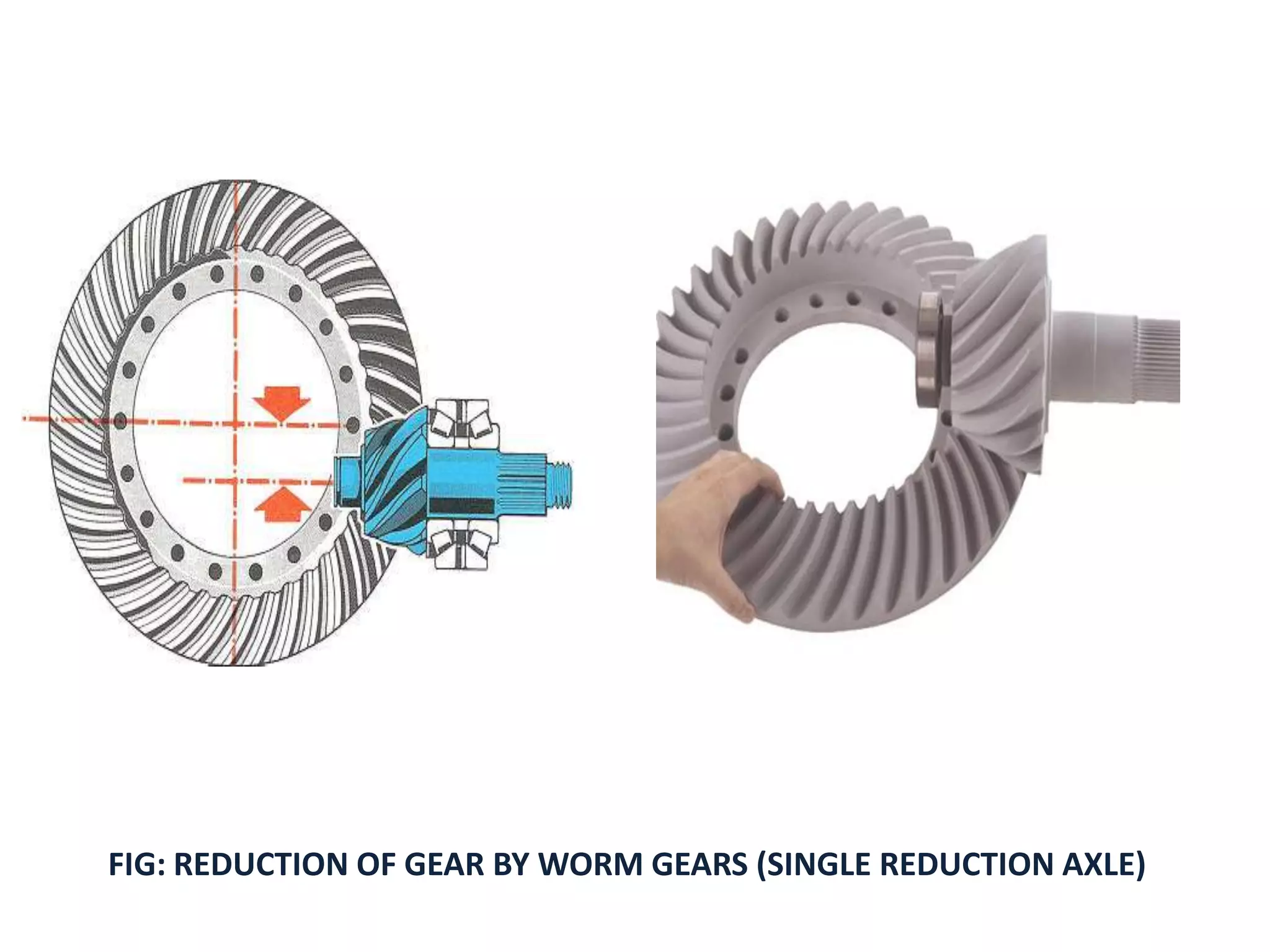
SINGLE REDUCTION AXLE:

A single axle construction in which one sets of reduction
 gears are used for reduction of gear ratio.

A reduction axle
 decreases the drive shaft
 speed to a less and
 manageable speed.

 If you have a 4:1 gear box
 then the wheels moves
 1/4 as fast but has 4 times
 the torque! But the car
 will be capable of carrying
 4 times the load.
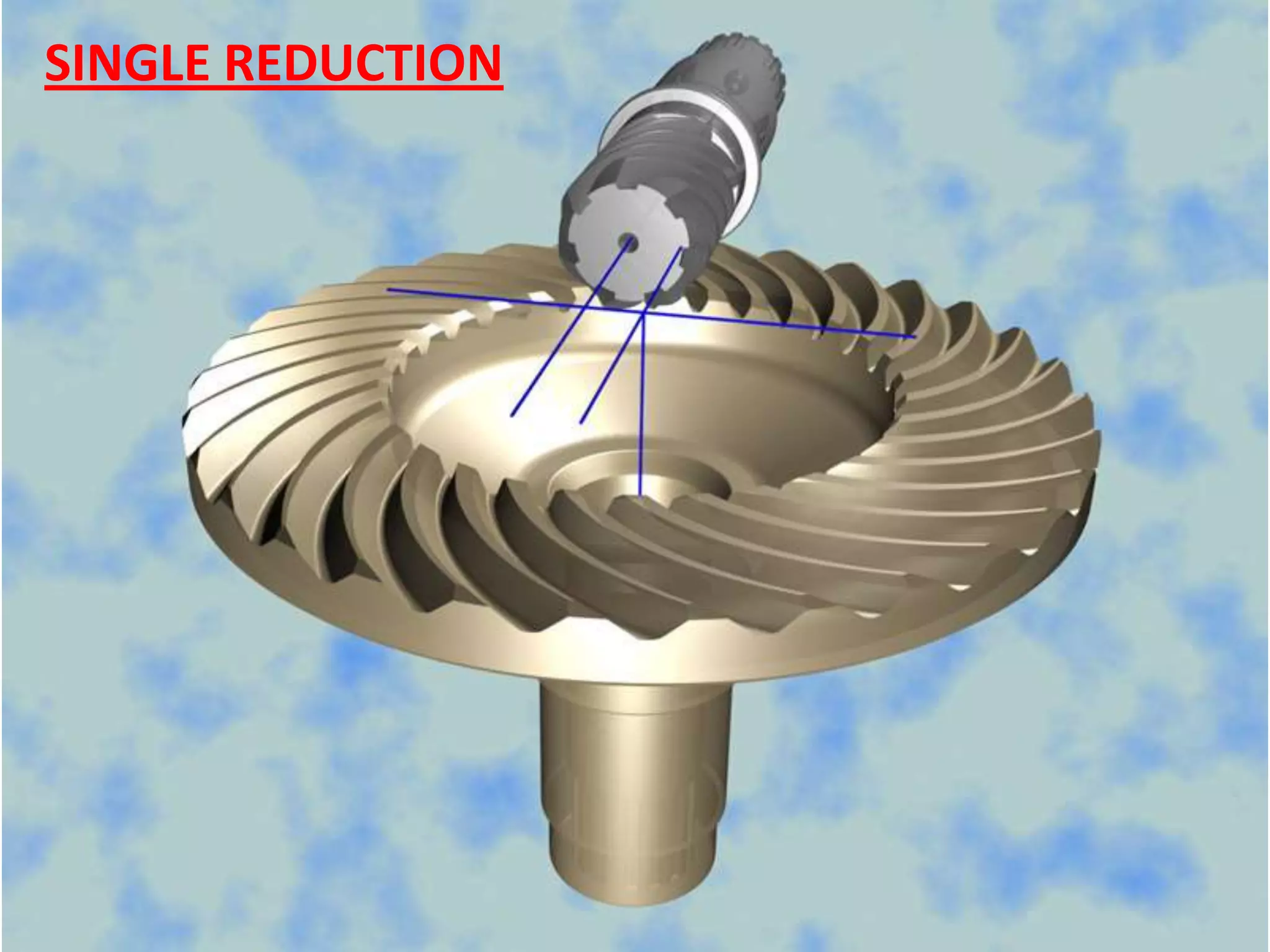
SINGLE REDUCTION
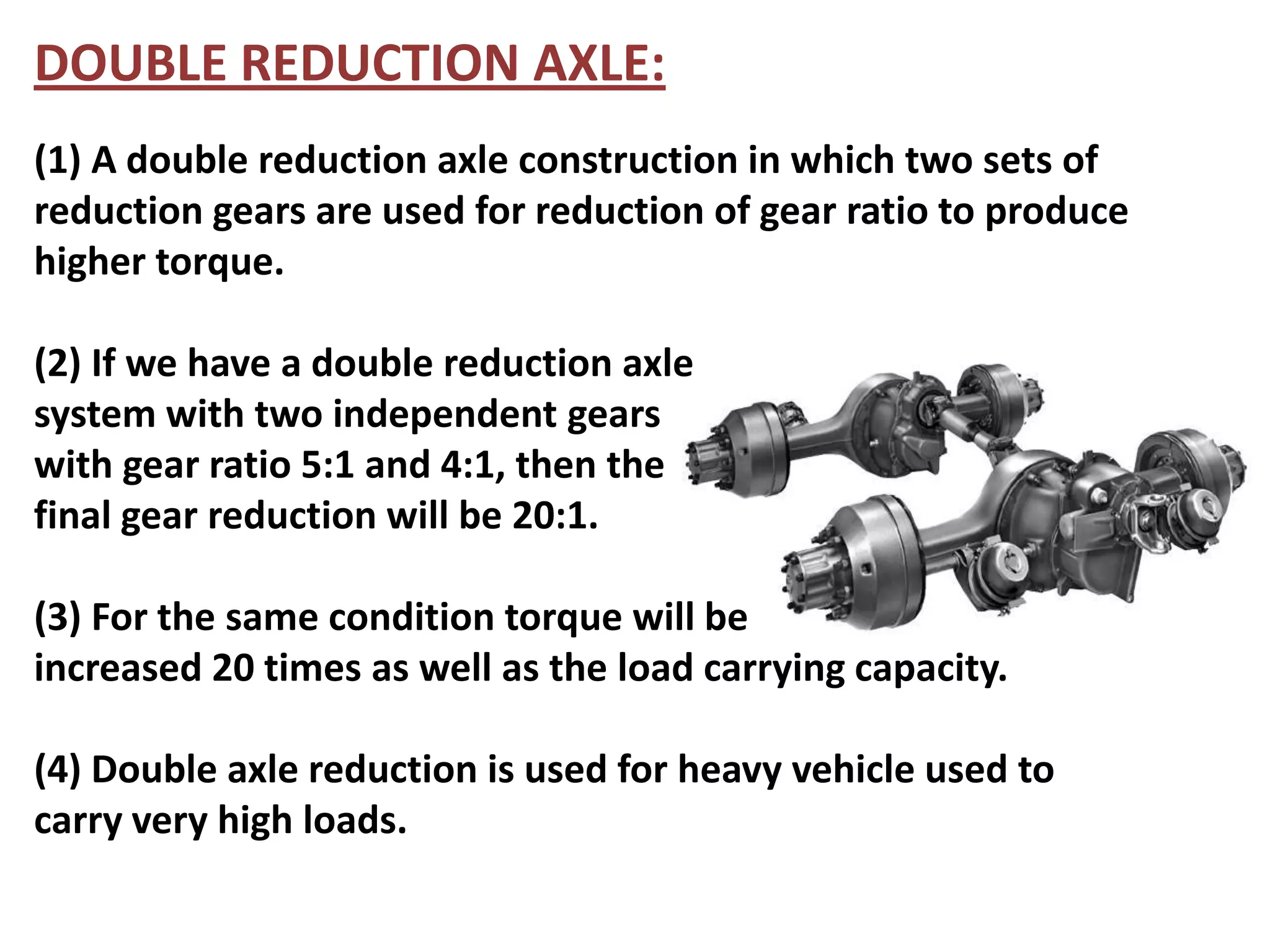
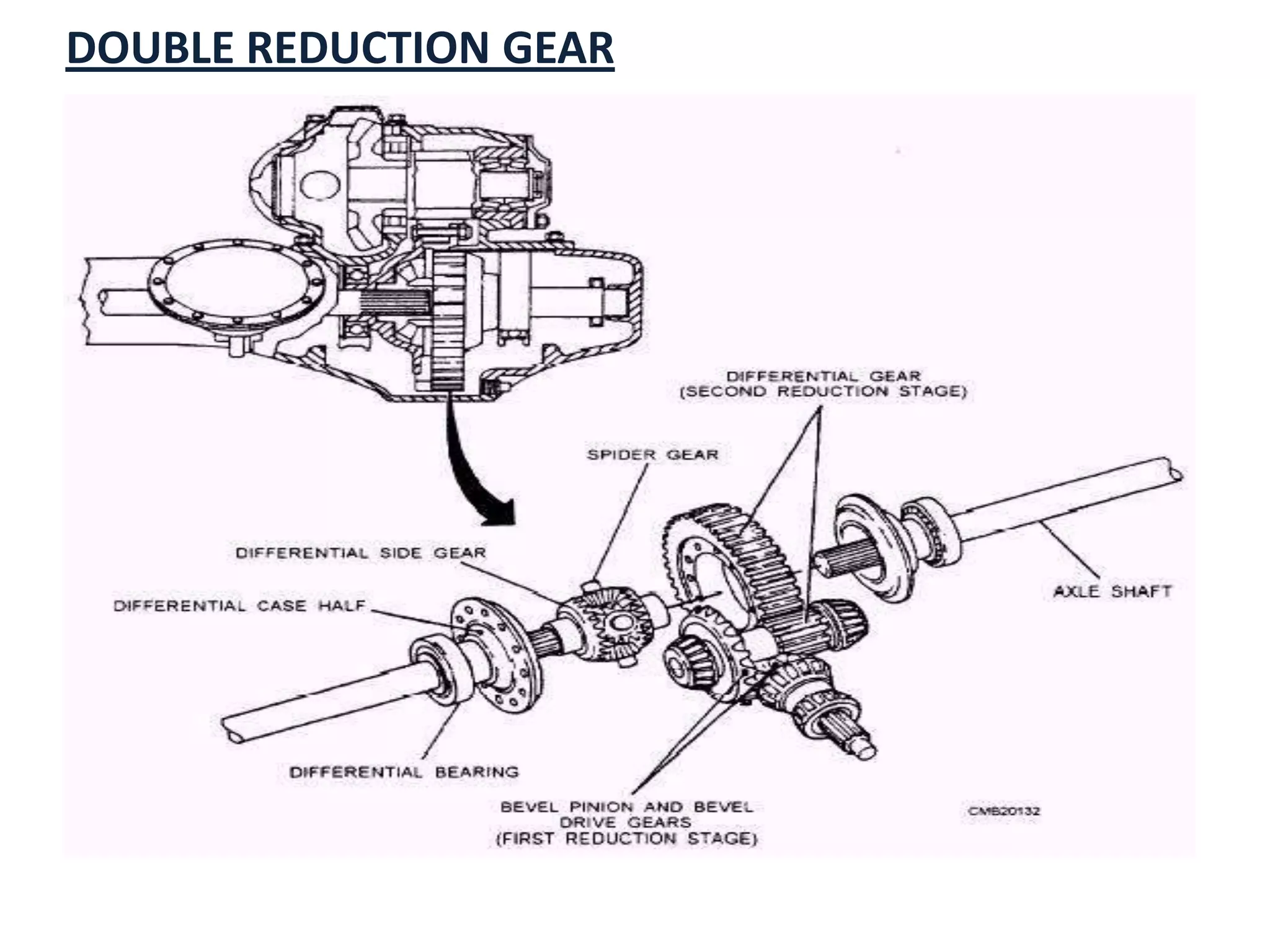
DOUBLE REDUCTION AXLE:
(1) A double reduction axle construction in which two sets of
reduction gears are used for reduction of gear ratio to produce
higher torque.

(2) If we have a double reduction axle
system with two independent gears
with gear ratio 5:1 and 4:1, then the
final gear reduction will be 20:1.

(3) For the same condition torque will be
increased 20 times as well as the load carrying capacity.

(4) Double axle reduction is used for heavy vehicle used to
carry very high loads.
DOUBLE REDUCTION GEAR
FIG: REDUCTION OF GEAR BY WORM GEARS (SINGLE REDUCTION AXLE)
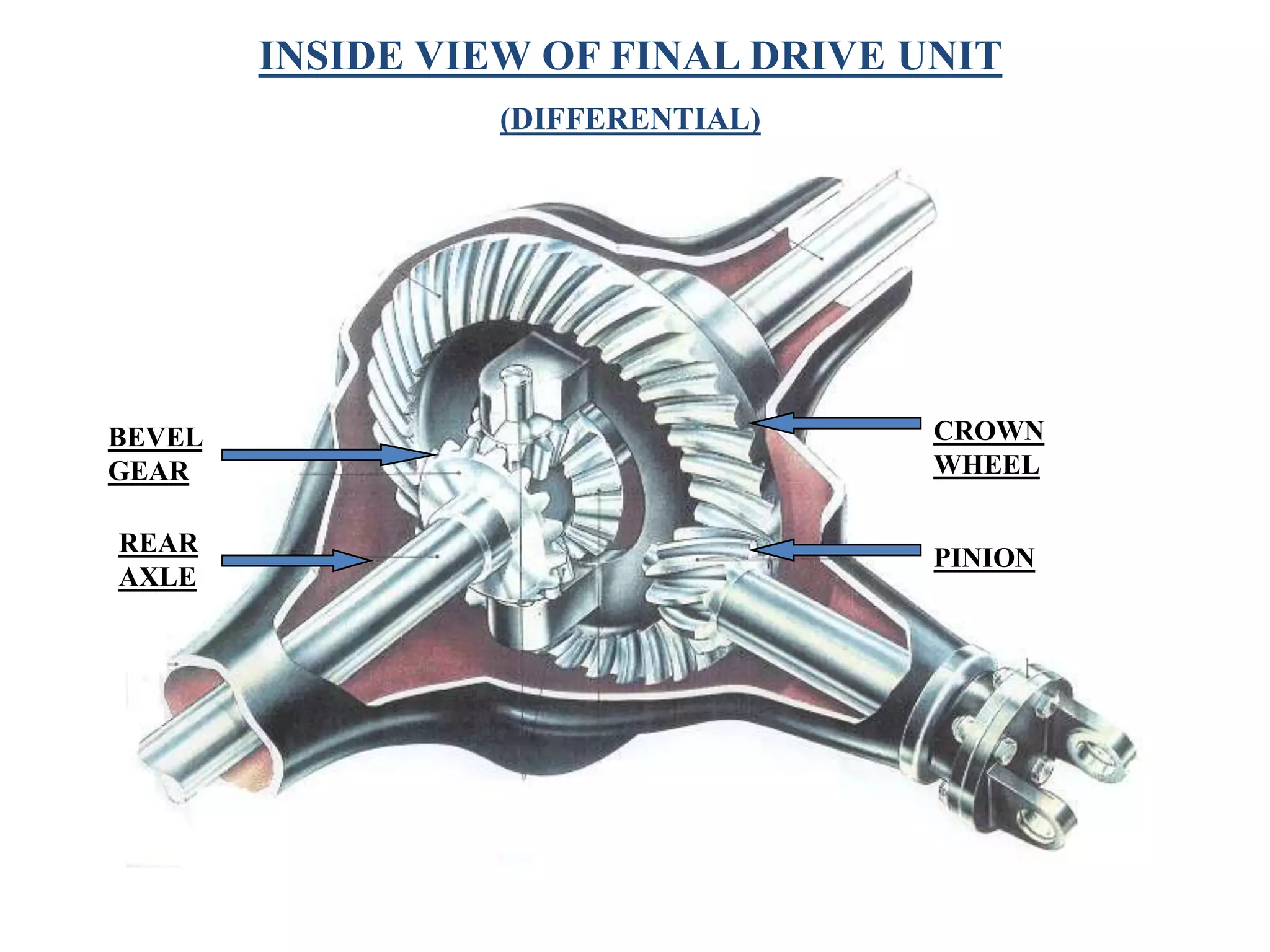
INSIDE VIEW OF FINAL DRIVE UNIT
                  (DIFFERENTIAL)


BEVEL                               CROWN
GEAR                                WHEEL

REAR
                                    PINION
AXLE
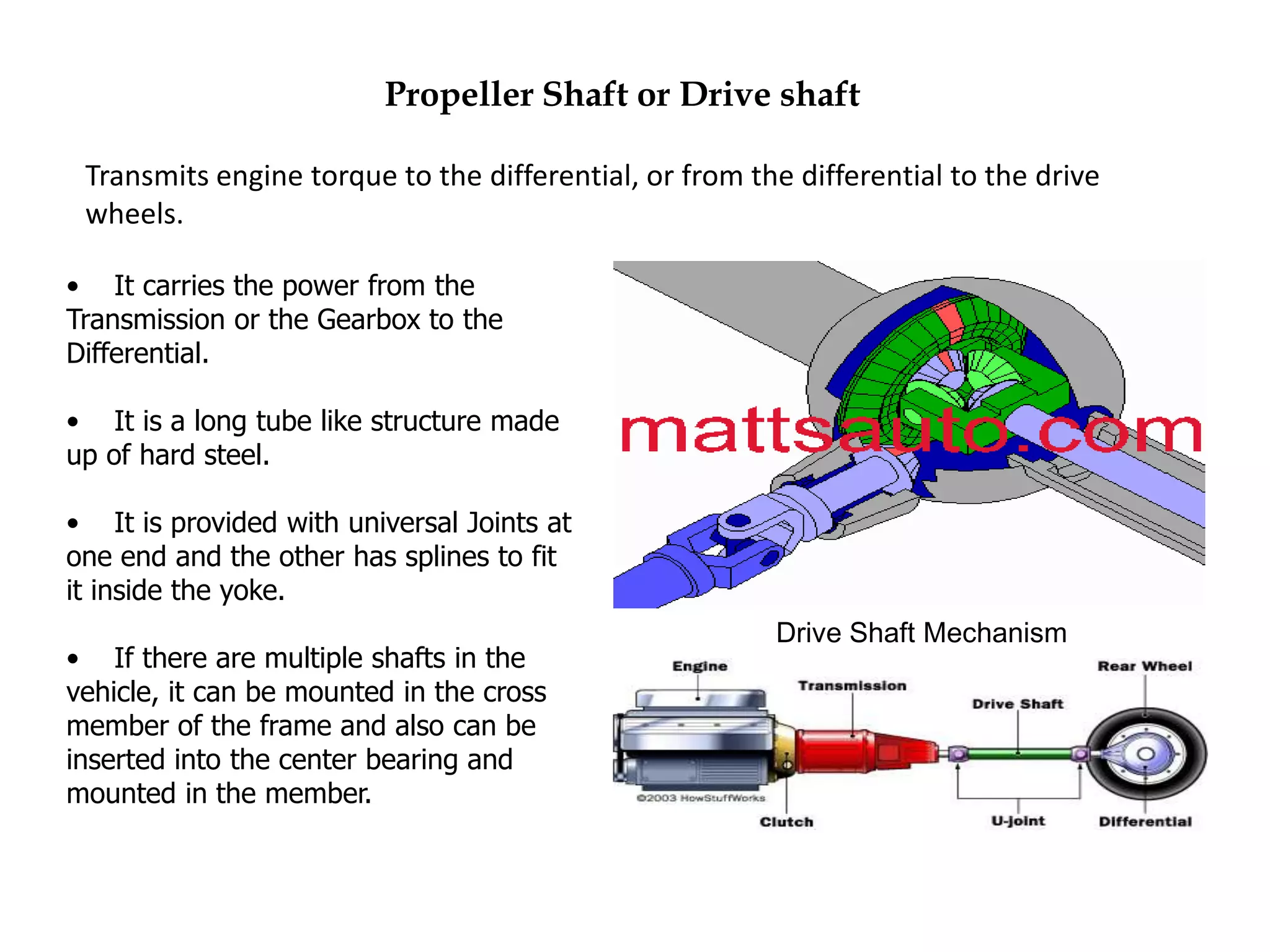
Propeller Shaft or Drive shaft

 Transmits engine torque to the differential, or from the differential to the drive
 wheels.

• It carries the power from the
Transmission or the Gearbox to the
Differential.

• It is a long tube like structure made
up of hard steel.

• It is provided with universal Joints at
one end and the other has splines to fit
it inside the yoke.
                                                        Drive Shaft Mechanism
• If there are multiple shafts in the
vehicle, it can be mounted in the cross
member of the frame and also can be
inserted into the center bearing and
mounted in the member.
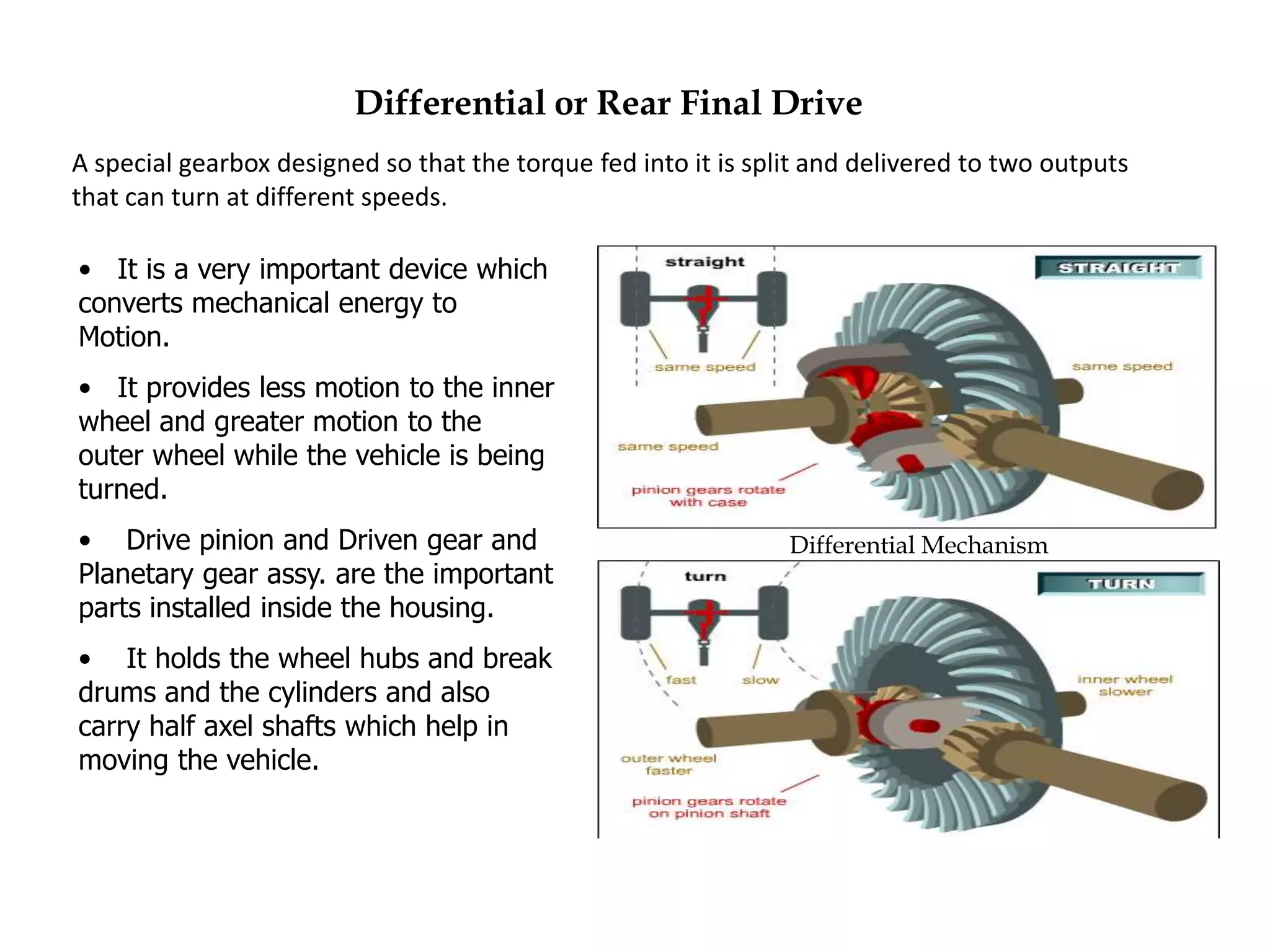
Differential or Rear Final Drive
A special gearbox designed so that the torque fed into it is split and delivered to two outputs
that can turn at different speeds.

• It is a very important device which
converts mechanical energy to
Motion.
• It provides less motion to the inner
wheel and greater motion to the
outer wheel while the vehicle is being
turned.
• Drive pinion and Driven gear and                              Differential Mechanism
Planetary gear assy. are the important
parts installed inside the housing.
• It holds the wheel hubs and break
drums and the cylinders and also
carry half axel shafts which help in
moving the vehicle.
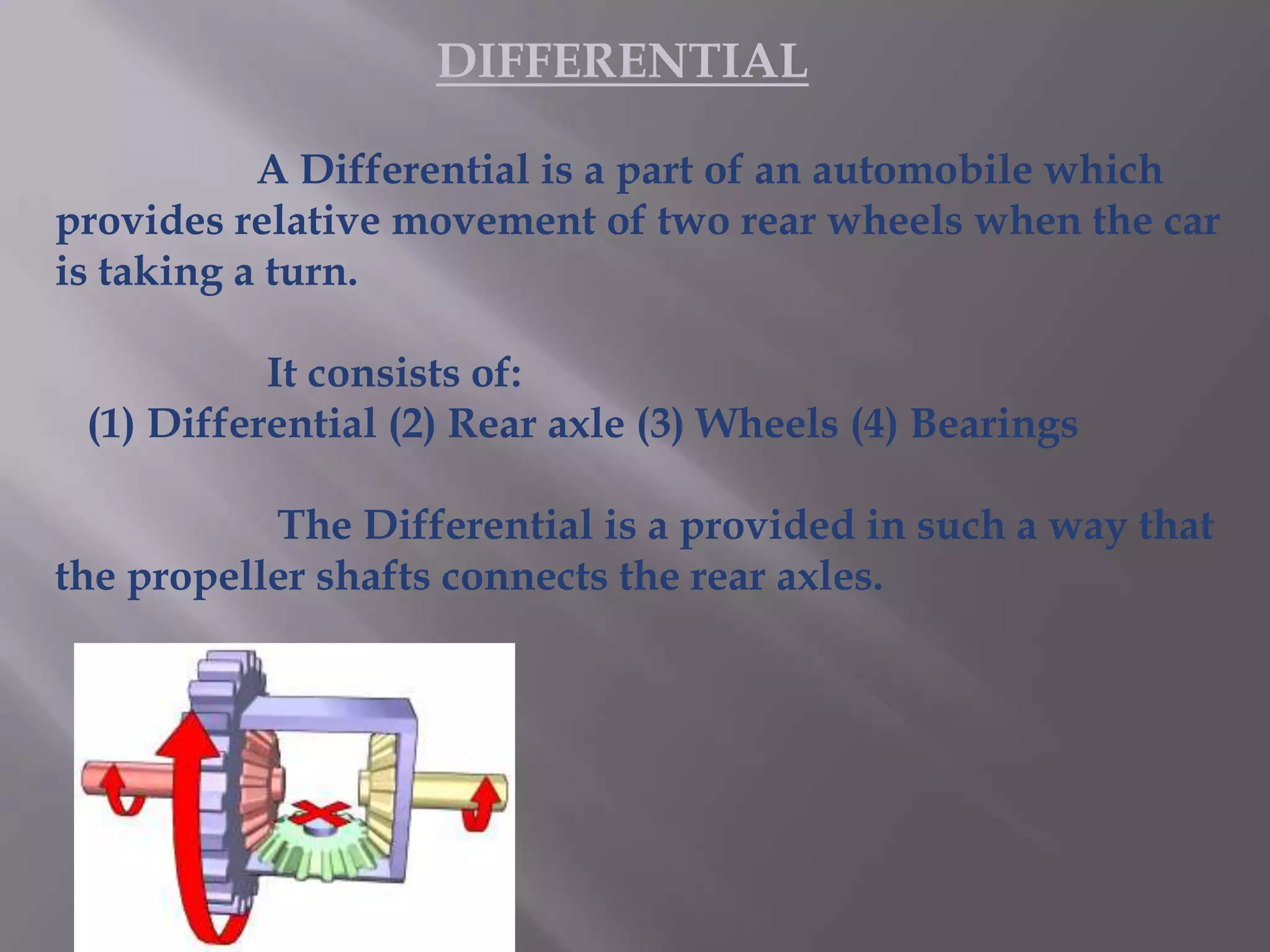
DIFFERENTIAL

           A Differential is a part of an automobile which
provides relative movement of two rear wheels when the car
is taking a turn.

           It consists of:
 (1) Differential (2) Rear axle (3) Wheels (4) Bearings

           The Differential is a provided in such a way that
the propeller shafts connects the rear axles.
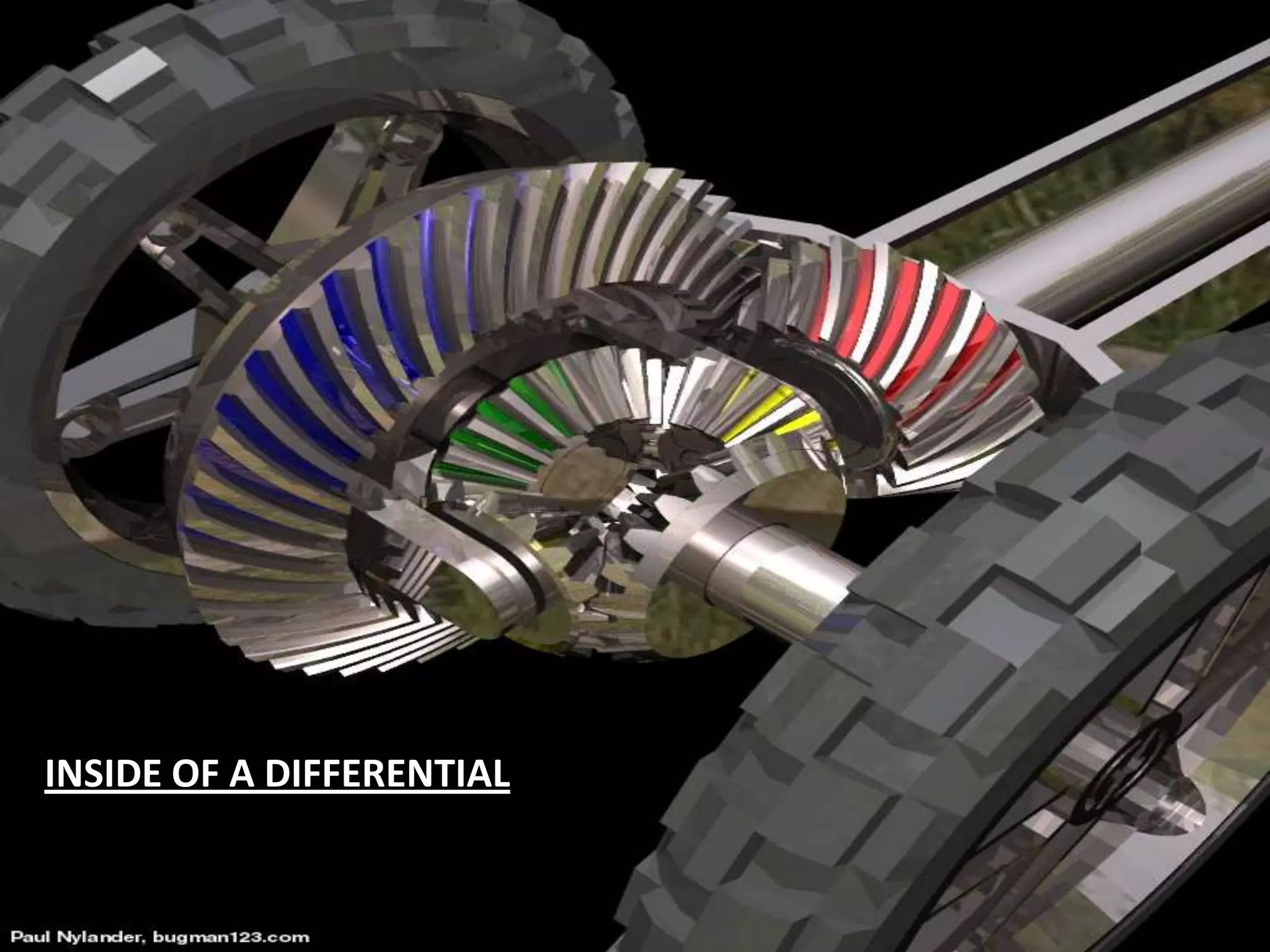
INSIDE OF A DIFFERENTIAL
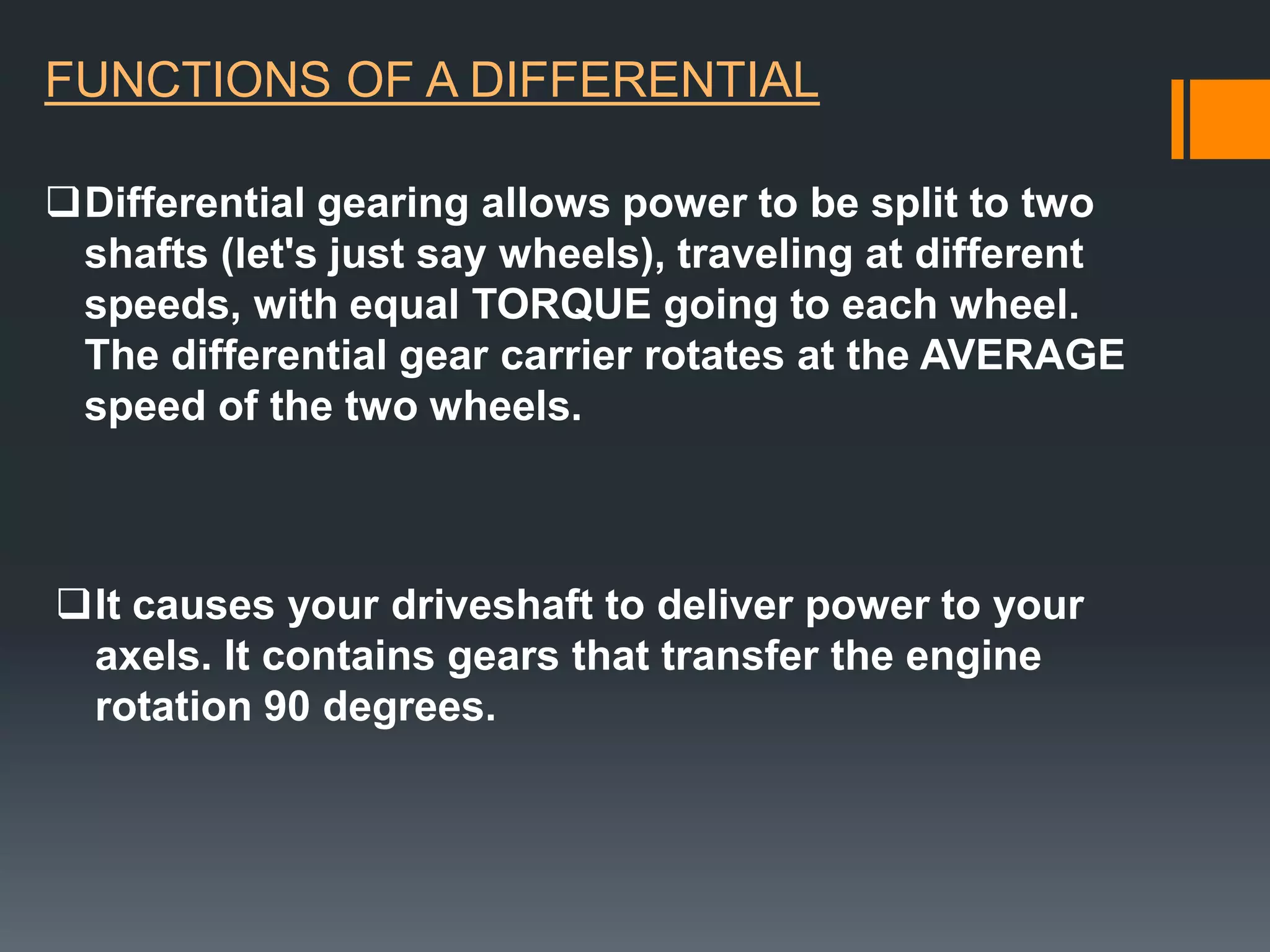
FUNCTIONS OF A DIFFERENTIAL

Differential gearing allows power to be split to two
 shafts (let's just say wheels), traveling at different
 speeds, with equal TORQUE going to each wheel.
 The differential gear carrier rotates at the AVERAGE
 speed of the two wheels.


It causes your driveshaft to deliver power to your
 axels. It contains gears that transfer the engine
 rotation 90 degrees.
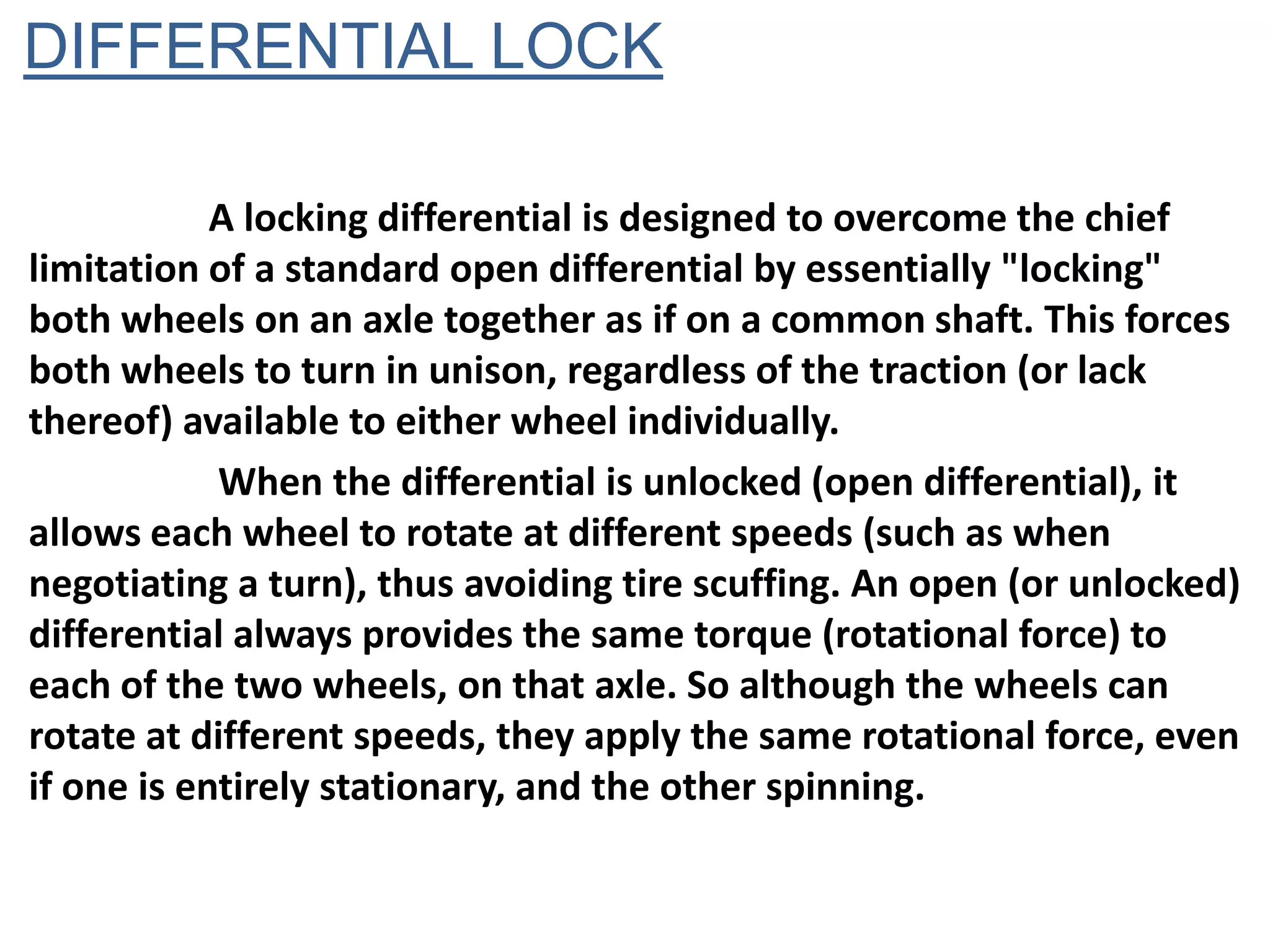
DIFFERENTIAL LOCK

            A locking differential is designed to overcome the chief
limitation of a standard open differential by essentially "locking"
both wheels on an axle together as if on a common shaft. This forces
both wheels to turn in unison, regardless of the traction (or lack
thereof) available to either wheel individually.
            When the differential is unlocked (open differential), it
allows each wheel to rotate at different speeds (such as when
negotiating a turn), thus avoiding tire scuffing. An open (or unlocked)
differential always provides the same torque (rotational force) to
each of the two wheels, on that axle. So although the wheels can
rotate at different speeds, they apply the same rotational force, even
if one is entirely stationary, and the other spinning.
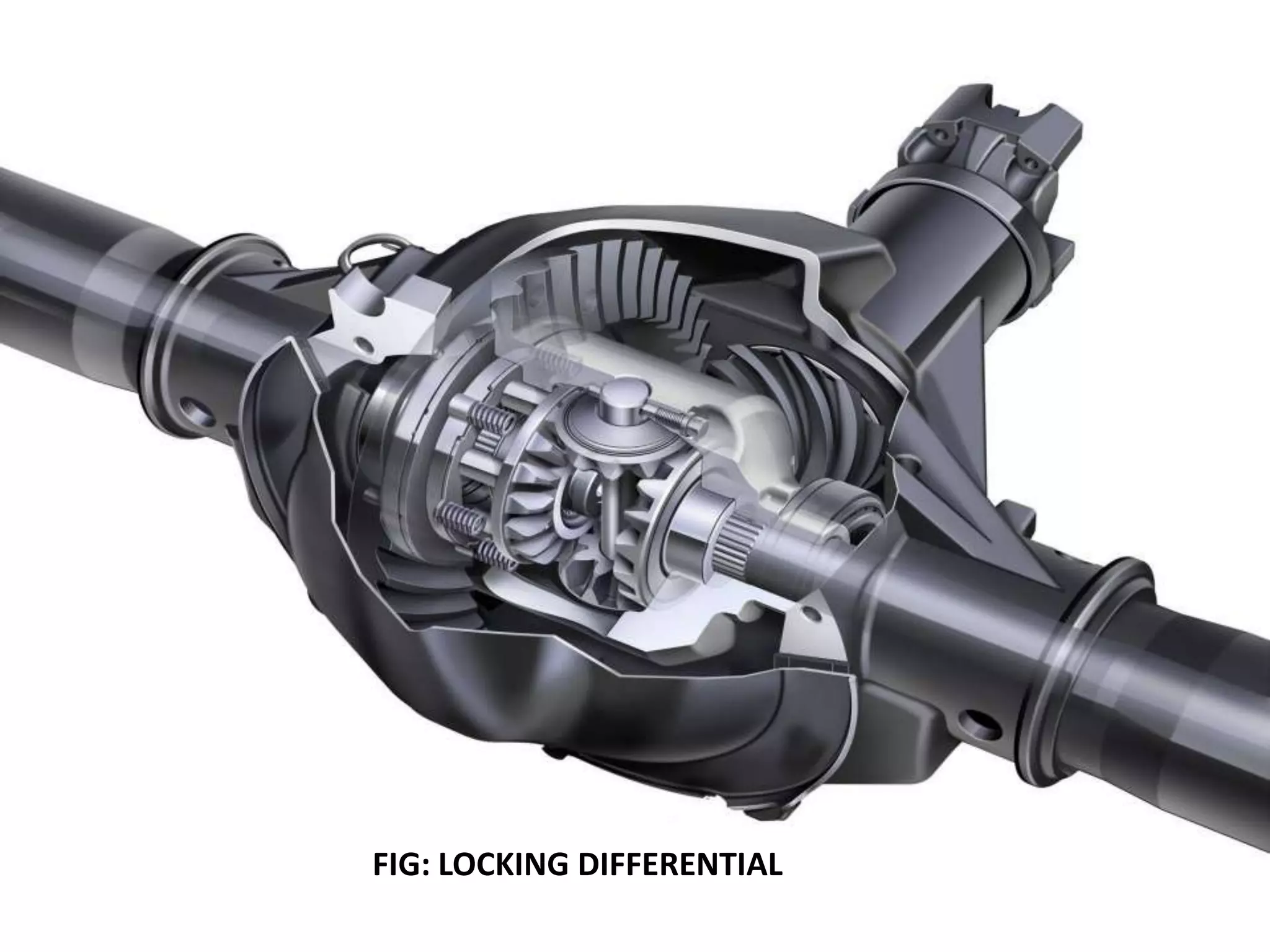
FIG: LOCKING DIFFERENTIAL
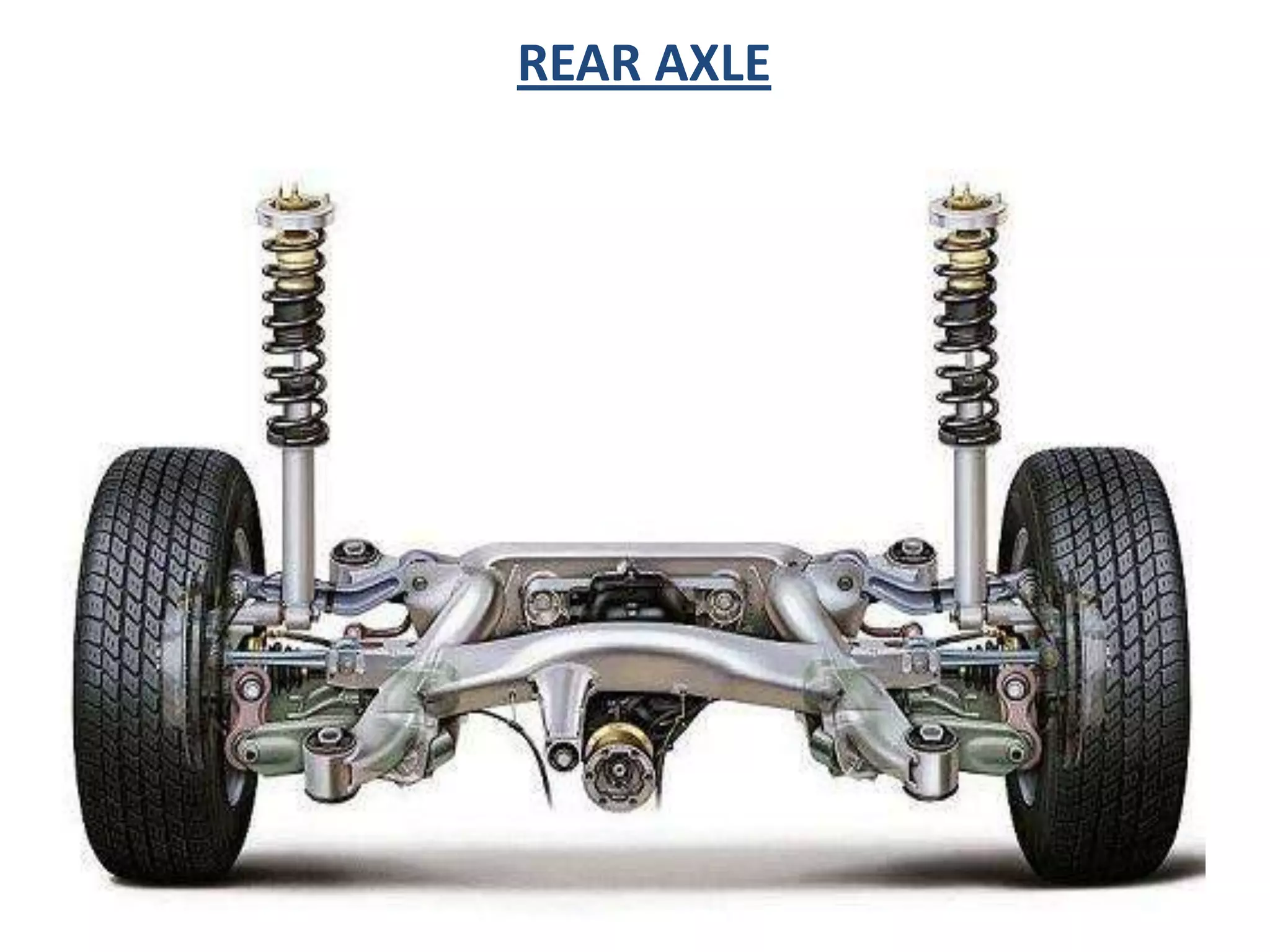
REAR AXLE
REAR AXLE
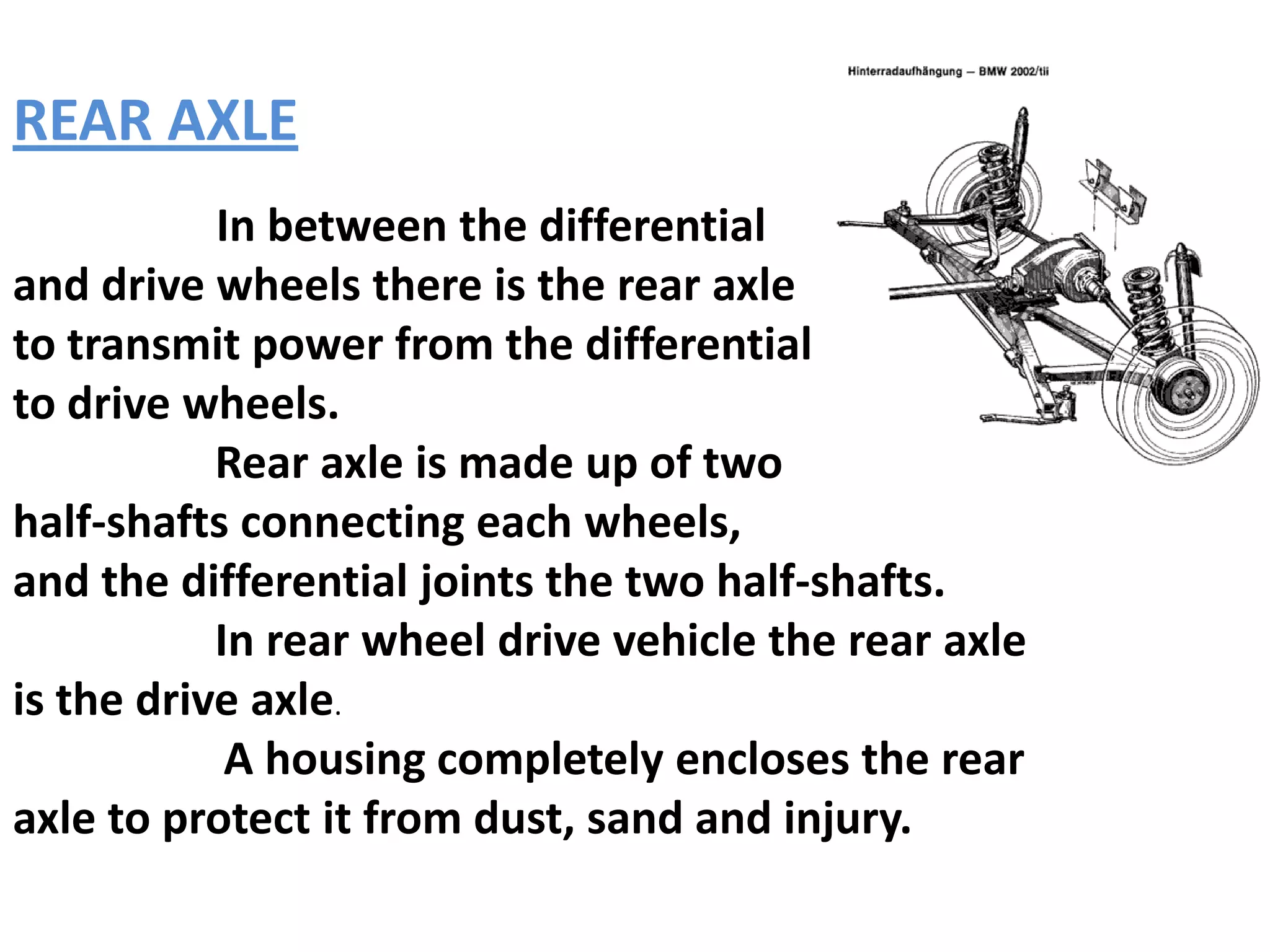
           In between the differential
and drive wheels there is the rear axle
to transmit power from the differential
to drive wheels.
           Rear axle is made up of two
half-shafts connecting each wheels,
and the differential joints the two half-shafts.
           In rear wheel drive vehicle the rear axle
is the drive axle.
            A housing completely encloses the rear
axle to protect it from dust, sand and injury.
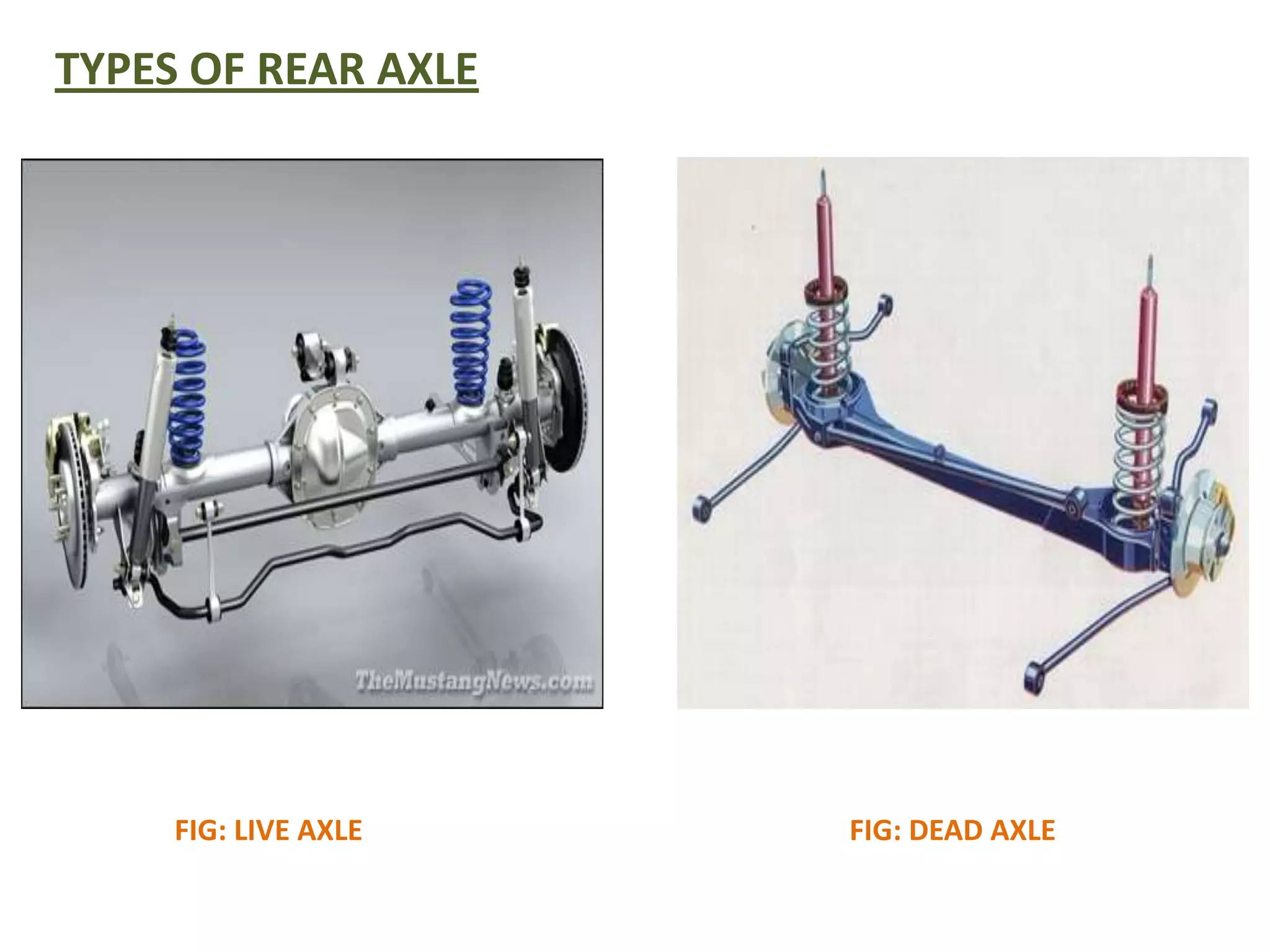
TYPES OF REAR AXLE


     FIG: LIVE AXLE   FIG: DEAD AXLE
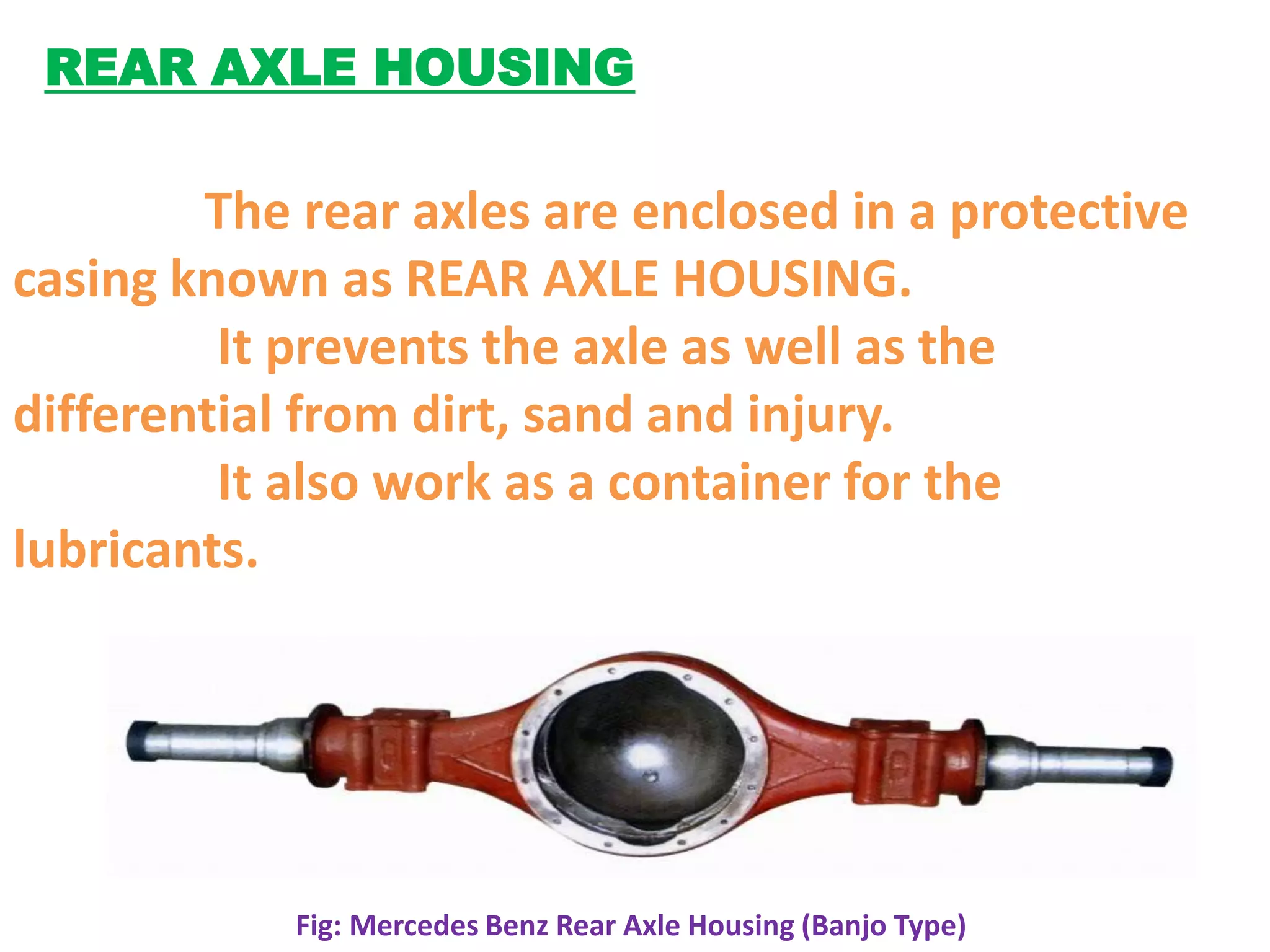
REAR AXLE HOUSING

        The rear axles are enclosed in a protective
casing known as REAR AXLE HOUSING.
         It prevents the axle as well as the
differential from dirt, sand and injury.
         It also work as a container for the
lubricants.


            Fig: Mercedes Benz Rear Axle Housing (Banjo Type)
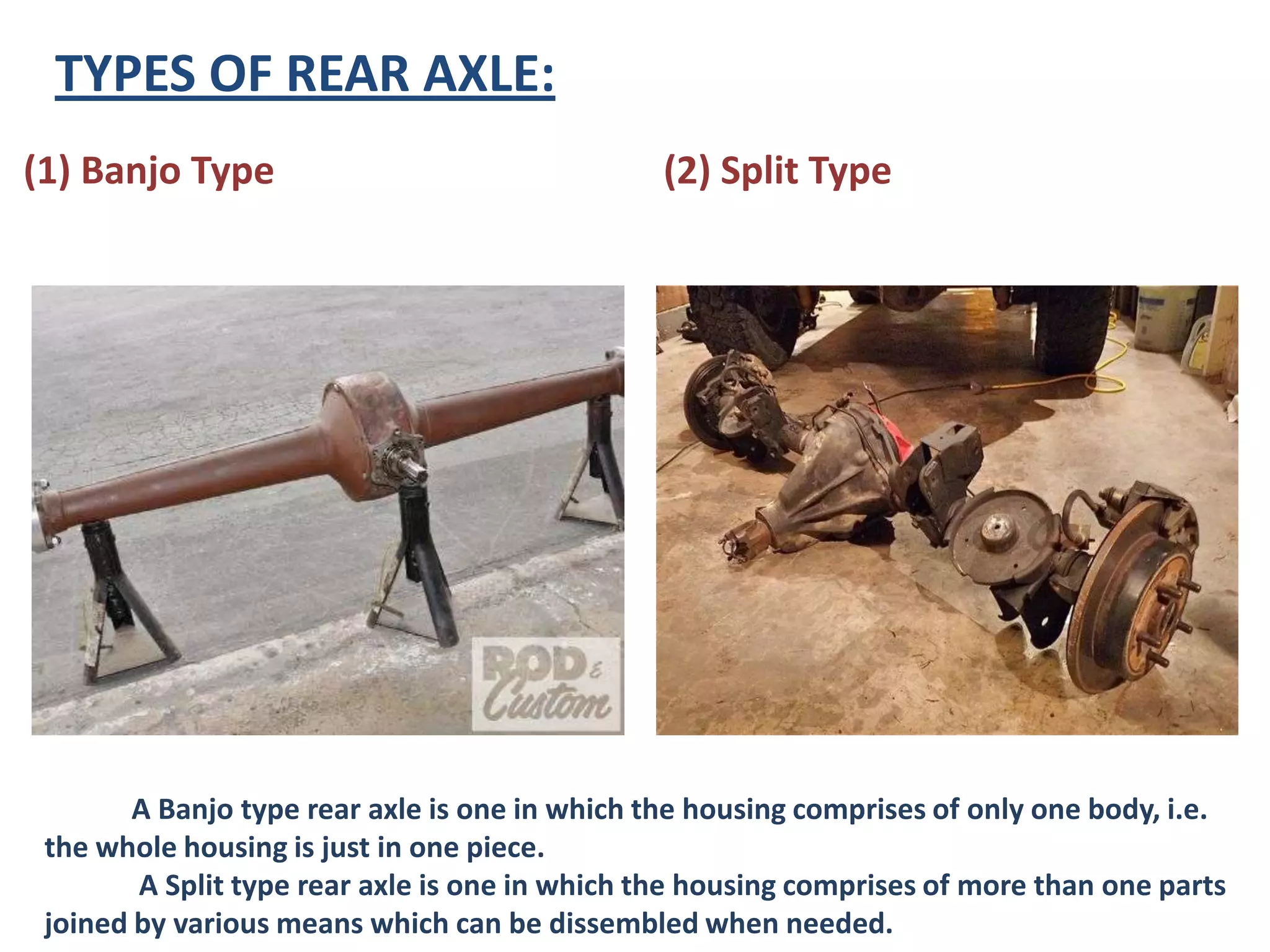
TYPES OF REAR AXLE:
(1) Banjo Type                                  (2) Split Type


        A Banjo type rear axle is one in which the housing comprises of only one body, i.e.
 the whole housing is just in one piece.
        A Split type rear axle is one in which the housing comprises of more than one parts
 joined by various means which can be dissembled when needed.
Unit iii by suman

Unit iii by suman

  • 1.
  • 2.
  • 3.
    REAR AXLE  Agroup of subassemblies or a separate unit of a motor-vehicle chassis (such as an automobile and tractor) that transmits torque from the propeller shaft or directly from the gear box to the propelling mechanism (wheels).  In most motor vehicles the rear axle has a housing, tubes for the axle shafts, a final drive (including the differential with reduction gears), and the axle shafts. The final drive and axle shafts are part of the motor-vehicle transmission.  Wheel brakes are mounted on the rear axle, as are the hubs for the wheels. The rear axle is joined to the frame or body of the motor vehicle by a suspension.
  • 4.
    FIG: REAR AXLEOF A FORD F-550 CUMMINS PICK-UP VAN
  • 5.
  • 6.
  • 7.
    FUNCTIONS OF AREAR AXLE: (1) Changing the direction of driveshaft rotation by 90 degrees to rotate the axle shafts. (2) Providing a final speed reduction between the drive shaft and the axle shafts through the final – drive gears or differential gears. (3) Providing differential action , so that one wheel can turn at a different speed as compared to the pother wheel, when required, Providing axle shafts or half-shafts to drive the rear wheels. (4) Acting as a thrust and torque reaction member during acceleration and breaking.
  • 8.
    FINAL DRIVE A final drive is that part of a power transmission system between the drive shaft and the differential. Its function is to change the direction of the power transmitted by the drive shaft through 90 degrees to the driving axles. At the same time it provides a fixed reduction between the speed of the drive shaft and the axle driving the wheels, i.e. the car moves at different speeds while the engine runs at most efficient stage.
  • 9.
    FINAL DRIVE COMPONENTS 1.Drive Axle 2. Final Drive 3. Suspension Cross Member 4. Trailing arm 5. Outer CV Joint 6. Driveshaft FIG: BMW 540i Final Drive 7. Suspension Strut
  • 10.
    SINGLE REDUCTION AXLE: Asingle axle construction in which one sets of reduction gears are used for reduction of gear ratio. A reduction axle decreases the drive shaft speed to a less and manageable speed.  If you have a 4:1 gear box then the wheels moves 1/4 as fast but has 4 times the torque! But the car will be capable of carrying 4 times the load.
  • 11.
  • 12.
    DOUBLE REDUCTION AXLE: (1)A double reduction axle construction in which two sets of reduction gears are used for reduction of gear ratio to produce higher torque. (2) If we have a double reduction axle system with two independent gears with gear ratio 5:1 and 4:1, then the final gear reduction will be 20:1. (3) For the same condition torque will be increased 20 times as well as the load carrying capacity. (4) Double axle reduction is used for heavy vehicle used to carry very high loads.
  • 13.
  • 14.
    FIG: REDUCTION OFGEAR BY WORM GEARS (SINGLE REDUCTION AXLE)
  • 15.
    INSIDE VIEW OFFINAL DRIVE UNIT (DIFFERENTIAL) BEVEL CROWN GEAR WHEEL REAR PINION AXLE
  • 16.
    Propeller Shaft orDrive shaft Transmits engine torque to the differential, or from the differential to the drive wheels. • It carries the power from the Transmission or the Gearbox to the Differential. • It is a long tube like structure made up of hard steel. • It is provided with universal Joints at one end and the other has splines to fit it inside the yoke. Drive Shaft Mechanism • If there are multiple shafts in the vehicle, it can be mounted in the cross member of the frame and also can be inserted into the center bearing and mounted in the member.
  • 17.
    Differential or RearFinal Drive A special gearbox designed so that the torque fed into it is split and delivered to two outputs that can turn at different speeds. • It is a very important device which converts mechanical energy to Motion. • It provides less motion to the inner wheel and greater motion to the outer wheel while the vehicle is being turned. • Drive pinion and Driven gear and Differential Mechanism Planetary gear assy. are the important parts installed inside the housing. • It holds the wheel hubs and break drums and the cylinders and also carry half axel shafts which help in moving the vehicle.
  • 18.
    DIFFERENTIAL A Differential is a part of an automobile which provides relative movement of two rear wheels when the car is taking a turn. It consists of: (1) Differential (2) Rear axle (3) Wheels (4) Bearings The Differential is a provided in such a way that the propeller shafts connects the rear axles.
  • 19.
    INSIDE OF ADIFFERENTIAL
  • 21.
    FUNCTIONS OF ADIFFERENTIAL Differential gearing allows power to be split to two shafts (let's just say wheels), traveling at different speeds, with equal TORQUE going to each wheel. The differential gear carrier rotates at the AVERAGE speed of the two wheels. It causes your driveshaft to deliver power to your axels. It contains gears that transfer the engine rotation 90 degrees.
  • 22.
    DIFFERENTIAL LOCK A locking differential is designed to overcome the chief limitation of a standard open differential by essentially "locking" both wheels on an axle together as if on a common shaft. This forces both wheels to turn in unison, regardless of the traction (or lack thereof) available to either wheel individually. When the differential is unlocked (open differential), it allows each wheel to rotate at different speeds (such as when negotiating a turn), thus avoiding tire scuffing. An open (or unlocked) differential always provides the same torque (rotational force) to each of the two wheels, on that axle. So although the wheels can rotate at different speeds, they apply the same rotational force, even if one is entirely stationary, and the other spinning.
  • 23.
  • 24.
  • 25.
    REAR AXLE In between the differential and drive wheels there is the rear axle to transmit power from the differential to drive wheels. Rear axle is made up of two half-shafts connecting each wheels, and the differential joints the two half-shafts. In rear wheel drive vehicle the rear axle is the drive axle. A housing completely encloses the rear axle to protect it from dust, sand and injury.
  • 26.
    TYPES OF REARAXLE FIG: LIVE AXLE FIG: DEAD AXLE
  • 27.
    REAR AXLE HOUSING The rear axles are enclosed in a protective casing known as REAR AXLE HOUSING. It prevents the axle as well as the differential from dirt, sand and injury. It also work as a container for the lubricants. Fig: Mercedes Benz Rear Axle Housing (Banjo Type)
  • 28.
    TYPES OF REARAXLE: (1) Banjo Type (2) Split Type A Banjo type rear axle is one in which the housing comprises of only one body, i.e. the whole housing is just in one piece. A Split type rear axle is one in which the housing comprises of more than one parts joined by various means which can be dissembled when needed.