CHILLING
GROUP ONE
THEORY OF CHILLING
u Chilling refers to the process in which the temperature of the food is reduced
to a low temperature above its freezing point but below the ambient to slow
down microbial growth and the rate of chemical reaction in foods.
u It causes minimal changes to sensory characteristic and nutritional properties
of food.
u To effectively chill food it is important to store food at right temperature
range. Above freezing and below 15 degrees Celsius.
u chilling only slows down microbial growth but may not completely stop it
therefore it is important to follow proper food handling and storage practices.
u Proper food handling and practices include, monitoring clean and hygienic
conditions, using proper packaging and adhering to appropriate time to ensure
food safety.
FACTORS TO CONSIDER DURING CHILLING
1. Temperature
u Microorganisms grow best at temperatures above 15 degrees Celsius and below 8 degrees Celsius
the rate decreases.
u The chilling temperature range is an important factor that inhibits microbial growth without
altering nutritional value of food.
2. Relative humidity of the environment
u Proper humidity levels are crucial to prevent dry outs or excess moisture which can lead to
spoilage and microbial growth.
u High humidity in cold rooms should be avoided since condensation on the walls creates proper
environment for mold growth.
CONT…
3. Product type
u Different food products have varying composition, structures, and susceptibility to temperature
chance.
u For example vegetables are more sensitive to temperature and may quickly lose texture and
freshness when exposed to temperature that are too cold hence they require precise control.
4. Storage conditions
u Shelf life of the food can be extended considerably by modifying the temperature in the cold rooms.
u Overfilling of the fridge should be avoided to maintain proper ventilation and temperature control.
u Maintaining appropriate humidity and airflow helps prevent moisture loss which can lead to food
spoilage.
5. Airflow or air velocity
u adequate air flow can help prevent condensation build up on chilled item. Condensation can lead to
moisture related issues like spoilage.
u Optimizing airflow can improve the efficiency of chilling systems by ensuring that all parts of chilling
area
u Proper airflow management during chilling helps maintain quality and freshness of the chilled items
by preventing fluctuation and ensuring uniform cooling.
EQUIPMENTS FOR CHILLING
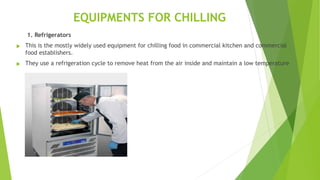
1. Refrigerators
u This is the mostly widely used equipment for chilling food in commercial kitchen and commercial
food establishers.
u They use a refrigeration cycle to remove heat from the air inside and maintain a low temperature
CONT…
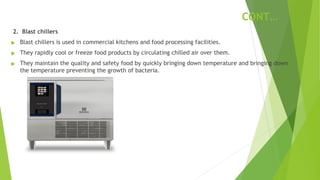
2. Blast chillers
u Blast chillers is used in commercial kitchens and food processing facilities.
u They rapidly cool or freeze food products by circulating chilled air over them.
u They maintain the quality and safety food by quickly bringing down temperature and bringing down
the temperature preventing the growth of bacteria.
Conti…
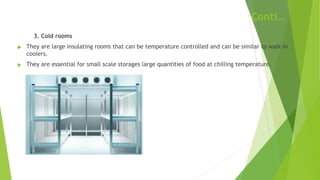
3. Cold rooms
u They are large insulating rooms that can be temperature controlled and can be similar to walk in
coolers.
u They are essential for small scale storages large quantities of food at chilling temperature.
Cont…
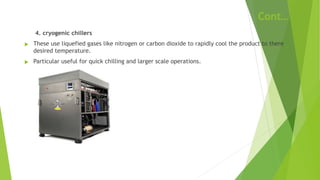
4. cryogenic chillers
u These use liquefied gases like nitrogen or carbon dioxide to rapidly cool the product to there
desired temperature.
u Particular useful for quick chilling and larger scale operations.
Cont.….
5. Evaporative coolers
u These use the evaporation of water to cool the air, which in turn chills the food products.
u They are eaten used in conjunction with other chilling systems to maintain the delivered
temperature.
Cont…
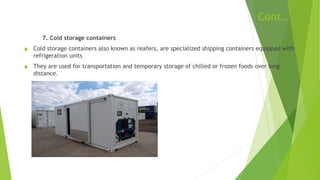
7. Cold storage containers
u Cold storage containers also known as reafers, are specialized shipping containers equipped with
refrigeration units
u They are used for transportation and temporary storage of chilled or frozen foods over long
distance.
EFFECTS OF CHILLING
1. Texture change
u Chilling process can affects the texture of foods.
u For example freezing can make fruits and vegetables mushy when they are thawed.
u Meat and poultry can become tough and dry when chilled for long.
2. Nutritional quality
u Chilling can preserve the nutritional quality of foods by slowing down the degradation of vitamins
and antioxidants.
u Although chilling can cause loss of nutrients in certain types of food for example vitamin A and C
are sensitive to light and high temperature.
u Prolonged chilling can also lead to loss of nutrients in vegetables and fruits.
Cont.…
3. Moisture loss
u Prolonged chilling can cause certain foods to loose moisture, leading dryness and dehydration.
u This is particularly true for foods with high water contents such as fruits, vegetables and meat.
4. Biochemical changes
u Chilling can affects the biochemical composition of food including the levels of bioactive
compounds like antioxidants.
5. physiological changes
u For fresh produce, chilling can slow down physiological processes like respiration and ripening,
which can maintain freshness.
cont.…
6. Spoilage
u While chilling can help preserve foods and prevent spoilage, excessive chilling or extended storage
periods can increase the risk of spoilage and microbial growth.
u This can result in food that is spoilage, discolored or has unpleasant odor.
7. Microbial growth
u Chilling slows down the growth of microorganism, which can cause spoilage
8. Flavor change.
u Cooling can affects the flavor of certain food such as fruits and vegetables.
u For example chilling can make tomatoes loose their natural flavor, while sweet fruits may become
less sweet.
u The flavor of some species and herbs may also be affected by regrigeration.
CONCLUSION
u In conclusion the chilling process plays a critical role across diverse industries, from
food processing to pharmaceuticals and beyond.
u By employing effective chilling techniques, business can uphold product quality,
extends shelf life and ensures food security.

Chilling in food processing and preservation

  • 1.
  • 2.
    THEORY OF CHILLING uChilling refers to the process in which the temperature of the food is reduced to a low temperature above its freezing point but below the ambient to slow down microbial growth and the rate of chemical reaction in foods. u It causes minimal changes to sensory characteristic and nutritional properties of food. u To effectively chill food it is important to store food at right temperature range. Above freezing and below 15 degrees Celsius. u chilling only slows down microbial growth but may not completely stop it therefore it is important to follow proper food handling and storage practices. u Proper food handling and practices include, monitoring clean and hygienic conditions, using proper packaging and adhering to appropriate time to ensure food safety.
  • 3.
    FACTORS TO CONSIDERDURING CHILLING 1. Temperature u Microorganisms grow best at temperatures above 15 degrees Celsius and below 8 degrees Celsius the rate decreases. u The chilling temperature range is an important factor that inhibits microbial growth without altering nutritional value of food. 2. Relative humidity of the environment u Proper humidity levels are crucial to prevent dry outs or excess moisture which can lead to spoilage and microbial growth. u High humidity in cold rooms should be avoided since condensation on the walls creates proper environment for mold growth.
  • 4.
    CONT… 3. Product type uDifferent food products have varying composition, structures, and susceptibility to temperature chance. u For example vegetables are more sensitive to temperature and may quickly lose texture and freshness when exposed to temperature that are too cold hence they require precise control. 4. Storage conditions u Shelf life of the food can be extended considerably by modifying the temperature in the cold rooms. u Overfilling of the fridge should be avoided to maintain proper ventilation and temperature control. u Maintaining appropriate humidity and airflow helps prevent moisture loss which can lead to food spoilage. 5. Airflow or air velocity u adequate air flow can help prevent condensation build up on chilled item. Condensation can lead to moisture related issues like spoilage. u Optimizing airflow can improve the efficiency of chilling systems by ensuring that all parts of chilling area u Proper airflow management during chilling helps maintain quality and freshness of the chilled items by preventing fluctuation and ensuring uniform cooling.
  • 5.
    EQUIPMENTS FOR CHILLING 1.Refrigerators u This is the mostly widely used equipment for chilling food in commercial kitchen and commercial food establishers. u They use a refrigeration cycle to remove heat from the air inside and maintain a low temperature
  • 6.
    CONT… 2. Blast chillers uBlast chillers is used in commercial kitchens and food processing facilities. u They rapidly cool or freeze food products by circulating chilled air over them. u They maintain the quality and safety food by quickly bringing down temperature and bringing down the temperature preventing the growth of bacteria.
  • 7.
    Conti… 3. Cold rooms uThey are large insulating rooms that can be temperature controlled and can be similar to walk in coolers. u They are essential for small scale storages large quantities of food at chilling temperature.
  • 8.
    Cont… 4. cryogenic chillers uThese use liquefied gases like nitrogen or carbon dioxide to rapidly cool the product to there desired temperature. u Particular useful for quick chilling and larger scale operations.
  • 9.
    Cont.…. 5. Evaporative coolers uThese use the evaporation of water to cool the air, which in turn chills the food products. u They are eaten used in conjunction with other chilling systems to maintain the delivered temperature.
  • 10.
    Cont… 7. Cold storagecontainers u Cold storage containers also known as reafers, are specialized shipping containers equipped with refrigeration units u They are used for transportation and temporary storage of chilled or frozen foods over long distance.
  • 11.
    EFFECTS OF CHILLING 1.Texture change u Chilling process can affects the texture of foods. u For example freezing can make fruits and vegetables mushy when they are thawed. u Meat and poultry can become tough and dry when chilled for long. 2. Nutritional quality u Chilling can preserve the nutritional quality of foods by slowing down the degradation of vitamins and antioxidants. u Although chilling can cause loss of nutrients in certain types of food for example vitamin A and C are sensitive to light and high temperature. u Prolonged chilling can also lead to loss of nutrients in vegetables and fruits.
  • 12.
    Cont.… 3. Moisture loss uProlonged chilling can cause certain foods to loose moisture, leading dryness and dehydration. u This is particularly true for foods with high water contents such as fruits, vegetables and meat. 4. Biochemical changes u Chilling can affects the biochemical composition of food including the levels of bioactive compounds like antioxidants. 5. physiological changes u For fresh produce, chilling can slow down physiological processes like respiration and ripening, which can maintain freshness.
  • 13.
    cont.… 6. Spoilage u Whilechilling can help preserve foods and prevent spoilage, excessive chilling or extended storage periods can increase the risk of spoilage and microbial growth. u This can result in food that is spoilage, discolored or has unpleasant odor. 7. Microbial growth u Chilling slows down the growth of microorganism, which can cause spoilage 8. Flavor change. u Cooling can affects the flavor of certain food such as fruits and vegetables. u For example chilling can make tomatoes loose their natural flavor, while sweet fruits may become less sweet. u The flavor of some species and herbs may also be affected by regrigeration.
  • 14.
    CONCLUSION u In conclusionthe chilling process plays a critical role across diverse industries, from food processing to pharmaceuticals and beyond. u By employing effective chilling techniques, business can uphold product quality, extends shelf life and ensures food security.