INTRODUCTION
• Milk is defined as the whole, fresh, clean,
  lacteal secretion obtained by the complete
  milking of one or more milch animals.
• In India, the term ‘milk’ refers to cow or buffalo
  milk, or a combination of the two.
• India is the largest producer of milk and as per
  National Dairy Development Board (NDDB)’s
  estimation, the country produced 102 million
  MT of milk in 2007-08 with annual worth of
  Rs. 1,232 billions.
SPECIAL TYPES OF MILK
• Under the category of special milk are included those
  processed milk products which physically resemble
  and behave like liquid milk.
• These processed milk products are:-
   Standardized milk
   Homogenized milk
   Sterilized milk
   Flavored milk
   Toned milk &
   Double toned milk.
STANDARADIZED MILK
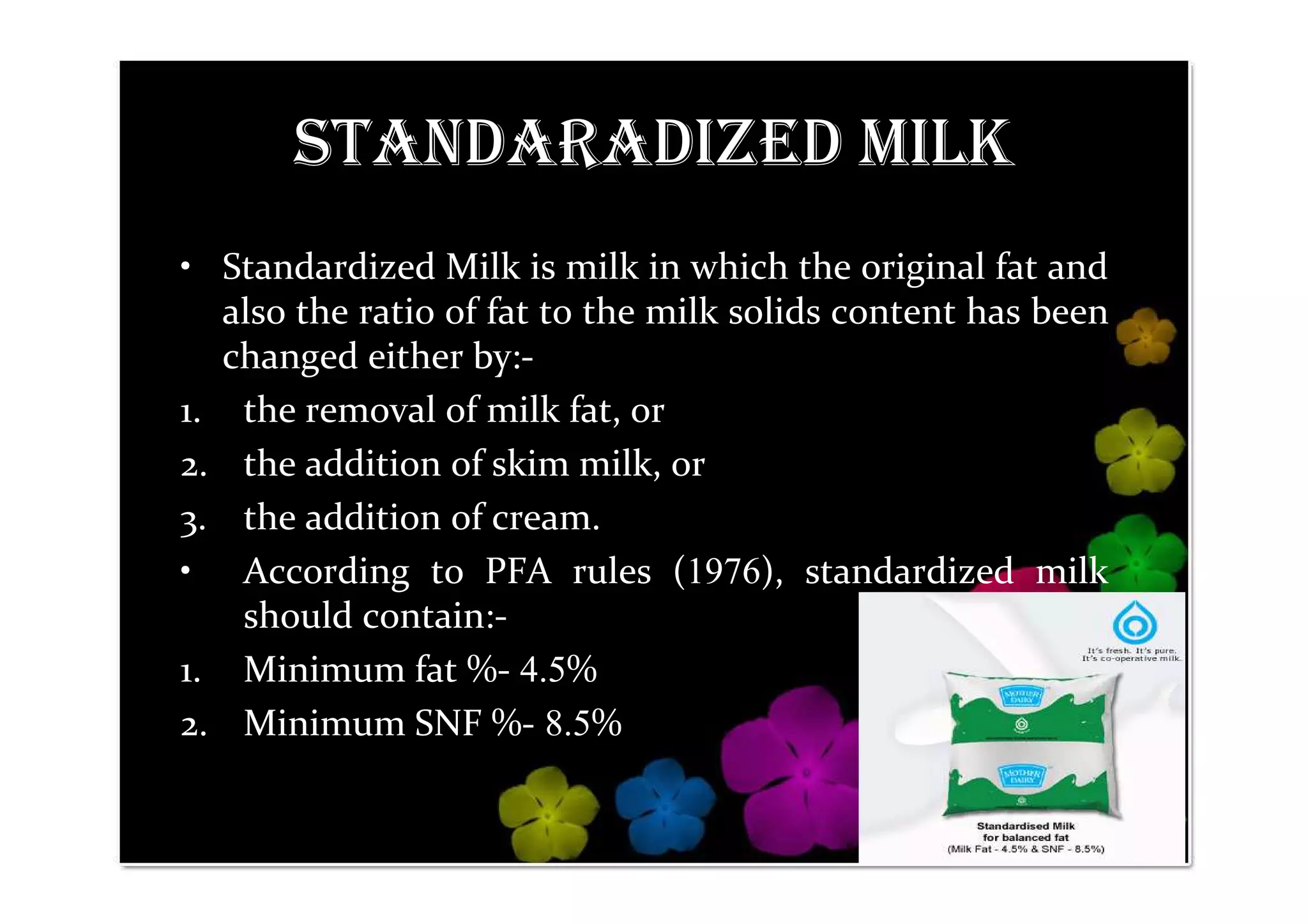
• Standardized Milk is milk in which the original fat and
  also the ratio of fat to the milk solids content has been
  changed either by:-
1. the removal of milk fat, or
2. the addition of skim milk, or
3. the addition of cream.
• According to PFA rules (1976), standardized milk
   should contain:-
1. Minimum fat %- 4.5%
2. Minimum SNF %- 8.5%
CALCULATION REGARDING
   STANDARDIZATION OF MILK
• The Pearson’s square is used to calculate the relative
  quantities of materials required for standardization.
• The Pearson’s square method can be understood by
  following example:-
  Given that the fat percentage of cream is 28% and milk
  is 3%. How many kg of cream and milk will be
  required to make 500 kg of milk testing 4% fat?
  sol.          28.0              1.0

                        4.0
                 3.0             24.0
                                 25.0
=>1.0:25.0 = C:500,
where C is cream required in kgs
or 1/25 = C/500
or C= 500/25
⇒ C= 20 kgs
⇒ milk required= 500-20
                 = 480 kgs
HOMOGENIZED MILK
• Homogenized Milk is milk which has been treated in
  such a manner as to insure breakup of the fat globules
  to such an extent that after 48 hours quiescent storage
  no visible cream separation occurs on the milk.
• Homogenization refers to the process of forcing the
  milk through a homogenizer with the object of sub-
  dividing the fat globules.
• In efficiently homogenized milk, the fat globules are
  subdivided to 2 microns or less in diameter.
FLOWSHEET FOR HOMOGENIZED MILK
       MANUFACTURING

           Receiving milk

   Cooling to 5°C and bulk storage

        Pre-heating(35-40°C)

       Filtration/Clarification

           Cooling to 5°C

   Standardizing and storage(5°C)

         Pre-heating(60°C)
Homogenization

 Single stage homogenization                      Two stage homogenization
(2500psi at 60°C for milk with fat             (2000 psi at first stage & 500psi at
           upto 6%)                          the second stage for milk with more
                                                       than 6% fat)


                      Pasteurization(holder or HTST)

                                 Cooling(5°C)

                                       Bottling

                                     Storage(5°C)
STERILIZED MILK
• Sterilized Milk may be defined as milk which
  has been heated to a temperature of 100°C or
  above for such lengths of time that it remains
  fit for the human consumption.
• The above definition does not always mean
  that treated milk must be completely free of
  bacterial spores.
FLOW SHEET FOR STERILIZED MILK MANUFACTURING

A. IN-BOTTLE STERILIZATION:-
   IN-
                    Receiving milk

             Cooling to 5°C & bulk storage

                 Pre-heating(35-40°C)

                Filtration/Clarification

                    Cooling to 5°C

             Standardizing & Storage(5°C)

                  Pre-heating(60°C)
Homogenization (2500 psi) (60°C)

         Clarification (60°C)

           Filling & capping
   (in cleaned & sterilized bottles)

Sterilization(110°-120°C/25-30 minutes)

   Cooling ( at room temperature)

    Storage (at room temperature)
B. ULTRA HIGH TEMPERATURE STERILIZATION:-


                   Receiving milk

            Cooling to 5°C & bulk storage

                Pre-heating(35-40°C)

               Filtration/Clarification

                   Cooling to 5°C

            Standardizing & Storage(5°C)

                 Pre-heating(60°C)
Homogenization (2500 psi) (60°C)

         Clarification (60°C)

Sterilization (130°-150°C/1-20 seconds)

            Rapid cooling

         Aseptic packaging

   Storage (at room temperature)
TYPES OF STERILIZERS
A. For in-bottle sterilization:-
   The sterilizers used            for   in-bottle
   sterilization are:-
   Batch sterilizers
   Continuous sterilizers
B. For UHT sterilization:-
  Two types of sterilizes are used for ultra high
  temperature sterilization of milk. These are:-
  Sterilizers operating with direct steam heating.
  Sterilizers operating with indirect steam
  heating.
FLAVOURED MILK
• Flavoured Milk is a milk to which some flavours
  have been added.
• When the term ‘milk’ is used, the product should
  contain a milk fat %age at least equal to the
  minimum legal requirements for market milk.
• When the fat %age is lower i.e. 1-2%, the term
  ‘drink’ is used
TYPES OF FLAVOURED MILK
• Chocolate milks/drinks:- The ingredients used
  for chocolate milk/drink are:
  Cocoa powder- 1.0-1.5%
  Sugar- 5.0-7.0 %
  Sodium alginate(stabilizer)- 0.2%
• Fruit flavoured milks/drinks:-
  Permitted fruit flavours/essences, together
  with permitted matching colours and sugars
  are used.
  The common flavours used are strawberry,
  mango, vanilla, banana etc.
FLOWSHEET FOR FLAVORED MILK/DRINKS
                       Receiving milk

                        Standardizing

      Pre-heating(60°C)
Homogenization 2500psi                       Pre-heating(35-40°C)

                           Filtration

               Mixing cocoa, sugar & stabilizer
                             OR
            Mixing flavour/essence, colour & sugar

             Pasteurization (71°C for 30 minutes)

                          Cooling (5°C)

                   Bottling & storage(5°C)
TONED MILK
• Toned Milk refers to milk obtained by the addition of
  water and skim milk powder to whole milk.
• In practice, whole buffalo milk is admixed with
  reconstituted spray dried skim milk powder for the
  production of toned milk.
• Under PFA rules(1976), toned milk should contain a
  minimum of
  3.0% fat &
  8.5% solids-not-fat throughout India
FLOWSHEET FOR TONED MILK MANUFACTURING

         Receiving of water in pasteurizing vat

                 Pre-heating(38-43°C)

            Addition of skim milk powder

                        Mixing

            Addition of whole buffalo milk

                        Mixing

                       Filtration

           Pasteurization(63°C/30 minutes)

                     Cooling(5°C)

               Packaging & Storage(5°C)
DOUBLE TONED MILK
• Double Toned Milk is milk which is also
  obtained by the addition of water and skim
  milk powder to whole milk.
• Under the PFA rules(1976), Double Toned
  Milk should contain a minimum of
  1.5% fat
  9.0% solid-not-fat throughout India.
De, S.: Outlines Of Dairy Technology, Oxford University
Press, 13th edition, pp- 90-116.
Eckles, C.H., Combs, W.B., & Macy, H.: Milk And Milk
Products, Tata McGraw Hill Publishing Company Ltd,
4th edition, pp-196-199.
Johnson, W. & ,Fundamentals Of Dairy Chemistry, CBS
Publishers, 2nd edition, pp- 224-228.
http://www.fao.org/docrep/w2840e/w2840e0b.htm
http://www.fao.org/docrep/w2840e/w2840e3.htm
http://www.microbiologyprocedure.com/microbiology-in-
dairy/Sterilization-of-milk.htm
http://foodscience.uoguelph.ca/dairyedu/uht.html
http://www.erg.msu.edu/~steffe/handbook/sterile.html
http://www.whqlibdoc.who.int/monograph/WHO_MON
O_48_(p269).pdf
http://www.mohfw.nic.in/MethodsofAnalysis-
MilkandMilkProducts-final-nov05.pdf
http://www.puntofocal.gov.ar/doc/nchn/27/pdf
http://www.ajph.aphapublications.org/cgi/reprint/11/2/14
9.pdf
http://www.oxfordjournals.org/content/41/6/643.fullpdf
http://www.foodscience.uoguelph.ca/dairyedu/homogeniz
ation.html
Special types of milk

Special types of milk

  • 2.
    INTRODUCTION • Milk isdefined as the whole, fresh, clean, lacteal secretion obtained by the complete milking of one or more milch animals. • In India, the term ‘milk’ refers to cow or buffalo milk, or a combination of the two. • India is the largest producer of milk and as per National Dairy Development Board (NDDB)’s estimation, the country produced 102 million MT of milk in 2007-08 with annual worth of Rs. 1,232 billions.
  • 3.
    SPECIAL TYPES OFMILK • Under the category of special milk are included those processed milk products which physically resemble and behave like liquid milk. • These processed milk products are:- Standardized milk Homogenized milk Sterilized milk Flavored milk Toned milk & Double toned milk.
  • 4.
    STANDARADIZED MILK • StandardizedMilk is milk in which the original fat and also the ratio of fat to the milk solids content has been changed either by:- 1. the removal of milk fat, or 2. the addition of skim milk, or 3. the addition of cream. • According to PFA rules (1976), standardized milk should contain:- 1. Minimum fat %- 4.5% 2. Minimum SNF %- 8.5%
  • 5.
    CALCULATION REGARDING STANDARDIZATION OF MILK • The Pearson’s square is used to calculate the relative quantities of materials required for standardization. • The Pearson’s square method can be understood by following example:- Given that the fat percentage of cream is 28% and milk is 3%. How many kg of cream and milk will be required to make 500 kg of milk testing 4% fat? sol. 28.0 1.0 4.0 3.0 24.0 25.0
  • 6.
    =>1.0:25.0 = C:500, whereC is cream required in kgs or 1/25 = C/500 or C= 500/25 ⇒ C= 20 kgs ⇒ milk required= 500-20 = 480 kgs
  • 8.
    HOMOGENIZED MILK • HomogenizedMilk is milk which has been treated in such a manner as to insure breakup of the fat globules to such an extent that after 48 hours quiescent storage no visible cream separation occurs on the milk. • Homogenization refers to the process of forcing the milk through a homogenizer with the object of sub- dividing the fat globules. • In efficiently homogenized milk, the fat globules are subdivided to 2 microns or less in diameter.
  • 11.
    FLOWSHEET FOR HOMOGENIZEDMILK MANUFACTURING Receiving milk Cooling to 5°C and bulk storage Pre-heating(35-40°C) Filtration/Clarification Cooling to 5°C Standardizing and storage(5°C) Pre-heating(60°C)
  • 12.
    Homogenization Single stagehomogenization Two stage homogenization (2500psi at 60°C for milk with fat (2000 psi at first stage & 500psi at upto 6%) the second stage for milk with more than 6% fat) Pasteurization(holder or HTST) Cooling(5°C) Bottling Storage(5°C)
  • 13.
    STERILIZED MILK • SterilizedMilk may be defined as milk which has been heated to a temperature of 100°C or above for such lengths of time that it remains fit for the human consumption. • The above definition does not always mean that treated milk must be completely free of bacterial spores.
  • 14.
    FLOW SHEET FORSTERILIZED MILK MANUFACTURING A. IN-BOTTLE STERILIZATION:- IN- Receiving milk Cooling to 5°C & bulk storage Pre-heating(35-40°C) Filtration/Clarification Cooling to 5°C Standardizing & Storage(5°C) Pre-heating(60°C)
  • 15.
    Homogenization (2500 psi)(60°C) Clarification (60°C) Filling & capping (in cleaned & sterilized bottles) Sterilization(110°-120°C/25-30 minutes) Cooling ( at room temperature) Storage (at room temperature)
  • 16.
    B. ULTRA HIGHTEMPERATURE STERILIZATION:- Receiving milk Cooling to 5°C & bulk storage Pre-heating(35-40°C) Filtration/Clarification Cooling to 5°C Standardizing & Storage(5°C) Pre-heating(60°C)
  • 17.
    Homogenization (2500 psi)(60°C) Clarification (60°C) Sterilization (130°-150°C/1-20 seconds) Rapid cooling Aseptic packaging Storage (at room temperature)
  • 18.
    TYPES OF STERILIZERS A.For in-bottle sterilization:- The sterilizers used for in-bottle sterilization are:- Batch sterilizers Continuous sterilizers
  • 19.
    B. For UHTsterilization:- Two types of sterilizes are used for ultra high temperature sterilization of milk. These are:- Sterilizers operating with direct steam heating. Sterilizers operating with indirect steam heating.
  • 22.
    FLAVOURED MILK • FlavouredMilk is a milk to which some flavours have been added. • When the term ‘milk’ is used, the product should contain a milk fat %age at least equal to the minimum legal requirements for market milk. • When the fat %age is lower i.e. 1-2%, the term ‘drink’ is used
  • 23.
    TYPES OF FLAVOUREDMILK • Chocolate milks/drinks:- The ingredients used for chocolate milk/drink are: Cocoa powder- 1.0-1.5% Sugar- 5.0-7.0 % Sodium alginate(stabilizer)- 0.2%
  • 24.
    • Fruit flavouredmilks/drinks:- Permitted fruit flavours/essences, together with permitted matching colours and sugars are used. The common flavours used are strawberry, mango, vanilla, banana etc.
  • 25.
    FLOWSHEET FOR FLAVOREDMILK/DRINKS Receiving milk Standardizing Pre-heating(60°C) Homogenization 2500psi Pre-heating(35-40°C) Filtration Mixing cocoa, sugar & stabilizer OR Mixing flavour/essence, colour & sugar Pasteurization (71°C for 30 minutes) Cooling (5°C) Bottling & storage(5°C)
  • 26.
    TONED MILK • TonedMilk refers to milk obtained by the addition of water and skim milk powder to whole milk. • In practice, whole buffalo milk is admixed with reconstituted spray dried skim milk powder for the production of toned milk. • Under PFA rules(1976), toned milk should contain a minimum of 3.0% fat & 8.5% solids-not-fat throughout India
  • 27.
    FLOWSHEET FOR TONEDMILK MANUFACTURING Receiving of water in pasteurizing vat Pre-heating(38-43°C) Addition of skim milk powder Mixing Addition of whole buffalo milk Mixing Filtration Pasteurization(63°C/30 minutes) Cooling(5°C) Packaging & Storage(5°C)
  • 28.
    DOUBLE TONED MILK •Double Toned Milk is milk which is also obtained by the addition of water and skim milk powder to whole milk. • Under the PFA rules(1976), Double Toned Milk should contain a minimum of 1.5% fat 9.0% solid-not-fat throughout India.
  • 29.
    De, S.: OutlinesOf Dairy Technology, Oxford University Press, 13th edition, pp- 90-116. Eckles, C.H., Combs, W.B., & Macy, H.: Milk And Milk Products, Tata McGraw Hill Publishing Company Ltd, 4th edition, pp-196-199. Johnson, W. & ,Fundamentals Of Dairy Chemistry, CBS Publishers, 2nd edition, pp- 224-228. http://www.fao.org/docrep/w2840e/w2840e0b.htm http://www.fao.org/docrep/w2840e/w2840e3.htm http://www.microbiologyprocedure.com/microbiology-in- dairy/Sterilization-of-milk.htm http://foodscience.uoguelph.ca/dairyedu/uht.html
  • 30.