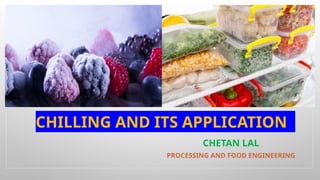
CHILLING AND ITS APPLICATION
CHETAN LAL
PROCESSING AND FOOD ENGINEERING
PRESERVATION BY LOW TEMPERATURE
The use of low temperature to preserve foods is based upon that
facts that the activities of food borne microorganisms and enzyme
reactions can be slow down or stopped at temperature above
freezing temperature and generally stopped at subfreezing
temperatures.
Low temperature can be produced by:
1. Refrigeration or chilling.
CHILLING
Preservation of food at temperature above
freezing and below 15 °C is known as
refrigeration or chilling.
Chilling is a short term process of
preservation.
It is used to reduce the rate of biochemical
and microbiological changes and hence to
extend shelf life of fresh processed foods.
It causes minimal changes to sensory
characteristics and nutritional properties of
foods.
CHILLING RETARDS
 Growth of microorganisms.
 Chilling retards spoilage and prevent food poisoning
by slowing the growth of microbes during storage.
 Postharvest and post slaughter metabolic activities of
plant and animal tissues respectively.
 Deteriorative chemical reaction, including enzyme
catalysed oxidative browning or oxidation of lipids
and chemical changes associated with colour
degradation, autolysis of fish and loss of nutritive
value of foods.
CATEGORIES OF CHILLED FOOD
According to storage temperature range :
• -1 °C to 1 °C (fresh fish, meats, sausages, smoked
meat and ground meat).
• 0 °C to 5 °C (pasteurization milk, canned meat,
cream, yoghurt, salad, sandwiches, baked, foods,
soups and sauces).
• 0 °C to 8 °C (soft fruit and fruit juices, cooked rice
hard cheese and butter).
CHILLING EQUIPMENT
1. MECHANICAL REFRIGERATORS.
2. CRYOGENIC SYSTEMS.
1. MECHANICAL REFRIGERATORS
 A mechanical refrigerator, also known as a household refrigerator, is
a common appliance used to preserve food and beverages at low
temperatures.
 Mechanical refrigerators have four basis elements: an evaporator, a
compressor, a condenser and an expansion valve.
 A refrigerant circulates between the four element of the refrigerator,
changing state from liquid to gas and back to liquid.
MECHANICAL REFRIGERATORS: COMPONENT
 COMPRESSOR: This is the heart of the refrigerator. It compresses the
refrigerant gas, increasing its pressure and temperature.
 CONDENSER: The compressed refrigerant gas flows through the condenser,
where it releases heat to the surrounding environment. This heat is typically
expelled to the back or bottom of the refrigerator.
 EXPANSION VALVE: The refrigerant gas, now a liquid, passes through the
expansion valve, where it expands rapidly and cools down significantly.
 EVAPORATOR: The cold refrigerant gas flows through the evaporator coils,
which are located inside the refrigerator. As the refrigerant gas absorbs heat
from the inside of the refrigerator, it evaporates back into a gas.
 REFRIGERANT: This is a special fluid that circulates through the
MECHANICAL REFRIGERATORS: WORKS
 COMPRESSION: The compressor compresses the refrigerant gas, increasing
its pressure and temperature.
 CONDENSATION: The compressed refrigerant gas flows through the
condenser, where it releases heat to the surrounding environment.
 EXPANSION: The refrigerant gas, now a liquid, passes through the
expansion valve, where it expands rapidly and cools down significantly.
 EVAPORATION: The cold refrigerant gas flows through the evaporator coils,
which are located inside the refrigerator. As the refrigerant gas absorbs heat
from the inside of the refrigerator, it evaporates back into a gas.
 REPEAT: The cycle then repeats, with the compressor compressing the
2. CRYOGENIC SYSTEMS.
 A cryogenic system refrigerator, also known as a cryofreezes or
cryogenic freezer, is a specialized refrigeration unit capable of
maintaining extremely low temperatures, typically below -150°C (-
238°F).
 Cryogenic chillers use solid carbon dioxide, liquid carbon dioxide and
liquid and liquid nitrogen.
 Solid carbon dioxide remove latent heat of sublimation and liquid
cryogens remove latent heat of vaporisation
VARIOUS APPLICATIONS, INCLUDING:
• Food preservation, industrial application, medical and biological
EFFECT ON FOOD
 The most significant effect of chilling on the sensory
characterises of processed foods is hardening due to
solidification of fats and oils.
 Other effect include enzymatic browning, lipolysis, colour
and flavour deterioration and retro gradation of starch to
cause staling of bread, protein denaturation, vitamin
degradation.
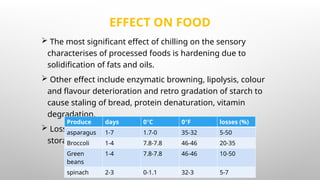
 Losses of vitamin C in selected vegetables during cold
storage.
Produce days 0°C 0°F losses (%)
asparagus 1-7 1.7-0 35-32 5-50
Broccoli 1-4 7.8-7.8 46-46 20-35
Green
beans
1-4 7.8-7.8 46-46 10-50
spinach 2-3 0-1.1 32-3 5-7
DESIRABLE CONSEQUENCES OF
CHILLING TEMPERATURE
 Growth of mesophilic and thermophilic microbes is greatly
retarded at chilling temperature. Psychotropic microorganism, of
course, grow well in the range of 0 °C to 15 °C but is much slower
in this range.
 Rate of respiration and ripping usually declines as the
temperature is reduced below 4 °C in this case of climacteric
fruits.
EFFECT OF TEMPERATURE ON
RATES OF RESPIRATION IN FRUITS
AND VEGETABLES
Commo
dity
0 °C 4.5 °C 15.5 °C
Apples 300-1500 600-2700 2300-7900
Peas (green) 8200-8400 1300-16000 39300-44500
Strawberries 2700-3800 3600-6800 15600-20300
British thermal unit (Btu) per ton 24
hr at:
1Btu = 1055.06
Joule
UNDESIRABLE CONSEQUENCES OF CHILLING
TEMPERATURES
 COLD SHORTENING
• Animal muscle which is exposed immediately after slaughter
can undergo a detrimental occurrence known as cold
shorting if it is promptly cooled to a temperature range of 0
°C to 5 °C.
 CHILLING INJURY
• A substantial number of fruit and vegetables especially those
of tropical or subtropical origin, develop a physiological
disorders when exposed to temperature but above freezing
temperature.
SUPER CHILLING
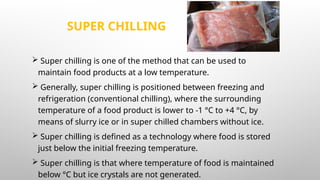
 Super chilling is one of the method that can be used to
maintain food products at a low temperature.
 Generally, super chilling is positioned between freezing and
refrigeration (conventional chilling), where the surrounding
temperature of a food product is lower to -1 °C to +4 °C, by
means of slurry ice or in super chilled chambers without ice.
 Super chilling is defined as a technology where food is stored
just below the initial freezing temperature.
 Super chilling is that where temperature of food is maintained
below °C but ice crystals are not generated.
DEFINITION OF SUPER CHILLING
 Super chilling is that where temperature of food is maintained below
0 °C but ice crystals are not generated. (ando et al. 2004)
 Super chilling is definition as a technology where food is stored just
below the initial freezing temperature. (beaufort et al. 2009)
PROCESSING STEPS FOR SUPER
CHILLING OF FISH/SEAFOOD
SHELF LIFE ASPECTS IN
RELATIONSHIP TO SUPER
CHILLING TECHNOLOGY
 SUPER CHILLING OF FISH: with the reduction of temperature from -1
°C to -3 °C, the shelf-life increased from 21 to 35 days.
 SUPER CHILLED SALMON: shelf-life double at storage temperature of -
4 °C to -3.6 °C compared to ice chilled storage with respect to microbial and
chemical analysis.
 SUPER CHILLED PORK ROASTS: shelf life of at least 16 weeks
compared to 2 weeks for the chilled products .
QUALITY ASPECTS IN RELATION TO SUPER
CHILLING TECHNOLOGY
 Storage of cold-smoke salmon at -2 °C for 1 days did not have any
serious consequences on the quality compared to control (absence of
super chilling).
 During super chilled storage of Kurume prawn, the brightness of tail
colour could be retained compared to traditional refrigeration.
 Drip loss was found to be lower in super chilled samples than in
chilled sample both in cod and salon fillets as well as in pork roasts.
Chilling Techniques in Food Processing .pptx

Chilling Techniques in Food Processing .pptx

  • 1.
    CHILLING AND ITSAPPLICATION CHETAN LAL PROCESSING AND FOOD ENGINEERING
  • 2.
    PRESERVATION BY LOWTEMPERATURE The use of low temperature to preserve foods is based upon that facts that the activities of food borne microorganisms and enzyme reactions can be slow down or stopped at temperature above freezing temperature and generally stopped at subfreezing temperatures. Low temperature can be produced by: 1. Refrigeration or chilling.
  • 3.
    CHILLING Preservation of foodat temperature above freezing and below 15 °C is known as refrigeration or chilling. Chilling is a short term process of preservation. It is used to reduce the rate of biochemical and microbiological changes and hence to extend shelf life of fresh processed foods. It causes minimal changes to sensory characteristics and nutritional properties of foods.
  • 4.
    CHILLING RETARDS  Growthof microorganisms.  Chilling retards spoilage and prevent food poisoning by slowing the growth of microbes during storage.  Postharvest and post slaughter metabolic activities of plant and animal tissues respectively.  Deteriorative chemical reaction, including enzyme catalysed oxidative browning or oxidation of lipids and chemical changes associated with colour degradation, autolysis of fish and loss of nutritive value of foods.
  • 5.
    CATEGORIES OF CHILLEDFOOD According to storage temperature range : • -1 °C to 1 °C (fresh fish, meats, sausages, smoked meat and ground meat). • 0 °C to 5 °C (pasteurization milk, canned meat, cream, yoghurt, salad, sandwiches, baked, foods, soups and sauces). • 0 °C to 8 °C (soft fruit and fruit juices, cooked rice hard cheese and butter).
  • 6.
    CHILLING EQUIPMENT 1. MECHANICALREFRIGERATORS. 2. CRYOGENIC SYSTEMS.
  • 7.
    1. MECHANICAL REFRIGERATORS A mechanical refrigerator, also known as a household refrigerator, is a common appliance used to preserve food and beverages at low temperatures.  Mechanical refrigerators have four basis elements: an evaporator, a compressor, a condenser and an expansion valve.  A refrigerant circulates between the four element of the refrigerator, changing state from liquid to gas and back to liquid.
  • 8.
    MECHANICAL REFRIGERATORS: COMPONENT COMPRESSOR: This is the heart of the refrigerator. It compresses the refrigerant gas, increasing its pressure and temperature.  CONDENSER: The compressed refrigerant gas flows through the condenser, where it releases heat to the surrounding environment. This heat is typically expelled to the back or bottom of the refrigerator.  EXPANSION VALVE: The refrigerant gas, now a liquid, passes through the expansion valve, where it expands rapidly and cools down significantly.  EVAPORATOR: The cold refrigerant gas flows through the evaporator coils, which are located inside the refrigerator. As the refrigerant gas absorbs heat from the inside of the refrigerator, it evaporates back into a gas.  REFRIGERANT: This is a special fluid that circulates through the
  • 9.
    MECHANICAL REFRIGERATORS: WORKS COMPRESSION: The compressor compresses the refrigerant gas, increasing its pressure and temperature.  CONDENSATION: The compressed refrigerant gas flows through the condenser, where it releases heat to the surrounding environment.  EXPANSION: The refrigerant gas, now a liquid, passes through the expansion valve, where it expands rapidly and cools down significantly.  EVAPORATION: The cold refrigerant gas flows through the evaporator coils, which are located inside the refrigerator. As the refrigerant gas absorbs heat from the inside of the refrigerator, it evaporates back into a gas.  REPEAT: The cycle then repeats, with the compressor compressing the
  • 10.
    2. CRYOGENIC SYSTEMS. A cryogenic system refrigerator, also known as a cryofreezes or cryogenic freezer, is a specialized refrigeration unit capable of maintaining extremely low temperatures, typically below -150°C (- 238°F).  Cryogenic chillers use solid carbon dioxide, liquid carbon dioxide and liquid and liquid nitrogen.  Solid carbon dioxide remove latent heat of sublimation and liquid cryogens remove latent heat of vaporisation VARIOUS APPLICATIONS, INCLUDING: • Food preservation, industrial application, medical and biological
  • 11.
    EFFECT ON FOOD The most significant effect of chilling on the sensory characterises of processed foods is hardening due to solidification of fats and oils.  Other effect include enzymatic browning, lipolysis, colour and flavour deterioration and retro gradation of starch to cause staling of bread, protein denaturation, vitamin degradation.  Losses of vitamin C in selected vegetables during cold storage. Produce days 0°C 0°F losses (%) asparagus 1-7 1.7-0 35-32 5-50 Broccoli 1-4 7.8-7.8 46-46 20-35 Green beans 1-4 7.8-7.8 46-46 10-50 spinach 2-3 0-1.1 32-3 5-7
  • 12.
    DESIRABLE CONSEQUENCES OF CHILLINGTEMPERATURE  Growth of mesophilic and thermophilic microbes is greatly retarded at chilling temperature. Psychotropic microorganism, of course, grow well in the range of 0 °C to 15 °C but is much slower in this range.  Rate of respiration and ripping usually declines as the temperature is reduced below 4 °C in this case of climacteric fruits.
  • 13.
    EFFECT OF TEMPERATUREON RATES OF RESPIRATION IN FRUITS AND VEGETABLES Commo dity 0 °C 4.5 °C 15.5 °C Apples 300-1500 600-2700 2300-7900 Peas (green) 8200-8400 1300-16000 39300-44500 Strawberries 2700-3800 3600-6800 15600-20300 British thermal unit (Btu) per ton 24 hr at: 1Btu = 1055.06 Joule
  • 14.
    UNDESIRABLE CONSEQUENCES OFCHILLING TEMPERATURES  COLD SHORTENING • Animal muscle which is exposed immediately after slaughter can undergo a detrimental occurrence known as cold shorting if it is promptly cooled to a temperature range of 0 °C to 5 °C.  CHILLING INJURY • A substantial number of fruit and vegetables especially those of tropical or subtropical origin, develop a physiological disorders when exposed to temperature but above freezing temperature.
  • 15.
    SUPER CHILLING  Superchilling is one of the method that can be used to maintain food products at a low temperature.  Generally, super chilling is positioned between freezing and refrigeration (conventional chilling), where the surrounding temperature of a food product is lower to -1 °C to +4 °C, by means of slurry ice or in super chilled chambers without ice.  Super chilling is defined as a technology where food is stored just below the initial freezing temperature.  Super chilling is that where temperature of food is maintained below °C but ice crystals are not generated.
  • 16.
    DEFINITION OF SUPERCHILLING  Super chilling is that where temperature of food is maintained below 0 °C but ice crystals are not generated. (ando et al. 2004)  Super chilling is definition as a technology where food is stored just below the initial freezing temperature. (beaufort et al. 2009)
  • 17.
    PROCESSING STEPS FORSUPER CHILLING OF FISH/SEAFOOD
  • 18.
    SHELF LIFE ASPECTSIN RELATIONSHIP TO SUPER CHILLING TECHNOLOGY  SUPER CHILLING OF FISH: with the reduction of temperature from -1 °C to -3 °C, the shelf-life increased from 21 to 35 days.  SUPER CHILLED SALMON: shelf-life double at storage temperature of - 4 °C to -3.6 °C compared to ice chilled storage with respect to microbial and chemical analysis.  SUPER CHILLED PORK ROASTS: shelf life of at least 16 weeks compared to 2 weeks for the chilled products .
  • 19.
    QUALITY ASPECTS INRELATION TO SUPER CHILLING TECHNOLOGY  Storage of cold-smoke salmon at -2 °C for 1 days did not have any serious consequences on the quality compared to control (absence of super chilling).  During super chilled storage of Kurume prawn, the brightness of tail colour could be retained compared to traditional refrigeration.  Drip loss was found to be lower in super chilled samples than in chilled sample both in cod and salon fillets as well as in pork roasts.