Ice cream
freezers
Geetika K. Gopi
Ice cream freezing
 Freezing is one of the most important
operations in the making of ice cream for upon it
depends the quality, palatability and yield of the
finished product.
 Ice cream contains a considerable quantity of
air, up to half of its volume. This gives the
product its characteristic lightness. Without air,
ice cream would be similar to a frozen ice cube.
Freezing process
• The mix with the proper amount of colour and
flavouring materials generally added at the freezer,
is quickly frozen while being agitated to incorporate
air in such away as to produce and control the
formation of small ice crystals which is necessary to
give smoothness in body and texture, palatability
and satisfactory overrun in the finished product.
• When ice cream is partially frozen to a certain
consistency it is drawn from the freezer into
packages and quickly transferred to cold storage
rooms where the freezing and hardening is
completed without agitation.
Functions
a) To freeze a portion of the water of the mix to get
a smooth product
b) To incorporate a predetermined amount of air
uniformly into the mix to get proper overrun
c) To mix fruits and flavoring into the mix while
being frozen
* OVERRUN- the amount of air incorporated into
a frozen product is measured by overrun
Fast freezing is essential for a smooth product,
because ice crystals that are formed quickly are
smaller than those formed slowly. Therefore, it is
desirable to freeze and draw from the freezer in as
short time as possible. The freezing time and
temperature are affected by the type of freezer used.
a) Batch freezer: Horizontal, direct expansion type
b) Continuous freezer: Horizontal, direct expansion type
c) Soft– serve freezer: Batch and automatic continuous
freezers of the direct expansion type
• Ice-cream mix is frozen in single-batch machines or
in continuous freezers.
• both machines utilize a cylindrical chamber with
double wall which acts as a jacket to contain the
refrigerant. On the axis of the cylinder, a rotating
dasher and scraper keep the mix thoroughly
agitated and remove the ice from the refrigerated
wall.
Batch freezers
Batch freezers are used in very small ice cream
factories.
• each batch must be measured, colored and flavored
separately.
• the brine type; the salt and ice type;
• direct – expansion type(using ammonia or Freon as
refrigerant), including vertical, horizontal, and
single-, triple -, and quadruple – type freezers.
• horizontal cylinder type with the freezing cylinder
refrigerated with one of the halo carbon
refrigerants, most often being R-22 or R-502.
Batch freezers
• There is a mix supply tank located above the
freezing cylinder, so that mix will flow by gravity
into the cylinder when a valve is opened.
• The usual procedure is to charge the freezer,
turn on the dasher and start the refrigeration.
• A slide or pivot on the bottom portion of the
front door allows the ice cream to be drawn in to
containers or bulk cans.
Batch freezers
• The dasher is designed to propel the product
toward the discharge port.
• Subsequent batches are put into the mix supply
tank as soon as the previous charge is dropped
into the freezing cylinder.
• Ice cream can be made by every 6-7 min by
experienced operators.
Batch freezers
• Ice cream made with batch freezers has both
larger ice crystals and bigger air cells than ice
cream made with the same mix on continuous
freezers.
• Flavours, fruits, and nuts are added to the batch
in the freezer just before it is drawn
Continuous ice cream freezers
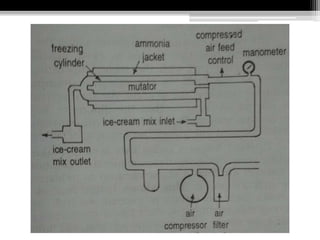
• The process consists of continually feeding a
metered amount of ice cream mix and air into one
end of the freezing chamber.
• As the mixture passes through the freezing
chamber it is agitated and partially frozen and then
discharged in a continuous stream of about the
same consistency usually obtained from a batch
freezer.
Continuous ice cream freezers
• This partially frozen stream is delivered into
packages, which are then placed in the
hardening room to complete the freezing
process.
• One major difference in continuous processing is
that freezing is done under pressure.
Continuous ice cream freezers
• In the continuous freezer, following mix
processing, the mix is drawn into a flavor tank
where any liquid flavors, fruit purees, or colors
are added.
• A mixture of the ice-cream mix and a controlled
volume of air is pumped under pressure into one
or more horizontal jacketed tubes, each provided
with a rotating dasher and scraper.
Continuous ice cream freezers
• The mix is chilled to a temperature of about -
6.1°C and is slowly and continuously forced out
of a vertical discharge tube directly into the final
containers.
• The mix then enters the dynamic freezing
process which both freezes a portion of the water
and whips air into the frozen mix.
• Mix is pumped through this freezer and is drawn
off the other end in a matter of 30 seconds.
Advantages of continuous freezers
• Less use of stabilizer- large amount of ice
crystals formed- less viscosity needed
• Shorter ageing time- less air incorporation
• Less flavor material is needed- smaller ice
crystals melt rapidly- slightly more pronounced
flavor
• Smoother ice cream
• Small lactose crystals- less sandiness
Pumps
Rotary pumps – 7-14 kg/cm2
Two general pumping arrangements
A pump and a hold back valve at the discharge port
Valve – imposing a pressure on the cylinder during
freezing which compress the air incorporated
Another option a mix pump or mix air pump metering
the mix into the chamber and a rotary pump at the
discharge of the cylinder
Drives are of three types
(i) Electric motor powering a mechanical variable
speed;
(ii) Frequency inverters with electronic speed control
for standard electric motors. A gear reducer is
always used between motor and pump;
(iii) Hydraulic pumping systems connected to
hydraulic motors on the pumps. The hydraulic
pumping units may be located within the freezer
housing or remotely outside the production room.
Dashers
• Scrape the frozen film from the cylinder wall, carry it
to the centre and circulate it from one end to other for
rapid and uniform cooling
• To beat the mix and whip air into it
• To eject the frozen mix rapidly
• 170rpm to 250rpm
• Outer frame carrying 2/ more sets of scraper blades
rotate in one direction
• Central part- beater- whipping- longitudinal rods/
paddles that rotate in opposite direction
Adding ingredients and flavors
Flavoring materials are added after the mix has been
made- added at the ageing tank or in flavor tanks
located upstream of the ice cream freezer.
Pieces of fruit should not be added to the mix prior to
freezing in continuous freezer.
Ripple pump
Ingredients like purees, syrups, conserves etc pumped
into the product carrying line by ripple pump.
Air incorporation
Air is incorporated into the ice cream mixture in various
ways, depending on the churning method. Air is added
or whipped into the ice cream during the churning
process, and is almost solely responsibility for the
density and texture. The more air added, the lighter
and less creamy the ice cream will be.
What holds the air in place and makes
the foam stable?
It is the semi-crystalline globules of milk fat that
make the foam stable and hold the air bubbles in
place. The concentrated sweetened cream coats
the ice crystals and sticks them to each other.
When the mix is churning, the semi-crystalline
globules of milk fat connect to each other
forming long strands that hold the air bubbles in
place, making the foam stable.
During churning, milk fat globules
form a chain around air bubbles
making the foam stable
Thank
you

Ice cream freezers

  • 1.
  • 2.
    Ice cream freezing Freezing is one of the most important operations in the making of ice cream for upon it depends the quality, palatability and yield of the finished product.  Ice cream contains a considerable quantity of air, up to half of its volume. This gives the product its characteristic lightness. Without air, ice cream would be similar to a frozen ice cube.
  • 3.
    Freezing process • Themix with the proper amount of colour and flavouring materials generally added at the freezer, is quickly frozen while being agitated to incorporate air in such away as to produce and control the formation of small ice crystals which is necessary to give smoothness in body and texture, palatability and satisfactory overrun in the finished product. • When ice cream is partially frozen to a certain consistency it is drawn from the freezer into packages and quickly transferred to cold storage rooms where the freezing and hardening is completed without agitation.
  • 5.
    Functions a) To freezea portion of the water of the mix to get a smooth product b) To incorporate a predetermined amount of air uniformly into the mix to get proper overrun c) To mix fruits and flavoring into the mix while being frozen * OVERRUN- the amount of air incorporated into a frozen product is measured by overrun
  • 6.
    Fast freezing isessential for a smooth product, because ice crystals that are formed quickly are smaller than those formed slowly. Therefore, it is desirable to freeze and draw from the freezer in as short time as possible. The freezing time and temperature are affected by the type of freezer used.
  • 8.
    a) Batch freezer:Horizontal, direct expansion type b) Continuous freezer: Horizontal, direct expansion type c) Soft– serve freezer: Batch and automatic continuous freezers of the direct expansion type
  • 9.
    • Ice-cream mixis frozen in single-batch machines or in continuous freezers. • both machines utilize a cylindrical chamber with double wall which acts as a jacket to contain the refrigerant. On the axis of the cylinder, a rotating dasher and scraper keep the mix thoroughly agitated and remove the ice from the refrigerated wall.
  • 10.
    Batch freezers Batch freezersare used in very small ice cream factories. • each batch must be measured, colored and flavored separately. • the brine type; the salt and ice type; • direct – expansion type(using ammonia or Freon as refrigerant), including vertical, horizontal, and single-, triple -, and quadruple – type freezers. • horizontal cylinder type with the freezing cylinder refrigerated with one of the halo carbon refrigerants, most often being R-22 or R-502.
  • 11.
    Batch freezers • Thereis a mix supply tank located above the freezing cylinder, so that mix will flow by gravity into the cylinder when a valve is opened. • The usual procedure is to charge the freezer, turn on the dasher and start the refrigeration. • A slide or pivot on the bottom portion of the front door allows the ice cream to be drawn in to containers or bulk cans.
  • 12.
    Batch freezers • Thedasher is designed to propel the product toward the discharge port. • Subsequent batches are put into the mix supply tank as soon as the previous charge is dropped into the freezing cylinder. • Ice cream can be made by every 6-7 min by experienced operators.
  • 14.
    Batch freezers • Icecream made with batch freezers has both larger ice crystals and bigger air cells than ice cream made with the same mix on continuous freezers. • Flavours, fruits, and nuts are added to the batch in the freezer just before it is drawn
  • 16.
    Continuous ice creamfreezers • The process consists of continually feeding a metered amount of ice cream mix and air into one end of the freezing chamber. • As the mixture passes through the freezing chamber it is agitated and partially frozen and then discharged in a continuous stream of about the same consistency usually obtained from a batch freezer.
  • 17.
    Continuous ice creamfreezers • This partially frozen stream is delivered into packages, which are then placed in the hardening room to complete the freezing process. • One major difference in continuous processing is that freezing is done under pressure.
  • 18.
    Continuous ice creamfreezers • In the continuous freezer, following mix processing, the mix is drawn into a flavor tank where any liquid flavors, fruit purees, or colors are added. • A mixture of the ice-cream mix and a controlled volume of air is pumped under pressure into one or more horizontal jacketed tubes, each provided with a rotating dasher and scraper.
  • 19.
    Continuous ice creamfreezers • The mix is chilled to a temperature of about - 6.1°C and is slowly and continuously forced out of a vertical discharge tube directly into the final containers. • The mix then enters the dynamic freezing process which both freezes a portion of the water and whips air into the frozen mix. • Mix is pumped through this freezer and is drawn off the other end in a matter of 30 seconds.
  • 21.
    Advantages of continuousfreezers • Less use of stabilizer- large amount of ice crystals formed- less viscosity needed • Shorter ageing time- less air incorporation • Less flavor material is needed- smaller ice crystals melt rapidly- slightly more pronounced flavor • Smoother ice cream • Small lactose crystals- less sandiness
  • 23.
    Pumps Rotary pumps –7-14 kg/cm2 Two general pumping arrangements A pump and a hold back valve at the discharge port Valve – imposing a pressure on the cylinder during freezing which compress the air incorporated Another option a mix pump or mix air pump metering the mix into the chamber and a rotary pump at the discharge of the cylinder
  • 24.
    Drives are ofthree types (i) Electric motor powering a mechanical variable speed; (ii) Frequency inverters with electronic speed control for standard electric motors. A gear reducer is always used between motor and pump; (iii) Hydraulic pumping systems connected to hydraulic motors on the pumps. The hydraulic pumping units may be located within the freezer housing or remotely outside the production room.
  • 25.
    Dashers • Scrape thefrozen film from the cylinder wall, carry it to the centre and circulate it from one end to other for rapid and uniform cooling • To beat the mix and whip air into it • To eject the frozen mix rapidly • 170rpm to 250rpm • Outer frame carrying 2/ more sets of scraper blades rotate in one direction • Central part- beater- whipping- longitudinal rods/ paddles that rotate in opposite direction
  • 27.
    Adding ingredients andflavors Flavoring materials are added after the mix has been made- added at the ageing tank or in flavor tanks located upstream of the ice cream freezer. Pieces of fruit should not be added to the mix prior to freezing in continuous freezer. Ripple pump Ingredients like purees, syrups, conserves etc pumped into the product carrying line by ripple pump.
  • 28.
    Air incorporation Air isincorporated into the ice cream mixture in various ways, depending on the churning method. Air is added or whipped into the ice cream during the churning process, and is almost solely responsibility for the density and texture. The more air added, the lighter and less creamy the ice cream will be.
  • 29.
    What holds theair in place and makes the foam stable? It is the semi-crystalline globules of milk fat that make the foam stable and hold the air bubbles in place. The concentrated sweetened cream coats the ice crystals and sticks them to each other. When the mix is churning, the semi-crystalline globules of milk fat connect to each other forming long strands that hold the air bubbles in place, making the foam stable.
  • 30.
    During churning, milkfat globules form a chain around air bubbles making the foam stable
  • 31.