FACTOR LABEL METHOD & CONVERSION
             FACTORS
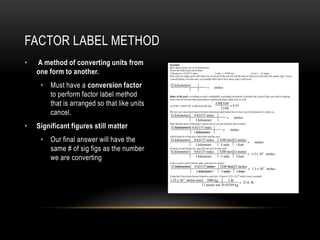
FACTOR LABEL METHOD
•   A method of converting units from
    one form to another.
     • Must have a conversion factor
       to perform factor label method
       that is arranged so that like units
       cancel.
•   Significant figures still matter
     • Our final answer will have the
       same # of sig figs as the number
       we are converting
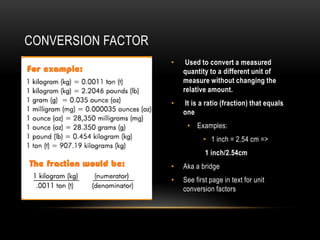
CONVERSION FACTOR
                    •    Used to convert a measured
                        quantity to a different unit of
                        measure without changing the
                        relative amount.
                    •   It is a ratio (fraction) that equals
                        one
                         • Examples:
                               • 1 inch = 2.54 cm =>
                                1 inch/2.54cm
                    •   Aka a bridge
                    •   See first page in text for unit
                        conversion factors
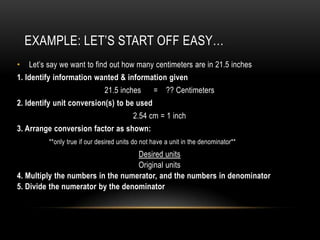
EXAMPLE: LET’S START OFF EASY…
•   Let’s say we want to find out how many centimeters are in 21.5 inches
1. Identify information wanted & information given
                               21.5 inches        = ?? Centimeters
2. Identify unit conversion(s) to be used
                                          2.54 cm = 1 inch
3. Arrange conversion factor as shown:
          **only true if our desired units do not have a unit in the denominator**
                                   Desired units
                                   Original units
4. Multiply the numbers in the numerator, and the numbers in denominator
5. Divide the numerator by the denominator
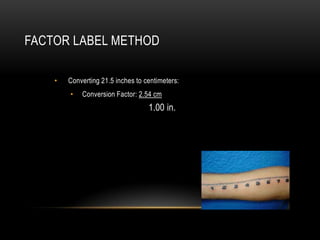
FACTOR LABEL METHOD

    •   Converting 21.5 inches to centimeters:
        •   Conversion Factor: 2.54 cm
                                   1.00 in.
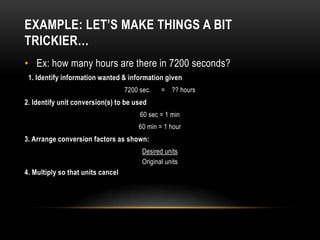
EXAMPLE: LET’S MAKE THINGS A BIT
TRICKIER…
• Ex: how many hours are there in 7200 seconds?
 1. Identify information wanted & information given
                                   7200 sec.    = ?? hours
2. Identify unit conversion(s) to be used
                                        60 sec = 1 min
                                       60 min = 1 hour
3. Arrange conversion factors as shown:
                                         Desired units
                                         Original units
4. Multiply so that units cancel
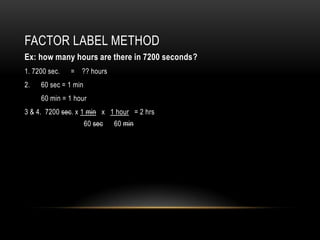
FACTOR LABEL METHOD
Ex: how many hours are there in 7200 seconds?
1. 7200 sec.   = ?? hours
2.   60 sec = 1 min
     60 min = 1 hour
3 & 4. 7200 sec. x 1 min x 1 hour = 2 hrs
                      60 sec   60 min
EXAMPLE: YOUR TURN!

Try this one: How many inches are in 1.00 miles?
1.   Identify information wanted & information given
2.   Identify unit conversion(s) to be used


1.   Arrange conversion factor as shown:
                                      Desired units
                                      Original units
4. Multiply so that units cancel
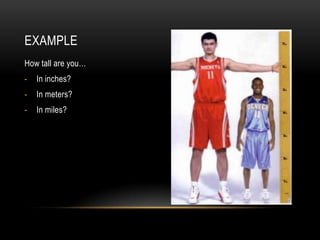
EXAMPLE
How tall are you…
-   In inches?
-   In meters?
-   In miles?
EXAMPLE: CONVERTING RATES
•   What is 65 miles per hour converted to feet per second?
     • NOTE: the word “per” identifies that there is a ratio
          • Rewrite as 65 miles and feet
                            hour          sec
EXAMPLE: THE MORE DIFFICULT STUFF!
What is 65 miles per hour converted to feet per second?

1.    Identify information wanted & information given


1.    Identify unit conversion(s) to be used


1.    Arrange conversion factors so that desired units are left


2.    Multiply so that units cancel
FACTOR LABEL METHOD
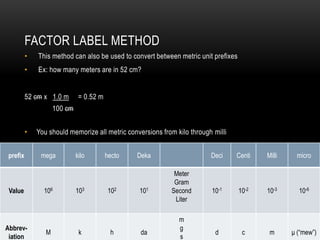
         •   This method can also be used to convert between metric unit prefixes
         •   Ex: how many meters are in 52 cm?


         52 cm x 1.0 m        = 0.52 m
                    100 cm


         •   You should memorize all metric conversions from kilo through milli


prefix        mega           kilo        hecto   Deka                    Deci     Centi    Milli    micro

                                                            Meter
                                                            Gram
 Value         106           103         102     101       Second         10-1      10-2   10-3      10-6
                                                            Liter

                                                              m
Abbrev-                                                       g
                M             k           h       da                       d         c      m      μ (“mew”)
 iation                                                       s

Factor label method

  • 1.
    FACTOR LABEL METHOD& CONVERSION FACTORS
  • 2.
    FACTOR LABEL METHOD • A method of converting units from one form to another. • Must have a conversion factor to perform factor label method that is arranged so that like units cancel. • Significant figures still matter • Our final answer will have the same # of sig figs as the number we are converting
  • 3.
    CONVERSION FACTOR • Used to convert a measured quantity to a different unit of measure without changing the relative amount. • It is a ratio (fraction) that equals one • Examples: • 1 inch = 2.54 cm => 1 inch/2.54cm • Aka a bridge • See first page in text for unit conversion factors
  • 4.
    EXAMPLE: LET’S STARTOFF EASY… • Let’s say we want to find out how many centimeters are in 21.5 inches 1. Identify information wanted & information given 21.5 inches = ?? Centimeters 2. Identify unit conversion(s) to be used 2.54 cm = 1 inch 3. Arrange conversion factor as shown: **only true if our desired units do not have a unit in the denominator** Desired units Original units 4. Multiply the numbers in the numerator, and the numbers in denominator 5. Divide the numerator by the denominator
  • 5.
    FACTOR LABEL METHOD • Converting 21.5 inches to centimeters: • Conversion Factor: 2.54 cm 1.00 in.
  • 6.
    EXAMPLE: LET’S MAKETHINGS A BIT TRICKIER… • Ex: how many hours are there in 7200 seconds? 1. Identify information wanted & information given 7200 sec. = ?? hours 2. Identify unit conversion(s) to be used 60 sec = 1 min 60 min = 1 hour 3. Arrange conversion factors as shown: Desired units Original units 4. Multiply so that units cancel
  • 7.
    FACTOR LABEL METHOD Ex:how many hours are there in 7200 seconds? 1. 7200 sec. = ?? hours 2. 60 sec = 1 min 60 min = 1 hour 3 & 4. 7200 sec. x 1 min x 1 hour = 2 hrs 60 sec 60 min
  • 8.
    EXAMPLE: YOUR TURN! Trythis one: How many inches are in 1.00 miles? 1. Identify information wanted & information given 2. Identify unit conversion(s) to be used 1. Arrange conversion factor as shown: Desired units Original units 4. Multiply so that units cancel
  • 9.
    EXAMPLE How tall areyou… - In inches? - In meters? - In miles?
  • 10.
    EXAMPLE: CONVERTING RATES • What is 65 miles per hour converted to feet per second? • NOTE: the word “per” identifies that there is a ratio • Rewrite as 65 miles and feet hour sec
  • 11.
    EXAMPLE: THE MOREDIFFICULT STUFF! What is 65 miles per hour converted to feet per second? 1. Identify information wanted & information given 1. Identify unit conversion(s) to be used 1. Arrange conversion factors so that desired units are left 2. Multiply so that units cancel
  • 12.
    FACTOR LABEL METHOD • This method can also be used to convert between metric unit prefixes • Ex: how many meters are in 52 cm? 52 cm x 1.0 m = 0.52 m 100 cm • You should memorize all metric conversions from kilo through milli prefix mega kilo hecto Deka Deci Centi Milli micro Meter Gram Value 106 103 102 101 Second 10-1 10-2 10-3 10-6 Liter m Abbrev- g M k h da d c m μ (“mew”) iation s