Frank Lloyd
Wright:
Design
Philosophy
By
:
Devesh
Anand
&
Shatakshi
Bhatt
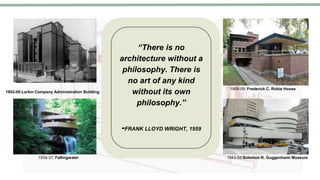
“There is no
architecture without a
philosophy. There is
no art of any kind
without its own
philosophy.”
-FRANK LLOYD WRIGHT, 1959
1902-06:Larkin Company Administration Building
1908-09: Frederick C. Robie House
1934-37: Fallingwater 1943-59:Solomon R. Guggenheim Museum
Frank Lloyd Wright (1867-1959), is a renowned American Architect. He trained under Louis Sullivan and started his own firm in
1893.
Biography
1867
1876
1885
1887
1889
1893
1893- 1911
1911
1940
Birth
Introduced to
Froebel
blocks
Taliesin, a new
home and
studio
1949
1959
Joins Adler
and Sullivan
in Chicago
Starts his own
practice
Awarded Gold Medal
of American Institute
of Architects
Part time job
with Allan D.
Conover
Oak Park,
Illinois, own
house
Works like Winslow
House, Unity
Temple, Robie
House etc
Established
F.L. Wright
Foundation
F.L. Wright
passes away
in Arizona
Philosophy
“The spirit in which these buildings are conceived sees all these together at work as one thing.”
Wright embraced new technologies and tactics
Architecture as “the great mother art, behind which all others are definitely, distinctly and inevitably related.”
“buildings like people must first be sincere, must be true.”
Environment that were not only functional but also “eloquent and humane.”
Philosophy
Design for Democracy
Integrity and Connection
Nature’s Principles and Structure
Material and Machines
Architecture as the Great Mother Art
Case 1: Falling Water
Built partly over a waterfall, the sound of the waterfall is
encouraged within the interior spaces.
Design alterations for existing trees to grow in interiors
Philosophy in Design
Fallingwater, 1935
Nature’s Principles and Structure
The colors of the interior were limited to two colors to blend
into the natural environment.
Slabs design gives an impression of continuity, integrating it
with its surroundings
Philosophy in Design
Fallingwater, 1935
Integrity and Connection
No metal frames were used in the opening where the glass
meets the stone. Instead, recesses were made in the
stone.
Stones were sourced locally from a quarry nearby.
Philosophy in Design
Fallingwater, 1935
Material and Machines
Case 2: Taliesin West
The building used local natural materials like the available desert
stone in the site. Natural redwood timber for the roof.
Wright constantly made changes as per the need to keep up with
the changing environment.
The use of natural light also played a major part in the design.
The walls and ceiling were designed in such a way as to remove
unwanted sun rays while letting in a horizontal line
Philosophy in Design
Taliesin West, 1937
Design for Democracy
Nature’s Principles and Structure
Material and Machines
Each building is connected through a series of walkways, terraces,
pools and gardens. The desert texture in exteriors integrate it with
its surroundings
Integrity and Connection
Case 3: Guggenheim
Museum
Open floor plans were widely appreciated for their social and
interactive purposes
Large skylights revolutionized the way museums were designed
and have been widely imitated by other museums later
Philosophy in Design
Guggenheim Museum, 1959
Design for Democracy
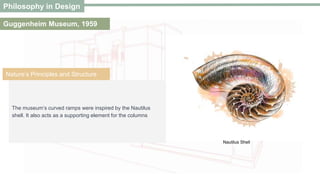
The museum’s curved ramps were inspired by the Nautilus
shell. It also acts as a supporting element for the columns
Philosophy in Design
Guggenheim Museum, 1959
Nature’s Principles and Structure
Nautilus Shell
Philosophy in Design
Guggenheim Museum, 1959
Design & Style
Design & Style
Prairie Style (1899-1910)
With the “Prairie house”— a long, low, open plan structure that eschewed the typical high, straight-sided box in order to
emphasize the horizontal line of the prairie and domesticity.
Interior walls were minimised to create an open plan to foster a sense of community for inhabitants and a harmonious
connection to the natural world.
Examples
● Robie House, 1909 in Chicago, Illinois
● Fallingwater house 1937 in Mill Run, Pennsylvania
Design & Style
Prairie Style (1899-1910)
● Strong geometry and massing, including
large central chimneys
● Brick or stucco exteriors
● Connected indoor and outdoor spaces
● Interior wood banding
● Restrained use of applied ornamentation
● Exploration of motifs: one shape or plant
form explored through furniture, wood
carving, plaster, art glass and other
elements within a building
● Open, asymmetric floor plans
Design & Style
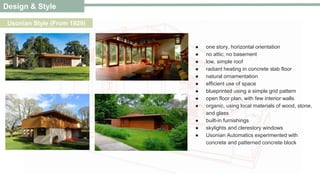
Usonian Style (From 1929)
Financial crisis of 1929 and ensuing Great Depression that gripped the United States and the rest of the world, Wright began
working on affordable housing, which developed into the Usonian house.
A house could be compared to a living organism with all parts relating to the whole, making form and function wholly
intertwined.
Usonian Automatic to describe a Usonian style house made of inexpensive concrete blocks.
Examples
The Zimmerman House (1950) Toufic H. Kalil House (1955) Curtis Meyer House (1948) in Galesburn
Design & Style
Usonian Style (From 1929)
● one story, horizontal orientation
● no attic; no basement
● low, simple roof
● radiant heating in concrete slab floor
● natural ornamentation
● efficient use of space
● blueprinted using a simple grid pattern
● open floor plan, with few interior walls
● organic, using local materials of wood, stone,
and glass
● built-in furnishings
● skylights and clerestory windows
● Usonian Automatics experimented with
concrete and patterned concrete block
References
● Frank Lloyd Wright. (n.d.). Retrieved from http://www.steinerag.com/flw/Books/c1401.htm
● Craven, J. (2019). What is a Usonian house? ThoughtCo. Retrieved from https://www.thoughtco.com/usonian-style-home-frank-
lloyd-wright-177787
● Caffin, C. (2015, February 17). Frank Lloyd Wright's Usonian Vision is Alive and Well in Pleasantville. Pleasantville-Briarcliff
Manor, NY Patch. Retrieved from https://patch.com
● The Bachman-Wilson House: What is a Usonian House? | Crystal Bridges Museum of American Art. (2014, March 8). Retrieved
from https://crystalbridges.org/blog/bachman-wilson-house-usonian-house/
● McManus, R., & McManus, R. (2017). Style 101: Prairie | IS Architecture. IS Architecture | Custom Residential Architecture and
Historic Preservation. Retrieved from https://isarchitecture.com/style-101-prairie/
● About Frank Lloyd Wright - Frank Lloyd Wright Foundation. (2023, April 26). Retrieved from https://franklloydwright.org/frank-
lloyd-wright/
● The philosophy behind iconic Frank Lloyd Wright architecture. (n.d.). Retrieved from
https://www.engelvoelkers.com/en/blog/luxury-living/architecture/the-philosophy-behind-iconic-frank-lloyd-wright-architecture/
Thank You

Frank Lloyd Wright: Design Philosphy.pptx

  • 1.
  • 2.
    “There is no architecturewithout a philosophy. There is no art of any kind without its own philosophy.” -FRANK LLOYD WRIGHT, 1959 1902-06:Larkin Company Administration Building 1908-09: Frederick C. Robie House 1934-37: Fallingwater 1943-59:Solomon R. Guggenheim Museum
  • 3.
    Frank Lloyd Wright(1867-1959), is a renowned American Architect. He trained under Louis Sullivan and started his own firm in 1893. Biography 1867 1876 1885 1887 1889 1893 1893- 1911 1911 1940 Birth Introduced to Froebel blocks Taliesin, a new home and studio 1949 1959 Joins Adler and Sullivan in Chicago Starts his own practice Awarded Gold Medal of American Institute of Architects Part time job with Allan D. Conover Oak Park, Illinois, own house Works like Winslow House, Unity Temple, Robie House etc Established F.L. Wright Foundation F.L. Wright passes away in Arizona
  • 4.
  • 5.
    “The spirit inwhich these buildings are conceived sees all these together at work as one thing.” Wright embraced new technologies and tactics Architecture as “the great mother art, behind which all others are definitely, distinctly and inevitably related.” “buildings like people must first be sincere, must be true.” Environment that were not only functional but also “eloquent and humane.” Philosophy Design for Democracy Integrity and Connection Nature’s Principles and Structure Material and Machines Architecture as the Great Mother Art
  • 6.
  • 7.
    Built partly overa waterfall, the sound of the waterfall is encouraged within the interior spaces. Design alterations for existing trees to grow in interiors Philosophy in Design Fallingwater, 1935 Nature’s Principles and Structure
  • 8.
    The colors ofthe interior were limited to two colors to blend into the natural environment. Slabs design gives an impression of continuity, integrating it with its surroundings Philosophy in Design Fallingwater, 1935 Integrity and Connection
  • 9.
    No metal frameswere used in the opening where the glass meets the stone. Instead, recesses were made in the stone. Stones were sourced locally from a quarry nearby. Philosophy in Design Fallingwater, 1935 Material and Machines
  • 10.
  • 11.
    The building usedlocal natural materials like the available desert stone in the site. Natural redwood timber for the roof. Wright constantly made changes as per the need to keep up with the changing environment. The use of natural light also played a major part in the design. The walls and ceiling were designed in such a way as to remove unwanted sun rays while letting in a horizontal line Philosophy in Design Taliesin West, 1937 Design for Democracy Nature’s Principles and Structure Material and Machines Each building is connected through a series of walkways, terraces, pools and gardens. The desert texture in exteriors integrate it with its surroundings Integrity and Connection
  • 12.
  • 13.
    Open floor planswere widely appreciated for their social and interactive purposes Large skylights revolutionized the way museums were designed and have been widely imitated by other museums later Philosophy in Design Guggenheim Museum, 1959 Design for Democracy
  • 14.
    The museum’s curvedramps were inspired by the Nautilus shell. It also acts as a supporting element for the columns Philosophy in Design Guggenheim Museum, 1959 Nature’s Principles and Structure Nautilus Shell
  • 15.
  • 16.
  • 17.
    Design & Style PrairieStyle (1899-1910) With the “Prairie house”— a long, low, open plan structure that eschewed the typical high, straight-sided box in order to emphasize the horizontal line of the prairie and domesticity. Interior walls were minimised to create an open plan to foster a sense of community for inhabitants and a harmonious connection to the natural world. Examples ● Robie House, 1909 in Chicago, Illinois ● Fallingwater house 1937 in Mill Run, Pennsylvania
  • 18.
    Design & Style PrairieStyle (1899-1910) ● Strong geometry and massing, including large central chimneys ● Brick or stucco exteriors ● Connected indoor and outdoor spaces ● Interior wood banding ● Restrained use of applied ornamentation ● Exploration of motifs: one shape or plant form explored through furniture, wood carving, plaster, art glass and other elements within a building ● Open, asymmetric floor plans
  • 19.
    Design & Style UsonianStyle (From 1929) Financial crisis of 1929 and ensuing Great Depression that gripped the United States and the rest of the world, Wright began working on affordable housing, which developed into the Usonian house. A house could be compared to a living organism with all parts relating to the whole, making form and function wholly intertwined. Usonian Automatic to describe a Usonian style house made of inexpensive concrete blocks. Examples The Zimmerman House (1950) Toufic H. Kalil House (1955) Curtis Meyer House (1948) in Galesburn
  • 20.
    Design & Style UsonianStyle (From 1929) ● one story, horizontal orientation ● no attic; no basement ● low, simple roof ● radiant heating in concrete slab floor ● natural ornamentation ● efficient use of space ● blueprinted using a simple grid pattern ● open floor plan, with few interior walls ● organic, using local materials of wood, stone, and glass ● built-in furnishings ● skylights and clerestory windows ● Usonian Automatics experimented with concrete and patterned concrete block
  • 21.
    References ● Frank LloydWright. (n.d.). Retrieved from http://www.steinerag.com/flw/Books/c1401.htm ● Craven, J. (2019). What is a Usonian house? ThoughtCo. Retrieved from https://www.thoughtco.com/usonian-style-home-frank- lloyd-wright-177787 ● Caffin, C. (2015, February 17). Frank Lloyd Wright's Usonian Vision is Alive and Well in Pleasantville. Pleasantville-Briarcliff Manor, NY Patch. Retrieved from https://patch.com ● The Bachman-Wilson House: What is a Usonian House? | Crystal Bridges Museum of American Art. (2014, March 8). Retrieved from https://crystalbridges.org/blog/bachman-wilson-house-usonian-house/ ● McManus, R., & McManus, R. (2017). Style 101: Prairie | IS Architecture. IS Architecture | Custom Residential Architecture and Historic Preservation. Retrieved from https://isarchitecture.com/style-101-prairie/ ● About Frank Lloyd Wright - Frank Lloyd Wright Foundation. (2023, April 26). Retrieved from https://franklloydwright.org/frank- lloyd-wright/ ● The philosophy behind iconic Frank Lloyd Wright architecture. (n.d.). Retrieved from https://www.engelvoelkers.com/en/blog/luxury-living/architecture/the-philosophy-behind-iconic-frank-lloyd-wright-architecture/ Thank You