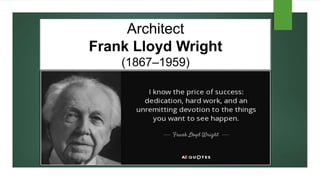
Architect
Frank Lloyd Wright
(1867–1959)
Frank LloydWright
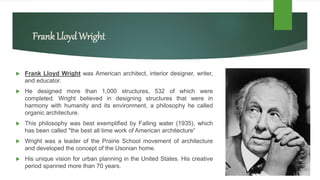
 Frank Lloyd Wright was American architect, interior designer, writer,
and educator.
 He designed more than 1,000 structures, 532 of which were
completed. Wright believed in designing structures that were in
harmony with humanity and its environment, a philosophy he called
organic architecture.
 This philosophy was best exemplified by Falling water (1935), which
has been called "the best all time work of American architecture“
 Wright was a leader of the Prairie School movement of architecture
and developed the concept of the Usonian home.
 His unique vision for urban planning in the United States. His creative
period spanned more than 70 years.
Early Life :
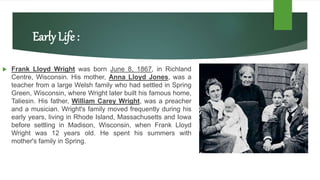
 Frank Lloyd Wright was born June 8, 1867, in Richland
Centre, Wisconsin. His mother, Anna Lloyd Jones, was a
teacher from a large Welsh family who had settled in Spring
Green, Wisconsin, where Wright later built his famous home,
Taliesin. His father, William Carey Wright, was a preacher
and a musician. Wright's family moved frequently during his
early years, living in Rhode Island, Massachusetts and Iowa
before settling in Madison, Wisconsin, when Frank Lloyd
Wright was 12 years old. He spent his summers with
mother's family in Spring.
Architecture Education
 In 1885, the year Wright graduated from public high school in Madison.
 His parents divorced and his father moved away, never to be heard from again. That
year, Wright enrolled at the University of Wisconsin at Madison to study civil
engineering.
 In order to pay his tuition and help support his family, he worked for the dean of the
engineering department and assisted the acclaimed architect Joseph Silsbee with the
construction of the Unity Chapel.
 The experience convinced Wright that he wanted to become an Architect, and
 In 1887 he dropped out of school to go to work for Silsbee in Chicago.
Professional Life
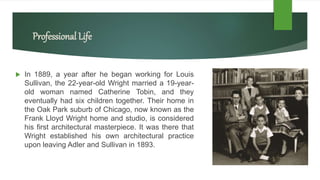
 In 1889, a year after he began working for Louis
Sullivan, the 22-year-old Wright married a 19-year-
old woman named Catherine Tobin, and they
eventually had six children together. Their home in
the Oak Park suburb of Chicago, now known as the
Frank Lloyd Wright home and studio, is considered
his first architectural masterpiece. It was there that
Wright established his own architectural practice
upon leaving Adler and Sullivan in 1893.
Beginning Of his Work
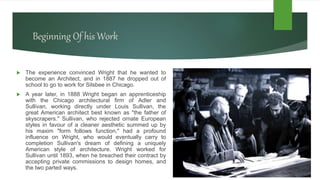
 The experience convinced Wright that he wanted to
become an Architect, and in 1887 he dropped out of
school to go to work for Silsbee in Chicago.
 A year later, in 1888 Wright began an apprenticeship
with the Chicago architectural firm of Adler and
Sullivan, working directly under Louis Sullivan, the
great American architect best known as "the father of
skyscrapers." Sullivan, who rejected ornate European
styles in favour of a cleaner aesthetic summed up by
his maxim "form follows function," had a profound
influence on Wright, who would eventually carry to
completion Sullivan's dream of defining a uniquely
American style of architecture. Wright worked for
Sullivan until 1893, when he breached their contract by
accepting private commissions to design homes, and
the two parted ways.
Cont.…..
 In his autobiography, Wright recounts that he also had a short
stint in another Chicago architecture office. Feeling that he
was underpaid for the quality of his work for Silsbee (at $8 a
week), the young draftsman quit and found work as
a designer at the firm of Beers, Clay, and Dutton. However,
Wright soon realized that he was not ready to handle building
design by himself; he left his new job to return to Joseph
Silsbee this time with a raise in salary.
 A year After in 1893, he designed the Winslow House in
River Forest, which with its horizontal emphasis and
expansive, open interior spaces is the first example of
Wright's revolutionary style, later dubbed "organic
Architecture."
As an Architect
Transition and experimentation
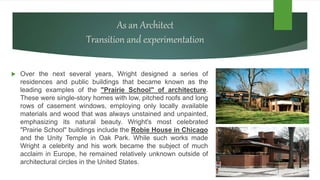
 Over the next several years, Wright designed a series of
residences and public buildings that became known as the
leading examples of the "Prairie School" of architecture.
These were single-story homes with low, pitched roofs and long
rows of casement windows, employing only locally available
materials and wood that was always unstained and unpainted,
emphasizing its natural beauty. Wright's most celebrated
"Prairie School" buildings include the Robie House in Chicago
and the Unity Temple in Oak Park. While such works made
Wright a celebrity and his work became the subject of much
acclaim in Europe, he remained relatively unknown outside of
architectural circles in the United States.
Cont.…..
 Soon after the completion of the Winslow House in 1894, Edward Waller, a friend and
former client, invited Wright to meet Chicago architect and planner Daniel Burnham.
Burnham had been impressed by the Winslow House and other examples of Wright's
work, he offered to finance a 4-year education at the École des Beaux-Arts and two
years in Rome. To top it off, Wright would have a position in Burnham's firm upon his
return. In spite of guaranteed success and support of his family, Wright declined the
offer. Burnham, who had directed the classical design of the World's Columbian
Exposition was a major proponent of the Beaux Arts movement, thought that Wright
was making a foolish mistake. Yet for Wright, the classical education of the École
lacked creativity and was altogether at odds with his vision of modern American
architecture
Philosophy & Concept
 Frank Lloyd Wright was American architect, interior designer,
writer, and educator.
 He designed more than 1,000 structures, 532 of which were
completed. Wright believed in designing structures that were in
harmony with humanity and its environment, a philosophy he called
organic architecture.
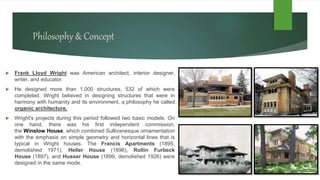
 Wright's projects during this period followed two basic models. On
one hand, there was his first independent commission,
the Winslow House, which combined Sullivanesque ornamentation
with the emphasis on simple geometry and horizontal lines that is
typical in Wright houses. The Francis Apartments (1895,
demolished 1971), Heller House (1896), Rollin Furbeck
House (1897), and Husser House (1899, demolished 1926) were
designed in the same mode.
Style & Philosophy
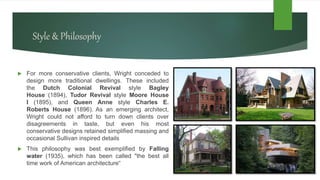
 For more conservative clients, Wright conceded to
design more traditional dwellings. These included
the Dutch Colonial Revival style Bagley
House (1894), Tudor Revival style Moore House
I (1895), and Queen Anne style Charles E.
Roberts House (1896). As an emerging architect,
Wright could not afford to turn down clients over
disagreements in taste, but even his most
conservative designs retained simplified massing and
occasional Sullivan inspired details
 This philosophy was best exemplified by Falling
water (1935), which has been called "the best all
time work of American architecture“
Taliesin; The House & The Studio
 In 1909, after 20 years of marriage, Wright
suddenly abandoned his wife, children and
practice and moved to Germany with a woman
named Mamah Borthwick Cheney, the wife of a
client. Working with the acclaimed publisher
Ernst Wasmuth, while in Germany Wright put
together two portfolios of his work that further
raised his international profile as one of the
leading living architects. In 1913, Wright and
Cheney returned to the United States, and
Wright designed them a home on the land of his
maternal ancestors in Spring Green, Wisconsin.
Named Taliesin, Welsh for "shining brow," it was
one of the most acclaimed works of his life
Taliesinaccident & Makeup
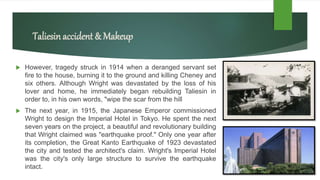
 However, tragedy struck in 1914 when a deranged servant set
fire to the house, burning it to the ground and killing Cheney and
six others. Although Wright was devastated by the loss of his
lover and home, he immediately began rebuilding Taliesin in
order to, in his own words, "wipe the scar from the hill
 The next year, in 1915, the Japanese Emperor commissioned
Wright to design the Imperial Hotel in Tokyo. He spent the next
seven years on the project, a beautiful and revolutionary building
that Wright claimed was "earthquake proof." Only one year after
its completion, the Great Kanto Earthquake of 1923 devastated
the city and tested the architect's claim. Wright's Imperial Hotel
was the city's only large structure to survive the earthquake
intact.
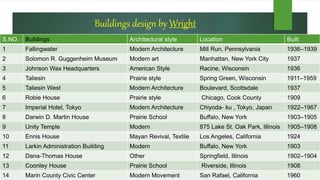
Buildings design by Wright
S.NO. Buildings Architectural style Location Built
1 Fallingwater Modern Architecture Mill Run, Pennsylvania 1936–1939
2 Solomon R. Guggenheim Museum Modern art Manhattan, New York City 1937
3 Johnson Wax Headquarters American Style Racine, Wisconsin 1936
4 Taliesin Prairie style Spring Green, Wisconsin 1911–1959
5 Taliesin West Modern Architecture Boulevard, Scottsdale 1937
6 Robie House Prairie style Chicago, Cook County 1909
7 Imperial Hotel, Tokyo Modern Architecture Chiyoda- ku , Tokyo, Japan 1922–1967
8 Darwin D. Martin House Prairie School Buffalo, New York 1903–1905
9 Unity Temple Modern 875 Lake St. Oak Park, Illinois 1905–1908
10 Ennis House Mayan Revival, Textile Los Angeles, California 1924
11 Larkin Administration Building Modern Buffalo, New York 1903
12 Dana-Thomas House Other Springfield, Illinois 1902–1904
13 Coonley House Prairie School Riverside, Illinois 1908
14 Marin County Civic Center Modern Movement San Rafael, California 1960
Wright’s Work on Interior
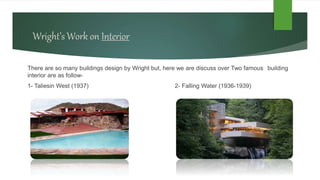
There are so many buildings design by Wright but, here we are discuss over Two famous building
interior are as follow-
1- Taliesin West (1937) 2- Falling Water (1936-1939)
Wright’s Concept on Interior
 Frank Lloyd Wright is one of America’s most influential architects and interior designers of our
time. Believing that a home was more than a home by being a work of art, the designs of
Wright interior furnishings were as influential as the exterior frameworks.
 Wright’s concept of organic architecture required that the interior spaces express freedom and
tranquillity as well. Wright started that “the most truly satisfactory apartments are those in which
most or all of the furniture is built in as part of the original scheme considering the whole as an
integral unit.
 He did not trust the interior design capabilities of his clients to continue the fluidity and harmony
of the home. Also, commercially produced furnishings were over elaborate and poorly
constructed; therefore, not appropriate to be placed in clients’ homes.
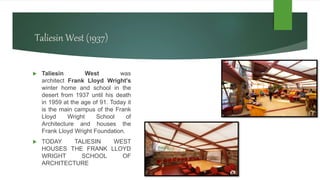
Taliesin West (1937)
 Taliesin West was
architect Frank Lloyd Wright's
winter home and school in the
desert from 1937 until his death
in 1959 at the age of 91. Today it
is the main campus of the Frank
Lloyd Wright School of
Architecture and houses the
Frank Lloyd Wright Foundation.
 TODAY TALIESIN WEST
HOUSES THE FRANK LLOYD
WRIGHT SCHOOL OF
ARCHITECTURE
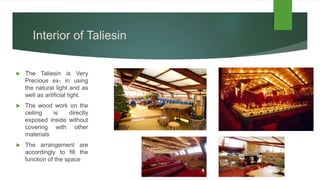
Interior of Taliesin
 The Taliesin is Very
Precious ex- in using
the natural light and as
well as artificial light.
 The wood work on the
ceiling is directly
exposed inside without
covering with other
materials
 The arrangement are
accordingly to fill the
function of the space
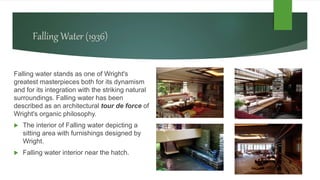
Falling Water (1936)
Falling water stands as one of Wright's
greatest masterpieces both for its dynamism
and for its integration with the striking natural
surroundings. Falling water has been
described as an architectural tour de force of
Wright's organic philosophy.
 The interior of Falling water depicting a
sitting area with furnishings designed by
Wright.
 Falling water interior near the hatch.
Interior of Falling Water
 The Interior Of falling
Water is based on
natural and communistic
design.
 Wright design in a
manner that there is
feeling of neutrality and
satisfaction, in the
environment.
 The design in inside is
complement to the
outside design,
Introduction to
Frank Lloyd Wright
furniture
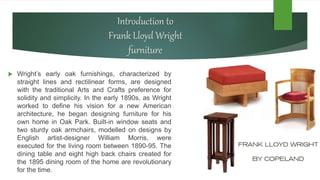
 Wright’s early oak furnishings, characterized by
straight lines and rectilinear forms, are designed
with the traditional Arts and Crafts preference for
solidity and simplicity. In the early 1890s, as Wright
worked to define his vision for a new American
architecture, he began designing furniture for his
own home in Oak Park. Built-in window seats and
two sturdy oak armchairs, modelled on designs by
English artist-designer William Morris, were
executed for the living room between 1890-95. The
dining table and eight high back chairs created for
the 1895 dining room of the home are revolutionary
for the time.
Wright’s Furniture
 Bold, innovative and
architectural, the furnishings
and decorative arts of Wright’s
Chicago years were conceived
as integral elements of his
Prairie interiors, designed in
harmony with each specific
commission. Incorporating
furniture, lighting, and
decorative arts into the
structure of his buildings
enabled Wright to achieve a
harmonious and unified
interior.
Awards & Achievement
Later in his life and well after his death in 1959, Wright received much honorary recognition for his lifetime
achievements,
1- He received Gold Medal awards from The Royal Institute of British Architects (RIBA) in 1941.
2- He received Gold Medal awards from The American Institute of Architects (AIA) in 1949.
3- He was awarded the Franklin Institute's Frank P. Brown Medal in 1953.
4- He received honorary degrees from several universities (including his "alma mater", the University of
Wisconsin) and several nations named him as an honorary board member to their national academies of art
and/or architecture. In 2000.
5- In 2004, one of the spires included in his design was erected in his memory. Consisting of roughly 1,700
individual pieces of steel, the Frank Lloyd Wright Spire is visible from nearly everywhere in residential
Scottsdale and illuminates the night sky with a stunning, futuristic architectural ambiance of teal and blue.
Assignment on
Work of
Architect Frank LloydWright
Presented to
Ar. Danish Quadri
Presented By
Mohd Kashif 13 DPID 303
Basil Azeem 13 DPID 307
Musarrat Ali 13 DPID 310
Mohd Salman Khan 12 DPID 276
Mohd Zeeshan Wali 12 DPID 266

Frank lloyd wright 303

  • 1.
  • 2.
    Frank LloydWright  FrankLloyd Wright was American architect, interior designer, writer, and educator.  He designed more than 1,000 structures, 532 of which were completed. Wright believed in designing structures that were in harmony with humanity and its environment, a philosophy he called organic architecture.  This philosophy was best exemplified by Falling water (1935), which has been called "the best all time work of American architecture“  Wright was a leader of the Prairie School movement of architecture and developed the concept of the Usonian home.  His unique vision for urban planning in the United States. His creative period spanned more than 70 years.
  • 3.
    Early Life : Frank Lloyd Wright was born June 8, 1867, in Richland Centre, Wisconsin. His mother, Anna Lloyd Jones, was a teacher from a large Welsh family who had settled in Spring Green, Wisconsin, where Wright later built his famous home, Taliesin. His father, William Carey Wright, was a preacher and a musician. Wright's family moved frequently during his early years, living in Rhode Island, Massachusetts and Iowa before settling in Madison, Wisconsin, when Frank Lloyd Wright was 12 years old. He spent his summers with mother's family in Spring.
  • 4.
    Architecture Education  In1885, the year Wright graduated from public high school in Madison.  His parents divorced and his father moved away, never to be heard from again. That year, Wright enrolled at the University of Wisconsin at Madison to study civil engineering.  In order to pay his tuition and help support his family, he worked for the dean of the engineering department and assisted the acclaimed architect Joseph Silsbee with the construction of the Unity Chapel.  The experience convinced Wright that he wanted to become an Architect, and  In 1887 he dropped out of school to go to work for Silsbee in Chicago.
  • 5.
    Professional Life  In1889, a year after he began working for Louis Sullivan, the 22-year-old Wright married a 19-year- old woman named Catherine Tobin, and they eventually had six children together. Their home in the Oak Park suburb of Chicago, now known as the Frank Lloyd Wright home and studio, is considered his first architectural masterpiece. It was there that Wright established his own architectural practice upon leaving Adler and Sullivan in 1893.
  • 6.
    Beginning Of hisWork  The experience convinced Wright that he wanted to become an Architect, and in 1887 he dropped out of school to go to work for Silsbee in Chicago.  A year later, in 1888 Wright began an apprenticeship with the Chicago architectural firm of Adler and Sullivan, working directly under Louis Sullivan, the great American architect best known as "the father of skyscrapers." Sullivan, who rejected ornate European styles in favour of a cleaner aesthetic summed up by his maxim "form follows function," had a profound influence on Wright, who would eventually carry to completion Sullivan's dream of defining a uniquely American style of architecture. Wright worked for Sullivan until 1893, when he breached their contract by accepting private commissions to design homes, and the two parted ways.
  • 7.
    Cont.…..  In hisautobiography, Wright recounts that he also had a short stint in another Chicago architecture office. Feeling that he was underpaid for the quality of his work for Silsbee (at $8 a week), the young draftsman quit and found work as a designer at the firm of Beers, Clay, and Dutton. However, Wright soon realized that he was not ready to handle building design by himself; he left his new job to return to Joseph Silsbee this time with a raise in salary.  A year After in 1893, he designed the Winslow House in River Forest, which with its horizontal emphasis and expansive, open interior spaces is the first example of Wright's revolutionary style, later dubbed "organic Architecture."
  • 8.
    As an Architect Transitionand experimentation  Over the next several years, Wright designed a series of residences and public buildings that became known as the leading examples of the "Prairie School" of architecture. These were single-story homes with low, pitched roofs and long rows of casement windows, employing only locally available materials and wood that was always unstained and unpainted, emphasizing its natural beauty. Wright's most celebrated "Prairie School" buildings include the Robie House in Chicago and the Unity Temple in Oak Park. While such works made Wright a celebrity and his work became the subject of much acclaim in Europe, he remained relatively unknown outside of architectural circles in the United States.
  • 9.
    Cont.…..  Soon afterthe completion of the Winslow House in 1894, Edward Waller, a friend and former client, invited Wright to meet Chicago architect and planner Daniel Burnham. Burnham had been impressed by the Winslow House and other examples of Wright's work, he offered to finance a 4-year education at the École des Beaux-Arts and two years in Rome. To top it off, Wright would have a position in Burnham's firm upon his return. In spite of guaranteed success and support of his family, Wright declined the offer. Burnham, who had directed the classical design of the World's Columbian Exposition was a major proponent of the Beaux Arts movement, thought that Wright was making a foolish mistake. Yet for Wright, the classical education of the École lacked creativity and was altogether at odds with his vision of modern American architecture
  • 10.
    Philosophy & Concept Frank Lloyd Wright was American architect, interior designer, writer, and educator.  He designed more than 1,000 structures, 532 of which were completed. Wright believed in designing structures that were in harmony with humanity and its environment, a philosophy he called organic architecture.  Wright's projects during this period followed two basic models. On one hand, there was his first independent commission, the Winslow House, which combined Sullivanesque ornamentation with the emphasis on simple geometry and horizontal lines that is typical in Wright houses. The Francis Apartments (1895, demolished 1971), Heller House (1896), Rollin Furbeck House (1897), and Husser House (1899, demolished 1926) were designed in the same mode.
  • 11.
    Style & Philosophy For more conservative clients, Wright conceded to design more traditional dwellings. These included the Dutch Colonial Revival style Bagley House (1894), Tudor Revival style Moore House I (1895), and Queen Anne style Charles E. Roberts House (1896). As an emerging architect, Wright could not afford to turn down clients over disagreements in taste, but even his most conservative designs retained simplified massing and occasional Sullivan inspired details  This philosophy was best exemplified by Falling water (1935), which has been called "the best all time work of American architecture“
  • 12.
    Taliesin; The House& The Studio  In 1909, after 20 years of marriage, Wright suddenly abandoned his wife, children and practice and moved to Germany with a woman named Mamah Borthwick Cheney, the wife of a client. Working with the acclaimed publisher Ernst Wasmuth, while in Germany Wright put together two portfolios of his work that further raised his international profile as one of the leading living architects. In 1913, Wright and Cheney returned to the United States, and Wright designed them a home on the land of his maternal ancestors in Spring Green, Wisconsin. Named Taliesin, Welsh for "shining brow," it was one of the most acclaimed works of his life
  • 13.
    Taliesinaccident & Makeup However, tragedy struck in 1914 when a deranged servant set fire to the house, burning it to the ground and killing Cheney and six others. Although Wright was devastated by the loss of his lover and home, he immediately began rebuilding Taliesin in order to, in his own words, "wipe the scar from the hill  The next year, in 1915, the Japanese Emperor commissioned Wright to design the Imperial Hotel in Tokyo. He spent the next seven years on the project, a beautiful and revolutionary building that Wright claimed was "earthquake proof." Only one year after its completion, the Great Kanto Earthquake of 1923 devastated the city and tested the architect's claim. Wright's Imperial Hotel was the city's only large structure to survive the earthquake intact.
  • 14.
    Buildings design byWright S.NO. Buildings Architectural style Location Built 1 Fallingwater Modern Architecture Mill Run, Pennsylvania 1936–1939 2 Solomon R. Guggenheim Museum Modern art Manhattan, New York City 1937 3 Johnson Wax Headquarters American Style Racine, Wisconsin 1936 4 Taliesin Prairie style Spring Green, Wisconsin 1911–1959 5 Taliesin West Modern Architecture Boulevard, Scottsdale 1937 6 Robie House Prairie style Chicago, Cook County 1909 7 Imperial Hotel, Tokyo Modern Architecture Chiyoda- ku , Tokyo, Japan 1922–1967 8 Darwin D. Martin House Prairie School Buffalo, New York 1903–1905 9 Unity Temple Modern 875 Lake St. Oak Park, Illinois 1905–1908 10 Ennis House Mayan Revival, Textile Los Angeles, California 1924 11 Larkin Administration Building Modern Buffalo, New York 1903 12 Dana-Thomas House Other Springfield, Illinois 1902–1904 13 Coonley House Prairie School Riverside, Illinois 1908 14 Marin County Civic Center Modern Movement San Rafael, California 1960
  • 15.
    Wright’s Work onInterior There are so many buildings design by Wright but, here we are discuss over Two famous building interior are as follow- 1- Taliesin West (1937) 2- Falling Water (1936-1939)
  • 16.
    Wright’s Concept onInterior  Frank Lloyd Wright is one of America’s most influential architects and interior designers of our time. Believing that a home was more than a home by being a work of art, the designs of Wright interior furnishings were as influential as the exterior frameworks.  Wright’s concept of organic architecture required that the interior spaces express freedom and tranquillity as well. Wright started that “the most truly satisfactory apartments are those in which most or all of the furniture is built in as part of the original scheme considering the whole as an integral unit.  He did not trust the interior design capabilities of his clients to continue the fluidity and harmony of the home. Also, commercially produced furnishings were over elaborate and poorly constructed; therefore, not appropriate to be placed in clients’ homes.
  • 17.
    Taliesin West (1937) Taliesin West was architect Frank Lloyd Wright's winter home and school in the desert from 1937 until his death in 1959 at the age of 91. Today it is the main campus of the Frank Lloyd Wright School of Architecture and houses the Frank Lloyd Wright Foundation.  TODAY TALIESIN WEST HOUSES THE FRANK LLOYD WRIGHT SCHOOL OF ARCHITECTURE
  • 18.
    Interior of Taliesin The Taliesin is Very Precious ex- in using the natural light and as well as artificial light.  The wood work on the ceiling is directly exposed inside without covering with other materials  The arrangement are accordingly to fill the function of the space
  • 19.
    Falling Water (1936) Fallingwater stands as one of Wright's greatest masterpieces both for its dynamism and for its integration with the striking natural surroundings. Falling water has been described as an architectural tour de force of Wright's organic philosophy.  The interior of Falling water depicting a sitting area with furnishings designed by Wright.  Falling water interior near the hatch.
  • 20.
    Interior of FallingWater  The Interior Of falling Water is based on natural and communistic design.  Wright design in a manner that there is feeling of neutrality and satisfaction, in the environment.  The design in inside is complement to the outside design,
  • 21.
    Introduction to Frank LloydWright furniture  Wright’s early oak furnishings, characterized by straight lines and rectilinear forms, are designed with the traditional Arts and Crafts preference for solidity and simplicity. In the early 1890s, as Wright worked to define his vision for a new American architecture, he began designing furniture for his own home in Oak Park. Built-in window seats and two sturdy oak armchairs, modelled on designs by English artist-designer William Morris, were executed for the living room between 1890-95. The dining table and eight high back chairs created for the 1895 dining room of the home are revolutionary for the time.
  • 22.
    Wright’s Furniture  Bold,innovative and architectural, the furnishings and decorative arts of Wright’s Chicago years were conceived as integral elements of his Prairie interiors, designed in harmony with each specific commission. Incorporating furniture, lighting, and decorative arts into the structure of his buildings enabled Wright to achieve a harmonious and unified interior.
  • 23.
    Awards & Achievement Laterin his life and well after his death in 1959, Wright received much honorary recognition for his lifetime achievements, 1- He received Gold Medal awards from The Royal Institute of British Architects (RIBA) in 1941. 2- He received Gold Medal awards from The American Institute of Architects (AIA) in 1949. 3- He was awarded the Franklin Institute's Frank P. Brown Medal in 1953. 4- He received honorary degrees from several universities (including his "alma mater", the University of Wisconsin) and several nations named him as an honorary board member to their national academies of art and/or architecture. In 2000. 5- In 2004, one of the spires included in his design was erected in his memory. Consisting of roughly 1,700 individual pieces of steel, the Frank Lloyd Wright Spire is visible from nearly everywhere in residential Scottsdale and illuminates the night sky with a stunning, futuristic architectural ambiance of teal and blue.
  • 24.
    Assignment on Work of ArchitectFrank LloydWright Presented to Ar. Danish Quadri Presented By Mohd Kashif 13 DPID 303 Basil Azeem 13 DPID 307 Musarrat Ali 13 DPID 310 Mohd Salman Khan 12 DPID 276 Mohd Zeeshan Wali 12 DPID 266