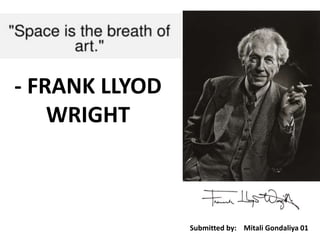
- FRANK LLYOD
WRIGHT
Submitted by: Mitali Gondaliya 01
About Frank Llyod Wright…
•Born (Frank Lincoln Wright) in Wisconsin on June 8, 1867 – April 9, 1959, was
an American architect, interior designer, writer, and educator, who designed
more than 1,000 structures, 532 of which were completed.
•His mother was a teacher and she encouraged him to learn about art, music,
and nature.
When Wright was nine, his mother gave him a set of blocks, a children's
learning toy. Consisted of various geometrically shaped blocks that could be
assembled in various combination to form 3D composition.
•Started formal education in University of Winsconsin- Madison School of
Engeneering.
•Left the college after 2 years and moved to Chicago, Illinois; to join the firm of
J.L. Silsbee.
•Year later he moved to join Adler and Sulivan’s firm as a chief assistant.
•By 1893, Wright established his own practice and home in the Chicago suburb
of Oak Park, Illinois.
His Philosophy…
“Nature is my manifestation of God. I go to nature every day for inspiration in
the day's work. I follow in building the principles which nature has used in its
domain.”
•Born just two years after the end of the American Civil War, he witnessd to the
extraordinary changes that swept the world from the leisurely pace of the 19th
century to the remarkable speed of the 20th century .
•Wright welcomed and embraced the social and technological changes made
possible by the Industrial Revolution and enthusiastically initiated his own
architectural revolution.
•He took full advantage of the material opportunities presented by the scientific
and technological advances of the 20th century without losing the 19th century
spiritual and romantic values with which he had grown up.
His Philosophy…
•his goal was to create an architecture that addressed the individual physical,
social, and spiritual needs of the modern American citizen. Each home was
uniquely fashioned to meet the needs of its owners and the particular qualities
of its location.
•He called his architecture “organic” and described it as that “great living
creative spirit which from generation to generation, from age to age, proceeds,
persists, creates, according to the nature of man and his circumstances as they
both change.”
•Wright changed (Louis Sullivan’s Form follows Functions) phrase to “form and
function are one,” using nature as the best example of this integration.
•Organic architecture involves a respect for the properties of the materials—you
don’t twist steel into a flower(for example, Wright rejected the idea of making a
bank look like a Greek temple).
integrate the spaces into a coherent whole: a
marriage between the site and the structure and a
union between the context and the structure.
1. Prairie Style…
•Wright's residential designs were known as "prairie houses" because the designs
complemented the land around Chicago. These houses featured
extended low buildings with shallow, sloping roofs
clean sky lines
suppressed chimneys
overhangs
terraces all using unfinished materials.
The houses are credited with being the first examples of the "open plan".
Windows are long and low, allowing a connection between the interior and
nature, outside, that was new to western architecture and reflected the influence
of Japanese architecture on Wright. The manipulation of interior space in
residential and public buildings are hallmarks of his style.
•Examples are Robie House, Larkin Building, Darwin Martin House, etc.
1. Prairie Style…
PLANNING CONCEPT
• Cruciform plan with wings radiating from a central space
• Bringing house and landscape into a more intimate relationship was a
favorite device of Wright
• A central fireplace provided a visual pivot
1 2
3
4
5 6
1 – Verandah
2 – Reception Hall
3 – Dining Hall
4 – Living Room
5 – Kitchen
6 – Rear Verandah
2. Organic Style…
•The Prairie Houses reflect an all-encompassing philosophy that Wright termed
“Organic Architecture.” By this Wright meant that buildings should be suited to
their environment and a product of their place, purpose and time.
•key principles of Wright’s philosophy listed below:
Unity: Each building Wright designed was conceived as an integral whole - from
site to structure, interior and exterior, furniture, ornament and architecture, each
element was connected.
Nature: a building should relate harmoniously to its environment. The
architecture of the Robie House is defined by dramatic horizontal lines and
masses that evoke the landscape of the prairie. They give the appearance of a
lower profile which reinforces the unity between the house and its site.
stone, brick, and wood had traditionally been covered, painted and plastered
Ornamentation: In his Prairie Houses Wright typically avoided. Wright
understood that there was an aesthetic appeal in architecture beyond the appeal
of applied ornamentation. Planes and volumes, solids and voids, all combine to
create interesting visual symmetries, juxtapositions, and rhythms, both outside
and inside.
Interior of Oak Park
2. Organic Style…
Art glass: Wright redefined the nature and role of decorative stained glass. Prior
to Wright’s innovations stained glass windows were treated much like paintings,
rather than an integral part of the design of the house……translucent bands of
windows called “Light-screens”.
planters: In tandem with the long planters that run the length of the main floor,
balcony, bedroom level, and west porch, provided decorative accents, reinforcing
the integral relationship between the structure and nature.
Cornice: The copper “cornice” encircles the roof of the building. It is an elaborate
gutter: instead of simply adding a gutter or concealing it within the soffit, Wright
creates a copper cornice which houses the gutter and covers a portion of the
soffit as well, becomes a striking visual element on the exterior and, at the same
time, serves a functional purpose.
Interior window detail Site & its context
second stairway
Stained Glass
Unity
Openings
Nature
Planters
1.1 Robie House
The lot is three times longer than it is
wide—60 feet wide and 180 feet long
Site Layout
N
1.1 Robie House
•The Frederick C. Robie House is a designed and built
between 1908 and 1910 by architect FLW and is renowned
as the greatest example of the Prairie School style, the first
architectural style that was uniquely American.
•Typical of Wright's Prairie houses, he designed not only
the house, but all of the interiors, the windows, lighting,
rugs, furniture and textiles.
1.1 Robie House
•In plan, the house is designed as two large rectangles that seem to slide by one
another. Mr. Wright referred to the rectangle on the southwest portion of the site,
which contains the principal living spaces of the house, as "the major vessel." On
the first floor are the "billiards" room (west end) and children's playroom (east
end).
•On the second floor are the entry hall at the top of the central stairway, the living
room (west end) and the dining room (east end).
•The living and dining rooms flow into one another along the south side of the
building and open through a series of twelve French doors containing art glass
panels to an exterior balcony running the length of the south side of the building
that overlooks the enclosed garden.
• The west end of the living room contains a “prow” with art glass windows and
two art glass doors that open onto the west porch beneath the cantilevered roof.
Wright intended that the users of the building move freely from the interior space
to the exterior space.
Rear View
•The rectangle on the northeast portion of the site, called "the minor vessel,"
contains the more functional and service-related rooms of the house. On the
first floor is the main door and entrance hall (west end) from which a stairway
leads to the second floor living and dining rooms.
•Further east are a coat closet and back stairway, the boiler room, laundry
room, and coal storage room, followed by a small workshop, half bath, and a
three-car garage.
•On the second floor of the minor vessel is a guest bedroom above the
entrance hall and an adjoining full bath.
•East of the back stairway are the kitchen and butler’s pantry, and the
servants’ sitting room.
•Two bedrooms and a full bathroom above the garage complete the quarters
for the live-in servants.
1.1 Robie House
Ground floor Plan
First floor Plan
Second floor Plan
Rows of windows --- Living Room
The third floor overlaps the
major and minor vessels in
the center of the building.
Wright referred to the third
floor as the “belvedere,” the
“place in command of
beautiful views.”
1.1 Robie House
Exterior
•The projecting cantilevered roof eaves, continuous bands of art-glass windows,
and the use of Roman brick emphasize the horizontal, which had rich associations
for Wright.
•The exterior walls are double-walled construction of a Chicago common brick
core with a red-orange iron-spotted Roman brick veneer. To further emphasize the
horizontal of the bricks, the horizontal joints were filled with a cream-colored
mortar and the small vertical joints were filled with brick-colored mortar.
•From a distance, this creates an impression of continuous lines of horizontal color
and minimizes the appearance of individual bricks.
•The design of the art glass windows is an abstract pattern of colored and clear
glass using Wright's favorite 30 and 60-degree angles. Wright used similar designs
in tapestries inside the house and for gates surrounding the outdoor spaces and
enclosing the garage courtyard.
•Wright designed house with a largely steel structure (the first use of steel beam
cantilevers in a residential building with span of 17 feet 5 inches from the
supporting brick piers.
•copings, lintels, sills and other exterior trimwork are of limestone.
View of the garage courtyard
•The steel beams carry most of the building's weight to piers at the east and west
ends. As a result, the exterior walls have little structural function, and thus are
filled with doors and windows containing art glass panels.
•contains 174 art glass window and door panels in 29 different designs. art glass
are possibly just abstract geometric forms, using stylized forms from nature.
•Also the glass made the interior seem bigger; he made it feel more spacy and airy
by adding large and numerous windows and stained glass.
•The front door and main entrance is partially hidden on the northwest side of the
building beneath an overhanging balcony in order to create a sense of privacy and
protection for the family. The entrance hall itself is low-ceilinged and dark.
1.1 Robie House
2.1 Fallingwater •Wild animals live near it.
Trees surround it. Water swirls
underneath. Huge boulders
rest at its feet. Architect Frank
Lloyd Wright designed
Fallingwater to be in harmony
with nature.
•it is listed
among Smithsonian's Life List
of 28 places "to visit before
you die“, designated
a National Historic
Landmark in 1966.In 1991,
members of the AIA named
the house the "best all-time
work of American
architecture" and in 2007, it
was ranked 29th on the list of
America's Favorite
Architecture according to the
AIA.
Site Layout
2.1 Fallingwater
•Fallingwater or Kaufmann
Residence is a house designed in 1935
in Pennsylvania. The home was built
partly over a waterfall on Bear Run in
the Laurel Highlands of the Allegheny
Mountains. The house was designed as
a weekend home for the family
of Edgar J. Kaufmann.
Site Layout
2.1 Fallingwater
•Considered by some as the most
famous private house ever built,
epitomizes man living in harmony
with nature. Wright designed the
house so that the whole building
rests on top of the waterfall,
appearing as naturally formed as the
rocks, trees and rhododendrons
which embrace it.
•The house is constructed of local
sandstone, reinforced concrete, steel
and glass. The construction is a series
of cantilevered balconies and
terraces, using stone for all verticals
and concrete for the horizontal.
•All the stone at Fallingwater was
quarried about 500 feet west of the
waterfalls. Workers put up the stone in
a rough, shifting manner so it would
look like rock coming right from the
ground.
•The strong horizontal and vertical lines
are a distinctive feature of Fallingwater.
•Spaces are designed to bring nature
inside the 4 walls.
2.1 Fallingwater
•The most striking element of the
design—and the biggest
engineering challenge—is the
series of reinforced concrete
terraces cantilevered above the
rocky ledges and parallel to the
natural lines of the site.
•The house’s terraces echo the
pattern of the rock ledges below.
•Wright and his team used upside
down T-shaped beams integrated
into a monolithic concrete slab
which both formed the ceiling of
the space below and provided
resistance against compression.
2.1 Fallingwater
2.1 Fallingwater
• Interiors are simple though vibrant,
because of use of a triadic color
scheme for furnishings and
monochromatic scheme of brown for
walls, ceiling and floors.
• Staircase leading to the waterfall
adds as an element of interest and is
a fascinating feature of the house.
• Rock outcroppings as structural
feature and walls built directly out of
rock bed of rushing stream
• Deep toned polished walnut fashioned
into book shelves, ledges, low and
wide tables
• Stone paved interiors.
•Bear Run and the sound of its water
permeate the house, especially during
the spring when the snow is melting,
and locally quarried stone walls and
cantilevered terraces resembling the
nearby rock formations are meant to
be in harmony.
•The staircase leading down from the
living room to the stream is accessed
by movable horizontal glass panes. In
conformance with Wright's views, the
main entry door is away from the falls.
• Another major achievement of Wright in the 1930s – design of a low-cost
house prototype called the ‘Usonian’ home (from William Butler’s term of the
USA in his Utopian novel Erewhom of 1872)
• Logical evolution from the Prairie house design.
• Designed a kit of parts including:
A concrete slab foundation floated on a drained bed of cinders and sand
Into this slab, radiating hot-water inserted
3. Usonian Style…
Usonian houses represented a modernization of the Prairie house concept,
both in their greater simplicity and in their plan:
•Floor slab with integral radiant heating
• Built in furniture, Open kitchen
• Utility core
• Modular plan
• Pinwheel growth out of a central fire place and the two-level roof.
• All functions simplified, modernized, made more economical in
construction.
•Bedrooms were typically isolated and relatively small, encouraging the family
to gather in the main living areas.
3. Usonian Style…
3.1 Weltzheimer/Johnson House
•It is a Usonian style house designed by Frank Lloyd Wright in Oberlin, Ohio. Now
owned byOberlin College, it is operated as part of the Allen Memorial Art
Museum. The house was originally named the Charles Weltzheimer Residence.
•the house bears the typical features of the Usonian style: brick construction, an
"L" shaped plan, a flat roof with large overhangs and a carport.
•It is the only Usonian built outside of California that used redwood in its
construction. The unusually elaborate curvilinear motifs in the panels in
theclerestory are unique to this house. Wright himself also created a detailed
landscape plan for the property.
•another expression of Wright's answer to the demand for beautiful and
affordable middle-class homes in post-WWII America. Pairing innovation with
basic construction materials and techniques, the concepts of organic
architecture evolved into these characteristics: a flowing floor plan with distinct
public and private wings, a grid-patterned concrete slab floor with radiant heat, a
flat roof and cantilevered carport, masonry fireplace mass, board and batten walls
with simple built-in furniture, and tall glass walls and doors opening to the
landscape.
Plan
•uses brick masonry and redwood and has several distinctive features,
including the hundreds of stained balls forming the roof dentil ornamentation
whose circular motif is echoed in the shadow panel screens of the clerestory
and the interior brick columns that separate the living room from the
"workspace", Wright's name for the kitchen in his Usonian homes.
3.1 Weltzheimer/Johnson House
3.2 Gordon House
•The Gordon House is a residence, located
within the Oregon Garden, in
Silverton, Oregon. It is one of the last of
the Usonian series designed for American
working-class consumers.
•The house was designed in 1957 for
Evelyn and Conrad Gordon, and finished in
1963 (four years after Frank Lloyd Wright's
death). It was originally located adjacent
to the Willamette River, Oregon.
•The house is constructed of cedar and
painted cinder block and continues
Wright's tradition of custom patterned
wood cutout window lattice known
as fretwork.
Front Elevation
•With 203 m² of floor space, the house boasts windows and glass French doors in the living
room and Wright's classic horizontal designs and features connecting interior and exterior space.
•The 2nd storey features two bedrooms, each with its own private balcony. Designed based on a
seven foot square grid, the house is visually anchored to a single mass of windowless concrete
block forming the walls of the small basement and kitchen and extending beyond the roofline,
obscuring various vents and the large skylight to the kitchen ("workspace") below.
Fretwork North side Elevation
Living room Site Layout
Larkin Administrative Building
•The Larkin Building was designed in 1903 by FLW and built in 1904-1906 for
the Larkin Soap Company of New York.
•The 5-storey dark red brick building used pink tinted mortar and utilized steel
frame construction.
•It was noted for many innovations, including air conditioning, stained
glass windows, built-in desk furniture, and suspended toilet bowls. Though this
was an office building, it still caught the essence of Frank Lloyd Wright's type of
architecture.
•was demolished in 1950.
Horizontal bands
with verticality
•Exterior details of the 61 m x
41 m building were executed in
red sandstone.
Rear Side Elevation
Side Elevation
Larkin Administrative Building Front Elevation
Plan
•It was Wright’s first independent, large-
scale commercial project.
•the primary spaces radiate out from the
core of the building, a steel frame
sheathed in masonry encloses a large,
open, five-story well illuminated by
skylights at the heart of the building.
•Executive staff occupied desks in this
space, and a grid of thick balconies
extended up and around it.
•The building’s exterior was volumetric
and grandiose, and a geometric program
of ornament complemented assertively
rectangular buttresses surmounted by
globes and figural sculptures by Wright’s
frequent collaborator, Richard Bock.
•A 23 m light court was located in the
center of the building which provided
natural sunlight to all of the floors.
•The first floor plan was of lobby and mail grouping, the second floor consisted
of the typewriter operators' department, the third floor was the mail
department, the fourth floor was the mail room, and the fifth floor consisted of
a restaurant and kitchen, balconies, and a conservatory.
Larkin Administrative Building
•The interior walls were made of
semi-vitreous, hard, cream colored
brick.
•the entrance doors,
windows, and skylights were
of glass.
•Floors, desktops, and cabinet tops were covered with magnesite for sound
absorption. For floors, magnesite was mixed with cement & poured, over a layer
to impart its resiliency. Magnesite was also used for sculptural decoration on the
piers surrounding the light court and for panels and beams around the executive
offices at the south end of the main floor.
•Wright designed much of the furniture, the chairs were made out of steel and
hung from the tables to make cleaning the floors easy.
Larkin Administrative Building
Sculptures
Steel Railings
Solomon R. Guggenheim Museum
• Guggenhiem museum is the first permanent
museum (rather than converted from a private
house) built in USA.
• FLW was commissioned to design a building to
house the Museum of Non-Objective Painting
(collection of Impressionist, Post-Impressionist,
early Modern and contemporary art. )
• This building was immediately recognized as an
architectural landmark and the most
important building of Wright's late career.
This design got inspired
from inverted ziggurat
• the cylindrical building, wider at the top than the bottom, was conceived as a
"temple of the spirit".
•The building underwent extensive expansion and renovations in 1992 (when an
adjoining tower was built) and from 2005 to 2008.
•The collection is shared with the museum's sister museums in Bilbao, Spain, and
elsewhere. In 2013, nearly 1.2 million people visited the museum.
Solomon R. Guggenheim Museum
River
Hudson
Site Layout………Museum & its surrounding
Location: 1071 FIFTH AVENUE , NEW YORK
“FORM AND FUNCTION SHOULD BE ONE, JOINED IN A SPIRITUAL
UNION” - FRANK LLOYD
Solomon R. Guggenheim Museum
•Its unique ramp gallery
extends up from ground level
in a long, continuous spiral
along the outer edges of the
building to end just under the
ceiling skylight.
•He designed this building where form &
function are following together.
• FLW thought in curves and straight lines which is helding symbolic significance
i.e., triangles—for structural unity
circles __suggested infinity
spire __aspiration
spiral __organic process
square __integrity
The principle “form and function are one” is thoroughly visible in the plan for the
Guggenheim Museum. According to Wright’s design, visitors would enter the
building, take an elevator to the top and enjoy a continuous art-viewing experience
while descending along the spiral ramp.
RESTORATION IN BUILDING:
In 1990, the Wright building was closed to the
public to enable the expansion and a major
interior restoration, which was overseen by the
firm.
The restoration opened the entire Wright
building to the public for the first time,
converting spaces that had been used for storage
and offices into galleries.
This museum was restored and expanded and It
contains 4,750 square meters of new and
renovated gallery space, 130 square meters of
new office space, a restored restaurant, and
retrofitted support and storage spaces.First floor plan
Solomon R. Guggenheim Museum
The tower's simple facade and grid pattern highlight
Wright's unique spiral design and serves as a
backdrop to the rising urban landscape behind the
museum.
Solomon R. Guggenheim Museum
“I want a temple of spirit, a monument!”
•The spiral design recalled
a nautilus shell, with continuous
spaces flowing freely one into
another.
•Even as it embraced nature,
Wright’s design also expresses his
take on modernist architecture's
rigid geometry.
•The city location required Wright
to design the building in a vertical
rather than a horizontal form, far
different from his earlier, rural
works.
•impact-echo technology, in which sound waves are
sent into the concrete and the rebound is measured in
order to locate voids within the walls
•The ramp is a helix, complicated helix, being
interrupted by a bulging balcony at each revolution.
• The ramp leans outward, but other elements, such
as the structural fins that transfer the weight of the
ramp to the outside walls, and rise to support the
central skylight, lean in.
•The balustrade which is slightly tilted is a simple
concrete wall with a pleasantly rounded top.
Ramp described as a simple spiral
whose diameter increases as it
rises
•Overlapping curves, complex intersections, a long
interval of smooth planes interrupted by the vertical
cylinders that contain the men's and women's
washrooms.
•From street, looks like a white ribbon ribbon,curled
into a cylindrical stack which is made up of reinforced
concrete .
Solomon R. Guggenheim Museum
A monument to modernism, the unique architecture of the space, with its spiral ramp
riding to a domed skylight, continues to thrill visitors and provide a unique forum for
the presentation of contemporary art.
Taliesin East
Taliesin West, Arizona (desert)
(former house)
Taliesin East, Wisconsin
Spring House
Taliesin West
Wright’s own house in Illinois
Summary
“space within that building is the reality of that building”
•FLW was one of the most prolific & influential architects of the 20th century.
From his early Prairie style homes to the monumental curves of the Guggenheim
museum, he brought an individuality for the North American Architectural Style
which was very much rich in emotion & sensitive to its surrounding.
“do not try to teach design…….teach principles”

Flw

  • 1.
    - FRANK LLYOD WRIGHT Submittedby: Mitali Gondaliya 01
  • 2.
    About Frank LlyodWright… •Born (Frank Lincoln Wright) in Wisconsin on June 8, 1867 – April 9, 1959, was an American architect, interior designer, writer, and educator, who designed more than 1,000 structures, 532 of which were completed. •His mother was a teacher and she encouraged him to learn about art, music, and nature. When Wright was nine, his mother gave him a set of blocks, a children's learning toy. Consisted of various geometrically shaped blocks that could be assembled in various combination to form 3D composition. •Started formal education in University of Winsconsin- Madison School of Engeneering. •Left the college after 2 years and moved to Chicago, Illinois; to join the firm of J.L. Silsbee. •Year later he moved to join Adler and Sulivan’s firm as a chief assistant. •By 1893, Wright established his own practice and home in the Chicago suburb of Oak Park, Illinois.
  • 3.
    His Philosophy… “Nature ismy manifestation of God. I go to nature every day for inspiration in the day's work. I follow in building the principles which nature has used in its domain.” •Born just two years after the end of the American Civil War, he witnessd to the extraordinary changes that swept the world from the leisurely pace of the 19th century to the remarkable speed of the 20th century . •Wright welcomed and embraced the social and technological changes made possible by the Industrial Revolution and enthusiastically initiated his own architectural revolution. •He took full advantage of the material opportunities presented by the scientific and technological advances of the 20th century without losing the 19th century spiritual and romantic values with which he had grown up.
  • 5.
    His Philosophy… •his goalwas to create an architecture that addressed the individual physical, social, and spiritual needs of the modern American citizen. Each home was uniquely fashioned to meet the needs of its owners and the particular qualities of its location. •He called his architecture “organic” and described it as that “great living creative spirit which from generation to generation, from age to age, proceeds, persists, creates, according to the nature of man and his circumstances as they both change.” •Wright changed (Louis Sullivan’s Form follows Functions) phrase to “form and function are one,” using nature as the best example of this integration. •Organic architecture involves a respect for the properties of the materials—you don’t twist steel into a flower(for example, Wright rejected the idea of making a bank look like a Greek temple). integrate the spaces into a coherent whole: a marriage between the site and the structure and a union between the context and the structure.
  • 6.
    1. Prairie Style… •Wright'sresidential designs were known as "prairie houses" because the designs complemented the land around Chicago. These houses featured extended low buildings with shallow, sloping roofs clean sky lines suppressed chimneys overhangs terraces all using unfinished materials. The houses are credited with being the first examples of the "open plan". Windows are long and low, allowing a connection between the interior and nature, outside, that was new to western architecture and reflected the influence of Japanese architecture on Wright. The manipulation of interior space in residential and public buildings are hallmarks of his style. •Examples are Robie House, Larkin Building, Darwin Martin House, etc.
  • 7.
    1. Prairie Style… PLANNINGCONCEPT • Cruciform plan with wings radiating from a central space • Bringing house and landscape into a more intimate relationship was a favorite device of Wright • A central fireplace provided a visual pivot 1 2 3 4 5 6 1 – Verandah 2 – Reception Hall 3 – Dining Hall 4 – Living Room 5 – Kitchen 6 – Rear Verandah
  • 8.
    2. Organic Style… •ThePrairie Houses reflect an all-encompassing philosophy that Wright termed “Organic Architecture.” By this Wright meant that buildings should be suited to their environment and a product of their place, purpose and time. •key principles of Wright’s philosophy listed below: Unity: Each building Wright designed was conceived as an integral whole - from site to structure, interior and exterior, furniture, ornament and architecture, each element was connected. Nature: a building should relate harmoniously to its environment. The architecture of the Robie House is defined by dramatic horizontal lines and masses that evoke the landscape of the prairie. They give the appearance of a lower profile which reinforces the unity between the house and its site. stone, brick, and wood had traditionally been covered, painted and plastered Ornamentation: In his Prairie Houses Wright typically avoided. Wright understood that there was an aesthetic appeal in architecture beyond the appeal of applied ornamentation. Planes and volumes, solids and voids, all combine to create interesting visual symmetries, juxtapositions, and rhythms, both outside and inside.
  • 9.
  • 10.
    2. Organic Style… Artglass: Wright redefined the nature and role of decorative stained glass. Prior to Wright’s innovations stained glass windows were treated much like paintings, rather than an integral part of the design of the house……translucent bands of windows called “Light-screens”. planters: In tandem with the long planters that run the length of the main floor, balcony, bedroom level, and west porch, provided decorative accents, reinforcing the integral relationship between the structure and nature. Cornice: The copper “cornice” encircles the roof of the building. It is an elaborate gutter: instead of simply adding a gutter or concealing it within the soffit, Wright creates a copper cornice which houses the gutter and covers a portion of the soffit as well, becomes a striking visual element on the exterior and, at the same time, serves a functional purpose.
  • 11.
    Interior window detailSite & its context second stairway
  • 12.
  • 13.
    1.1 Robie House Thelot is three times longer than it is wide—60 feet wide and 180 feet long Site Layout N
  • 14.
    1.1 Robie House •TheFrederick C. Robie House is a designed and built between 1908 and 1910 by architect FLW and is renowned as the greatest example of the Prairie School style, the first architectural style that was uniquely American. •Typical of Wright's Prairie houses, he designed not only the house, but all of the interiors, the windows, lighting, rugs, furniture and textiles.
  • 16.
    1.1 Robie House •Inplan, the house is designed as two large rectangles that seem to slide by one another. Mr. Wright referred to the rectangle on the southwest portion of the site, which contains the principal living spaces of the house, as "the major vessel." On the first floor are the "billiards" room (west end) and children's playroom (east end). •On the second floor are the entry hall at the top of the central stairway, the living room (west end) and the dining room (east end). •The living and dining rooms flow into one another along the south side of the building and open through a series of twelve French doors containing art glass panels to an exterior balcony running the length of the south side of the building that overlooks the enclosed garden. • The west end of the living room contains a “prow” with art glass windows and two art glass doors that open onto the west porch beneath the cantilevered roof. Wright intended that the users of the building move freely from the interior space to the exterior space.
  • 17.
  • 18.
    •The rectangle onthe northeast portion of the site, called "the minor vessel," contains the more functional and service-related rooms of the house. On the first floor is the main door and entrance hall (west end) from which a stairway leads to the second floor living and dining rooms. •Further east are a coat closet and back stairway, the boiler room, laundry room, and coal storage room, followed by a small workshop, half bath, and a three-car garage. •On the second floor of the minor vessel is a guest bedroom above the entrance hall and an adjoining full bath. •East of the back stairway are the kitchen and butler’s pantry, and the servants’ sitting room. •Two bedrooms and a full bathroom above the garage complete the quarters for the live-in servants. 1.1 Robie House
  • 19.
  • 20.
    Second floor Plan Rowsof windows --- Living Room The third floor overlaps the major and minor vessels in the center of the building. Wright referred to the third floor as the “belvedere,” the “place in command of beautiful views.”
  • 21.
    1.1 Robie House Exterior •Theprojecting cantilevered roof eaves, continuous bands of art-glass windows, and the use of Roman brick emphasize the horizontal, which had rich associations for Wright. •The exterior walls are double-walled construction of a Chicago common brick core with a red-orange iron-spotted Roman brick veneer. To further emphasize the horizontal of the bricks, the horizontal joints were filled with a cream-colored mortar and the small vertical joints were filled with brick-colored mortar. •From a distance, this creates an impression of continuous lines of horizontal color and minimizes the appearance of individual bricks. •The design of the art glass windows is an abstract pattern of colored and clear glass using Wright's favorite 30 and 60-degree angles. Wright used similar designs in tapestries inside the house and for gates surrounding the outdoor spaces and enclosing the garage courtyard. •Wright designed house with a largely steel structure (the first use of steel beam cantilevers in a residential building with span of 17 feet 5 inches from the supporting brick piers. •copings, lintels, sills and other exterior trimwork are of limestone.
  • 22.
    View of thegarage courtyard
  • 23.
    •The steel beamscarry most of the building's weight to piers at the east and west ends. As a result, the exterior walls have little structural function, and thus are filled with doors and windows containing art glass panels. •contains 174 art glass window and door panels in 29 different designs. art glass are possibly just abstract geometric forms, using stylized forms from nature. •Also the glass made the interior seem bigger; he made it feel more spacy and airy by adding large and numerous windows and stained glass. •The front door and main entrance is partially hidden on the northwest side of the building beneath an overhanging balcony in order to create a sense of privacy and protection for the family. The entrance hall itself is low-ceilinged and dark. 1.1 Robie House
  • 24.
    2.1 Fallingwater •Wildanimals live near it. Trees surround it. Water swirls underneath. Huge boulders rest at its feet. Architect Frank Lloyd Wright designed Fallingwater to be in harmony with nature. •it is listed among Smithsonian's Life List of 28 places "to visit before you die“, designated a National Historic Landmark in 1966.In 1991, members of the AIA named the house the "best all-time work of American architecture" and in 2007, it was ranked 29th on the list of America's Favorite Architecture according to the AIA. Site Layout
  • 25.
    2.1 Fallingwater •Fallingwater orKaufmann Residence is a house designed in 1935 in Pennsylvania. The home was built partly over a waterfall on Bear Run in the Laurel Highlands of the Allegheny Mountains. The house was designed as a weekend home for the family of Edgar J. Kaufmann. Site Layout
  • 26.
    2.1 Fallingwater •Considered bysome as the most famous private house ever built, epitomizes man living in harmony with nature. Wright designed the house so that the whole building rests on top of the waterfall, appearing as naturally formed as the rocks, trees and rhododendrons which embrace it. •The house is constructed of local sandstone, reinforced concrete, steel and glass. The construction is a series of cantilevered balconies and terraces, using stone for all verticals and concrete for the horizontal.
  • 30.
    •All the stoneat Fallingwater was quarried about 500 feet west of the waterfalls. Workers put up the stone in a rough, shifting manner so it would look like rock coming right from the ground. •The strong horizontal and vertical lines are a distinctive feature of Fallingwater. •Spaces are designed to bring nature inside the 4 walls. 2.1 Fallingwater
  • 31.
    •The most strikingelement of the design—and the biggest engineering challenge—is the series of reinforced concrete terraces cantilevered above the rocky ledges and parallel to the natural lines of the site. •The house’s terraces echo the pattern of the rock ledges below. •Wright and his team used upside down T-shaped beams integrated into a monolithic concrete slab which both formed the ceiling of the space below and provided resistance against compression. 2.1 Fallingwater
  • 32.
    2.1 Fallingwater • Interiorsare simple though vibrant, because of use of a triadic color scheme for furnishings and monochromatic scheme of brown for walls, ceiling and floors. • Staircase leading to the waterfall adds as an element of interest and is a fascinating feature of the house. • Rock outcroppings as structural feature and walls built directly out of rock bed of rushing stream • Deep toned polished walnut fashioned into book shelves, ledges, low and wide tables • Stone paved interiors.
  • 34.
    •Bear Run andthe sound of its water permeate the house, especially during the spring when the snow is melting, and locally quarried stone walls and cantilevered terraces resembling the nearby rock formations are meant to be in harmony. •The staircase leading down from the living room to the stream is accessed by movable horizontal glass panes. In conformance with Wright's views, the main entry door is away from the falls.
  • 36.
    • Another majorachievement of Wright in the 1930s – design of a low-cost house prototype called the ‘Usonian’ home (from William Butler’s term of the USA in his Utopian novel Erewhom of 1872) • Logical evolution from the Prairie house design. • Designed a kit of parts including: A concrete slab foundation floated on a drained bed of cinders and sand Into this slab, radiating hot-water inserted 3. Usonian Style…
  • 37.
    Usonian houses representeda modernization of the Prairie house concept, both in their greater simplicity and in their plan: •Floor slab with integral radiant heating • Built in furniture, Open kitchen • Utility core • Modular plan • Pinwheel growth out of a central fire place and the two-level roof. • All functions simplified, modernized, made more economical in construction. •Bedrooms were typically isolated and relatively small, encouraging the family to gather in the main living areas. 3. Usonian Style…
  • 38.
    3.1 Weltzheimer/Johnson House •Itis a Usonian style house designed by Frank Lloyd Wright in Oberlin, Ohio. Now owned byOberlin College, it is operated as part of the Allen Memorial Art Museum. The house was originally named the Charles Weltzheimer Residence. •the house bears the typical features of the Usonian style: brick construction, an "L" shaped plan, a flat roof with large overhangs and a carport. •It is the only Usonian built outside of California that used redwood in its construction. The unusually elaborate curvilinear motifs in the panels in theclerestory are unique to this house. Wright himself also created a detailed landscape plan for the property. •another expression of Wright's answer to the demand for beautiful and affordable middle-class homes in post-WWII America. Pairing innovation with basic construction materials and techniques, the concepts of organic architecture evolved into these characteristics: a flowing floor plan with distinct public and private wings, a grid-patterned concrete slab floor with radiant heat, a flat roof and cantilevered carport, masonry fireplace mass, board and batten walls with simple built-in furniture, and tall glass walls and doors opening to the landscape.
  • 39.
  • 40.
    •uses brick masonryand redwood and has several distinctive features, including the hundreds of stained balls forming the roof dentil ornamentation whose circular motif is echoed in the shadow panel screens of the clerestory and the interior brick columns that separate the living room from the "workspace", Wright's name for the kitchen in his Usonian homes. 3.1 Weltzheimer/Johnson House
  • 42.
    3.2 Gordon House •TheGordon House is a residence, located within the Oregon Garden, in Silverton, Oregon. It is one of the last of the Usonian series designed for American working-class consumers. •The house was designed in 1957 for Evelyn and Conrad Gordon, and finished in 1963 (four years after Frank Lloyd Wright's death). It was originally located adjacent to the Willamette River, Oregon. •The house is constructed of cedar and painted cinder block and continues Wright's tradition of custom patterned wood cutout window lattice known as fretwork. Front Elevation
  • 43.
    •With 203 m²of floor space, the house boasts windows and glass French doors in the living room and Wright's classic horizontal designs and features connecting interior and exterior space. •The 2nd storey features two bedrooms, each with its own private balcony. Designed based on a seven foot square grid, the house is visually anchored to a single mass of windowless concrete block forming the walls of the small basement and kitchen and extending beyond the roofline, obscuring various vents and the large skylight to the kitchen ("workspace") below.
  • 44.
  • 45.
  • 46.
    Larkin Administrative Building •TheLarkin Building was designed in 1903 by FLW and built in 1904-1906 for the Larkin Soap Company of New York. •The 5-storey dark red brick building used pink tinted mortar and utilized steel frame construction. •It was noted for many innovations, including air conditioning, stained glass windows, built-in desk furniture, and suspended toilet bowls. Though this was an office building, it still caught the essence of Frank Lloyd Wright's type of architecture. •was demolished in 1950.
  • 47.
    Horizontal bands with verticality •Exteriordetails of the 61 m x 41 m building were executed in red sandstone.
  • 48.
  • 49.
    Larkin Administrative BuildingFront Elevation Plan •It was Wright’s first independent, large- scale commercial project. •the primary spaces radiate out from the core of the building, a steel frame sheathed in masonry encloses a large, open, five-story well illuminated by skylights at the heart of the building. •Executive staff occupied desks in this space, and a grid of thick balconies extended up and around it. •The building’s exterior was volumetric and grandiose, and a geometric program of ornament complemented assertively rectangular buttresses surmounted by globes and figural sculptures by Wright’s frequent collaborator, Richard Bock.
  • 51.
    •A 23 mlight court was located in the center of the building which provided natural sunlight to all of the floors.
  • 52.
    •The first floorplan was of lobby and mail grouping, the second floor consisted of the typewriter operators' department, the third floor was the mail department, the fourth floor was the mail room, and the fifth floor consisted of a restaurant and kitchen, balconies, and a conservatory. Larkin Administrative Building •The interior walls were made of semi-vitreous, hard, cream colored brick. •the entrance doors, windows, and skylights were of glass.
  • 53.
    •Floors, desktops, andcabinet tops were covered with magnesite for sound absorption. For floors, magnesite was mixed with cement & poured, over a layer to impart its resiliency. Magnesite was also used for sculptural decoration on the piers surrounding the light court and for panels and beams around the executive offices at the south end of the main floor. •Wright designed much of the furniture, the chairs were made out of steel and hung from the tables to make cleaning the floors easy. Larkin Administrative Building
  • 54.
  • 55.
    Solomon R. GuggenheimMuseum • Guggenhiem museum is the first permanent museum (rather than converted from a private house) built in USA. • FLW was commissioned to design a building to house the Museum of Non-Objective Painting (collection of Impressionist, Post-Impressionist, early Modern and contemporary art. ) • This building was immediately recognized as an architectural landmark and the most important building of Wright's late career. This design got inspired from inverted ziggurat • the cylindrical building, wider at the top than the bottom, was conceived as a "temple of the spirit". •The building underwent extensive expansion and renovations in 1992 (when an adjoining tower was built) and from 2005 to 2008. •The collection is shared with the museum's sister museums in Bilbao, Spain, and elsewhere. In 2013, nearly 1.2 million people visited the museum.
  • 57.
    Solomon R. GuggenheimMuseum River Hudson Site Layout………Museum & its surrounding Location: 1071 FIFTH AVENUE , NEW YORK
  • 59.
    “FORM AND FUNCTIONSHOULD BE ONE, JOINED IN A SPIRITUAL UNION” - FRANK LLOYD Solomon R. Guggenheim Museum •Its unique ramp gallery extends up from ground level in a long, continuous spiral along the outer edges of the building to end just under the ceiling skylight. •He designed this building where form & function are following together.
  • 60.
    • FLW thoughtin curves and straight lines which is helding symbolic significance i.e., triangles—for structural unity circles __suggested infinity spire __aspiration spiral __organic process square __integrity
  • 61.
    The principle “formand function are one” is thoroughly visible in the plan for the Guggenheim Museum. According to Wright’s design, visitors would enter the building, take an elevator to the top and enjoy a continuous art-viewing experience while descending along the spiral ramp. RESTORATION IN BUILDING: In 1990, the Wright building was closed to the public to enable the expansion and a major interior restoration, which was overseen by the firm. The restoration opened the entire Wright building to the public for the first time, converting spaces that had been used for storage and offices into galleries. This museum was restored and expanded and It contains 4,750 square meters of new and renovated gallery space, 130 square meters of new office space, a restored restaurant, and retrofitted support and storage spaces.First floor plan Solomon R. Guggenheim Museum
  • 62.
    The tower's simplefacade and grid pattern highlight Wright's unique spiral design and serves as a backdrop to the rising urban landscape behind the museum. Solomon R. Guggenheim Museum “I want a temple of spirit, a monument!” •The spiral design recalled a nautilus shell, with continuous spaces flowing freely one into another. •Even as it embraced nature, Wright’s design also expresses his take on modernist architecture's rigid geometry. •The city location required Wright to design the building in a vertical rather than a horizontal form, far different from his earlier, rural works.
  • 64.
    •impact-echo technology, inwhich sound waves are sent into the concrete and the rebound is measured in order to locate voids within the walls •The ramp is a helix, complicated helix, being interrupted by a bulging balcony at each revolution. • The ramp leans outward, but other elements, such as the structural fins that transfer the weight of the ramp to the outside walls, and rise to support the central skylight, lean in. •The balustrade which is slightly tilted is a simple concrete wall with a pleasantly rounded top. Ramp described as a simple spiral whose diameter increases as it rises •Overlapping curves, complex intersections, a long interval of smooth planes interrupted by the vertical cylinders that contain the men's and women's washrooms. •From street, looks like a white ribbon ribbon,curled into a cylindrical stack which is made up of reinforced concrete . Solomon R. Guggenheim Museum
  • 65.
    A monument tomodernism, the unique architecture of the space, with its spiral ramp riding to a domed skylight, continues to thrill visitors and provide a unique forum for the presentation of contemporary art.
  • 67.
  • 68.
    Taliesin West, Arizona(desert) (former house) Taliesin East, Wisconsin Spring House
  • 69.
  • 70.
  • 71.
    Summary “space within thatbuilding is the reality of that building” •FLW was one of the most prolific & influential architects of the 20th century. From his early Prairie style homes to the monumental curves of the Guggenheim museum, he brought an individuality for the North American Architectural Style which was very much rich in emotion & sensitive to its surrounding. “do not try to teach design…….teach principles”