OM INSTITURE OF ARCHITECTURE
AND DESIGN
TOPIC :- AR. FRANK LLOYD WRIGHT
SUBMITED TO : AR. ROHIT SIR
SUBMITTED BY : GIRDHAR
ROLL NO. : 1610463001
BRANCH : B.ARCH 3rd SEM
FRANK
LLOYD
WRIGHT
Frank Lloyd Wright (June 8, 1867 – April 9, 1959) was
an American architect, interior designer, writer, and
educator, who designed more than 1,000 structures,
532 of which were completed. Wright believed in
designing structures that were in harmony with
humanity and its environment, a philosophy he
called organic architecture. This philosophy was best
exemplified by Falling water (1935).
He often designed interior elements for these buildings
as well, including furniture and stained glass.
Wright attended Madison High School, but there is
no evidence of his graduation. He was admitted to
the University of Wisconsin–Madison as a special
student in 1886. There he joined Phi Delta
Theta fraternity, took classes part-time for two
semesters, and worked with a professor of civil
engineering, Allan D. Conover.Wright left the school
without taking a degree
EDUCATION OF F.L.W
SOME POINTS
OF
THINKING OF FLW
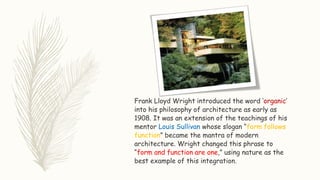
Frank Lloyd Wright introduced the word ‘organic’
into his philosophy of architecture as early as
1908. It was an extension of the teachings of his
mentor Louis Sullivan whose slogan “form follows
function” became the mantra of modern
architecture. Wright changed this phrase to
“form and function are one,” using nature as the
best example of this integration.
Although the word ‘organic’ in common usage
refers to something which has the
characteristics of animals or plants, Frank Lloyd
Wright’s organic architecture takes on a new
meaning. It is not a style of imitation, because he
did not claim to be building forms which were
representative of nature. Instead, organic
architecture is a reinterpretation of nature’s
principles as they had been filtered through the
intelligent minds of men and women who could
then build forms which are more natural than
nature itself.
Organic architecture involves a respect for the
properties of the materials—you don’t twist steel
into a flower—and a respect for the harmonious
relationship between the form/design and the
function of the building (for example, Wright
rejected the idea of making a bank look like a
Greek temple). Organic architecture is also an
attempt to integrate the spaces into a coherent
whole: a marriage between the site and the
structure and a union between the context and
the structure
When asked in 1939 if there was a way to control
a client’s potentially bad taste in selecting
housing designs for his Broadacre City project,
Wright replied, “Even if he wanted bad ones he
could find only good ones because in an organic
architecture, that is to say an architecture based
upon organic ideals, bad design would be
unthinkable.” In this way, the question of style
was not important to Frank Lloyd Wright. A
building was a product of its place and its time,
intimately connected to a particular moment and
site—never the result of an imposed style.
“I do not believe in adding enrichment merely for the sake of
enrichment. Unless it adds clearness to the enunciation of the
theme, it is undesirable, for it is very little understood.”
WORDS OF FLW
Wright gave careful consideration to the materials he
used. He chose materials based on their natural
strengths and properties. He focus wasn’t on dressing
his building and getting more complication.
Frank Lloyd Wright was famous for his quote, “No
house should ever be on a hill or on anything. It should
be of the hill. Belonging to it. Hill and house should live
together, each the happier for the other.” Wright
carefully designed buildings that were a continuation
of their surrounding environment. He applied this
philosophy to all of his works. Falling water is a
textbook example. Its cantilevers mirror the rock
formation that creates the waterfall immediately
below the structure. Wright liked to mix indoor and
outdoor spaces. The light screens, or glass walls,
wrapping the living spaces of Falling water bring the
outside environment into the house. The protruding
overhangs and shaded cantilevers pull the interior
spaces into the outside environment. The low profile of
his buildings ground them in the earth. The long, low
horizontals are meant to suggest a horizon.
Frank Lloyd Wright was a true pioneer. He was an
avant-garde architect whose ideals led to architectural
masterpieces that are relevant nearly a century later.
As designers, we can find inspiration in his
architectural philosophies. As with his buildings, every
detail in our designs should serve a purpose. We must
consider the nature of the materials and technologies
we use and figure out how to maximize their native
capabilities to achieve our goals.
If we adopt his views on form and function, then we
can simplify our interaction models by combining
content, form and UI. We should also consider each
part of the design and its contribution to the whole.
Finally, we might consider creating harmony in the
relationship between our digital design and the physical
device. In addition to the fundamental design
principles we use every day, these ideals could push our
work in new and exciting directions.
FAMIOUS BUILDINGS
OF
FRANK LLOYD WRIGHT
ROBIE HOUSE
The Frederick C. Robie House is a U.S. National Historic
Landmark on the campus of the University of Chicago in
the South Side neighborhood of Hyde
Park in Chicago, Illinois, at 5757 S. Built between 1909
and 1910, the building was designed by architect Frank
Lloyd Wright and is renowned as the greatest example of
the Prairie School style, the first architectural style
considered uniquely American
Wright designed the robie house for the man named
robie . He was the 28 year boy who was the assistant
manager in his dad’s company. Robie's tenure in his
home was short lived, however. As a result of financial
problems incurred by the death of his father in July
1908 and the deterioration of his marriage, Robie was
forced to sell the house after living in it for only
fourteen months. David Lee Taylor, president of
Taylor-Critchfield Company, an advertising agency,
bought the house and all of its Wright-designed
contents in December 1911. Taylor died less than a
year later, and his widow, Ellen Taylor, sold the house
and most of its contents to Marshall D. Wilber,
treasurer of the Wilber Mercantile Agency, in
November 1912. The Wilbers were the last family to
live in Robie House, living there for fourteen years.
Further they sold the house for institutional purpose.
HISTORY OF ROBIE HOUSE
EXTERIOR
OF
ROBIE HOUSE
The projecting cantilevered roof eaves, continuous
bands of art-glass windows, and the use of Roman
brick emphasize the horizontal, which had rich
associations for Wright. The horizontal line reminded
him of the American prairie and was a line of repose
and shelter, appropriate for a house. The exterior
walls are double-wythe construction of a Chicago
common brick core with a red-orange iron-spotted
Roman brick veneer. To further emphasize the
horizontal of the bricks, the horizontal joints were
filled with a cream-colored mortar and the small
vertical joints were filled with brick-colored mortar.
From a distance, this complex and
expensive tuckpointing creates an impression
of continuous lines of horizontal color and
minimizes the appearance of individual bricks.
The design of the art glass windows is an
abstract pattern of colored and clear glass
using Wright's favorite 30 and 60-degree
angles. Wright used similar designs in
tapestries inside the house and for gates
surrounding the outdoor spaces and enclosing
the garage courtyard. Robie's generous
budget allowed Wright to design a house with
a largely steel structure.
INTERIOR
OF
ROBIE HOUSE
GROUND FLOOR
In plan, the house is designed as two large
rectangles that seem to slide by one another. Mr.
Wright referred to the rectangle on the southwest
portion of the site, which contains the principal living
spaces of the house, as "the major vessel." On the
ground floor are the "billiards" room (west end) and
children's playroom (east end). The billiards room
provided access to a large walk-in safe and a storage
area built underneath the front porch projection at
the west end of the site. The billiards and playroom
open into a small passage and doors near the center
of the building to an enclosed garden on the south
side of the building. Another door from the playroom
opens into the courtyard on the east end of the site.
On the ground floor is the main door and entrance
hall (west end) from which a stairway leads to the
second floor living and dining rooms. A half bath is
located on the north side of the entrance hall.
Further east are a coat closet and back stairway,
the boiler room, laundry room, and coal storage
room, followed by a small workshop, half bath, and a
three-car garage. The westernmost bay of the
garage originally contained a mechanic’s pit, and the
eastern most bay contained equipment to wash and
clean automobiles.
FIRST FLOOR
On the second floor are the entry hall at the top of the
central stairway, the living room (west end) and the
dining room (east end). Built-in inglenook bench cabinetry
originally separated the entry hallway from the living
room. The living and dining rooms flow into one another
along the south side of the building and open through a
series of twelve French doors containing art glass panels
to an exterior balcony running the length of the south
side of the building that overlooks the enclosed garden.
The west end of the living room contains a “prow” with
art glass windows and two art glass doors that open onto
the west porch beneath the cantilevered roof. Wright
intended that the users of the building move freely from
the interior space to the exterior space.`
The rectangle on the northeast portion of the
site, called "the minor vessel," contains the
more functional and service-related rooms of
the house. On the second floor of the minor
vessel is a guest bedroom above the entrance
hall and an adjoining full bath. East of the back
stairway are the kitchen and butler’s pantry,
and the servants’ sitting room. Two bedrooms
and a full bathroom above the garage complete
the quarters for the live-in servants.
THIRD FLOOR
The third floor overlaps the major and minor vessels
in the center of the building. Wright referred to the
third floor as the “belvedere,” the “place in command
of beautiful views.” The south side of the third floor
contains the master bedroom, dressing area, a full
bathroom, and, through a small closet and an art glass
door, a balcony facing south and west. Two additional
bedrooms and a full bathroom are located on the
north side of this floor. All of the windows on this
level contain art glass panels. Dresser drawers are
built into the walls of the bedrooms underneath the
windows, and project into the eave spaces.
Wright used 179 glass in house and of 29 different types.
Here are some of them :-
One another best thing in robie house is :-
FALLING WATER HOUSE
Falling water or the Kaufmann Residence is a house
designed by architect Frank Lloyd Wright in 1935 in
rural southwestern Pennsylvania, 43 miles (69 km)
southeast of Pittsburgh. The home was built partly over a
waterfall on Bear Run in the Mill Run section of Stewart
Township, Fayette County, Pennsylvania, in the Laurel
Highlands of the Allegheny Mountains. The house was
designed as a weekend home for the family of Liliane
Kaufmann and her husband, Edgar J. Kaufmann, owner
of Kaufmann's department store. Time cited it after its
completion as Wright's "most beautiful job"; it is listed
among Smithsonian's Life List of 28 places "to visit before
you die“. In 1991, members of the American Institute of
Architects named the house the "best all-time work of
American architecture" and in 2007.
Falling water stands as one of Wright's greatest
masterpieces both for its dynamism and for its
integration with the striking natural
surroundings. Falling water has been described
as an architectural tour de force of Wright's
organic philosophy. Wright's passion
for Japanese architecture was strongly
reflected in the design of Falling water,
particularly in the importance of
interpenetrating exterior and interior spaces
and the strong emphasis placed on harmony
between man and nature.
Falling water was the family's weekend home from
1937 until 1963, when Kaufmann, jr., donated the
property to the Western Pennsylvania Conservancy. In
1964, it was opened to the public as a museum. The
house (according to the informational pamphlet
distributed on the grounds) hosts more than 120,000
visitors each year.
Years later Kaufmann, jr., said, "[Wright] understood
that people were creatures of nature, hence an
architecture which conformed to nature would
conform to what was basic in people.
SOME THING ABOUT
DESIGH OF FALLING WATER
HOUSE
This organically designed private residence was
intended to be a nature retreat for its owners. The
house is well-known for its connection to the site; it is
built on top of an active waterfall which flows beneath
the house. The fireplace hearth in the living room
integrates boulders found on the site and upon which
the house was built — ledge rock which protrudes up to
a foot through the living room floor was left in place to
demonstrably link the outside with the inside. Wright
had initially intended that the ledge be cut flush with
the floor, but this had been one of the Kaufmann
family's favorite sunning spots, so Mr. Kaufmann
suggested that it be left as it was. The stone floors
are waxed, while the hearth is left plain, giving the
impression of dry rocks protruding from a stream.
On the hillside above the main house stands a
four-bay carport, servants' quarters, and a guest
house. These attached outbuildings were built two
years later using the same quality of materials
and attention to detail as the main house. The
guest quarters feature a spring-fed swimming
pool which overflows and drains to the river
below.
Wright had planned in the beginning to have the
house blend into its natural settings in rural
Pennsylvania. In doing this, he limited his color
choices to two colors, light ochre for the
concrete and his signature Cherokee red for the
steel.
Frank lloyd wright
Frank lloyd wright
Frank lloyd wright
Frank lloyd wright

Frank lloyd wright

  • 1.
    OM INSTITURE OFARCHITECTURE AND DESIGN TOPIC :- AR. FRANK LLOYD WRIGHT SUBMITED TO : AR. ROHIT SIR SUBMITTED BY : GIRDHAR ROLL NO. : 1610463001 BRANCH : B.ARCH 3rd SEM
  • 2.
  • 3.
    Frank Lloyd Wright(June 8, 1867 – April 9, 1959) was an American architect, interior designer, writer, and educator, who designed more than 1,000 structures, 532 of which were completed. Wright believed in designing structures that were in harmony with humanity and its environment, a philosophy he called organic architecture. This philosophy was best exemplified by Falling water (1935). He often designed interior elements for these buildings as well, including furniture and stained glass.
  • 4.
    Wright attended MadisonHigh School, but there is no evidence of his graduation. He was admitted to the University of Wisconsin–Madison as a special student in 1886. There he joined Phi Delta Theta fraternity, took classes part-time for two semesters, and worked with a professor of civil engineering, Allan D. Conover.Wright left the school without taking a degree EDUCATION OF F.L.W
  • 5.
  • 6.
    Frank Lloyd Wrightintroduced the word ‘organic’ into his philosophy of architecture as early as 1908. It was an extension of the teachings of his mentor Louis Sullivan whose slogan “form follows function” became the mantra of modern architecture. Wright changed this phrase to “form and function are one,” using nature as the best example of this integration.
  • 7.
    Although the word‘organic’ in common usage refers to something which has the characteristics of animals or plants, Frank Lloyd Wright’s organic architecture takes on a new meaning. It is not a style of imitation, because he did not claim to be building forms which were representative of nature. Instead, organic architecture is a reinterpretation of nature’s principles as they had been filtered through the intelligent minds of men and women who could then build forms which are more natural than nature itself.
  • 8.
    Organic architecture involvesa respect for the properties of the materials—you don’t twist steel into a flower—and a respect for the harmonious relationship between the form/design and the function of the building (for example, Wright rejected the idea of making a bank look like a Greek temple). Organic architecture is also an attempt to integrate the spaces into a coherent whole: a marriage between the site and the structure and a union between the context and the structure
  • 9.
    When asked in1939 if there was a way to control a client’s potentially bad taste in selecting housing designs for his Broadacre City project, Wright replied, “Even if he wanted bad ones he could find only good ones because in an organic architecture, that is to say an architecture based upon organic ideals, bad design would be unthinkable.” In this way, the question of style was not important to Frank Lloyd Wright. A building was a product of its place and its time, intimately connected to a particular moment and site—never the result of an imposed style.
  • 10.
    “I do notbelieve in adding enrichment merely for the sake of enrichment. Unless it adds clearness to the enunciation of the theme, it is undesirable, for it is very little understood.” WORDS OF FLW
  • 11.
    Wright gave carefulconsideration to the materials he used. He chose materials based on their natural strengths and properties. He focus wasn’t on dressing his building and getting more complication.
  • 12.
    Frank Lloyd Wrightwas famous for his quote, “No house should ever be on a hill or on anything. It should be of the hill. Belonging to it. Hill and house should live together, each the happier for the other.” Wright carefully designed buildings that were a continuation of their surrounding environment. He applied this philosophy to all of his works. Falling water is a textbook example. Its cantilevers mirror the rock formation that creates the waterfall immediately below the structure. Wright liked to mix indoor and outdoor spaces. The light screens, or glass walls, wrapping the living spaces of Falling water bring the outside environment into the house. The protruding overhangs and shaded cantilevers pull the interior spaces into the outside environment. The low profile of his buildings ground them in the earth. The long, low horizontals are meant to suggest a horizon.
  • 13.
    Frank Lloyd Wrightwas a true pioneer. He was an avant-garde architect whose ideals led to architectural masterpieces that are relevant nearly a century later. As designers, we can find inspiration in his architectural philosophies. As with his buildings, every detail in our designs should serve a purpose. We must consider the nature of the materials and technologies we use and figure out how to maximize their native capabilities to achieve our goals. If we adopt his views on form and function, then we can simplify our interaction models by combining content, form and UI. We should also consider each part of the design and its contribution to the whole. Finally, we might consider creating harmony in the relationship between our digital design and the physical device. In addition to the fundamental design principles we use every day, these ideals could push our work in new and exciting directions.
  • 14.
  • 15.
  • 16.
    The Frederick C.Robie House is a U.S. National Historic Landmark on the campus of the University of Chicago in the South Side neighborhood of Hyde Park in Chicago, Illinois, at 5757 S. Built between 1909 and 1910, the building was designed by architect Frank Lloyd Wright and is renowned as the greatest example of the Prairie School style, the first architectural style considered uniquely American
  • 17.
    Wright designed therobie house for the man named robie . He was the 28 year boy who was the assistant manager in his dad’s company. Robie's tenure in his home was short lived, however. As a result of financial problems incurred by the death of his father in July 1908 and the deterioration of his marriage, Robie was forced to sell the house after living in it for only fourteen months. David Lee Taylor, president of Taylor-Critchfield Company, an advertising agency, bought the house and all of its Wright-designed contents in December 1911. Taylor died less than a year later, and his widow, Ellen Taylor, sold the house and most of its contents to Marshall D. Wilber, treasurer of the Wilber Mercantile Agency, in November 1912. The Wilbers were the last family to live in Robie House, living there for fourteen years. Further they sold the house for institutional purpose. HISTORY OF ROBIE HOUSE
  • 18.
  • 19.
    The projecting cantileveredroof eaves, continuous bands of art-glass windows, and the use of Roman brick emphasize the horizontal, which had rich associations for Wright. The horizontal line reminded him of the American prairie and was a line of repose and shelter, appropriate for a house. The exterior walls are double-wythe construction of a Chicago common brick core with a red-orange iron-spotted Roman brick veneer. To further emphasize the horizontal of the bricks, the horizontal joints were filled with a cream-colored mortar and the small vertical joints were filled with brick-colored mortar.
  • 20.
    From a distance,this complex and expensive tuckpointing creates an impression of continuous lines of horizontal color and minimizes the appearance of individual bricks. The design of the art glass windows is an abstract pattern of colored and clear glass using Wright's favorite 30 and 60-degree angles. Wright used similar designs in tapestries inside the house and for gates surrounding the outdoor spaces and enclosing the garage courtyard. Robie's generous budget allowed Wright to design a house with a largely steel structure.
  • 21.
  • 22.
  • 23.
    In plan, thehouse is designed as two large rectangles that seem to slide by one another. Mr. Wright referred to the rectangle on the southwest portion of the site, which contains the principal living spaces of the house, as "the major vessel." On the ground floor are the "billiards" room (west end) and children's playroom (east end). The billiards room provided access to a large walk-in safe and a storage area built underneath the front porch projection at the west end of the site. The billiards and playroom open into a small passage and doors near the center of the building to an enclosed garden on the south side of the building. Another door from the playroom opens into the courtyard on the east end of the site.
  • 24.
    On the groundfloor is the main door and entrance hall (west end) from which a stairway leads to the second floor living and dining rooms. A half bath is located on the north side of the entrance hall. Further east are a coat closet and back stairway, the boiler room, laundry room, and coal storage room, followed by a small workshop, half bath, and a three-car garage. The westernmost bay of the garage originally contained a mechanic’s pit, and the eastern most bay contained equipment to wash and clean automobiles.
  • 26.
  • 27.
    On the secondfloor are the entry hall at the top of the central stairway, the living room (west end) and the dining room (east end). Built-in inglenook bench cabinetry originally separated the entry hallway from the living room. The living and dining rooms flow into one another along the south side of the building and open through a series of twelve French doors containing art glass panels to an exterior balcony running the length of the south side of the building that overlooks the enclosed garden. The west end of the living room contains a “prow” with art glass windows and two art glass doors that open onto the west porch beneath the cantilevered roof. Wright intended that the users of the building move freely from the interior space to the exterior space.`
  • 28.
    The rectangle onthe northeast portion of the site, called "the minor vessel," contains the more functional and service-related rooms of the house. On the second floor of the minor vessel is a guest bedroom above the entrance hall and an adjoining full bath. East of the back stairway are the kitchen and butler’s pantry, and the servants’ sitting room. Two bedrooms and a full bathroom above the garage complete the quarters for the live-in servants.
  • 30.
  • 31.
    The third flooroverlaps the major and minor vessels in the center of the building. Wright referred to the third floor as the “belvedere,” the “place in command of beautiful views.” The south side of the third floor contains the master bedroom, dressing area, a full bathroom, and, through a small closet and an art glass door, a balcony facing south and west. Two additional bedrooms and a full bathroom are located on the north side of this floor. All of the windows on this level contain art glass panels. Dresser drawers are built into the walls of the bedrooms underneath the windows, and project into the eave spaces.
  • 33.
    Wright used 179glass in house and of 29 different types. Here are some of them :-
  • 34.
    One another bestthing in robie house is :-
  • 35.
  • 36.
    Falling water orthe Kaufmann Residence is a house designed by architect Frank Lloyd Wright in 1935 in rural southwestern Pennsylvania, 43 miles (69 km) southeast of Pittsburgh. The home was built partly over a waterfall on Bear Run in the Mill Run section of Stewart Township, Fayette County, Pennsylvania, in the Laurel Highlands of the Allegheny Mountains. The house was designed as a weekend home for the family of Liliane Kaufmann and her husband, Edgar J. Kaufmann, owner of Kaufmann's department store. Time cited it after its completion as Wright's "most beautiful job"; it is listed among Smithsonian's Life List of 28 places "to visit before you die“. In 1991, members of the American Institute of Architects named the house the "best all-time work of American architecture" and in 2007.
  • 37.
    Falling water standsas one of Wright's greatest masterpieces both for its dynamism and for its integration with the striking natural surroundings. Falling water has been described as an architectural tour de force of Wright's organic philosophy. Wright's passion for Japanese architecture was strongly reflected in the design of Falling water, particularly in the importance of interpenetrating exterior and interior spaces and the strong emphasis placed on harmony between man and nature.
  • 38.
    Falling water wasthe family's weekend home from 1937 until 1963, when Kaufmann, jr., donated the property to the Western Pennsylvania Conservancy. In 1964, it was opened to the public as a museum. The house (according to the informational pamphlet distributed on the grounds) hosts more than 120,000 visitors each year. Years later Kaufmann, jr., said, "[Wright] understood that people were creatures of nature, hence an architecture which conformed to nature would conform to what was basic in people.
  • 39.
    SOME THING ABOUT DESIGHOF FALLING WATER HOUSE
  • 40.
    This organically designedprivate residence was intended to be a nature retreat for its owners. The house is well-known for its connection to the site; it is built on top of an active waterfall which flows beneath the house. The fireplace hearth in the living room integrates boulders found on the site and upon which the house was built — ledge rock which protrudes up to a foot through the living room floor was left in place to demonstrably link the outside with the inside. Wright had initially intended that the ledge be cut flush with the floor, but this had been one of the Kaufmann family's favorite sunning spots, so Mr. Kaufmann suggested that it be left as it was. The stone floors are waxed, while the hearth is left plain, giving the impression of dry rocks protruding from a stream.
  • 41.
    On the hillsideabove the main house stands a four-bay carport, servants' quarters, and a guest house. These attached outbuildings were built two years later using the same quality of materials and attention to detail as the main house. The guest quarters feature a spring-fed swimming pool which overflows and drains to the river below. Wright had planned in the beginning to have the house blend into its natural settings in rural Pennsylvania. In doing this, he limited his color choices to two colors, light ochre for the concrete and his signature Cherokee red for the steel.