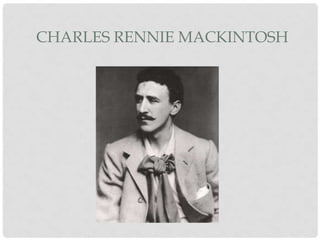
CHARLES RENNIE MACKINTOSH
BACKGROUND

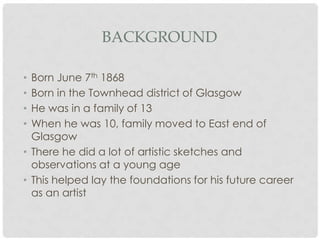
• Born June 7th 1868
• Born in the Townhead district of Glasgow
• He was in a family of 13
• When he was 10, family moved to East end of
  Glasgow
• There he did a lot of artistic sketches and
  observations at a young age
• This helped lay the foundations for his future career
  as an artist
EDUCATION

• His education started with
  an architecture
  apprenticeship in 1884 to
  John Hutchison
• In the same year he
  enrolled for architecture
  evening classes at the
  Glasgow School of Art
  where he met his future
  wife, Margaret MacDonald
• He also did a painting class
  from 1884-85
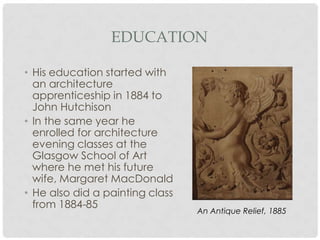
                                 An Antique Relief, 1885
EARLY WORK
• His classes lead to him
  becoming a junior
  draughtsman in 1889, for the
  offices of Honeyman and
  Keppie – a large architecture
  firm in Glasgow
• In 1890 he was awarded a
  travel scholarship for his
  work, which funded a trip to
  Italy. This reinvigorated him
  gave him a new perspective
  for his work
• In 1896 he won a competition
  to design the new Glasgow
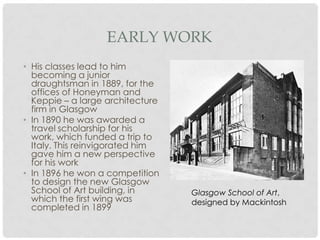
  School of Art building, in      Glasgow School of
  which the first wing was        Art, designed by Mackintosh
  completed in 1899
THE FOUR
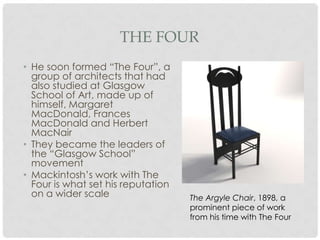
• He soon formed “The Four”, a
  group of architects that had
  also studied at Glasgow
  School of Art, made up of
  himself, Margaret
  MacDonald, Frances
  MacDonald and Herbert
  MacNair
• They became the leaders of
  the “Glasgow School”
  movement
• Mackintosh’s work with The
  Four is what set his reputation
  on a wider scale                  The Argyle Chair, 1898, a
                                    prominent piece of work
                                    from his time with The Four
LATER WORK

• In 1904 Mackintosh became a
  partner of Honeyman and
  Keppie, and in 1907 the second
  wing of the Glasgow School of Art
  was completed
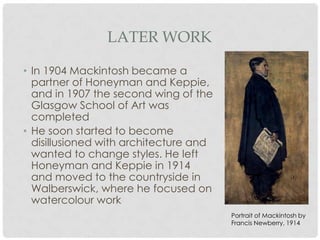
• He soon started to become
  disillusioned with architecture and
  wanted to change styles. He left
  Honeyman and Keppie in 1914
  and moved to the countryside in
  Walberswick, where he focused on
  watercolour work
                                        Portrait of Mackintosh by
                                        Francis Newberry, 1914
DEATH
• In 1927 Mackintosh was
  forced to move to London
  from his house in
  France, due to illness
• That year he was
  diagnosed with
  cancer, but a brief
  recovery left him resting at
  home a few months
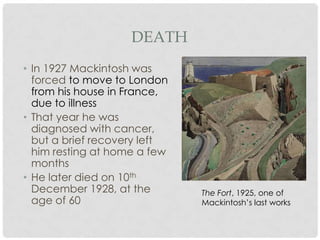
• He later died on 10th
  December 1928, at the          The Fort, 1925, one of
  age of 60                      Mackintosh’s last works
INFLUENCES

• Mackintosh held the ideologies of John Ruskin and
  AWN Pugin, who championed the gothic revival
  and arts and crafts movements - honestly of
  craft, ethical design, etc
• He was also very much influenced by Japanese
  design, he liked the idea of the simple forms and
  natural materials used in their designs
• These helped start his own design style: a contrast of
  strong right angles and floral decoration
LEGACY
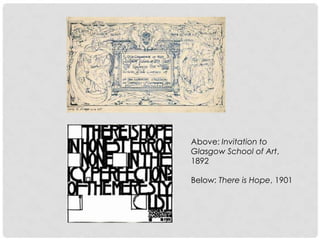
• To this day, Mackintosh is still influential to contemporary
  design. His graphic works are still looked at today as examples
  of art nouveau with a blend of early modernism. His
  combination of Japanism with the European movements is still
  revered today.
• Through his architectural work with The Four, we can see the
  concepts and principles they used are still relevant in design
  and architecture work currently.
• His shift in artistic style from architecture to more traditional
  watercolours and paintings was unheard of at the time and
  still is, we found it very interesting that he would give up his
  whole career and reputation as an architect just to pursue
  new styles.
Above: Invitation to
Glasgow School of
Art, 1892

Below: There is Hope, 1901
BIBLIOGRAPHY

• Books:
• Baxter, C. & Moffat, A. (1989). Remembering
  Charles Rennie Mackintosh: An Illustrated
  Bibliography. Britain: Colin Baxter Photography Ltd.
• Buchanan, W., Macauley, J., Macmillan, A., Rawson
  , G. & Trowles, P. (1989). Mackintosh’s Masterwork.
  San Francisco: Chronicle Books
• Cooper, J. (1978). Mackintosh Architecture. London:
  Academy Editions
• Nuttgens, P (1988). Mackintosh and his
  Contemporaries. London: John Murry Ltd.
BIBLIOGRAPHY

• Websites:
• Hunterian Art Gallery (2012). Mackintosh Online
  Catalogue. Retrieved from
  http://www.huntsearch.gla.ac.uk/mackintosh/
• Ryan, V. (2012). An Introduction to Charles Rennie
  Mackintosh. Retrieved from
  http://www.technologystudent.com/joints/rennie1.
  html
• Scotcities (2013). Charles Rennie Mackintosh –
  Architect & Designer. Retrieved from
  http://www.scotcities.com/mackintosh/
BIBLIOGRAPHY
• Images part one:
• Annan, J. (1893). [Photograph of Charles Rennie Mackintosh]. Retrieved from:
  http://www.abbeville.com/interiors.asp?ISBN=1558597913
• Annan, R. & Annan, T. (1907). [Photograph of the Glasgow School of Art].
  Retrieved from:
  http://www.britannica.com/EBchecked/media/12761/Glasgow-School-of-Art-
  library-by-Charles-Mackintosh-1907-09
• Mackintosh, C.R. (1892). Invitation to the Glasgow School of Art. [Drawing]
  Retrieved from: http://www.huntsearch.gla.ac.uk/cgi-
  bin/foxweb/huntsearch_Mackintosh/DetailedResults.fwx?searchTerm=41544
• Mackintosh, C.R. (1898). Argyle Chair. [Furniture] Retrieved from:
  http://latinlover1102.wordpress.com/2009/08/24/old-and-new-designer/
• Mackintosh, C.R. (1901). There is Hope. [Drawing] Retrieved from:
  http://fiddlesticksandnonsense.squarespace.com/posts-
  old/2009/7/14/mackintoshthere-is-hope.html
BIBLIOGRAPHY
• Images part two:
• Mackintosh, C.R. (1898). Argyle Chair. [Furniture] Retrieved from:
  http://latinlover1102.wordpress.com/2009/08/24/old-and-new-
  designer/
• Mackintosh, C.R. (1886). An Antique Relief. [Painting] Retrieved from:
  http://www.huntsearch.gla.ac.uk/cgi-
  bin/foxweb/huntsearch_Mackintosh/DetailedResults.fwx?SearchTerm
  =41030&reqMethod=Link
• Mackintosh, C.R. (1925). The Fort. [Painting] Retrieved from:
  http://www.collioure.com.au/mackintosh3.htm
• Newberry, F. (1914). Charles Rennie Mackintosh. [Painting] Retrieved
  from: http://www.nationalgalleries.org/collection/artists-a-
  z/N/3620/artist_name/Francis%20Henry%20Newbery/record_id/2644
THE TEAM

•   Amy Young
•   Chandler Heath
•   Heston Hawe
•   Shangyuan “Giles” Yang

• Presenters: Chandler and Heston
• All team members worked on all other aspects of
  the project equally

Charles Rennie Mackintosh

  • 1.
  • 2.
    BACKGROUND • Born June7th 1868 • Born in the Townhead district of Glasgow • He was in a family of 13 • When he was 10, family moved to East end of Glasgow • There he did a lot of artistic sketches and observations at a young age • This helped lay the foundations for his future career as an artist
  • 3.
    EDUCATION • His educationstarted with an architecture apprenticeship in 1884 to John Hutchison • In the same year he enrolled for architecture evening classes at the Glasgow School of Art where he met his future wife, Margaret MacDonald • He also did a painting class from 1884-85 An Antique Relief, 1885
  • 4.
    EARLY WORK • Hisclasses lead to him becoming a junior draughtsman in 1889, for the offices of Honeyman and Keppie – a large architecture firm in Glasgow • In 1890 he was awarded a travel scholarship for his work, which funded a trip to Italy. This reinvigorated him gave him a new perspective for his work • In 1896 he won a competition to design the new Glasgow School of Art building, in Glasgow School of which the first wing was Art, designed by Mackintosh completed in 1899
  • 5.
    THE FOUR • Hesoon formed “The Four”, a group of architects that had also studied at Glasgow School of Art, made up of himself, Margaret MacDonald, Frances MacDonald and Herbert MacNair • They became the leaders of the “Glasgow School” movement • Mackintosh’s work with The Four is what set his reputation on a wider scale The Argyle Chair, 1898, a prominent piece of work from his time with The Four
  • 6.
    LATER WORK • In1904 Mackintosh became a partner of Honeyman and Keppie, and in 1907 the second wing of the Glasgow School of Art was completed • He soon started to become disillusioned with architecture and wanted to change styles. He left Honeyman and Keppie in 1914 and moved to the countryside in Walberswick, where he focused on watercolour work Portrait of Mackintosh by Francis Newberry, 1914
  • 7.
    DEATH • In 1927Mackintosh was forced to move to London from his house in France, due to illness • That year he was diagnosed with cancer, but a brief recovery left him resting at home a few months • He later died on 10th December 1928, at the The Fort, 1925, one of age of 60 Mackintosh’s last works
  • 8.
    INFLUENCES • Mackintosh heldthe ideologies of John Ruskin and AWN Pugin, who championed the gothic revival and arts and crafts movements - honestly of craft, ethical design, etc • He was also very much influenced by Japanese design, he liked the idea of the simple forms and natural materials used in their designs • These helped start his own design style: a contrast of strong right angles and floral decoration
  • 9.
    LEGACY • To thisday, Mackintosh is still influential to contemporary design. His graphic works are still looked at today as examples of art nouveau with a blend of early modernism. His combination of Japanism with the European movements is still revered today. • Through his architectural work with The Four, we can see the concepts and principles they used are still relevant in design and architecture work currently. • His shift in artistic style from architecture to more traditional watercolours and paintings was unheard of at the time and still is, we found it very interesting that he would give up his whole career and reputation as an architect just to pursue new styles.
  • 10.
    Above: Invitation to GlasgowSchool of Art, 1892 Below: There is Hope, 1901
  • 11.
    BIBLIOGRAPHY • Books: • Baxter,C. & Moffat, A. (1989). Remembering Charles Rennie Mackintosh: An Illustrated Bibliography. Britain: Colin Baxter Photography Ltd. • Buchanan, W., Macauley, J., Macmillan, A., Rawson , G. & Trowles, P. (1989). Mackintosh’s Masterwork. San Francisco: Chronicle Books • Cooper, J. (1978). Mackintosh Architecture. London: Academy Editions • Nuttgens, P (1988). Mackintosh and his Contemporaries. London: John Murry Ltd.
  • 12.
    BIBLIOGRAPHY • Websites: • HunterianArt Gallery (2012). Mackintosh Online Catalogue. Retrieved from http://www.huntsearch.gla.ac.uk/mackintosh/ • Ryan, V. (2012). An Introduction to Charles Rennie Mackintosh. Retrieved from http://www.technologystudent.com/joints/rennie1. html • Scotcities (2013). Charles Rennie Mackintosh – Architect & Designer. Retrieved from http://www.scotcities.com/mackintosh/
  • 13.
    BIBLIOGRAPHY • Images partone: • Annan, J. (1893). [Photograph of Charles Rennie Mackintosh]. Retrieved from: http://www.abbeville.com/interiors.asp?ISBN=1558597913 • Annan, R. & Annan, T. (1907). [Photograph of the Glasgow School of Art]. Retrieved from: http://www.britannica.com/EBchecked/media/12761/Glasgow-School-of-Art- library-by-Charles-Mackintosh-1907-09 • Mackintosh, C.R. (1892). Invitation to the Glasgow School of Art. [Drawing] Retrieved from: http://www.huntsearch.gla.ac.uk/cgi- bin/foxweb/huntsearch_Mackintosh/DetailedResults.fwx?searchTerm=41544 • Mackintosh, C.R. (1898). Argyle Chair. [Furniture] Retrieved from: http://latinlover1102.wordpress.com/2009/08/24/old-and-new-designer/ • Mackintosh, C.R. (1901). There is Hope. [Drawing] Retrieved from: http://fiddlesticksandnonsense.squarespace.com/posts- old/2009/7/14/mackintoshthere-is-hope.html
  • 14.
    BIBLIOGRAPHY • Images parttwo: • Mackintosh, C.R. (1898). Argyle Chair. [Furniture] Retrieved from: http://latinlover1102.wordpress.com/2009/08/24/old-and-new- designer/ • Mackintosh, C.R. (1886). An Antique Relief. [Painting] Retrieved from: http://www.huntsearch.gla.ac.uk/cgi- bin/foxweb/huntsearch_Mackintosh/DetailedResults.fwx?SearchTerm =41030&reqMethod=Link • Mackintosh, C.R. (1925). The Fort. [Painting] Retrieved from: http://www.collioure.com.au/mackintosh3.htm • Newberry, F. (1914). Charles Rennie Mackintosh. [Painting] Retrieved from: http://www.nationalgalleries.org/collection/artists-a- z/N/3620/artist_name/Francis%20Henry%20Newbery/record_id/2644
  • 15.
    THE TEAM • Amy Young • Chandler Heath • Heston Hawe • Shangyuan “Giles” Yang • Presenters: Chandler and Heston • All team members worked on all other aspects of the project equally