












Framework in Research
Dr. Bhavin C Chauhan
Founder
Blogger, Communication Consultant and Inspirational Speaker
Assistant Professor, Department of Education
Faculty of Education and Psychology
The Maharaja Sayajirao University of Baroda
Vadodara, Gujarat, India
bhavincchauhan@gmail.com
http://edutainmentwithbhavinchauhan.blogspot.com/
https://wordlifewithme.blogspot.com/
Mob. No. 9979896161
Framework in Research
In research, a framework offers a conceptual or theoretical
foundation, providing structure and support for the study.
Framework in Research
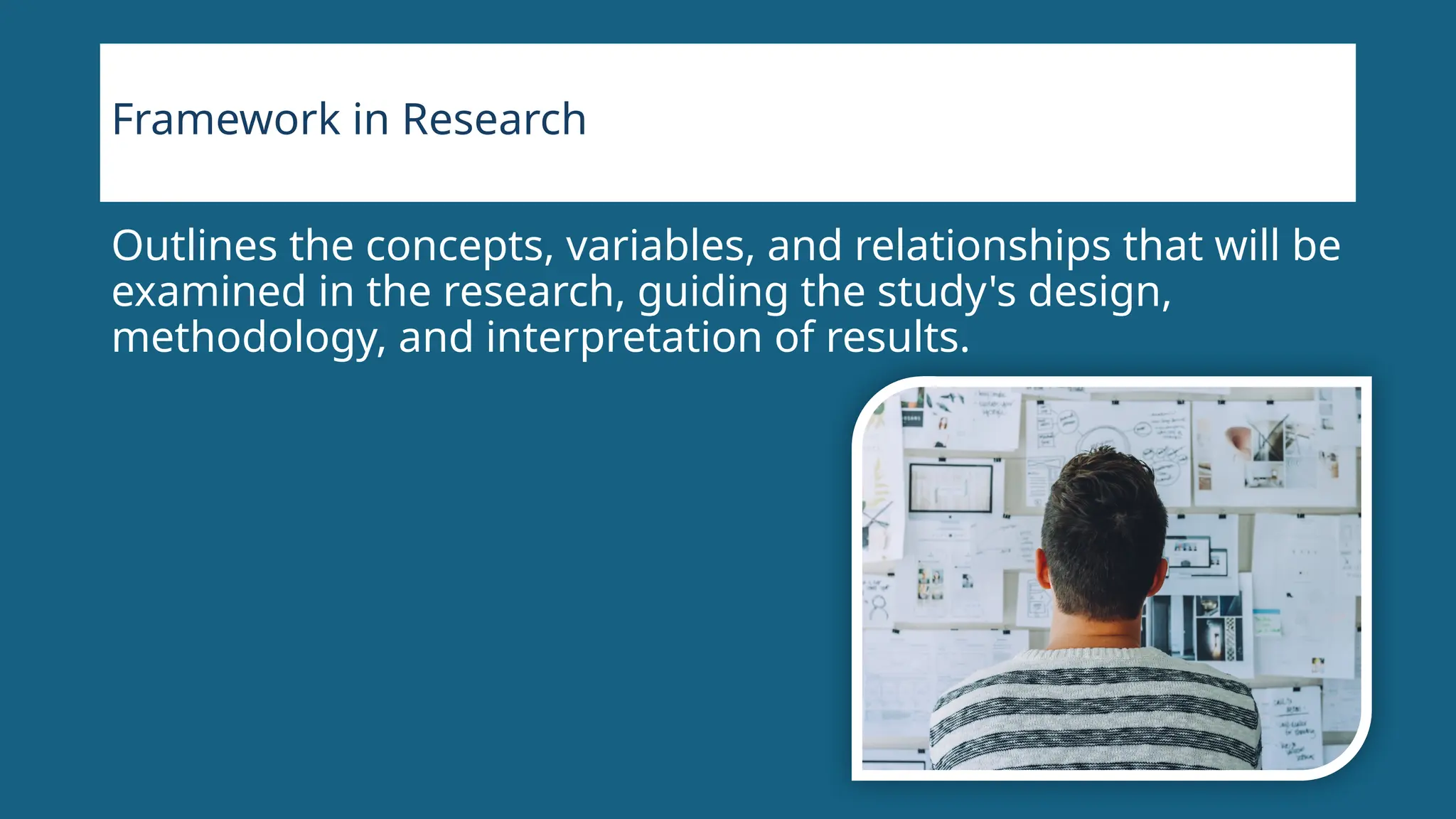
Outlines the concepts, variables, and relationships that will be
examined in the research, guiding the study's design,
methodology, and interpretation of results.
Framework in Research
Frameworks help the researcher to define what is being
studied, how it will be examined, and why it matters.
Importance of Frameworks
Importance of a Framework in Research
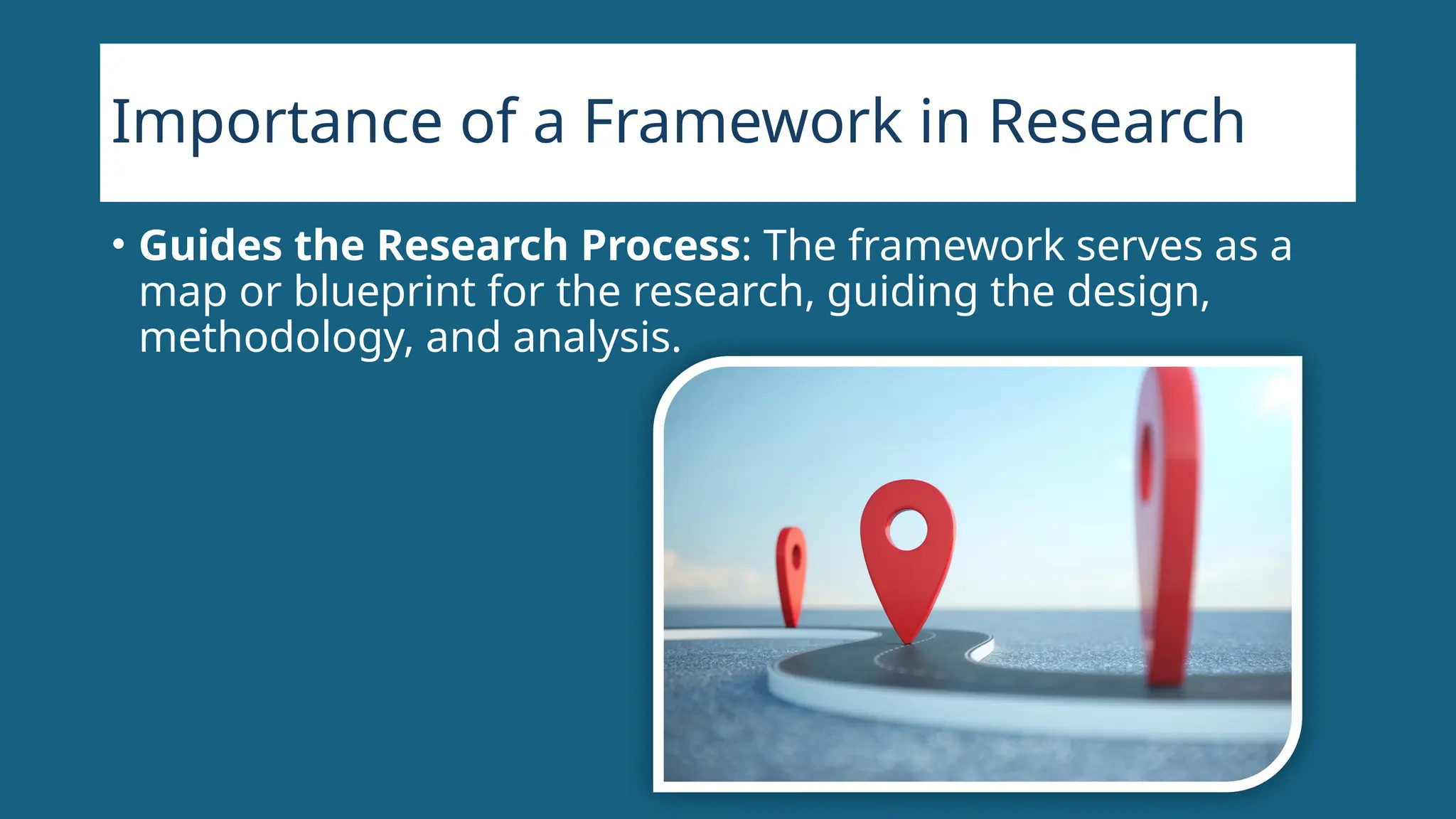
• Guides the Research Process: The framework serves as a
map or blueprint for the research, guiding the design,
methodology, and analysis.
Importance of a Framework in Research
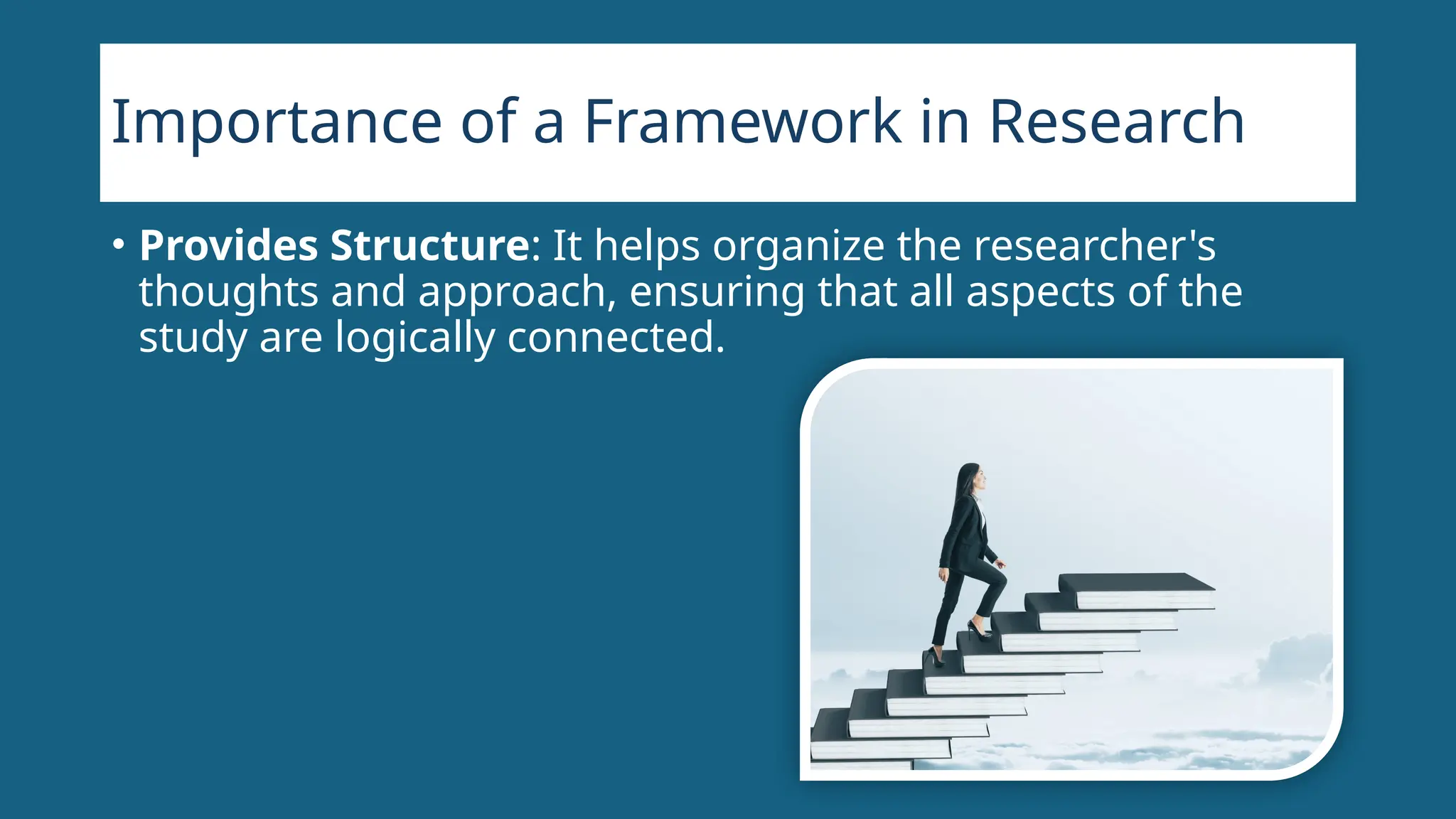
• Provides Structure: It helps organize the researcher's
thoughts and approach, ensuring that all aspects of the
study are logically connected.
Importance of a Framework in Research
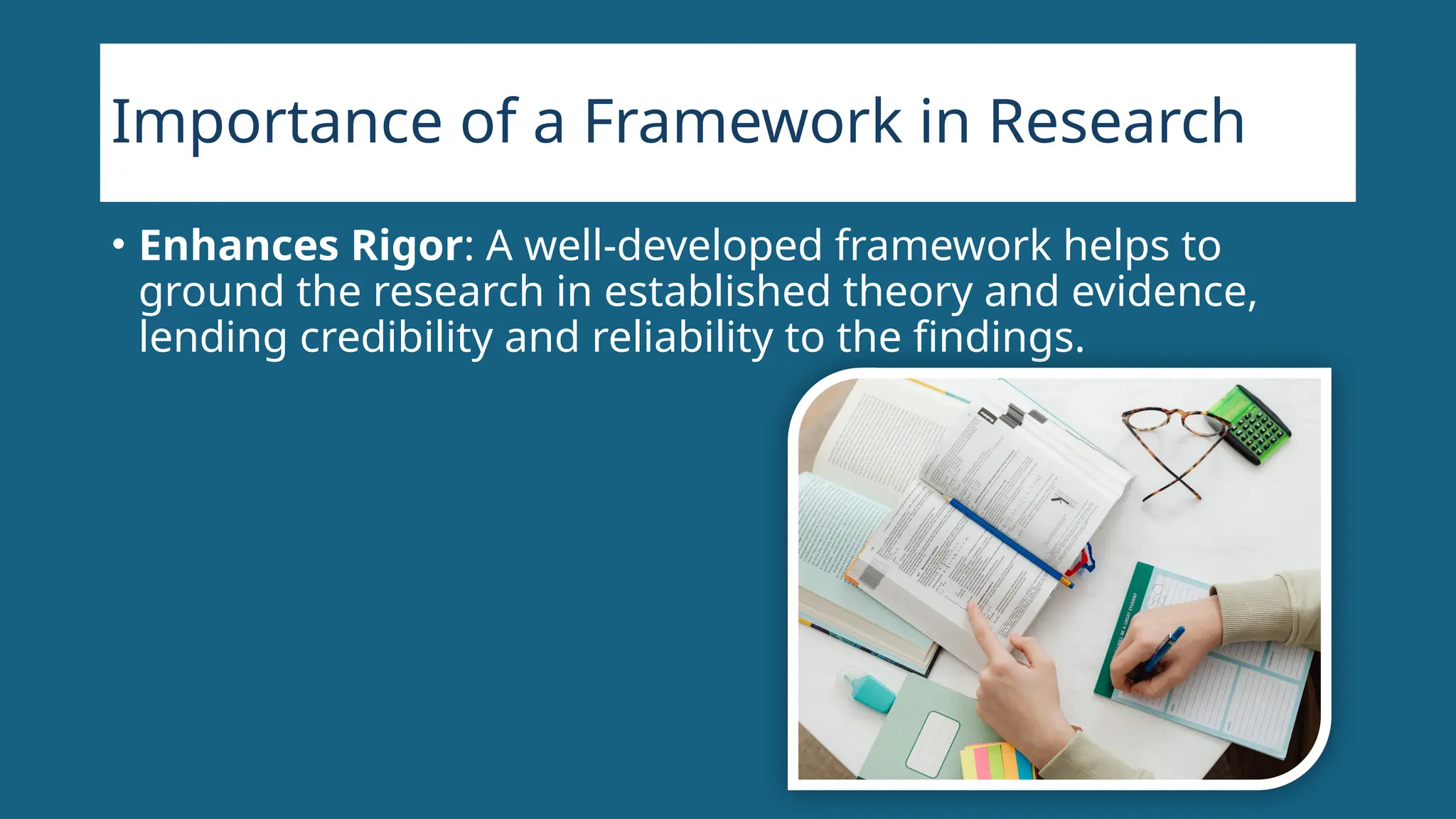
• Enhances Rigor: A well-developed framework helps to
ground the research in established theory and evidence,
lending credibility and reliability to the findings.
Importance of a Framework in Research
• Clarifies Concepts: The framework helps clarify key
concepts and variables, providing clear definitions and
relationships for the reader.
Importance of a Framework in Research
• Facilitates Communication: By outlining the theoretical or
conceptual foundations, the framework makes it easier to
communicate the research problem, purpose, and approach
to others.
Importance of a Framework in Research
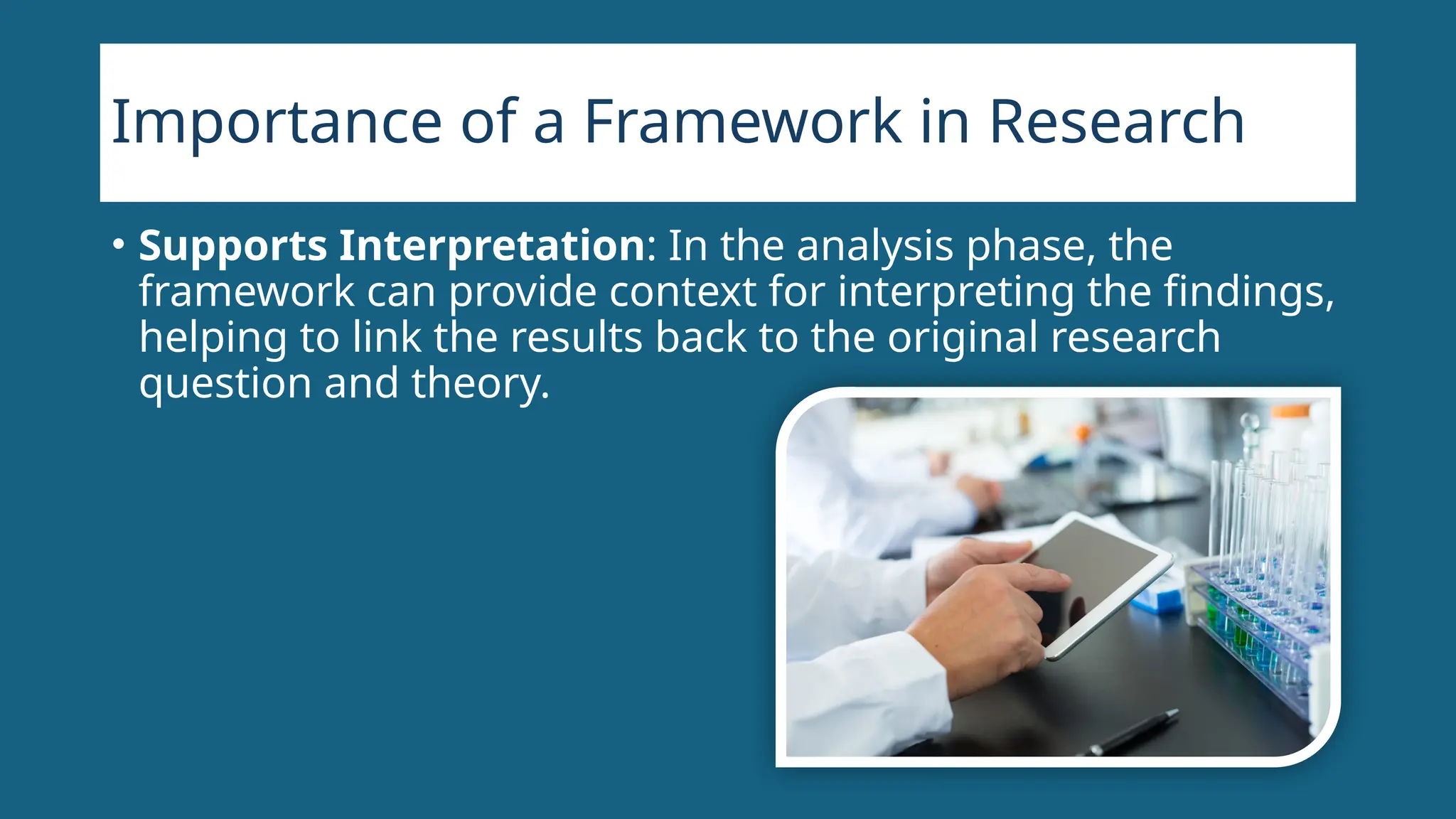
• Supports Interpretation: In the analysis phase, the
framework can provide context for interpreting the findings,
helping to link the results back to the original research
question and theory.
Types of Frameworks
Conceptual
Framework:
• This type organizes the ideas and
theories that underlie the research
problem. It’s based on existing
knowledge, models, and concepts.
Conceptual frameworks help to illustrate
how the researcher’s ideas and
hypotheses relate to the literature and
inform their research questions.
Theoretical
Framework
• The theoretical framework stems from a
specific theory or set of theories and is
used to support or challenge existing
knowledge. It’s often used in studies that
aim to validate or test a specific theory
or develop new theoretical perspectives.
Analytical Framework
• This framework helps the
researcher systematically
analyze data or information. It
is often used in qualitative
research to guide the process
of data categorization and
analysis.
Methodological Framework
• This focuses on the methods, strategies, and procedures
used in the research. It helps define the techniques for data
collection, analysis, and interpretation.
Principles of Frameworks
Principles of an
Effective
Framework
• Relevance: The framework should
be directly related to the research
problem and objectives. It should
contribute meaningfully to
understanding the problem.
Principles of an
Effective Framework
• Clarity: It must clearly define
key concepts, variables, and
relationships in a way that is
understandable to others.
Principles of an
Effective
Framework
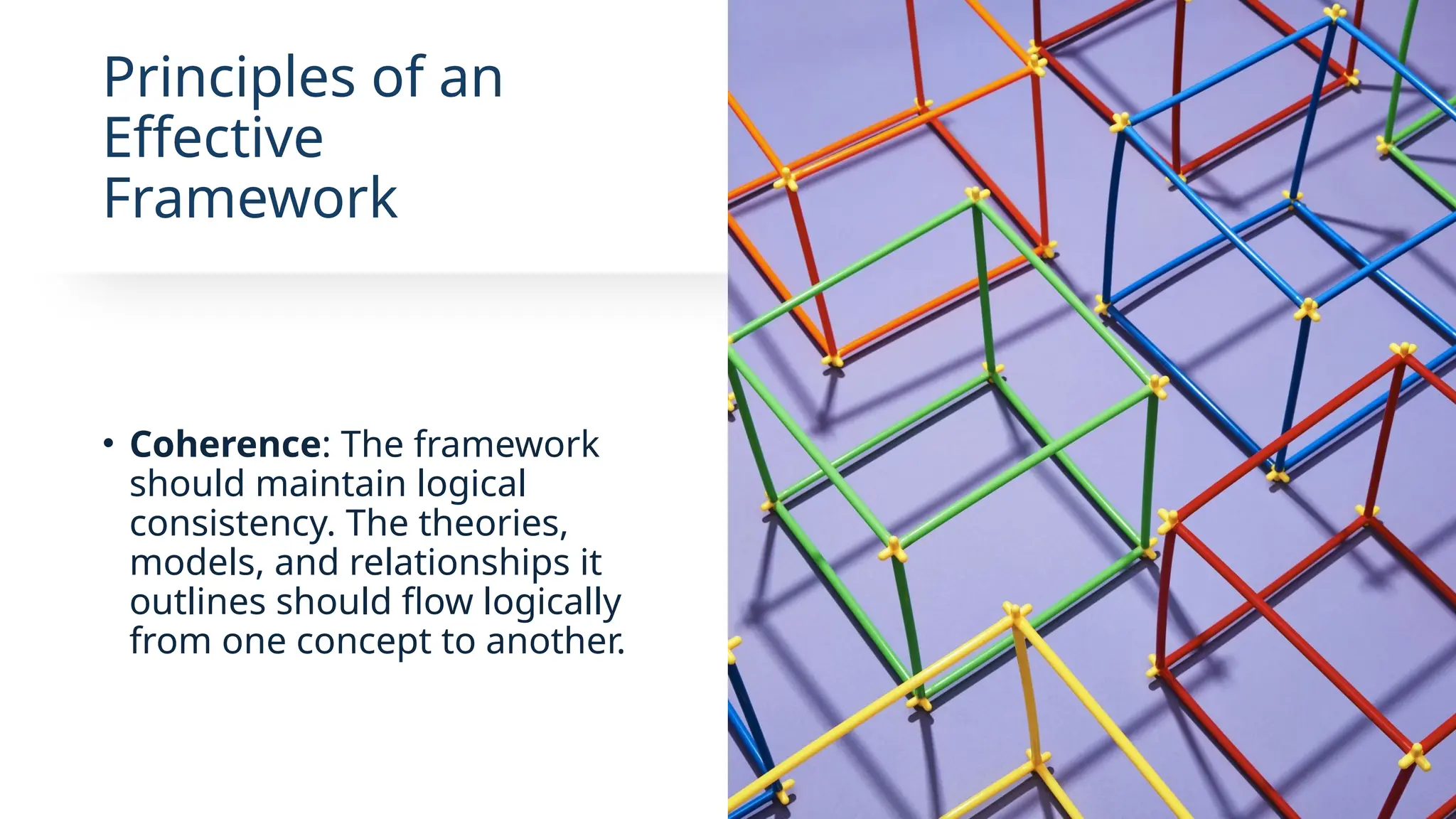
• Coherence: The framework
should maintain logical
consistency. The theories,
models, and relationships it
outlines should flow logically
from one concept to another.
Principles of an
Effective Framework
• Flexibility: While frameworks
provide structure, they should
also allow for adaptation based
on the progression of research.
Principles of an Effective Framework
• Rigor: The framework must be supported by literature,
research, and evidence. It should be grounded in theory and
concepts that have been rigorously developed or tested.
Steps for Frameworks
Steps to Develop an Effective Framework for
Research
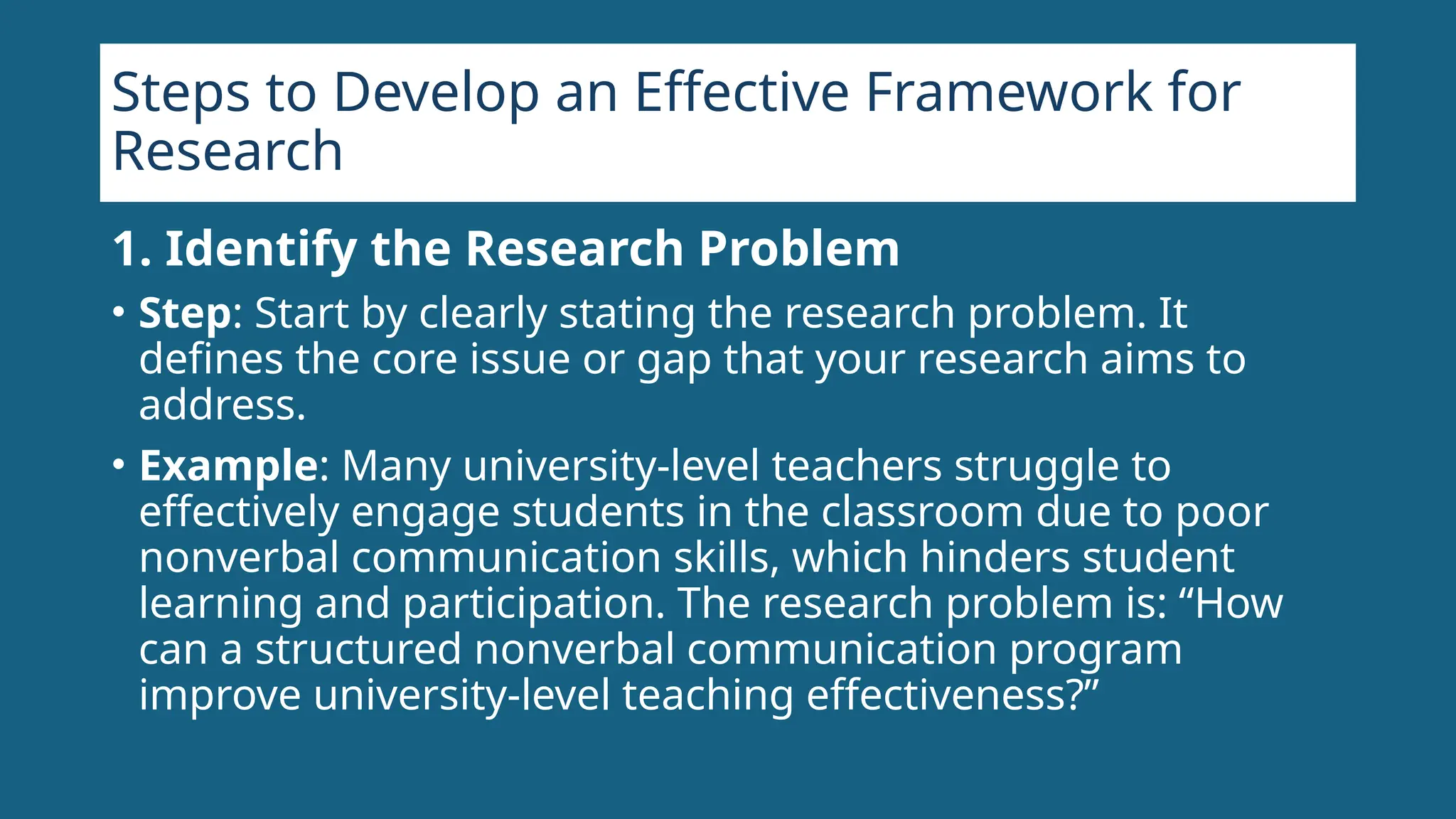
1. Identify the Research Problem
• Step: Start by clearly stating the research problem. It
defines the core issue or gap that your research aims to
address.
• Example: Many university-level teachers struggle to
effectively engage students in the classroom due to poor
nonverbal communication skills, which hinders student
learning and participation. The research problem is: “How
can a structured nonverbal communication program
improve university-level teaching effectiveness?”
Steps to Develop an Effective Framework
2. Conduct a Literature Review
• Step: Review existing research to understand what studies,
theories, and models are available on nonverbal communication
in educational settings. Identify key findings, gaps, and
opportunities for your own research.
• Example: After reviewing the literature, you find that research
highlights the importance of body language, gestures, facial
expressions, and eye contact in teaching. However, there are few
studies focusing specifically on structured training programs for
university teachers to enhance their nonverbal communication
skills. This gap suggests a need for such a program.
Steps to Develop an Effective Framework
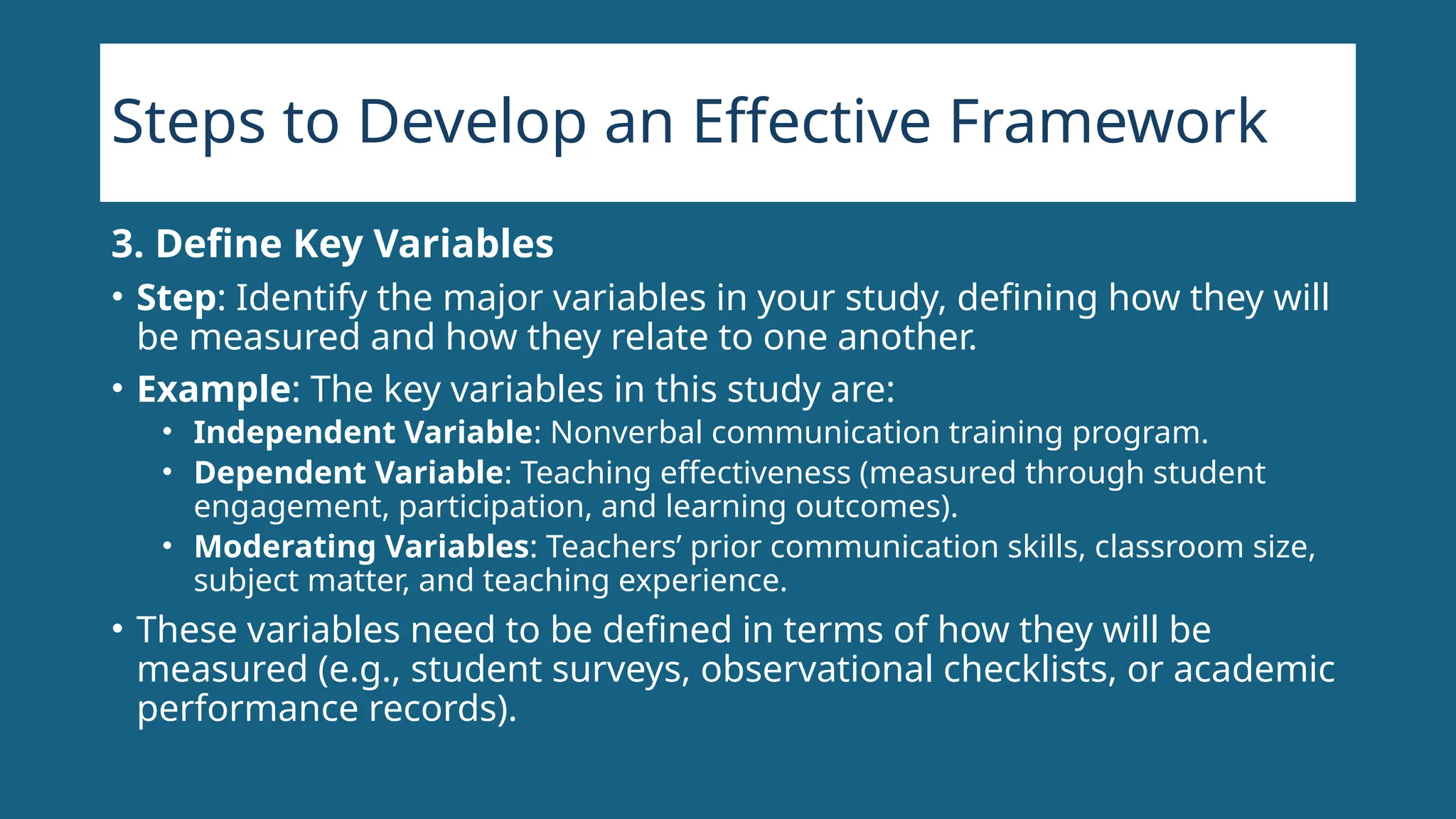
3. Define Key Variables
• Step: Identify the major variables in your study, defining how they will
be measured and how they relate to one another.
• Example: The key variables in this study are:
• Independent Variable: Nonverbal communication training program.
• Dependent Variable: Teaching effectiveness (measured through student
engagement, participation, and learning outcomes).
• Moderating Variables: Teachers’ prior communication skills, classroom size,
subject matter, and teaching experience.
• These variables need to be defined in terms of how they will be
measured (e.g., student surveys, observational checklists, or academic
performance records).
Steps to Develop an Effective Framework
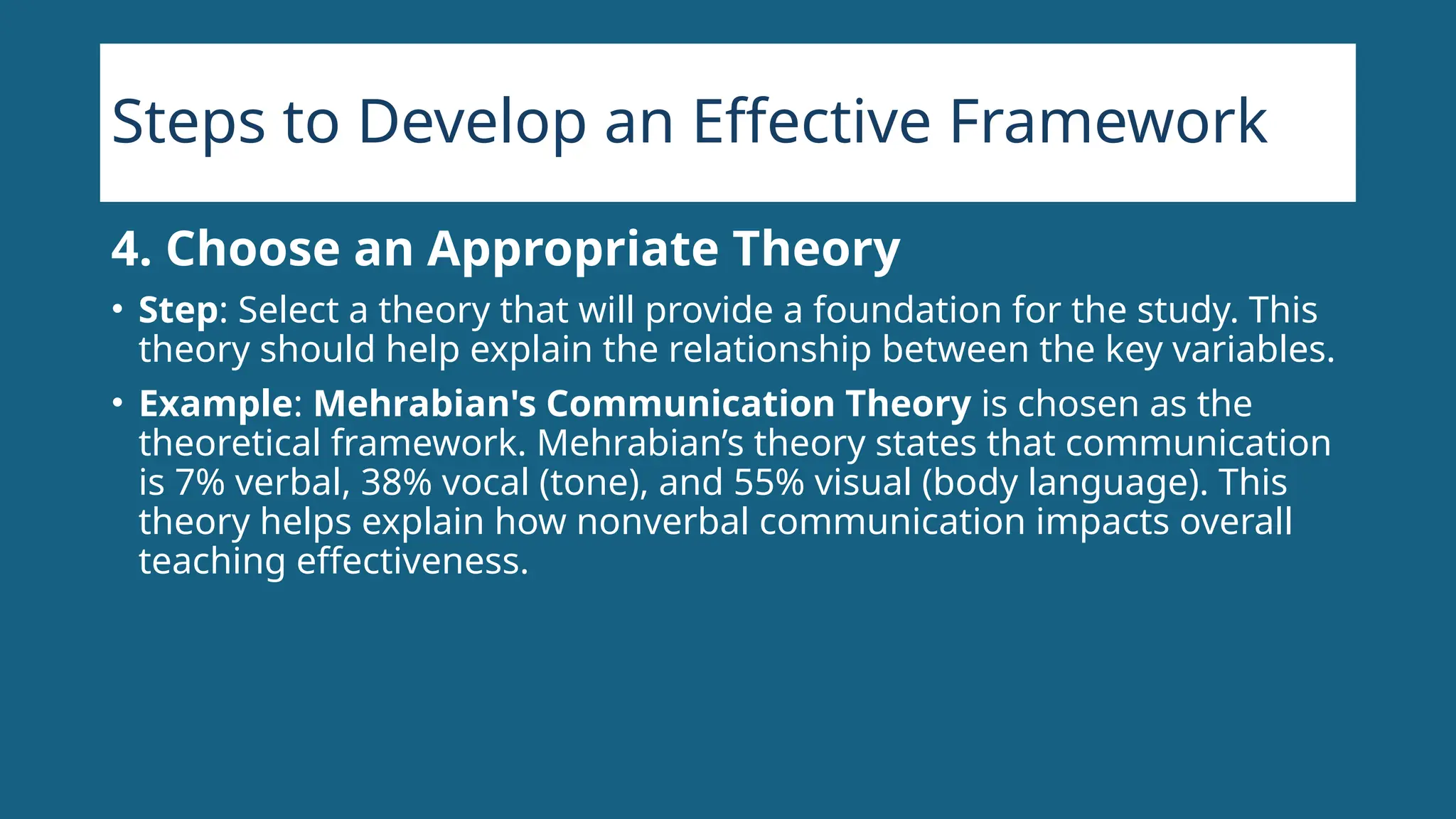
4. Choose an Appropriate Theory
• Step: Select a theory that will provide a foundation for the study. This
theory should help explain the relationship between the key variables.
• Example: Mehrabian's Communication Theory is chosen as the
theoretical framework. Mehrabian’s theory states that communication
is 7% verbal, 38% vocal (tone), and 55% visual (body language). This
theory helps explain how nonverbal communication impacts overall
teaching effectiveness.
Steps to Develop an Effective Framework
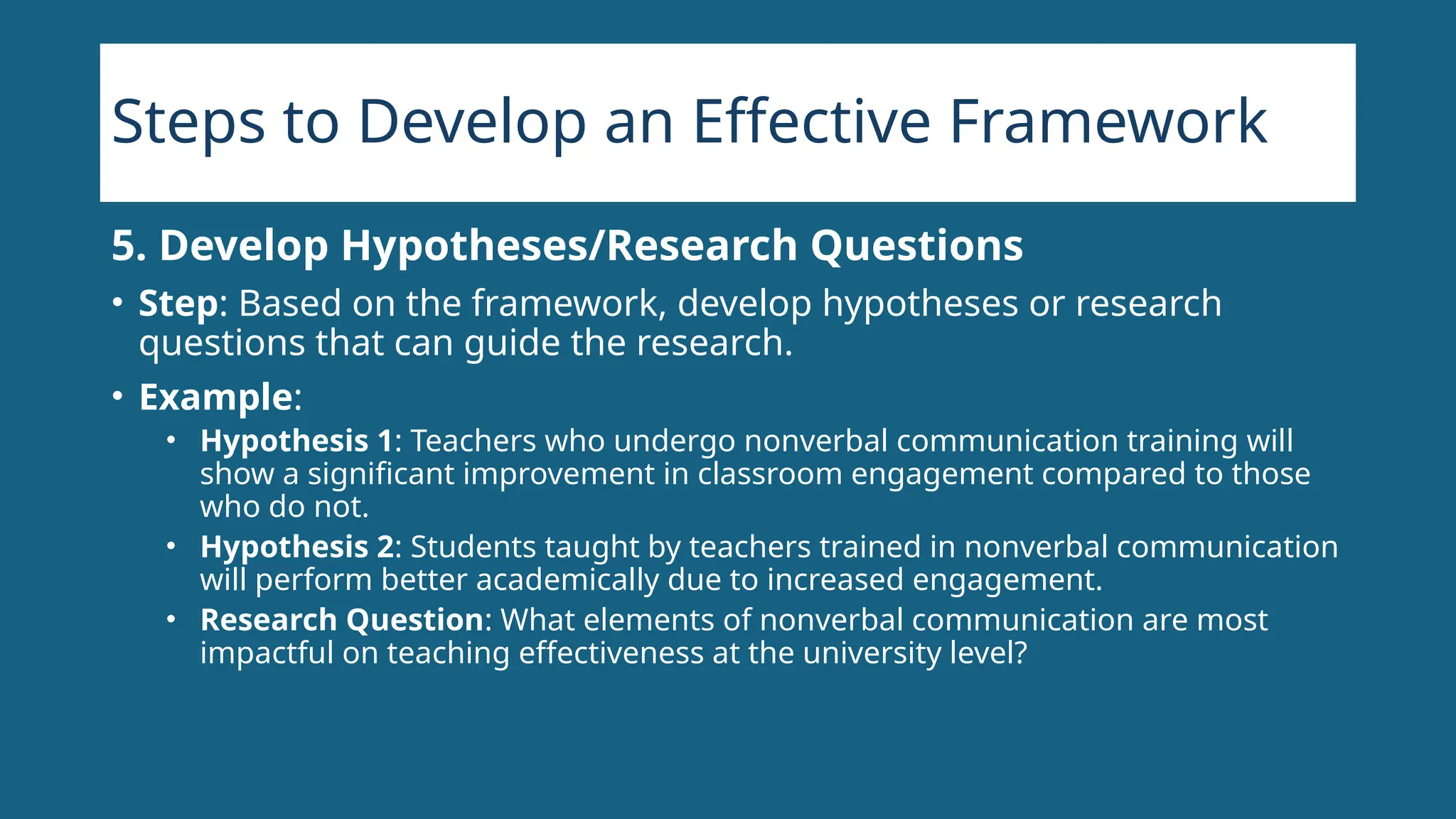
5. Develop Hypotheses/Research Questions
• Step: Based on the framework, develop hypotheses or research
questions that can guide the research.
• Example:
• Hypothesis 1: Teachers who undergo nonverbal communication training will
show a significant improvement in classroom engagement compared to those
who do not.
• Hypothesis 2: Students taught by teachers trained in nonverbal communication
will perform better academically due to increased engagement.
• Research Question: What elements of nonverbal communication are most
impactful on teaching effectiveness at the university level?
Steps to Develop an Effective Framework
6. Illustrate the Framework
• Step: Create a visual representation of your framework, showing the
relationships between the variables and how they connect.
• Example: A simple diagram might illustrate:
• Nonverbal Communication Program (Independent Variable) → Teaching
Effectiveness (Dependent Variable).
• Arrows could indicate moderating factors like teacher experience, classroom
size, and subject matter, showing their influence on teaching effectiveness.
Steps to Develop an Effective Framework
7. Align with Methodology
• Step: Make sure your research framework aligns with your chosen research
methodology and methods for data collection and analysis.
• Example: Since this is a program evaluation, a quasi-experimental design could
be used, where one group of teachers receives the nonverbal communication
training (experimental group), and another group does not (control group). Data
could be collected through pre- and post-training classroom observations,
student feedback surveys, and academic performance comparisons.
• Methodology: Mixed methods approach (combining qualitative observations
and quantitative analysis of student engagement and performance data) would
be most appropriate, ensuring both statistical rigor and a rich understanding of
how nonverbal communication impacts classroom dynamics.
Remember
• Iterative Nature: Developing a research framework is often
an iterative process. Ph.D. scholars should expect to refine
their frameworks as their understanding of the literature
and their research questions evolve.
Remember
• Link to Literature: Ph.D. scholars should ensure that their
framework is not created in isolation but is deeply rooted in
existing literature. This demonstrates that their research
contributes to the ongoing academic conversation.
Thank YOU!
Dr. Bhavin C Chauhan
Founder
Blogger, Communication Consultant and Inspirational Speaker
Assistant Professor, Department of Education
Faculty of Education and Psychology
The Maharaja Sayajirao University of Baroda
Vadodara, Gujarat, India
bhavincchauhan@gmail.com
http://edutainmentwithbhavinchauhan.blogspot.com/
https://wordlifewithme.blogspot.com/
Mob. No. 9979896161

Framework in Research: Basic Introduction

  • 1.
    Framework in Research Dr.Bhavin C Chauhan Founder Blogger, Communication Consultant and Inspirational Speaker Assistant Professor, Department of Education Faculty of Education and Psychology The Maharaja Sayajirao University of Baroda Vadodara, Gujarat, India bhavincchauhan@gmail.com http://edutainmentwithbhavinchauhan.blogspot.com/ https://wordlifewithme.blogspot.com/ Mob. No. 9979896161
  • 2.
    Framework in Research Inresearch, a framework offers a conceptual or theoretical foundation, providing structure and support for the study.
  • 3.
    Framework in Research Outlinesthe concepts, variables, and relationships that will be examined in the research, guiding the study's design, methodology, and interpretation of results.
  • 4.
    Framework in Research Frameworkshelp the researcher to define what is being studied, how it will be examined, and why it matters.
  • 5.
  • 6.
    Importance of aFramework in Research • Guides the Research Process: The framework serves as a map or blueprint for the research, guiding the design, methodology, and analysis.
  • 7.
    Importance of aFramework in Research • Provides Structure: It helps organize the researcher's thoughts and approach, ensuring that all aspects of the study are logically connected.
  • 8.
    Importance of aFramework in Research • Enhances Rigor: A well-developed framework helps to ground the research in established theory and evidence, lending credibility and reliability to the findings.
  • 9.
    Importance of aFramework in Research • Clarifies Concepts: The framework helps clarify key concepts and variables, providing clear definitions and relationships for the reader.
  • 10.
    Importance of aFramework in Research • Facilitates Communication: By outlining the theoretical or conceptual foundations, the framework makes it easier to communicate the research problem, purpose, and approach to others.
  • 11.
    Importance of aFramework in Research • Supports Interpretation: In the analysis phase, the framework can provide context for interpreting the findings, helping to link the results back to the original research question and theory.
  • 12.
  • 13.
    Conceptual Framework: • This typeorganizes the ideas and theories that underlie the research problem. It’s based on existing knowledge, models, and concepts. Conceptual frameworks help to illustrate how the researcher’s ideas and hypotheses relate to the literature and inform their research questions.
  • 14.
    Theoretical Framework • The theoreticalframework stems from a specific theory or set of theories and is used to support or challenge existing knowledge. It’s often used in studies that aim to validate or test a specific theory or develop new theoretical perspectives.
  • 15.
    Analytical Framework • Thisframework helps the researcher systematically analyze data or information. It is often used in qualitative research to guide the process of data categorization and analysis.
  • 16.
    Methodological Framework • Thisfocuses on the methods, strategies, and procedures used in the research. It helps define the techniques for data collection, analysis, and interpretation.
  • 17.
  • 18.
    Principles of an Effective Framework •Relevance: The framework should be directly related to the research problem and objectives. It should contribute meaningfully to understanding the problem.
  • 19.
    Principles of an EffectiveFramework • Clarity: It must clearly define key concepts, variables, and relationships in a way that is understandable to others.
  • 20.
    Principles of an Effective Framework •Coherence: The framework should maintain logical consistency. The theories, models, and relationships it outlines should flow logically from one concept to another.
  • 21.
    Principles of an EffectiveFramework • Flexibility: While frameworks provide structure, they should also allow for adaptation based on the progression of research.
  • 22.
    Principles of anEffective Framework • Rigor: The framework must be supported by literature, research, and evidence. It should be grounded in theory and concepts that have been rigorously developed or tested.
  • 23.
  • 24.
    Steps to Developan Effective Framework for Research 1. Identify the Research Problem • Step: Start by clearly stating the research problem. It defines the core issue or gap that your research aims to address. • Example: Many university-level teachers struggle to effectively engage students in the classroom due to poor nonverbal communication skills, which hinders student learning and participation. The research problem is: “How can a structured nonverbal communication program improve university-level teaching effectiveness?”
  • 25.
    Steps to Developan Effective Framework 2. Conduct a Literature Review • Step: Review existing research to understand what studies, theories, and models are available on nonverbal communication in educational settings. Identify key findings, gaps, and opportunities for your own research. • Example: After reviewing the literature, you find that research highlights the importance of body language, gestures, facial expressions, and eye contact in teaching. However, there are few studies focusing specifically on structured training programs for university teachers to enhance their nonverbal communication skills. This gap suggests a need for such a program.
  • 26.
    Steps to Developan Effective Framework 3. Define Key Variables • Step: Identify the major variables in your study, defining how they will be measured and how they relate to one another. • Example: The key variables in this study are: • Independent Variable: Nonverbal communication training program. • Dependent Variable: Teaching effectiveness (measured through student engagement, participation, and learning outcomes). • Moderating Variables: Teachers’ prior communication skills, classroom size, subject matter, and teaching experience. • These variables need to be defined in terms of how they will be measured (e.g., student surveys, observational checklists, or academic performance records).
  • 27.
    Steps to Developan Effective Framework 4. Choose an Appropriate Theory • Step: Select a theory that will provide a foundation for the study. This theory should help explain the relationship between the key variables. • Example: Mehrabian's Communication Theory is chosen as the theoretical framework. Mehrabian’s theory states that communication is 7% verbal, 38% vocal (tone), and 55% visual (body language). This theory helps explain how nonverbal communication impacts overall teaching effectiveness.
  • 28.
    Steps to Developan Effective Framework 5. Develop Hypotheses/Research Questions • Step: Based on the framework, develop hypotheses or research questions that can guide the research. • Example: • Hypothesis 1: Teachers who undergo nonverbal communication training will show a significant improvement in classroom engagement compared to those who do not. • Hypothesis 2: Students taught by teachers trained in nonverbal communication will perform better academically due to increased engagement. • Research Question: What elements of nonverbal communication are most impactful on teaching effectiveness at the university level?
  • 29.
    Steps to Developan Effective Framework 6. Illustrate the Framework • Step: Create a visual representation of your framework, showing the relationships between the variables and how they connect. • Example: A simple diagram might illustrate: • Nonverbal Communication Program (Independent Variable) → Teaching Effectiveness (Dependent Variable). • Arrows could indicate moderating factors like teacher experience, classroom size, and subject matter, showing their influence on teaching effectiveness.
  • 30.
    Steps to Developan Effective Framework 7. Align with Methodology • Step: Make sure your research framework aligns with your chosen research methodology and methods for data collection and analysis. • Example: Since this is a program evaluation, a quasi-experimental design could be used, where one group of teachers receives the nonverbal communication training (experimental group), and another group does not (control group). Data could be collected through pre- and post-training classroom observations, student feedback surveys, and academic performance comparisons. • Methodology: Mixed methods approach (combining qualitative observations and quantitative analysis of student engagement and performance data) would be most appropriate, ensuring both statistical rigor and a rich understanding of how nonverbal communication impacts classroom dynamics.
  • 31.
    Remember • Iterative Nature:Developing a research framework is often an iterative process. Ph.D. scholars should expect to refine their frameworks as their understanding of the literature and their research questions evolve.
  • 32.
    Remember • Link toLiterature: Ph.D. scholars should ensure that their framework is not created in isolation but is deeply rooted in existing literature. This demonstrates that their research contributes to the ongoing academic conversation.
  • 33.
    Thank YOU! Dr. BhavinC Chauhan Founder Blogger, Communication Consultant and Inspirational Speaker Assistant Professor, Department of Education Faculty of Education and Psychology The Maharaja Sayajirao University of Baroda Vadodara, Gujarat, India bhavincchauhan@gmail.com http://edutainmentwithbhavinchauhan.blogspot.com/ https://wordlifewithme.blogspot.com/ Mob. No. 9979896161