Theoretical Framework and
Conceptual Framework:
Rudiments of A Good Research
Dickson Adom
What is a Theoretical Framework
 It is the ‘blueprint’ or guide for a research (Grant &
Osanloo, 2014). It is ‘borrowed’ by the researcher to build
his/her own house.
 It serves as the foundation upon which a research is
constructed.
 Sinclair (2007) compares the role of the theoretical
framework to that of a map or travel plan.
 Brondizio, Leemans, and Solecki (2014) contend that it is
the specific theory or theories about aspects of human
endeavour that can be useful to the study of events.
What is a Theoretical Framework
 All aspects of the dissertation research should connect to
the theoretical framework (Grant & Osanloo, 2014).
 The relevant theory or theories that underpin the
knowledge base of the phenomenon to be researched.
 It consists of theoretical principles, constructs, concepts,
and tenants of a theory (Grant & Osanloo, 2014).
 Make a unique application of the selected theory so as to
apply the theoretical constructs to his/her dissertation
study.
Importance of Theoretical
Framework in Research
 It provides the structure to define how a researcher
defines his/her study philosophically, epistemologically,
methodology and analytically (Grant & Osanloo, 2014).
 It normally serves as the focus for the research study and
it is linked to the research problem under study.
Importance of Theoretical
Framework in Research
 It guides a researcher’s choice of research design and
data analysis plan.
 It provides a common worldview or lens from which to
support one’s thinking on the problem and analysis of
data (Grant & Osanloo, 2014).
 The theoretical framework guides and must resonates
with every aspect of the research (Statement of the
problem, Literature Review, Methodology, Presentation
and Discussion of Findings).
Importance of Theoretical
Framework in Research
 The theoretical framework guides the kind of data to be
collected (Lester, 2005).
 Simon and Goes (2011) as well as Maxwell (2004) avers
that theoretical frameworks deepen the essence of the
study.
 It convinces readers that the study is not based on the
personal instincts of the researcher but rather on
established theory gathered via credible studies.
Examples of Theoretical Framework
 Transformational Theory
 Culture Theory
 Cognitive Theory
 Gender Theory
 Behavioral Theory
 Developmental Theory
 Human Environment Relations Theory
 Culture Ecology Theory
 Culture Determinism Theory
How To Construct a Theoretical
Framework
 There is no one perfect or right theory for a dissertation,
though certain theories are popular (Grant & Osanloo,
2014).
 The theory must reflect the understanding of the
researcher regarding the study and must direct the study
(Simon & Goes, 2011).
 The selection of a theoretical framework requires a
thorough understanding of the problem, purpose,
significance and research questions of a study (Grant &
Osanloo, 2014).
How To Construct a Theoretical
Framework
 The chosen theoretical framework must accentuate the
purpose and importance of the study dissertation (Grant
& Osanloo, 2014).
 Consider the guiding principles of the study and situate
the problem in relation to a theoretical context.
 The research questions of the study must entail
noticeable aspects of the theoretical framework and must
agree with the assertions promulgated by the theorists of
the selected theory (Maxwell, 2004).
How To Construct a Theoretical
Framework
 The research findings accrued finally from the study may
support, extend, or modify an existing theory that was
borrowed for the study (Lester, 2005).
 The researcher may critique, develop and/or expand the
theory that served as a guide for his/her study vis-à-vis
the findings gleaned from the study (Grant & Osanloo,
2014).
 Munhall and Chenail (2008) contend that this should be
done at the data analysis stage.
How To Construct a Theoretical
Framework
 Using Grant and Osanloo (2014) checklist to identify the
suitable theoretical framework for a study:
1. What discipline will the theory be applied to?
2. Does the theory agree with the methodology plan for the
study?
3. Is the theory to be selected well developed with many
theoretical constructs?
4. Have specific concepts or theoretical principles been
selected to meet the objectives of the study?
How To Construct a Theoretical
Framework
5. Does the problem of the study, the purpose and
importance of the study correlates with the theoretical
framework?
6. Can the theory be used hand in hand with the research
questions for the study?
7. Does the theoretical framework inform the literature
review?
8. Does the data analysis plan agrees with the selected
theoretical framework?
9. Does the theoretical framework undergirds the
conclusions and recommendations based on the data
analysis?
How To Construct a Theoretical
Framework
Simon and Goes (2011) also suggest some points that can
help articulate the theory for an informed research:
1. The main concern for inquiry in the research
2. The key variables in the research
3. Read and review current related literature on the topic
using key word search.
4. List the constructs and variables that might be relevant
for the study.
5. Consider how the variables are related to the theory
How To Construct a Theoretical
Framework
6. Revise the search and add the word ‘theory’ to the key
words to find the theories and theorists most in line with
the thinking of the researcher.
7. Discuss the propositions of each theory and highlight its
relevance to the research.
8. Consider alternative theories that challenges the
perspectives of the researcher.
9. Consider the limitations associated with the selected
theory which the problem to be investigated can help
address or provide logic explanations.
Where To Place The Theoretical
Framework in A Thesis
 The student must select and clarify a theoretical framework
from the time the dissertation topic is initially conceptualized
(Dooyeweerd as cited in Sire, 2004).
 Staunch researchers profess that the researcher’s choice
of a theory must be stated explicitly early in the writing of a
dissertation (Grant & Osanloo, 2014).
 Mertens (1998) argues that the theoretical framework
influence every decision made by the researcher in the
carrying out of the research.
What is Conceptual Framework
 Conceptual framework is a structure which the researcher
believes could best explain the natural progression of the
phenomenon to be studied (Camp, 2001).
It offers a logical structure of connected concepts that help
provide a picture or visual display of how ideas in a study
relate to one another (Grant & Osanloo, 2014).
It assists the researcher to specify and define the concepts
within the problem of the study (Luse, Mennecke &
Townsend, 2012).
What is Conceptual Framework
 It represents an integrated way of looking at a problem
under study (Liehr & Smith, 1999).
 It is seen as an outline of courses of action or preferred
approach to a thought to be carried out in a research
study (Dixon, Gulliver & Gibbon, 2001).
 Miles and Huberman (1994, p.18) opine that conceptual
frameworks can be ‘graphical or in a narrative form
showing the key variables or constructs to be studied and
the presumed relationships between them’.
Importance of Conceptual Framework in
Research
 It aids the researcher to identify and construct his/her
worldview and approach to the topic of study (Grant &
Osanloo, 2014).
 It brings together related concepts to explain or predict a
given event or give a detailed understanding of the
research problem and its asserted solution (Liehr &
Smith, 1999).
 It accentuates the reasons why a research topic is worth
studying, the assumptions of a researcher, the scholars
s/he agrees with and disagrees with and how s/he
conceptually grounds his/her approach (Evans, 2007).
How To Construct a Conceptual
Framework
 Mostly, diagrams are created to clearly define the
constructs or variables of the research topic and their
relationships are shown by the use of arrows.
 Researchers are at liberty to adopt existing frameworks,
but have to modify it to suit the nature of the context of
their research as well as the nature of their research
questions (Fisher, 2007).
 Fisher adds that a good conceptual framework must also
be expressed in writing for it to be understood clearly.
Differences Between Theoretical
Framework and Conceptual Framework
 Theoretical framework is curled from an existing theory or
theories in the literature that has already been tested and
validated by others and is considered as an acceptable
theory in the scholarly literature (Grant & Osanloo, 2014).
 Conceptual framework is the researcher’s understanding
of how the research problem will be explored, the specific
direction the research will have to take, and the relationship
between the different variables in the study.
Differences Between Theoretical
Framework and Conceptual Framework
 While a whole theory may serve as one’s theoretical
framework, a conceptual framework is carefully put
together in the form of a conceptual model and
immediately applied to a particular study (Liehr & Smith,
1999).
 Theoretical framework is derived from a theory while
conceptual framework is derived from concepts.
Where To Place The Conceptual
Framework in A Thesis
 Since the theoretical perspectives of the main
variables or constructs of a study are rigorously
reviewed in chapter two of a thesis, the conceptual
framework are mostly placed in the chapter two.
Culture Theory
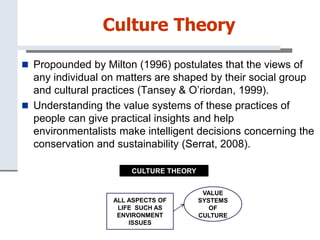
 Propounded by Milton (1996) postulates that the views of
any individual on matters are shaped by their social group
and cultural practices (Tansey & O’riordan, 1999).
 Understanding the value systems of these practices of
people can give practical insights and help
environmentalists make intelligent decisions concerning the
conservation and sustainability (Serrat, 2008).
VALUE
SYSTEMS
OF
CULTURE
ALL ASPECTS OF
LIFE SUCH AS
ENVIRONMENT
ISSUES
CULTURE THEORY
Culture Determinism Theory
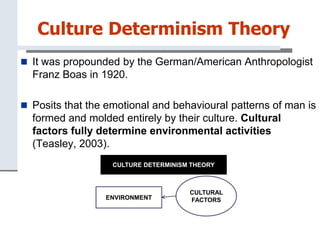
 It was propounded by the German/American Anthropologist
Franz Boas in 1920.
 Posits that the emotional and behavioural patterns of man is
formed and molded entirely by their culture. Cultural
factors fully determine environmental activities
(Teasley, 2003).
CULTURE DETERMINISM THEORY
ENVIRONMENT
CULTURAL
FACTORS
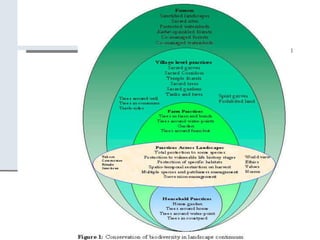
Pandey’s (2000) Conservation of
Biodiversity in Landscape Continuum
Conceptual Framework
 There is a strong link between the biodiversity not just in the
Protected Areas but also the landscape continuum with the
cultural practices of a people.
 Traditional conservation ethos is reflected in cultural
practices such as sacred groves, taboos, ceremonies and
religious beliefs.
 Traditional conservation ethos in the cultural practices is still
capable of protecting the decimating biodiversity.
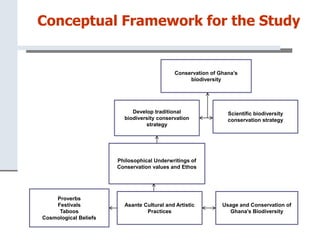
Conceptual Framework for the Study
Conservation of Ghana’s
biodiversity
Develop traditional
biodiversity conservation
strategy
Scientific biodiversity
conservation strategy
Philosophical Underwritings of
Conservation values and Ethos
Asante Cultural and Artistic
Practices
Usage and Conservation of
Ghana’s Biodiversity
Proverbs
Festivals
Taboos
Cosmological Beliefs
Conceptual Framework for the study
 The Asante cultural and artistic practices have a strong
relationship with the usage of Ghana’s biodiversity.
 The traditional conservation ethos enshrined in the cultural
and artistic practices still hold great worth in the
conservation of biodiversity in modern societies.
 Believes traditional biodiversity strategy can be developed
from those conservation ethos to complement the scientific
models of conservation popularly used in Ghana.
Thank you
References
Lester, F. (2005). On the Theoretical, Conceptual and Philosophical
Foundations for Research in Mathematics Education. ZDM, 37(6), 457-
467.
Camp, W.G. (2001). Formulating and Evaluating Theoretical Frameworks
for Career and Technical Education Research. Journal of Vocational
Educational Research, 26(1), 27-39.
Maxwell, J. (2004). Qualitative Research Design: An Interactive Approach
(2nd ed.). Thousand Oaks, CA: Sage.
Munhall, P. & Chenail, R. (2008). Qualitative Research Proposals and
Reports: A Guide (3rd ed.). Sudbury, MA: Jones and Bartlett
Luse, A., Mennecke, B., & Townsend, A. (2012). Selecting a Research
Topic: A Framework for Doctoral Students. International Journal of
Doctoral Studies, 7, 143-152.
Mertens, D. (1998). Research Methods in Education and Psychology:
Integrating Diversity with Quantitative and Qualitative Approaches.
Thousand Oaks: Sage.
References
Sire, J. (2004). Naming the Elephant: Worldview as a Concept. Downers
Grove, IL: InterVasity.
Grant, C. & Osanloo, A. (2014). Understanding, Selecting, and Integrating
a Theoretical Framework in Dissertation Research: Creating the
Blueprint for your ‘House’. Administrative Issues Journal, Vol. 4, Issue 2.
Simon, K.M. & Goes, J. (2011). Developing a Theoretical Framework.
http://www.dissertationrecipes.com (accessed 12/02/2017).

THEORETICALANDCONCEPTUALFRAMEWORKS.ppt

  • 1.
    Theoretical Framework and ConceptualFramework: Rudiments of A Good Research Dickson Adom
  • 2.
    What is aTheoretical Framework  It is the ‘blueprint’ or guide for a research (Grant & Osanloo, 2014). It is ‘borrowed’ by the researcher to build his/her own house.  It serves as the foundation upon which a research is constructed.  Sinclair (2007) compares the role of the theoretical framework to that of a map or travel plan.  Brondizio, Leemans, and Solecki (2014) contend that it is the specific theory or theories about aspects of human endeavour that can be useful to the study of events.
  • 3.
    What is aTheoretical Framework  All aspects of the dissertation research should connect to the theoretical framework (Grant & Osanloo, 2014).  The relevant theory or theories that underpin the knowledge base of the phenomenon to be researched.  It consists of theoretical principles, constructs, concepts, and tenants of a theory (Grant & Osanloo, 2014).  Make a unique application of the selected theory so as to apply the theoretical constructs to his/her dissertation study.
  • 4.
    Importance of Theoretical Frameworkin Research  It provides the structure to define how a researcher defines his/her study philosophically, epistemologically, methodology and analytically (Grant & Osanloo, 2014).  It normally serves as the focus for the research study and it is linked to the research problem under study.
  • 5.
    Importance of Theoretical Frameworkin Research  It guides a researcher’s choice of research design and data analysis plan.  It provides a common worldview or lens from which to support one’s thinking on the problem and analysis of data (Grant & Osanloo, 2014).  The theoretical framework guides and must resonates with every aspect of the research (Statement of the problem, Literature Review, Methodology, Presentation and Discussion of Findings).
  • 6.
    Importance of Theoretical Frameworkin Research  The theoretical framework guides the kind of data to be collected (Lester, 2005).  Simon and Goes (2011) as well as Maxwell (2004) avers that theoretical frameworks deepen the essence of the study.  It convinces readers that the study is not based on the personal instincts of the researcher but rather on established theory gathered via credible studies.
  • 7.
    Examples of TheoreticalFramework  Transformational Theory  Culture Theory  Cognitive Theory  Gender Theory  Behavioral Theory  Developmental Theory  Human Environment Relations Theory  Culture Ecology Theory  Culture Determinism Theory
  • 8.
    How To Constructa Theoretical Framework  There is no one perfect or right theory for a dissertation, though certain theories are popular (Grant & Osanloo, 2014).  The theory must reflect the understanding of the researcher regarding the study and must direct the study (Simon & Goes, 2011).  The selection of a theoretical framework requires a thorough understanding of the problem, purpose, significance and research questions of a study (Grant & Osanloo, 2014).
  • 9.
    How To Constructa Theoretical Framework  The chosen theoretical framework must accentuate the purpose and importance of the study dissertation (Grant & Osanloo, 2014).  Consider the guiding principles of the study and situate the problem in relation to a theoretical context.  The research questions of the study must entail noticeable aspects of the theoretical framework and must agree with the assertions promulgated by the theorists of the selected theory (Maxwell, 2004).
  • 10.
    How To Constructa Theoretical Framework  The research findings accrued finally from the study may support, extend, or modify an existing theory that was borrowed for the study (Lester, 2005).  The researcher may critique, develop and/or expand the theory that served as a guide for his/her study vis-à-vis the findings gleaned from the study (Grant & Osanloo, 2014).  Munhall and Chenail (2008) contend that this should be done at the data analysis stage.
  • 11.
    How To Constructa Theoretical Framework  Using Grant and Osanloo (2014) checklist to identify the suitable theoretical framework for a study: 1. What discipline will the theory be applied to? 2. Does the theory agree with the methodology plan for the study? 3. Is the theory to be selected well developed with many theoretical constructs? 4. Have specific concepts or theoretical principles been selected to meet the objectives of the study?
  • 12.
    How To Constructa Theoretical Framework 5. Does the problem of the study, the purpose and importance of the study correlates with the theoretical framework? 6. Can the theory be used hand in hand with the research questions for the study? 7. Does the theoretical framework inform the literature review? 8. Does the data analysis plan agrees with the selected theoretical framework? 9. Does the theoretical framework undergirds the conclusions and recommendations based on the data analysis?
  • 13.
    How To Constructa Theoretical Framework Simon and Goes (2011) also suggest some points that can help articulate the theory for an informed research: 1. The main concern for inquiry in the research 2. The key variables in the research 3. Read and review current related literature on the topic using key word search. 4. List the constructs and variables that might be relevant for the study. 5. Consider how the variables are related to the theory
  • 14.
    How To Constructa Theoretical Framework 6. Revise the search and add the word ‘theory’ to the key words to find the theories and theorists most in line with the thinking of the researcher. 7. Discuss the propositions of each theory and highlight its relevance to the research. 8. Consider alternative theories that challenges the perspectives of the researcher. 9. Consider the limitations associated with the selected theory which the problem to be investigated can help address or provide logic explanations.
  • 15.
    Where To PlaceThe Theoretical Framework in A Thesis  The student must select and clarify a theoretical framework from the time the dissertation topic is initially conceptualized (Dooyeweerd as cited in Sire, 2004).  Staunch researchers profess that the researcher’s choice of a theory must be stated explicitly early in the writing of a dissertation (Grant & Osanloo, 2014).  Mertens (1998) argues that the theoretical framework influence every decision made by the researcher in the carrying out of the research.
  • 16.
    What is ConceptualFramework  Conceptual framework is a structure which the researcher believes could best explain the natural progression of the phenomenon to be studied (Camp, 2001). It offers a logical structure of connected concepts that help provide a picture or visual display of how ideas in a study relate to one another (Grant & Osanloo, 2014). It assists the researcher to specify and define the concepts within the problem of the study (Luse, Mennecke & Townsend, 2012).
  • 17.
    What is ConceptualFramework  It represents an integrated way of looking at a problem under study (Liehr & Smith, 1999).  It is seen as an outline of courses of action or preferred approach to a thought to be carried out in a research study (Dixon, Gulliver & Gibbon, 2001).  Miles and Huberman (1994, p.18) opine that conceptual frameworks can be ‘graphical or in a narrative form showing the key variables or constructs to be studied and the presumed relationships between them’.
  • 18.
    Importance of ConceptualFramework in Research  It aids the researcher to identify and construct his/her worldview and approach to the topic of study (Grant & Osanloo, 2014).  It brings together related concepts to explain or predict a given event or give a detailed understanding of the research problem and its asserted solution (Liehr & Smith, 1999).  It accentuates the reasons why a research topic is worth studying, the assumptions of a researcher, the scholars s/he agrees with and disagrees with and how s/he conceptually grounds his/her approach (Evans, 2007).
  • 19.
    How To Constructa Conceptual Framework  Mostly, diagrams are created to clearly define the constructs or variables of the research topic and their relationships are shown by the use of arrows.  Researchers are at liberty to adopt existing frameworks, but have to modify it to suit the nature of the context of their research as well as the nature of their research questions (Fisher, 2007).  Fisher adds that a good conceptual framework must also be expressed in writing for it to be understood clearly.
  • 20.
    Differences Between Theoretical Frameworkand Conceptual Framework  Theoretical framework is curled from an existing theory or theories in the literature that has already been tested and validated by others and is considered as an acceptable theory in the scholarly literature (Grant & Osanloo, 2014).  Conceptual framework is the researcher’s understanding of how the research problem will be explored, the specific direction the research will have to take, and the relationship between the different variables in the study.
  • 21.
    Differences Between Theoretical Frameworkand Conceptual Framework  While a whole theory may serve as one’s theoretical framework, a conceptual framework is carefully put together in the form of a conceptual model and immediately applied to a particular study (Liehr & Smith, 1999).  Theoretical framework is derived from a theory while conceptual framework is derived from concepts.
  • 22.
    Where To PlaceThe Conceptual Framework in A Thesis  Since the theoretical perspectives of the main variables or constructs of a study are rigorously reviewed in chapter two of a thesis, the conceptual framework are mostly placed in the chapter two.
  • 23.
    Culture Theory  Propoundedby Milton (1996) postulates that the views of any individual on matters are shaped by their social group and cultural practices (Tansey & O’riordan, 1999).  Understanding the value systems of these practices of people can give practical insights and help environmentalists make intelligent decisions concerning the conservation and sustainability (Serrat, 2008). VALUE SYSTEMS OF CULTURE ALL ASPECTS OF LIFE SUCH AS ENVIRONMENT ISSUES CULTURE THEORY
  • 24.
    Culture Determinism Theory It was propounded by the German/American Anthropologist Franz Boas in 1920.  Posits that the emotional and behavioural patterns of man is formed and molded entirely by their culture. Cultural factors fully determine environmental activities (Teasley, 2003). CULTURE DETERMINISM THEORY ENVIRONMENT CULTURAL FACTORS
  • 26.
    Pandey’s (2000) Conservationof Biodiversity in Landscape Continuum Conceptual Framework  There is a strong link between the biodiversity not just in the Protected Areas but also the landscape continuum with the cultural practices of a people.  Traditional conservation ethos is reflected in cultural practices such as sacred groves, taboos, ceremonies and religious beliefs.  Traditional conservation ethos in the cultural practices is still capable of protecting the decimating biodiversity.
  • 27.
    Conceptual Framework forthe Study Conservation of Ghana’s biodiversity Develop traditional biodiversity conservation strategy Scientific biodiversity conservation strategy Philosophical Underwritings of Conservation values and Ethos Asante Cultural and Artistic Practices Usage and Conservation of Ghana’s Biodiversity Proverbs Festivals Taboos Cosmological Beliefs
  • 28.
    Conceptual Framework forthe study  The Asante cultural and artistic practices have a strong relationship with the usage of Ghana’s biodiversity.  The traditional conservation ethos enshrined in the cultural and artistic practices still hold great worth in the conservation of biodiversity in modern societies.  Believes traditional biodiversity strategy can be developed from those conservation ethos to complement the scientific models of conservation popularly used in Ghana.
  • 29.
  • 30.
    References Lester, F. (2005).On the Theoretical, Conceptual and Philosophical Foundations for Research in Mathematics Education. ZDM, 37(6), 457- 467. Camp, W.G. (2001). Formulating and Evaluating Theoretical Frameworks for Career and Technical Education Research. Journal of Vocational Educational Research, 26(1), 27-39. Maxwell, J. (2004). Qualitative Research Design: An Interactive Approach (2nd ed.). Thousand Oaks, CA: Sage. Munhall, P. & Chenail, R. (2008). Qualitative Research Proposals and Reports: A Guide (3rd ed.). Sudbury, MA: Jones and Bartlett Luse, A., Mennecke, B., & Townsend, A. (2012). Selecting a Research Topic: A Framework for Doctoral Students. International Journal of Doctoral Studies, 7, 143-152. Mertens, D. (1998). Research Methods in Education and Psychology: Integrating Diversity with Quantitative and Qualitative Approaches. Thousand Oaks: Sage.
  • 31.
    References Sire, J. (2004).Naming the Elephant: Worldview as a Concept. Downers Grove, IL: InterVasity. Grant, C. & Osanloo, A. (2014). Understanding, Selecting, and Integrating a Theoretical Framework in Dissertation Research: Creating the Blueprint for your ‘House’. Administrative Issues Journal, Vol. 4, Issue 2. Simon, K.M. & Goes, J. (2011). Developing a Theoretical Framework. http://www.dissertationrecipes.com (accessed 12/02/2017).