PRESENTED BY:
MARTIN OTUNDO RICHARD
PhD( project management student)–JKUAT
–MOMBASA CAMPUS, KENYA -2015
+254721246744
THEORETICAL AND
CONCEPTUAL FRAMEWORKS
Session objectives
By the end of the session the learner should be
able to:
 Explain the concept of theoretical framework
 Develop a theoretical framework in research
 Describe the significance of a theoretical
framework in research.
 Describe a conceptual framework
 Distinguish between a theoretical framework and
a conceptual framework.
 State the features of a conceptual framework.
 A theoretical framework is a summary of the
researcher’s theory regarding a particular
problem that is developed through a review of
previously tested knowledge of variables
involved. It identifies a plan for investigation and
interpretation of the findings.
 It relates to philosophical basis on which the
research takes place and form the link between
the theoretical aspects and practical components
of the investigation undertaken. Therefore it’’ has
implications for every decision made in the
research process’’(Mertens,1998,3)
What is a theoretical framework?
THEORETICAL
FRAMEWORK
What is a theoretical framework?
 Theoretical framework can be considered as a
conceptual model that establishes a sense of
structure that guides the research process. It
includes the variables a researcher intends to
measure and relationships he/she seeks to
understand. Essentially, this is where a
researcher develops a “theory” and build his/her
case for investigating that theory.
 The theoretical framework is the researcher’s
presentation of a theory that explains a particular
problem and it is not based on his/her suspicions
alone.
Theoretical framework in a research report
 Theoretical framework is presented in the early
section of a dissertation mainly in chapter two of
the report and provides the rationale for
conducting your research to investigate a
particular research problem.
 It involves a well-supported rationale and is
organized in a manner that helps the reader
understand and asses the perspective of the
researcher.
When developing a theoretical framework:
 The researcher start by describing what
is known about the variables involved,
what is known about their relationship,
and what can be explained thus far.
 One need to to investigate other
researchers’ theories behind these
relationships and identify a theory (or a
combination of theories) that explain
his/her major research problem.
When developing a theoretical framework:
(cont’d)
 The researcher need to consider
alternative theories that might challenge
his/her perspective.
 One also considers the limitations
associated with his/her theory and quite
possibly that problem could be better
understood by other theoretical
frameworks.
Significance of a theoretical framework
 It helps the researcher to consider other possible
frameworks and to reduce biases that may sway
the researcher’s interpretation.
 It clarifies researcher’s implicit theory in a manner
that is more clearly defined.
Significance of a theoretical framework
 It demonstrates that the relationships proposed
by the researcher are not based on his/her
personal instincts or guesses, but rather formed
from facts obtained from authors of previous
research.
 The theoretical framework allows a researcher to
present the research problem in light of summary
of the literature.
Significance of a theoretical
framework
 It shows the reader why the researcher thinks
that the variables involved are related and the
inclusion of previous research and theories that
support researcher’s belief are essential to
defending the rationale.
 It determines how the researcher perceives,
make sense of, and interpret his/her data.
Explanation of theoretical framework helps the
reader understand the researchers' perspective
and context.
CONCEPTUAL
FRAMEWORK
What is a conceptual framework?
 Mugenda and Mugenda (2003), define a
conceptual framework as a hypothesized model
identifying the concepts under study and their
relationships. It provides an outline of the
preferred approach in the research and also
outlines the relationships and the desired effects,
forming independent and dependent variables
respectively.
 It also a schematic representation showing the
relationship between different types of variables
involved in the study such as relationship
between independent variables and the
dependent variable. (Tidwell,2012)
What is a conceptual framework?
 It’s the researcher’s own position on the problem
and gives direction to the study.
 Consists of concepts that are placed within a
logical and sequential design. It represents less
formal structure and used for studies in which
existing theory is incapable or insufficient. Its
based on specific concepts and propositions,
derived from empirical observation and intuition.
What is a conceptual framework?
 Miles and Huberman (1994) in Corry and Stella
(2012)defined a conceptual framework as a visual
or written product, one that “explains, either
graphically or in narrative form, the main things to
be studied—the key factors, concepts, or
variables—and the presumed relationships
among them” (p. 18).1
 Conceptual framework is a network, or “a plane,”
of interlinked concepts that together provide a
comprehensive understanding of a phenomenon
or phenomena.
Features of conceptual
frameworks
The main features of conceptual frameworks are as
follows:
 1. A conceptual framework is not merely a
collection of concepts but, rather, a construct in
which each concept plays an integral role.
According to Miles and Huberman (1994), a
conceptual framework “lays out the key factors,
constructs, or variables, and presumes
relationships among them” (p. 440). To
discourage loose usage of the term conceptual
framework, I propose basing conceptual
frameworks not on variable or factors but on
concepts alone. When variables or factors are
Features of conceptual
frameworks
 2. A conceptual framework provides not a
causal/analytical setting but, rather, an
interpretative approach to social reality.
 3. Rather than offering a theoretical explanation,
as do quantitative models, conceptual
frameworks provide understanding.
 4. A conceptual framework provides not
knowledge of “hard facts” but, rather, “soft
interpretation of intentions” (Levering, 2002, p.
38).
Features of conceptual
frameworks
 5. Conceptual frameworks are indeterminist in
nature and therefore do not enable us to predict
an outcome. Levering (2002) has suggested that
“the idea that human behavior can be explained
and predicted is roughly based on the concept of
external factors being caught in an accidental
cohesion, and the idea that human actions can be
understood, but not predicted, is based on the
concept of freedom” (p. 38).
 6. Conceptual frameworks can be developed and
constructed through a process of qualitative
analysis.
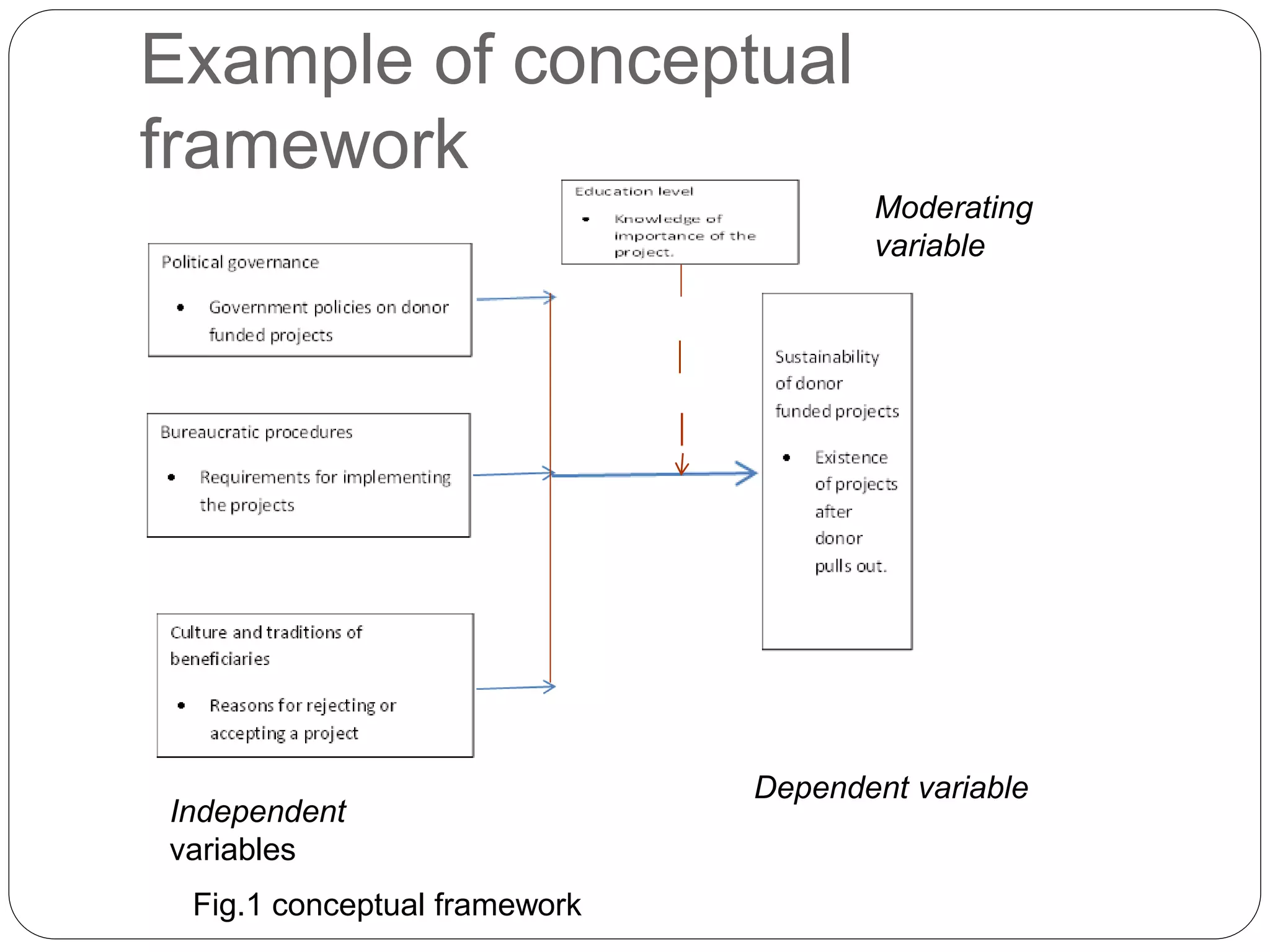
Example of conceptual
framework
Dependent variable
Independent
variables
Fig.1 conceptual framework
Moderating
variable
REFERENCES
 Mugenda, O.M. & Mugenda, A.G. (2003).
Research methods: Quantitative and qualitative
approaches.2nd. Rev. ed. Nairobi: Act press.
 Jabareen,Y(2009).International journal of
qualitative methods,Technion—Israel Institute of
Technology Technion City, Haifa, Israel.
 Tidwell, w (2012) writing a conceptual framework,
Ashford university, ITT technical institute,
Westwood college.
http://www.slideshare.net/wtidwell/writing-a-
conceptual-framework?next_slideshow=2
Accessed on 29th July 2015
REFERENCES
 Corry, M, and Stella,J.,(2012)Developing a
framework for research in online K-12 distance
education." Quarterly Review of Distance
Education 13.3 (2012): 133+. Academic OneFile.
Web. 29 July 2015.
http://go.galegroup.com/ps/i.do
THANK YOU

THEORETICAL_AND_CONCEPTUAL_FRAMEWORKS.pptx

  • 1.
    PRESENTED BY: MARTIN OTUNDORICHARD PhD( project management student)–JKUAT –MOMBASA CAMPUS, KENYA -2015 +254721246744 THEORETICAL AND CONCEPTUAL FRAMEWORKS
  • 2.
    Session objectives By theend of the session the learner should be able to:  Explain the concept of theoretical framework  Develop a theoretical framework in research  Describe the significance of a theoretical framework in research.  Describe a conceptual framework  Distinguish between a theoretical framework and a conceptual framework.  State the features of a conceptual framework.
  • 3.
     A theoreticalframework is a summary of the researcher’s theory regarding a particular problem that is developed through a review of previously tested knowledge of variables involved. It identifies a plan for investigation and interpretation of the findings.  It relates to philosophical basis on which the research takes place and form the link between the theoretical aspects and practical components of the investigation undertaken. Therefore it’’ has implications for every decision made in the research process’’(Mertens,1998,3) What is a theoretical framework?
  • 4.
  • 5.
    What is atheoretical framework?  Theoretical framework can be considered as a conceptual model that establishes a sense of structure that guides the research process. It includes the variables a researcher intends to measure and relationships he/she seeks to understand. Essentially, this is where a researcher develops a “theory” and build his/her case for investigating that theory.  The theoretical framework is the researcher’s presentation of a theory that explains a particular problem and it is not based on his/her suspicions alone.
  • 6.
    Theoretical framework ina research report  Theoretical framework is presented in the early section of a dissertation mainly in chapter two of the report and provides the rationale for conducting your research to investigate a particular research problem.  It involves a well-supported rationale and is organized in a manner that helps the reader understand and asses the perspective of the researcher.
  • 7.
    When developing atheoretical framework:  The researcher start by describing what is known about the variables involved, what is known about their relationship, and what can be explained thus far.  One need to to investigate other researchers’ theories behind these relationships and identify a theory (or a combination of theories) that explain his/her major research problem.
  • 8.
    When developing atheoretical framework: (cont’d)  The researcher need to consider alternative theories that might challenge his/her perspective.  One also considers the limitations associated with his/her theory and quite possibly that problem could be better understood by other theoretical frameworks.
  • 9.
    Significance of atheoretical framework  It helps the researcher to consider other possible frameworks and to reduce biases that may sway the researcher’s interpretation.  It clarifies researcher’s implicit theory in a manner that is more clearly defined.
  • 10.
    Significance of atheoretical framework  It demonstrates that the relationships proposed by the researcher are not based on his/her personal instincts or guesses, but rather formed from facts obtained from authors of previous research.  The theoretical framework allows a researcher to present the research problem in light of summary of the literature.
  • 11.
    Significance of atheoretical framework  It shows the reader why the researcher thinks that the variables involved are related and the inclusion of previous research and theories that support researcher’s belief are essential to defending the rationale.  It determines how the researcher perceives, make sense of, and interpret his/her data. Explanation of theoretical framework helps the reader understand the researchers' perspective and context.
  • 12.
  • 13.
    What is aconceptual framework?  Mugenda and Mugenda (2003), define a conceptual framework as a hypothesized model identifying the concepts under study and their relationships. It provides an outline of the preferred approach in the research and also outlines the relationships and the desired effects, forming independent and dependent variables respectively.  It also a schematic representation showing the relationship between different types of variables involved in the study such as relationship between independent variables and the dependent variable. (Tidwell,2012)
  • 14.
    What is aconceptual framework?  It’s the researcher’s own position on the problem and gives direction to the study.  Consists of concepts that are placed within a logical and sequential design. It represents less formal structure and used for studies in which existing theory is incapable or insufficient. Its based on specific concepts and propositions, derived from empirical observation and intuition.
  • 15.
    What is aconceptual framework?  Miles and Huberman (1994) in Corry and Stella (2012)defined a conceptual framework as a visual or written product, one that “explains, either graphically or in narrative form, the main things to be studied—the key factors, concepts, or variables—and the presumed relationships among them” (p. 18).1  Conceptual framework is a network, or “a plane,” of interlinked concepts that together provide a comprehensive understanding of a phenomenon or phenomena.
  • 16.
    Features of conceptual frameworks Themain features of conceptual frameworks are as follows:  1. A conceptual framework is not merely a collection of concepts but, rather, a construct in which each concept plays an integral role. According to Miles and Huberman (1994), a conceptual framework “lays out the key factors, constructs, or variables, and presumes relationships among them” (p. 440). To discourage loose usage of the term conceptual framework, I propose basing conceptual frameworks not on variable or factors but on concepts alone. When variables or factors are
  • 17.
    Features of conceptual frameworks 2. A conceptual framework provides not a causal/analytical setting but, rather, an interpretative approach to social reality.  3. Rather than offering a theoretical explanation, as do quantitative models, conceptual frameworks provide understanding.  4. A conceptual framework provides not knowledge of “hard facts” but, rather, “soft interpretation of intentions” (Levering, 2002, p. 38).
  • 18.
    Features of conceptual frameworks 5. Conceptual frameworks are indeterminist in nature and therefore do not enable us to predict an outcome. Levering (2002) has suggested that “the idea that human behavior can be explained and predicted is roughly based on the concept of external factors being caught in an accidental cohesion, and the idea that human actions can be understood, but not predicted, is based on the concept of freedom” (p. 38).  6. Conceptual frameworks can be developed and constructed through a process of qualitative analysis.
  • 19.
    Example of conceptual framework Dependentvariable Independent variables Fig.1 conceptual framework Moderating variable
  • 20.
    REFERENCES  Mugenda, O.M.& Mugenda, A.G. (2003). Research methods: Quantitative and qualitative approaches.2nd. Rev. ed. Nairobi: Act press.  Jabareen,Y(2009).International journal of qualitative methods,Technion—Israel Institute of Technology Technion City, Haifa, Israel.  Tidwell, w (2012) writing a conceptual framework, Ashford university, ITT technical institute, Westwood college. http://www.slideshare.net/wtidwell/writing-a- conceptual-framework?next_slideshow=2 Accessed on 29th July 2015
  • 21.
    REFERENCES  Corry, M,and Stella,J.,(2012)Developing a framework for research in online K-12 distance education." Quarterly Review of Distance Education 13.3 (2012): 133+. Academic OneFile. Web. 29 July 2015. http://go.galegroup.com/ps/i.do
  • 22.