Role of AI in Education:
Education
Reimagined!
Dr. Bhavin Chauhan
Department of Education,
Faculty of Education and Psychology
The Maharaja Sayajirao University of Baroda
Vadodara, Gujarat, India
chauhan.bhavin-edu@msubaroda.ac.in
Mob. No. 9979896161
http://edutainmentwithbhavinchauhan.blogspot.com/
https://wordlifewithme.blogspot.com/
AI- Concept
• Artificial intelligence (AI) is a
scientific field that involves
creating machines and
computers that can learn,
reason, and act in ways that
would normally require
human intelligence.
AI- Concept
• Artificial Intelligence, refers
to the simulation of human
intelligence in machines.
• Computer systems capable
of performing complex tasks
that historically only a
human could do, such as
reasoning, making decisions,
or solving problems.
National
Education
Policy (NEP)
2020
recommends
Artificial
Intelligence
(AI)
• India's National Education Policy
(NEP) 2020 acknowledges the
potential of Artificial Intelligence (AI)
to transform the educational
landscape.
• It emphasizes the use of AI to
enhance educational processes, make
learning more personalized and
inclusive, and improve the overall
effectiveness of the education system.
Key Recommendation by NEP 2020 on
the Use of AI in Education
• Personalized Learning
• Teacher and Student Support
• Assessment
• Content Development
• Language Translation and Support
• Educational Accessibility
• Networking and Collaboration
• Skill Development and Lifelong Learning
• Data Analytics and Decision Making
• Enhancing Online and Digital Education
Potential Benefits Potential Dangers
Greater accuracy for certain repeatable
tasks, such as assembling vehicles or
computers.
Job loss due to increased automation.
Decreased operational costs due to
greater efficiency of machines.
Potential for bias or discrimination as a
result of the data set on which the AI is
trained.
Increased personalization within digital
services and products.
Possible cybersecurity concerns.
Improved decision-making in certain
situations.
Lack of transparency over how decisions
are arrived at, resulting in less-than-
optimal solutions.
Ability to quickly generate new content,
such as text or images.
Potential to create misinformation, as
well as inadvertently violate laws and
regulations.
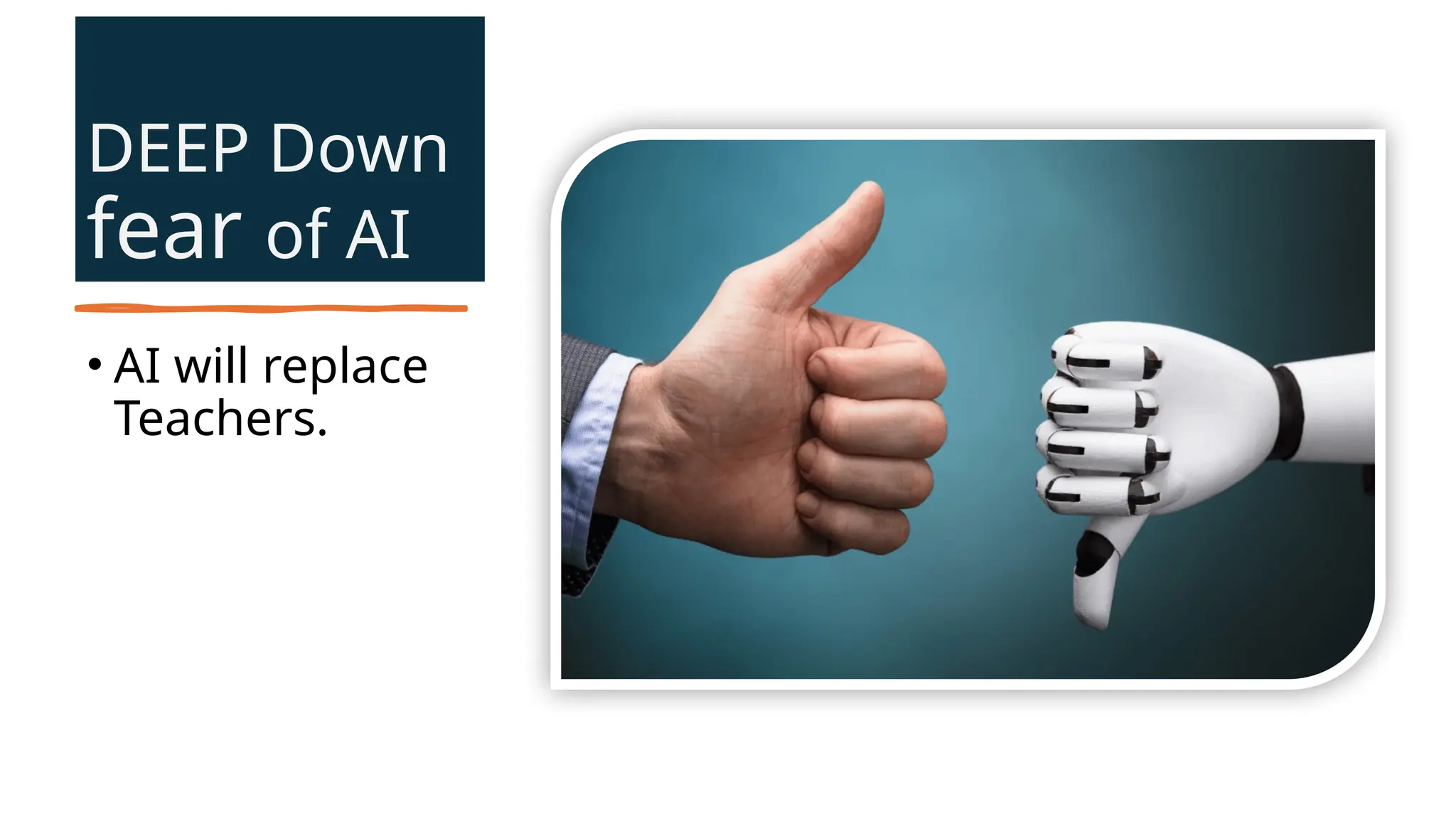
DEEP Down
fear of AI
• AI will replace
Teachers.
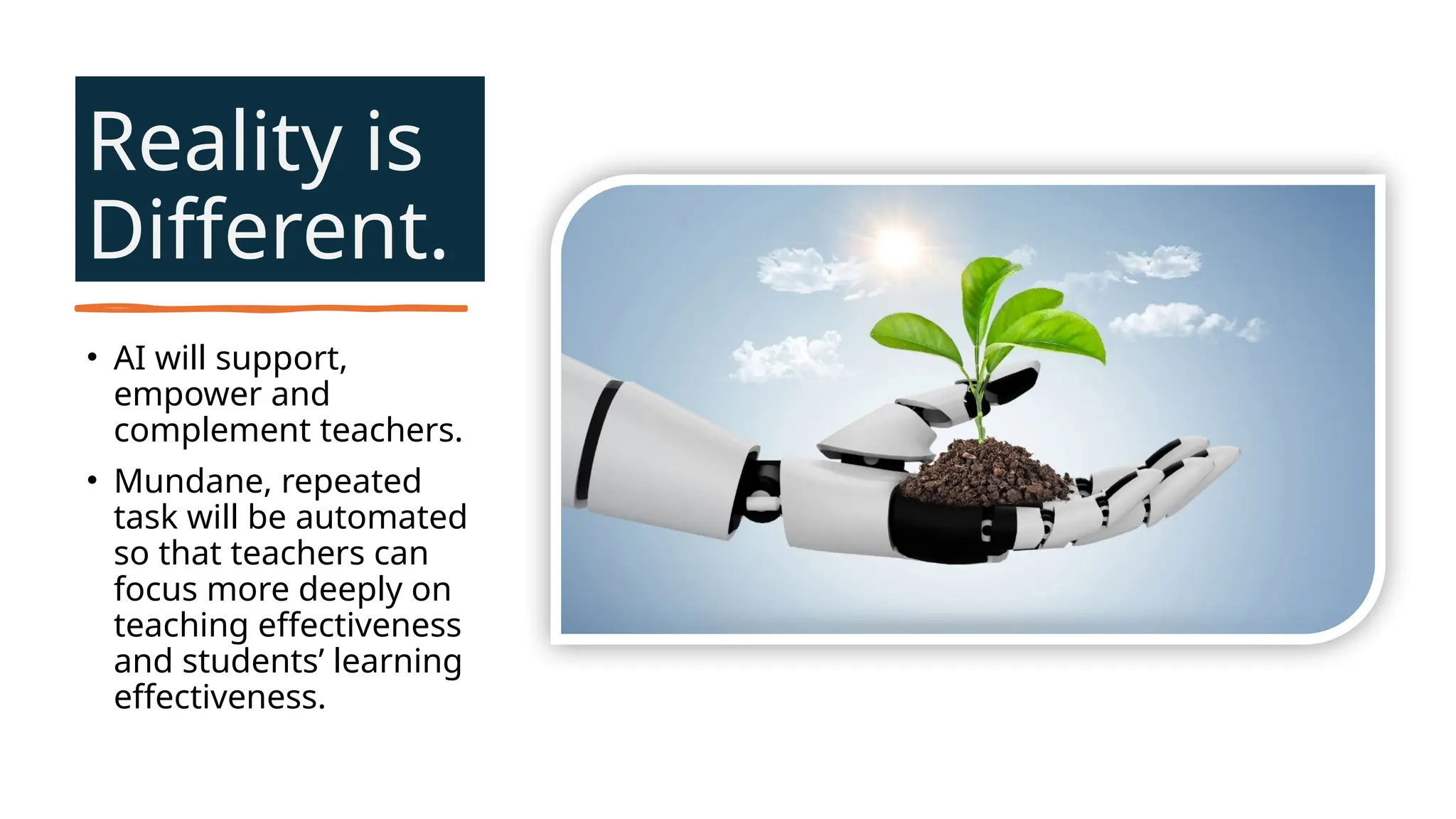
Reality is
Different.
• AI will support,
empower and
complement teachers.
• Mundane, repeated
task will be automated
so that teachers can
focus more deeply on
teaching effectiveness
and students’ learning
effectiveness.
Why AI in
Education
• Personalization of
Learning Experiences
• AI enables personalized
learning by adapting
content, pace, and learning
strategies to meet the
unique needs of each
student, improving
engagement and outcomes.
Real-life
Example
• Newsela adjusts the
reading level of
current event articles
to suit the individual
student's reading
ability, enhancing
comprehension and
engagement.
Why AI in
Education
• Increased Accessibility
• AI makes education more
accessible to students with
disabilities or those who
require additional support
through tools that tailor
learning experiences to
their needs.
Real-life
Example
• Google's Project Euphonia
uses AI to help people with
speech impairments
communicate more easily,
thereby making digital
educational content more
accessible to them.
Why AI in
Education
• Enhancing Efficiency and
Productivity
• AI automates
administrative tasks like
grading and attendance,
freeing up teachers to
spend more time on
instruction and student
support.
Real-life
Example
• Knewton provides an AI-
powered platform that
offers automated grading of
assignments, significantly
reducing teachers'
workload.
Why AI in
Education
• Facilitating Data-Driven
Decision Making
• AI offers insights into
student performance and
learning trends, enabling
educators and institutions
to make informed decisions
that improve educational
outcomes.
Real-life
Example
• The Georgia State University
uses an AI-enhanced
advising system to analyze
student data and identify
those at risk, improving
graduation rates.
Why AI in Education
• Improving Engagement and
Interactive Learning
• AI-powered tools enhance
engagement through
interactive and immersive
learning experiences like
simulations, gamified learning,
and virtual reality.
Real-life
Example
• Querium's StepWise virtual
tutor uses AI to provide
step-by-step coaching in
STEM subjects, making
learning more interactive
and engaging.
Why AI in
Education
• Breaking Language
Barriers
• AI facilitates multilingual
education and breaks down
language barriers, allowing
students from different
linguistic backgrounds to
access quality education.
Real-life
Example
• Duolingo uses AI to offer
personalized language
learning experiences,
supporting a wide range of
languages and helping to
bridge language gaps.
Why AI in
Education
• Supporting Continuous
Learning and Professional
Development
• AI promotes lifelong
learning by offering
personalized professional
development resources for
educators and learners,
keeping skills relevant in a
rapidly changing world.
Real-life
Example
• LinkedIn Learning uses AI to
recommend courses based
on users' job roles, skills,
and previous learning
patterns, supporting
continuous professional
growth.
Why AI in
Education
• Predictive Analytics for
Early Intervention
• AI's predictive analytics
identify students who may
need additional support,
enabling timely intervention
to address academic or well-
being concerns.
Real-life
Example
• Purdue University's Course
Signals system uses
predictive analytics to flag
students who might be at
risk, allowing for early
intervention and support.
Why AI in
Education
• Encouraging Innovative
Educational Practices
• AI inspires innovation in
teaching and learning
methods, pushing the
boundaries of traditional
education and encouraging
the exploration of new
pedagogical approaches.
Real-life
Example
• The AI-powered Jill Watson, a
virtual teaching assistant at
Georgia Tech, handles
routine queries, allowing
instructors to focus on more
complex student needs and
innovative teaching
methods.
How to
Integrate AI
with
Education
• Personalized Learning Paths
• AI algorithms analyze students' learning styles, strengths, and
weaknesses to create personalized study plans, making
education more effective.
Real-life
Example
• DreamBox Learning offers
math lessons that adjust in
real-time, providing students
with tasks tailored to their
skill level.
How to
Integrate AI
with Education
• Intelligent Tutoring
Systems
• These systems simulate one-
on-one interaction between
students and tutors, offering
personalized feedback and
instruction without replacing
human interaction.
Real-life Example
• Carnegie Learning's MATHia software
provides real-time feedback and
personalized learning experiences,
mimicking a human tutor's support.
How to
Integrate AI
with Education
• Automating Administrative
Tasks
• AI streamlines administrative
duties like grading,
attendance tracking, and
admissions processes,
allowing educators to focus
more on teaching.
Real-life
Example
• The AI-powered tool
Gradescope helps teachers
grade assignments more
quickly and consistently,
even adapting to different
grading styles.
How to
Integrate AI
with Education
• Enhancing Classroom
Interaction
• AI-driven tools can enhance
interaction during lessons
through real-time
questions, polls, and
feedback, engaging
students more effectively.
How to Integrate AI
with Education
• Supporting Students with
Disabilities
• AI offers customized solutions for
students with disabilities, such as
adaptive learning tools and accessible
content, enhancing their learning
experience.
Real-life Example
• Microsoft's Learning Tools use AI to
improve reading comprehension for
students with dyslexia, providing text
decoding solutions and immersive
reading experiences.
How to Integrate AI
with Education
• Language Learning
• AI facilitates language learning by
offering personalized feedback, voice
recognition, and interactive
conversational practice.
Real-life Example
• Duolingo's AI-driven platform
assesses user proficiency and
customizes lessons, using speech
recognition to provide feedback on
pronunciation.
• Predictive Analytics for Improving Outcomes
• AI analyzes data on student performance and engagement
to predict outcomes and identify students who may need
additional support.
How to Integrate AI with
Education
Real Life
Example
• The University of California,
Irvine, uses predictive
analytics to identify students
at risk of dropping out,
enabling timely intervention.
How to
Integrate AI
with Education
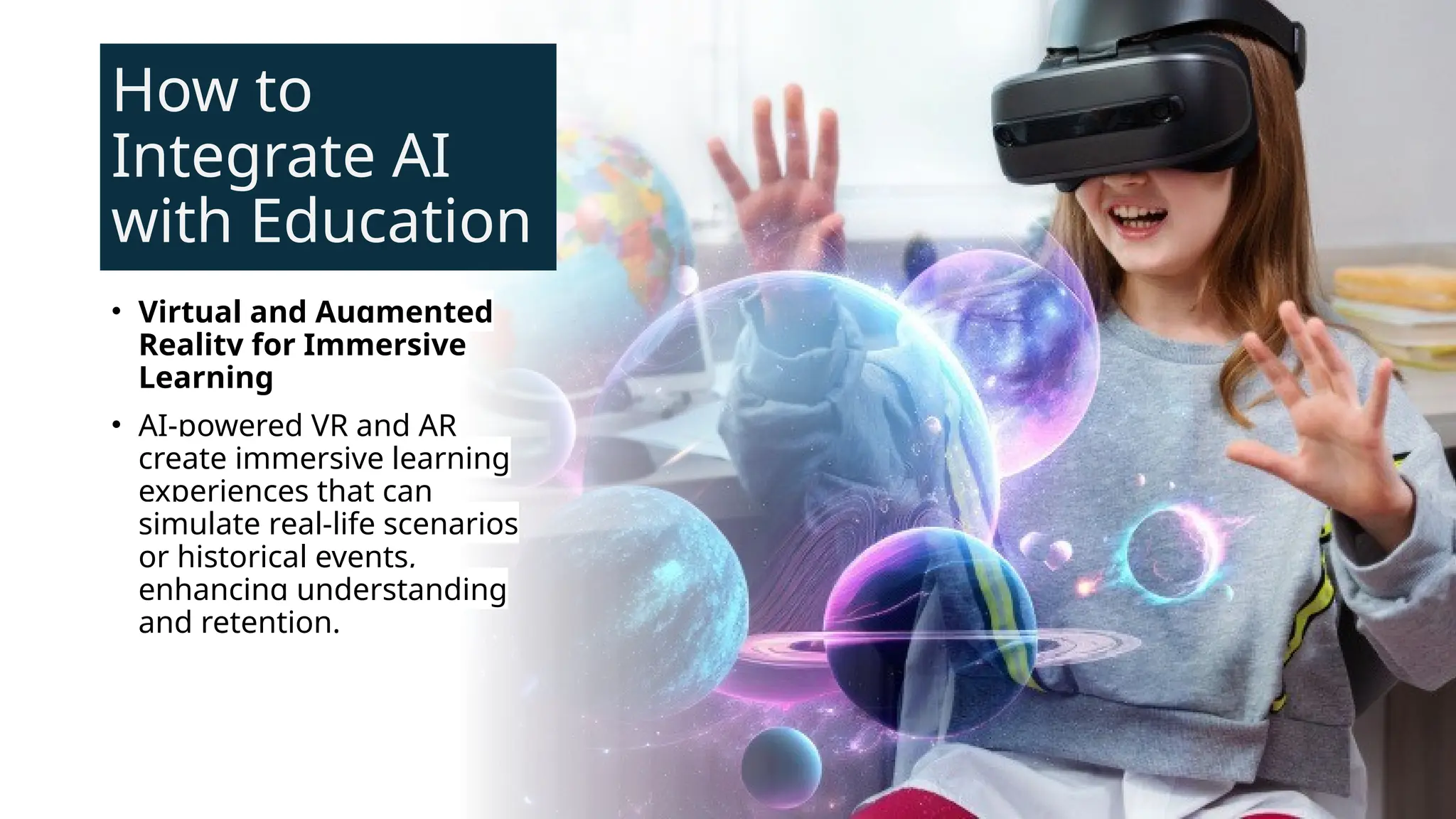
• Virtual and Augmented
Reality for Immersive
Learning
• AI-powered VR and AR
create immersive learning
experiences that can
simulate real-life scenarios
or historical events,
enhancing understanding
and retention.
Real-life
Example
• Labster's virtual labs use AI
to simulate science
experiments, allowing
students to conduct
experiments virtually that
would be impossible or
unsafe in a traditional
classroom.
How to Integrate
AI with
Education
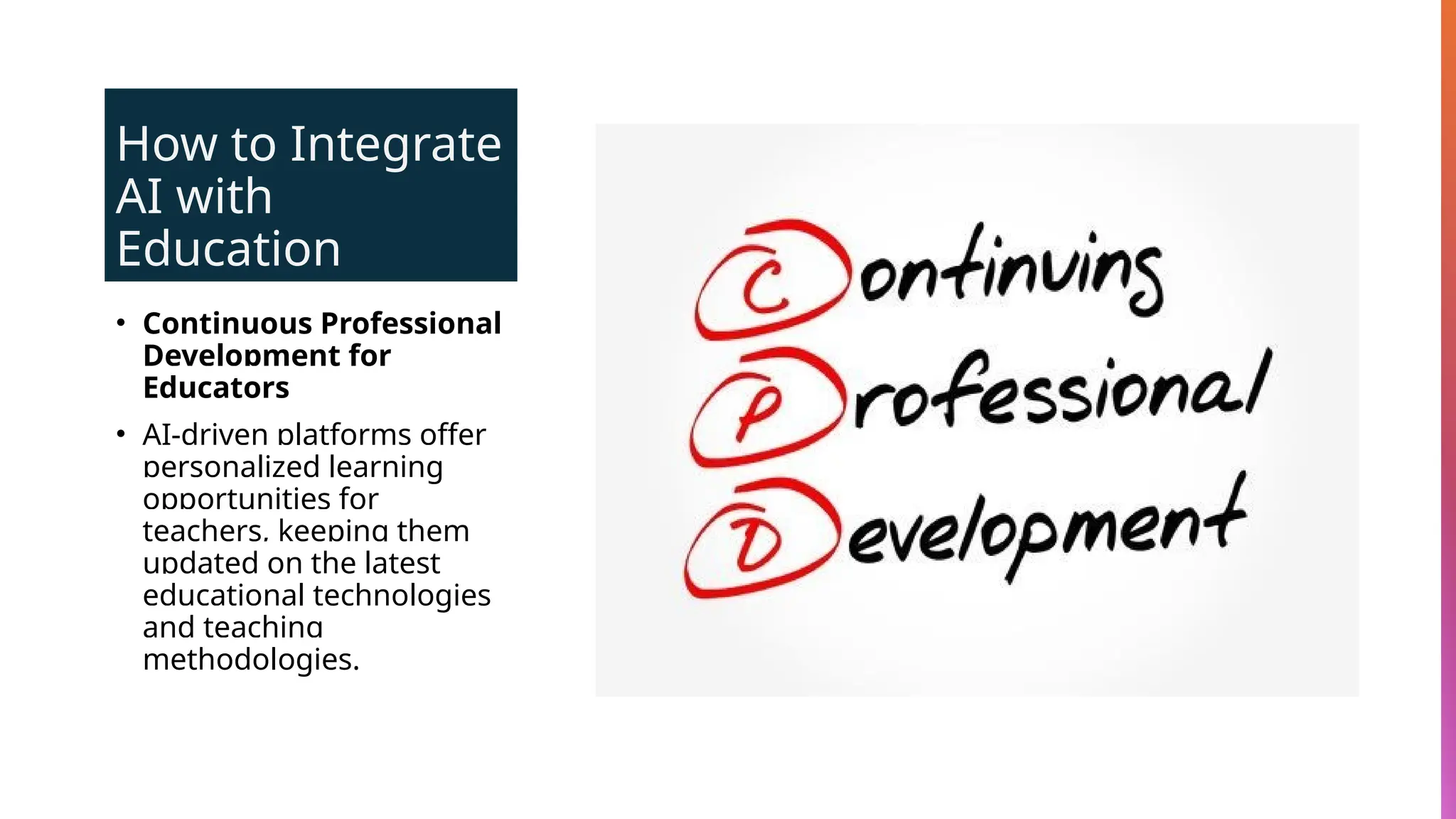
• Continuous Professional
Development for
Educators
• AI-driven platforms offer
personalized learning
opportunities for
teachers, keeping them
updated on the latest
educational technologies
and teaching
methodologies.
Real Life
Example
• Coursera, EdX,
FutureLearn, OpenLearn
and other MOOCs use AI
to suggest courses to
educators based on their
interests, teaching areas,
and previous course
engagements.
Best AI Tools
for Educators
• Turnitin: Primarily known for its plagiarism detection capabilities,
Turnitin employs AI to help educators ensure academic integrity.
It also provides feedback tools that can assist students in
improving their writing skills by identifying grammatical errors
and suggesting improvements.
Best AI Tools
for Educators
• Knewton: Knewton provides an adaptive learning platform that
personalizes educational content to match the learning pace and
style of individual students. By analyzing data on how students
interact with the material, Knewton can tailor educational
pathways to optimize learning outcomes.
Best AI Tools
for Educators
• Carnegie Learning: This AI-driven platform focuses on providing
personalized math education. It leverages cognitive science and
AI technologies to offer tailored instructions, practice, and
feedback to students, aiming to improve their understanding and
performance in math.
Best AI Tools
for Educators
• Chat GPT by OpenAI: Although not solely
focused on education, GPT has been widely
used in educational research for natural
language processing tasks. It can generate
human-like text, answer questions, and
even create content, making it a valuable
tool for developing educational materials
and interactive learning experiences.
Best AI Tools
for Educators
• ALEKS (Assessment and Learning in
Knowledge Spaces): ALEKS is an online
tutoring and assessment program that uses AI
to provide personalized learning experiences in
subjects like mathematics, chemistry, and
statistics. It assesses a student's knowledge to
identify what they know and what they're ready
to learn next, facilitating a tailored learning
path.
Best AI Tools
for Educators
• Squirrel AI: This is one of the leading
adaptive learning platforms, providing
students with personalized and dynamic
learning pathways. It uses sophisticated
algorithms to diagnose a student's
knowledge gaps and tailor the curriculum
accordingly, making it a powerful tool in
educational outcomes research.
Best AI Tools
for Educators
• EduBrite: EduBrite is a Learning
Management System (LMS) that utilizes AI
to provide personalized learning
experiences and analytics for both
corporate training and educational
institutions. Its capabilities include micro-
learning, assessments, and certifications
that cater to varied learning needs.
Best AI Tools for
Educators
• Watson Education by IBM: This
AI-powered platform provides
educators with insights into
learning habits and
performances, enabling
personalized learning
experiences. Watson can analyze
a wide range of data to provide
feedback and recommendations
that improve teaching strategies
and student outcomes.
Best AI Tools
for Educators
• Content Technologies, Inc.
(CTI): CTI uses AI to create
customized textbooks and
educational content. By
analyzing curricula and
evaluating existing textbooks,
it can produce tailor-made
textbooks that cater to the
specific requirements of a
course or institution.
Success Formula
Artificial Intelligence
+ Human Intelligence
Positive Future for Educators
Early to…
•Adopt
•Adept
Free and
Beginner Friendly
Programmes
•
Google's Introduction to Gen
erative AI
• https://www.coursera.org/le
arn/ai-for-everyone
Let’s Check Your Understanding!
AI can automate mundane tasks, allowing teachers to focus
on:
A) Only administrative work
B) Only grading and attendance
C) Teaching effectiveness and student learning
D) Taking more breaks
Answer is C.
Let’s Check Your Understanding!
How does AI contribute to personalizing learning
experiences?
A) By grading assignments only
B) By providing the same content to every student
C) By adapting content, pace, and learning strategies to each student's
needs
D) By offering only standardized tests
Answer is C.
Let’s Check Your Understanding!
Which project by Google aims to help people with speech
impairments communicate more easily?
A) Google Lens
B) Project Euphonia
C) Google Assistant
D) Google Translate
Answer is B.
Let’s Check Your Understanding!
AI-powered advising systems in universities aim to:
A) Decrease graduation rates
B) Make the admission process more competitive
C) Replace academic advisors
D) Identify at-risk students for timely intervention
Answer is D.
Let’s Check Your Understanding!
What does AI's predictive analytics in education aim to
improve?
A) Only the scheduling of classes
B) Outcomes by predicting students who may need additional support
C) The complexity of exams
D) The number of textbooks required
Answer is B.
Let’s Check Your Understanding!
What does the AI platform "Knewton" specialize in?
A) Adaptive physical education
B) Personalizing educational content
C) Only history lessons
D) Science experiments
Answer is B.
Unwanted Advice!
Learn!
Thank YOU!
Dr. Bhavin Chauhan
Communication Consultant and Founder of Communication Consultancy
Assistant Professor, Faculty of Education and Psychology, The Maharaja Sayajirao University of Baroda
Blogger @ https://nonverbalwithme.blogspot.com/
http://edutainmentwithbhavinchauhan.blogspot.com/
https://bhavinspirational.blogspot.com/
bhavincchauhan@gmail.com
WhatsApp- 9979896161

Role of AI (Artificial Intelligence) in Education

  • 1.
    Role of AIin Education: Education Reimagined! Dr. Bhavin Chauhan Department of Education, Faculty of Education and Psychology The Maharaja Sayajirao University of Baroda Vadodara, Gujarat, India chauhan.bhavin-edu@msubaroda.ac.in Mob. No. 9979896161 http://edutainmentwithbhavinchauhan.blogspot.com/ https://wordlifewithme.blogspot.com/
  • 2.
    AI- Concept • Artificialintelligence (AI) is a scientific field that involves creating machines and computers that can learn, reason, and act in ways that would normally require human intelligence.
  • 3.
    AI- Concept • ArtificialIntelligence, refers to the simulation of human intelligence in machines. • Computer systems capable of performing complex tasks that historically only a human could do, such as reasoning, making decisions, or solving problems.
  • 4.
    National Education Policy (NEP) 2020 recommends Artificial Intelligence (AI) • India'sNational Education Policy (NEP) 2020 acknowledges the potential of Artificial Intelligence (AI) to transform the educational landscape. • It emphasizes the use of AI to enhance educational processes, make learning more personalized and inclusive, and improve the overall effectiveness of the education system.
  • 5.
    Key Recommendation byNEP 2020 on the Use of AI in Education • Personalized Learning • Teacher and Student Support • Assessment • Content Development • Language Translation and Support • Educational Accessibility • Networking and Collaboration • Skill Development and Lifelong Learning • Data Analytics and Decision Making • Enhancing Online and Digital Education
  • 6.
    Potential Benefits PotentialDangers Greater accuracy for certain repeatable tasks, such as assembling vehicles or computers. Job loss due to increased automation. Decreased operational costs due to greater efficiency of machines. Potential for bias or discrimination as a result of the data set on which the AI is trained. Increased personalization within digital services and products. Possible cybersecurity concerns. Improved decision-making in certain situations. Lack of transparency over how decisions are arrived at, resulting in less-than- optimal solutions. Ability to quickly generate new content, such as text or images. Potential to create misinformation, as well as inadvertently violate laws and regulations.
  • 7.
    DEEP Down fear ofAI • AI will replace Teachers.
  • 8.
    Reality is Different. • AIwill support, empower and complement teachers. • Mundane, repeated task will be automated so that teachers can focus more deeply on teaching effectiveness and students’ learning effectiveness.
  • 9.
    Why AI in Education •Personalization of Learning Experiences • AI enables personalized learning by adapting content, pace, and learning strategies to meet the unique needs of each student, improving engagement and outcomes.
  • 10.
    Real-life Example • Newsela adjuststhe reading level of current event articles to suit the individual student's reading ability, enhancing comprehension and engagement.
  • 11.
    Why AI in Education •Increased Accessibility • AI makes education more accessible to students with disabilities or those who require additional support through tools that tailor learning experiences to their needs.
  • 12.
    Real-life Example • Google's ProjectEuphonia uses AI to help people with speech impairments communicate more easily, thereby making digital educational content more accessible to them.
  • 13.
    Why AI in Education •Enhancing Efficiency and Productivity • AI automates administrative tasks like grading and attendance, freeing up teachers to spend more time on instruction and student support.
  • 14.
    Real-life Example • Knewton providesan AI- powered platform that offers automated grading of assignments, significantly reducing teachers' workload.
  • 15.
    Why AI in Education •Facilitating Data-Driven Decision Making • AI offers insights into student performance and learning trends, enabling educators and institutions to make informed decisions that improve educational outcomes.
  • 16.
    Real-life Example • The GeorgiaState University uses an AI-enhanced advising system to analyze student data and identify those at risk, improving graduation rates.
  • 17.
    Why AI inEducation • Improving Engagement and Interactive Learning • AI-powered tools enhance engagement through interactive and immersive learning experiences like simulations, gamified learning, and virtual reality.
  • 18.
    Real-life Example • Querium's StepWisevirtual tutor uses AI to provide step-by-step coaching in STEM subjects, making learning more interactive and engaging.
  • 19.
    Why AI in Education •Breaking Language Barriers • AI facilitates multilingual education and breaks down language barriers, allowing students from different linguistic backgrounds to access quality education.
  • 20.
    Real-life Example • Duolingo usesAI to offer personalized language learning experiences, supporting a wide range of languages and helping to bridge language gaps.
  • 21.
    Why AI in Education •Supporting Continuous Learning and Professional Development • AI promotes lifelong learning by offering personalized professional development resources for educators and learners, keeping skills relevant in a rapidly changing world.
  • 22.
    Real-life Example • LinkedIn Learninguses AI to recommend courses based on users' job roles, skills, and previous learning patterns, supporting continuous professional growth.
  • 23.
    Why AI in Education •Predictive Analytics for Early Intervention • AI's predictive analytics identify students who may need additional support, enabling timely intervention to address academic or well- being concerns.
  • 24.
    Real-life Example • Purdue University'sCourse Signals system uses predictive analytics to flag students who might be at risk, allowing for early intervention and support.
  • 25.
    Why AI in Education •Encouraging Innovative Educational Practices • AI inspires innovation in teaching and learning methods, pushing the boundaries of traditional education and encouraging the exploration of new pedagogical approaches.
  • 26.
    Real-life Example • The AI-poweredJill Watson, a virtual teaching assistant at Georgia Tech, handles routine queries, allowing instructors to focus on more complex student needs and innovative teaching methods.
  • 27.
    How to Integrate AI with Education •Personalized Learning Paths • AI algorithms analyze students' learning styles, strengths, and weaknesses to create personalized study plans, making education more effective.
  • 28.
    Real-life Example • DreamBox Learningoffers math lessons that adjust in real-time, providing students with tasks tailored to their skill level.
  • 29.
    How to Integrate AI withEducation • Intelligent Tutoring Systems • These systems simulate one- on-one interaction between students and tutors, offering personalized feedback and instruction without replacing human interaction.
  • 30.
    Real-life Example • CarnegieLearning's MATHia software provides real-time feedback and personalized learning experiences, mimicking a human tutor's support.
  • 31.
    How to Integrate AI withEducation • Automating Administrative Tasks • AI streamlines administrative duties like grading, attendance tracking, and admissions processes, allowing educators to focus more on teaching.
  • 32.
    Real-life Example • The AI-poweredtool Gradescope helps teachers grade assignments more quickly and consistently, even adapting to different grading styles.
  • 33.
    How to Integrate AI withEducation • Enhancing Classroom Interaction • AI-driven tools can enhance interaction during lessons through real-time questions, polls, and feedback, engaging students more effectively.
  • 34.
    How to IntegrateAI with Education • Supporting Students with Disabilities • AI offers customized solutions for students with disabilities, such as adaptive learning tools and accessible content, enhancing their learning experience.
  • 35.
    Real-life Example • Microsoft'sLearning Tools use AI to improve reading comprehension for students with dyslexia, providing text decoding solutions and immersive reading experiences.
  • 36.
    How to IntegrateAI with Education • Language Learning • AI facilitates language learning by offering personalized feedback, voice recognition, and interactive conversational practice.
  • 37.
    Real-life Example • Duolingo'sAI-driven platform assesses user proficiency and customizes lessons, using speech recognition to provide feedback on pronunciation.
  • 38.
    • Predictive Analyticsfor Improving Outcomes • AI analyzes data on student performance and engagement to predict outcomes and identify students who may need additional support. How to Integrate AI with Education
  • 39.
    Real Life Example • TheUniversity of California, Irvine, uses predictive analytics to identify students at risk of dropping out, enabling timely intervention.
  • 40.
    How to Integrate AI withEducation • Virtual and Augmented Reality for Immersive Learning • AI-powered VR and AR create immersive learning experiences that can simulate real-life scenarios or historical events, enhancing understanding and retention.
  • 41.
    Real-life Example • Labster's virtuallabs use AI to simulate science experiments, allowing students to conduct experiments virtually that would be impossible or unsafe in a traditional classroom.
  • 42.
    How to Integrate AIwith Education • Continuous Professional Development for Educators • AI-driven platforms offer personalized learning opportunities for teachers, keeping them updated on the latest educational technologies and teaching methodologies.
  • 43.
    Real Life Example • Coursera,EdX, FutureLearn, OpenLearn and other MOOCs use AI to suggest courses to educators based on their interests, teaching areas, and previous course engagements.
  • 44.
    Best AI Tools forEducators • Turnitin: Primarily known for its plagiarism detection capabilities, Turnitin employs AI to help educators ensure academic integrity. It also provides feedback tools that can assist students in improving their writing skills by identifying grammatical errors and suggesting improvements.
  • 45.
    Best AI Tools forEducators • Knewton: Knewton provides an adaptive learning platform that personalizes educational content to match the learning pace and style of individual students. By analyzing data on how students interact with the material, Knewton can tailor educational pathways to optimize learning outcomes.
  • 46.
    Best AI Tools forEducators • Carnegie Learning: This AI-driven platform focuses on providing personalized math education. It leverages cognitive science and AI technologies to offer tailored instructions, practice, and feedback to students, aiming to improve their understanding and performance in math.
  • 47.
    Best AI Tools forEducators • Chat GPT by OpenAI: Although not solely focused on education, GPT has been widely used in educational research for natural language processing tasks. It can generate human-like text, answer questions, and even create content, making it a valuable tool for developing educational materials and interactive learning experiences.
  • 48.
    Best AI Tools forEducators • ALEKS (Assessment and Learning in Knowledge Spaces): ALEKS is an online tutoring and assessment program that uses AI to provide personalized learning experiences in subjects like mathematics, chemistry, and statistics. It assesses a student's knowledge to identify what they know and what they're ready to learn next, facilitating a tailored learning path.
  • 49.
    Best AI Tools forEducators • Squirrel AI: This is one of the leading adaptive learning platforms, providing students with personalized and dynamic learning pathways. It uses sophisticated algorithms to diagnose a student's knowledge gaps and tailor the curriculum accordingly, making it a powerful tool in educational outcomes research.
  • 50.
    Best AI Tools forEducators • EduBrite: EduBrite is a Learning Management System (LMS) that utilizes AI to provide personalized learning experiences and analytics for both corporate training and educational institutions. Its capabilities include micro- learning, assessments, and certifications that cater to varied learning needs.
  • 51.
    Best AI Toolsfor Educators • Watson Education by IBM: This AI-powered platform provides educators with insights into learning habits and performances, enabling personalized learning experiences. Watson can analyze a wide range of data to provide feedback and recommendations that improve teaching strategies and student outcomes.
  • 52.
    Best AI Tools forEducators • Content Technologies, Inc. (CTI): CTI uses AI to create customized textbooks and educational content. By analyzing curricula and evaluating existing textbooks, it can produce tailor-made textbooks that cater to the specific requirements of a course or institution.
  • 53.
    Success Formula Artificial Intelligence +Human Intelligence Positive Future for Educators
  • 54.
  • 55.
    Free and Beginner Friendly Programmes • Google'sIntroduction to Gen erative AI • https://www.coursera.org/le arn/ai-for-everyone
  • 56.
    Let’s Check YourUnderstanding! AI can automate mundane tasks, allowing teachers to focus on: A) Only administrative work B) Only grading and attendance C) Teaching effectiveness and student learning D) Taking more breaks Answer is C.
  • 57.
    Let’s Check YourUnderstanding! How does AI contribute to personalizing learning experiences? A) By grading assignments only B) By providing the same content to every student C) By adapting content, pace, and learning strategies to each student's needs D) By offering only standardized tests Answer is C.
  • 58.
    Let’s Check YourUnderstanding! Which project by Google aims to help people with speech impairments communicate more easily? A) Google Lens B) Project Euphonia C) Google Assistant D) Google Translate Answer is B.
  • 59.
    Let’s Check YourUnderstanding! AI-powered advising systems in universities aim to: A) Decrease graduation rates B) Make the admission process more competitive C) Replace academic advisors D) Identify at-risk students for timely intervention Answer is D.
  • 60.
    Let’s Check YourUnderstanding! What does AI's predictive analytics in education aim to improve? A) Only the scheduling of classes B) Outcomes by predicting students who may need additional support C) The complexity of exams D) The number of textbooks required Answer is B.
  • 61.
    Let’s Check YourUnderstanding! What does the AI platform "Knewton" specialize in? A) Adaptive physical education B) Personalizing educational content C) Only history lessons D) Science experiments Answer is B.
  • 62.
  • 63.
    Thank YOU! Dr. BhavinChauhan Communication Consultant and Founder of Communication Consultancy Assistant Professor, Faculty of Education and Psychology, The Maharaja Sayajirao University of Baroda Blogger @ https://nonverbalwithme.blogspot.com/ http://edutainmentwithbhavinchauhan.blogspot.com/ https://bhavinspirational.blogspot.com/ bhavincchauhan@gmail.com WhatsApp- 9979896161