Research
Dr Bhavin Chauhan
M.A. (English), M.Ed., NET (Education),
Ph.D. (Communication Skills)
Remember
Research is thinking in print.
The way to get started
is to QUIT talking
and BEGIN doing.
Walt Disney
Defining Research
Creswell (2014)
• Definition: “Research is a process of steps used to collect
and analyze information to increase our understanding of a
topic or issue.”
• Source: Creswell, J. W. (2014). Research Design: Qualitative,
Quantitative, and Mixed Methods Approaches (4th ed.). SAGE
Publications.
Defining Research
Kerlinger (1973)
• Definition: “Research is a systematic, controlled, empirical,
and critical investigation of hypothetical propositions about
the presumed relations among natural phenomena.”
• Source: Kerlinger, F. N. (1973). Foundations of Behavioral
Research. Holt, Rinehart and Winston.
Defining Research
Best and Kahn (1998)
• Definition: “Research is the systematic and objective
analysis and recording of controlled observations that may
lead to the development of generalizations, principles, or
theories, resulting in prediction and possibly ultimate
control of events.”
• Source: Best, J. W., & Kahn, J. V. (1998). Research in Education
(8th ed.). Allyn and Bacon.
Defining Research
Saunders, Lewis, and Thornhill (2009)
• Definition: “Research is something that people undertake in
order to find out things in a systematic way, thereby
increasing their knowledge.”
• Source: Saunders, M., Lewis, P., & Thornhill, A. (2009).
Research Methods for Business Students (5th ed.). Pearson
Education Limited.
Defining Research
Grinnell (1993)
• Definition: “Research is a structured inquiry that utilizes
acceptable scientific methodology to solve problems and
create new knowledge that is generally applicable.”
• Source: Grinnell, R. M. (1993). Social Work Research and
Evaluation. F.E. Peacock Publishers.
Defining Research
• Babbie (2004)
• Definition: “Research is a systematic inquiry to describe,
explain, predict, and control the observed phenomenon.”
• Source: Babbie, E. (2004). The Practice of Social Research
(10th ed.). Wadsworth Publishing.
Defining Research
Denzin and Lincoln (2005)
• Definition: “Research involves a set of interpretive, material
practices that make the world visible. These practices
transform the world.”
• Source: Denzin, N. K., & Lincoln, Y. S. (2005). The Sage
Handbook of Qualitative Research (3rd ed.). SAGE
Publications.
Defining Research
Leedy and Ormrod (2015)
• Definition: “Research is a systematic process of collecting,
analyzing, and interpreting information—data—in order to
increase our understanding of a phenomenon about which
we are interested or concerned.”
• Source: Leedy, P. D., & Ormrod, J. E. (2015). Practical
Research: Planning and Design (11th ed.). Pearson.
Defining Research
Kothari (2004)
• Definition: “Research is an art of scientific investigation. It is
a careful investigation or inquiry especially through search
for new facts in any branch of knowledge.”
• Source: Kothari, C. R. (2004). Research Methodology: Methods
and Techniques (2nd ed.). New Age International.
Defining Research
• Burns (2000)
• Definition: “Research is a systematic investigation to find
answers to a problem.”
• Source: Burns, R. B. (2000). Introduction to Research Methods
(4th ed.). SAGE Publications.
Defining Research
• Walliman (2011)
• Definition: “Research is a way of finding out things you
didn’t know, a way of developing and testing new ideas, and
a way of providing solutions to problems.”
• Source: Walliman, N. (2011). Research Methods: The Basics.
Routledge.
Defining Research
Neuman (2011)
• Definition: “Research is a collection of methods people use
systematically to produce knowledge.”
• Source: Neuman, W. L. (2011). Social Research Methods:
Qualitative and Quantitative Approaches (7th ed.). Pearson.
Defining Research
Fraenkel and Wallen (2009)
• Definition: “Research is a careful and systematic means of
solving problems.”
• Source: Fraenkel, J. R., & Wallen, N. E. (2009). How to Design
and Evaluate Research in Education (7th ed.). McGraw-Hill.
Defining Research
Graziano and Raulin (2004)
• Definition: “Research is a process of inquiry and
investigation; it is systematic, methodical, and ethical;
research can help solve practical problems and increase
knowledge.”
• Source: Graziano, A. M., & Raulin, M. L. (2004). Research
Methods: A Process of Inquiry (5th ed.). Pearson.
Defining Research
Mertens (2014)
• Definition: “Research is a systematic investigation involving
the analysis of data to answer a question or contribute to a
body of knowledge.”
• Source: Mertens, D. M. (2014). Research and Evaluation in
Education and Psychology: Integrating Diversity with
Quantitative, Qualitative, and Mixed Methods (4th ed.). SAGE
Publications.
My Own Definition
• Research is a dynamic and systematic pursuit of knowledge,
driven by curiosity and guided by methodical inquiry. It is the
art and science of exploring the unknown, challenging
assumptions, and seeking innovative solutions to complex
problems. Through careful observation, rigorous analysis, and
creative thinking, research transforms ideas into insights and
contributes to the advancement of society by uncovering new
possibilities and deepening our understanding of the world.
My Own Definitions
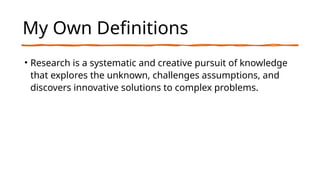
• Research is a systematic and creative pursuit of knowledge
that explores the unknown, challenges assumptions, and
discovers innovative solutions to complex problems.
Process of Research [Common]
1. Problem Identification and Definition
• Description: Identify a specific problem or opportunity for
improvement. Clearly define the problem to understand its
scope and impact.
• Example: An engineer notices that existing solar panels
have low efficiency in converting sunlight to electricity and
aims to improve it.
Process of Research
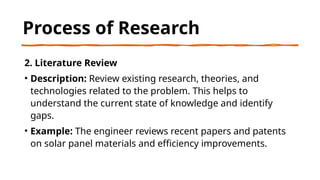
2. Literature Review
• Description: Review existing research, theories, and
technologies related to the problem. This helps to
understand the current state of knowledge and identify
gaps.
• Example: The engineer reviews recent papers and patents
on solar panel materials and efficiency improvements.
Process of Research
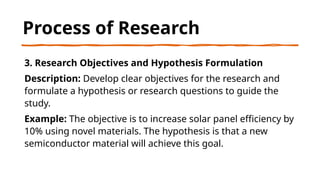
3. Research Objectives and Hypothesis Formulation
Description: Develop clear objectives for the research and
formulate a hypothesis or research questions to guide the
study.
Example: The objective is to increase solar panel efficiency by
10% using novel materials. The hypothesis is that a new
semiconductor material will achieve this goal.
Process of Research
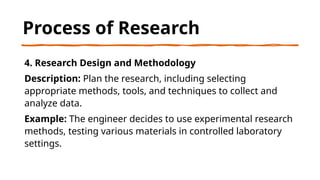
4. Research Design and Methodology
Description: Plan the research, including selecting
appropriate methods, tools, and techniques to collect and
analyze data.
Example: The engineer decides to use experimental research
methods, testing various materials in controlled laboratory
settings.
Process of Research
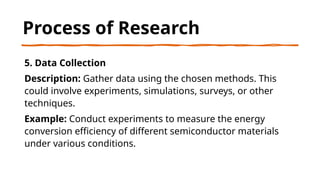
5. Data Collection
Description: Gather data using the chosen methods. This
could involve experiments, simulations, surveys, or other
techniques.
Example: Conduct experiments to measure the energy
conversion efficiency of different semiconductor materials
under various conditions.
Process of Research
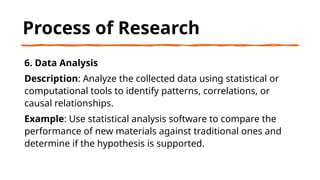
6. Data Analysis
Description: Analyze the collected data using statistical or
computational tools to identify patterns, correlations, or
causal relationships.
Example: Use statistical analysis software to compare the
performance of new materials against traditional ones and
determine if the hypothesis is supported.
Process of Research
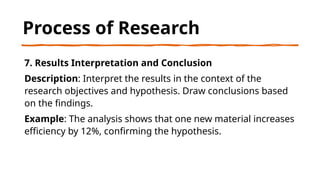
7. Results Interpretation and Conclusion
Description: Interpret the results in the context of the
research objectives and hypothesis. Draw conclusions based
on the findings.
Example: The analysis shows that one new material increases
efficiency by 12%, confirming the hypothesis.
Process of Research
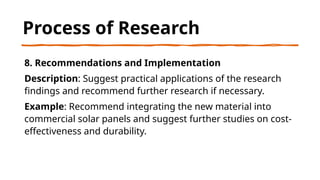
8. Recommendations and Implementation
Description: Suggest practical applications of the research
findings and recommend further research if necessary.
Example: Recommend integrating the new material into
commercial solar panels and suggest further studies on cost-
effectiveness and durability.
Process of Research
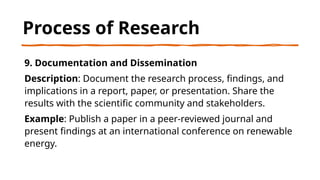
9. Documentation and Dissemination
Description: Document the research process, findings, and
implications in a report, paper, or presentation. Share the
results with the scientific community and stakeholders.
Example: Publish a paper in a peer-reviewed journal and
present findings at an international conference on renewable
energy.
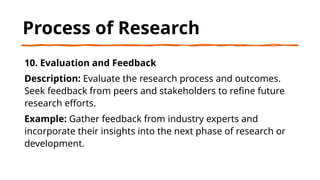
Process of Research
10. Evaluation and Feedback
Description: Evaluate the research process and outcomes.
Seek feedback from peers and stakeholders to refine future
research efforts.
Example: Gather feedback from industry experts and
incorporate their insights into the next phase of research or
development.
Thank YOU

Research: Concept, Definitions and Understanding

  • 1.
    Research Dr Bhavin Chauhan M.A.(English), M.Ed., NET (Education), Ph.D. (Communication Skills)
  • 2.
  • 3.
    The way toget started is to QUIT talking and BEGIN doing. Walt Disney
  • 4.
    Defining Research Creswell (2014) •Definition: “Research is a process of steps used to collect and analyze information to increase our understanding of a topic or issue.” • Source: Creswell, J. W. (2014). Research Design: Qualitative, Quantitative, and Mixed Methods Approaches (4th ed.). SAGE Publications.
  • 5.
    Defining Research Kerlinger (1973) •Definition: “Research is a systematic, controlled, empirical, and critical investigation of hypothetical propositions about the presumed relations among natural phenomena.” • Source: Kerlinger, F. N. (1973). Foundations of Behavioral Research. Holt, Rinehart and Winston.
  • 6.
    Defining Research Best andKahn (1998) • Definition: “Research is the systematic and objective analysis and recording of controlled observations that may lead to the development of generalizations, principles, or theories, resulting in prediction and possibly ultimate control of events.” • Source: Best, J. W., & Kahn, J. V. (1998). Research in Education (8th ed.). Allyn and Bacon.
  • 7.
    Defining Research Saunders, Lewis,and Thornhill (2009) • Definition: “Research is something that people undertake in order to find out things in a systematic way, thereby increasing their knowledge.” • Source: Saunders, M., Lewis, P., & Thornhill, A. (2009). Research Methods for Business Students (5th ed.). Pearson Education Limited.
  • 8.
    Defining Research Grinnell (1993) •Definition: “Research is a structured inquiry that utilizes acceptable scientific methodology to solve problems and create new knowledge that is generally applicable.” • Source: Grinnell, R. M. (1993). Social Work Research and Evaluation. F.E. Peacock Publishers.
  • 9.
    Defining Research • Babbie(2004) • Definition: “Research is a systematic inquiry to describe, explain, predict, and control the observed phenomenon.” • Source: Babbie, E. (2004). The Practice of Social Research (10th ed.). Wadsworth Publishing.
  • 10.
    Defining Research Denzin andLincoln (2005) • Definition: “Research involves a set of interpretive, material practices that make the world visible. These practices transform the world.” • Source: Denzin, N. K., & Lincoln, Y. S. (2005). The Sage Handbook of Qualitative Research (3rd ed.). SAGE Publications.
  • 11.
    Defining Research Leedy andOrmrod (2015) • Definition: “Research is a systematic process of collecting, analyzing, and interpreting information—data—in order to increase our understanding of a phenomenon about which we are interested or concerned.” • Source: Leedy, P. D., & Ormrod, J. E. (2015). Practical Research: Planning and Design (11th ed.). Pearson.
  • 12.
    Defining Research Kothari (2004) •Definition: “Research is an art of scientific investigation. It is a careful investigation or inquiry especially through search for new facts in any branch of knowledge.” • Source: Kothari, C. R. (2004). Research Methodology: Methods and Techniques (2nd ed.). New Age International.
  • 13.
    Defining Research • Burns(2000) • Definition: “Research is a systematic investigation to find answers to a problem.” • Source: Burns, R. B. (2000). Introduction to Research Methods (4th ed.). SAGE Publications.
  • 14.
    Defining Research • Walliman(2011) • Definition: “Research is a way of finding out things you didn’t know, a way of developing and testing new ideas, and a way of providing solutions to problems.” • Source: Walliman, N. (2011). Research Methods: The Basics. Routledge.
  • 15.
    Defining Research Neuman (2011) •Definition: “Research is a collection of methods people use systematically to produce knowledge.” • Source: Neuman, W. L. (2011). Social Research Methods: Qualitative and Quantitative Approaches (7th ed.). Pearson.
  • 16.
    Defining Research Fraenkel andWallen (2009) • Definition: “Research is a careful and systematic means of solving problems.” • Source: Fraenkel, J. R., & Wallen, N. E. (2009). How to Design and Evaluate Research in Education (7th ed.). McGraw-Hill.
  • 17.
    Defining Research Graziano andRaulin (2004) • Definition: “Research is a process of inquiry and investigation; it is systematic, methodical, and ethical; research can help solve practical problems and increase knowledge.” • Source: Graziano, A. M., & Raulin, M. L. (2004). Research Methods: A Process of Inquiry (5th ed.). Pearson.
  • 18.
    Defining Research Mertens (2014) •Definition: “Research is a systematic investigation involving the analysis of data to answer a question or contribute to a body of knowledge.” • Source: Mertens, D. M. (2014). Research and Evaluation in Education and Psychology: Integrating Diversity with Quantitative, Qualitative, and Mixed Methods (4th ed.). SAGE Publications.
  • 19.
    My Own Definition •Research is a dynamic and systematic pursuit of knowledge, driven by curiosity and guided by methodical inquiry. It is the art and science of exploring the unknown, challenging assumptions, and seeking innovative solutions to complex problems. Through careful observation, rigorous analysis, and creative thinking, research transforms ideas into insights and contributes to the advancement of society by uncovering new possibilities and deepening our understanding of the world.
  • 20.
    My Own Definitions •Research is a systematic and creative pursuit of knowledge that explores the unknown, challenges assumptions, and discovers innovative solutions to complex problems.
  • 21.
    Process of Research[Common] 1. Problem Identification and Definition • Description: Identify a specific problem or opportunity for improvement. Clearly define the problem to understand its scope and impact. • Example: An engineer notices that existing solar panels have low efficiency in converting sunlight to electricity and aims to improve it.
  • 22.
    Process of Research 2.Literature Review • Description: Review existing research, theories, and technologies related to the problem. This helps to understand the current state of knowledge and identify gaps. • Example: The engineer reviews recent papers and patents on solar panel materials and efficiency improvements.
  • 23.
    Process of Research 3.Research Objectives and Hypothesis Formulation Description: Develop clear objectives for the research and formulate a hypothesis or research questions to guide the study. Example: The objective is to increase solar panel efficiency by 10% using novel materials. The hypothesis is that a new semiconductor material will achieve this goal.
  • 24.
    Process of Research 4.Research Design and Methodology Description: Plan the research, including selecting appropriate methods, tools, and techniques to collect and analyze data. Example: The engineer decides to use experimental research methods, testing various materials in controlled laboratory settings.
  • 25.
    Process of Research 5.Data Collection Description: Gather data using the chosen methods. This could involve experiments, simulations, surveys, or other techniques. Example: Conduct experiments to measure the energy conversion efficiency of different semiconductor materials under various conditions.
  • 26.
    Process of Research 6.Data Analysis Description: Analyze the collected data using statistical or computational tools to identify patterns, correlations, or causal relationships. Example: Use statistical analysis software to compare the performance of new materials against traditional ones and determine if the hypothesis is supported.
  • 27.
    Process of Research 7.Results Interpretation and Conclusion Description: Interpret the results in the context of the research objectives and hypothesis. Draw conclusions based on the findings. Example: The analysis shows that one new material increases efficiency by 12%, confirming the hypothesis.
  • 28.
    Process of Research 8.Recommendations and Implementation Description: Suggest practical applications of the research findings and recommend further research if necessary. Example: Recommend integrating the new material into commercial solar panels and suggest further studies on cost- effectiveness and durability.
  • 29.
    Process of Research 9.Documentation and Dissemination Description: Document the research process, findings, and implications in a report, paper, or presentation. Share the results with the scientific community and stakeholders. Example: Publish a paper in a peer-reviewed journal and present findings at an international conference on renewable energy.
  • 30.
    Process of Research 10.Evaluation and Feedback Description: Evaluate the research process and outcomes. Seek feedback from peers and stakeholders to refine future research efforts. Example: Gather feedback from industry experts and incorporate their insights into the next phase of research or development.
  • 31.