
In process control , validation of large scale
process and Case Studies
Presented By:
Divya Ashok Dhule
M. Pharm.(Pharmaceutical Chemistry) 1st
Year
Rashtrasant Tukadoji Maharaj Nagpur University
Nagpur-440033
In Process Control
• Process control in pharmaceutical process chemistry is essential for ensuring the
quality, safety, and efficacy of pharmaceutical products. It involves the monitoring
and regulation of various parameters throughout the manufacturing process to
maintain consistency and meet regulatory standards. Here are some key aspects of
process control in pharmaceutical process chemistry:
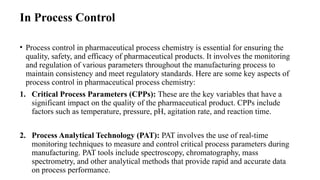
1. Critical Process Parameters (CPPs): These are the key variables that have a
significant impact on the quality of the pharmaceutical product. CPPs include
factors such as temperature, pressure, pH, agitation rate, and reaction time.
2. Process Analytical Technology (PAT): PAT involves the use of real-time
monitoring techniques to measure and control critical process parameters during
manufacturing. PAT tools include spectroscopy, chromatography, mass
spectrometry, and other analytical methods that provide rapid and accurate data
on process performance.
3. Quality by Design (QbD): QbD is a systematic approach to pharmaceutical
development that emphasizes the understanding of how formulation and process
variables influence product quality. QbD principles guide the design of robust
manufacturing processes with built-in controls to ensure consistent product quality.
4. Risk Assessment and Mitigation: Identifying and mitigating risks associated with
the manufacturing process is crucial for ensuring product safety and compliance with
regulatory requirements. Risk assessment techniques such as Failure Mode and Effects
Analysis (FMEA) help identify potential failure modes and develop strategies to
prevent or mitigate them.
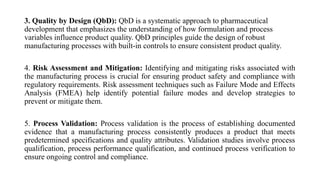
5. Process Validation: Process validation is the process of establishing documented
evidence that a manufacturing process consistently produces a product that meets
predetermined specifications and quality attributes. Validation studies involve process
qualification, process performance qualification, and continued process verification to
ensure ongoing control and compliance.
6. Control Strategy Development: A control strategy outlines how critical process
parameters will be monitored and controlled throughout the manufacturing process. It
includes procedures for deviation management, corrective actions, and change control
to ensure product quality and regulatory compliance.
7. Regulatory Compliance: Pharmaceutical manufacturing processes must comply
with regulatory requirements set forth by agencies such as the Food and Drug
Administration (FDA) in the United States and the European Medicines Agency
(EMA) in Europe. Compliance involves adhering to Good Manufacturing Practices
(GMP), following established guidelines, and maintaining comprehensive
documentation of process controls and quality assurance activities.
• Overall, process control in pharmaceutical process chemistry is a multifaceted
discipline that integrates scientific principles, advanced technology, and regulatory
compliance to ensure the production of safe and effective pharmaceutical products.
Validation of Large Scale Process
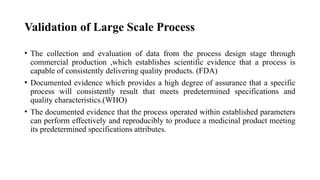
• The collection and evaluation of data from the process design stage through
commercial production ,which establishes scientific evidence that a process is
capable of consistently delivering quality products. (FDA)
• Documented evidence which provides a high degree of assurance that a specific
process will consistently result that meets predetermined specifications and
quality characteristics.(WHO)
• The documented evidence that the process operated within established parameters
can perform effectively and reproducibly to produce a medicinal product meeting
its predetermined specifications attributes.
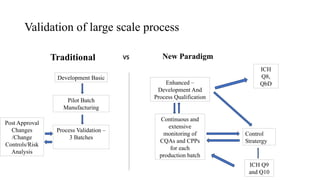
Validation of large scale process
Traditional New Paradigm
VS
Development Basic
Pilot Batch
Manufacturing
Process Validation –
3 Batches
Post Approval
Changes
/Change
Controls/Risk
Analysis
Enhanced –
Development And
Process Qualification
Continuous and
extensive
monitoring of
CQAs and CPPs
for each
production batch
ICH
Q8,
QbD
Control
Stratergy
ICH Q9
and Q10
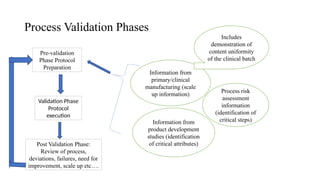
Process Validation Phases
Pre-validation
Phase Protocol
Preparation
Validation Phase
Protocol
execution
Post Validation Phase:
Review of process,
deviations, failures, need for
improvement, scale up etc….
Information from
primary/clinical
manufacturing (scale
up information)
Information from
product development
studies (identification
of critical attributes)
Process risk
assessment
information
(identification of
critical steps)
Includes
demonstration of
content uniformity
of the clinical batch
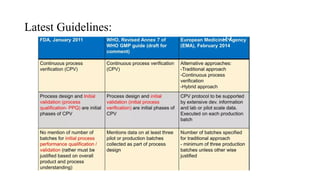
Latest Guidelines:
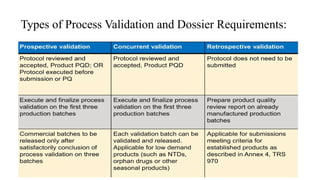
Types of Process Validation and Dossier Requirements:
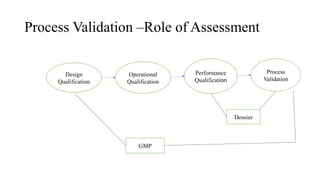
Process Validation –Role of Assessment
Design
Qualification
Operational
Qualification
Performance
Qualification
Process
Validation
Dossier
GMP
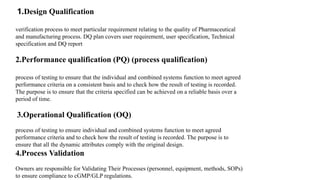
1.Design Qualification
verification process to meet particular requirement relating to the quality of Pharmaceutical
and manufacturing process. DQ plan covers user requirement, user specification, Technical
specification and DQ report
2.Performance qualification (PQ) (process qualification)
process of testing to ensure that the individual and combined systems function to meet agreed
performance criteria on a consistent basis and to check how the result of testing is recorded.
The purpose is to ensure that the criteria specified can be achieved on a reliable basis over a
period of time.
3.Operational Qualification (OQ)
process of testing to ensure individual and combined systems function to meet agreed
performance criteria and to check how the result of testing is recorded. The purpose is to
ensure that all the dynamic attributes comply with the original design.
4.Process Validation
Owners are responsible for Validating Their Processes (personnel, equipment, methods, SOPs)
to ensure compliance to cGMP/GLP regulations.
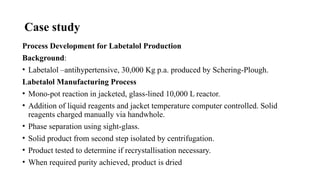
Case study
Process Development for Labetalol Production
Background:
• Labetalol –antihypertensive, 30,000 Kg p.a. produced by Schering-Plough.
Labetalol Manufacturing Process
• Mono-pot reaction in jacketed, glass-lined 10,000 L reactor.
• Addition of liquid reagents and jacket temperature computer controlled. Solid
reagents charged manually via handwhole.
• Phase separation using sight-glass.
• Solid product from second step isolated by centrifugation.
• Product tested to determine if recrystallisation necessary.
• When required purity achieved, product is dried
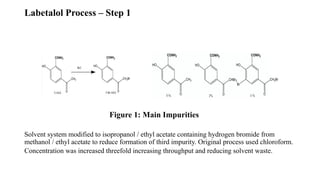
Labetalol Process – Step 1
Solvent system modified to isopropanol / ethyl acetate containing hydrogen bromide from
methanol / ethyl acetate to reduce formation of third impurity. Original process used chloroform.
Concentration was increased threefold increasing throughput and reducing solvent waste.
Figure 1: Main Impurities
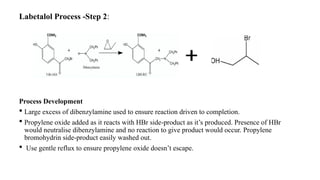
Labetalol Process -Step 2:
Process Development
 Large excess of dibenzylamine used to ensure reaction driven to completion.
 Propylene oxide added as it reacts with HBr side-product as it’s produced. Presence of HBr
would neutralise dibenzylamine and no reaction to give product would occur. Propylene
bromohydrin side-product easily washed out.
 Use gentle reflux to ensure propylene oxide doesn’t escape.
References:
• TEXTBOOK PROCESS CHEMISTRY IN THE PHARMACEUTICAL
INDUSTRY BY KUMAR G.
• Sitompul, Johnner & Lee, Hyung & Kim, Yook & Chang, Matthew. (2013). A
Scaling-up Synthesis from Laboratory Scale to Pilot Scale and to near Commercial
Scale for Paste-Glue Production. Journal of Engineering and Technological Science.
45. 9-24. 10.5614/j.eng.technol.sci.2013.45.1.2.
THANK
YOU

In process control , validation of large scale process and Case Studies.pptx

  • 1.
    In process control, validation of large scale process and Case Studies Presented By: Divya Ashok Dhule M. Pharm.(Pharmaceutical Chemistry) 1st Year Rashtrasant Tukadoji Maharaj Nagpur University Nagpur-440033
  • 2.
    In Process Control •Process control in pharmaceutical process chemistry is essential for ensuring the quality, safety, and efficacy of pharmaceutical products. It involves the monitoring and regulation of various parameters throughout the manufacturing process to maintain consistency and meet regulatory standards. Here are some key aspects of process control in pharmaceutical process chemistry: 1. Critical Process Parameters (CPPs): These are the key variables that have a significant impact on the quality of the pharmaceutical product. CPPs include factors such as temperature, pressure, pH, agitation rate, and reaction time. 2. Process Analytical Technology (PAT): PAT involves the use of real-time monitoring techniques to measure and control critical process parameters during manufacturing. PAT tools include spectroscopy, chromatography, mass spectrometry, and other analytical methods that provide rapid and accurate data on process performance.
  • 3.
    3. Quality byDesign (QbD): QbD is a systematic approach to pharmaceutical development that emphasizes the understanding of how formulation and process variables influence product quality. QbD principles guide the design of robust manufacturing processes with built-in controls to ensure consistent product quality. 4. Risk Assessment and Mitigation: Identifying and mitigating risks associated with the manufacturing process is crucial for ensuring product safety and compliance with regulatory requirements. Risk assessment techniques such as Failure Mode and Effects Analysis (FMEA) help identify potential failure modes and develop strategies to prevent or mitigate them. 5. Process Validation: Process validation is the process of establishing documented evidence that a manufacturing process consistently produces a product that meets predetermined specifications and quality attributes. Validation studies involve process qualification, process performance qualification, and continued process verification to ensure ongoing control and compliance.
  • 4.
    6. Control StrategyDevelopment: A control strategy outlines how critical process parameters will be monitored and controlled throughout the manufacturing process. It includes procedures for deviation management, corrective actions, and change control to ensure product quality and regulatory compliance. 7. Regulatory Compliance: Pharmaceutical manufacturing processes must comply with regulatory requirements set forth by agencies such as the Food and Drug Administration (FDA) in the United States and the European Medicines Agency (EMA) in Europe. Compliance involves adhering to Good Manufacturing Practices (GMP), following established guidelines, and maintaining comprehensive documentation of process controls and quality assurance activities. • Overall, process control in pharmaceutical process chemistry is a multifaceted discipline that integrates scientific principles, advanced technology, and regulatory compliance to ensure the production of safe and effective pharmaceutical products.
  • 5.
    Validation of LargeScale Process • The collection and evaluation of data from the process design stage through commercial production ,which establishes scientific evidence that a process is capable of consistently delivering quality products. (FDA) • Documented evidence which provides a high degree of assurance that a specific process will consistently result that meets predetermined specifications and quality characteristics.(WHO) • The documented evidence that the process operated within established parameters can perform effectively and reproducibly to produce a medicinal product meeting its predetermined specifications attributes.
  • 6.
    Validation of largescale process Traditional New Paradigm VS Development Basic Pilot Batch Manufacturing Process Validation – 3 Batches Post Approval Changes /Change Controls/Risk Analysis Enhanced – Development And Process Qualification Continuous and extensive monitoring of CQAs and CPPs for each production batch ICH Q8, QbD Control Stratergy ICH Q9 and Q10
  • 7.
    Process Validation Phases Pre-validation PhaseProtocol Preparation Validation Phase Protocol execution Post Validation Phase: Review of process, deviations, failures, need for improvement, scale up etc…. Information from primary/clinical manufacturing (scale up information) Information from product development studies (identification of critical attributes) Process risk assessment information (identification of critical steps) Includes demonstration of content uniformity of the clinical batch
  • 8.
  • 9.
    Types of ProcessValidation and Dossier Requirements:
  • 10.
    Process Validation –Roleof Assessment Design Qualification Operational Qualification Performance Qualification Process Validation Dossier GMP
  • 11.
    1.Design Qualification verification processto meet particular requirement relating to the quality of Pharmaceutical and manufacturing process. DQ plan covers user requirement, user specification, Technical specification and DQ report 2.Performance qualification (PQ) (process qualification) process of testing to ensure that the individual and combined systems function to meet agreed performance criteria on a consistent basis and to check how the result of testing is recorded. The purpose is to ensure that the criteria specified can be achieved on a reliable basis over a period of time. 3.Operational Qualification (OQ) process of testing to ensure individual and combined systems function to meet agreed performance criteria and to check how the result of testing is recorded. The purpose is to ensure that all the dynamic attributes comply with the original design. 4.Process Validation Owners are responsible for Validating Their Processes (personnel, equipment, methods, SOPs) to ensure compliance to cGMP/GLP regulations.
  • 12.
    Case study Process Developmentfor Labetalol Production Background: • Labetalol –antihypertensive, 30,000 Kg p.a. produced by Schering-Plough. Labetalol Manufacturing Process • Mono-pot reaction in jacketed, glass-lined 10,000 L reactor. • Addition of liquid reagents and jacket temperature computer controlled. Solid reagents charged manually via handwhole. • Phase separation using sight-glass. • Solid product from second step isolated by centrifugation. • Product tested to determine if recrystallisation necessary. • When required purity achieved, product is dried
  • 13.
    Labetalol Process –Step 1 Solvent system modified to isopropanol / ethyl acetate containing hydrogen bromide from methanol / ethyl acetate to reduce formation of third impurity. Original process used chloroform. Concentration was increased threefold increasing throughput and reducing solvent waste. Figure 1: Main Impurities
  • 14.
    Labetalol Process -Step2: Process Development  Large excess of dibenzylamine used to ensure reaction driven to completion.  Propylene oxide added as it reacts with HBr side-product as it’s produced. Presence of HBr would neutralise dibenzylamine and no reaction to give product would occur. Propylene bromohydrin side-product easily washed out.  Use gentle reflux to ensure propylene oxide doesn’t escape.
  • 15.
    References: • TEXTBOOK PROCESSCHEMISTRY IN THE PHARMACEUTICAL INDUSTRY BY KUMAR G. • Sitompul, Johnner & Lee, Hyung & Kim, Yook & Chang, Matthew. (2013). A Scaling-up Synthesis from Laboratory Scale to Pilot Scale and to near Commercial Scale for Paste-Glue Production. Journal of Engineering and Technological Science. 45. 9-24. 10.5614/j.eng.technol.sci.2013.45.1.2.
  • 16.