• Interpretation of Organic Compound by IR, NMR and Mass
Spectrometry
• ATR-IR
• NOESY Technique
• Mass Fragmentation & Its Rule
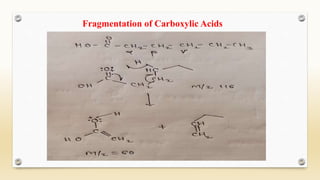
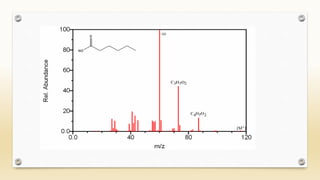
• Fragmentation of –COOH group
• Ring Rule
Mangal Kamble
M pharm Sem-II Pharma’chemistry
Dr. D. Y. Patil College of Pharmacy Akurdi, Pune.
ADVANCED SPECTRALANALYSIS
INFRARED SPECTROSCOPY
Wat is ATR-IR?
• Attenuated total reflectance (ATR) spectroscopy is a
versatile and powerful technique for infrared
spectroscopy which enables samples to be examined
directly in the solid or liquid state without further
preparation.
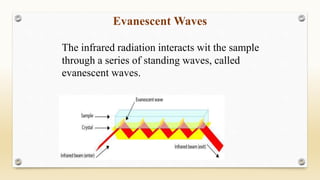
Evanescent Waves
The infrared radiation interacts wit the sample
through a series of standing waves, called
evanescent waves.
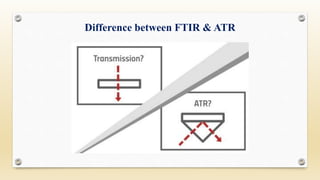
Difference between FTIR & ATR
Crystal used in ATR cells are made from materials that
have low solubility in water & a very high refractive
index.
Crystals are typically made of:
• Zinc Selenide (ZnSe)
• Germanium (Ge)
• Diamond
• Zinc Sulfide (ZnS)
• Silicon (Si)
Crystal Composition
Sample analysis
• Analysing liquids
• Analysing Solids
• Analysing Powders
• ATR can be used to analyse non-aqueous solutions such
as oils, lubricants, paints, glues, solvents, inks, dyes, gels
and pastes.
• Biological industries
• Pharmaceutical industries
• Medicinal industries
• Chemical industries includes measurement of drugs during
manufactured by fermentation of methods, following the
kinetics of metabolism of dietary constituents, investigation of
detergents and cosmetics, or identification of contaminants in
waste water, etc.
• Using ATR combined wit spectral summation the infrared
spectra of solutes, Very dilute aqueous solutions can be
measured.
Application
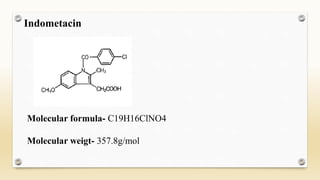
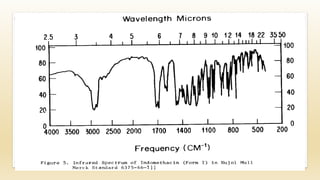
Indometacin
Molecular formula- C19H16ClNO4
Molecular weigt- 357.8g/mol
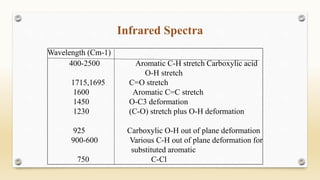
400-2500 Aromatic C-H stretch Carboxylic acid
O-H stretch
1715,1695 C=O stretch
1600 Aromatic C=C stretch
1450 O-C3 deformation
1230 (C-O) stretch plus O-H deformation
925 Carboxylic O-H out of plane deformation
900-600 Various C-H out of plane deformation for
substituted aromatic
750 C-Cl
Wavelength (Cm-1)
Infrared Spectra
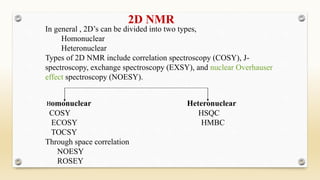
2D NMR
In general , 2D’s can be divided into two types,
Homonuclear
Heteronuclear
Types of 2D NMR include correlation spectroscopy (COSY), J-
spectroscopy, exchange spectroscopy (EXSY), and nuclear Overhauser
effect spectroscopy (NOESY).
Homonuclear Heteronuclear
COSY HSQC
ECOSY HMBC
TOCSY
Through space correlation
NOESY
ROSEY
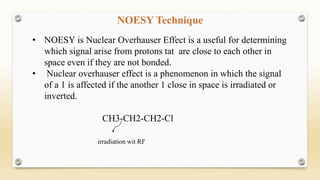
NOESY Technique
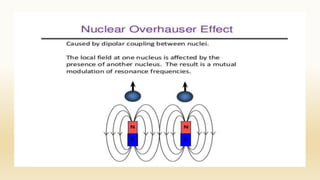
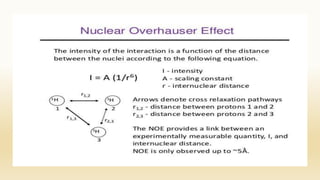
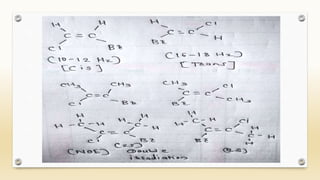
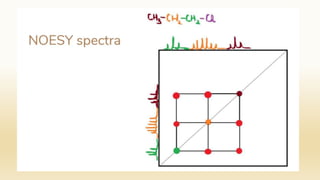
• NOESY is Nuclear Overhauser Effect is a useful for determining
which signal arise from protons tat are close to each other in
space even if they are not bonded.
• Nuclear overhauser effect is a phenomenon in which the signal
of a 1 is affected if the another 1 close in space is irradiated or
inverted.
CH3-CH2-CH2-Cl
irradiation wit RF
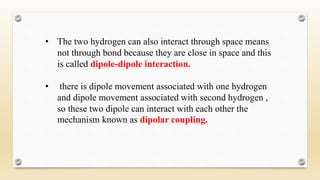
• The two hydrogen can also interact through space means
not through bond because they are close in space and this
is called dipole-dipole interaction.
• there is dipole movement associated with one hydrogen
and dipole movement associated with second hydrogen ,
so these two dipole can interact with each other the
mechanism known as dipolar coupling.
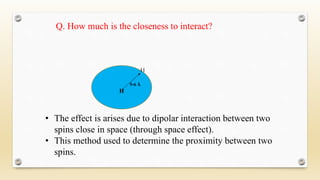
Q. How much is the closeness to interact?
5-6 Å
H
H
• The effect is arises due to dipolar interaction between two
spins close in space (through space effect).
• This method used to determine the proximity between two
spins.
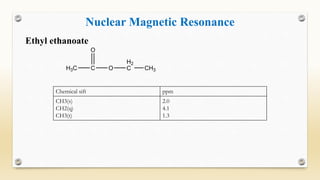
Nuclear Magnetic Resonance
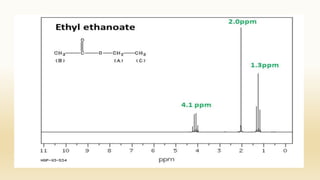
Ethyl ethanoate
Chemical sift ppm
CH3(s)
CH2(q)
CH3(t)
2.0
4.1
1.3
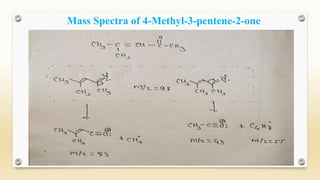
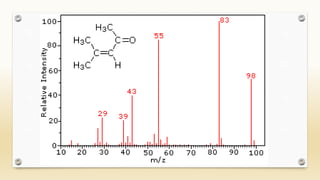
Mass Spectra of 4-Methyl-3-pentene-2-one
Fragmentation of Carboxylic Acids
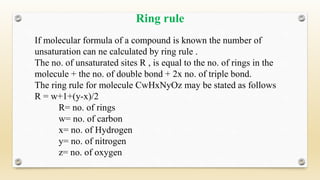
If molecular formula of a compound is known the number of
unsaturation can ne calculated by ring rule .
The no. of unsaturated sites R , is equal to the no. of rings in the
molecule + the no. of double bond + 2x no. of triple bond.
The ring rule for molecule CwHxNyOz may be stated as follows
R = w+1+(y-x)/2
R= no. of rings
w= no. of carbon
x= no. of Hydrogen
y= no. of nitrogen
z= no. of oxygen
Ring rule
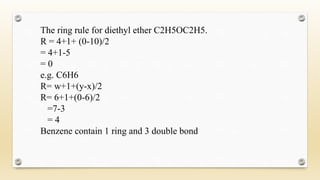
The ring rule for diethyl ether C2H5OC2H5.
R = 4+1+ (0-10)/2
= 4+1-5
= 0
e.g. C6H6
R= w+1+(y-x)/2
R= 6+1+(0-6)/2
=7-3
= 4
Benzene contain 1 ring and 3 double bond
Advanced spectral analysis

Advanced spectral analysis

  • 1.
    • Interpretation ofOrganic Compound by IR, NMR and Mass Spectrometry • ATR-IR • NOESY Technique • Mass Fragmentation & Its Rule • Fragmentation of –COOH group • Ring Rule Mangal Kamble M pharm Sem-II Pharma’chemistry Dr. D. Y. Patil College of Pharmacy Akurdi, Pune. ADVANCED SPECTRALANALYSIS
  • 2.
    INFRARED SPECTROSCOPY Wat isATR-IR? • Attenuated total reflectance (ATR) spectroscopy is a versatile and powerful technique for infrared spectroscopy which enables samples to be examined directly in the solid or liquid state without further preparation.
  • 3.
    Evanescent Waves The infraredradiation interacts wit the sample through a series of standing waves, called evanescent waves.
  • 4.
  • 5.
    Crystal used inATR cells are made from materials that have low solubility in water & a very high refractive index. Crystals are typically made of: • Zinc Selenide (ZnSe) • Germanium (Ge) • Diamond • Zinc Sulfide (ZnS) • Silicon (Si) Crystal Composition
  • 6.
    Sample analysis • Analysingliquids • Analysing Solids • Analysing Powders • ATR can be used to analyse non-aqueous solutions such as oils, lubricants, paints, glues, solvents, inks, dyes, gels and pastes.
  • 7.
    • Biological industries •Pharmaceutical industries • Medicinal industries • Chemical industries includes measurement of drugs during manufactured by fermentation of methods, following the kinetics of metabolism of dietary constituents, investigation of detergents and cosmetics, or identification of contaminants in waste water, etc. • Using ATR combined wit spectral summation the infrared spectra of solutes, Very dilute aqueous solutions can be measured. Application
  • 8.
  • 9.
    400-2500 Aromatic C-Hstretch Carboxylic acid O-H stretch 1715,1695 C=O stretch 1600 Aromatic C=C stretch 1450 O-C3 deformation 1230 (C-O) stretch plus O-H deformation 925 Carboxylic O-H out of plane deformation 900-600 Various C-H out of plane deformation for substituted aromatic 750 C-Cl Wavelength (Cm-1) Infrared Spectra
  • 11.
    2D NMR In general, 2D’s can be divided into two types, Homonuclear Heteronuclear Types of 2D NMR include correlation spectroscopy (COSY), J- spectroscopy, exchange spectroscopy (EXSY), and nuclear Overhauser effect spectroscopy (NOESY). Homonuclear Heteronuclear COSY HSQC ECOSY HMBC TOCSY Through space correlation NOESY ROSEY
  • 12.
    NOESY Technique • NOESYis Nuclear Overhauser Effect is a useful for determining which signal arise from protons tat are close to each other in space even if they are not bonded. • Nuclear overhauser effect is a phenomenon in which the signal of a 1 is affected if the another 1 close in space is irradiated or inverted. CH3-CH2-CH2-Cl irradiation wit RF
  • 13.
    • The twohydrogen can also interact through space means not through bond because they are close in space and this is called dipole-dipole interaction. • there is dipole movement associated with one hydrogen and dipole movement associated with second hydrogen , so these two dipole can interact with each other the mechanism known as dipolar coupling.
  • 14.
    Q. How muchis the closeness to interact? 5-6 Å H H • The effect is arises due to dipolar interaction between two spins close in space (through space effect). • This method used to determine the proximity between two spins.
  • 20.
    Nuclear Magnetic Resonance Ethylethanoate Chemical sift ppm CH3(s) CH2(q) CH3(t) 2.0 4.1 1.3
  • 22.
    Mass Spectra of4-Methyl-3-pentene-2-one
  • 24.
  • 26.
    If molecular formulaof a compound is known the number of unsaturation can ne calculated by ring rule . The no. of unsaturated sites R , is equal to the no. of rings in the molecule + the no. of double bond + 2x no. of triple bond. The ring rule for molecule CwHxNyOz may be stated as follows R = w+1+(y-x)/2 R= no. of rings w= no. of carbon x= no. of Hydrogen y= no. of nitrogen z= no. of oxygen Ring rule
  • 27.
    The ring rulefor diethyl ether C2H5OC2H5. R = 4+1+ (0-10)/2 = 4+1-5 = 0 e.g. C6H6 R= w+1+(y-x)/2 R= 6+1+(0-6)/2 =7-3 = 4 Benzene contain 1 ring and 3 double bond