

GC-AAS
PRESENTED BY
Mr. Darshan N U
M Pharmacy Second semester
Dept. of Pharmaceutical Chemistry
Sri Adichunchanagiri College of Pharmacy
PRESENTING TO
Dr. T Yunus Pasha
Professor and Head of Department
Dept. of Pharmaceutical Chemistry
Sri Adichunchanagiri College of Pharmacy
Gas Chromatography-Atomic Absorption Spectroscopy
1
HYPHENATED TECHNIQUES:
 Hyphenated techniques is a combination or coupling of two different analytical techniques with the help of
proper interface.
 Hirschfield (1980) introduced the term “hyphenation” to refer to the combination of a separation technique and
one or more spectroscopic detection techniques.
 The number of existing techniques has been combined to expand the utility
 The direct conjugation of chromatographic technique with spectroscopic examination constitutes several
powerful analytical techniques.
 Hyphenated techniques ranges from the combination of: separation-separation, separation- identification, and
identification-identification techniques.
2
LIST OF HYPHENATED TECHNIQUES
 LC-MS LC-API-MS
 LC-NMR LC-ESI-MS
 GC-MS LC-NMR-MS
 CE-MS ESI-MS-MS
 GC-NMR LC-PDA-MS
 GC-AES HPLC-ICP-AES
 GC-AAS
3
4
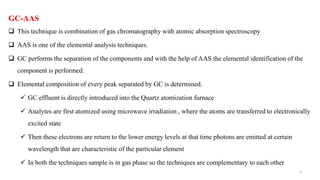
GC-AAS
 This technique is combination of gas chromatography with atomic absorption spectroscopy
 AAS is one of the elemental analysis techniques.
 GC performs the separation of the components and with the help of AAS the elemental identification of the
component is performed.
 Elemental composition of every peak separated by GC is determined.
 GC effluent is directly introduced into the Quartz atomization furnace
 Analytes are first atomized using microwave irradiation , where the atoms are transferred to electronically
excited state
 Then these electrons are return to the lower energy levels at that time photons are emitted at certain
wavelength that are characteristic of the particular element
 In both the techniques sample is in gas phase so the techniques are complementary to each other
An eighth-inch steel plate was placed on top of the G.C. to act as an optical table for the
magnetically mounted optical components of the A.A.S. 1/2 inch diameter hole was drilled
through the plate to allow the transfer line and its heater passage. The G.C. was directly interfaced
to the lower electrode with a stainless steel transfer line. The transfer line was sealed to the
electrode by means of a teflon ferrule which also served to electrically isolate it from the
electrode. A chrome1-alumel thermocouple pyrometer was used to monitor the transfer line
temperature. The stainless steel transfer line was later replaced with pyrex capillary tubing.
• There are essentially only three interferences encountered in GC-AAS;
(a) molecular interference is any broad band absorption at the same wavelength as the atomic
resonance line,
(b) atomic (spectral) interference is any element that absorbs at the same wavelength being
measured (this is a theoretical possiblility though it has not been observed), and
(c) chemical interference is related to the chemical form of the sample and indirectly effects the
atomization efficiency,
6
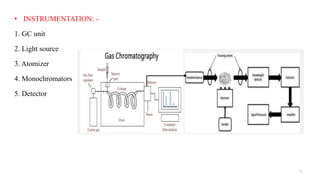
• INSTRUMENTATION: -
1. GC unit
2. Light source
3. Atomizer
4. Monochromators
5. Detector
7
1. GC unit: -
GAS CHROMATOGRAPHY
 Carrier gas
 Flow regulators & Flow Meters
 Injection devices
 Columns
 Temperature control devices
 Detectors
8
CARRIER GAS: -
Requirements of a carrier gas: -
• Inertness
• Suitable for the detector
• High purity
• Easily available
• Cheap
• Should not cause the risk of fire
• Should give best column performance
9
1. Hydrogen
Better thermal conductivity
Disadvantage: it reacts with unsaturated compounds & inflammable
2. Helium
excellent thermal conductivity it is expensive
3. Nitrogen
reduced sensitivity & it is inexpensive
10
Flow regulators & Flow meters: - Deliver the gas with uniform pressure/flow rate - Rota meter & Soap
bubble flow meter
✓ Rota meter: - placed before column inlet it has a glass tube with a float held on to a spring. the level of
the float is determined by the flow rate of carrier gas.
✓ Soap Bubble Meter: -Similar to Rota meter & instead of a float, soap bubble formed indicates the flow
rate.
11
12
Injector:
• Here the sample is volatilized and the resulting gas entrained into the carrier stream entering the GC
column.
• Injector Types
1. Split/ Splitless Injector
2. On-Column Injector
3. High Oven Temperature On-Column Injector
4. Large Volume On-Column Injector
5. Packed Column Injector
6. Purged Packed Injector
7. Programmable Temperature Vaporizing Injector
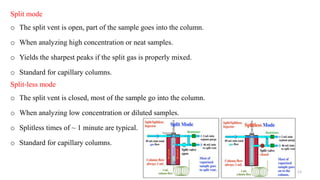
Split mode
o The split vent is open, part of the sample goes into the column.
o When analyzing high concentration or neat samples.
o Yields the sharpest peaks if the split gas is properly mixed.
o Standard for capillary columns.
Split-less mode
o The split vent is closed, most of the sample go into the column.
o When analyzing low concentration or diluted samples.
o Splitless times of ~ 1 minute are typical.
o Standard for capillary columns.
13
COLUMNS: -
Column is one of the important parts of GC which decides the separation efficiency. Columns are made up
of glass and stainless steel.
Classification of columns: -
Depending on its use:
✓ Analytical column
✓ Preparative column
Depending on its nature Column Types: -
✓ Packed column: - Are available in packed manner commercially and hence are called as Packed column.
14
Open tubular/ Capillary Column: -
They are made up of long capillary tubing of 30-90 meters in length and have diameter of 0.025 to
0.075 cm. These are made up of stainless steel and are in the form of a coil. The inner wall of the
capillary is coated with stationary phase liquid in the form of a thin film. These column offer least
resistance to the flow of carrier gas and hence they are more efficient than packed column which
offer more resistance to flow of carrier gas.
15
Temperature control devices
Preheaters: preheaters are used in gas chromatography to convert the sample into its vapour from
and mix them with the mobile phase or carrier gas. The preheaters are present along with injecting
devices. As soon as liquid samples are injected, they are converted into vapour form.
Thermostatically Controlled oven : The principle of separation in gas chromatography is
partition . Since partition co-efficient as well as solubility of a solute depends on temperature ,
tempearature maintenance in a column is highly essential for efficient separation.
As columns are long, they cannot be enclosed in oven easily . Hence the columns are in a coiled
form and enclosed in thermostatically controlled oven. These ovens are highly accurate and can
maintain temperature nearest to 0.1o C
16
Thermal conductivity detector
(T.C.D.) OR Katharometer
The principle is based upon thermal conductivity difference between carrier gas and that of
component . Katharometer has two platinum wires of uniform dimensions which form part of
wheatstone bridge. Through one of them, pure carrier gas always flows through and through other,
the effluents of the column passes. The two platinum wires are heated electrically and hence assume
equilibrium conditions of temperature and electrical resistance. When pure carrier gas passes through
both of them, there is no difference in temperature or resistance and hence a baseline is recorded.
17
02. RADIATION SOURCE:
The radiation source for AAS should emit stable, intense radiation of the element to be determined, usually
a resonance line of the element
The two most common line sources used in atomic absorption are the
• Hollow cathode lamp
• The electrode less discharge lamp
18
HOLLOW CATHODE LAMP:
 The hollow cathode lamp is an excellent, bright line source for most of the elements
determinable by atomic absorption.
 HCL is the most common radiation source in AAS.
 It contains a tungsten anode and a hollow cylindrical cathode made of the element to be
determined.
 These are sealed in a glass tube filled with an inert gas (neon, argon).
 Each element has its own unique lamp which must be used for that analysis.
19
03.ATOMISERS:
In order to achieve absorption of atoms, it becomes necessary to reduce the sample to the
atomic state.
Atomization is separation of particles into individual molecules and breaking molecules into
atoms. This is done by exposing the analyte to high temperatures in a flame or graphite
furnace Atomizer converts the liquid into small droplets which are easily vapourised.
This is done by
• Flame atomisers
• Non-flame atomisers
20
I. Flame atomizer: -
a.) Total consumption burner- Total consumption burner. In this whole sample is atomized into the flame, hence
named as total consumption burner. In this burner, the sample solution, the fuel, and oxidizing gases are passed
through separate passages to meet at the opening of the base of flame. Then the flame breaks the sample in
liquid form into the droplets which are evaporated and burns. Leaving the residue which is reduced to atoms.
b.) premixed burner- It is most widely used because of uniformity in flame intensity. In this the sample solution,
fuel and oxidant are mixed before they reach the tip. The fine droplets get carried out along with the fuel gas at
outlet, the large drops of sample get collected in chamber and are drained out.
Advantages
➢ Non-turbulent
➢ Noiseless
➢ Stable
21
Disadvantages
➢ Only 5% sample reaches to the flame
➢ Rest 95% is wasted.
22
Flame temperature for various gas mixtures
II. Non-flame atomizer (Electrothermal atomizer)
Nebulization- Conversion of the liquid sample to a fine spray
Desolvation- Solid atoms are mixed with the gaseous fuel.
Volatilization- Solid atoms are converted to a vapor in the flame.
There are three types of particles that exist in the flame: 1) Atoms 2) Ions 3) Molecules
Nebulization: - Before the liquid sample enters the burner, it is converted into droplets this method of
formation of small droplets its called nebulization. Common method of nebulization is by use of gas moving at
high velocity, called pneumatic nebulization.
23
4. Monochromators: -
Important part in an AA spectrophotometer. It is used to separate out all of the thousands of lines. Without a
good monochromator, detection limits are severely compromised. A monochromator is used to select the
specific wavelength of light which is absorbed by the sample, and to exclude other wavelengths. The selection
of the specific light allows the determination of the selected element in the presence of others.
They are of two types:
Prism monochromator: - Quartz material is used for making prism, as quartz is transparent over entire region.
Grating monochromator: - it consists of a series of parallel straight lines cut into a plane surface.
24
5. Detector: -
The light selected by the monochromator is directed onto a detector that is typically a photomultiplier tube,
whose function is to convert the light signal into an electrical signal proportional to the light intensity. The
processing of electrical signal is fulfilled by a signal amplifier. The signal could be displayed for readout, or
further fed into a data station for printout by the requested format.
Photomultiplier Tubes Components
• Made of a glass vacuum tube
• Photocathode
• Several dynodes
• One anode
25
APPLICATIONs
26
27
1. In 1976, NATO Science Committee's Panel on Marine Sciences, in regard to a sunken cargo ship carrying
tetraethyl lead (TEL), concluded that very little is known of the reactions of TEL and sea water.
Speculations of the effects ranged from "catastrophic" to "no effect." G.C.- A.A. is an ideal method for
studying the kinetics of TEL in sea water.
2. A study of leaded gasolines was first chosen to demonstrate the usefulness of the techniques. The G.C.-
A.A. can also be used for air sampling analysis, where air samples are trapped out in a cold trap or on an
adsorbent and placed in the G.C. A large portion of atmospheric molecular lead pollution is attributed to
evaporating gasoline. A simple experiment was designed to determine lead concentrations in evaporating
gasoline.
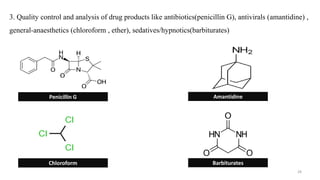
3. Quality control and analysis of drug products like antibiotics(penicillin G), antivirals (amantidine) ,
general-anaesthetics (chloroform , ether), sedatives/hypnotics(barbiturates)
28
Penicillin G Amantidine
Chloroform Barbiturates
4. Assay of drugs-purity of a compound can be determined for example drugs like atropine sulphate,
clove oil, stearic acid.
29
Atropine Sulphate Eugenol
Stearic Acid
5. In determining the levels of metabolites in body fluids like plasma, serum, urine.
6. Analysis of foods like carbohydrates, proteins, lipids, vitamins, steroids, drug and pesticides
residues.
7. Dairy product analysis like milk, butter-for detection of aldehydes, milk sugars, ketones and fatty
acids.
8. Separation and identification of volatile materials, plastics, natural and synthetic polymers,
paints and microbiological samples.
30
31
9. GC-AAS is main tool used in sports anti doping laboratories to test athletes urine samples for
prohibited performance enhancing drugs.
EG : anabolic steroids.
10. Impurity profiling of pharmaceuticals.
Model impurity profiling: gc-aas trace of commercial sample of propranolol with impurities
11. GC-AAS is becoming the tool of choice for tracking organic pollutants in the environment.
12. Identification of drugs of abuse & metabolites of drugs of abuse in blood, urine & saliva.
13.The G.C.-A.A. system is very sensitive and extremely selective and is ideal for monitoring
volatile metal compounds.
32
Reference
• Article by Shubham kumar Vishwakarma GITAM University
• Text book of pharmaceutical analysis by Dr .S. Ravishankar
• DEVELOPMENT AND APPLICATIONS OF GAS CHROMATOGRAPHY ATOMIC ABSORPTION
INTERFACE INSTRUMENTATION Article by Eric Leon Kiesel (Louisiana State University and
Agricultural & Mechanical College)
• Wikipedia and other internet sources.
33
THANK YOU
34

GC-AAS Hyphenated Technique.

  • 1.
    GC-AAS PRESENTED BY Mr. DarshanN U M Pharmacy Second semester Dept. of Pharmaceutical Chemistry Sri Adichunchanagiri College of Pharmacy PRESENTING TO Dr. T Yunus Pasha Professor and Head of Department Dept. of Pharmaceutical Chemistry Sri Adichunchanagiri College of Pharmacy Gas Chromatography-Atomic Absorption Spectroscopy 1
  • 2.
    HYPHENATED TECHNIQUES:  Hyphenatedtechniques is a combination or coupling of two different analytical techniques with the help of proper interface.  Hirschfield (1980) introduced the term “hyphenation” to refer to the combination of a separation technique and one or more spectroscopic detection techniques.  The number of existing techniques has been combined to expand the utility  The direct conjugation of chromatographic technique with spectroscopic examination constitutes several powerful analytical techniques.  Hyphenated techniques ranges from the combination of: separation-separation, separation- identification, and identification-identification techniques. 2
  • 3.
    LIST OF HYPHENATEDTECHNIQUES  LC-MS LC-API-MS  LC-NMR LC-ESI-MS  GC-MS LC-NMR-MS  CE-MS ESI-MS-MS  GC-NMR LC-PDA-MS  GC-AES HPLC-ICP-AES  GC-AAS 3
  • 4.
    4 GC-AAS  This techniqueis combination of gas chromatography with atomic absorption spectroscopy  AAS is one of the elemental analysis techniques.  GC performs the separation of the components and with the help of AAS the elemental identification of the component is performed.  Elemental composition of every peak separated by GC is determined.  GC effluent is directly introduced into the Quartz atomization furnace  Analytes are first atomized using microwave irradiation , where the atoms are transferred to electronically excited state  Then these electrons are return to the lower energy levels at that time photons are emitted at certain wavelength that are characteristic of the particular element  In both the techniques sample is in gas phase so the techniques are complementary to each other
  • 5.
    An eighth-inch steelplate was placed on top of the G.C. to act as an optical table for the magnetically mounted optical components of the A.A.S. 1/2 inch diameter hole was drilled through the plate to allow the transfer line and its heater passage. The G.C. was directly interfaced to the lower electrode with a stainless steel transfer line. The transfer line was sealed to the electrode by means of a teflon ferrule which also served to electrically isolate it from the electrode. A chrome1-alumel thermocouple pyrometer was used to monitor the transfer line temperature. The stainless steel transfer line was later replaced with pyrex capillary tubing.
  • 6.
    • There areessentially only three interferences encountered in GC-AAS; (a) molecular interference is any broad band absorption at the same wavelength as the atomic resonance line, (b) atomic (spectral) interference is any element that absorbs at the same wavelength being measured (this is a theoretical possiblility though it has not been observed), and (c) chemical interference is related to the chemical form of the sample and indirectly effects the atomization efficiency, 6
  • 7.
    • INSTRUMENTATION: - 1.GC unit 2. Light source 3. Atomizer 4. Monochromators 5. Detector 7
  • 8.
    1. GC unit:- GAS CHROMATOGRAPHY  Carrier gas  Flow regulators & Flow Meters  Injection devices  Columns  Temperature control devices  Detectors 8
  • 9.
    CARRIER GAS: - Requirementsof a carrier gas: - • Inertness • Suitable for the detector • High purity • Easily available • Cheap • Should not cause the risk of fire • Should give best column performance 9
  • 10.
    1. Hydrogen Better thermalconductivity Disadvantage: it reacts with unsaturated compounds & inflammable 2. Helium excellent thermal conductivity it is expensive 3. Nitrogen reduced sensitivity & it is inexpensive 10
  • 11.
    Flow regulators &Flow meters: - Deliver the gas with uniform pressure/flow rate - Rota meter & Soap bubble flow meter ✓ Rota meter: - placed before column inlet it has a glass tube with a float held on to a spring. the level of the float is determined by the flow rate of carrier gas. ✓ Soap Bubble Meter: -Similar to Rota meter & instead of a float, soap bubble formed indicates the flow rate. 11
  • 12.
    12 Injector: • Here thesample is volatilized and the resulting gas entrained into the carrier stream entering the GC column. • Injector Types 1. Split/ Splitless Injector 2. On-Column Injector 3. High Oven Temperature On-Column Injector 4. Large Volume On-Column Injector 5. Packed Column Injector 6. Purged Packed Injector 7. Programmable Temperature Vaporizing Injector
  • 13.
    Split mode o Thesplit vent is open, part of the sample goes into the column. o When analyzing high concentration or neat samples. o Yields the sharpest peaks if the split gas is properly mixed. o Standard for capillary columns. Split-less mode o The split vent is closed, most of the sample go into the column. o When analyzing low concentration or diluted samples. o Splitless times of ~ 1 minute are typical. o Standard for capillary columns. 13
  • 14.
    COLUMNS: - Column isone of the important parts of GC which decides the separation efficiency. Columns are made up of glass and stainless steel. Classification of columns: - Depending on its use: ✓ Analytical column ✓ Preparative column Depending on its nature Column Types: - ✓ Packed column: - Are available in packed manner commercially and hence are called as Packed column. 14
  • 15.
    Open tubular/ CapillaryColumn: - They are made up of long capillary tubing of 30-90 meters in length and have diameter of 0.025 to 0.075 cm. These are made up of stainless steel and are in the form of a coil. The inner wall of the capillary is coated with stationary phase liquid in the form of a thin film. These column offer least resistance to the flow of carrier gas and hence they are more efficient than packed column which offer more resistance to flow of carrier gas. 15
  • 16.
    Temperature control devices Preheaters:preheaters are used in gas chromatography to convert the sample into its vapour from and mix them with the mobile phase or carrier gas. The preheaters are present along with injecting devices. As soon as liquid samples are injected, they are converted into vapour form. Thermostatically Controlled oven : The principle of separation in gas chromatography is partition . Since partition co-efficient as well as solubility of a solute depends on temperature , tempearature maintenance in a column is highly essential for efficient separation. As columns are long, they cannot be enclosed in oven easily . Hence the columns are in a coiled form and enclosed in thermostatically controlled oven. These ovens are highly accurate and can maintain temperature nearest to 0.1o C 16
  • 17.
    Thermal conductivity detector (T.C.D.)OR Katharometer The principle is based upon thermal conductivity difference between carrier gas and that of component . Katharometer has two platinum wires of uniform dimensions which form part of wheatstone bridge. Through one of them, pure carrier gas always flows through and through other, the effluents of the column passes. The two platinum wires are heated electrically and hence assume equilibrium conditions of temperature and electrical resistance. When pure carrier gas passes through both of them, there is no difference in temperature or resistance and hence a baseline is recorded. 17
  • 18.
    02. RADIATION SOURCE: Theradiation source for AAS should emit stable, intense radiation of the element to be determined, usually a resonance line of the element The two most common line sources used in atomic absorption are the • Hollow cathode lamp • The electrode less discharge lamp 18
  • 19.
    HOLLOW CATHODE LAMP: The hollow cathode lamp is an excellent, bright line source for most of the elements determinable by atomic absorption.  HCL is the most common radiation source in AAS.  It contains a tungsten anode and a hollow cylindrical cathode made of the element to be determined.  These are sealed in a glass tube filled with an inert gas (neon, argon).  Each element has its own unique lamp which must be used for that analysis. 19
  • 20.
    03.ATOMISERS: In order toachieve absorption of atoms, it becomes necessary to reduce the sample to the atomic state. Atomization is separation of particles into individual molecules and breaking molecules into atoms. This is done by exposing the analyte to high temperatures in a flame or graphite furnace Atomizer converts the liquid into small droplets which are easily vapourised. This is done by • Flame atomisers • Non-flame atomisers 20
  • 21.
    I. Flame atomizer:- a.) Total consumption burner- Total consumption burner. In this whole sample is atomized into the flame, hence named as total consumption burner. In this burner, the sample solution, the fuel, and oxidizing gases are passed through separate passages to meet at the opening of the base of flame. Then the flame breaks the sample in liquid form into the droplets which are evaporated and burns. Leaving the residue which is reduced to atoms. b.) premixed burner- It is most widely used because of uniformity in flame intensity. In this the sample solution, fuel and oxidant are mixed before they reach the tip. The fine droplets get carried out along with the fuel gas at outlet, the large drops of sample get collected in chamber and are drained out. Advantages ➢ Non-turbulent ➢ Noiseless ➢ Stable 21 Disadvantages ➢ Only 5% sample reaches to the flame ➢ Rest 95% is wasted.
  • 22.
    22 Flame temperature forvarious gas mixtures
  • 23.
    II. Non-flame atomizer(Electrothermal atomizer) Nebulization- Conversion of the liquid sample to a fine spray Desolvation- Solid atoms are mixed with the gaseous fuel. Volatilization- Solid atoms are converted to a vapor in the flame. There are three types of particles that exist in the flame: 1) Atoms 2) Ions 3) Molecules Nebulization: - Before the liquid sample enters the burner, it is converted into droplets this method of formation of small droplets its called nebulization. Common method of nebulization is by use of gas moving at high velocity, called pneumatic nebulization. 23
  • 24.
    4. Monochromators: - Importantpart in an AA spectrophotometer. It is used to separate out all of the thousands of lines. Without a good monochromator, detection limits are severely compromised. A monochromator is used to select the specific wavelength of light which is absorbed by the sample, and to exclude other wavelengths. The selection of the specific light allows the determination of the selected element in the presence of others. They are of two types: Prism monochromator: - Quartz material is used for making prism, as quartz is transparent over entire region. Grating monochromator: - it consists of a series of parallel straight lines cut into a plane surface. 24
  • 25.
    5. Detector: - Thelight selected by the monochromator is directed onto a detector that is typically a photomultiplier tube, whose function is to convert the light signal into an electrical signal proportional to the light intensity. The processing of electrical signal is fulfilled by a signal amplifier. The signal could be displayed for readout, or further fed into a data station for printout by the requested format. Photomultiplier Tubes Components • Made of a glass vacuum tube • Photocathode • Several dynodes • One anode 25
  • 26.
  • 27.
    27 1. In 1976,NATO Science Committee's Panel on Marine Sciences, in regard to a sunken cargo ship carrying tetraethyl lead (TEL), concluded that very little is known of the reactions of TEL and sea water. Speculations of the effects ranged from "catastrophic" to "no effect." G.C.- A.A. is an ideal method for studying the kinetics of TEL in sea water. 2. A study of leaded gasolines was first chosen to demonstrate the usefulness of the techniques. The G.C.- A.A. can also be used for air sampling analysis, where air samples are trapped out in a cold trap or on an adsorbent and placed in the G.C. A large portion of atmospheric molecular lead pollution is attributed to evaporating gasoline. A simple experiment was designed to determine lead concentrations in evaporating gasoline.
  • 28.
    3. Quality controland analysis of drug products like antibiotics(penicillin G), antivirals (amantidine) , general-anaesthetics (chloroform , ether), sedatives/hypnotics(barbiturates) 28 Penicillin G Amantidine Chloroform Barbiturates
  • 29.
    4. Assay ofdrugs-purity of a compound can be determined for example drugs like atropine sulphate, clove oil, stearic acid. 29 Atropine Sulphate Eugenol Stearic Acid
  • 30.
    5. In determiningthe levels of metabolites in body fluids like plasma, serum, urine. 6. Analysis of foods like carbohydrates, proteins, lipids, vitamins, steroids, drug and pesticides residues. 7. Dairy product analysis like milk, butter-for detection of aldehydes, milk sugars, ketones and fatty acids. 8. Separation and identification of volatile materials, plastics, natural and synthetic polymers, paints and microbiological samples. 30
  • 31.
    31 9. GC-AAS ismain tool used in sports anti doping laboratories to test athletes urine samples for prohibited performance enhancing drugs. EG : anabolic steroids. 10. Impurity profiling of pharmaceuticals. Model impurity profiling: gc-aas trace of commercial sample of propranolol with impurities
  • 32.
    11. GC-AAS isbecoming the tool of choice for tracking organic pollutants in the environment. 12. Identification of drugs of abuse & metabolites of drugs of abuse in blood, urine & saliva. 13.The G.C.-A.A. system is very sensitive and extremely selective and is ideal for monitoring volatile metal compounds. 32
  • 33.
    Reference • Article byShubham kumar Vishwakarma GITAM University • Text book of pharmaceutical analysis by Dr .S. Ravishankar • DEVELOPMENT AND APPLICATIONS OF GAS CHROMATOGRAPHY ATOMIC ABSORPTION INTERFACE INSTRUMENTATION Article by Eric Leon Kiesel (Louisiana State University and Agricultural & Mechanical College) • Wikipedia and other internet sources. 33
  • 34.