1
Prepared by:
Arpana Bhusal
BNS
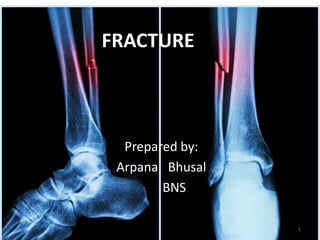
FRACTURE
DEFINITION
A fracture means that a bone is broken or
cracked.
A fracture is a structural break in the normal
continuity of bone.
2
CAUSES
Direct force:
When the bone breaks at the place where
force is applied . Example , severe blow.
Indirect force:
When a bone breaks at another place and not
where the force was applied. Example , fall.
3
Cont…..
Force of muscular action:
Voilent condition of group of muscles may pull
pieces of bone away from the point where the
muscle is attached . Example , fracture of knee.
4
Cont…….
 Force of ligement:
Twisting of a joint can cause its ligament to
pull so hard at the joint that causes fracture.
Example fracture of lower leg bone.
5
Types of fracture
 Simple fracture:
 It break of the bone into two clean margin.
 Compound and complicated fracture:
 It break of the bone in more than one part
and teaming of the body of the body part.
Eg blood vessels, muscle nd other parts of
organ.
6
Cont…..
Green stick fracture:
It break of the bone on only one side.
Open fracture:
It extends through the skin and membrane.
Closed fracture:
The broken ends of the bone do not cut open the
skin and show on the out side.
7
Cont…..
Transverse fracture:
The fracture is straight across the bone.
Spiral fracture:
A fracture twisting around the shaft of the bone.
8
Cont…..
Pathologic fracture:
It is a fracture which is occurred due to disease
condition. Such as cancer and osteoporosis.
Complete fracture:
Fracture line involves entire cross- section of
the bone , and bone fragements are usually
displaced.
9
Cont…..
Incomplete fracture :
Fracture involves only a portion of the cross-
section of the bone . One side breaks; the other
usually just bends.
10
Sing and symptoms of fracture
• Acute pain
• Loss of function
• Deformity
• Shortening of the extermity
• Abnormal mobility 11
Cont……
• Swelling
• Tenderness
• Localized edema
• Numbness
• Injured muscle, blood vessels, nerves.
12
diagnosis
• History collection
• Physical examination
• X-ray
o Anterior
o Posterior and
o Lateral view
• CT Scan
13
Management
• EMERGENCY MANAGEMENT:
Check circulation , breathing and airway of the
patient and also maintain it .
Check vital sign.
Immediately after injury , immobilize the body
part while the patient have to move.
14
Cont….
We should splint the fracture.
To support the fracture site.
In an upper extermities injury , the arm may be
bandaged to the chest or an injured forearm may
be placed in a sling.
15
Cont…..
Cover the wound of an open fracture with a
sterile dressing to prevent contaminating of
deeper tissue.
Medical management:
The general aim of early fracture management is
to control bleeding , provide pain relief , prevent
further injury etc.
16
Types of treatment
Cast immobilization:
A plaster or cast is the most common type of
fracture because most broken bones can heal
successfully.
17
Cont…..
Functional cast:
A fracture allow limited or controlled
movement of nearby joints. This treatment is
desirable for some but not all fracture.
18
Cont….
Traction :
Traction is usually used to bones by a gentle,
steady pulling action. The pulling force may be
transmitted to the bone through skin tapes or a
metal pin through a bone.
19
Cont……
External fixation:
In this type of treatment , pins , are placed into
the broken bone above and below the fracture
sites.
20
Cont……
Internal fixation:
In this type of treatment , an Orthopedist must
perform surgery on the bone. During this
operation , the bone fragment are first
repositioned into their normal alignment by
attaching metal plates.
21
complication
Loss of muscle strength.
Infection
Shock
Bone problem.
22
THANK YOU

FRACTURE

  • 1.
  • 2.
    DEFINITION A fracture meansthat a bone is broken or cracked. A fracture is a structural break in the normal continuity of bone. 2
  • 3.
    CAUSES Direct force: When thebone breaks at the place where force is applied . Example , severe blow. Indirect force: When a bone breaks at another place and not where the force was applied. Example , fall. 3
  • 4.
    Cont….. Force of muscularaction: Voilent condition of group of muscles may pull pieces of bone away from the point where the muscle is attached . Example , fracture of knee. 4
  • 5.
    Cont…….  Force ofligement: Twisting of a joint can cause its ligament to pull so hard at the joint that causes fracture. Example fracture of lower leg bone. 5
  • 6.
    Types of fracture Simple fracture:  It break of the bone into two clean margin.  Compound and complicated fracture:  It break of the bone in more than one part and teaming of the body of the body part. Eg blood vessels, muscle nd other parts of organ. 6
  • 7.
    Cont….. Green stick fracture: Itbreak of the bone on only one side. Open fracture: It extends through the skin and membrane. Closed fracture: The broken ends of the bone do not cut open the skin and show on the out side. 7
  • 8.
    Cont….. Transverse fracture: The fractureis straight across the bone. Spiral fracture: A fracture twisting around the shaft of the bone. 8
  • 9.
    Cont….. Pathologic fracture: It isa fracture which is occurred due to disease condition. Such as cancer and osteoporosis. Complete fracture: Fracture line involves entire cross- section of the bone , and bone fragements are usually displaced. 9
  • 10.
    Cont….. Incomplete fracture : Fractureinvolves only a portion of the cross- section of the bone . One side breaks; the other usually just bends. 10
  • 11.
    Sing and symptomsof fracture • Acute pain • Loss of function • Deformity • Shortening of the extermity • Abnormal mobility 11
  • 12.
    Cont…… • Swelling • Tenderness •Localized edema • Numbness • Injured muscle, blood vessels, nerves. 12
  • 13.
    diagnosis • History collection •Physical examination • X-ray o Anterior o Posterior and o Lateral view • CT Scan 13
  • 14.
    Management • EMERGENCY MANAGEMENT: Checkcirculation , breathing and airway of the patient and also maintain it . Check vital sign. Immediately after injury , immobilize the body part while the patient have to move. 14
  • 15.
    Cont…. We should splintthe fracture. To support the fracture site. In an upper extermities injury , the arm may be bandaged to the chest or an injured forearm may be placed in a sling. 15
  • 16.
    Cont….. Cover the woundof an open fracture with a sterile dressing to prevent contaminating of deeper tissue. Medical management: The general aim of early fracture management is to control bleeding , provide pain relief , prevent further injury etc. 16
  • 17.
    Types of treatment Castimmobilization: A plaster or cast is the most common type of fracture because most broken bones can heal successfully. 17
  • 18.
    Cont….. Functional cast: A fractureallow limited or controlled movement of nearby joints. This treatment is desirable for some but not all fracture. 18
  • 19.
    Cont…. Traction : Traction isusually used to bones by a gentle, steady pulling action. The pulling force may be transmitted to the bone through skin tapes or a metal pin through a bone. 19
  • 20.
    Cont…… External fixation: In thistype of treatment , pins , are placed into the broken bone above and below the fracture sites. 20
  • 21.
    Cont…… Internal fixation: In thistype of treatment , an Orthopedist must perform surgery on the bone. During this operation , the bone fragment are first repositioned into their normal alignment by attaching metal plates. 21
  • 22.
    complication Loss of musclestrength. Infection Shock Bone problem. 22
  • 23.