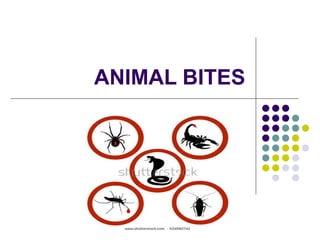
BITES
Presented By:- Khushpreet Kaur
B.Sc.(Nursing)
Gian Sagar Medical College & Hospital
Patiala(Punjab)
INTRODUCTION
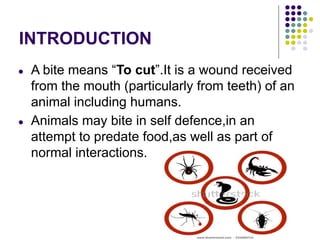
● A bite means “To cut”.It is a wound received
from the mouth (particularly from teeth) of an
animal including humans.
● Animals may bite in self defence,in an
attempt to predate food,as well as part of
normal interactions.
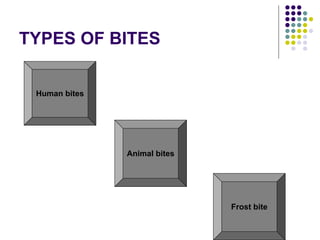
TYPES OF BITES
Human bites
Animal bites
Frost bite
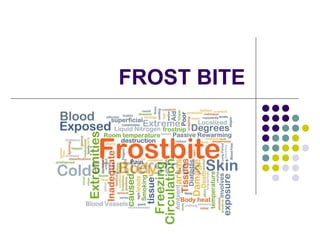
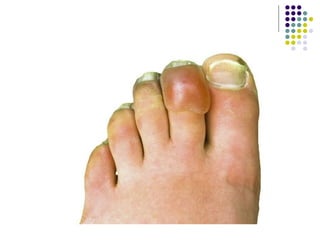
FROST BITE
INTRODUCTION
● Described as the “tissue necrosis” due to
freezing which results in the formation of
crystals in the tissues & cells .
● It is a ‘Misnomer’ term.
● Actually it is not a bite due to any
insect,animal.
● It is an EMERGENCY condition.Also called
“COLD BURNS”
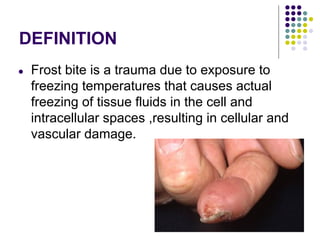
DEFINITION
● Frost bite is a trauma due to exposure to
freezing temperatures that causes actual
freezing of tissue fluids in the cell and
intracellular spaces ,resulting in cellular and
vascular damage.
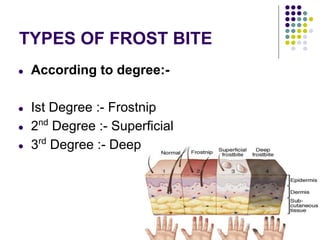
TYPES OF FROST BITE
● According to degree:-
● Ist Degree :- Frostnip
● 2nd
Degree :- Superficial
● 3rd
Degree :- Deep
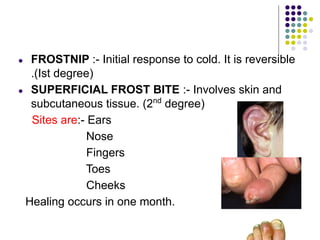
● FROSTNIP :- Initial response to cold. It is reversible
.(Ist degree)
● SUPERFICIAL FROST BITE :- Involves skin and
subcutaneous tissue. (2nd
degree)
Sites are:- Ears
Nose
Fingers
Toes
Cheeks
Healing occurs in one month.
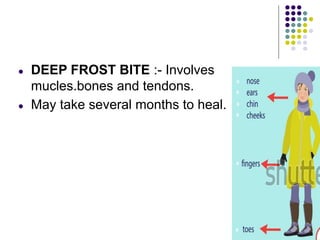
● DEEP FROST BITE :- Involves
mucles.bones and tendons.
● May take several months to heal.
RISK FACTORS
● Diabetes
● Beta-Blockers
● Peripheral Neuropathy
● Exposure to liquid nitrogen
● Aerosol sprays (Deuodorant burns)
Severity of cold injury is determined
by duration of exposure, temperature to wich
body part was exposed, wind velocity during
exposure,condition(wet or dry clothing).
CLINICAL MANIFESTATIONS
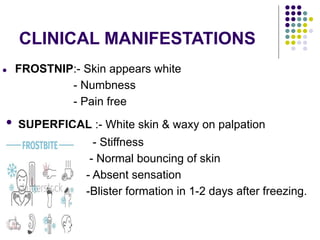
● FROSTNIP:- Skin appears white
- Numbness
- Pain free
• SUPERFICAL :- White skin & waxy on palpation
- Stiffness
- Normal bouncing of skin
- Absent sensation
-Blister formation in 1-2 days after freezing.
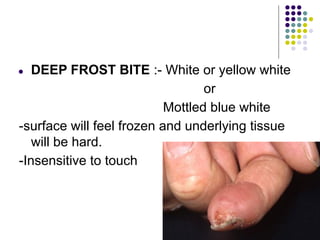
● DEEP FROST BITE :- White or yellow white
or
Mottled blue white
-surface will feel frozen and underlying tissue
will be hard.
-Insensitive to touch
DIAGNOSTIC EVALUATIONS
● Physical Examination – To check severity
- Degree of cold burns
-Sensation,stiffness
• X-Ray
•Bone scan
•MRI
To determine severity of frost bite
MANAGEMENT
● General Management
● Medical management
● Surgical management
● Nursing management :- Nursing Assessment
- Nursing Diagnosis
GENERAL MANAGEMENT
● Firstly if patient is not alert . Assess for:- Airway
-Breathing
-Circulation
•Handle the part gently to avoid further mechanical
injury.
•Remove all the constricting clothings that can
impair circulation including watch,rings etc.
•Wet clothings should be removed immediately.
MEDICAL MANAGEMENT
● NON
PHARMACOLOGICAL :-
Goal :- To restore
normal body
temperature
Rewarming
Passive
External
Rewarming
Active
External
Rewarming
● Passive External Rewarming :- Involves
moving the patient to warm,dry place,
removing damp clothings and placing warm
blankets on the patient.
● Active External Rewarming:- Used for
moderate profound hypothermia and heat is
applied directly to the site.
● Frozen extremities are usually placed in a 37
degree C to 40 degree C (98.6 F to 104 F)
circulating bath for 30-40 mintue.
● Treatment is repeated untill circulation is
effectively restored . If clothing ,socks or
gloves are frozen to extremity.They should be
left on and removed after rewarming.
● During rewarming an analgesic is
administered.
● MASSAGE IS CONTRAINDICATED.
HYDROTHERAPY:- For the affected part to aid
circulation .Also called HYDROTHEAPY.
•PHARMACOLOGICAL MANAGEMENT:-
NSAID’S:- Ibuprofen
TEATNUS PROPHYLAXIS :-Teatnus toxoid or
immune globulin.
TOPICAL ALOVERA CREAM
ALPHA BLOCKERS:- Buflomedil (to increase
peripheral blood flow)
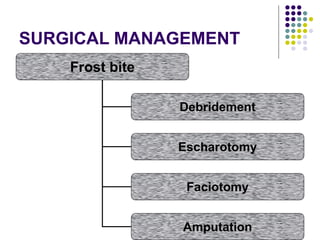
SURGICAL MANAGEMENT
Frost bite
Debridement
Escharotomy
Faciotomy
Amputation
✔ Debridement:- For proper healing ,frostbite
skin needs to be free of damaged,dead or
infective tissue for proper ciculation and to
permit joint motion.
✔ Escharotomy :- (incision through eschar) to
prevent further tissue damage ,to allow for
normal circulation and to permit joint motion
✔ Faciotomy :- In which fascia is cut to releive
tension or pressure.Commonly used to treat
circulation.(Compartment Syndrome).
✔Amputation:- May be required if the injured
area is untreated or treatment is unsuccesful.
NURSING MANAGEMENT
✔NURSING ASSESSMENT
▪To assess the patient’s ABC. if patient is not
alert
▪To assess the affected site. Assess the skin
color.
▪Assess the degree of cold burn.
▪Assess for systemic signs.
NURSING DIAGNOSIS
Hypothermia related to loss of skin
microcirculation and open wound as
evidenced by monitoring temperature.
Acute pain related to tissue injury as
evidenced by pain scale.
Impaired skin integrity related to exposure to
cold as evidenced by discoloration of skin.
(blue mottled)
Risk for infection as evidenced by open
Hypothermia related to loss of skin
microcirculation and open wound as evidenced
by monitoring temperature.
● Goal:- To maintain adequate body temperature.
● Interventions:- To assess the core body temperature
frequently.
● To provide the warm environment by increasing
room temperature or with warmers.
● To work quickly when wounds are exposed.
● To provide rewarming to the patient.
● To provide whirlpool bath.
Acute pain related to tissue injury
as evidenced by pain scale
● Goal:- To relieve pain.
● Interventions:-To assess the severity of pain by
using pain scale.
● To provide emotional support & reaasurance.
● To give diversional therapy to patient. (Newspaper)
● To give comfortable postion to the patient
according to affected extremity.
● To administer analgesics as prescibed by the
doctor. i.e. Ibuprofen
Impaired skin integrity related to exposure
to cold as evidenced by discoloration of
skin. (blue mottled)
● Goal:- To maintain skin integrity
● Interventions:- To assess the skin integrity
(stiffness, waxiness, blister formation)
● To check the appearance of wound. (Redness,
discharge)
● To apply topical alovera cream.
● To assess for any discharge timely after dressing.
Risk for infection as evidenced by open
wound.
● Goal:- To prevent infection
● Interventions:- To assess the vital signs of
patient.
● To do dressing with prper aseptic techniques.
● To perform hand washing before or after any
procedure.
● To teach the patient not to touch the wound
un necessarily
● To provide adequate nutrition to patient.
PREVENTION OF FROST BITE
It is a key to decreasing the number and
overall morbidity of frost bite injuries. Frost
bite prevention involves having a working
knowledge of environmental risk &hazards of
outdoor activities in colder climate.
Seek shelter from wind or cold.
Wear several layers of loose and light
clothing's , which traps air from insulation,
such layering provides better protection than
a single bulky layer of heavy clothing's.
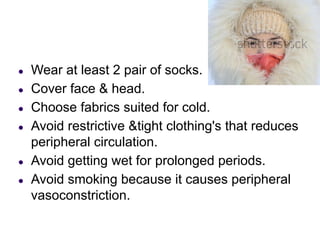
● Wear at least 2 pair of socks.
● Cover face & head.
● Choose fabrics suited for cold.
● Avoid restrictive &tight clothing's that reduces
peripheral circulation.
● Avoid getting wet for prolonged periods.
● Avoid smoking because it causes peripheral
vasoconstriction.
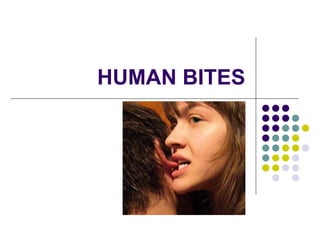
HUMAN BITES
INTRODUCTION
● Most human bites occur during a fight,
usually when one person punches someone
else with teeth. These a often referred to as
CLOSED–FIST BITES or FIGHT BITES.
● Incidence:- Men aged 16-25
Majority occur in young males who have been
drinking alcohol.
TYPES OF HUMAN BITES
Accidental
bites
Intentional
bites
● Intentional bites:- These are common in
very young children &in people with severe
learning difficulties a they are often unaware
that such behavior is socially unacceptable.
● Accidental bites :- These bites occur during
vigorous sexual activity particularly during
oral sex.
CLINICAL MANIFESTATIONS
● Major cut with or without bleeding
● Puncture wounds
● Bruising
● Crushing injuries
FIRST AID OF HUMAN BITE
● Calm and reassure the person .Wash hands
thoroughly with soap, put a pair of protective
gloves.
● If the area is not bleeding severely. Wash the
wound with mild soap and running water for
3-5 minutes & then cover the bite with clean
dressing. Remove the gloves and wash hand
again.
● If the area is actively bleeding ,apply direct
pressure with a clean dry cloth until the
breathing is controlled.
● Wrap some ice in a towel and apply it to the
area. This will ease the pain & help keep the
swelling down.
● Don’t apply ice directly on the skin because it
may freeze the skin.
● Raise the area.
● Get medical attention.
MEDICAL MANAGEMENT
● NSAID’S :- Acetaminophen
● TEATNUS TOXOID
● ANTIBIOTICS:- Amoxicillin 500 mg
Clavulanate 125 mg P.O for 3 days
ANIMAL BITES
DEFINITION
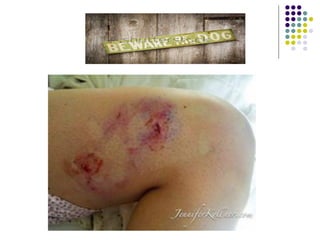
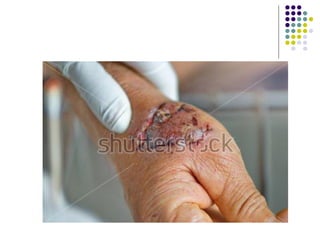
● It is a wound ,usually lacerations, caused by
the teeth. An animal bite usually results in a
break in a skin but also include contusions
from excessive pressure on body tissues
from the bite.
TYPES OF ANIMAL BITES
1. Snake Bite 2. Dog Bite
3. Scorpion
Bite 4. Spider Bite
5. Tick Bite
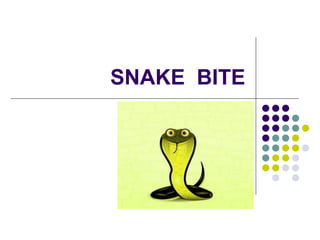
SNAKE BITE
INTRODUCTION
● Venomous (Poisonous) snakes i.e. Cobra &
Asps cause more than 28,000 bites in the US
as per survey in 2008.
● Across the globe more than 25,000
snakebites occur each year approx. 7000 of
these are venomous.
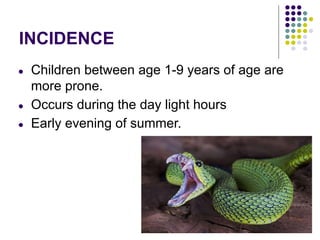
INCIDENCE
● Children between age 1-9 years of age are
more prone.
● Occurs during the day light hours
● Early evening of summer.
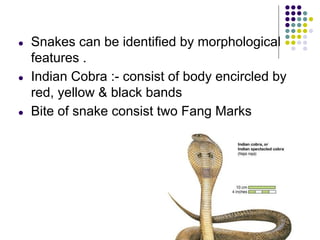
● Snakes can be identified by morphological
features .
● Indian Cobra :- consist of body encircled by
red, yellow & black bands
● Bite of snake consist two Fang Marks
CLINICAL MANIFESTATIONS
● About 1/3 of patients ,bitten by poisonous
snakes ,don’t exhibit serious venomation
because the amount of venom injected during
the bite is variable depending upon the length
time since the snake has last bite. (venom
glands are full or empty or its aggression at
that time.
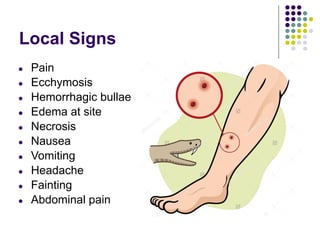
Local Signs
● Pain
● Ecchymosis
● Hemorrhagic bullae
● Edema at site
● Necrosis
● Nausea
● Vomiting
● Headache
● Fainting
● Abdominal pain
Systemic signs
● Neurological:- Paraesthesias
- Paralysis
•Hematologic :- Bleeding from nose, gums
-Internal bleeding
• Others:- -Dyspnea
- Diminish of vision -Tachycardia
- Renal failure -Muscle
weakness
-Intravascular coagulation -Coma
-Constricted pupils
- Metallic or rubber taste
-Shock
-Fasciculation's
FIRST AID
● Call the ambulance immediately.
● Note the time of bite.
● Keep calm & still as movement can cause the
venom to travel more quickly through the body.
● Patient is allowed to lie down quickly. Bleed the bite
site.
● Apply tourniquet above the bite site. It should be
tight enough to prevent venom to allow to go in
lymphatic circulation. Don’t allow the victim to walk
Cont…
● Give analgesic for relief of pain.
● Level of erythema at the site of bite should be
marked.The circumference of the limb shoul
be measured frequently at several locations
and 10 cm above the site of bite every 2-4
hourly.
● Transport the patient to hospital.
MEDICAL MANAGEMENT
● Antiteatnus serum
● Antibiotics
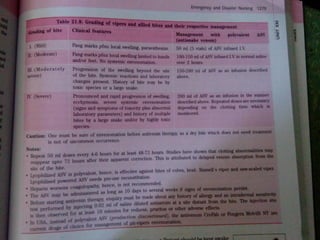
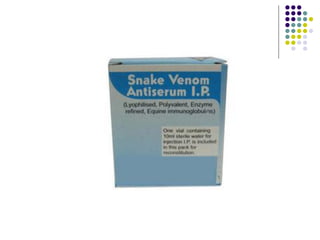
● Antivenin (Polyvalent antisnake
venom)ASV
NURSING ASSESSMENT
● Assess for ABC if patient is not alert.
● Get a description of snake, time of snake bite
from patient
● Assess for local reactions:- Burning, pain,
swelling, numbness.
● Watch foe systemic signs.
● Monitor vital signs closely.
● Measure circumference and characteristics of
extremity and mark every 15-30 minutes to
evaluate edema progression.
GENERAL NURSING
INTERVENTIONS
● To keep the patient calm and at rest in a recumbent
position with the affected extremity immobilized.
● To check vital signs, urine output, and lab.
Parameters regularly.
● To start an IV line with NS or RL
● To administer antivenin and alert for allergic
reactions.
● To administer oxygen if needed.
● To monitor for bleeding and administer blood
products for coagulopathy as prescribed by docter.
DON’T ON SNAKE BITE
● Don’t allow the person to become over
exerted. If necessary, carry the person to
safety.
● Don’t apply cold compress to a snake bite.
● Don’t cut the snake bite with a knife or razor.
● Don’t give the person anything by mouth.
● Don’t raise the site of bite above the level of
person’s heart.
PREVENTION FROM SNAKE BITE
● Avoid areas where snake may be hiding such as
under rocks or logs.
● Even through most snakes are not poisonous ,avoid
picking up or playing with any snake unless you
have been properly trained.
● If you hike often, consider snake bite kit. Don’t use
older snake bite kits, such as those containing razor
blades and suctions.
● Don’t provoke a snake That’s time when many
serious bites occur.
● When hiking in an area known to have snakes wear
long pants and boots.
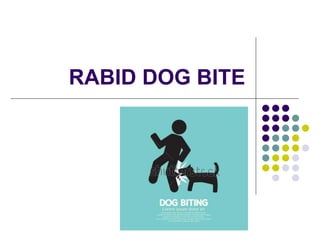
RABID DOG BITE
INTRODUCTION
● Pet dogs kept by humans are mostly not
immunized against rabies and when they
come in contact with stray dogs, have a
chance to get infection with rabies virus and
become rabid.
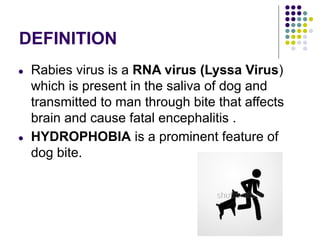
DEFINITION
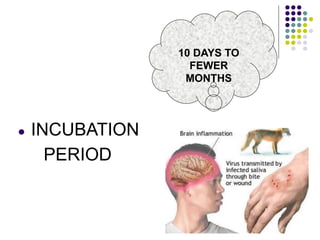
● Rabies virus is a RNA virus (Lyssa Virus)
which is present in the saliva of dog and
transmitted to man through bite that affects
brain and cause fatal encephalitis .
● HYDROPHOBIA is a prominent feature of
dog bite.
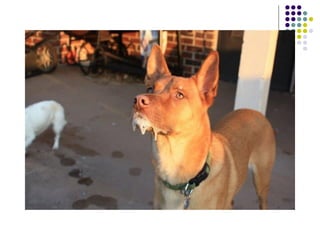
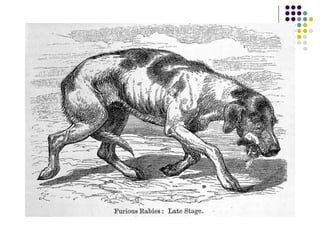
IDENTIFICATION OF A RABID DOG
● Restlessness
● Excessive barking
● May lie or sit quiet
● Drooling of saliva from mouth (Frothy)
QUIET DOGS ARE MOST DANGEROUS
THAN BARKING DOGS
● INCUBATION
PERIOD
10 DAYS TO
FEWER
MONTHS
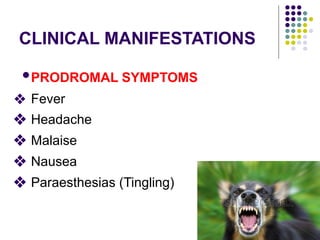
CLINICAL MANIFESTATIONS
•PRODROMAL SYMPTOMS
❖ Fever
❖ Headache
❖ Malaise
❖ Nausea
❖ Paraesthesias (Tingling)
● ENCEPHALITIC SYMPTOMS
❖ Agitation -Muscle spasms
❖ Confusion - Hyperesthesia
❖ Hydrophobia - Paralysis
❖ Aerophobia
❖ Seizures
• Autonomic symptoms:- Salivation,
Lacrimation, Postural hypotension,
Arrythmias ,Cranial nerve palsies
DIAGNOSTIC EVALUATIONS
● Diagnosis is generally made on clinical
symptoms.
● FLURESCENT ANTIBODY TEST (To detect
Rabies antigen in corneal impressions or
salivary secretions).
● Confirmation by NEGRI BODIES in the brain
on postmortem examination .
FIRST AID MANANGEMENT
● Perform thorough washing of the bitten area with
soap and water or clean with running water for 5-10
minutes.
● Wound may be dressed with a sterile gauze or a
clean cloth.
● In case of bite by a rabid dog ,the wound may be
allow to bleed.
● A viricidal solution (10% POVIDINE IODINE ) or
(70%ALCOHOL) should be used to irrigate the
wound.
● Refer the patient to hospital.
MEDICAL MANAGEMENT
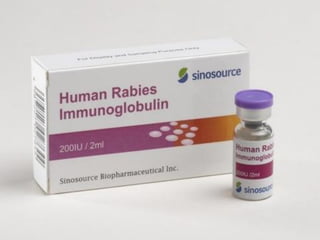
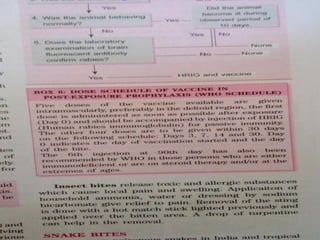
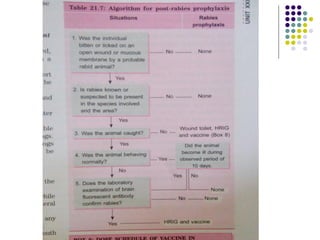
● PASSIVE IMMUNIZATION :- With antirabies
serum containing Human Rabies
Immunoglobin (HRIG) may be instituted .
● Dose:- 20 Units/Kg and equine antiserum is
40 units/kg .It is given after sensitivity test.
● Half dose is infiltered around the wound and
half is given by deep IM inj.
● ACTIVE IMMUNIZATION :- Is done with
antirabies vaccine .Immunity conferred by the
vaccination lasts for 3-5 years.
NURSING ASSESSMENT
● Assess for ABC if patient is not alert.
● Get a description about dog bite. How??
When??
● Ask about the dog’s feature before or after
the bite
● Watch for fever and ask the patient about
Headache , tingling, Nausea etc.
● Ask the patient about rabies vaccine is
administered previously or not???
● Monitor vital signs of the patient closely.
GENERAL NURSING
INTERVENTIONS
● To provide patient isolation.
● To provide calm environment to patient as well
as padded railing bed.
● To give low head position to patient.
● To perform hand washing before or after any
procedure to prevent self contamination and
spread of disease
● To continuously monitor cardiovascular,
nutritional and respiratory status of patient
Cont…
● To give emotional and spirtual support to
family by helping them cope with patient’s
symptoms and probable death.
● To prevent bathing of patient and must not
having running water in the room.
● To maintain aseptic techniques while
dressing.
PRECAUTIONS FOR NURSES
● Wear gloves while handling the patients.
● Should avoid cuts/wounds on the finger while
dealing with patients.
● Avoid contact of patient’s blood with any
abrasions or cuts while taking blood samples.
● Don’t put hands/fingers un necessarily in the
mouth of patient while putting Ryle’s tubing.
● Avoid contact with eye secretions of patient.
SCORPIAN BITE
INTRODUCTION
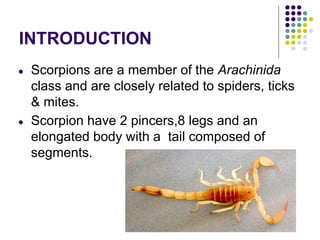
● Scorpions are a member of the Arachinida
class and are closely related to spiders, ticks
& mites.
● Scorpion have 2 pincers,8 legs and an
elongated body with a tail composed of
segments.
DEFINITION
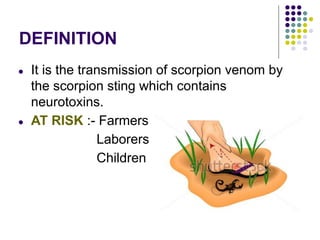
● It is the transmission of scorpion venom by
the scorpion sting which contains
neurotoxins.
● AT RISK :- Farmers
Laborers
Children
CLINICAL MANIFESTATIONS
● Discomfort usually ranges from moderate to severe .
● Painful, tingling, burning or numbing sensation at
sting site.
● SEVERE SYMPTOMS:-
❖ Widespread numbness -Hypotension
❖ Difficulty in swallowing -Shock
❖ A thick tongue -Paraesthesia
❖ Blurred vision - Convulsions
❖ Roving eye movements - Coma
❖ Excessive salivation
❖ Dyspnea
Symptoms may lead to medical emergencies.
FIRST AID FOR SCOPION BITE
● Application of tight tourniquet to retard
absorption of venom.
● Keep the patient calm and apply pressure
dressing or ice cold packs to sting site to
delay absorption. (For 10 minutes).
● Sting part should be kept in independent
position.
● Seek medical attention.
MEDICAL MANAGEMENT
● ANTIVENOM (ANASCORP):- Made by
immunizing horses with venom & then
antivenom is harvested.
● NSAID’S :- Acetaminophen (Tylenol) 1-2 tab.
Every 4 hourly.
Not to exceed 3grams/24 hours.
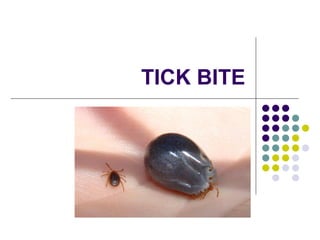
TICK BITE
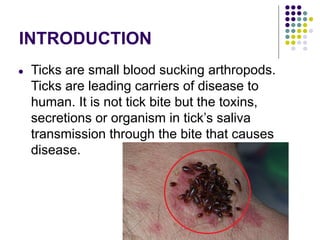
INTRODUCTION
● Ticks are small blood sucking arthropods.
Ticks are leading carriers of disease to
human. It is not tick bite but the toxins,
secretions or organism in tick’s saliva
transmission through the bite that causes
disease.
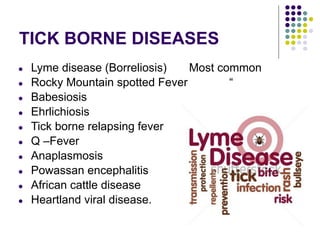
TICK BORNE DISEASES
● Lyme disease (Borreliosis) Most common
● Rocky Mountain spotted Fever “
● Babesiosis
● Ehrlichiosis
● Tick borne relapsing fever
● Q –Fever
● Anaplasmosis
● Powassan encephalitis
● African cattle disease
● Heartland viral disease.
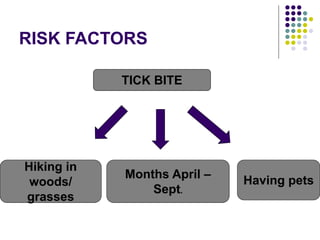
RISK FACTORS
TICK BITE
Hiking in
woods/
grasses
Months April –
Sept.
Having pets
CLINICAL MANIFESTATIONS
● Local redness
● Rash near the bite
● Localized intense pain
● Flu like symptoms such as achiness, chills and
headaches
● Fever
● Numbness -Paralysis
● Confusion -Shortness of breath
● Nausea
● Vomiting
● Palpitations
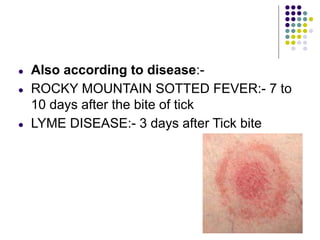
● Also according to disease:-
● ROCKY MOUNTAIN SOTTED FEVER:- 7 to
10 days after the bite of tick
● LYME DISEASE:- 3 days after Tick bite
DIAGNOSTIC EVALUATIONS
● Physical examination
● Blood test
● Examination of blood under microscope
MEDICAL MANAGEMENT
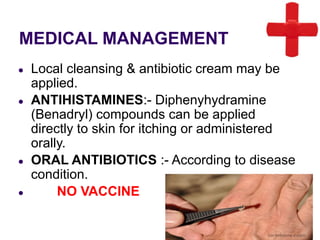
● Local cleansing & antibiotic cream may be
applied.
● ANTIHISTAMINES:- Diphenyhydramine
(Benadryl) compounds can be applied
directly to skin for itching or administered
orally.
● ORAL ANTIBIOTICS :- According to disease
condition.
● NO VACCINE
SPIDER BITE
INTRODUCTION
● Although there are 20,000 species of
venomous in the world, only 50 species
cause illness. Bite can cause localized
reaction or systemic anaphylaxis.
● Can be:- BLACK WIDOW SPIDERS (found in
fallen branches, under furniture, firewood's)
● BROWN RECLUSE SPIDERS:- (found in
dark areas such as garages, boxes)
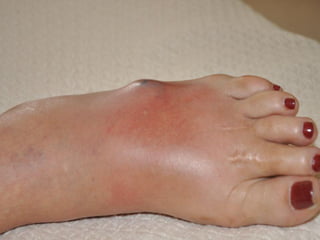
CLINICAL MANIFESTATIONS
(BLACK WIDOW SPIDERS)
● Venom is neurotoxic
● Pinprick sensation
● Tiny red bite mark
● Approx. 15-60 minutes later,patient will report
severe pain that will increase over next 12 to 48
hours
● SYSTEMIC SYMPTOMS:- -Nausea -Vomiting
-Abdominal cramping
-HTN -Dyspnea
-Paresthesias
-Tachycardia
Cont….
● Muscle spasms & HTN can reoccur for 12 to
24 hours.
● Chest & abdominal pain
● Seizures
● Shock
● Bites on lower body cause Abdominal rigidity
whereas bite on upper body lead to chest,
back and shoulder rigidity.
CLINICAL MANIFESTATIONS
(BROWN RECLUSE SPIDERS)
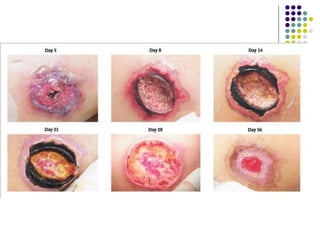
● Venom is cytotoxic
● Initially bite is insignificant with local reaction
…Itching …Erythema (6 to 12 hours)
● Painful, bluish –purplish purpura around bite
● May progress to necroting ulceration wound
by 7 to 14 days.
● Other :- Fever -Chills
-Joint pain -Malaise
-Nausea -Vomiting
MEDICAL MANAGEMENT
(Black widow spiders)
● Treatment includes cooling the area to slow
the action of neurotoxin.
● Iv access should be established and oxygen
administered as needed.
● Wound should be cleaned prperly.
● TEATNUS TOXOID
● MUSCLE RELAXANTS:- Calcium gluconate,
Diazepam or Methocarbamol
● ANALGESICS
MEDICAL MANAGEMENT
(Brown Reculse Spiders)
● Depends upon severity:-
● Initial interventions include cleansing the bite with
mild antiseptics soap, providing cool compress and
elevating the affected extremity.
● ANAGESICS,TEATNUS
TOXOID,ANTIHISTAMINES,ANTIBIOTICS for
prevention of secondary infection.
● DAPSONE (Avlosulfon):- A polymorpho nuclear
leukocyte inhibtor.
NURSING ASSESSMENT
NURSING DIAGNOSIS
Acute pain related to tissue destruction as
evidenced by pain scale.
Impaired skin integrity related to tissue
destruction to as evidenced by discoloration
of skin.
Deficit fluid volume related to hemorrhage as
evidenced by decreased urine output.
Risk for infection as evidenced by open
wound.
1. Acute pain related to tissue destruction as
evidenced by pain scale
● Goal:- To relieve pain.
● Interventions:-To assess the severity of pain
by using pain scale.
● To provide emotional support & reassurance.
● To give diversonal therapy to patient.
(Newspaper)
● To give comfortable position to the patient
according to affected extremity.
● To administer analgesics as prescribed by the
doctor. i.e. Ibuprofen
2. Impaired skin integrity related to tissue
destruction to as evidenced by
discoloration of skin.
● Goal:- To maintain skin integrity
● Interventions:- To assess the skin integrity
(stiffness, waxiness, blister formation)
● To check the appearance of wound.
(Redness, discharge)
● To apply topical medications
● To assess for any discharge timely after
dressing.
3. fluid volume related to hemorrhage as
evidenced by decreased urine output.
● Goal:- To maintain adequate fluid volume of
the body.
● Interventions:- -To assess the skin turgor.
● To assess capillary refill.
● To monitoe intake/output of the patient.
● To administer IV Fluids.
● To give blood transfusions as per needed.
4.Risk for infection as evidenced by open
wound.
● Goal:- To prevent infection
● Interventions:- To assess the vital signs of
patient.
● To do dressing with proper aseptic
techniques.
● To perform hand washing before or after any
procedure.
● To teach the patient not to touch the wound
un necessarily
● To provide adequate nutrition to patient.
REFERENCES
● H.Janice,”BRUNNER &SUDDARTH’S
Textbook of Medical-Surgical Nursing”;13th
ed; Wolter Kluwer; New Delhi; Pg no:2135-37
● Lewis, “Medical Surgical Nursing”;6th
ed;
Mosby; Missouri; Pg no:1854-60
● Heitkemper, “Medical Surgical Nursing”;7th
ed; Mosby; Missouri; Pg no: 1830-37
● W& W Lippincott ,”Manual of Nursing
Practice” :8th
ed; Jaypee; Noida; Pg
no:1160-62
● Black J.M, “Medical Surgical Nursing” ;7th
ed;
ELSEVIER ; New Delhi; Pg no:2506-07
Bites Medical Surgical Nursing

Bites Medical Surgical Nursing

  • 1.
    BITES Presented By:- KhushpreetKaur B.Sc.(Nursing) Gian Sagar Medical College & Hospital Patiala(Punjab)
  • 2.
    INTRODUCTION ● A bitemeans “To cut”.It is a wound received from the mouth (particularly from teeth) of an animal including humans. ● Animals may bite in self defence,in an attempt to predate food,as well as part of normal interactions.
  • 3.
    TYPES OF BITES Humanbites Animal bites Frost bite
  • 4.
  • 6.
    INTRODUCTION ● Described asthe “tissue necrosis” due to freezing which results in the formation of crystals in the tissues & cells . ● It is a ‘Misnomer’ term. ● Actually it is not a bite due to any insect,animal. ● It is an EMERGENCY condition.Also called “COLD BURNS”
  • 7.
    DEFINITION ● Frost biteis a trauma due to exposure to freezing temperatures that causes actual freezing of tissue fluids in the cell and intracellular spaces ,resulting in cellular and vascular damage.
  • 8.
    TYPES OF FROSTBITE ● According to degree:- ● Ist Degree :- Frostnip ● 2nd Degree :- Superficial ● 3rd Degree :- Deep
  • 9.
    ● FROSTNIP :-Initial response to cold. It is reversible .(Ist degree) ● SUPERFICIAL FROST BITE :- Involves skin and subcutaneous tissue. (2nd degree) Sites are:- Ears Nose Fingers Toes Cheeks Healing occurs in one month.
  • 10.
    ● DEEP FROSTBITE :- Involves mucles.bones and tendons. ● May take several months to heal.
  • 11.
    RISK FACTORS ● Diabetes ●Beta-Blockers ● Peripheral Neuropathy ● Exposure to liquid nitrogen ● Aerosol sprays (Deuodorant burns) Severity of cold injury is determined by duration of exposure, temperature to wich body part was exposed, wind velocity during exposure,condition(wet or dry clothing).
  • 12.
    CLINICAL MANIFESTATIONS ● FROSTNIP:-Skin appears white - Numbness - Pain free • SUPERFICAL :- White skin & waxy on palpation - Stiffness - Normal bouncing of skin - Absent sensation -Blister formation in 1-2 days after freezing.
  • 13.
    ● DEEP FROSTBITE :- White or yellow white or Mottled blue white -surface will feel frozen and underlying tissue will be hard. -Insensitive to touch
  • 14.
    DIAGNOSTIC EVALUATIONS ● PhysicalExamination – To check severity - Degree of cold burns -Sensation,stiffness • X-Ray •Bone scan •MRI To determine severity of frost bite
  • 15.
    MANAGEMENT ● General Management ●Medical management ● Surgical management ● Nursing management :- Nursing Assessment - Nursing Diagnosis
  • 16.
    GENERAL MANAGEMENT ● Firstlyif patient is not alert . Assess for:- Airway -Breathing -Circulation •Handle the part gently to avoid further mechanical injury. •Remove all the constricting clothings that can impair circulation including watch,rings etc. •Wet clothings should be removed immediately.
  • 17.
    MEDICAL MANAGEMENT ● NON PHARMACOLOGICAL:- Goal :- To restore normal body temperature Rewarming Passive External Rewarming Active External Rewarming
  • 18.
    ● Passive ExternalRewarming :- Involves moving the patient to warm,dry place, removing damp clothings and placing warm blankets on the patient. ● Active External Rewarming:- Used for moderate profound hypothermia and heat is applied directly to the site.
  • 19.
    ● Frozen extremitiesare usually placed in a 37 degree C to 40 degree C (98.6 F to 104 F) circulating bath for 30-40 mintue. ● Treatment is repeated untill circulation is effectively restored . If clothing ,socks or gloves are frozen to extremity.They should be left on and removed after rewarming. ● During rewarming an analgesic is administered. ● MASSAGE IS CONTRAINDICATED.
  • 20.
    HYDROTHERAPY:- For theaffected part to aid circulation .Also called HYDROTHEAPY. •PHARMACOLOGICAL MANAGEMENT:- NSAID’S:- Ibuprofen TEATNUS PROPHYLAXIS :-Teatnus toxoid or immune globulin. TOPICAL ALOVERA CREAM ALPHA BLOCKERS:- Buflomedil (to increase peripheral blood flow)
  • 21.
  • 22.
    ✔ Debridement:- Forproper healing ,frostbite skin needs to be free of damaged,dead or infective tissue for proper ciculation and to permit joint motion. ✔ Escharotomy :- (incision through eschar) to prevent further tissue damage ,to allow for normal circulation and to permit joint motion
  • 23.
    ✔ Faciotomy :-In which fascia is cut to releive tension or pressure.Commonly used to treat circulation.(Compartment Syndrome). ✔Amputation:- May be required if the injured area is untreated or treatment is unsuccesful.
  • 24.
    NURSING MANAGEMENT ✔NURSING ASSESSMENT ▪Toassess the patient’s ABC. if patient is not alert ▪To assess the affected site. Assess the skin color. ▪Assess the degree of cold burn. ▪Assess for systemic signs.
  • 25.
    NURSING DIAGNOSIS Hypothermia relatedto loss of skin microcirculation and open wound as evidenced by monitoring temperature. Acute pain related to tissue injury as evidenced by pain scale. Impaired skin integrity related to exposure to cold as evidenced by discoloration of skin. (blue mottled) Risk for infection as evidenced by open
  • 26.
    Hypothermia related toloss of skin microcirculation and open wound as evidenced by monitoring temperature. ● Goal:- To maintain adequate body temperature. ● Interventions:- To assess the core body temperature frequently. ● To provide the warm environment by increasing room temperature or with warmers. ● To work quickly when wounds are exposed. ● To provide rewarming to the patient. ● To provide whirlpool bath.
  • 27.
    Acute pain relatedto tissue injury as evidenced by pain scale ● Goal:- To relieve pain. ● Interventions:-To assess the severity of pain by using pain scale. ● To provide emotional support & reaasurance. ● To give diversional therapy to patient. (Newspaper) ● To give comfortable postion to the patient according to affected extremity. ● To administer analgesics as prescibed by the doctor. i.e. Ibuprofen
  • 28.
    Impaired skin integrityrelated to exposure to cold as evidenced by discoloration of skin. (blue mottled) ● Goal:- To maintain skin integrity ● Interventions:- To assess the skin integrity (stiffness, waxiness, blister formation) ● To check the appearance of wound. (Redness, discharge) ● To apply topical alovera cream. ● To assess for any discharge timely after dressing.
  • 29.
    Risk for infectionas evidenced by open wound. ● Goal:- To prevent infection ● Interventions:- To assess the vital signs of patient. ● To do dressing with prper aseptic techniques. ● To perform hand washing before or after any procedure. ● To teach the patient not to touch the wound un necessarily ● To provide adequate nutrition to patient.
  • 30.
    PREVENTION OF FROSTBITE It is a key to decreasing the number and overall morbidity of frost bite injuries. Frost bite prevention involves having a working knowledge of environmental risk &hazards of outdoor activities in colder climate. Seek shelter from wind or cold. Wear several layers of loose and light clothing's , which traps air from insulation, such layering provides better protection than a single bulky layer of heavy clothing's.
  • 31.
    ● Wear atleast 2 pair of socks. ● Cover face & head. ● Choose fabrics suited for cold. ● Avoid restrictive &tight clothing's that reduces peripheral circulation. ● Avoid getting wet for prolonged periods. ● Avoid smoking because it causes peripheral vasoconstriction.
  • 32.
  • 33.
    INTRODUCTION ● Most humanbites occur during a fight, usually when one person punches someone else with teeth. These a often referred to as CLOSED–FIST BITES or FIGHT BITES. ● Incidence:- Men aged 16-25 Majority occur in young males who have been drinking alcohol.
  • 34.
    TYPES OF HUMANBITES Accidental bites Intentional bites
  • 35.
    ● Intentional bites:-These are common in very young children &in people with severe learning difficulties a they are often unaware that such behavior is socially unacceptable. ● Accidental bites :- These bites occur during vigorous sexual activity particularly during oral sex.
  • 36.
    CLINICAL MANIFESTATIONS ● Majorcut with or without bleeding ● Puncture wounds ● Bruising ● Crushing injuries
  • 37.
    FIRST AID OFHUMAN BITE ● Calm and reassure the person .Wash hands thoroughly with soap, put a pair of protective gloves. ● If the area is not bleeding severely. Wash the wound with mild soap and running water for 3-5 minutes & then cover the bite with clean dressing. Remove the gloves and wash hand again. ● If the area is actively bleeding ,apply direct pressure with a clean dry cloth until the breathing is controlled.
  • 38.
    ● Wrap someice in a towel and apply it to the area. This will ease the pain & help keep the swelling down. ● Don’t apply ice directly on the skin because it may freeze the skin. ● Raise the area. ● Get medical attention.
  • 39.
    MEDICAL MANAGEMENT ● NSAID’S:- Acetaminophen ● TEATNUS TOXOID ● ANTIBIOTICS:- Amoxicillin 500 mg Clavulanate 125 mg P.O for 3 days
  • 40.
  • 41.
    DEFINITION ● It isa wound ,usually lacerations, caused by the teeth. An animal bite usually results in a break in a skin but also include contusions from excessive pressure on body tissues from the bite.
  • 42.
    TYPES OF ANIMALBITES 1. Snake Bite 2. Dog Bite 3. Scorpion Bite 4. Spider Bite 5. Tick Bite
  • 43.
  • 44.
    INTRODUCTION ● Venomous (Poisonous)snakes i.e. Cobra & Asps cause more than 28,000 bites in the US as per survey in 2008. ● Across the globe more than 25,000 snakebites occur each year approx. 7000 of these are venomous.
  • 45.
    INCIDENCE ● Children betweenage 1-9 years of age are more prone. ● Occurs during the day light hours ● Early evening of summer.
  • 47.
    ● Snakes canbe identified by morphological features . ● Indian Cobra :- consist of body encircled by red, yellow & black bands ● Bite of snake consist two Fang Marks
  • 48.
    CLINICAL MANIFESTATIONS ● About1/3 of patients ,bitten by poisonous snakes ,don’t exhibit serious venomation because the amount of venom injected during the bite is variable depending upon the length time since the snake has last bite. (venom glands are full or empty or its aggression at that time.
  • 49.
    Local Signs ● Pain ●Ecchymosis ● Hemorrhagic bullae ● Edema at site ● Necrosis ● Nausea ● Vomiting ● Headache ● Fainting ● Abdominal pain
  • 50.
    Systemic signs ● Neurological:-Paraesthesias - Paralysis •Hematologic :- Bleeding from nose, gums -Internal bleeding • Others:- -Dyspnea - Diminish of vision -Tachycardia - Renal failure -Muscle weakness -Intravascular coagulation -Coma -Constricted pupils - Metallic or rubber taste -Shock -Fasciculation's
  • 51.
    FIRST AID ● Callthe ambulance immediately. ● Note the time of bite. ● Keep calm & still as movement can cause the venom to travel more quickly through the body. ● Patient is allowed to lie down quickly. Bleed the bite site. ● Apply tourniquet above the bite site. It should be tight enough to prevent venom to allow to go in lymphatic circulation. Don’t allow the victim to walk
  • 52.
    Cont… ● Give analgesicfor relief of pain. ● Level of erythema at the site of bite should be marked.The circumference of the limb shoul be measured frequently at several locations and 10 cm above the site of bite every 2-4 hourly. ● Transport the patient to hospital.
  • 53.
    MEDICAL MANAGEMENT ● Antiteatnusserum ● Antibiotics ● Antivenin (Polyvalent antisnake venom)ASV
  • 56.
    NURSING ASSESSMENT ● Assessfor ABC if patient is not alert. ● Get a description of snake, time of snake bite from patient ● Assess for local reactions:- Burning, pain, swelling, numbness. ● Watch foe systemic signs. ● Monitor vital signs closely. ● Measure circumference and characteristics of extremity and mark every 15-30 minutes to evaluate edema progression.
  • 57.
    GENERAL NURSING INTERVENTIONS ● Tokeep the patient calm and at rest in a recumbent position with the affected extremity immobilized. ● To check vital signs, urine output, and lab. Parameters regularly. ● To start an IV line with NS or RL ● To administer antivenin and alert for allergic reactions. ● To administer oxygen if needed. ● To monitor for bleeding and administer blood products for coagulopathy as prescribed by docter.
  • 58.
    DON’T ON SNAKEBITE ● Don’t allow the person to become over exerted. If necessary, carry the person to safety. ● Don’t apply cold compress to a snake bite. ● Don’t cut the snake bite with a knife or razor. ● Don’t give the person anything by mouth. ● Don’t raise the site of bite above the level of person’s heart.
  • 59.
    PREVENTION FROM SNAKEBITE ● Avoid areas where snake may be hiding such as under rocks or logs. ● Even through most snakes are not poisonous ,avoid picking up or playing with any snake unless you have been properly trained. ● If you hike often, consider snake bite kit. Don’t use older snake bite kits, such as those containing razor blades and suctions. ● Don’t provoke a snake That’s time when many serious bites occur. ● When hiking in an area known to have snakes wear long pants and boots.
  • 60.
  • 61.
    INTRODUCTION ● Pet dogskept by humans are mostly not immunized against rabies and when they come in contact with stray dogs, have a chance to get infection with rabies virus and become rabid.
  • 62.
    DEFINITION ● Rabies virusis a RNA virus (Lyssa Virus) which is present in the saliva of dog and transmitted to man through bite that affects brain and cause fatal encephalitis . ● HYDROPHOBIA is a prominent feature of dog bite.
  • 63.
    IDENTIFICATION OF ARABID DOG ● Restlessness ● Excessive barking ● May lie or sit quiet ● Drooling of saliva from mouth (Frothy) QUIET DOGS ARE MOST DANGEROUS THAN BARKING DOGS
  • 66.
  • 67.
    CLINICAL MANIFESTATIONS •PRODROMAL SYMPTOMS ❖Fever ❖ Headache ❖ Malaise ❖ Nausea ❖ Paraesthesias (Tingling)
  • 68.
    ● ENCEPHALITIC SYMPTOMS ❖Agitation -Muscle spasms ❖ Confusion - Hyperesthesia ❖ Hydrophobia - Paralysis ❖ Aerophobia ❖ Seizures • Autonomic symptoms:- Salivation, Lacrimation, Postural hypotension, Arrythmias ,Cranial nerve palsies
  • 71.
    DIAGNOSTIC EVALUATIONS ● Diagnosisis generally made on clinical symptoms. ● FLURESCENT ANTIBODY TEST (To detect Rabies antigen in corneal impressions or salivary secretions). ● Confirmation by NEGRI BODIES in the brain on postmortem examination .
  • 72.
    FIRST AID MANANGEMENT ●Perform thorough washing of the bitten area with soap and water or clean with running water for 5-10 minutes. ● Wound may be dressed with a sterile gauze or a clean cloth. ● In case of bite by a rabid dog ,the wound may be allow to bleed. ● A viricidal solution (10% POVIDINE IODINE ) or (70%ALCOHOL) should be used to irrigate the wound. ● Refer the patient to hospital.
  • 73.
    MEDICAL MANAGEMENT ● PASSIVEIMMUNIZATION :- With antirabies serum containing Human Rabies Immunoglobin (HRIG) may be instituted . ● Dose:- 20 Units/Kg and equine antiserum is 40 units/kg .It is given after sensitivity test. ● Half dose is infiltered around the wound and half is given by deep IM inj. ● ACTIVE IMMUNIZATION :- Is done with antirabies vaccine .Immunity conferred by the vaccination lasts for 3-5 years.
  • 77.
    NURSING ASSESSMENT ● Assessfor ABC if patient is not alert. ● Get a description about dog bite. How?? When?? ● Ask about the dog’s feature before or after the bite ● Watch for fever and ask the patient about Headache , tingling, Nausea etc. ● Ask the patient about rabies vaccine is administered previously or not??? ● Monitor vital signs of the patient closely.
  • 78.
    GENERAL NURSING INTERVENTIONS ● Toprovide patient isolation. ● To provide calm environment to patient as well as padded railing bed. ● To give low head position to patient. ● To perform hand washing before or after any procedure to prevent self contamination and spread of disease ● To continuously monitor cardiovascular, nutritional and respiratory status of patient
  • 79.
    Cont… ● To giveemotional and spirtual support to family by helping them cope with patient’s symptoms and probable death. ● To prevent bathing of patient and must not having running water in the room. ● To maintain aseptic techniques while dressing.
  • 80.
    PRECAUTIONS FOR NURSES ●Wear gloves while handling the patients. ● Should avoid cuts/wounds on the finger while dealing with patients. ● Avoid contact of patient’s blood with any abrasions or cuts while taking blood samples. ● Don’t put hands/fingers un necessarily in the mouth of patient while putting Ryle’s tubing. ● Avoid contact with eye secretions of patient.
  • 83.
  • 84.
    INTRODUCTION ● Scorpions area member of the Arachinida class and are closely related to spiders, ticks & mites. ● Scorpion have 2 pincers,8 legs and an elongated body with a tail composed of segments.
  • 85.
    DEFINITION ● It isthe transmission of scorpion venom by the scorpion sting which contains neurotoxins. ● AT RISK :- Farmers Laborers Children
  • 86.
    CLINICAL MANIFESTATIONS ● Discomfortusually ranges from moderate to severe . ● Painful, tingling, burning or numbing sensation at sting site. ● SEVERE SYMPTOMS:- ❖ Widespread numbness -Hypotension ❖ Difficulty in swallowing -Shock ❖ A thick tongue -Paraesthesia ❖ Blurred vision - Convulsions ❖ Roving eye movements - Coma ❖ Excessive salivation ❖ Dyspnea Symptoms may lead to medical emergencies.
  • 87.
    FIRST AID FORSCOPION BITE ● Application of tight tourniquet to retard absorption of venom. ● Keep the patient calm and apply pressure dressing or ice cold packs to sting site to delay absorption. (For 10 minutes). ● Sting part should be kept in independent position. ● Seek medical attention.
  • 88.
    MEDICAL MANAGEMENT ● ANTIVENOM(ANASCORP):- Made by immunizing horses with venom & then antivenom is harvested. ● NSAID’S :- Acetaminophen (Tylenol) 1-2 tab. Every 4 hourly. Not to exceed 3grams/24 hours.
  • 89.
  • 90.
    INTRODUCTION ● Ticks aresmall blood sucking arthropods. Ticks are leading carriers of disease to human. It is not tick bite but the toxins, secretions or organism in tick’s saliva transmission through the bite that causes disease.
  • 91.
    TICK BORNE DISEASES ●Lyme disease (Borreliosis) Most common ● Rocky Mountain spotted Fever “ ● Babesiosis ● Ehrlichiosis ● Tick borne relapsing fever ● Q –Fever ● Anaplasmosis ● Powassan encephalitis ● African cattle disease ● Heartland viral disease.
  • 92.
    RISK FACTORS TICK BITE Hikingin woods/ grasses Months April – Sept. Having pets
  • 93.
    CLINICAL MANIFESTATIONS ● Localredness ● Rash near the bite ● Localized intense pain ● Flu like symptoms such as achiness, chills and headaches ● Fever ● Numbness -Paralysis ● Confusion -Shortness of breath ● Nausea ● Vomiting ● Palpitations
  • 94.
    ● Also accordingto disease:- ● ROCKY MOUNTAIN SOTTED FEVER:- 7 to 10 days after the bite of tick ● LYME DISEASE:- 3 days after Tick bite
  • 95.
    DIAGNOSTIC EVALUATIONS ● Physicalexamination ● Blood test ● Examination of blood under microscope
  • 96.
    MEDICAL MANAGEMENT ● Localcleansing & antibiotic cream may be applied. ● ANTIHISTAMINES:- Diphenyhydramine (Benadryl) compounds can be applied directly to skin for itching or administered orally. ● ORAL ANTIBIOTICS :- According to disease condition. ● NO VACCINE
  • 97.
  • 98.
    INTRODUCTION ● Although thereare 20,000 species of venomous in the world, only 50 species cause illness. Bite can cause localized reaction or systemic anaphylaxis. ● Can be:- BLACK WIDOW SPIDERS (found in fallen branches, under furniture, firewood's) ● BROWN RECLUSE SPIDERS:- (found in dark areas such as garages, boxes)
  • 99.
    CLINICAL MANIFESTATIONS (BLACK WIDOWSPIDERS) ● Venom is neurotoxic ● Pinprick sensation ● Tiny red bite mark ● Approx. 15-60 minutes later,patient will report severe pain that will increase over next 12 to 48 hours ● SYSTEMIC SYMPTOMS:- -Nausea -Vomiting -Abdominal cramping -HTN -Dyspnea -Paresthesias -Tachycardia
  • 100.
    Cont…. ● Muscle spasms& HTN can reoccur for 12 to 24 hours. ● Chest & abdominal pain ● Seizures ● Shock ● Bites on lower body cause Abdominal rigidity whereas bite on upper body lead to chest, back and shoulder rigidity.
  • 102.
    CLINICAL MANIFESTATIONS (BROWN RECLUSESPIDERS) ● Venom is cytotoxic ● Initially bite is insignificant with local reaction …Itching …Erythema (6 to 12 hours) ● Painful, bluish –purplish purpura around bite ● May progress to necroting ulceration wound by 7 to 14 days. ● Other :- Fever -Chills -Joint pain -Malaise -Nausea -Vomiting
  • 104.
    MEDICAL MANAGEMENT (Black widowspiders) ● Treatment includes cooling the area to slow the action of neurotoxin. ● Iv access should be established and oxygen administered as needed. ● Wound should be cleaned prperly. ● TEATNUS TOXOID ● MUSCLE RELAXANTS:- Calcium gluconate, Diazepam or Methocarbamol ● ANALGESICS
  • 105.
    MEDICAL MANAGEMENT (Brown ReculseSpiders) ● Depends upon severity:- ● Initial interventions include cleansing the bite with mild antiseptics soap, providing cool compress and elevating the affected extremity. ● ANAGESICS,TEATNUS TOXOID,ANTIHISTAMINES,ANTIBIOTICS for prevention of secondary infection. ● DAPSONE (Avlosulfon):- A polymorpho nuclear leukocyte inhibtor.
  • 106.
    NURSING ASSESSMENT NURSING DIAGNOSIS Acutepain related to tissue destruction as evidenced by pain scale. Impaired skin integrity related to tissue destruction to as evidenced by discoloration of skin. Deficit fluid volume related to hemorrhage as evidenced by decreased urine output. Risk for infection as evidenced by open wound.
  • 107.
    1. Acute painrelated to tissue destruction as evidenced by pain scale ● Goal:- To relieve pain. ● Interventions:-To assess the severity of pain by using pain scale. ● To provide emotional support & reassurance. ● To give diversonal therapy to patient. (Newspaper) ● To give comfortable position to the patient according to affected extremity. ● To administer analgesics as prescribed by the doctor. i.e. Ibuprofen
  • 108.
    2. Impaired skinintegrity related to tissue destruction to as evidenced by discoloration of skin. ● Goal:- To maintain skin integrity ● Interventions:- To assess the skin integrity (stiffness, waxiness, blister formation) ● To check the appearance of wound. (Redness, discharge) ● To apply topical medications ● To assess for any discharge timely after dressing.
  • 109.
    3. fluid volumerelated to hemorrhage as evidenced by decreased urine output. ● Goal:- To maintain adequate fluid volume of the body. ● Interventions:- -To assess the skin turgor. ● To assess capillary refill. ● To monitoe intake/output of the patient. ● To administer IV Fluids. ● To give blood transfusions as per needed.
  • 110.
    4.Risk for infectionas evidenced by open wound. ● Goal:- To prevent infection ● Interventions:- To assess the vital signs of patient. ● To do dressing with proper aseptic techniques. ● To perform hand washing before or after any procedure. ● To teach the patient not to touch the wound un necessarily ● To provide adequate nutrition to patient.
  • 111.
    REFERENCES ● H.Janice,”BRUNNER &SUDDARTH’S Textbookof Medical-Surgical Nursing”;13th ed; Wolter Kluwer; New Delhi; Pg no:2135-37 ● Lewis, “Medical Surgical Nursing”;6th ed; Mosby; Missouri; Pg no:1854-60 ● Heitkemper, “Medical Surgical Nursing”;7th ed; Mosby; Missouri; Pg no: 1830-37 ● W& W Lippincott ,”Manual of Nursing Practice” :8th ed; Jaypee; Noida; Pg no:1160-62 ● Black J.M, “Medical Surgical Nursing” ;7th ed; ELSEVIER ; New Delhi; Pg no:2506-07