BONE, MUSCLE and
JOINT INJURIES
1
© 2021, Haramaya University
Department of Emergency and Critical Care Nursing
Basic First Aid and Emergency Care
By:- Ame Mehadi (BSc, MSc)
There are four basic types of bone, muscle, and joint injuries:
►Fracture
►Sprain
►Strain
►Muscle Cramps
© 2021, Haramaya University
Department of Emergency and Critical Care Nursing
Basic First Aid and Emergency Care
By:- Ame Mehadi (BSc, MSc)
FRACTURES (#)
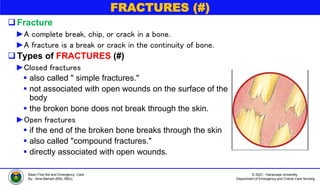
Fracture
►A complete break, chip, or crack in a bone.
►A fracture is a break or crack in the continuity of bone.
Types of FRACTURES (#)
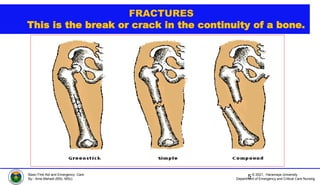
►Closed fractures
 also called " simple fractures."
 not associated with open wounds on the surface of the
body
 the broken bone does not break through the skin.
►Open fractures
 if the end of the broken bone breaks through the skin
 also called "compound fractures."
 directly associated with open wounds.
© 2021, Haramaya University
Department of Emergency and Critical Care Nursing
Basic First Aid and Emergency Care
By:- Ame Mehadi (BSc, MSc)
Types of FRACTURES (#)
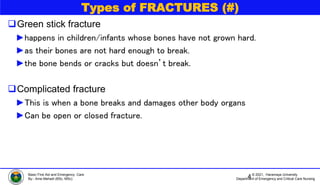
Green stick fracture
►happens in children/infants whose bones have not grown hard.
►as their bones are not hard enough to break.
►the bone bends or cracks but doesn’t break.
Complicated fracture
►This is when a bone breaks and damages other body organs
►Can be open or closed fracture.
4
© 2021, Haramaya University
Department of Emergency and Critical Care Nursing
Basic First Aid and Emergency Care
By:- Ame Mehadi (BSc, MSc)
FRACTURES
This is the break or crack in the continuity of a bone.
5
© 2021, Haramaya University
Department of Emergency and Critical Care Nursing
Basic First Aid and Emergency Care
By:- Ame Mehadi (BSc, MSc)
FRACTURES (#)
 Causes of Fracture
1. Traumatic fracture
 The most common causes of fractures are MVA or accidents
related to falls, recreational and sports activities
2. Pathologic fracture
 Fracture result from diseased process
6
© 2021, Haramaya University
Department of Emergency and Critical Care Nursing
Basic First Aid and Emergency Care
By:- Ame Mehadi (BSc, MSc)
FRACTURES (#)
Signs and Symptoms
►Pain, swelling, tenderness and difficulty of moving the injured part
►Grating sensation of broken bones rubbing together
►Abnormal movement in an area of the body
►Difference in shape and length of corresponding bones on the two sides of
the body
►Obvious deformities
►Discoloration
7
© 2021, Haramaya University
Department of Emergency and Critical Care Nursing
Basic First Aid and Emergency Care
By:- Ame Mehadi (BSc, MSc)
FRACTURES (#)
Objectives of first aid
►To prevent blood lose
►To keep the broken bone ends and the adjacent joints from moving.
►To transport the victim to hospital
►To give care for shock.
►To relief pain
© 2021, Haramaya University
Department of Emergency and Critical Care Nursing
Basic First Aid and Emergency Care
By:- Ame Mehadi (BSc, MSc)
FRACTURES (#)
First aid principles
►Safety – protect against further injury.
►Follow ABC approach
 open airway and provide artificial respiration, if needed.
►Call for an ambulance or medical assistance, as needed.
►Prevent mov’ts of the injured parts & the adjacent joint.
►Elevate involved extremities if possible w/o disturbing the suspected #.
►Apply splint, if medical assistance delayed.
►Don't wash, or probe or do not insert your fingers in to the wound.
►If a fragment of bone is protruding, cover the entire wound with sterile dressing.
►Do not replace any bone fragments.
9
© 2021, Haramaya University
Department of Emergency and Critical Care Nursing
Basic First Aid and Emergency Care
By:- Ame Mehadi (BSc, MSc)
Splinting
Splinting
►can be metallic, wooden or other devices
►many varieties of splints commercially available and
►can also be made locally from different materials.
►applied to the arms, legs or trunk
►to immobilize the injured part when # is suspected.
►also protect against further injury during transportation.
10
© 2021, Haramaya University
Department of Emergency and Critical Care Nursing
Basic First Aid and Emergency Care
By:- Ame Mehadi (BSc, MSc)
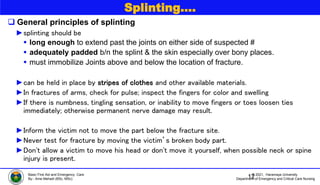
Types of splints
Soft splints
►are soft, bulky objects
►e.g., a folded blanket, towel, pillow, or bandage
Rigid splints
►are hard, fixed objects
►e.g., a board, a rolled newspaper, a tree branch
Anatomical splints
►use another body part for support
►e.g., immobilize an injured leg by securing it to the
uninjured leg
Slings
►use cloth looped around the neck to support an upper
extremity (e.g., the arm or wrist).
© 2021, Haramaya University
Department of Emergency and Critical Care Nursing
Basic First Aid and Emergency Care
By:- Ame Mehadi (BSc, MSc)
Splinting….
 General principles of splinting
►splinting should be
 long enough to extend past the joints on either side of suspected #
 adequately padded b/n the splint & the skin especially over bony places.
 must immobilize Joints above and below the location of fracture.
►can be held in place by stripes of clothes and other available materials.
►In fractures of arms, check for pulse; inspect the fingers for color and swelling
►If there is numbness, tingling sensation, or inability to move fingers or toes loosen ties
immediately; otherwise permanent nerve damage may result.
►Inform the victim not to move the part below the fracture site.
►Never test for fracture by moving the victim’s broken body part.
►Don't allow a victim to move his head or don't move it yourself, when possible neck or spine
injury is present.
12
© 2021, Haramaya University
Department of Emergency and Critical Care Nursing
Basic First Aid and Emergency Care
By:- Ame Mehadi (BSc, MSc)
Specific Fractures
Scalp Injuries and fracture of the skull
►Wounds of the scalp, even if small, tend to profusely bleed.
►Deep scalp wounds may be complicated by fragment from skull fractures or
they may contain hair, glass or other foreign materials.
First Aid Measures
►Do not try to clean scalp wounds.
►Control bleeding by raising the victim’s head and shoulder; do not bend the
neck (fracture may be present).
►Place a sterile dressing on the wound.
►Apply a bandage to hold the dressing in place and to provide pressure.
© 2021, Haramaya University
Department of Emergency and Critical Care Nursing
Basic First Aid and Emergency Care
By:- Ame Mehadi (BSc, MSc)
Face and jaw fracture
It often occurs as a result of automobile accidents or other type of violent
injuries.
The immediate problems are obstruction of the air passage by blood,
saliva, and other secretions; swelling and severe hemorrhage.
First aid measures
►Call for ambulance and seek immediate medical assistance.
►Maintain an open air way.
►Provide continues support to the head to prevent air way obstruction.
►If the victim is conscious help to lean foreword to drain secretion from mouth and
cough up.
►Give artificial respiration if necessary.
►Treat for shock.
►Apply protective dressing as necessary
© 2021, Haramaya University
Department of Emergency and Critical Care Nursing
Basic First Aid and Emergency Care
By:- Ame Mehadi (BSc, MSc)
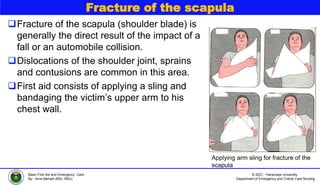
Fracture of the scapula
Fracture of the scapula (shoulder blade) is
generally the direct result of the impact of a
fall or an automobile collision.
Dislocations of the shoulder joint, sprains
and contusions are common in this area.
First aid consists of applying a sling and
bandaging the victim’s upper arm to his
chest wall.
Applying arm sling for fracture of the
scapula
© 2021, Haramaya University
Department of Emergency and Critical Care Nursing
Basic First Aid and Emergency Care
By:- Ame Mehadi (BSc, MSc)
Fracture of the clavicle
Fractures of the clavicle (collar bone) usually occur in the weakest
portion, which is one third of the distance from the tip of the shoulder
to the sternum.
First Aid Measures:
►Consists of applying a sling to elevate and immobilize the arm and shoulder
blade.
© 2021, Haramaya University
Department of Emergency and Critical Care Nursing
Basic First Aid and Emergency Care
By:- Ame Mehadi (BSc, MSc)
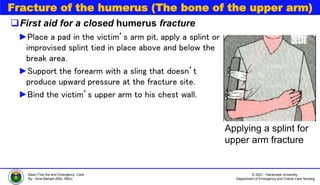
Fracture of the humerus (The bone of the upper arm)
First aid for a closed humerus fracture
►Place a pad in the victim’s arm pit, apply a splint or
improvised splint tied in place above and below the
break area.
►Support the forearm with a sling that doesn’t
produce upward pressure at the fracture site.
►Bind the victim’s upper arm to his chest wall.
Applying a splint for
upper arm fracture
© 2021, Haramaya University
Department of Emergency and Critical Care Nursing
Basic First Aid and Emergency Care
By:- Ame Mehadi (BSc, MSc)
First aid measure for an open fracture
Remove the victim’s cloth
Control bleeding by applying direct pressure and elevating the part
Cover the wound with a large sterile or clean dressing and apply a
splint that does not press against the area of the break.
Do not attempt to cleanse the wound and push a protruding bone
back
Arrange for transportation as soon as possible
N.B. Remember that the three places to immobilize a fracture of the
upper arm are:
►Broken bone ends
►Shoulder
►Elbow
© 2021, Haramaya University
Department of Emergency and Critical Care Nursing
Basic First Aid and Emergency Care
By:- Ame Mehadi (BSc, MSc)
Elbow fracture
Elbow fractures may involve the lower part of the humerus or the
upper bones of the forearm.
First aid measures
►Place the victim’s forearm in a sling and bind it to his body (if the elbow can
be bent).
►If the elbow cannot be bent, immobilize the fracture at the upper arm, at the
elbow and at the wrist against the chest and the abdomen and at the hip.
►Lie the victim down and elevate the arm.
►If a splint is not available, wrap a pillow about the arm centering it at the
elbow and tie or pin the two sides together.
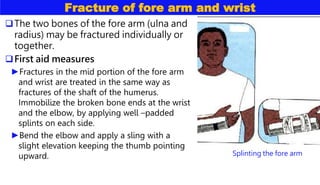
Fracture of fore arm and wrist
The two bones of the fore arm (ulna and
radius) may be fractured individually or
together.
First aid measures
►Fractures in the mid portion of the fore arm
and wrist are treated in the same way as
fractures of the shaft of the humerus.
Immobilize the broken bone ends at the wrist
and the elbow, by applying well –padded
splints on each side.
►Bend the elbow and apply a sling with a
slight elevation keeping the thumb pointing
upward. Splinting the fore arm
© 2021, Haramaya University
Department of Emergency and Critical Care Nursing
Basic First Aid and Emergency Care
By:- Ame Mehadi (BSc, MSc)
Fracture of the spine
The back bone, or spinal column is composed of 33 bones called
vertebrae.
It encloses the spinal cord which passes through circular openings in
the separate vertebras.
Fracture of the neck or back are extremely dangerous because the
slightest movement may cause further damage to the spinal cord and
result in paralysis.
© 2021, Haramaya University
Department of Emergency and Critical Care Nursing
Basic First Aid and Emergency Care
By:- Ame Mehadi (BSc, MSc)
Fracture of the spine
First aid measures for fracture of the neck (Cervical Vertebrae)
►Do not allow the victim’s head to be bent foreword or backward or to move
from side to side.
►If the victim is lying on his back, a small pad or towel may be placed in the
space under his neck (do not put a pillow under his head).
►Place rolled up clothing, blankets or sand bags around to prevent movement.
►Anchor the restraining materials with bricks or stones.
►Seek medical advice and send for ambulance with trained personnel.
© 2021, Haramaya University
Department of Emergency and Critical Care Nursing
Basic First Aid and Emergency Care
By:- Ame Mehadi (BSc, MSc)
Fracture of the spine
First aid for fracture of the back (Thoracic and lumbar vertebrae)
►Handle as gently as possible (avoid unnecessary movement).
►Send for an ambulance.
►Until help arrives leave the victim in the position in which he was found.
►Do not twist the neck or back.
►Arrange rolled up blankets or clothing on both sides of the trunk, head and neck for
immobilization.
►If a person with a fracture of the back must be turned to obtain an open air way,
make sure to obtain enough help so that the entire body is turned as a unit and no
part twists or turns faster than other parts.
►While transferring the victim, the body should be held as a unit with the head,
shoulder, trunk, the hip and the legs, each supported by one person.
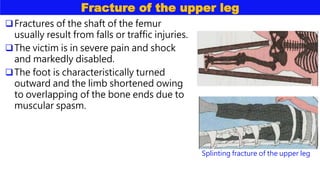
Fracture of the upper leg
Fractures of the shaft of the femur
usually result from falls or traffic injuries.
The victim is in severe pain and shock
and markedly disabled.
The foot is characteristically turned
outward and the limb shortened owing
to overlapping of the bone ends due to
muscular spasm.
Splinting fracture of the upper leg
© 2021, Haramaya University
Department of Emergency and Critical Care Nursing
Basic First Aid and Emergency Care
By:- Ame Mehadi (BSc, MSc)
First aid measures
If the victim is to be transported only for short distance on a stretcher,
place a blanket between the legs and bind them together.
To apply the board splint, assemble needed supplies.
If you use improvised board splints, they should be well padded and
should reach from the victim’s armpit on the outer side and groin or
the inner side to below his heel.
The bandages will be tied on the following areas: just below the arm
pit, at the abdomen, at the hip, above and below the fracture site, at
the lower leg and ankle and foot with figure of eight bandage.
Don’t try to cleanse open wound (if present).
If possible apply a traction splint for the fracture of the shaft of the
femur.
Fracture of the kneecap (Patella)
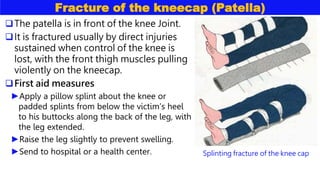
The patella is in front of the knee Joint.
It is fractured usually by direct injuries
sustained when control of the knee is
lost, with the front thigh muscles pulling
violently on the kneecap.
First aid measures
►Apply a pillow splint about the knee or
padded splints from below the victim’s heel
to his buttocks along the back of the leg, with
the leg extended.
►Raise the leg slightly to prevent swelling.
►Send to hospital or a health center. Splinting fracture of the knee cap
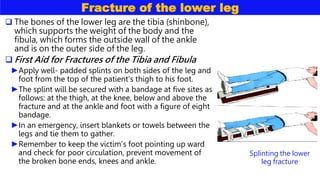
Fracture of the lower leg
 The bones of the lower leg are the tibia (shinbone),
which supports the weight of the body and the
fibula, which forms the outside wall of the ankle
and is on the outer side of the leg.
 First Aid for Fractures of the Tibia and Fibula
►Apply well- padded splints on both sides of the leg and
foot from the top of the patient’s thigh to his foot.
►The splint will be secured with a bandage at five sites as
follows: at the thigh, at the knee, below and above the
fracture and at the ankle and foot with a figure of eight
bandage.
►In an emergency, insert blankets or towels between the
legs and tie them to gather.
►Remember to keep the victim’s foot pointing up ward
and check for poor circulation, prevent movement of
the broken bone ends, knees and ankle.
Splinting the lower
leg fracture
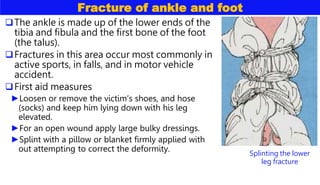
Fracture of ankle and foot
The ankle is made up of the lower ends of the
tibia and fibula and the first bone of the foot
(the talus).
Fractures in this area occur most commonly in
active sports, in falls, and in motor vehicle
accident.
First aid measures
►Loosen or remove the victim’s shoes, and hose
(socks) and keep him lying down with his leg
elevated.
►For an open wound apply large bulky dressings.
►Splint with a pillow or blanket firmly applied with
out attempting to correct the deformity. Splinting the lower
leg fracture
© 2021, Haramaya University
Department of Emergency and Critical Care Nursing
Basic First Aid and Emergency Care
By:- Ame Mehadi (BSc, MSc)
Dislocation
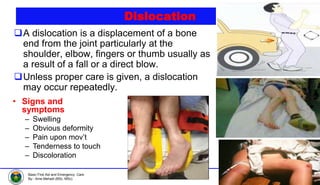
A dislocation is a displacement of a bone
end from the joint particularly at the
shoulder, elbow, fingers or thumb usually as
a result of a fall or a direct blow.
Unless proper care is given, a dislocation
may occur repeatedly.
• Signs and
symptoms
– Swelling
– Obvious deformity
– Pain upon mov’t
– Tenderness to touch
– Discoloration
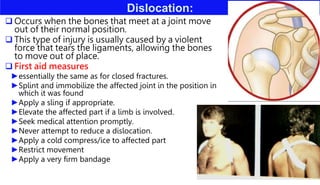
Dislocation:
 Occurs when the bones that meet at a joint move
out of their normal position.
 This type of injury is usually caused by a violent
force that tears the ligaments, allowing the bones
to move out of place.
 First aid measures
►essentially the same as for closed fractures.
►Splint and immobilize the affected joint in the position in
which it was found
►Apply a sling if appropriate.
►Elevate the affected part if a limb is involved.
►Seek medical attention promptly.
►Never attempt to reduce a dislocation.
►Apply a cold compress/ice to affected part
►Restrict movement
►Apply a very firm bandage
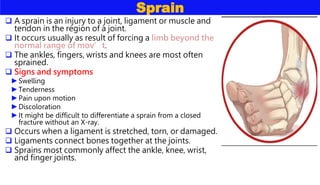
Sprain
 A sprain is an injury to a joint, ligament or muscle and
tendon in the region of a joint.
 It occurs usually as result of forcing a limb beyond the
normal range of mov’t.
 The ankles, fingers, wrists and knees are most often
sprained.
 Signs and symptoms
►Swelling
►Tenderness
►Pain upon motion
►Discoloration
►It might be difficult to differentiate a sprain from a closed
fracture without an X-ray.
 Occurs when a ligament is stretched, torn, or damaged.
 Ligaments connect bones together at the joints.
 Sprains most commonly affect the ankle, knee, wrist,
and finger joints.
© 2021, Haramaya University
Department of Emergency and Critical Care Nursing
Basic First Aid and Emergency Care
By:- Ame Mehadi (BSc, MSc)
Sprain
First aid measures
►If the victim’s ankle or knee is affected, do not allow him to walk.
►Loosen or remove the victim’s shoes, apply a pillow or blanket, splint and
elevate the victim’s leg to prevent swelling.
►Apply cold wet pad or place a small bag of crushed ice on the affected area
over a towel intermittently, to protect the victim’s skin.
►If swelling and pain persist, seek medical attention.
© 2021, Haramaya University
Department of Emergency and Critical Care Nursing
Basic First Aid and Emergency Care
By:- Ame Mehadi (BSc, MSc)
Strain
 Strains are injuries to muscle resulting from over stretching. The fibers are
stretched and sometimes partially torn.
 Commonly strains occur on the back muscles, due to improper lifting technique.
 To avoid back strain when a heavy object must be lifted, observe the following
precaution.
 Place the feet close to the object firmly and apart.
 Squat; do not lean forward keeping the back as straight as possible and get a
good grip on the object.
 Lift slowly, pushing up with the strong thigh and leg muscles are bearing the
weight.
 Occurs when a tendon or muscle is stretched, torn, or damaged.
 Tendons connect muscles to bones.
 Strains are often caused by overworking a muscle (e.g., by lifting an overly heavy
object or by repetitively performing the same action).
 They usually involve the muscles in the neck, back, thigh, or the back of the lower
leg.
33
© 2021, Haramaya University
Department of Emergency and Critical Care Nursing
Basic First Aid and Emergency Care
By:- Ame Mehadi (BSc, MSc)
Strain
First aid measures
►Bed rest, heat and use of a board under the
mattress for firm support are recommended for
person with a strained back.
►Cool the area by applying an ice pack or cold
compress for the first 24 hours.
►After 24 hours, apply heat, warm, wet and
care.
►Seek medical care;
34
© 2021, Haramaya University
Department of Emergency and Critical Care Nursing
Basic First Aid and Emergency Care
By:- Ame Mehadi (BSc, MSc)
Muscle Cramps
A muscle cramp is a painful condition that can be caused by heavy
exercise or staying in the same position for too long. You can usually
stop the pain by stretching and massaging the area with the cramp,
resting, or changing position.
© 2021, Haramaya University
Department of Emergency and Critical Care Nursing
Basic First Aid and Emergency Care
By:- Ame Mehadi (BSc, MSc) 36

Bone, Muscle & Joint Injuries.pptx

  • 1.
  • 2.
    © 2021, HaramayaUniversity Department of Emergency and Critical Care Nursing Basic First Aid and Emergency Care By:- Ame Mehadi (BSc, MSc) There are four basic types of bone, muscle, and joint injuries: ►Fracture ►Sprain ►Strain ►Muscle Cramps
  • 3.
    © 2021, HaramayaUniversity Department of Emergency and Critical Care Nursing Basic First Aid and Emergency Care By:- Ame Mehadi (BSc, MSc) FRACTURES (#) Fracture ►A complete break, chip, or crack in a bone. ►A fracture is a break or crack in the continuity of bone. Types of FRACTURES (#) ►Closed fractures  also called " simple fractures."  not associated with open wounds on the surface of the body  the broken bone does not break through the skin. ►Open fractures  if the end of the broken bone breaks through the skin  also called "compound fractures."  directly associated with open wounds.
  • 4.
    © 2021, HaramayaUniversity Department of Emergency and Critical Care Nursing Basic First Aid and Emergency Care By:- Ame Mehadi (BSc, MSc) Types of FRACTURES (#) Green stick fracture ►happens in children/infants whose bones have not grown hard. ►as their bones are not hard enough to break. ►the bone bends or cracks but doesn’t break. Complicated fracture ►This is when a bone breaks and damages other body organs ►Can be open or closed fracture. 4
  • 5.
    © 2021, HaramayaUniversity Department of Emergency and Critical Care Nursing Basic First Aid and Emergency Care By:- Ame Mehadi (BSc, MSc) FRACTURES This is the break or crack in the continuity of a bone. 5
  • 6.
    © 2021, HaramayaUniversity Department of Emergency and Critical Care Nursing Basic First Aid and Emergency Care By:- Ame Mehadi (BSc, MSc) FRACTURES (#)  Causes of Fracture 1. Traumatic fracture  The most common causes of fractures are MVA or accidents related to falls, recreational and sports activities 2. Pathologic fracture  Fracture result from diseased process 6
  • 7.
    © 2021, HaramayaUniversity Department of Emergency and Critical Care Nursing Basic First Aid and Emergency Care By:- Ame Mehadi (BSc, MSc) FRACTURES (#) Signs and Symptoms ►Pain, swelling, tenderness and difficulty of moving the injured part ►Grating sensation of broken bones rubbing together ►Abnormal movement in an area of the body ►Difference in shape and length of corresponding bones on the two sides of the body ►Obvious deformities ►Discoloration 7
  • 8.
    © 2021, HaramayaUniversity Department of Emergency and Critical Care Nursing Basic First Aid and Emergency Care By:- Ame Mehadi (BSc, MSc) FRACTURES (#) Objectives of first aid ►To prevent blood lose ►To keep the broken bone ends and the adjacent joints from moving. ►To transport the victim to hospital ►To give care for shock. ►To relief pain
  • 9.
    © 2021, HaramayaUniversity Department of Emergency and Critical Care Nursing Basic First Aid and Emergency Care By:- Ame Mehadi (BSc, MSc) FRACTURES (#) First aid principles ►Safety – protect against further injury. ►Follow ABC approach  open airway and provide artificial respiration, if needed. ►Call for an ambulance or medical assistance, as needed. ►Prevent mov’ts of the injured parts & the adjacent joint. ►Elevate involved extremities if possible w/o disturbing the suspected #. ►Apply splint, if medical assistance delayed. ►Don't wash, or probe or do not insert your fingers in to the wound. ►If a fragment of bone is protruding, cover the entire wound with sterile dressing. ►Do not replace any bone fragments. 9
  • 10.
    © 2021, HaramayaUniversity Department of Emergency and Critical Care Nursing Basic First Aid and Emergency Care By:- Ame Mehadi (BSc, MSc) Splinting Splinting ►can be metallic, wooden or other devices ►many varieties of splints commercially available and ►can also be made locally from different materials. ►applied to the arms, legs or trunk ►to immobilize the injured part when # is suspected. ►also protect against further injury during transportation. 10
  • 11.
    © 2021, HaramayaUniversity Department of Emergency and Critical Care Nursing Basic First Aid and Emergency Care By:- Ame Mehadi (BSc, MSc) Types of splints Soft splints ►are soft, bulky objects ►e.g., a folded blanket, towel, pillow, or bandage Rigid splints ►are hard, fixed objects ►e.g., a board, a rolled newspaper, a tree branch Anatomical splints ►use another body part for support ►e.g., immobilize an injured leg by securing it to the uninjured leg Slings ►use cloth looped around the neck to support an upper extremity (e.g., the arm or wrist).
  • 12.
    © 2021, HaramayaUniversity Department of Emergency and Critical Care Nursing Basic First Aid and Emergency Care By:- Ame Mehadi (BSc, MSc) Splinting….  General principles of splinting ►splinting should be  long enough to extend past the joints on either side of suspected #  adequately padded b/n the splint & the skin especially over bony places.  must immobilize Joints above and below the location of fracture. ►can be held in place by stripes of clothes and other available materials. ►In fractures of arms, check for pulse; inspect the fingers for color and swelling ►If there is numbness, tingling sensation, or inability to move fingers or toes loosen ties immediately; otherwise permanent nerve damage may result. ►Inform the victim not to move the part below the fracture site. ►Never test for fracture by moving the victim’s broken body part. ►Don't allow a victim to move his head or don't move it yourself, when possible neck or spine injury is present. 12
  • 13.
    © 2021, HaramayaUniversity Department of Emergency and Critical Care Nursing Basic First Aid and Emergency Care By:- Ame Mehadi (BSc, MSc) Specific Fractures Scalp Injuries and fracture of the skull ►Wounds of the scalp, even if small, tend to profusely bleed. ►Deep scalp wounds may be complicated by fragment from skull fractures or they may contain hair, glass or other foreign materials. First Aid Measures ►Do not try to clean scalp wounds. ►Control bleeding by raising the victim’s head and shoulder; do not bend the neck (fracture may be present). ►Place a sterile dressing on the wound. ►Apply a bandage to hold the dressing in place and to provide pressure.
  • 14.
    © 2021, HaramayaUniversity Department of Emergency and Critical Care Nursing Basic First Aid and Emergency Care By:- Ame Mehadi (BSc, MSc) Face and jaw fracture It often occurs as a result of automobile accidents or other type of violent injuries. The immediate problems are obstruction of the air passage by blood, saliva, and other secretions; swelling and severe hemorrhage. First aid measures ►Call for ambulance and seek immediate medical assistance. ►Maintain an open air way. ►Provide continues support to the head to prevent air way obstruction. ►If the victim is conscious help to lean foreword to drain secretion from mouth and cough up. ►Give artificial respiration if necessary. ►Treat for shock. ►Apply protective dressing as necessary
  • 15.
    © 2021, HaramayaUniversity Department of Emergency and Critical Care Nursing Basic First Aid and Emergency Care By:- Ame Mehadi (BSc, MSc) Fracture of the scapula Fracture of the scapula (shoulder blade) is generally the direct result of the impact of a fall or an automobile collision. Dislocations of the shoulder joint, sprains and contusions are common in this area. First aid consists of applying a sling and bandaging the victim’s upper arm to his chest wall. Applying arm sling for fracture of the scapula
  • 16.
    © 2021, HaramayaUniversity Department of Emergency and Critical Care Nursing Basic First Aid and Emergency Care By:- Ame Mehadi (BSc, MSc) Fracture of the clavicle Fractures of the clavicle (collar bone) usually occur in the weakest portion, which is one third of the distance from the tip of the shoulder to the sternum. First Aid Measures: ►Consists of applying a sling to elevate and immobilize the arm and shoulder blade.
  • 17.
    © 2021, HaramayaUniversity Department of Emergency and Critical Care Nursing Basic First Aid and Emergency Care By:- Ame Mehadi (BSc, MSc) Fracture of the humerus (The bone of the upper arm) First aid for a closed humerus fracture ►Place a pad in the victim’s arm pit, apply a splint or improvised splint tied in place above and below the break area. ►Support the forearm with a sling that doesn’t produce upward pressure at the fracture site. ►Bind the victim’s upper arm to his chest wall. Applying a splint for upper arm fracture
  • 18.
    © 2021, HaramayaUniversity Department of Emergency and Critical Care Nursing Basic First Aid and Emergency Care By:- Ame Mehadi (BSc, MSc) First aid measure for an open fracture Remove the victim’s cloth Control bleeding by applying direct pressure and elevating the part Cover the wound with a large sterile or clean dressing and apply a splint that does not press against the area of the break. Do not attempt to cleanse the wound and push a protruding bone back Arrange for transportation as soon as possible N.B. Remember that the three places to immobilize a fracture of the upper arm are: ►Broken bone ends ►Shoulder ►Elbow
  • 19.
    © 2021, HaramayaUniversity Department of Emergency and Critical Care Nursing Basic First Aid and Emergency Care By:- Ame Mehadi (BSc, MSc) Elbow fracture Elbow fractures may involve the lower part of the humerus or the upper bones of the forearm. First aid measures ►Place the victim’s forearm in a sling and bind it to his body (if the elbow can be bent). ►If the elbow cannot be bent, immobilize the fracture at the upper arm, at the elbow and at the wrist against the chest and the abdomen and at the hip. ►Lie the victim down and elevate the arm. ►If a splint is not available, wrap a pillow about the arm centering it at the elbow and tie or pin the two sides together.
  • 20.
    Fracture of forearm and wrist The two bones of the fore arm (ulna and radius) may be fractured individually or together. First aid measures ►Fractures in the mid portion of the fore arm and wrist are treated in the same way as fractures of the shaft of the humerus. Immobilize the broken bone ends at the wrist and the elbow, by applying well –padded splints on each side. ►Bend the elbow and apply a sling with a slight elevation keeping the thumb pointing upward. Splinting the fore arm
  • 21.
    © 2021, HaramayaUniversity Department of Emergency and Critical Care Nursing Basic First Aid and Emergency Care By:- Ame Mehadi (BSc, MSc) Fracture of the spine The back bone, or spinal column is composed of 33 bones called vertebrae. It encloses the spinal cord which passes through circular openings in the separate vertebras. Fracture of the neck or back are extremely dangerous because the slightest movement may cause further damage to the spinal cord and result in paralysis.
  • 22.
    © 2021, HaramayaUniversity Department of Emergency and Critical Care Nursing Basic First Aid and Emergency Care By:- Ame Mehadi (BSc, MSc) Fracture of the spine First aid measures for fracture of the neck (Cervical Vertebrae) ►Do not allow the victim’s head to be bent foreword or backward or to move from side to side. ►If the victim is lying on his back, a small pad or towel may be placed in the space under his neck (do not put a pillow under his head). ►Place rolled up clothing, blankets or sand bags around to prevent movement. ►Anchor the restraining materials with bricks or stones. ►Seek medical advice and send for ambulance with trained personnel.
  • 23.
    © 2021, HaramayaUniversity Department of Emergency and Critical Care Nursing Basic First Aid and Emergency Care By:- Ame Mehadi (BSc, MSc) Fracture of the spine First aid for fracture of the back (Thoracic and lumbar vertebrae) ►Handle as gently as possible (avoid unnecessary movement). ►Send for an ambulance. ►Until help arrives leave the victim in the position in which he was found. ►Do not twist the neck or back. ►Arrange rolled up blankets or clothing on both sides of the trunk, head and neck for immobilization. ►If a person with a fracture of the back must be turned to obtain an open air way, make sure to obtain enough help so that the entire body is turned as a unit and no part twists or turns faster than other parts. ►While transferring the victim, the body should be held as a unit with the head, shoulder, trunk, the hip and the legs, each supported by one person.
  • 24.
    Fracture of theupper leg Fractures of the shaft of the femur usually result from falls or traffic injuries. The victim is in severe pain and shock and markedly disabled. The foot is characteristically turned outward and the limb shortened owing to overlapping of the bone ends due to muscular spasm. Splinting fracture of the upper leg
  • 25.
    © 2021, HaramayaUniversity Department of Emergency and Critical Care Nursing Basic First Aid and Emergency Care By:- Ame Mehadi (BSc, MSc) First aid measures If the victim is to be transported only for short distance on a stretcher, place a blanket between the legs and bind them together. To apply the board splint, assemble needed supplies. If you use improvised board splints, they should be well padded and should reach from the victim’s armpit on the outer side and groin or the inner side to below his heel. The bandages will be tied on the following areas: just below the arm pit, at the abdomen, at the hip, above and below the fracture site, at the lower leg and ankle and foot with figure of eight bandage. Don’t try to cleanse open wound (if present). If possible apply a traction splint for the fracture of the shaft of the femur.
  • 26.
    Fracture of thekneecap (Patella) The patella is in front of the knee Joint. It is fractured usually by direct injuries sustained when control of the knee is lost, with the front thigh muscles pulling violently on the kneecap. First aid measures ►Apply a pillow splint about the knee or padded splints from below the victim’s heel to his buttocks along the back of the leg, with the leg extended. ►Raise the leg slightly to prevent swelling. ►Send to hospital or a health center. Splinting fracture of the knee cap
  • 27.
    Fracture of thelower leg  The bones of the lower leg are the tibia (shinbone), which supports the weight of the body and the fibula, which forms the outside wall of the ankle and is on the outer side of the leg.  First Aid for Fractures of the Tibia and Fibula ►Apply well- padded splints on both sides of the leg and foot from the top of the patient’s thigh to his foot. ►The splint will be secured with a bandage at five sites as follows: at the thigh, at the knee, below and above the fracture and at the ankle and foot with a figure of eight bandage. ►In an emergency, insert blankets or towels between the legs and tie them to gather. ►Remember to keep the victim’s foot pointing up ward and check for poor circulation, prevent movement of the broken bone ends, knees and ankle. Splinting the lower leg fracture
  • 28.
    Fracture of ankleand foot The ankle is made up of the lower ends of the tibia and fibula and the first bone of the foot (the talus). Fractures in this area occur most commonly in active sports, in falls, and in motor vehicle accident. First aid measures ►Loosen or remove the victim’s shoes, and hose (socks) and keep him lying down with his leg elevated. ►For an open wound apply large bulky dressings. ►Splint with a pillow or blanket firmly applied with out attempting to correct the deformity. Splinting the lower leg fracture
  • 29.
    © 2021, HaramayaUniversity Department of Emergency and Critical Care Nursing Basic First Aid and Emergency Care By:- Ame Mehadi (BSc, MSc) Dislocation A dislocation is a displacement of a bone end from the joint particularly at the shoulder, elbow, fingers or thumb usually as a result of a fall or a direct blow. Unless proper care is given, a dislocation may occur repeatedly. • Signs and symptoms – Swelling – Obvious deformity – Pain upon mov’t – Tenderness to touch – Discoloration
  • 30.
    Dislocation:  Occurs whenthe bones that meet at a joint move out of their normal position.  This type of injury is usually caused by a violent force that tears the ligaments, allowing the bones to move out of place.  First aid measures ►essentially the same as for closed fractures. ►Splint and immobilize the affected joint in the position in which it was found ►Apply a sling if appropriate. ►Elevate the affected part if a limb is involved. ►Seek medical attention promptly. ►Never attempt to reduce a dislocation. ►Apply a cold compress/ice to affected part ►Restrict movement ►Apply a very firm bandage
  • 31.
    Sprain  A sprainis an injury to a joint, ligament or muscle and tendon in the region of a joint.  It occurs usually as result of forcing a limb beyond the normal range of mov’t.  The ankles, fingers, wrists and knees are most often sprained.  Signs and symptoms ►Swelling ►Tenderness ►Pain upon motion ►Discoloration ►It might be difficult to differentiate a sprain from a closed fracture without an X-ray.  Occurs when a ligament is stretched, torn, or damaged.  Ligaments connect bones together at the joints.  Sprains most commonly affect the ankle, knee, wrist, and finger joints.

  • 32.
    © 2021, HaramayaUniversity Department of Emergency and Critical Care Nursing Basic First Aid and Emergency Care By:- Ame Mehadi (BSc, MSc) Sprain First aid measures ►If the victim’s ankle or knee is affected, do not allow him to walk. ►Loosen or remove the victim’s shoes, apply a pillow or blanket, splint and elevate the victim’s leg to prevent swelling. ►Apply cold wet pad or place a small bag of crushed ice on the affected area over a towel intermittently, to protect the victim’s skin. ►If swelling and pain persist, seek medical attention.
  • 33.
    © 2021, HaramayaUniversity Department of Emergency and Critical Care Nursing Basic First Aid and Emergency Care By:- Ame Mehadi (BSc, MSc) Strain  Strains are injuries to muscle resulting from over stretching. The fibers are stretched and sometimes partially torn.  Commonly strains occur on the back muscles, due to improper lifting technique.  To avoid back strain when a heavy object must be lifted, observe the following precaution.  Place the feet close to the object firmly and apart.  Squat; do not lean forward keeping the back as straight as possible and get a good grip on the object.  Lift slowly, pushing up with the strong thigh and leg muscles are bearing the weight.  Occurs when a tendon or muscle is stretched, torn, or damaged.  Tendons connect muscles to bones.  Strains are often caused by overworking a muscle (e.g., by lifting an overly heavy object or by repetitively performing the same action).  They usually involve the muscles in the neck, back, thigh, or the back of the lower leg. 33
  • 34.
    © 2021, HaramayaUniversity Department of Emergency and Critical Care Nursing Basic First Aid and Emergency Care By:- Ame Mehadi (BSc, MSc) Strain First aid measures ►Bed rest, heat and use of a board under the mattress for firm support are recommended for person with a strained back. ►Cool the area by applying an ice pack or cold compress for the first 24 hours. ►After 24 hours, apply heat, warm, wet and care. ►Seek medical care; 34
  • 35.
    © 2021, HaramayaUniversity Department of Emergency and Critical Care Nursing Basic First Aid and Emergency Care By:- Ame Mehadi (BSc, MSc) Muscle Cramps A muscle cramp is a painful condition that can be caused by heavy exercise or staying in the same position for too long. You can usually stop the pain by stretching and massaging the area with the cramp, resting, or changing position.
  • 36.
    © 2021, HaramayaUniversity Department of Emergency and Critical Care Nursing Basic First Aid and Emergency Care By:- Ame Mehadi (BSc, MSc) 36