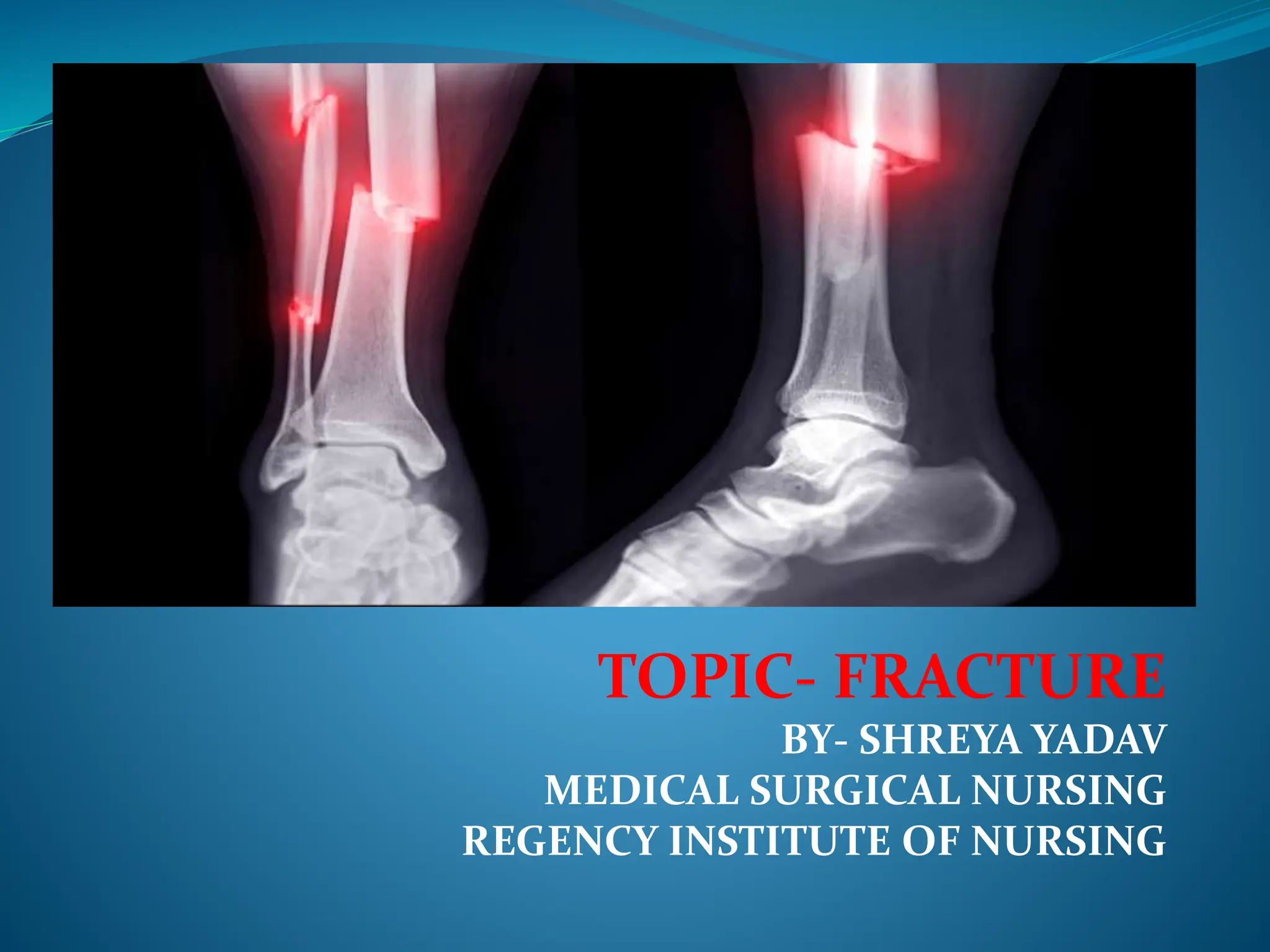
TOPIC- FRACTURE
BY- SHREYA YADAV
MEDICAL SURGICAL NURSING
REGENCY INSTITUTE OF NURSING
FRACTURE
Fracture is a disruption or break in the
continuity of the structure of bone.
Although traumatic injuries account for the
majority of fractures, some fractures are
secondary to a disease process such as caner
or osteoporosis.
TYPES OF FRACTURE
Open Fracture
Closed Fracture
Incomplete fracture
Complete fracture
Displaced Fracture
Nondisplaced Fracture
According to the direction of the fracture line:
Linear Fracture
Oblique Fracture
Transverse Fracture
Longitudinal Fracture
Spiral Fracture
 Open Fracture:- In an open fracture ,the skin
is broken and bone exposed, causing soft
tissue injury.
 Closed Fracture: The skin remains intact and
bone is not exposed.
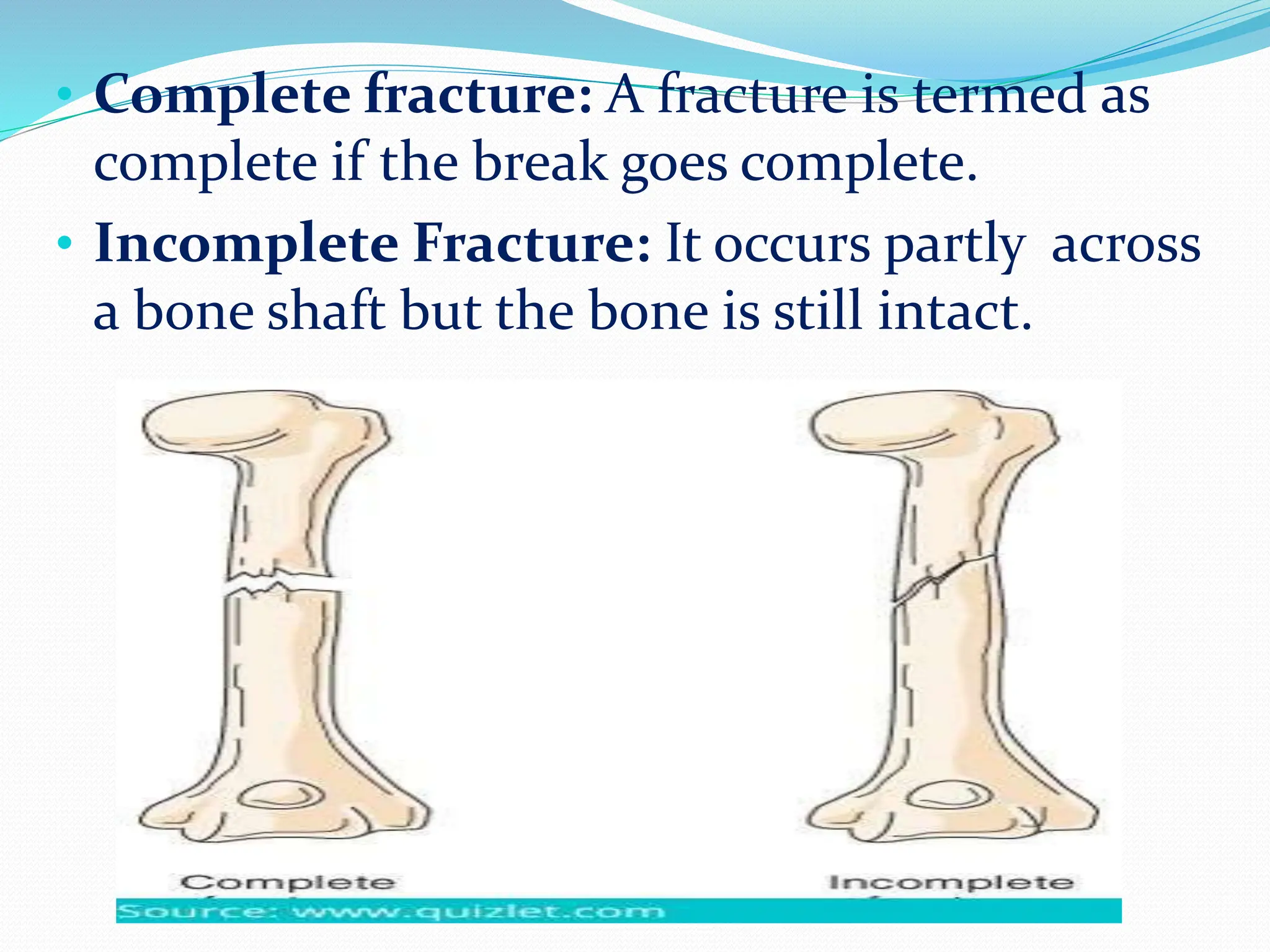
• Complete fracture: A fracture is termed as
complete if the break goes complete.
• Incomplete Fracture: It occurs partly across
a bone shaft but the bone is still intact.
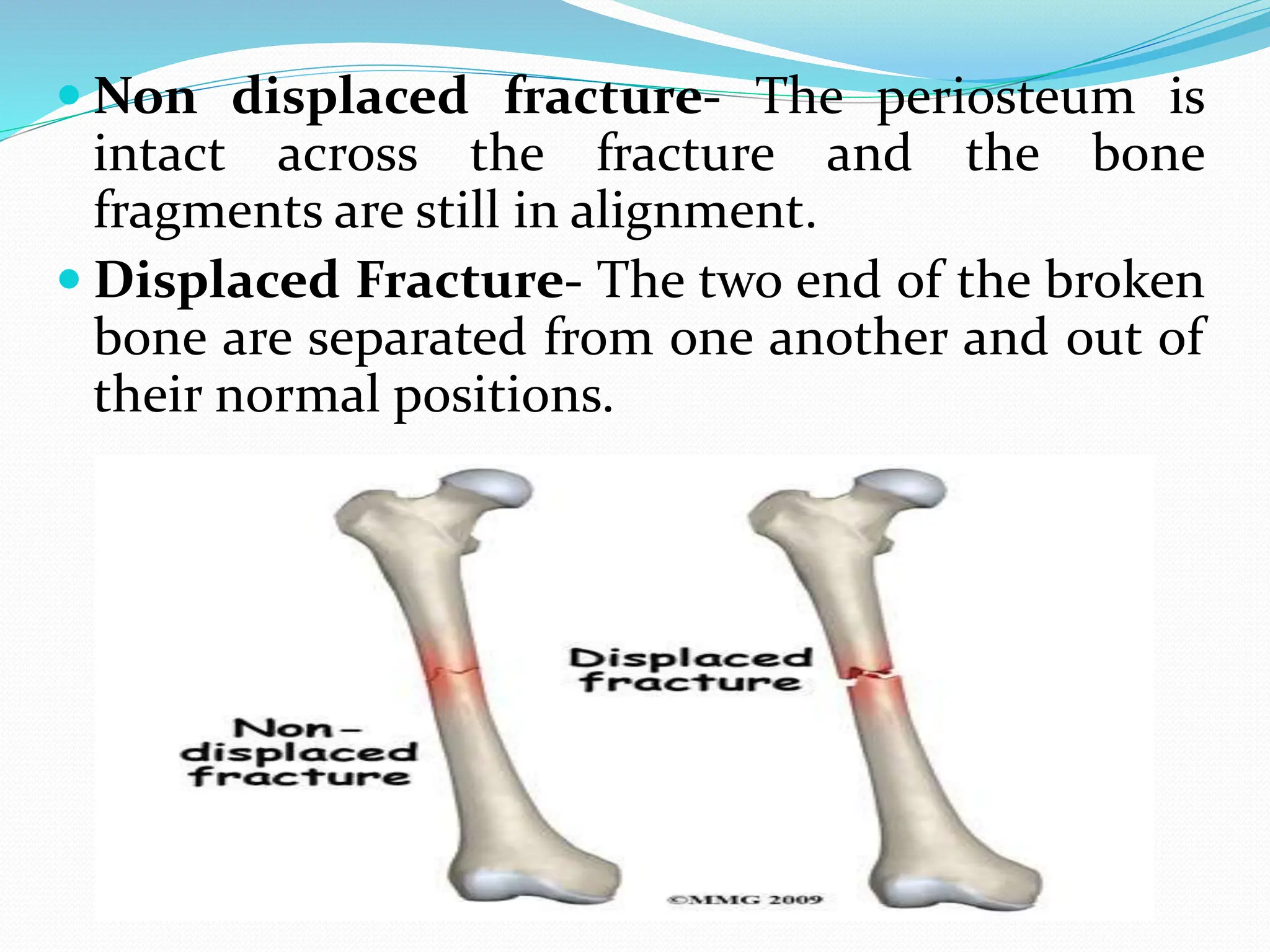
 Non displaced fracture- The periosteum is
intact across the fracture and the bone
fragments are still in alignment.
 Displaced Fracture- The two end of the broken
bone are separated from one another and out of
their normal positions.
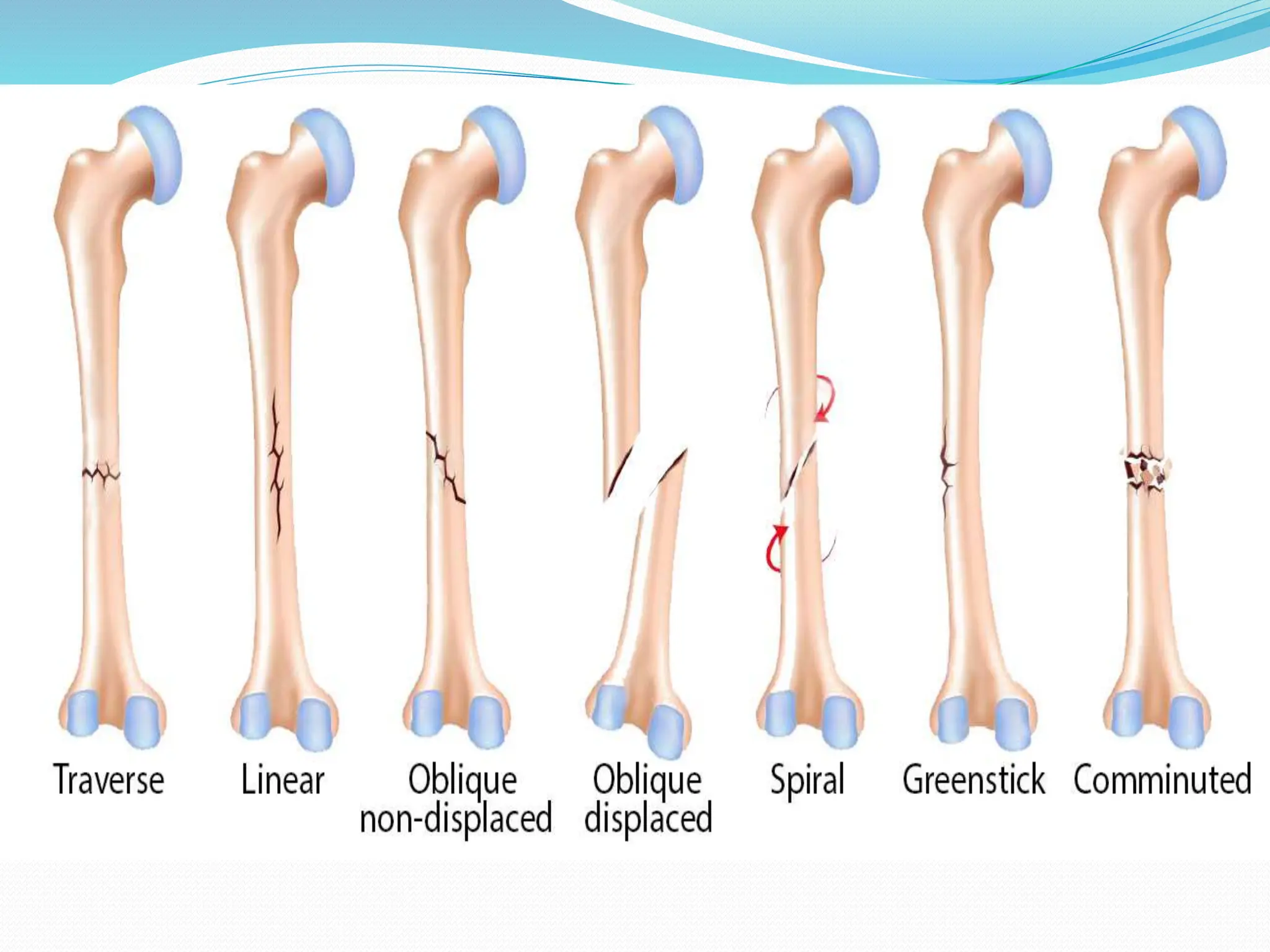
Transverse Fracture – In which the
line of the fracture extend across the
bone sharp at right angle to the
longitudinal axis.
Linear Fracture- A straight clean
break along the bone that is typically
the result of a direct fall.
Oblique Fracture- It is a type of
fracture in which the line of fracture
extends in an oblique direction.
 Spiral Fracture- It is a type of fracture
in which the line of fracture extends in
an Spiral direction along the shaft of
the bone.
 Greenstick fracture- The fracture is
an incomplete fracture with one side
splinted and other side bent.
 Comminuted fracture- In which bone
is broken, splintered or crushed into a
number of pieces.
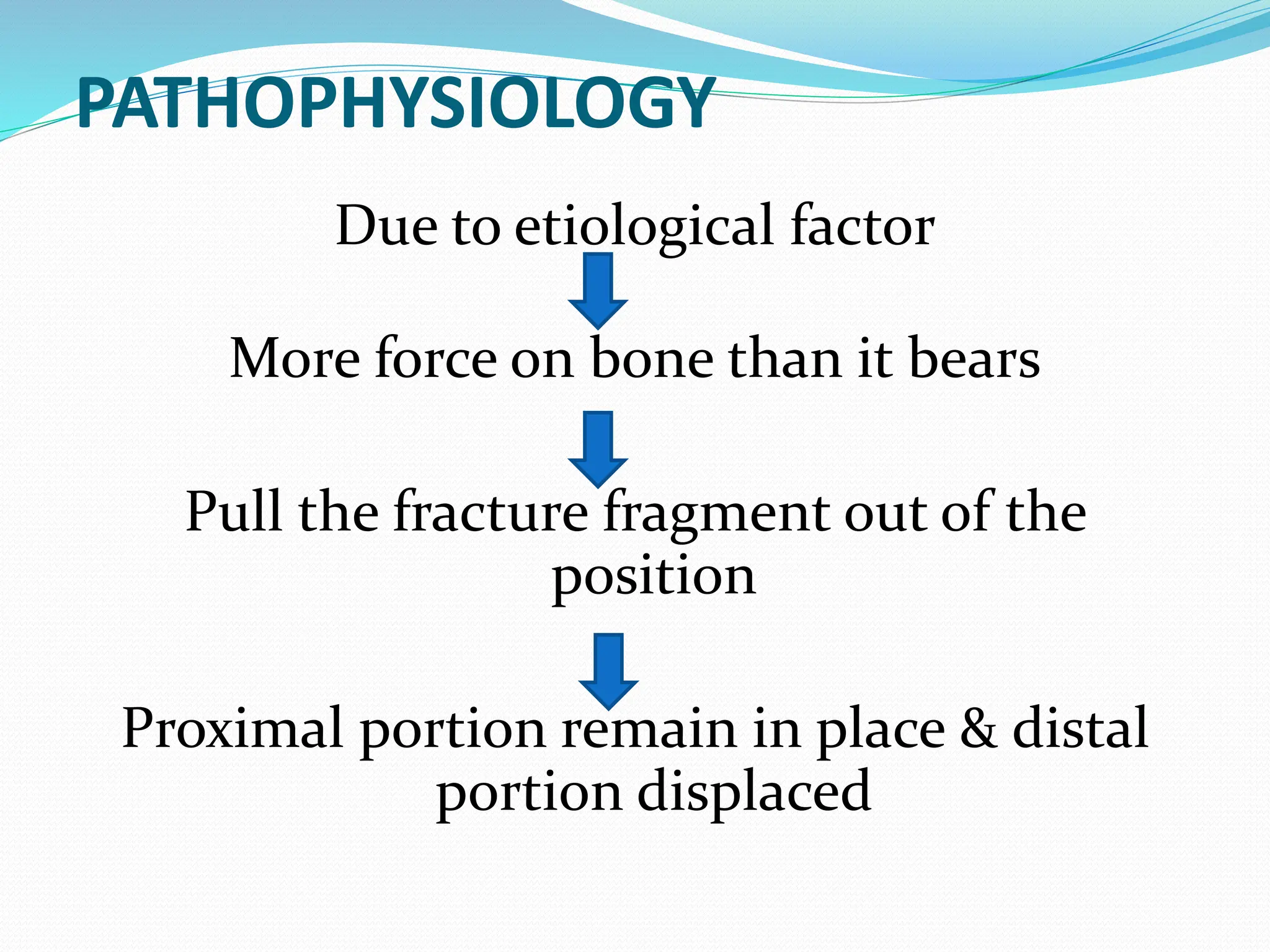
PATHOPHYSIOLOGY
Due to etiological factor
More force on bone than it bears
Pull the fracture fragment out of the
position
Proximal portion remain in place & distal
portion displaced
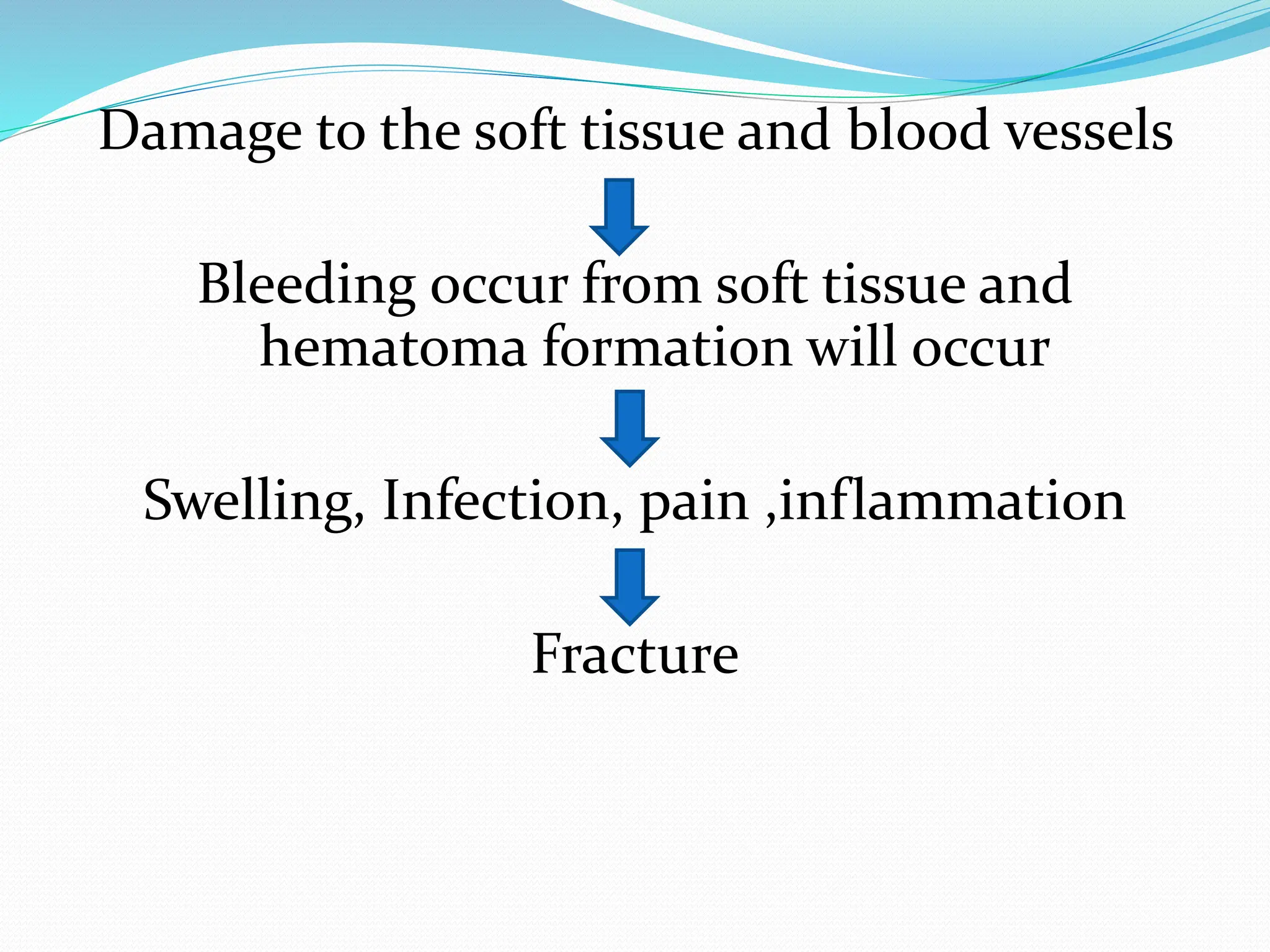
Damage to the soft tissue and blood vessels
Bleeding occur from soft tissue and
hematoma formation will occur
Swelling, Infection, pain ,inflammation
Fracture
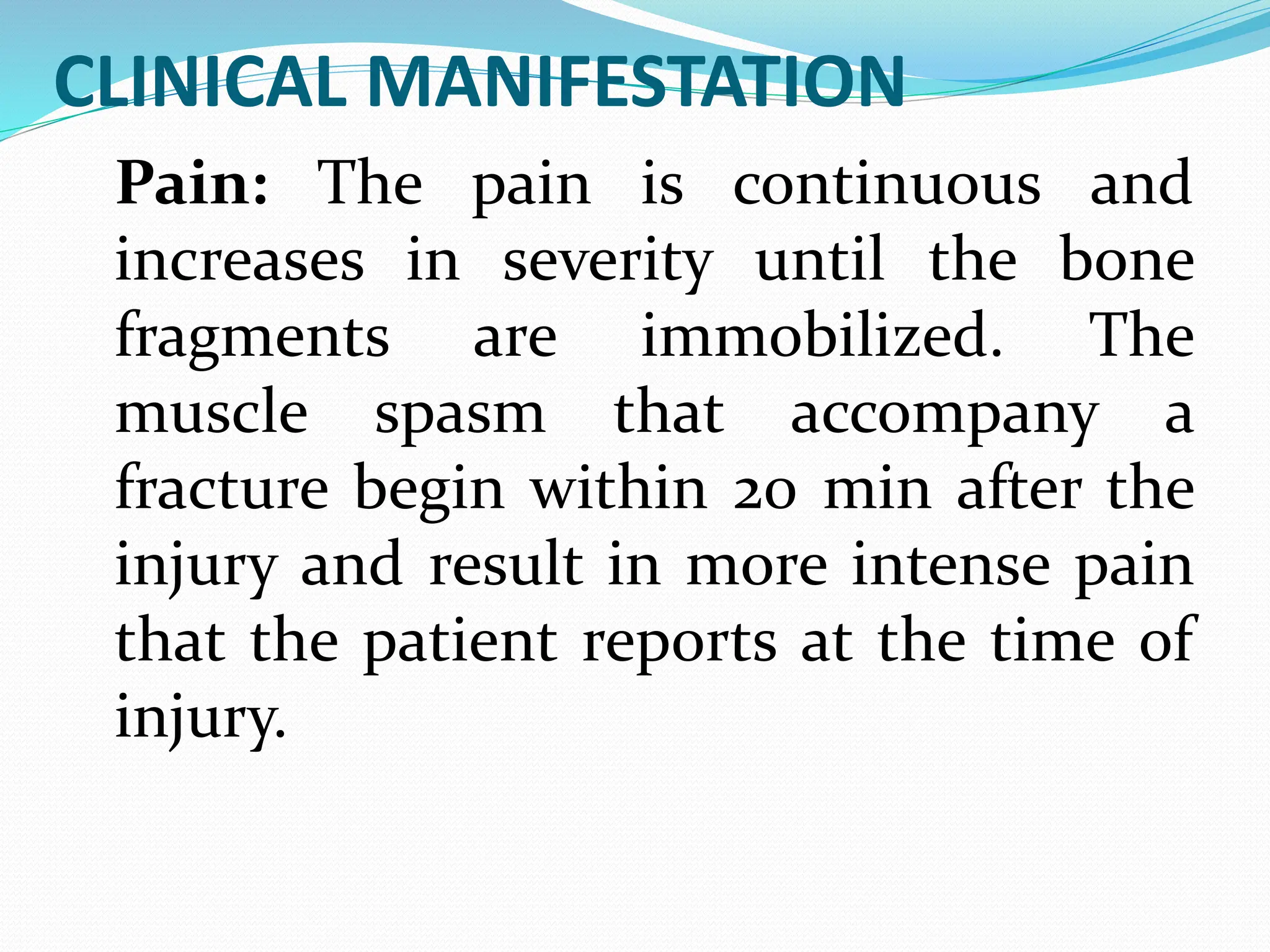
CLINICAL MANIFESTATION
Pain: The pain is continuous and
increases in severity until the bone
fragments are immobilized. The
muscle spasm that accompany a
fracture begin within 20 min after the
injury and result in more intense pain
that the patient reports at the time of
injury.
Loss of Function- After a fracture, the
extremity can not function properly
because normal function of the muscles
depends on the integrity of the bone to
which they are attached. Pain
contributes to the loss of function.
Deformity- Rotation of the fragments
in a fracture of the arm or leg causes a
deformity
Shortening- In fracture of long bones,
there is actual shortening of the
extremity
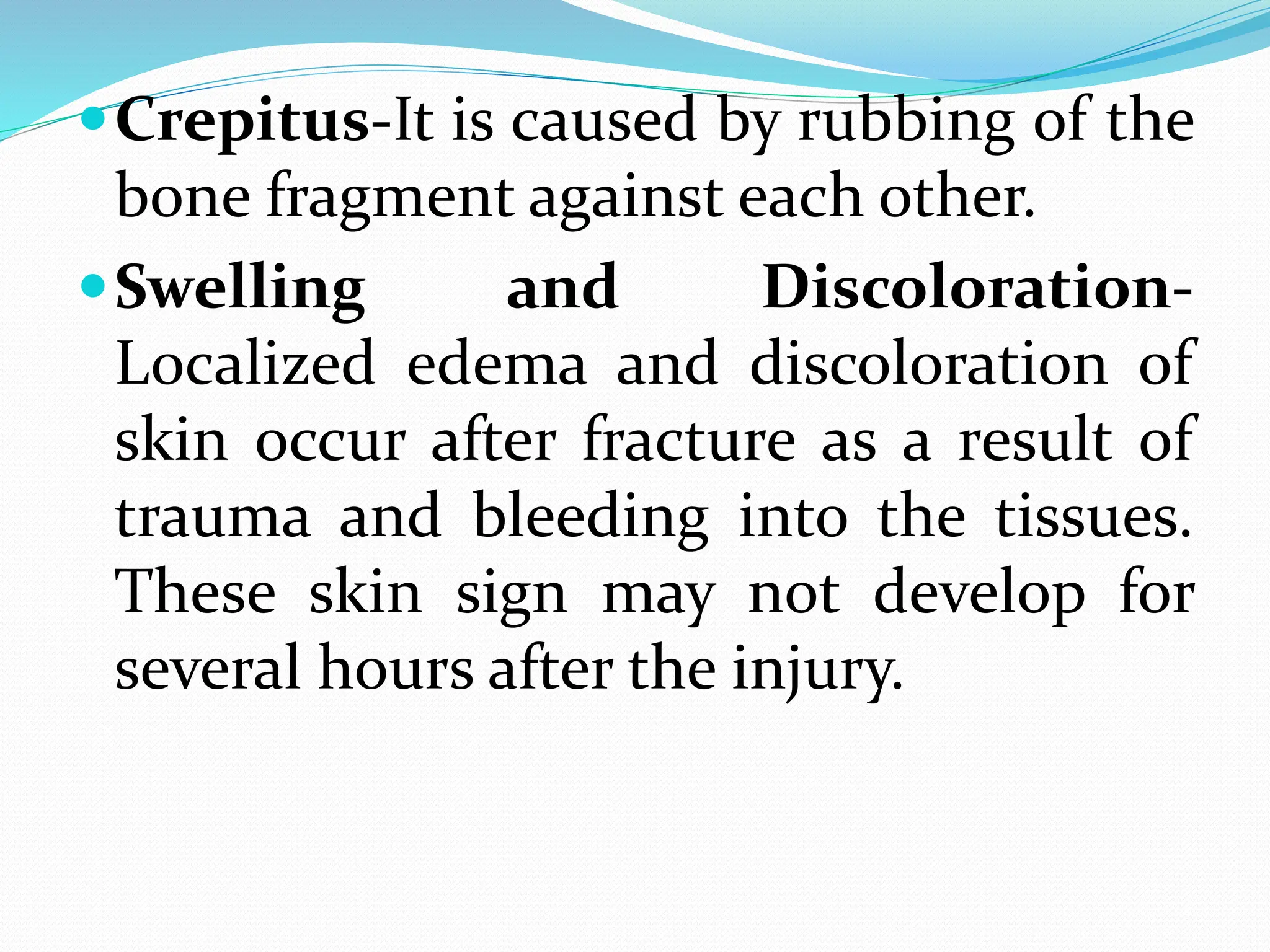
Crepitus-It is caused by rubbing of the
bone fragment against each other.
Swelling and Discoloration-
Localized edema and discoloration of
skin occur after fracture as a result of
trauma and bleeding into the tissues.
These skin sign may not develop for
several hours after the injury.
DIAGNOSTIC EVALUATION
History collection
Physical examination
X-ray
CT- scan(assess bone, soft tissues and
joints damage)
Magnetic resonance imaging(MRI)
MANAGEMENT
MEDICAL MANAGEMENT:
 Muscle relaxant and to reduce
pain(Carisoprodol, Cyclobenzaprine or
Mehocarbmol).
 Tetanus Toxoid to prevent tetanus
 Antibiotics (Cephalosporin)
 Anti-inflammatory (corticosteroids)
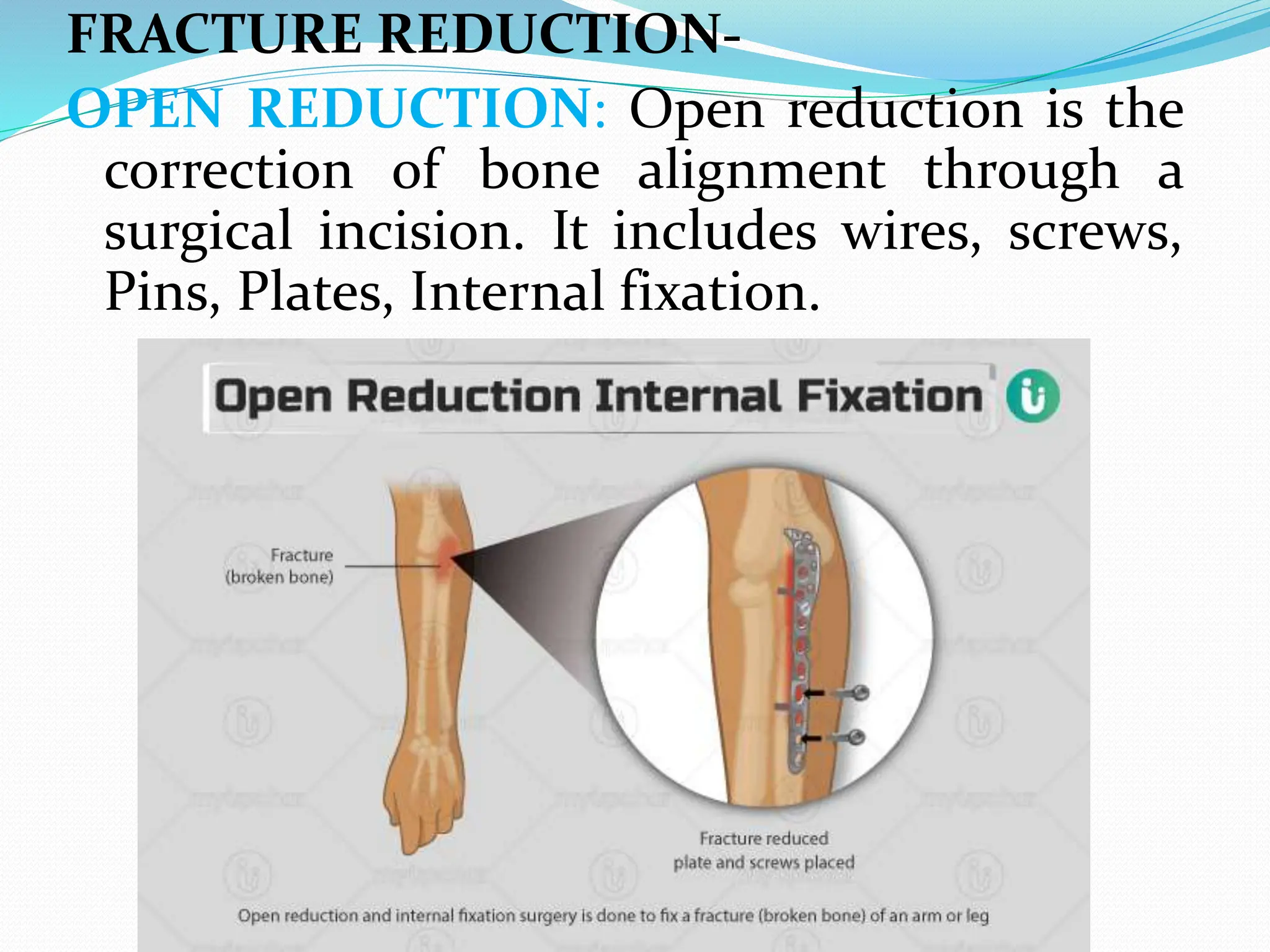
FRACTURE REDUCTION-
OPEN REDUCTION: Open reduction is the
correction of bone alignment through a
surgical incision. It includes wires, screws,
Pins, Plates, Internal fixation.
CLOSED REDUCTION- It is nonsurgical ,
manual realignment of bone fragments to
their previous anatomic position.
TRACTION- It is the application of pulling
force to an injured or diseased body part or
extremity. It is used to prevent pain , muscle
spasm, immobilized a joint or part of the
body and to promote active and passive
exercise.
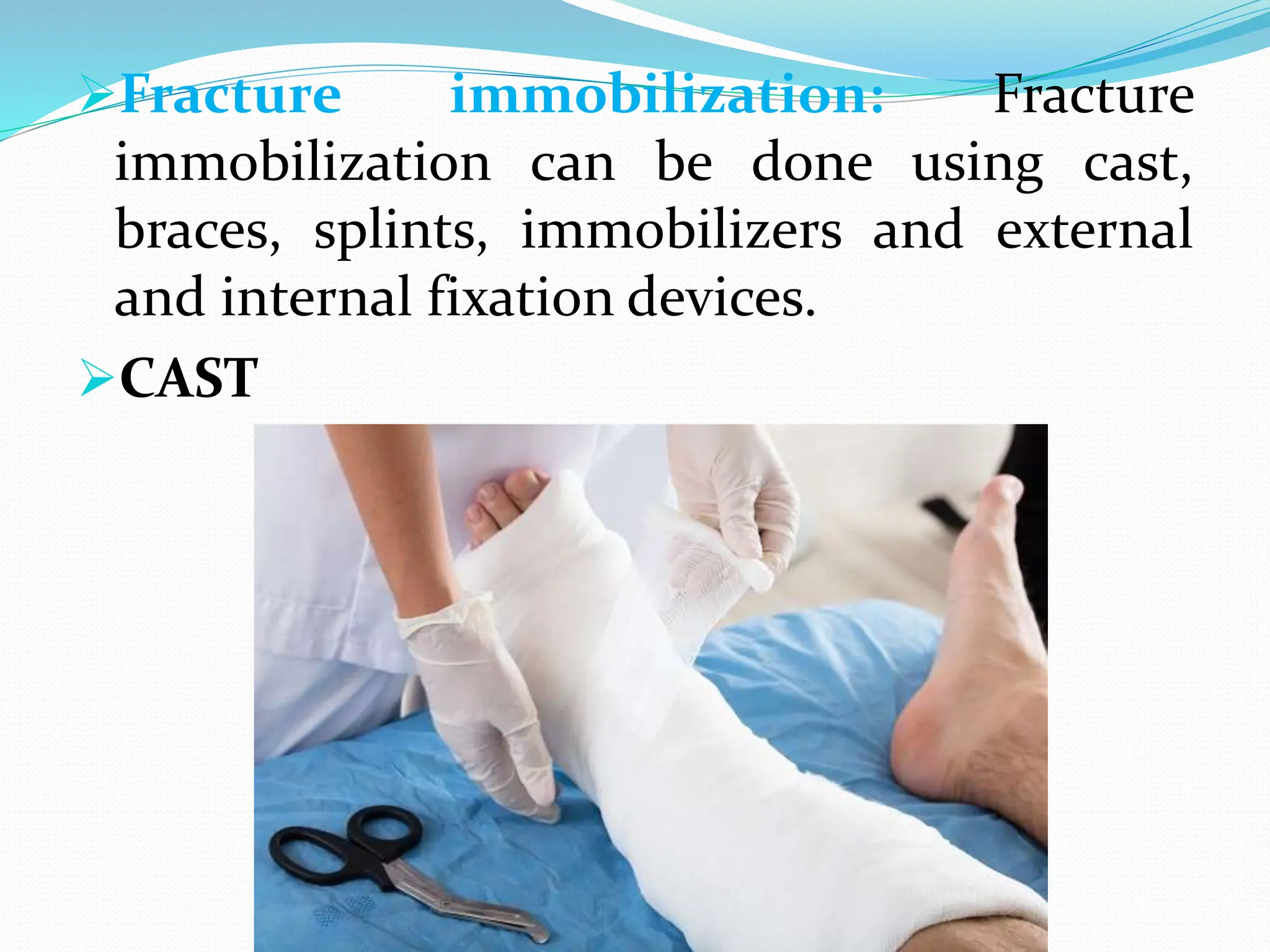
Fracture immobilization: Fracture
immobilization can be done using cast,
braces, splints, immobilizers and external
and internal fixation devices.
CAST
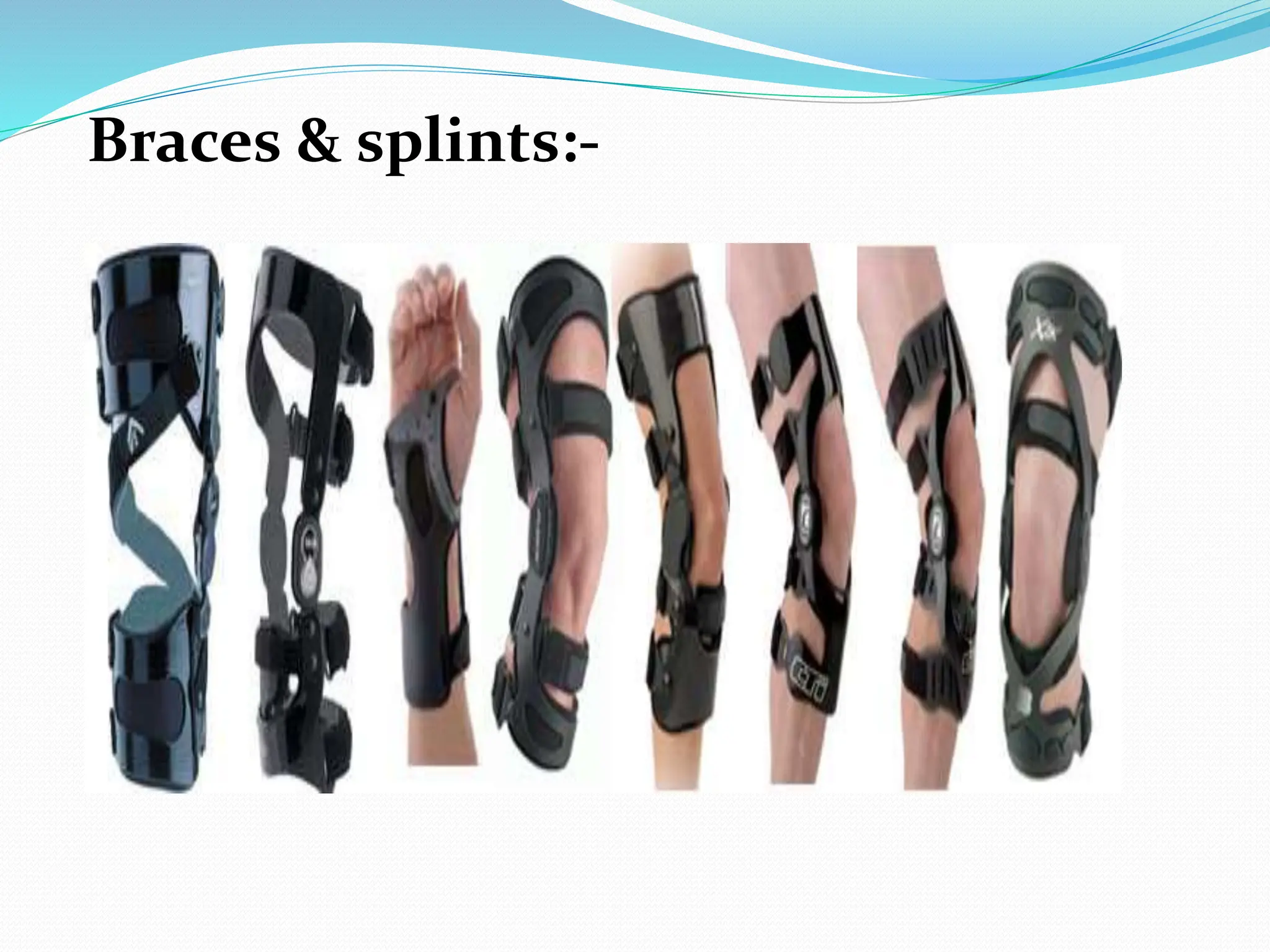
Braces & splints:-
INTERNAL & EXTERNAL FIXATION
NURSING MANAGEMENT
 Advice patient to drive in a standard speed.
 Stretching and warm up muscles priopr to exercise.
 Provide protien, vitamin B,C &D, Calcium
,phosphorus and magnesium rich diet.
 Advice to don’t drink and drive.
 Adequate foot wear and lightening are maintain.
 Administer medicine as prescribed by doctor.
NURSING DIAGNOSIS
 Acute pain related to bone displacement, muscle
spasm as evidence by patient verbalization.
 Impaired physical mobility related to loss of
integrity of bone structure as evidenced by
unwilling to move or limited range of motion.
 Risk of constipation related to immobility and
change in eating pattern.
 Knowledge deficit related to fracture as evidenced
by patient is not following instructions properly.
FRACTURE PPT.pptx

FRACTURE PPT.pptx

  • 1.
    TOPIC- FRACTURE BY- SHREYAYADAV MEDICAL SURGICAL NURSING REGENCY INSTITUTE OF NURSING
  • 2.
    FRACTURE Fracture is adisruption or break in the continuity of the structure of bone. Although traumatic injuries account for the majority of fractures, some fractures are secondary to a disease process such as caner or osteoporosis.
  • 3.
    TYPES OF FRACTURE OpenFracture Closed Fracture Incomplete fracture Complete fracture Displaced Fracture Nondisplaced Fracture According to the direction of the fracture line: Linear Fracture Oblique Fracture Transverse Fracture Longitudinal Fracture Spiral Fracture
  • 4.
     Open Fracture:-In an open fracture ,the skin is broken and bone exposed, causing soft tissue injury.  Closed Fracture: The skin remains intact and bone is not exposed.
  • 5.
    • Complete fracture:A fracture is termed as complete if the break goes complete. • Incomplete Fracture: It occurs partly across a bone shaft but the bone is still intact.
  • 6.
     Non displacedfracture- The periosteum is intact across the fracture and the bone fragments are still in alignment.  Displaced Fracture- The two end of the broken bone are separated from one another and out of their normal positions.
  • 8.
    Transverse Fracture –In which the line of the fracture extend across the bone sharp at right angle to the longitudinal axis. Linear Fracture- A straight clean break along the bone that is typically the result of a direct fall. Oblique Fracture- It is a type of fracture in which the line of fracture extends in an oblique direction.
  • 9.
     Spiral Fracture-It is a type of fracture in which the line of fracture extends in an Spiral direction along the shaft of the bone.  Greenstick fracture- The fracture is an incomplete fracture with one side splinted and other side bent.  Comminuted fracture- In which bone is broken, splintered or crushed into a number of pieces.
  • 10.
    PATHOPHYSIOLOGY Due to etiologicalfactor More force on bone than it bears Pull the fracture fragment out of the position Proximal portion remain in place & distal portion displaced
  • 12.
    Damage to thesoft tissue and blood vessels Bleeding occur from soft tissue and hematoma formation will occur Swelling, Infection, pain ,inflammation Fracture
  • 13.
    CLINICAL MANIFESTATION Pain: Thepain is continuous and increases in severity until the bone fragments are immobilized. The muscle spasm that accompany a fracture begin within 20 min after the injury and result in more intense pain that the patient reports at the time of injury.
  • 14.
    Loss of Function-After a fracture, the extremity can not function properly because normal function of the muscles depends on the integrity of the bone to which they are attached. Pain contributes to the loss of function. Deformity- Rotation of the fragments in a fracture of the arm or leg causes a deformity Shortening- In fracture of long bones, there is actual shortening of the extremity
  • 15.
    Crepitus-It is causedby rubbing of the bone fragment against each other. Swelling and Discoloration- Localized edema and discoloration of skin occur after fracture as a result of trauma and bleeding into the tissues. These skin sign may not develop for several hours after the injury.
  • 16.
    DIAGNOSTIC EVALUATION History collection Physicalexamination X-ray CT- scan(assess bone, soft tissues and joints damage) Magnetic resonance imaging(MRI)
  • 17.
    MANAGEMENT MEDICAL MANAGEMENT:  Musclerelaxant and to reduce pain(Carisoprodol, Cyclobenzaprine or Mehocarbmol).  Tetanus Toxoid to prevent tetanus  Antibiotics (Cephalosporin)  Anti-inflammatory (corticosteroids)
  • 18.
    FRACTURE REDUCTION- OPEN REDUCTION:Open reduction is the correction of bone alignment through a surgical incision. It includes wires, screws, Pins, Plates, Internal fixation.
  • 19.
    CLOSED REDUCTION- Itis nonsurgical , manual realignment of bone fragments to their previous anatomic position.
  • 20.
    TRACTION- It isthe application of pulling force to an injured or diseased body part or extremity. It is used to prevent pain , muscle spasm, immobilized a joint or part of the body and to promote active and passive exercise.
  • 21.
    Fracture immobilization: Fracture immobilizationcan be done using cast, braces, splints, immobilizers and external and internal fixation devices. CAST
  • 22.
  • 23.
  • 24.
    NURSING MANAGEMENT  Advicepatient to drive in a standard speed.  Stretching and warm up muscles priopr to exercise.  Provide protien, vitamin B,C &D, Calcium ,phosphorus and magnesium rich diet.  Advice to don’t drink and drive.  Adequate foot wear and lightening are maintain.  Administer medicine as prescribed by doctor.
  • 25.
    NURSING DIAGNOSIS  Acutepain related to bone displacement, muscle spasm as evidence by patient verbalization.  Impaired physical mobility related to loss of integrity of bone structure as evidenced by unwilling to move or limited range of motion.  Risk of constipation related to immobility and change in eating pattern.  Knowledge deficit related to fracture as evidenced by patient is not following instructions properly.