FRACTURE
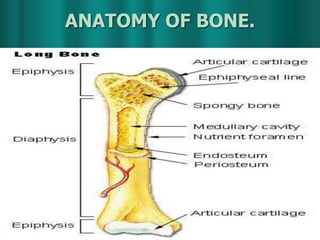
ANATOMY OF BONE.
INTRODUCTION
 Our skeleton is tough and flexible. It
supports weight and protects our internal
organs. Bone tissue stores minerals, such
as calcium, and it is constantly renewed,
which is how our bones are able to heal.
 Bones are cleverly designed to allow
movement at the joints and provide great
stability. The bones provide a light but
strong framework for the bodies soft
tissues.
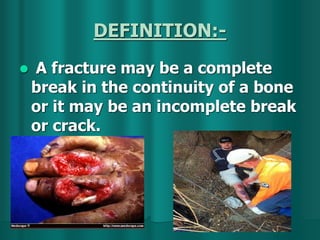
DEFINITION:-
 A fracture may be a complete
break in the continuity of a bone
or it may be an incomplete break
or crack.
TYPES:-
 FRACTURE-DISLOCATION
 According to their etiology
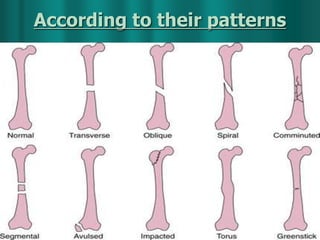
 According to their patterns
• Fracture-dislocation describes joint fractures
that produce joint instability.
This classification is incomplete, since
fracture-dislocation of the shoulder indicates
dislocation of the shoulder but does not
indicate which bone, the scapula or the
humerus, is fractured.
Fracture-dislocations can be difficult to treat
because they represent intra-articular
fracture plus supporting tissue laxity.
When fracture and dislocation are found
together, the prognosis is poorer than if each
problem occurred separately.
FRACTURE-DISLOCATION
According to their etiology ;
 Fractures caused solely by sudden
injury;,
 Fatigue fractures ,
 Pathological fractures,
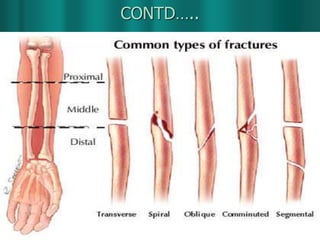
According to their patterns
CONTD…..
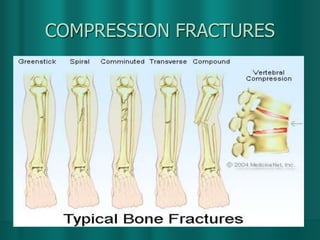
COMPRESSION FRACTURES
Etiology of Fractures:
 Extrinsic Causes
 Intrinsic Causes
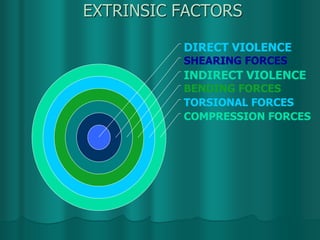
EXTRINSIC FACTORS
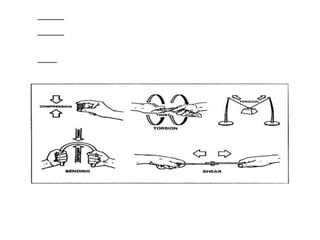
COMPRESSION FORCES
TORSIONAL FORCES
BENDING FORCES
INDIRECT VIOLENCE
SHEARING FORCES
DIRECT VIOLENCE
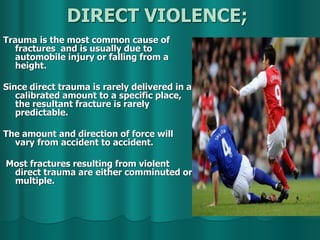
DIRECT VIOLENCE;
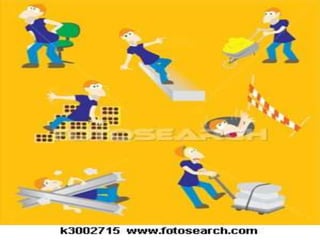
Trauma is the most common cause of
fractures and is usually due to
automobile injury or falling from a
height.
Since direct trauma is rarely delivered in a
calibrated amount to a specific place,
the resultant fracture is rarely
predictable.
The amount and direction of force will
vary from accident to accident.
Most fractures resulting from violent
direct trauma are either comminuted or
multiple.
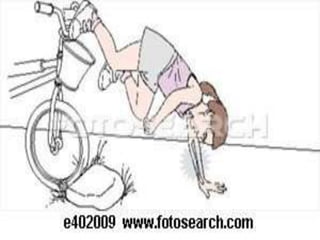
INDIRECT VIOLENCE
 Fractures due to indirect trauma are more
predictable than those due to direct
trauma.
 Generally a force is transmitted to a bone
in a specific fashion and at a "weak link"
within the bone, causing a fracture to
occur.
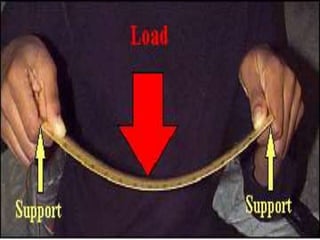
BENDING FORCES
 Bending fractures occur when force is applied to a
specific focal point on a bone to the extent that
the traumatic force overcomes the elastic limit of
the bone diaphysis.
 The initial effect of a bending force is a cortical
break opposite the site of the trauma. The
periosteum will remain intact on the side of the
force while tearing over the fracture on the
opposite side.
 With additional force the entire bone snaps, with
attendant tearing of vascular and soft tissue
structures within or on the diaphysis.
 Bending fractures are generally oblique or
transverse, or they may have a butterfly
fragment.
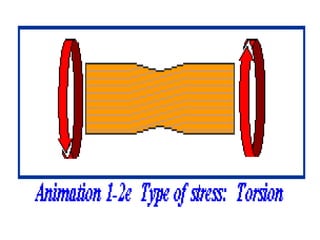
TORSIONAL FORCES
 Torsional fractures occur when a twisting
force is applied to the long axis of a bone.
 Usually this is a result of one end of a
bone being placed in a fixed position
while the other end of the bone is forced
to rotate.
 The resulting fracture will be a very long
spiral with sharp points and often sharp
edges. It is possible for the sharp points
or edges to compromise soft tissues or to
cut through the skin and result in an open
fracture. Torsional forces generally result
in short or long spiral fractures.
COMPRESSION FORCES
 Compressive forces along the long axis of
a bone may force the smaller diaphyseal or
metaphyseal portion of a bone to impact
into the larger epiphysis: bony substance
is thereby crushed. Similarly a
compressive force directed along the axis
of the spine may result in collapse of a
vertebral body. For compressive force to
result in fracture, one end of a bone must
be in a fixed position while the other end
is forced toward the fixed end.
Compressive forces result in impacted
fractures or compression fractures.
SHEARING FORCES
 A shearing fracture is caused by a force
transmitted along the axis of a bone,
which is then transferred to a portion of
the same bone that lies peripheral to the
axis or across a joint to other bones that
are not protected by the axis of the bone.
 The fracture line in a shear fracture will
be parallel to the direction of the applied
force. Shearing forces result in the
fracture of bony prominences not placed
along the direct axis of a diaphysis.
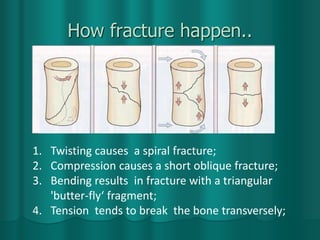
How fracture happen..
1. Twisting causes a spiral fracture;
2. Compression causes a short oblique fracture;
3. Bending results in fracture with a triangular
'butter-fly‘ fragment;
4. Tension tends to break the bone transversely;
Types of Fracture…cont.
Open fracture :
When the bony fragments are
exposed to external environment by
means of wound
Closed fracture :
The fracture fragments are not
exposed to outside
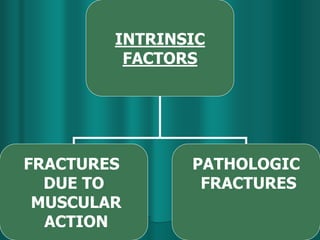
INTRINSIC
FACTORS
FRACTURES
DUE TO
MUSCULAR
ACTION
PATHOLOGIC
FRACTURES
Signs and Symptoms:
 pain,
 pulselessness,
 pallor,
 paresthesia,
 paralysis
Contd…..
OTHERS:-
 DYSFUNCTION
 LOCAL TRAUMA
 ABNORMAL POSTURE OR LIMB POSITIONING
 CREPITUS
 ABNORMAL MOBILITY
 RADIOGRAPHIC SIGNS
 FEVER
 ANAEMIA
 SHOCK
 NERVE INJURY
 NECROSIS OR GANGRENE
 FAT IN SYNOVIAL FLUID
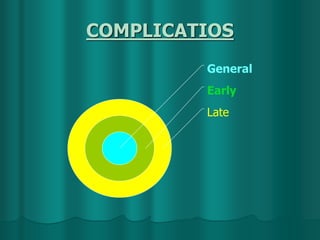
COMPLICATIOS
Late
Early
General
Complications of fractures
 General complications
 Shock
 ARDS
 Fat embolism
 Head, chest, abdomen and pelvic
injuries
 Crush syndrome
 Tetanus
 Gas gangrene
 Infections – UTI, Chest
 DVT/PE
 Bed sores
 Depression
Complications of fractures
 Early
 Visceral injury
 Vascular injury
 Compartment
syndrome (later
Volkmann
conctracture)
 Nerve injury
 Haemarthrosis
 Infection
Late
Delayed union
Non-union
Mal-union
Tendon rupture
Osteonecrosis
Osteoarthritis and
joint stiffness
MANAGEMENT
FIRST AID
 SEEK MEDICAL ATTENTION IMMEDIATELY. DO NOT
attempt to transport victim if you suspect head, back,
or neck injury.
 Immobilize and support affected bone in position
found. DO NOT try to push protruding bone back into
body or let victim move or use affected area.
 Control any bleeding through direct pressure.
 If bone is protruding, cover with clean cloth once
bleeding is controlled.
 Observe for shock . DO NOT give victim anything to
eat or drink.
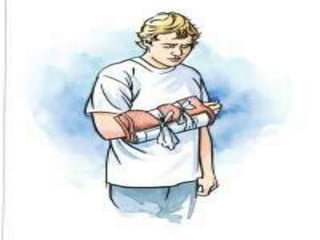
 Immobilize injured area, and, if no open wound
present, apply ice pack wrapped in clean cloth.
Immobilizing Fractured Bone:
 Check for sensation, warmth, and color of toes or
fingers below suspected break.
 Place padded splint under area of suspected break.
 -Use board, rolled newspaper or magazines, or
rolled blanket for splint.
-Wrap splint in cloth or towels for padding.
-Bind splint to limb using neckties, cloth, belts, or
rope. DO NOT bind directly over break.
CONTD…..
 Recheck often for sensation, warmth, and
coloring. If fingers or toes turn blue or
swell, loosen binding.
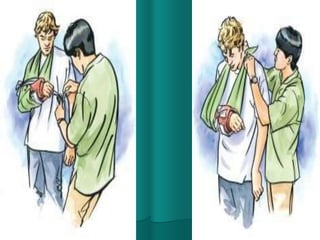
 For arm or shoulder injury, place splinted
arm in sling, with hand above elbow level.
Bind arm to victim's body by wrapping
towel or cloth over sling and around upper
arm and chest; tie towel or cloth under
victim's opposite arm.
Goals of fracture treatment
 Prevent fracture and soft tissue
complications,
 Get fracture to heal and in satisfactory
position for optimal functional recovery.
 Intra-articular fracture needs accurate
reduction & rigid fixation but non articular
fracture of bone require anatomical reduction
& stable fixation.
Management of the injured patient
 Don’t treat the X-rays of the fracture, but treat
the patient
 Life saving measures
 Diagnose and treat life threatening injuries (head
injuries, Chest & abdominal injuries)
 Emergency orthopaedic involvement
 Life saving
 Complication saving
 Emergency orthopaedic management (day 1)
 Monitoring of fracture (days to weeks)
 Rehabilitation and treatment of complications
(weeks to months)
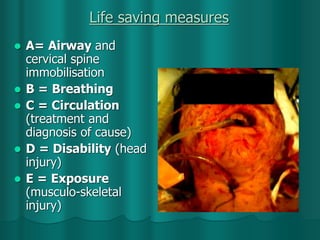
Life saving measures
 A= Airway and
cervical spine
immobilisation
 B = Breathing
 C = Circulation
(treatment and
diagnosis of cause)
 D = Disability (head
injury)
 E = Exposure
(musculo-skeletal
injury)
Treatment principle of fracture
1) Reduction
2) Maintain reduction ( hold until union)
3) Rehabilitate – restore function by movement
of the joint & patient itself.
4) Prevent or treat complications
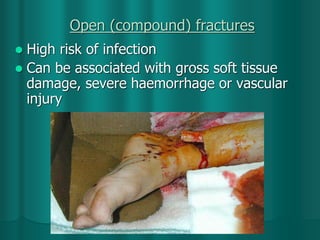
Open (compound) fractures
 High risk of infection
 Can be associated with gross soft tissue
damage, severe haemorrhage or vascular
injury
Open (compound) fractures - management
 While contacting orthopaedic team for
definitive surgical treatment
 Irrigate wound with N.S, if not available with
tap water. Cover wound with sterile moist
dressing.
 Immobilise limb preferable with external
fixator If not possible , by cast (including
joint above & below)
CONTD…..
 Remove obvious contaminants with
meticulous effort
 IV antibiotics (e.g. cefuroxime +/-
metronidazole or gentamicin)
 Tetanus prophylaxis.
 Check distal neurovascular status
 Re-assess
Reduction
 If necessary, what reduction technique?
1) Closed reduction
 Need anaesthesia/sedation, analgesia, x-ray
facilities, equipment, knowledge
 Used for minimally displaced fractures and
most fractures of children
Distal part of limb pulled in line of bone
Alignment adjusted in each plane
2) Open reduction
 Above + theatre staff + additional equipment
Maintain reduction
Necessary?
1) Relieve pain
2) Prevent mal-union – nature heals the
fracture, we keep it in a good position
3) Minimise non-union – maintenance of
reduction should be continuous
Maintain reduction
 How?
 1) External method
 POP (+ equivalents), traction,
external fixator
 2) Internal method
 Wires, pins, plates, nails, screws
Maintain reduction – external method
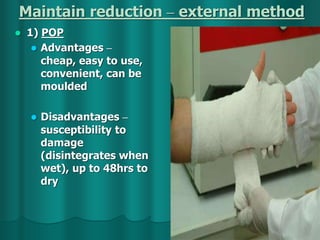
 1) POP
 Advantages –
cheap, easy to use,
convenient, can be
moulded
 Disadvantages –
susceptibility to
damage
(disintegrates when
wet), up to 48hrs to
dry
Maintain reduction – external method
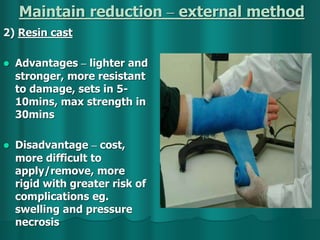
2) Resin cast
 Advantages – lighter and
stronger, more resistant
to damage, sets in 5-
10mins, max strength in
30mins
 Disadvantage – cost,
more difficult to
apply/remove, more
rigid with greater risk of
complications eg.
swelling and pressure
necrosis
Maintain reduction – external method
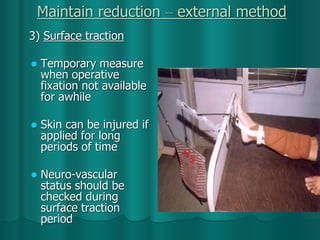
3) Surface traction
 Temporary measure
when operative
fixation not available
for awhile
 Skin can be injured if
applied for long
periods of time
 Neuro-vascular
status should be
checked during
surface traction
period
Maintain reduction – external method
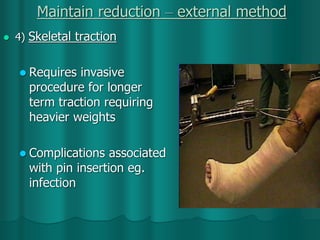
 4) Skeletal traction
 Requires invasive
procedure for longer
term traction requiring
heavier weights
 Complications associated
with pin insertion eg.
infection
Maintain reduction – external method
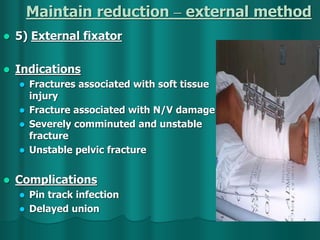
 5) External fixator
 Indications
 Fractures associated with soft tissue
injury
 Fracture associated with N/V damage
 Severely comminuted and unstable
fracture
 Unstable pelvic fracture
 Complications
 Pin track infection
 Delayed union
Maintain reduction – internal method
 Advantages
 Restoration of absolute anatomical state
 Shorter hospital stay
 Enables individuals to return to function
earlier
Contd…..
 Indications
 Fractures that need operative fixation
 Inherently unstable fractures prone to re-
displacement after reduction (eg. mid-shaft
femoral fractures)
 Pathological fracture
 Polytrauma (minimise ARDS)
 Patients with nursing difficulties
(paraplegics, v. elderly, multiple trauma)
Maintain reduction – internal method
 By.. Nail , plate , screws, wire.
 Complications
 Infection
 Non-union
 Implant failure
 Re-fracture
Maintain reduction – internal method
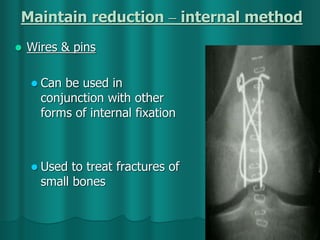
 Wires & pins
 Can be used in
conjunction with other
forms of internal fixation
 Used to treat fractures of
small bones
Maintain reduction – internal method
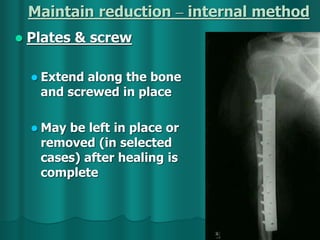
 Plates & screw
 Extend along the bone
and screwed in place
 May be left in place or
removed (in selected
cases) after healing is
complete
Maintain reduction – internal method
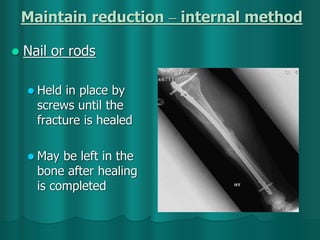
 Nail or rods
 Held in place by
screws until the
fracture is healed
 May be left in the
bone after healing
is completed
REHABLITATION:-
 Active use
 Active exercises
 Continuous passive motion
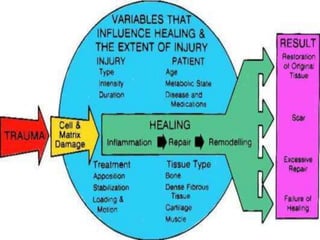
Factors Influencing Healing
Systemic Factors:-
 „„Age
 „„Hormones
 „„Functional activity
 „„Nerve function
 „„Nutrition
Factors Influencing Healing…cont.
Local Factors:-
 „„Energy of trauma
 „„Degree of bone loss
 „„Vascular injury
 „„Infection
 „„Type of bone fractured
 „„Degree of immobilization
 „„Pathological condition
NURSING MANAGEMENT:-
 ASSESSMENT:-
 "5 P's"
 Patient's general health
 signs and symptoms
 emotional status
 understanding of need for cast
 physical assessment of part to be immobilized
includes the neurovascular status of body part,
degree and location of swelling, bruising, and skin
abrasions.
Cond…..
 “Hot Spots” – area of the cast that feel warmer
than other sections.
 May indicates tissue necrosis or infection
under the cast.
 “Wet Spots” – May indicate the drainage
under the cast or a need for additional drying .
 Stains can indicate wound drainage or
bleeding, any other stained area should be
measured carefully and doccumented.
Contd…..
 Be aware of possible pressure points on
underlying structures, such as the lateral
malleolus under a shot leg castor epicondyle
under a short arm cast.
 An older cast may develop a sour smell because
of perspiration or normal sloughing of outer
skin layers.
 Musty, offensive odors under the cast may
indicate tissue necrosis or infection.
 If odor of mildew is present, the synthetic cast
may have not been dried properly after it
become wet
CONTED…..
continuous watch for the warning signs, which
are the ;
 undue swelling
 impaired circulation
 severe pain within the plaster
 The period of greatest danger is between 12 to
36 hours.
NURSING DIAGNOSIS:-
Acute pain r/t the musculoskeletal disorder.
 Expected outcome:- pain in the patient's body part
will be relieved.
 Nursing interventions;
 Assess the characteristics of the pain. ( asking the
patient to indicate the exact site of the pain, its
severity, and intensity of the pain)
 teach the diversional therapies to the patient.
CONTD…..
 Elevate the affected limb.
 apply the ice packs as prescribed.
 restrict the unnecessary movements and
keep the body part immobilized.
 involve the patient in the active and passive
ROM.
 administer the analgesics as prescribed.
NURSING DIAGNOSIS
 Impaired skin integrity r/t lacerations
and abrasions.
 Expected outcome:- skin integrity will be
maintained.
 Nursing interventions;
 assess for the skin of patient.
 assess for the edema, redness, numbness,
parasthesia and heat.
CONTD…..
 elevate the body part of the patient.
 encourage for the ROM exercises.
 teach about the care of the cast.
 report the orthopedist, if any of
above mentioned s/s appears.
NURSING DIAGNOSIS:-
Knowledge deficit r/t the treatment
regimen.
 Expected outcome:- patient will obtain the optimal
level of knowledge.
 Nursing interventions;
 Assess the level of knowledge and
understanding of the patient.
 provide the information to the patient about
the underlying pathologic condition and the
purpose and the expectations of the prescribed
treatment regimen.
CONTD…..
teach the patient about what is expected
from the patient during application.
explain about the sensations regarding
the cast application i.e. heat from the
hardening reaction of the plaster.
teach the patient that the body part will
be immobilized after the application of
the cast.
teach the about the care of the cast,
specially children.
CONTD…..
 Impaired physical mobility r/t the cast.
 Self care deficit : bathing/hygiene,
feeding , dressing/grooming , or
toileting due to restricted mobility.
Teaching the Patient with a Cast
Home Care:-
 Mobility aids & safety
 Prescribed exercise
 Elevate extremity to heart level
 Keep cast dry & cushion rough edges
 Don’t scratch under cast
 Report indicators of complications
 Avoid excessive use of injured extremity
 Report broken cast
By-Peter F. Cronholm, MD;
Wendy Barr, MD,
 Does osteoporosis screening decrease fracture risk in
postmenopausal women? Osteoporosis results in 1.3 million
fractures annually in the US. Of the approximately 25 million
American women with osteoporosis, 8 million have had a
documented fracture.
 The authors reviewed articles on risk factor assessment, bone
density tests, and osteoporosis treatment with
bisphosphonates.
 they found 3 clinical risk factors that consistently predicted
increased risk of fracture: advanced age, low weight or body
mass index, and nonuse of hormone replacement therapy. The
presence of any of the 3 risk factors increased the risk for
fracture by 70% (relative risk, 1.7).
 Thus found that the screening of high risk women helps to
reduce the number of hip and vertebral fractures.
BIBLIOGRAPHY
 Black M.Joyce.Medical Surgical Nursing(2008):Elsevier
publishers.vol-2,ed-8th. P-515 - 28
 Wilkins,Williams.Mannual of Nursing
Practice(2009):Wolter Kluner.ed-9.P-279-85.
 Keen Janet hicks,Swearingen Pulmelal.Critical Care
Nursing Consultant(1997):Mosby publishersvol-1st,ed-
1st.P-366,318,172,108.
 Adams Jhon Crawford , Hamblen David L. Outline of
Fractures including joint injuries(1999):Churchill
Livingstone publishers, ed-11th p 1-73.
 REFERENCES:-
 http://cal.vet.upenn.edu/projects/saortho/chapter_1
1/11mast.htm
 http://cal.vet.upenn.edu/projects/saortho/chapter_1
6/16mast.htm
../chapter_10/10mast.htm
Presentation on FRACTUREs for Nursing Professionals

  • 1.
  • 2.
  • 3.
    INTRODUCTION  Our skeletonis tough and flexible. It supports weight and protects our internal organs. Bone tissue stores minerals, such as calcium, and it is constantly renewed, which is how our bones are able to heal.  Bones are cleverly designed to allow movement at the joints and provide great stability. The bones provide a light but strong framework for the bodies soft tissues.
  • 4.
    DEFINITION:-  A fracturemay be a complete break in the continuity of a bone or it may be an incomplete break or crack.
  • 5.
    TYPES:-  FRACTURE-DISLOCATION  Accordingto their etiology  According to their patterns
  • 6.
    • Fracture-dislocation describesjoint fractures that produce joint instability. This classification is incomplete, since fracture-dislocation of the shoulder indicates dislocation of the shoulder but does not indicate which bone, the scapula or the humerus, is fractured. Fracture-dislocations can be difficult to treat because they represent intra-articular fracture plus supporting tissue laxity. When fracture and dislocation are found together, the prognosis is poorer than if each problem occurred separately. FRACTURE-DISLOCATION
  • 7.
    According to theiretiology ;  Fractures caused solely by sudden injury;,  Fatigue fractures ,  Pathological fractures,
  • 8.
  • 10.
  • 11.
  • 12.
    Etiology of Fractures: Extrinsic Causes  Intrinsic Causes
  • 13.
    EXTRINSIC FACTORS COMPRESSION FORCES TORSIONALFORCES BENDING FORCES INDIRECT VIOLENCE SHEARING FORCES DIRECT VIOLENCE
  • 14.
    DIRECT VIOLENCE; Trauma isthe most common cause of fractures and is usually due to automobile injury or falling from a height. Since direct trauma is rarely delivered in a calibrated amount to a specific place, the resultant fracture is rarely predictable. The amount and direction of force will vary from accident to accident. Most fractures resulting from violent direct trauma are either comminuted or multiple.
  • 15.
    INDIRECT VIOLENCE  Fracturesdue to indirect trauma are more predictable than those due to direct trauma.  Generally a force is transmitted to a bone in a specific fashion and at a "weak link" within the bone, causing a fracture to occur.
  • 17.
    BENDING FORCES  Bendingfractures occur when force is applied to a specific focal point on a bone to the extent that the traumatic force overcomes the elastic limit of the bone diaphysis.  The initial effect of a bending force is a cortical break opposite the site of the trauma. The periosteum will remain intact on the side of the force while tearing over the fracture on the opposite side.  With additional force the entire bone snaps, with attendant tearing of vascular and soft tissue structures within or on the diaphysis.  Bending fractures are generally oblique or transverse, or they may have a butterfly fragment.
  • 19.
    TORSIONAL FORCES  Torsionalfractures occur when a twisting force is applied to the long axis of a bone.  Usually this is a result of one end of a bone being placed in a fixed position while the other end of the bone is forced to rotate.  The resulting fracture will be a very long spiral with sharp points and often sharp edges. It is possible for the sharp points or edges to compromise soft tissues or to cut through the skin and result in an open fracture. Torsional forces generally result in short or long spiral fractures.
  • 21.
    COMPRESSION FORCES  Compressiveforces along the long axis of a bone may force the smaller diaphyseal or metaphyseal portion of a bone to impact into the larger epiphysis: bony substance is thereby crushed. Similarly a compressive force directed along the axis of the spine may result in collapse of a vertebral body. For compressive force to result in fracture, one end of a bone must be in a fixed position while the other end is forced toward the fixed end. Compressive forces result in impacted fractures or compression fractures.
  • 23.
    SHEARING FORCES  Ashearing fracture is caused by a force transmitted along the axis of a bone, which is then transferred to a portion of the same bone that lies peripheral to the axis or across a joint to other bones that are not protected by the axis of the bone.  The fracture line in a shear fracture will be parallel to the direction of the applied force. Shearing forces result in the fracture of bony prominences not placed along the direct axis of a diaphysis.
  • 25.
    How fracture happen.. 1.Twisting causes a spiral fracture; 2. Compression causes a short oblique fracture; 3. Bending results in fracture with a triangular 'butter-fly‘ fragment; 4. Tension tends to break the bone transversely;
  • 26.
    Types of Fracture…cont. Openfracture : When the bony fragments are exposed to external environment by means of wound Closed fracture : The fracture fragments are not exposed to outside
  • 27.
  • 28.
    Signs and Symptoms: pain,  pulselessness,  pallor,  paresthesia,  paralysis
  • 29.
    Contd….. OTHERS:-  DYSFUNCTION  LOCALTRAUMA  ABNORMAL POSTURE OR LIMB POSITIONING  CREPITUS  ABNORMAL MOBILITY  RADIOGRAPHIC SIGNS  FEVER  ANAEMIA  SHOCK  NERVE INJURY  NECROSIS OR GANGRENE  FAT IN SYNOVIAL FLUID
  • 30.
  • 31.
    Complications of fractures General complications  Shock  ARDS  Fat embolism  Head, chest, abdomen and pelvic injuries  Crush syndrome  Tetanus  Gas gangrene  Infections – UTI, Chest  DVT/PE  Bed sores  Depression
  • 32.
    Complications of fractures Early  Visceral injury  Vascular injury  Compartment syndrome (later Volkmann conctracture)  Nerve injury  Haemarthrosis  Infection Late Delayed union Non-union Mal-union Tendon rupture Osteonecrosis Osteoarthritis and joint stiffness
  • 33.
  • 34.
    FIRST AID  SEEKMEDICAL ATTENTION IMMEDIATELY. DO NOT attempt to transport victim if you suspect head, back, or neck injury.  Immobilize and support affected bone in position found. DO NOT try to push protruding bone back into body or let victim move or use affected area.  Control any bleeding through direct pressure.  If bone is protruding, cover with clean cloth once bleeding is controlled.  Observe for shock . DO NOT give victim anything to eat or drink.  Immobilize injured area, and, if no open wound present, apply ice pack wrapped in clean cloth.
  • 36.
    Immobilizing Fractured Bone: Check for sensation, warmth, and color of toes or fingers below suspected break.  Place padded splint under area of suspected break.  -Use board, rolled newspaper or magazines, or rolled blanket for splint. -Wrap splint in cloth or towels for padding. -Bind splint to limb using neckties, cloth, belts, or rope. DO NOT bind directly over break.
  • 37.
    CONTD…..  Recheck oftenfor sensation, warmth, and coloring. If fingers or toes turn blue or swell, loosen binding.  For arm or shoulder injury, place splinted arm in sling, with hand above elbow level. Bind arm to victim's body by wrapping towel or cloth over sling and around upper arm and chest; tie towel or cloth under victim's opposite arm.
  • 39.
    Goals of fracturetreatment  Prevent fracture and soft tissue complications,  Get fracture to heal and in satisfactory position for optimal functional recovery.  Intra-articular fracture needs accurate reduction & rigid fixation but non articular fracture of bone require anatomical reduction & stable fixation.
  • 40.
    Management of theinjured patient  Don’t treat the X-rays of the fracture, but treat the patient  Life saving measures  Diagnose and treat life threatening injuries (head injuries, Chest & abdominal injuries)  Emergency orthopaedic involvement  Life saving  Complication saving  Emergency orthopaedic management (day 1)  Monitoring of fracture (days to weeks)  Rehabilitation and treatment of complications (weeks to months)
  • 41.
    Life saving measures A= Airway and cervical spine immobilisation  B = Breathing  C = Circulation (treatment and diagnosis of cause)  D = Disability (head injury)  E = Exposure (musculo-skeletal injury)
  • 42.
    Treatment principle offracture 1) Reduction 2) Maintain reduction ( hold until union) 3) Rehabilitate – restore function by movement of the joint & patient itself. 4) Prevent or treat complications
  • 43.
    Open (compound) fractures High risk of infection  Can be associated with gross soft tissue damage, severe haemorrhage or vascular injury
  • 44.
    Open (compound) fractures- management  While contacting orthopaedic team for definitive surgical treatment  Irrigate wound with N.S, if not available with tap water. Cover wound with sterile moist dressing.  Immobilise limb preferable with external fixator If not possible , by cast (including joint above & below)
  • 45.
    CONTD…..  Remove obviouscontaminants with meticulous effort  IV antibiotics (e.g. cefuroxime +/- metronidazole or gentamicin)  Tetanus prophylaxis.  Check distal neurovascular status  Re-assess
  • 46.
    Reduction  If necessary,what reduction technique? 1) Closed reduction  Need anaesthesia/sedation, analgesia, x-ray facilities, equipment, knowledge  Used for minimally displaced fractures and most fractures of children Distal part of limb pulled in line of bone Alignment adjusted in each plane 2) Open reduction  Above + theatre staff + additional equipment
  • 47.
    Maintain reduction Necessary? 1) Relievepain 2) Prevent mal-union – nature heals the fracture, we keep it in a good position 3) Minimise non-union – maintenance of reduction should be continuous
  • 48.
    Maintain reduction  How? 1) External method  POP (+ equivalents), traction, external fixator  2) Internal method  Wires, pins, plates, nails, screws
  • 49.
    Maintain reduction –external method  1) POP  Advantages – cheap, easy to use, convenient, can be moulded  Disadvantages – susceptibility to damage (disintegrates when wet), up to 48hrs to dry
  • 50.
    Maintain reduction –external method 2) Resin cast  Advantages – lighter and stronger, more resistant to damage, sets in 5- 10mins, max strength in 30mins  Disadvantage – cost, more difficult to apply/remove, more rigid with greater risk of complications eg. swelling and pressure necrosis
  • 51.
    Maintain reduction –external method 3) Surface traction  Temporary measure when operative fixation not available for awhile  Skin can be injured if applied for long periods of time  Neuro-vascular status should be checked during surface traction period
  • 52.
    Maintain reduction –external method  4) Skeletal traction  Requires invasive procedure for longer term traction requiring heavier weights  Complications associated with pin insertion eg. infection
  • 53.
    Maintain reduction –external method  5) External fixator  Indications  Fractures associated with soft tissue injury  Fracture associated with N/V damage  Severely comminuted and unstable fracture  Unstable pelvic fracture  Complications  Pin track infection  Delayed union
  • 54.
    Maintain reduction –internal method  Advantages  Restoration of absolute anatomical state  Shorter hospital stay  Enables individuals to return to function earlier
  • 55.
    Contd…..  Indications  Fracturesthat need operative fixation  Inherently unstable fractures prone to re- displacement after reduction (eg. mid-shaft femoral fractures)  Pathological fracture  Polytrauma (minimise ARDS)  Patients with nursing difficulties (paraplegics, v. elderly, multiple trauma)
  • 56.
    Maintain reduction –internal method  By.. Nail , plate , screws, wire.  Complications  Infection  Non-union  Implant failure  Re-fracture
  • 57.
    Maintain reduction –internal method  Wires & pins  Can be used in conjunction with other forms of internal fixation  Used to treat fractures of small bones
  • 58.
    Maintain reduction –internal method  Plates & screw  Extend along the bone and screwed in place  May be left in place or removed (in selected cases) after healing is complete
  • 59.
    Maintain reduction –internal method  Nail or rods  Held in place by screws until the fracture is healed  May be left in the bone after healing is completed
  • 60.
    REHABLITATION:-  Active use Active exercises  Continuous passive motion
  • 63.
    Factors Influencing Healing SystemicFactors:-  „„Age  „„Hormones  „„Functional activity  „„Nerve function  „„Nutrition
  • 64.
    Factors Influencing Healing…cont. LocalFactors:-  „„Energy of trauma  „„Degree of bone loss  „„Vascular injury  „„Infection  „„Type of bone fractured  „„Degree of immobilization  „„Pathological condition
  • 65.
    NURSING MANAGEMENT:-  ASSESSMENT:- "5 P's"  Patient's general health  signs and symptoms  emotional status  understanding of need for cast  physical assessment of part to be immobilized includes the neurovascular status of body part, degree and location of swelling, bruising, and skin abrasions.
  • 66.
    Cond…..  “Hot Spots”– area of the cast that feel warmer than other sections.  May indicates tissue necrosis or infection under the cast.  “Wet Spots” – May indicate the drainage under the cast or a need for additional drying .  Stains can indicate wound drainage or bleeding, any other stained area should be measured carefully and doccumented.
  • 67.
    Contd…..  Be awareof possible pressure points on underlying structures, such as the lateral malleolus under a shot leg castor epicondyle under a short arm cast.  An older cast may develop a sour smell because of perspiration or normal sloughing of outer skin layers.  Musty, offensive odors under the cast may indicate tissue necrosis or infection.  If odor of mildew is present, the synthetic cast may have not been dried properly after it become wet
  • 68.
    CONTED….. continuous watch forthe warning signs, which are the ;  undue swelling  impaired circulation  severe pain within the plaster  The period of greatest danger is between 12 to 36 hours.
  • 69.
    NURSING DIAGNOSIS:- Acute painr/t the musculoskeletal disorder.  Expected outcome:- pain in the patient's body part will be relieved.  Nursing interventions;  Assess the characteristics of the pain. ( asking the patient to indicate the exact site of the pain, its severity, and intensity of the pain)  teach the diversional therapies to the patient.
  • 70.
    CONTD…..  Elevate theaffected limb.  apply the ice packs as prescribed.  restrict the unnecessary movements and keep the body part immobilized.  involve the patient in the active and passive ROM.  administer the analgesics as prescribed.
  • 71.
    NURSING DIAGNOSIS  Impairedskin integrity r/t lacerations and abrasions.  Expected outcome:- skin integrity will be maintained.  Nursing interventions;  assess for the skin of patient.  assess for the edema, redness, numbness, parasthesia and heat.
  • 72.
    CONTD…..  elevate thebody part of the patient.  encourage for the ROM exercises.  teach about the care of the cast.  report the orthopedist, if any of above mentioned s/s appears.
  • 73.
    NURSING DIAGNOSIS:- Knowledge deficitr/t the treatment regimen.  Expected outcome:- patient will obtain the optimal level of knowledge.  Nursing interventions;  Assess the level of knowledge and understanding of the patient.  provide the information to the patient about the underlying pathologic condition and the purpose and the expectations of the prescribed treatment regimen.
  • 74.
    CONTD….. teach the patientabout what is expected from the patient during application. explain about the sensations regarding the cast application i.e. heat from the hardening reaction of the plaster. teach the patient that the body part will be immobilized after the application of the cast. teach the about the care of the cast, specially children.
  • 75.
    CONTD…..  Impaired physicalmobility r/t the cast.  Self care deficit : bathing/hygiene, feeding , dressing/grooming , or toileting due to restricted mobility.
  • 76.
    Teaching the Patientwith a Cast Home Care:-  Mobility aids & safety  Prescribed exercise  Elevate extremity to heart level  Keep cast dry & cushion rough edges  Don’t scratch under cast  Report indicators of complications  Avoid excessive use of injured extremity  Report broken cast
  • 77.
    By-Peter F. Cronholm,MD; Wendy Barr, MD,  Does osteoporosis screening decrease fracture risk in postmenopausal women? Osteoporosis results in 1.3 million fractures annually in the US. Of the approximately 25 million American women with osteoporosis, 8 million have had a documented fracture.  The authors reviewed articles on risk factor assessment, bone density tests, and osteoporosis treatment with bisphosphonates.  they found 3 clinical risk factors that consistently predicted increased risk of fracture: advanced age, low weight or body mass index, and nonuse of hormone replacement therapy. The presence of any of the 3 risk factors increased the risk for fracture by 70% (relative risk, 1.7).  Thus found that the screening of high risk women helps to reduce the number of hip and vertebral fractures.
  • 79.
    BIBLIOGRAPHY  Black M.Joyce.MedicalSurgical Nursing(2008):Elsevier publishers.vol-2,ed-8th. P-515 - 28  Wilkins,Williams.Mannual of Nursing Practice(2009):Wolter Kluner.ed-9.P-279-85.  Keen Janet hicks,Swearingen Pulmelal.Critical Care Nursing Consultant(1997):Mosby publishersvol-1st,ed- 1st.P-366,318,172,108.  Adams Jhon Crawford , Hamblen David L. Outline of Fractures including joint injuries(1999):Churchill Livingstone publishers, ed-11th p 1-73.  REFERENCES:-  http://cal.vet.upenn.edu/projects/saortho/chapter_1 1/11mast.htm  http://cal.vet.upenn.edu/projects/saortho/chapter_1 6/16mast.htm ../chapter_10/10mast.htm