-Purvi Shah
(B.P.T)
CONTUSION
Contusion
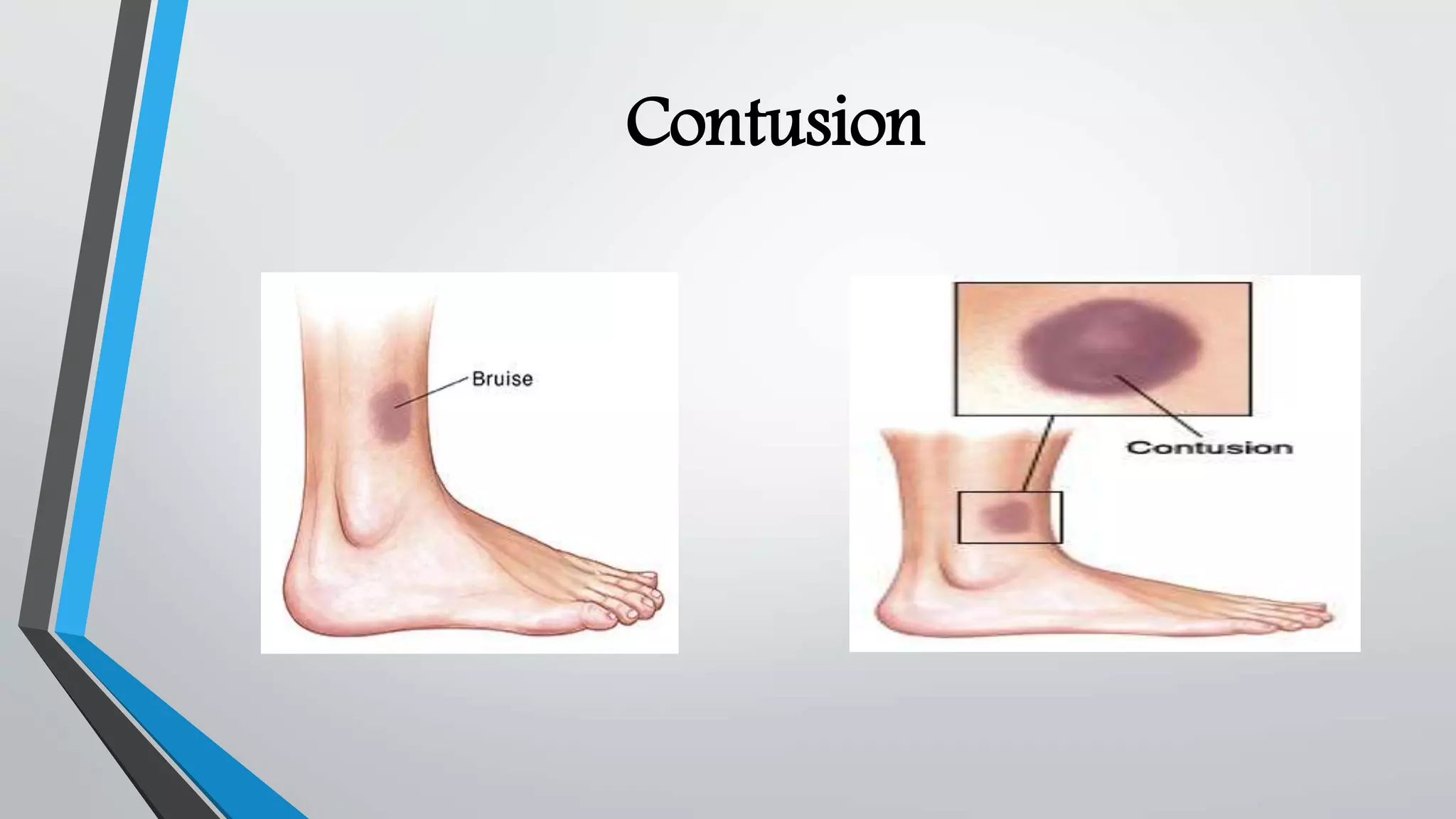
Also known as a BRUISE.
An injury to tissue or bone when blood vessels are
ruptured or broken & bleed in to the surrounding tissue.
This bleeding causes discoloration turning in to bruise.
Contusion usually happen from a hard hit, fall or blow.
Contusion may be painful to the touch because blood that
has pooled under the skin is putting pressure on nearby
nerve endings.
Contusion
Contusion is more common seen in elderly people rather
than children; because blood vessels become more delicate
with increasing age .
It is also occur with some medication especially those
interfere with blood clotting.
Less blood clotting means more blood leaks out of a damaged
blood vessels producing larger & visible contusion.
Condition and type of tissue: In soft tissues, a larger area is
bruised than would be in firmer tissue due to ease of blood to
invade tissue.
Gender: More bruising occurs in females due to
increased subcutaneous fat.
Skin tone: Bruises is more prominent in lighter
complexions.
Diseases: Coagulation , platelet and blood vessel diseases or
deficiencies can increase bruising due to more bleeding.
Location: More extensive vascularity causes more
bleeding. Areas such as the arms, knees, shins and the
facial area are especially common bruise sites.
Forces: Greater striking forces cause greater bruising.
BRUISE HARM SCORE
Bruise can be scored on a scale from 0–5 to categorize
the severity and danger of injury.
Harm Score Severity Level Notes
0 Light bruise No damage
1 Mild bruise Little damage
2 Moderate bruise Some damage
3 Serious bruise Dangerous
4 Extremely Very dangerous
5 Critical Risk of death
Clinical Features: A fresh bruise actually may reddish
then turn blue or dark purple within a few hours then
yellow or green after few days as its heals.
It’s tender & sometimes painful for first few days, but
the pain usually goes away as the color fades.
Physiotherapy
PRICE Protocol
Modify activity load & activity level
Arnica ointment or gel
Vitamin K cream
P = Protection
R = Rest
I = Ice Application ( 15 to 20 min)
C = Compression
E = Elevation
PRICE Protocol
Thank You

Purvi shah contusion ppt

  • 1.
  • 2.
    Contusion Also known asa BRUISE. An injury to tissue or bone when blood vessels are ruptured or broken & bleed in to the surrounding tissue. This bleeding causes discoloration turning in to bruise. Contusion usually happen from a hard hit, fall or blow. Contusion may be painful to the touch because blood that has pooled under the skin is putting pressure on nearby nerve endings.
  • 3.
  • 4.
    Contusion is morecommon seen in elderly people rather than children; because blood vessels become more delicate with increasing age . It is also occur with some medication especially those interfere with blood clotting. Less blood clotting means more blood leaks out of a damaged blood vessels producing larger & visible contusion.
  • 5.
    Condition and typeof tissue: In soft tissues, a larger area is bruised than would be in firmer tissue due to ease of blood to invade tissue. Gender: More bruising occurs in females due to increased subcutaneous fat. Skin tone: Bruises is more prominent in lighter complexions. Diseases: Coagulation , platelet and blood vessel diseases or deficiencies can increase bruising due to more bleeding.
  • 6.
    Location: More extensivevascularity causes more bleeding. Areas such as the arms, knees, shins and the facial area are especially common bruise sites. Forces: Greater striking forces cause greater bruising.
  • 7.
    BRUISE HARM SCORE Bruisecan be scored on a scale from 0–5 to categorize the severity and danger of injury. Harm Score Severity Level Notes 0 Light bruise No damage 1 Mild bruise Little damage 2 Moderate bruise Some damage 3 Serious bruise Dangerous 4 Extremely Very dangerous 5 Critical Risk of death
  • 8.
    Clinical Features: Afresh bruise actually may reddish then turn blue or dark purple within a few hours then yellow or green after few days as its heals. It’s tender & sometimes painful for first few days, but the pain usually goes away as the color fades.
  • 9.
    Physiotherapy PRICE Protocol Modify activityload & activity level Arnica ointment or gel Vitamin K cream
  • 10.
    P = Protection R= Rest I = Ice Application ( 15 to 20 min) C = Compression E = Elevation PRICE Protocol
  • 11.