FOUNTAIN
  MODEL
  Project Management
Fountain Model
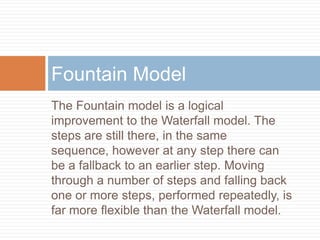
The Fountain model is a logical
improvement to the Waterfall model. The
steps are still there, in the same
sequence, however at any step there can
be a fallback to an earlier step. Moving
through a number of steps and falling back
one or more steps, performed repeatedly, is
far more flexible than the Waterfall model.
Fountain Model
Fountain Model Phases
 Analysis
 Requirements Specification

 Design

 Coding

 Testing and Integration

 Operation

 Maintenance or Evolution
Advantages
 many more interaction between design
and requirements
 supports iteration within phases

able to start the coding earlier
Disadvantages
•It may degraded into a code-a-bit test- a-
bit which requires frequent iterations and
refinement.
When to use?
• requirements keep on changing quite
frequently
• better use in the industry sectors
End ^-^

Fountain model

  • 1.
    FOUNTAIN MODEL Project Management
  • 2.
    Fountain Model The Fountainmodel is a logical improvement to the Waterfall model. The steps are still there, in the same sequence, however at any step there can be a fallback to an earlier step. Moving through a number of steps and falling back one or more steps, performed repeatedly, is far more flexible than the Waterfall model.
  • 3.
  • 4.
    Fountain Model Phases Analysis  Requirements Specification  Design  Coding  Testing and Integration  Operation  Maintenance or Evolution
  • 5.
    Advantages  many moreinteraction between design and requirements  supports iteration within phases able to start the coding earlier
  • 6.
    Disadvantages •It may degradedinto a code-a-bit test- a- bit which requires frequent iterations and refinement.
  • 7.
    When to use? •requirements keep on changing quite frequently • better use in the industry sectors
  • 8.

Editor's Notes

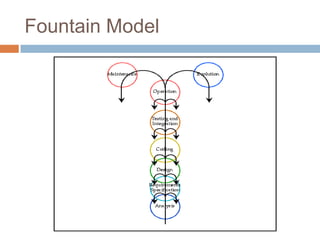
  • #4 In this model the circles representing the various phases overlap, explicitly representing an overlap between activities. The arrows within a phase represent iteration within the phase. The maintenance cycle is smaller, to symbolize reduced maintenance effort when the object oriented paradigm is used.