System Development Life
Cycle (SDLC)
Day-2
Team Emertxe
Course span-out
SDLC models
Models
 Waterfall
 V Shape
 Prototype
 Spiral
 Incremental
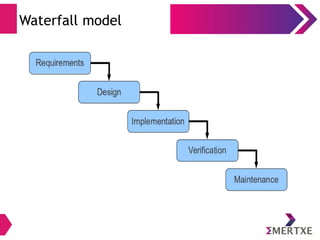
Waterfall model
Waterfall model
Strengths
 Easy to understand, easy to use
 Provides structure to inexperienced staff
 Milestones are well understood
 Sets requirements stability
 Good for management control (plan, staff, track)
 Works well when quality is more important than cost or
schedule
Weakness
 All requirements must be known upfront
 Inhibits flexibility
 Can give a false impression of progress
 Does not reflect problem-solving nature of software
development
 Integration is one big bang at the end
 Little opportunity for customer to preview
When to use?
 Requirements are very well known
 Product definition is stable
 Technology is understood
 New version of an existing product
 Porting an existing product to a new platform
V model
V model
Strengths
 Emphasize planning for verification and validation
 Each deliverable must be testable
 Project management can track progress by milestones
 Easy to use
Weakness
 Does not easily handle concurrent events
 Does not handle iterations or phases
 Does not easily handle dynamic changes in
requirements
 Does not contain risk analysis activities
When to use?
 Excellent choice for systems requiring high reliability
 All requirements are known up-front
 Solution and technology are known
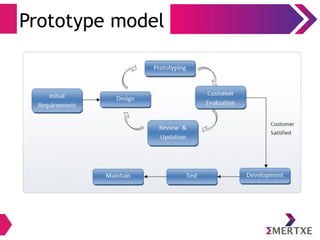
Prototype model
Prototype model
Strengths
 Customers can “see” the system requirements
 Developers learn from customers
 A more accurate end product
 Unexpected requirements accommodated
 Allows for flexible design and development
 Steady, visible signs of progress produced
 Interaction with the prototype stimulates awareness of
additional needed functionality
Weakness
 Tendency to abandon structured program development
for “code-and-fix” development
 Bad reputation for “quick-and-dirty” methods
 Overall maintainability may be overlooked
 The customer may want the prototype delivered.
 Process may continue forever (scope creep)
When to use?
 Requirements are unstable or have to be clarified
 As the requirements clarification stage of a waterfall
model
 Develop user interfaces
 Short-lived demonstrations
 New, original development
Spiral model
Spiral model
Strengths
 Provides early indication of risks
 Users see the system early because of rapid prototyping
tools
 Critical high-risk functions are developed first
 The design does not have to be perfect
 Users can be closely tied to all lifecycle steps
 Early and frequent feedback from users
 Cumulative costs assessed frequently
Weakness
 Time spent for evaluating risks too large
 Time spent planning, resetting objectives, doing risk
analysis and prototyping may be excessive
 The model is complex
 Risk assessment expertise is required
 Spiral may continue indefinitely
 Developers must be reassigned
When to use?
 When creation of a prototype is appropriate
 When costs and risk evaluation is important
 For medium to high-risk projects
 Long-term project commitment unwise because
of potential changes to economic priorities
 Users are unsure of their needs
 Requirements are complex
 New product line
 Significant changes are expected (research and
exploration)
Incremental model
Incremental model
Strengths
 Develop high-risk or major functions first
 Each release delivers an operational product
 Customer can respond to each build
 Uses “divide and conquer” breakdown of tasks
 Lowers initial delivery cost
 Initial product delivery is faster
 Customers get important functionality early
 Risk of changing requirements is reduced
Weakness
 Requires good planning and design
 Requires early definition of a complete system
 Well-defined module interfaces are required
 Total cost of the complete system is not lower
When to use?
 Risk, funding, schedule, program complexity, or need
for early realization of benefits.
 Most of the requirements are known up-front but are
expected to evolve over time
 A need to get basic functionality to the market early
 On projects which have lengthy development schedules
 On a project with new technology
Case studies
Product line p40
 Product line p40 is already existing in the market,
successfully used by customers
 In order to enhance performance requirements a new
ASIC got taped out
 p40 firmware to be ported to new ASIC, with enhanced
performance requirements
 Other functionality should work as expected
 Customers have given go ahead for upgraded version
• Life cycle
• Main list of activities
• Specific focus areas
• Risks
• Dependencies
Product line a400
 A400 is a high-availability telecom platform with
99.999% requirement
 There are certain new features addition to meet
network requirements as a401
 Security patches application to address latest
vulnerabilities
 Live upgrade in the network with 3 million users
• Life cycle
• Main list of activities
• Specific focus areas
• Risks
• Dependencies
Product PL v1.0
 PL v1.0 is a warehouse automation product priced at
40$ by ABC corporation
 ABC want to bring down cost to 30$ with new design
 R & D team is not sure about achieving this price-point
 ABC is not ready to compromise on established PL v1.0
functionality
• Life cycle
• Main list of activities
• Specific focus areas
• Risks
• Dependencies
Cloud enabling
 Product line 6500 series is a standalone consumer electronic device
 First time upgrade functionality is planned to be introduced for
connecting it with cloud services
 This has high risk as small failure might make the device unusable
 User experience should be smooth during upgrade, which involves
user testing
 Cost & risk to be assessed now
• Life cycle
• Main list of activities
• Specific focus areas
• Risks
• Dependencies
Online services
 KKT organization wants to launch a new online services to
customers
 They have decent understanding of the market but not sure how
they will receive the product
 To test waters first they would like to release the product to
market with Minimal Viable Product (MVP) with one complete user
flow working
 They would subsequently do a alpha testing with enthusiasts and
subsequently improve the product
• Life cycle
• Main list of activities
• Specific focus areas
• Risks
• Dependencies
Agile
What is Agile?
Agile - A mindset
• Learn through Discovery
• Collaboration
• Failing Early
• Seeking Feedback for
learning
• Strive for Continuous
Delivery
• Focus on Value
A mindset is the established set of attitudes held by someone
Defined by value
•Individuals and interactions over processes and tools
•Working software over comprehensive documentation
•Customer collaboration over contract negotiation
•Responding to change over following a plan
• Agile manifesto
• Formed by experts
Agile principles
Agile Practices
Flavors
Flavor Characteristics
Scrum “Reference Implementation”
of Agile. Time boxed.
Kanban Focus of understanding how
work flows, visualizing the
work. Limit WIP.
SAFe: Agile @
Scale
Handles integrating multiples
teams with program and
portfolio layers
Extreme
Programming
(XP)
Technical focus on development
practices. Prescribes practices
that are commonly needed to
make Scrum deliver high
quality. Time Boxed.
Requirement Engineering
Engineering Requirements
 The process of establishing the services that the
customer requires from a system
 Understanding constraints
 Requirements themselves are generated by engineering
the whole process
 Singular documented physical and functional need that
a particular product or service must be or perform
 Statement that identifies a necessary
attribute, capability, characteristic, or quality of a
system for it to have value and utility to a user
Having Requirement Analysis (RA) document captures customer‟s needs by
following a Engineering process
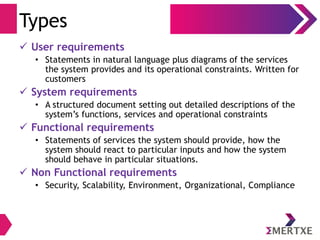
Types
 User requirements
• Statements in natural language plus diagrams of the services
the system provides and its operational constraints. Written for
customers
 System requirements
• A structured document setting out detailed descriptions of the
system‟s functions, services and operational constraints
 Functional requirements
• Statements of services the system should provide, how the
system should react to particular inputs and how the system
should behave in particular situations.
 Non Functional requirements
• Security, Scalability, Environment, Organizational, Compliance
Expectations
 Complete
• They should include description of all facilities required
 Consistent
• There should be no conflicts or uncertainties in the descriptions
of the system facilities
In practice, it is very difficult to produce a complete and consistent
requirement document
Elicitation process
 Interviewing and questionnaires
 Requirements workshops (Brain storming)
 Storyboards
 Prototyping
 Voice of Customer
Why challenging?
 Ideal system vs. possibility building it good
 Expectations
 Scope/boundary of the system
 Old, rusted demands and wishes
 Resistance to change
 Aiming at a moving target
 „Wicked problems‟ – More than one good solution
 Functional vs. Technical solutions
 Completeness
 Nice-to-have vs. critical functionality
Stakeholder issues
 Users don't have a clear idea of their requirements
 Will not commit to a set of written requirements
 Scope creep after cost and schedule have been fixed
 Communication gaps
 Users often do not participate in reviews
 Technically unsophisticated
 Don‟t understand the development process
 Don‟t know about present technology
Engineer issues
 Technical personnel and end users may have different
vocabularies
 Engineers and developers may try to make the
requirements fit an existing system
 Taking technical view of people's needs
Requirement spec
 A complete description of the behavior of a system to be
developed and may include a set of use cases that describe
interactions the users will have with the software
 In addition to a description of the software functions, the SRS also
contains non-functional requirements
 Process of checking that a software system meets specifications
and that it fulfils its intended purpose
 Validation: “Am I building the right product?”
 Verification: “Am I building the product right?”
Both development and test engineers will have Requirement Spec as the
common point of building product. But their views are different to ensure
customer requirements are met or exceeded.
System modeling
Use case model
 A use case diagram depicts the interactions various external
entities in the customer's environment will have with they system
being modeled
 A use case identifies an interaction that must be supported
between a given external entity, known as an actor, and the system
 A use case is typically labeled as a verb since it is identifying
system behavior
 An actor is labeled as a noun and is the entity that is requesting
some service from the system
Example: Microwave oven and its functionality
Use case modeling
Data flow model
 A Data Flow Mode describes how data is processed by the system
under development.
 The Flow of Data from one stage of processing to the next is shown
in this model
Data flow model
Stay connected
About us: Emertxe is India‟s one of the top IT finishing schools & self learning kits
provider. Our primary focus is on Embedded with diversification focus on Java,
Oracle and Android areas
Emertxe Information Technologies,
No-1, 9th Cross, 5th Main,
Jayamahal Extension,
Bangalore, Karnataka 560046
T: +91 80 6562 9666
E: training@emertxe.com
https://www.facebook.com/Emertxe https://twitter.com/EmertxeTweet https://www.slideshare.net/EmertxeSlides
THANK YOU

System Development Life Cycle (SDLC) - Part II

  • 1.
    System Development Life Cycle(SDLC) Day-2 Team Emertxe
  • 2.
  • 3.
  • 4.
    Models  Waterfall  VShape  Prototype  Spiral  Incremental
  • 5.
  • 6.
  • 7.
    Strengths  Easy tounderstand, easy to use  Provides structure to inexperienced staff  Milestones are well understood  Sets requirements stability  Good for management control (plan, staff, track)  Works well when quality is more important than cost or schedule
  • 8.
    Weakness  All requirementsmust be known upfront  Inhibits flexibility  Can give a false impression of progress  Does not reflect problem-solving nature of software development  Integration is one big bang at the end  Little opportunity for customer to preview
  • 9.
    When to use? Requirements are very well known  Product definition is stable  Technology is understood  New version of an existing product  Porting an existing product to a new platform
  • 10.
  • 11.
  • 12.
    Strengths  Emphasize planningfor verification and validation  Each deliverable must be testable  Project management can track progress by milestones  Easy to use
  • 13.
    Weakness  Does noteasily handle concurrent events  Does not handle iterations or phases  Does not easily handle dynamic changes in requirements  Does not contain risk analysis activities
  • 14.
    When to use? Excellent choice for systems requiring high reliability  All requirements are known up-front  Solution and technology are known
  • 15.
  • 16.
  • 17.
    Strengths  Customers can“see” the system requirements  Developers learn from customers  A more accurate end product  Unexpected requirements accommodated  Allows for flexible design and development  Steady, visible signs of progress produced  Interaction with the prototype stimulates awareness of additional needed functionality
  • 18.
    Weakness  Tendency toabandon structured program development for “code-and-fix” development  Bad reputation for “quick-and-dirty” methods  Overall maintainability may be overlooked  The customer may want the prototype delivered.  Process may continue forever (scope creep)
  • 19.
    When to use? Requirements are unstable or have to be clarified  As the requirements clarification stage of a waterfall model  Develop user interfaces  Short-lived demonstrations  New, original development
  • 20.
  • 21.
  • 22.
    Strengths  Provides earlyindication of risks  Users see the system early because of rapid prototyping tools  Critical high-risk functions are developed first  The design does not have to be perfect  Users can be closely tied to all lifecycle steps  Early and frequent feedback from users  Cumulative costs assessed frequently
  • 23.
    Weakness  Time spentfor evaluating risks too large  Time spent planning, resetting objectives, doing risk analysis and prototyping may be excessive  The model is complex  Risk assessment expertise is required  Spiral may continue indefinitely  Developers must be reassigned
  • 24.
    When to use? When creation of a prototype is appropriate  When costs and risk evaluation is important  For medium to high-risk projects  Long-term project commitment unwise because of potential changes to economic priorities  Users are unsure of their needs  Requirements are complex  New product line  Significant changes are expected (research and exploration)
  • 25.
  • 26.
  • 27.
    Strengths  Develop high-riskor major functions first  Each release delivers an operational product  Customer can respond to each build  Uses “divide and conquer” breakdown of tasks  Lowers initial delivery cost  Initial product delivery is faster  Customers get important functionality early  Risk of changing requirements is reduced
  • 28.
    Weakness  Requires goodplanning and design  Requires early definition of a complete system  Well-defined module interfaces are required  Total cost of the complete system is not lower
  • 29.
    When to use? Risk, funding, schedule, program complexity, or need for early realization of benefits.  Most of the requirements are known up-front but are expected to evolve over time  A need to get basic functionality to the market early  On projects which have lengthy development schedules  On a project with new technology
  • 30.
  • 31.
    Product line p40 Product line p40 is already existing in the market, successfully used by customers  In order to enhance performance requirements a new ASIC got taped out  p40 firmware to be ported to new ASIC, with enhanced performance requirements  Other functionality should work as expected  Customers have given go ahead for upgraded version • Life cycle • Main list of activities • Specific focus areas • Risks • Dependencies
  • 32.
    Product line a400 A400 is a high-availability telecom platform with 99.999% requirement  There are certain new features addition to meet network requirements as a401  Security patches application to address latest vulnerabilities  Live upgrade in the network with 3 million users • Life cycle • Main list of activities • Specific focus areas • Risks • Dependencies
  • 33.
    Product PL v1.0 PL v1.0 is a warehouse automation product priced at 40$ by ABC corporation  ABC want to bring down cost to 30$ with new design  R & D team is not sure about achieving this price-point  ABC is not ready to compromise on established PL v1.0 functionality • Life cycle • Main list of activities • Specific focus areas • Risks • Dependencies
  • 34.
    Cloud enabling  Productline 6500 series is a standalone consumer electronic device  First time upgrade functionality is planned to be introduced for connecting it with cloud services  This has high risk as small failure might make the device unusable  User experience should be smooth during upgrade, which involves user testing  Cost & risk to be assessed now • Life cycle • Main list of activities • Specific focus areas • Risks • Dependencies
  • 35.
    Online services  KKTorganization wants to launch a new online services to customers  They have decent understanding of the market but not sure how they will receive the product  To test waters first they would like to release the product to market with Minimal Viable Product (MVP) with one complete user flow working  They would subsequently do a alpha testing with enthusiasts and subsequently improve the product • Life cycle • Main list of activities • Specific focus areas • Risks • Dependencies
  • 36.
  • 37.
  • 38.
    Agile - Amindset • Learn through Discovery • Collaboration • Failing Early • Seeking Feedback for learning • Strive for Continuous Delivery • Focus on Value A mindset is the established set of attitudes held by someone
  • 39.
    Defined by value •Individualsand interactions over processes and tools •Working software over comprehensive documentation •Customer collaboration over contract negotiation •Responding to change over following a plan • Agile manifesto • Formed by experts
  • 40.
  • 41.
  • 42.
    Flavors Flavor Characteristics Scrum “ReferenceImplementation” of Agile. Time boxed. Kanban Focus of understanding how work flows, visualizing the work. Limit WIP. SAFe: Agile @ Scale Handles integrating multiples teams with program and portfolio layers Extreme Programming (XP) Technical focus on development practices. Prescribes practices that are commonly needed to make Scrum deliver high quality. Time Boxed.
  • 43.
  • 44.
    Engineering Requirements  Theprocess of establishing the services that the customer requires from a system  Understanding constraints  Requirements themselves are generated by engineering the whole process  Singular documented physical and functional need that a particular product or service must be or perform  Statement that identifies a necessary attribute, capability, characteristic, or quality of a system for it to have value and utility to a user Having Requirement Analysis (RA) document captures customer‟s needs by following a Engineering process
  • 45.
    Types  User requirements •Statements in natural language plus diagrams of the services the system provides and its operational constraints. Written for customers  System requirements • A structured document setting out detailed descriptions of the system‟s functions, services and operational constraints  Functional requirements • Statements of services the system should provide, how the system should react to particular inputs and how the system should behave in particular situations.  Non Functional requirements • Security, Scalability, Environment, Organizational, Compliance
  • 46.
    Expectations  Complete • Theyshould include description of all facilities required  Consistent • There should be no conflicts or uncertainties in the descriptions of the system facilities In practice, it is very difficult to produce a complete and consistent requirement document
  • 47.
    Elicitation process  Interviewingand questionnaires  Requirements workshops (Brain storming)  Storyboards  Prototyping  Voice of Customer
  • 48.
    Why challenging?  Idealsystem vs. possibility building it good  Expectations  Scope/boundary of the system  Old, rusted demands and wishes  Resistance to change  Aiming at a moving target  „Wicked problems‟ – More than one good solution  Functional vs. Technical solutions  Completeness  Nice-to-have vs. critical functionality
  • 49.
    Stakeholder issues  Usersdon't have a clear idea of their requirements  Will not commit to a set of written requirements  Scope creep after cost and schedule have been fixed  Communication gaps  Users often do not participate in reviews  Technically unsophisticated  Don‟t understand the development process  Don‟t know about present technology
  • 50.
    Engineer issues  Technicalpersonnel and end users may have different vocabularies  Engineers and developers may try to make the requirements fit an existing system  Taking technical view of people's needs
  • 51.
    Requirement spec  Acomplete description of the behavior of a system to be developed and may include a set of use cases that describe interactions the users will have with the software  In addition to a description of the software functions, the SRS also contains non-functional requirements  Process of checking that a software system meets specifications and that it fulfils its intended purpose  Validation: “Am I building the right product?”  Verification: “Am I building the product right?” Both development and test engineers will have Requirement Spec as the common point of building product. But their views are different to ensure customer requirements are met or exceeded.
  • 52.
  • 53.
    Use case model A use case diagram depicts the interactions various external entities in the customer's environment will have with they system being modeled  A use case identifies an interaction that must be supported between a given external entity, known as an actor, and the system  A use case is typically labeled as a verb since it is identifying system behavior  An actor is labeled as a noun and is the entity that is requesting some service from the system Example: Microwave oven and its functionality
  • 54.
  • 55.
    Data flow model A Data Flow Mode describes how data is processed by the system under development.  The Flow of Data from one stage of processing to the next is shown in this model
  • 56.
  • 57.
    Stay connected About us:Emertxe is India‟s one of the top IT finishing schools & self learning kits provider. Our primary focus is on Embedded with diversification focus on Java, Oracle and Android areas Emertxe Information Technologies, No-1, 9th Cross, 5th Main, Jayamahal Extension, Bangalore, Karnataka 560046 T: +91 80 6562 9666 E: training@emertxe.com https://www.facebook.com/Emertxe https://twitter.com/EmertxeTweet https://www.slideshare.net/EmertxeSlides
  • 58.