FOUNDATION
DEFINITION
• Lowest part of the structures which are in
direct contact with the ground and transmit
the loads of superstructure to the ground
LOADS ON FOUNDATION
• Types of foundation to be used depend on the
loads acting on it
– Dead load
– Live Load
– Wind load
BEARING CAPACITY OF SOIL
• Dead load and live load of the structure are
transmitted to the soil and hence it is
important to know the strength and behaviour
of the soil
• ULTIMATE BEARING CAPACITY
– Gross pressure intensity at the base of the
foundation at which the soil fails in shear
BEARING CAPACITY OF SOIL
SAFE BEARING CAPACITY
– Maximum pressure which the soil can carry safely
without risk of shear failure.
– It is obtained by dividing the ultimate bearing
capacity of a soil by a factor of safety
– Safe bearing capacity =
𝑈𝑙𝑡𝑖𝑚𝑎𝑡𝑒 𝑏𝑒𝑎𝑟𝑖𝑛𝑔 𝑐𝑎𝑝𝑎𝑐𝑖𝑡𝑦
𝐹𝑎𝑐𝑡𝑜𝑟 𝑜𝑓 𝑠𝑎𝑓𝑒𝑡𝑦
– Usual factor of safety is 2 to 3
TYPES OF FOUNDATION
TYPES OF FOUNDATION
• SHALLOW FOUNDATION (Depth less or equal to width)
– Isolated column footing
– Wall footing
– Combined footing
– Cantilever footing
– Inverted arch footing
– Raft Footing
• DEEP FOUNDATION (Depth greater than width)
– Pile foundation
– Pier foundation
– Well foundation
ISOLATED OR COLUMN FOOTING
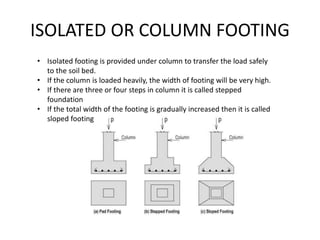
• Isolated footing is provided under column to transfer the load safely
to the soil bed.
• If the column is loaded heavily, the width of footing will be very high.
• If there are three or four steps in column it is called stepped
foundation
• If the total width of the footing is gradually increased then it is called
sloped footing
WALL FOOTING
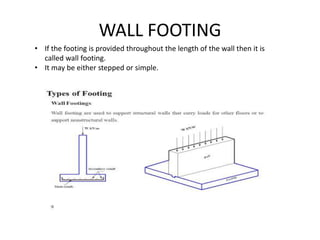
• If the footing is provided throughout the length of the wall then it is
called wall footing.
• It may be either stepped or simple.
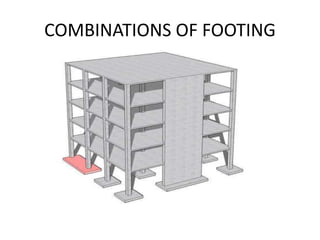
COMBINED FOOTING
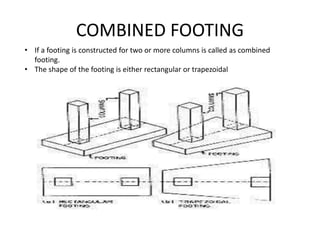
• If a footing is constructed for two or more columns is called as combined
footing.
• The shape of the footing is either rectangular or trapezoidal
CANTILEVER FOOTING
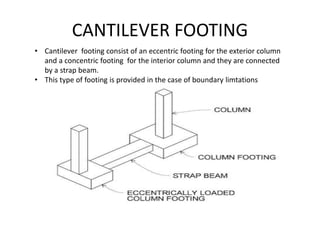
• Cantilever footing consist of an eccentric footing for the exterior column
and a concentric footing for the interior column and they are connected
by a strap beam.
• This type of footing is provided in the case of boundary limtations
CONTINUOUS FOOTING
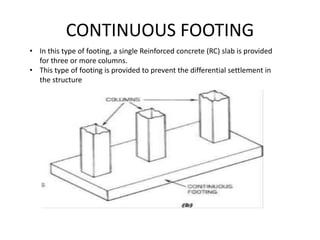
• In this type of footing, a single Reinforced concrete (RC) slab is provided
for three or more columns.
• This type of footing is provided to prevent the differential settlement in
the structure
INVERTED ARCH FOOTING
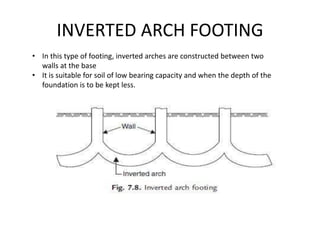
• In this type of footing, inverted arches are constructed between two
walls at the base
• It is suitable for soil of low bearing capacity and when the depth of the
foundation is to be kept less.
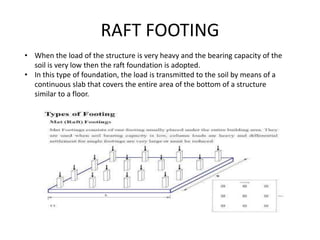
RAFT FOOTING
• When the load of the structure is very heavy and the bearing capacity of the
soil is very low then the raft foundation is adopted.
• In this type of foundation, the load is transmitted to the soil by means of a
continuous slab that covers the entire area of the bottom of a structure
similar to a floor.
COMBINATIONS OF FOOTING
DEEP FOUNDATION
• Deep foundation are those in which the depth
of the foundation is greater than its width.
PILE FOUNDATION :-
• The pile foundation may be used If the live
load and dead load from the structure is very
heavy and the distribution of load on soil is
uneven.
• Pile foundation are useful for constructing the
structure near sea-shore or river bed.
DEEP FOUNDATION
• Classification of piles
– Based on function or use
• End bearing piles
• Friction piles
• Compaction piles
• Sheet piles
• Batter Piles
• Under ream piles
• Fender Piles
END BEARING AND FRICTION PILES
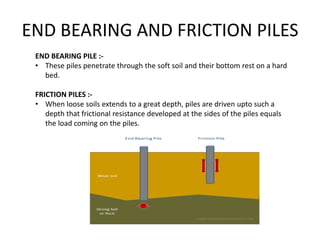
END BEARING PILE :-
• These piles penetrate through the soft soil and their bottom rest on a hard
bed.
FRICTION PILES :-
• When loose soils extends to a great depth, piles are driven upto such a
depth that frictional resistance developed at the sides of the piles equals
the load coming on the piles.
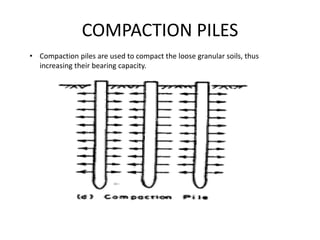
COMPACTION PILES
• Compaction piles are used to compact the loose granular soils, thus
increasing their bearing capacity.
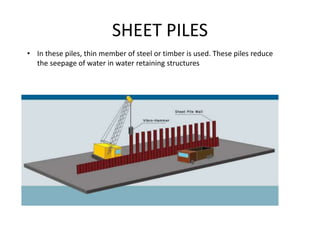
SHEET PILES
• In these piles, thin member of steel or timber is used. These piles reduce
the seepage of water in water retaining structures
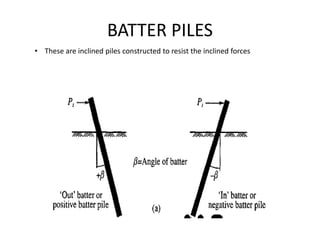
BATTER PILES
• These are inclined piles constructed to resist the inclined forces
UNDER REAM PILES
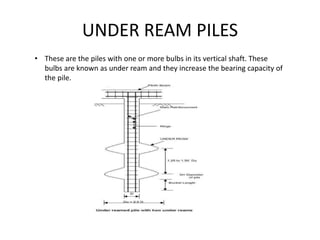
• These are the piles with one or more bulbs in its vertical shaft. These
bulbs are known as under ream and they increase the bearing capacity of
the pile.
FENDER PILES
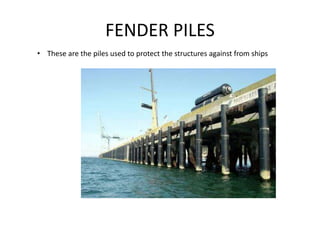
• These are the piles used to protect the structures against from ships
DEEP FOUNDATION
• Classification of piles
– Based on Materials
• Concrete plies
– Cast in situ concrete piles
» In this type, the piles are cast in the site itself. A bore is dug
into the ground by inserting a casing. After placing the
reinforcement, this bore is filled with cement concrete.
– Precast piles
» In this type, the piles are those which are manufactured in a
factory at a place away from the construction site and then
driven into the ground. They may be square, circular in
shape.
• Timber plies
• Steel plies
TIMBER PILES
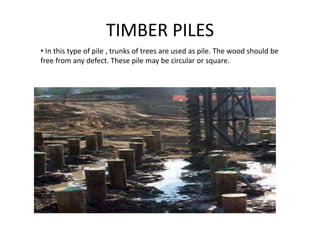
• In this type of pile , trunks of trees are used as pile. The wood should be
free from any defect. These pile may be circular or square.
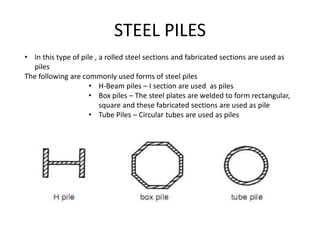
STEEL PILES
• In this type of pile , a rolled steel sections and fabricated sections are used as
piles
The following are commonly used forms of steel piles
• H-Beam piles – I section are used as piles
• Box piles – The steel plates are welded to form rectangular,
square and these fabricated sections are used as pile
• Tube Piles – Circular tubes are used as piles
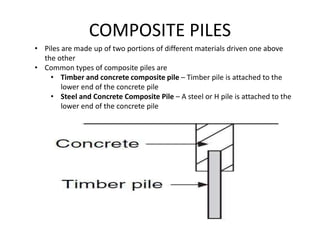
COMPOSITE PILES
• Piles are made up of two portions of different materials driven one above
the other
• Common types of composite piles are
• Timber and concrete composite pile – Timber pile is attached to the
lower end of the concrete pile
• Steel and Concrete Composite Pile – A steel or H pile is attached to the
lower end of the concrete pile
DEEP FOUNDATION
• PIER FOUNDATION :-
– It consists of a cylindrical column of larger
diameter to support the load through bearing
only.
– It will be shallower than the pile
DEEP FOUNDATION
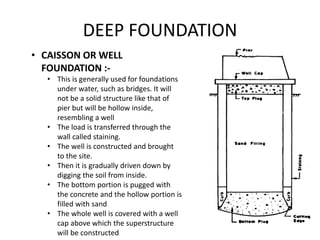
• CAISSON OR WELL
FOUNDATION :-
• This is generally used for foundations
under water, such as bridges. It will
not be a solid structure like that of
pier but will be hollow inside,
resembling a well
• The load is transferred through the
wall called staining.
• The well is constructed and brought
to the site.
• Then it is gradually driven down by
digging the soil from inside.
• The bottom portion is pugged with
the concrete and the hollow portion is
filled with sand
• The whole well is covered with a well
cap above which the superstructure
will be constructed
CAISSON PILES
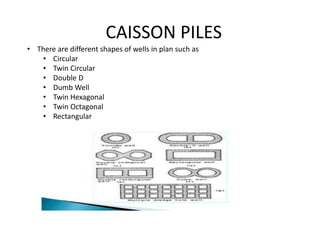
• There are different shapes of wells in plan such as
• Circular
• Twin Circular
• Double D
• Dumb Well
• Twin Hexagonal
• Twin Octagonal
• Rectangular
REQUIREMENTS OF GOOD
FOUNDATION
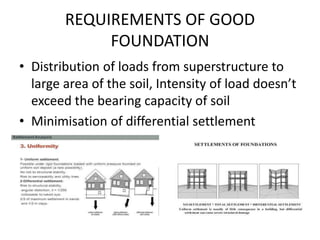
• Distribution of loads from superstructure to
large area of the soil, Intensity of load doesn’t
exceed the bearing capacity of soil
• Minimisation of differential settlement
REQUIREMENTS OF GOOD
FOUNDATION
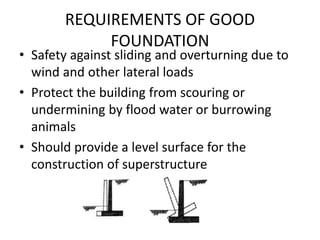
• Safety against sliding and overturning due to
wind and other lateral loads
• Protect the building from scouring or
undermining by flood water or burrowing
animals
• Should provide a level surface for the
construction of superstructure
METHODS TO IMPROVE THE BEARING
CAPACITY OF SOIL
• Increasing the depth of foundation
– Bearing capacity increases as the depth increases
• Draining the sub soil water
– Bearing capacity increases with lower water
content
• Compacting the soil
– Reduces the voids and increase the bearing
capacity. It can be achieved by driving piles
METHODS TO IMPROVE THE BEARING
CAPACITY OF SOIL
• By cement grouting
– Cement grout injected under pressure to seal
cracks increase the bearing capacity
• By Chemical Treatment
– Solution like silicates injected under pressure into
the soil

TYPES OF FOUNDATION.pptx

  • 1.
  • 2.
    DEFINITION • Lowest partof the structures which are in direct contact with the ground and transmit the loads of superstructure to the ground
  • 3.
    LOADS ON FOUNDATION •Types of foundation to be used depend on the loads acting on it – Dead load – Live Load – Wind load
  • 4.
    BEARING CAPACITY OFSOIL • Dead load and live load of the structure are transmitted to the soil and hence it is important to know the strength and behaviour of the soil • ULTIMATE BEARING CAPACITY – Gross pressure intensity at the base of the foundation at which the soil fails in shear
  • 5.
    BEARING CAPACITY OFSOIL SAFE BEARING CAPACITY – Maximum pressure which the soil can carry safely without risk of shear failure. – It is obtained by dividing the ultimate bearing capacity of a soil by a factor of safety – Safe bearing capacity = 𝑈𝑙𝑡𝑖𝑚𝑎𝑡𝑒 𝑏𝑒𝑎𝑟𝑖𝑛𝑔 𝑐𝑎𝑝𝑎𝑐𝑖𝑡𝑦 𝐹𝑎𝑐𝑡𝑜𝑟 𝑜𝑓 𝑠𝑎𝑓𝑒𝑡𝑦 – Usual factor of safety is 2 to 3
  • 6.
  • 7.
    TYPES OF FOUNDATION •SHALLOW FOUNDATION (Depth less or equal to width) – Isolated column footing – Wall footing – Combined footing – Cantilever footing – Inverted arch footing – Raft Footing • DEEP FOUNDATION (Depth greater than width) – Pile foundation – Pier foundation – Well foundation
  • 8.
    ISOLATED OR COLUMNFOOTING • Isolated footing is provided under column to transfer the load safely to the soil bed. • If the column is loaded heavily, the width of footing will be very high. • If there are three or four steps in column it is called stepped foundation • If the total width of the footing is gradually increased then it is called sloped footing
  • 9.
    WALL FOOTING • Ifthe footing is provided throughout the length of the wall then it is called wall footing. • It may be either stepped or simple.
  • 10.
    COMBINED FOOTING • Ifa footing is constructed for two or more columns is called as combined footing. • The shape of the footing is either rectangular or trapezoidal
  • 11.
    CANTILEVER FOOTING • Cantileverfooting consist of an eccentric footing for the exterior column and a concentric footing for the interior column and they are connected by a strap beam. • This type of footing is provided in the case of boundary limtations
  • 12.
    CONTINUOUS FOOTING • Inthis type of footing, a single Reinforced concrete (RC) slab is provided for three or more columns. • This type of footing is provided to prevent the differential settlement in the structure
  • 13.
    INVERTED ARCH FOOTING •In this type of footing, inverted arches are constructed between two walls at the base • It is suitable for soil of low bearing capacity and when the depth of the foundation is to be kept less.
  • 14.
    RAFT FOOTING • Whenthe load of the structure is very heavy and the bearing capacity of the soil is very low then the raft foundation is adopted. • In this type of foundation, the load is transmitted to the soil by means of a continuous slab that covers the entire area of the bottom of a structure similar to a floor.
  • 15.
  • 16.
    DEEP FOUNDATION • Deepfoundation are those in which the depth of the foundation is greater than its width. PILE FOUNDATION :- • The pile foundation may be used If the live load and dead load from the structure is very heavy and the distribution of load on soil is uneven. • Pile foundation are useful for constructing the structure near sea-shore or river bed.
  • 17.
    DEEP FOUNDATION • Classificationof piles – Based on function or use • End bearing piles • Friction piles • Compaction piles • Sheet piles • Batter Piles • Under ream piles • Fender Piles
  • 18.
    END BEARING ANDFRICTION PILES END BEARING PILE :- • These piles penetrate through the soft soil and their bottom rest on a hard bed. FRICTION PILES :- • When loose soils extends to a great depth, piles are driven upto such a depth that frictional resistance developed at the sides of the piles equals the load coming on the piles.
  • 19.
    COMPACTION PILES • Compactionpiles are used to compact the loose granular soils, thus increasing their bearing capacity.
  • 20.
    SHEET PILES • Inthese piles, thin member of steel or timber is used. These piles reduce the seepage of water in water retaining structures
  • 21.
    BATTER PILES • Theseare inclined piles constructed to resist the inclined forces
  • 22.
    UNDER REAM PILES •These are the piles with one or more bulbs in its vertical shaft. These bulbs are known as under ream and they increase the bearing capacity of the pile.
  • 23.
    FENDER PILES • Theseare the piles used to protect the structures against from ships
  • 24.
    DEEP FOUNDATION • Classificationof piles – Based on Materials • Concrete plies – Cast in situ concrete piles » In this type, the piles are cast in the site itself. A bore is dug into the ground by inserting a casing. After placing the reinforcement, this bore is filled with cement concrete. – Precast piles » In this type, the piles are those which are manufactured in a factory at a place away from the construction site and then driven into the ground. They may be square, circular in shape. • Timber plies • Steel plies
  • 25.
    TIMBER PILES • Inthis type of pile , trunks of trees are used as pile. The wood should be free from any defect. These pile may be circular or square.
  • 26.
    STEEL PILES • Inthis type of pile , a rolled steel sections and fabricated sections are used as piles The following are commonly used forms of steel piles • H-Beam piles – I section are used as piles • Box piles – The steel plates are welded to form rectangular, square and these fabricated sections are used as pile • Tube Piles – Circular tubes are used as piles
  • 27.
    COMPOSITE PILES • Pilesare made up of two portions of different materials driven one above the other • Common types of composite piles are • Timber and concrete composite pile – Timber pile is attached to the lower end of the concrete pile • Steel and Concrete Composite Pile – A steel or H pile is attached to the lower end of the concrete pile
  • 28.
    DEEP FOUNDATION • PIERFOUNDATION :- – It consists of a cylindrical column of larger diameter to support the load through bearing only. – It will be shallower than the pile
  • 29.
    DEEP FOUNDATION • CAISSONOR WELL FOUNDATION :- • This is generally used for foundations under water, such as bridges. It will not be a solid structure like that of pier but will be hollow inside, resembling a well • The load is transferred through the wall called staining. • The well is constructed and brought to the site. • Then it is gradually driven down by digging the soil from inside. • The bottom portion is pugged with the concrete and the hollow portion is filled with sand • The whole well is covered with a well cap above which the superstructure will be constructed
  • 30.
    CAISSON PILES • Thereare different shapes of wells in plan such as • Circular • Twin Circular • Double D • Dumb Well • Twin Hexagonal • Twin Octagonal • Rectangular
  • 31.
    REQUIREMENTS OF GOOD FOUNDATION •Distribution of loads from superstructure to large area of the soil, Intensity of load doesn’t exceed the bearing capacity of soil • Minimisation of differential settlement
  • 32.
    REQUIREMENTS OF GOOD FOUNDATION •Safety against sliding and overturning due to wind and other lateral loads • Protect the building from scouring or undermining by flood water or burrowing animals • Should provide a level surface for the construction of superstructure
  • 33.
    METHODS TO IMPROVETHE BEARING CAPACITY OF SOIL • Increasing the depth of foundation – Bearing capacity increases as the depth increases • Draining the sub soil water – Bearing capacity increases with lower water content • Compacting the soil – Reduces the voids and increase the bearing capacity. It can be achieved by driving piles
  • 34.
    METHODS TO IMPROVETHE BEARING CAPACITY OF SOIL • By cement grouting – Cement grout injected under pressure to seal cracks increase the bearing capacity • By Chemical Treatment – Solution like silicates injected under pressure into the soil