Dr.C. P. Dorlikar
CONTENT
 Introduction
 Age
 Structure
 Classification
 Occurrence
 Rock
 Essential Mineral
 Economic important
INTRODUCTION
 Deccan traps have been defined as the greatest volcano
formation of indian subcontinent.
 They located between (17-24,73-74E) and on of the volcanic
feature on the earth.
 Their thickness decreases towards east and in shahdol
district at amarkantak they are only about 160m thick.
 Deccan traps are largely made up of lavaflows of basic
composition.
Age:-
o The age of lava flow ranges from upper cretaceous to lower
Eocene.
o Deccan traps have been regarded as of paleocene age on
the basis of the following evidences.
• The Deccan trap overlies the bagh and lameta beds which
are of middle cretaceous age.
• In the saurashtra area of Gujarat,the “Nummulitic beds”of
lower Eocene age
Structure:-
• The Deccan traps flows are generally horizontal in attitude.
• But gentle dips of order of 10(degree)have also been
observed at some places.
• Lavas are believed to have intrupted subarially through
fissures in the earth crust.
Example:-
• In Narmada valley they run in the ENE-WSW direction.
• In Kokan their strike is N-S direction.
• In a cutch area of Gujarat these dyes trend in the NNE-SSW
direction.
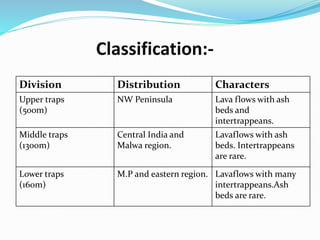
Classification:-
Division Distribution Characters
Upper traps
(500m)
NW Peninsula Lava flows with ash
beds and
intertrappeans.
Middle traps
(1300m)
Central India and
Malwa region.
Lavaflows with ash
beds. Intertrappeans
are rare.
Lower traps
(160m)
M.P and eastern region. Lavaflows with many
intertrappeans.Ash
beds are rare.
Occurrences
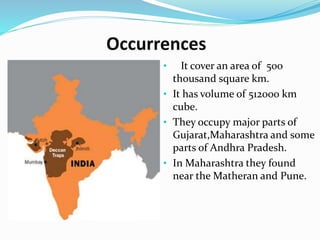
• It cover an area of 500
thousand square km.
• It has volume of 512000 km
cube.
• They occupy major parts of
Gujarat,Maharashtra and some
parts of Andhra Pradesh.
• In Maharashtra they found
near the Matheran and Pune.
Rocks:-
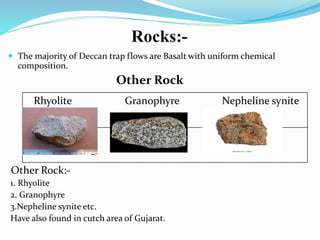
 The majority of Deccan trap flows are Basalt with uniform chemical
composition.
Other Rock
Other Rock:-
1. Rhyolite
2. Granophyre
3.Nepheline synite etc.
Have also found in cutch area of Gujarat.
Rhyolite Granophyre Nepheline synite
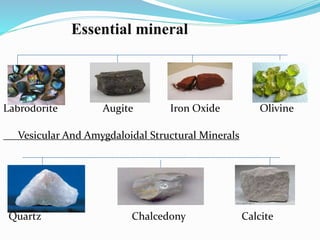
Essential mineral
Labrodorite Augite Iron Oxide Olivine
Vesicular And Amygdaloidal Structural Minerals
Quartz Chalcedony Calcite
Economic important:-
1)Road Metal:-
The Deccan tarp basalt use in road metal because
they have high crushing strength and good binding.
2)Building Stones:
The light colored Basalts are used as building
stones in many part of India.
3)Black Soil:-
The most fertile black soil of Malwa and Maharashtra,
have been derived from Deccan trap.
4)Aquifers:-
The vesicular and highly jointed lavaflows form good
aquifers which the ground water is obtained.
5)Bauxite Deposits:-
Bauxite deposits are formed due to prolonged
weathering of the Deccan traps.
Deccan Traps

Deccan Traps

  • 1.
  • 2.
    CONTENT  Introduction  Age Structure  Classification  Occurrence  Rock  Essential Mineral  Economic important
  • 3.
    INTRODUCTION  Deccan trapshave been defined as the greatest volcano formation of indian subcontinent.  They located between (17-24,73-74E) and on of the volcanic feature on the earth.  Their thickness decreases towards east and in shahdol district at amarkantak they are only about 160m thick.  Deccan traps are largely made up of lavaflows of basic composition.
  • 4.
    Age:- o The ageof lava flow ranges from upper cretaceous to lower Eocene. o Deccan traps have been regarded as of paleocene age on the basis of the following evidences. • The Deccan trap overlies the bagh and lameta beds which are of middle cretaceous age. • In the saurashtra area of Gujarat,the “Nummulitic beds”of lower Eocene age
  • 5.
    Structure:- • The Deccantraps flows are generally horizontal in attitude. • But gentle dips of order of 10(degree)have also been observed at some places. • Lavas are believed to have intrupted subarially through fissures in the earth crust. Example:- • In Narmada valley they run in the ENE-WSW direction. • In Kokan their strike is N-S direction. • In a cutch area of Gujarat these dyes trend in the NNE-SSW direction.
  • 6.
    Classification:- Division Distribution Characters Uppertraps (500m) NW Peninsula Lava flows with ash beds and intertrappeans. Middle traps (1300m) Central India and Malwa region. Lavaflows with ash beds. Intertrappeans are rare. Lower traps (160m) M.P and eastern region. Lavaflows with many intertrappeans.Ash beds are rare.
  • 7.
    Occurrences • It coveran area of 500 thousand square km. • It has volume of 512000 km cube. • They occupy major parts of Gujarat,Maharashtra and some parts of Andhra Pradesh. • In Maharashtra they found near the Matheran and Pune.
  • 8.
    Rocks:-  The majorityof Deccan trap flows are Basalt with uniform chemical composition. Other Rock Other Rock:- 1. Rhyolite 2. Granophyre 3.Nepheline synite etc. Have also found in cutch area of Gujarat. Rhyolite Granophyre Nepheline synite
  • 9.
    Essential mineral Labrodorite AugiteIron Oxide Olivine Vesicular And Amygdaloidal Structural Minerals Quartz Chalcedony Calcite
  • 10.
    Economic important:- 1)Road Metal:- TheDeccan tarp basalt use in road metal because they have high crushing strength and good binding. 2)Building Stones: The light colored Basalts are used as building stones in many part of India. 3)Black Soil:- The most fertile black soil of Malwa and Maharashtra, have been derived from Deccan trap.
  • 11.
    4)Aquifers:- The vesicular andhighly jointed lavaflows form good aquifers which the ground water is obtained. 5)Bauxite Deposits:- Bauxite deposits are formed due to prolonged weathering of the Deccan traps.