FOSSILS
What are fossils?
Where are fossils found?
How are fossils formed?
What are the types of fossils?
Do fossils tell us about our past?
What are fossils?
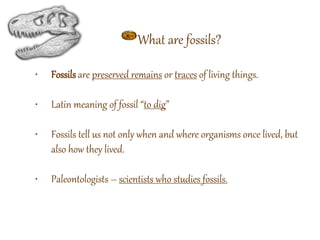
• Fossils are preserved remains or traces of living things.
• Latin meaning of fossil “to dig”
• Fossils tell us not only when and where organisms once lived, but
also how they lived.
• Paleontologists – scientists who studies fossils.
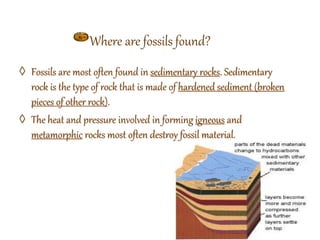
◊ Fossils are most often found in sedimentary rocks. Sedimentary
rock is the type of rock that is made of hardened sediment (broken
pieces of other rock).
◊ The heat and pressure involved in forming igneous and
metamorphic rocks most often destroy fossil material.
Where are fossils found?
• Most fossilsform when living thing die andare buried by sediments. The sediments
slowly harden into rock and preserve the shapes of the organisms.
• Usually, the remains of dead plants and animals are quickly destroyed. Scavengers
eat the dead organisms, or fungi and microorganisms cause them to decay
• Organisms havea better chance of being preservedif theyhave hardparts; i.e.
bones, shells, teeth, seeds, and woody stems.
How are fossils formed?
• Fossils found in rock include: petrified fossils, molds and casts, carbon films, and
trace fossils. Other fossils form when the remains of organisms are preserved in
substances such as tar, amber, or ice.
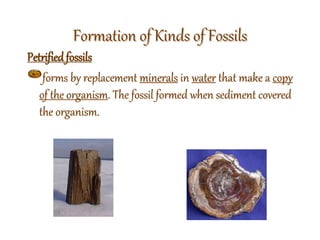
• Petrified fossils – minerals replace all or part of an organism.
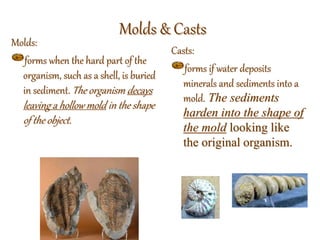
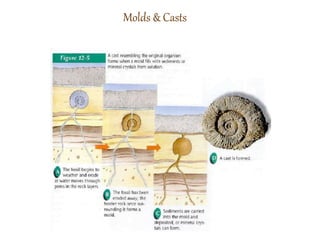
• Molds – a hollow area in the shape of or part of an organism.
• Casts – a copy of the shape of the organism.
• Carbon films – an extremely thin coating of carbon on rock (sediment
squeezes almost the entire decaying organism away).
• Trace fossils – provide evidence of the activities of living organisms. Ex.
Fossilized footprints.
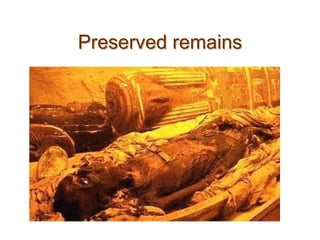
• Preserved remains – the entire organism remains with little or no change:
preserved by tar, amber (sap or resin), or ice.
What are the types of fossils?
Change Over Time
• Fossil record – provides evidence about the history of life on Earth.
The fossil record also shows that different groups of organisms have
changed over time.
• Older rocks – contain fossils of simpler organisms.
• Younger rocks – contain fossils of more complex organisms.
• Scientific theory – well –tested concept that explains a wide range of
observations.
• Evolution – is the gradual change in living things over long periods
of time.
• Extinct – when an organism no longer exists anywhere on Earth.
Do fossils tell us about our past?
Fossils and past Environments
•Fossils provide evidence of Earth’s past climateand environment.
For example: coal has been found in Antarctica. Coal forms
from plants in warm, swampy regions; therefore, that means that
Antarctica was not always cold as it is today.
Formation of Kinds of Fossils
Petrifiedfossils
forms by replacement minerals in water that make a copy
of the organism. The fossil formed when sediment covered
the organism.
Molds & Casts
Molds:
forms when the hard part of the
organism, such as a shell, is buried
in sediment. The organism decays
leaving a hollow mold in the shape
of the object.
Casts:
forms if water deposits
minerals and sediments into a
mold. The sediments
harden into the shape of
the mold looking like
the original organism.
“What are fossils?” video clip
Molds & Casts
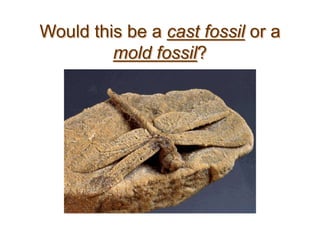
Would this be a cast fossil or a
mold fossil?
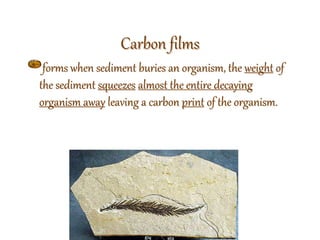
Carbon films
forms when sediment buries an organism, the weight of
the sediment squeezes almost the entire decaying
organism away leaving a carbon print of the organism.
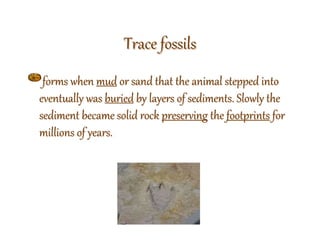
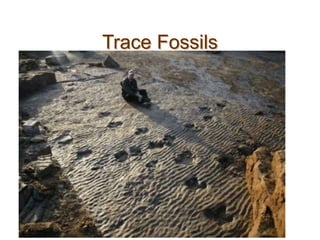
Trace fossils
forms when mud or sand that the animal stepped into
eventually was buried by layers of sediments. Slowly the
sediment became solid rock preserving the footprints for
millions of years.
Trace Fossils
Preserved fossils
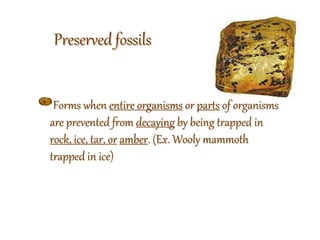
Forms when entire organisms or parts of organisms
are prevented from decaying by being trapped in
rock, ice, tar, or amber. (Ex. Wooly mammoth
trapped in ice)
Preserved remains
Ice Man discovery

3 Fossils PowerPoint.ppt

  • 1.
    FOSSILS What are fossils? Whereare fossils found? How are fossils formed? What are the types of fossils? Do fossils tell us about our past?
  • 2.
    What are fossils? •Fossils are preserved remains or traces of living things. • Latin meaning of fossil “to dig” • Fossils tell us not only when and where organisms once lived, but also how they lived. • Paleontologists – scientists who studies fossils.
  • 3.
    ◊ Fossils aremost often found in sedimentary rocks. Sedimentary rock is the type of rock that is made of hardened sediment (broken pieces of other rock). ◊ The heat and pressure involved in forming igneous and metamorphic rocks most often destroy fossil material. Where are fossils found?
  • 4.
    • Most fossilsformwhen living thing die andare buried by sediments. The sediments slowly harden into rock and preserve the shapes of the organisms. • Usually, the remains of dead plants and animals are quickly destroyed. Scavengers eat the dead organisms, or fungi and microorganisms cause them to decay • Organisms havea better chance of being preservedif theyhave hardparts; i.e. bones, shells, teeth, seeds, and woody stems. How are fossils formed?
  • 5.
    • Fossils foundin rock include: petrified fossils, molds and casts, carbon films, and trace fossils. Other fossils form when the remains of organisms are preserved in substances such as tar, amber, or ice. • Petrified fossils – minerals replace all or part of an organism. • Molds – a hollow area in the shape of or part of an organism. • Casts – a copy of the shape of the organism. • Carbon films – an extremely thin coating of carbon on rock (sediment squeezes almost the entire decaying organism away). • Trace fossils – provide evidence of the activities of living organisms. Ex. Fossilized footprints. • Preserved remains – the entire organism remains with little or no change: preserved by tar, amber (sap or resin), or ice. What are the types of fossils?
  • 6.
    Change Over Time •Fossil record – provides evidence about the history of life on Earth. The fossil record also shows that different groups of organisms have changed over time. • Older rocks – contain fossils of simpler organisms. • Younger rocks – contain fossils of more complex organisms. • Scientific theory – well –tested concept that explains a wide range of observations. • Evolution – is the gradual change in living things over long periods of time. • Extinct – when an organism no longer exists anywhere on Earth. Do fossils tell us about our past?
  • 7.
    Do fossils tellus about our past? Fossils and past Environments •Fossils provide evidence of Earth’s past climateand environment. For example: coal has been found in Antarctica. Coal forms from plants in warm, swampy regions; therefore, that means that Antarctica was not always cold as it is today.
  • 8.
    Formation of Kindsof Fossils Petrifiedfossils forms by replacement minerals in water that make a copy of the organism. The fossil formed when sediment covered the organism.
  • 9.
    Molds & Casts Molds: formswhen the hard part of the organism, such as a shell, is buried in sediment. The organism decays leaving a hollow mold in the shape of the object. Casts: forms if water deposits minerals and sediments into a mold. The sediments harden into the shape of the mold looking like the original organism.
  • 10.
  • 11.
  • 12.
    Would this bea cast fossil or a mold fossil?
  • 13.
    Carbon films forms whensediment buries an organism, the weight of the sediment squeezes almost the entire decaying organism away leaving a carbon print of the organism.
  • 14.
    Trace fossils forms whenmud or sand that the animal stepped into eventually was buried by layers of sediments. Slowly the sediment became solid rock preserving the footprints for millions of years.
  • 15.
  • 16.
    Preserved fossils Forms whenentire organisms or parts of organisms are prevented from decaying by being trapped in rock, ice, tar, or amber. (Ex. Wooly mammoth trapped in ice)
  • 17.
  • 18.