PROCESSES OF FOSSILIZATION
&
CONDITION REQUIRED FOR IT
DR. MUHAMMAD TARIQ
DEPARTMENT OF ZOOLOGY
GOVT. COLLEGE OF SCIENCE,
WAHDAT ROAD, LAHORE
FOSSILIZATION
•The process of a once
living organism
becoming a fossil is
called Fossilization.
FOSSILIZATION….contd….
•Fossilization is a very rare
process:
•Of all the organisms that have
lived on Earth,
•Only a very low percentage of
them ever become fossils.
•For animals that lack
hard shells or bones,
fossilization is even
more rare.
•As a result, the fossil record
contains many animals with
shells, bones, or
•Other hard parts, & few
softbodied organisms.
•There is virtually no fossil
record of jellyfish, worms, or
slugs.
•Insects, which are by far the
most common land animals,
•are only rarely found as fossils.
•Because mammal teeth are
much more resistant than other
bones,
• A large portion of the mammal
fossil record consists of teeth.
•This means the fossil
record will show many
organisms
•that had shells, bones or
other hard parts &
•Will almost always miss
the many soft-bodied
organisms that lived at
the same time.
TYPES
OF
FOSSILIZATION
TYPES OF
FOSSILIZATION
• PERMINERALIZATION/
PETRIFICATION
• REPLACEMENT /MINERALIZATION
• DISTILLATION/CARBONIZATION
• TRACES OF ORGANISMS
TYPES OF FOSSILIZATION
(i) PERMINERALIZATION/PETRIFICATION
• A type of fossilization in which
minerals are deposited into the pores
of the original hard parts of an
organism.
TYPES OF FOSSILIZATION
(i) PERMINERALIZATION/PETRIFICATION
• The most common method of
fossilization is permineralization.
• After a bone, wood fragment, or
shell is buried in sediment,
TYPES OF FOSSILIZATION
(i) PERMINERALIZATION/PETRIFICATION
• It may be exposed to mineral-rich
water that moves through the
sediment.
• This water will deposit minerals into
empty spaces, producing a fossil.
TYPES OF FOSSILIZATION
(i) PERMINERALIZATION/PETRIFICATION
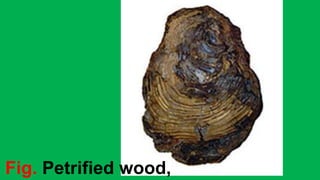
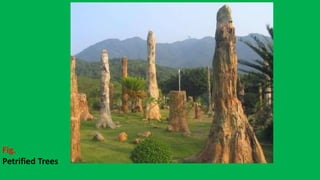
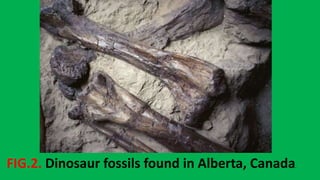
• E.g., Fossil Dinosaur bones,
petrified wood, & many marine
fossils were formed by
permineralization.
Fig. Petrified wood,
Fig.
Petrified Trees
FIG.2. Dinosaur fossils found in Alberta, Canada.
TYPES OF FOSSILIZATION
(i) PERMINERALIZATION/PETRIFICATION
• This type of fossilization takes
place
• when mineral-bearing ground
waters infiltrate porous bone,
shell, or plant material.
TYPES OF FOSSILIZATION
(i) PERMINERALIZATION/PETRIFICATION
• With the passing of time, these
underground waters will
deposit their mineral content in
the empty spaces of the hard
parts,
TYPES OF FOSSILIZATION
(i) PERMINERALIZATION/PETRIFICATION
• Thus making them heavier
& more resistant to
weathering.
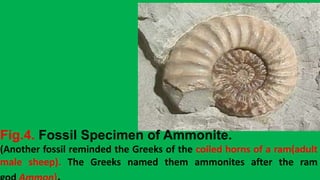
Fig.4. Fossil Specimen of Ammonite.
(Another fossil reminded the Greeks of the coiled horns of a ram(adult
male sheep). The Greeks named them ammonites after the ram
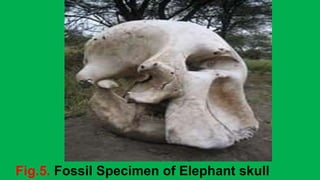
Fig.5. Fossil Specimen of Elephant skull
REPLACEMENT /
MINERALIZATION
• In some cases, the original
shell or bone dissolves away
• & is replaced by a different
mineral.
REPLACEMENT /MINERALIZATION
• E.g., Shells that were originally calcite
may be replaced by dolomite, quartz,
or pyrite.
• If quartz fossils are surrounded by a
calcite matrix, the calcite can be
dissolved away by acid,
REPLACEMENT /MINERALIZATION
Contd….
• Leaving behind an exquisitely
preserved quartz fossil.
REPLACEMENT/MINERALIZATION
•This occurs when the original
hard parts of an organism are
removed
•After being dissolved by
circulating groundwater.
REPLACEMENT/MINERALIZATION
•As the hard parts are dissolved
•there is almost a simultaneous
deposition of other mineral
substances in the resulting voids.
REPLACEMENT/MINERALIZATION
•In some replaced fossils the
original structure will have been
destroyed by the replacing
minerals.
REPLACEMENT/MINERALIZATION
•However, in others, as in the
case of certain mineralized tree
trunks,
•The remains may be preserved
in minute detail.
CARBONIZATION & DISTILLATION
•This process takes place as the
organic material slowly decays after
burial.
•During the process of
decomposition, the organic matter
gradually loses its gases & liquids,
CARBONIZATION &
DISTILLATION….contd…
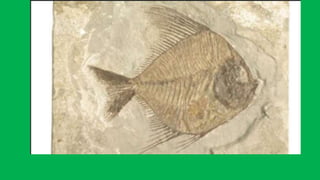
•leaving behind a thin film of
carbon.
•This is the process by which
coal is formed, &
CARBON FOSSILS…contd….
• The thin layer of
carbon left behind
CARBON FOSSILS…contd….
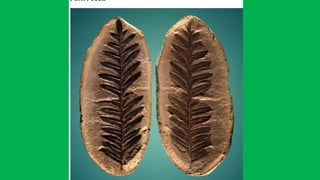
• Can show an organism’s
delicate parts like leaves
or plant
• E.g. Fern fossil 300 MYs
old.
CARBONIZATION &
DISTILLATION….contd…
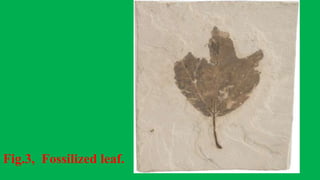
•Carbonized plant fossils
are commonly found in
many coal deposits.
Fig.3, Fossilized leaf.
CARBONIZATION &
DISTILLATION….contd…
•E.g., In addition, the remains of
fish, graptolites, & reptiles have
been preserved by
carbonization.
TRACES OF ORGANISMS
•These are remains of traces or
imprints of once living
organisms.
•Examples include molds & casts
of organisms.
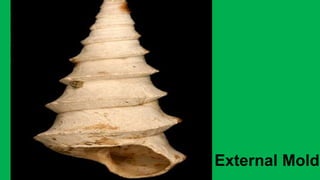
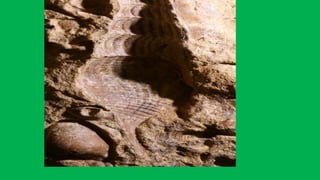
External Mold
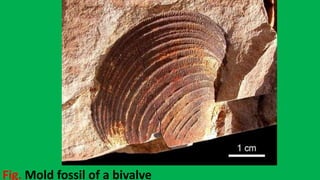
INTERNAL MOLDS:
• Molds of the underside of the
shell may be left on the
surface of rock
• That formed when sand or
mud filled the inside of the
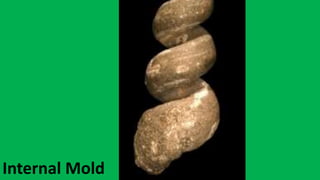
Internal Mold
Fig. Mold fossil of a bivalve
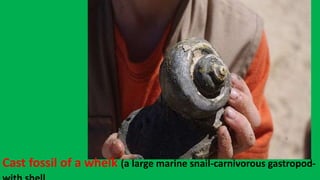
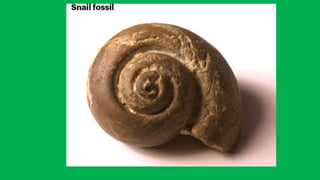
Cast fossil of a whelk (a large marine snail-carnivorous gastropod-
Casts fossils…..contd…
• E.g., Many mollusks i.e.
clams, snails, octopi &
squid,
• are commonly found as
casts.
TRACES OF
ORGANISMS…..contd……
•If for instance a shell had been
pressed down into the ocean
bottom before the sediment had
hardened into rock,
TRACES OF ORGANISMS…..contd…
•It may have left the impression of
the exterior of the shell.
•This impression is called a Mold.
•If at some later time this mold should
become filled with another material,
•This might produce a Cast.
TRACES OF ORGANISMS…..contd…
•A cast formed in this manner will show
the original external features of the
shell.
•Objects of this type are called external
molds
•If they show the external features of the
hard parts,
TRACES OF ORGANISMS…..contd…
•& Internal molds if the nature of
the inner parts is revealed.
•The tracks, trails & burrows
can be among the most useful –
•& puzzling – of all fossils.
TRACES OF ORGANISMS…..contd…
•Some of these, especially footprints,
may indicate not only the type of
animal that left them
•But may also furnish information
about how & where the animal
lived.
TRACKS AND TRAILS
• Tracks are footprints,
paw prints or claw
prints
TRACKS AND TRAILS
• Which become covered
with sediment before
they are washed away
by rain or wave.
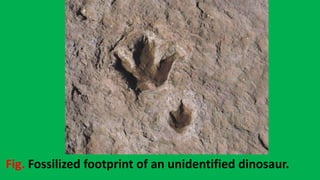
Fig. Fossilized footprint of an unidentified dinosaur.
TRACES OF ORGANISMS…..contd…
•For example, the study of a series of
the dinosaur tracks would not only
indicate the size & shape of the
dinosaur’s foot,
•But might also give indication as to
the weight & length of the animal.
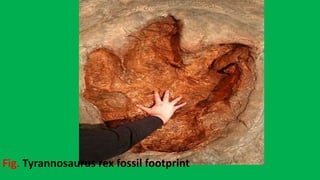
Fig. Tyrannosaurus rex fossil footprint
TRACES OF ORGANISMS…..contd…
•In addition, the type of rock
containing the tracks would
probably help to determine the
conditions under which the
animal had lived.
EXCEPTIONAL PRESERVATION
• Two of the most famous examples
of soft organism preservation are
• The Burgess Shale in Canada &
• The Solnhofen Limestone in
Germany.
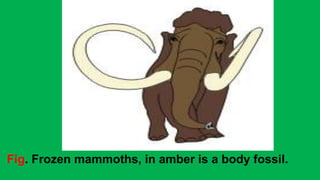
Fig. Frozen mammoths, in amber is a body fossil.
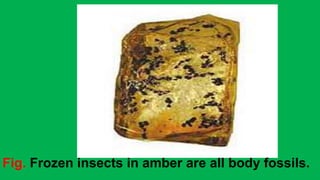
Fig. Frozen insects in amber are all body fossils.
EXCEPTIONAL PRESERVATION
• The Burgess Shale is 505 MY,s old &
• Records the first explosion of shelled
organisms in Earth’s oceans.
• Many of the Burgess Shale fossils are
bizarre animals (unconventional or unusual)
• That seem unrelated to any other
EXCEPTIONAL PRESERVATION
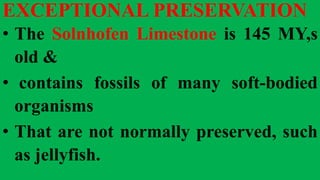
• The Solnhofen Limestone is 145 MY,s
old &
• contains fossils of many soft-bodied
organisms
• That are not normally preserved, such
as jellyfish.
EXCEPTIONAL PRESERVATION
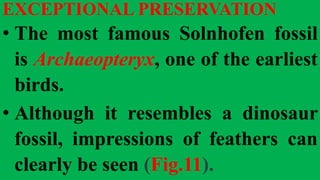
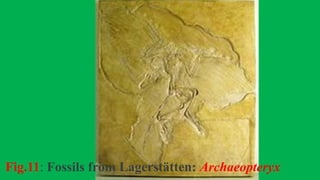
• The most famous Solnhofen fossil
is Archaeopteryx, one of the earliest
birds.
• Although it resembles a dinosaur
fossil, impressions of feathers can
clearly be seen (Fig.11).
Fig.11: Fossils from Lagerstätten: Archaeopteryx
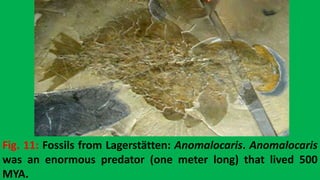
Fig. 11: Fossils from Lagerstätten: Anomalocaris. Anomalocaris
was an enormous predator (one meter long) that lived 500
MYA.
CONCLUSIONS
•Fossils are the remains & traces
of ancient plants & animals.
•For fossilization to take place,
•The original organism or plant
must posses hard parts,
CONCLUSIONS
•The organic remains
must escape destruction
immediately after death,
CONCLUSIONS
•& rapid burials must
take place in a material
capable of retarding
decomposition.
CONDITIONS REQUIRED FOR
FOSSILIZATION
In order for fossilization to take place, the
following conditions must be fulfilled:
i). Possesion of hard parts
ii). Escape immediate destruction after
death
iii). Rapid burial
CONDITIONS REQUIRED FOR
FOSSILIZATION
I). POSSESION OF HARD PARTS
•The organism should posses hard parts
e.g. bones, teeth, shells or woody tissue
of plant.
•However, even though the hard parts
are normally required,
CONDITIONS REQUIRED FOR
FOSSILIZATION
i). POSSESION OF HARD PARTS
•under unusually favorable
conditions of preservation,
•such fragile objects such as e.g.
jellyfish & insects have become
fossilized.
CONDITIONS REQUIRED FOR
FOSSILIZATION
ii). ESCAPE IMMEDIATE DESTRUCTION
AFTER DEATH
•The organic remains must escape
immediate destruction after death.
•If the hard parts of an organism should
be crushed, eroded or otherwise greatly
CONDITIONS REQUIRED FOR
FOSSILIZATION
ii). ESCAPE IMMEDIATE DESTRUCTION
AFTER DEATH
•This could result in the
alteration or complete
destruction of the fossil record
of that plant or animal.
CONDITIONS REQUIRED FOR
FOSSILIZATION
iii). RAPID BURIAL
•Rapid burial must take place in a
material capable of retarding
decomposition.
•In general the type of material in which
the remains are buried
CONDITIONS REQUIRED FOR
FOSSILIZATION
iii). RAPID BURIAL
•usually depends on where the
organisms lived
•e.g. the bones and shells of marine animals
are common as fossils
•Because they fell on the ocean floor after
CONDITIONS REQUIRED FOR
FOSSILIZATION
iii). RAPID BURIAL
•Under such conditions they were
covered by soft mud
•which later hardened to shales &
limestone of later geologic time.
CONDITIONS REQUIRED FOR
FOSSILIZATION
iii). RAPID BURIAL
•The soft muds are less likely to damage
the organism (organic remains).
•Certain fine-grained rocks
•e.g. limestone have faithfully preserved
delicate specimens as birds, insects &

Fossilization & conditions required for it.