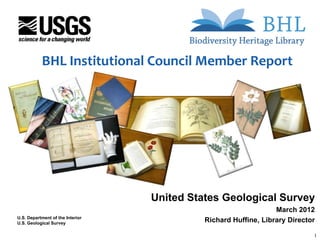
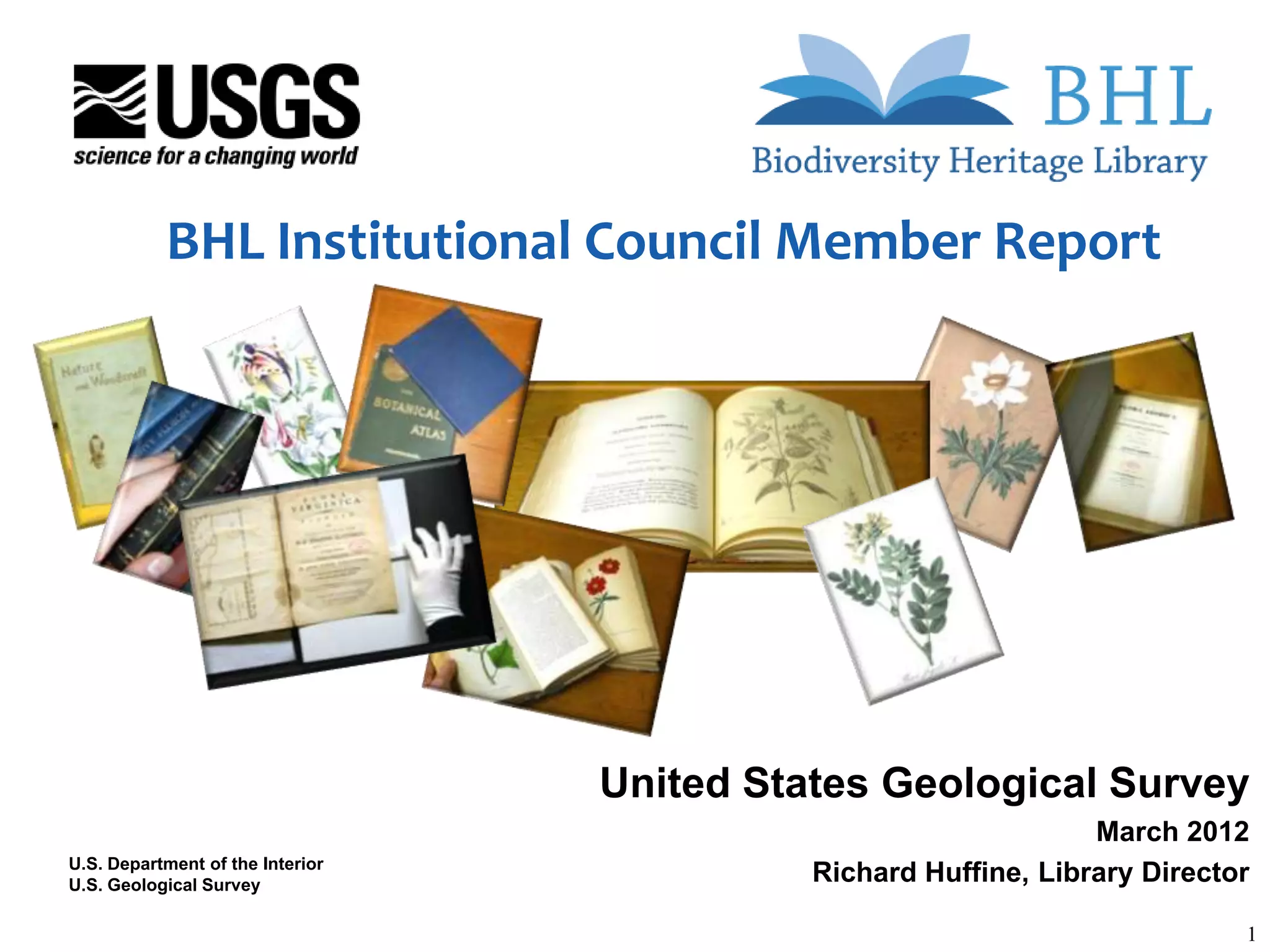
BHL Institutional Council Member Report


                                  United States Geological Survey
                                                                 March 2012
U.S. Department of the Interior
U.S. Geological Survey
                                            Richard Huffine, Library Director

                                                                            1
Brief History of Engagement
          Joined the BHL in November 2011
                Attended the Life and Literature Conference
          Met with Smithsonian-based BHL staff
          Acquired Digitization Equipment
                ScanPro 2000 – Microfilm/Microfiche
                Minolta PS 7000C MKII Color Book Scanner
          Scanned some sample material
                Currently trying to load using Macaw
          Submitted 6 books through Smithsonian
           IA contract
                Load completed 3/14/2012
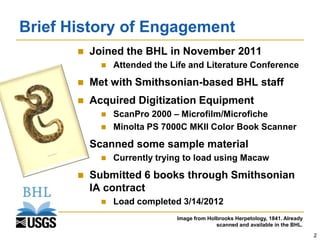
                               Image from Holbrooks Herpetology, 1841. Already
                                             scanned and available in the BHL.
                                                                                 2
Highlights
     The USGS is excited to contribute to BHL, both
      in content and capability, including:
           Strong collections in paleobotany and other
            scientific studies previously not included in the BHL
           Accessible collections that have been considered
            too rare for other institutions to scan
           Skills in geographic and geospatial technology that
            could improve the utility of BHL from place-based
            perspectives
           Interest in connecting biological and earth science
            research to improve understanding of the
            connections between geology, mineralogy, natural
            hazards and ecosystems

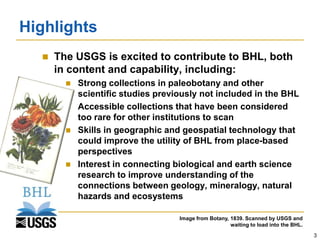
                                    Image from Botany, 1839. Scanned by USGS and
                                                       waiting to load into the BHL.
                                                                                       3
Accomplishments to Date
       We are scanning
            If we can get the Macaw service to work for us,
             we can add rare materials from our collection at a
             pretty good pace

       We are identifying collections
            We are reviewing our current inventories in
             biology, paleobotany, etc. and identifying
             materials that can be scanned

       We are building our capacity
            USGS staff have begun to appreciate the time
             and attention required to contribute to this effort
             and they are excited about the opportunity

                                Image from Die Alpenpflanzen (1879-1884). Scanned
                                         by USGS and waiting to load into the BHL.
                                                                                     4
Related Activities
       USGS has scanned over 75% of its’ published
        catalog
             Also collecting citations for USGS-authored works
              to represent USGS contributions to science
             Scanning is continuing as funds are identified
       Developing a Fedora Commons repository
             Also providing MODS Web Services and custom
              RSS feeds for interaction with the current system
       Recently released over 150,000 historic
        topographic maps in geoPDF format
             Producing 55,000 current topographic maps for
              the continental U.S. every 3 years

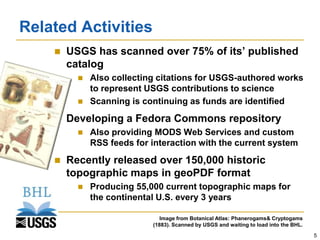
                               Image from Botanical Atlas: Phanerogams& Cryptogams
                            (1883). Scanned by USGS and waiting to load into the BHL.
                                                                                        5
Looking Forward
       The USGS is looking forward to becoming a
        valued partner in the next phase of the BHL
       We hope to bring breadth, depth, energy and
        enthusiasm to the project
       We look forward to supporting efforts to
        improve on the current capabilities and
        explore new ideas
       We appreciate the opportunity to contribute
        to this valuable effort
       We value the opportunity to partner with
        such esteemed institutions
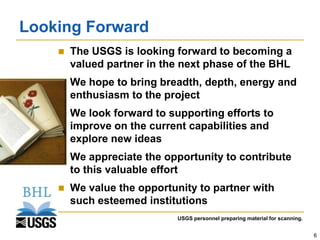
                             USGS personnel preparing material for scanning.


                                                                               6
Highlights
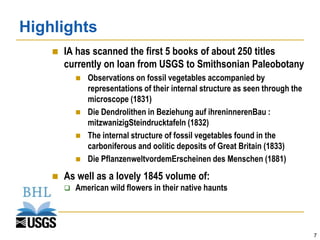
       IA has scanned the first 5 books of about 250 titles
        currently on loan from USGS to Smithsonian Paleobotany
               Observations on fossil vegetables accompanied by
                representations of their internal structure as seen through the
                microscope (1831)
               Die Dendrolithen in Beziehung auf ihreninnerenBau :
                mitzwanizigSteindrucktafeln (1832)
               The internal structure of fossil vegetables found in the
                carboniferous and oolitic deposits of Great Britain (1833)
               Die PflanzenweltvordemErscheinen des Menschen (1881)
       As well as a lovely 1845 volume of:
           American wild flowers in their native haunts


                                                                                  7
Highlights
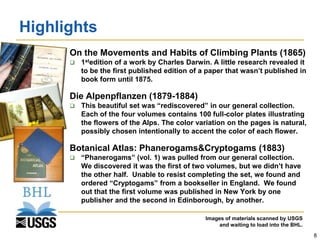
       On the Movements and Habits of Climbing Plants (1865)
           1stedition of a work by Charles Darwin. A little research revealed it
            to be the first published edition of a paper that wasn’t published in
            book form until 1875.

       Die Alpenpflanzen (1879-1884)
           This beautiful set was “rediscovered” in our general collection.
            Each of the four volumes contains 100 full-color plates illustrating
            the flowers of the Alps. The color variation on the pages is natural,
            possibly chosen intentionally to accent the color of each flower.

       Botanical Atlas: Phanerogams&Cryptogams (1883)
           “Phanerogams” (vol. 1) was pulled from our general collection.
            We discovered it was the first of two volumes, but we didn’t have
            the other half. Unable to resist completing the set, we found and
            ordered “Cryptogams” from a bookseller in England. We found
            out that the first volume was published in New York by one
            publisher and the second in Edinborough, by another.

                                                  Images of materials scanned by USGS
                                                       and waiting to load into the BHL.
                                                                                           8
Highlights
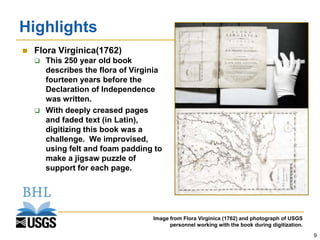
   Flora Virginica(1762)
     This 250 year old book
      describes the flora of Virginia
      fourteen years before the
      Declaration of Independence
      was written.
     With deeply creased pages
      and faded text (in Latin),
      digitizing this book was a
      challenge. We improvised,
      using felt and foam padding to
      make a jigsaw puzzle of
      support for each page.


                                  Image from Flora Virginica (1762) and photograph of USGS
                                        personnel working with the book during digitization.
                                                                                               9
Contacts

       Richard Huffine, Library Director
             703-648-7182
        rhuffine@usgs.gov
       Helen Tong, Digital Services Manager
            703-648-7182
        htong@usgs.gov
       Jenna Nolt, Digital Services Lead Developer
             (703) 648-6209
        jnolt@usgs.gov


                                                      10

BHLIC USGS Member Report, March 2012

  • 1.
    BHL Institutional CouncilMember Report United States Geological Survey March 2012 U.S. Department of the Interior U.S. Geological Survey Richard Huffine, Library Director 1
  • 2.
    Brief History ofEngagement  Joined the BHL in November 2011  Attended the Life and Literature Conference  Met with Smithsonian-based BHL staff  Acquired Digitization Equipment  ScanPro 2000 – Microfilm/Microfiche  Minolta PS 7000C MKII Color Book Scanner  Scanned some sample material  Currently trying to load using Macaw  Submitted 6 books through Smithsonian IA contract  Load completed 3/14/2012 Image from Holbrooks Herpetology, 1841. Already scanned and available in the BHL. 2
  • 3.
    Highlights  The USGS is excited to contribute to BHL, both in content and capability, including:  Strong collections in paleobotany and other scientific studies previously not included in the BHL  Accessible collections that have been considered too rare for other institutions to scan  Skills in geographic and geospatial technology that could improve the utility of BHL from place-based perspectives  Interest in connecting biological and earth science research to improve understanding of the connections between geology, mineralogy, natural hazards and ecosystems Image from Botany, 1839. Scanned by USGS and waiting to load into the BHL. 3
  • 4.
    Accomplishments to Date  We are scanning  If we can get the Macaw service to work for us, we can add rare materials from our collection at a pretty good pace  We are identifying collections  We are reviewing our current inventories in biology, paleobotany, etc. and identifying materials that can be scanned  We are building our capacity  USGS staff have begun to appreciate the time and attention required to contribute to this effort and they are excited about the opportunity Image from Die Alpenpflanzen (1879-1884). Scanned by USGS and waiting to load into the BHL. 4
  • 5.
    Related Activities  USGS has scanned over 75% of its’ published catalog  Also collecting citations for USGS-authored works to represent USGS contributions to science  Scanning is continuing as funds are identified  Developing a Fedora Commons repository  Also providing MODS Web Services and custom RSS feeds for interaction with the current system  Recently released over 150,000 historic topographic maps in geoPDF format  Producing 55,000 current topographic maps for the continental U.S. every 3 years Image from Botanical Atlas: Phanerogams& Cryptogams (1883). Scanned by USGS and waiting to load into the BHL. 5
  • 6.
    Looking Forward  The USGS is looking forward to becoming a valued partner in the next phase of the BHL  We hope to bring breadth, depth, energy and enthusiasm to the project  We look forward to supporting efforts to improve on the current capabilities and explore new ideas  We appreciate the opportunity to contribute to this valuable effort  We value the opportunity to partner with such esteemed institutions USGS personnel preparing material for scanning. 6
  • 7.
    Highlights  IA has scanned the first 5 books of about 250 titles currently on loan from USGS to Smithsonian Paleobotany  Observations on fossil vegetables accompanied by representations of their internal structure as seen through the microscope (1831)  Die Dendrolithen in Beziehung auf ihreninnerenBau : mitzwanizigSteindrucktafeln (1832)  The internal structure of fossil vegetables found in the carboniferous and oolitic deposits of Great Britain (1833)  Die PflanzenweltvordemErscheinen des Menschen (1881)  As well as a lovely 1845 volume of:  American wild flowers in their native haunts 7
  • 8.
    Highlights  On the Movements and Habits of Climbing Plants (1865)  1stedition of a work by Charles Darwin. A little research revealed it to be the first published edition of a paper that wasn’t published in book form until 1875.  Die Alpenpflanzen (1879-1884)  This beautiful set was “rediscovered” in our general collection. Each of the four volumes contains 100 full-color plates illustrating the flowers of the Alps. The color variation on the pages is natural, possibly chosen intentionally to accent the color of each flower.  Botanical Atlas: Phanerogams&Cryptogams (1883)  “Phanerogams” (vol. 1) was pulled from our general collection. We discovered it was the first of two volumes, but we didn’t have the other half. Unable to resist completing the set, we found and ordered “Cryptogams” from a bookseller in England. We found out that the first volume was published in New York by one publisher and the second in Edinborough, by another. Images of materials scanned by USGS and waiting to load into the BHL. 8
  • 9.
    Highlights  Flora Virginica(1762)  This 250 year old book describes the flora of Virginia fourteen years before the Declaration of Independence was written.  With deeply creased pages and faded text (in Latin), digitizing this book was a challenge. We improvised, using felt and foam padding to make a jigsaw puzzle of support for each page. Image from Flora Virginica (1762) and photograph of USGS personnel working with the book during digitization. 9
  • 10.
    Contacts  Richard Huffine, Library Director 703-648-7182 rhuffine@usgs.gov  Helen Tong, Digital Services Manager 703-648-7182 htong@usgs.gov  Jenna Nolt, Digital Services Lead Developer (703) 648-6209 jnolt@usgs.gov 10