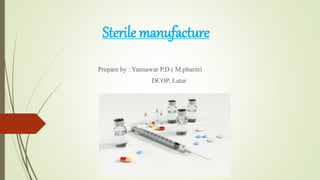
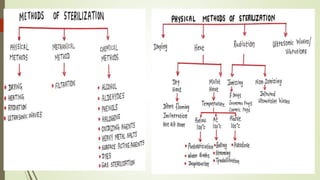
Sterile manufacture
Prepare by : Yannawar P.D ( M.pharm)
DCOP, Latur
Content
 Types of parenteral:
 Facilities requirement
 Layout of sterile product area:
 Additives used in parenteral or formulation of parenteral
 Production planning and processing:
 Tests for quality control:
Sterile products
 Sterile product are dosage form which are free from viable micro-organism.
 It includes parenteral and ophthalmic preparation and irrigating fluids.
 Parenteral
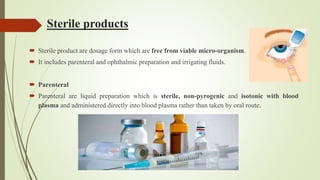
 Parenteral are liquid preparation which is sterile, non-pyrogenic and isotonic with blood
plasma and administered directly into blood plasma rather than taken by oral route.
Types of parenteral
PARENTERAL
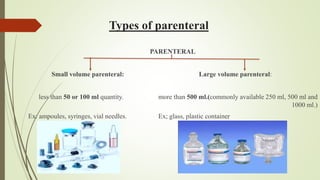
Small volume parenteral: Large volume parenteral:
less than 50 or 100 ml quantity. more than 500 ml.(commonly available 250 ml, 500 ml and
1000 ml.)
Ex: ampoules, syringes, vial needles. Ex; glass, plastic container
 Facility requirement
 Environmental control
 Traffic control
 Housekeeping
 Surface disinfection
 Air control
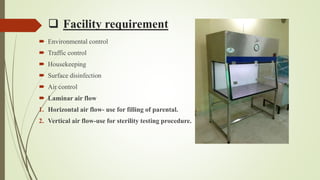
 Laminar air flow
1. Horizontal air flow- use for filling of parental.
2. Vertical air flow-use for sterility testing procedure.
Laminar air flow
 Definition:
• It provides unidirectional flow of air, which sweeps away dust, dirt, fibers, and microorganism &
• gives clean air moving with uniform velocity along with parallel line.
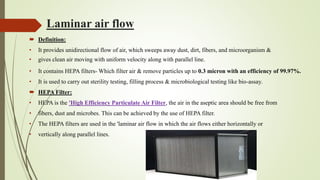
• It contains HEPA filters- Which filter air & remove particles up to 0.3 micron with an efficiency of 99.97%.
• It is used to carry out sterility testing, filling process & microbiological testing like bio-assay.
 HEPA Filter:
• HEPA is the 'High Efficiency Particulate Air Filter, the air in the aseptic area should be free from
• fibers, dust and microbes. This can be achieved by the use of HEPA filter.
• The HEPA filters are used in the 'laminar air flow in which the air flows either horizontally or
• vertically along parallel lines.
Layout of sterile product area:
 The sterile area can be divided into following categories:
1) Clean up area
2) Compounding or preparation area
3) Aseptic area
4) Quarantine area
5) Packaging & labeling area
Additives used in parenteral or Formulation of Parenteral
1. Vehicles
2. Anti-microbial agent
3. Antioxidant
4. Buffer
5. Preservatives
6. Tonicity contributors
.
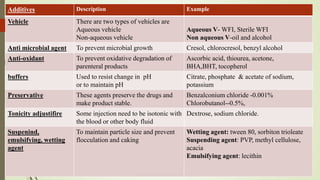
Additives Description Example
Vehicle There are two types of vehicles are
Aqueous vehicle
Non-aqueous vehicle
Aqueous V- WFI, Sterile WFI
Non aqueous V-oil and alcohol
Anti microbial agent To prevent microbial growth Cresol, chlorocresol, benzyl alcohol
Anti-oxidant To prevent oxidative degradation of
parenteral products
Ascorbic acid, thiourea, acetone,
BHA,BHT, tocopherol
buffers Used to resist change in pH
or to maintain pH
Citrate, phosphate & acetate of sodium,
potassium
Preservative These agents preserve the drugs and
make product stable.
Benzalconium chloride -0.001%
Chlorobutanol--0.5%,
Tonicity adjustifire Some injection need to be isotonic with
the blood or other body fluid
Dextrose, sodium chloride.
Suspenind,
emulsifying, wetting
agent
To maintain particle size and prevent
flocculation and caking
Wetting agent: tween 80, sorbiton trioleate
Suspending agent: PVP, methyl cellulose,
acacia
Emulsifying agent: lecithin
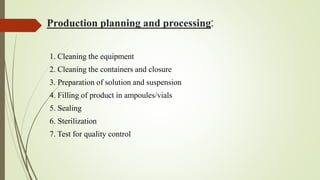
Production planning and processing:
1. Cleaning the equipment
2. Cleaning the containers and closure
3. Preparation of solution and suspension
4. Filling of product in ampoules/vials
5. Sealing
6. Sterilization
7. Test for quality control
.
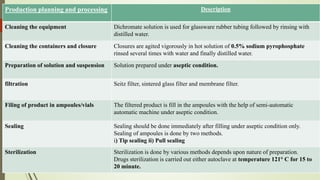
Production planning and processing Description
Cleaning the equipment Dichromate solution is used for glassware rubber tubing followed by rinsing with
distilled water.
Cleaning the containers and closure Closures are agited vigorously in hot solution of 0.5% sodium pyrophosphate
rinsed several times with water and finally distilled water.
Preparation of solution and suspension Solution prepared under aseptic condition.
filtration Seitz filter, sintered glass filter and membrane filter.
Filing of product in ampoules/vials The filtered product is fill in the ampoules with the help of semi-automatic
automatic machine under aseptic condition.
Sealing Sealing should be done immediately after filling under aseptic condition only.
Sealing of ampoules is done by two methods.
i) Tip sealing ii) Pull sealing
Sterilization Sterilization is done by various methods depends upon nature of preparation.
Drugs sterilization is carried out either autoclave at temperature 121° C for 15 to
20 minute.
Filling of product:
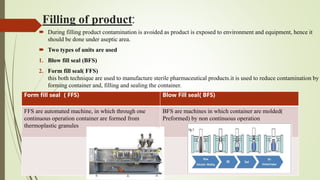
 During filling product contamination is avoided as product is exposed to environment and equipment, hence it
should be done under aseptic area.
 Two types of units are used
1. Blow fill seal (BFS)
2. Form fill seal( FFS)
this both technique are used to manufacture sterile pharmaceutical products.it is used to reduce contamination by
forming container and, filling and sealing the container.
Form fill seal ( FFS) Blow Fill seal( BFS)
FFS are automated machine, in which through one
continuous operation container are formed from
thermoplastic granules
BFS are machines in which container are molded(
Preformed) by non continuous operation
Sealing
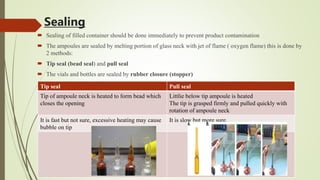
 Sealing of filled container should be done immediately to prevent product contamination
 The ampoules are sealed by melting portion of glass neck with jet of flame ( oxygen flame) this is done by
2 methods:
 Tip seal (bead seal) and pull seal
 The vials and bottles are sealed by rubber closure (stopper)
Tip seal Pull seal
Tip of ampoule neck is heated to form bead which
closes the opening
Littlie below tip ampoule is heated
The tip is grasped firmly and pulled quickly with
rotation of ampoule neck
It is fast but not sure, excessive heating may cause
bubble on tip
It is slow but more sure.
.
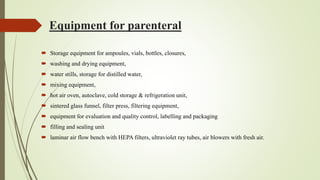
Equipment for parenteral
 Storage equipment for ampoules, vials, bottles, closures,
 washing and drying equipment,
 water stills, storage for distilled water,
 mixing equipment,
 hot air oven, autoclave, cold storage & refrigeration unit,
 sintered glass funnel, filter press, filtering equipment,
 equipment for evaluation and quality control, labelling and packaging
 filling and sealing unit
 laminar air flow bench with HEPA filters, ultraviolet ray tubes, air blowers with fresh air.
Test for QC or evaluation of parenteral
Sterility test
Pyrogen test
Clarity test
Leakage test
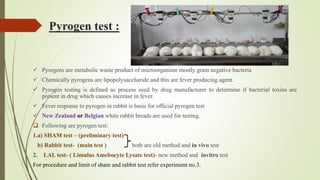
Pyrogen test :
 Pyorgens are metabolic waste product of microorganism mostly gram negative bacteria
 Chemically pyrogens are lipopolysaccharide and this are fever producing agent.
 Pyrogen testing is defined as process used by drug manufacturer to determine if bacterial toxins are
present in drug which causes increase in fever.
 Fever response to pyrogen in rabbit is basis for official pyrogen test
 New Zealand or Belgian white rabbit breads are used for testing.
 Following are pyrogen test:
1.a) SHAM test – (preliminary test)
b) Rabbit test- (main test ) both are old method and in vivo test
2. LAL test- ( Limulus Amebocyte Lysate test)- new method and invitro test
For procedure and limit of sham and rabbit test refer experiment no.3.
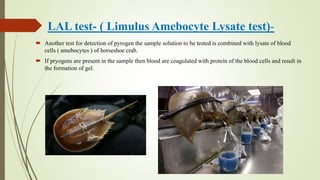
LAL test- ( Limulus Amebocyte Lysate test)-
 Another test for detection of pyrogen the sample solution to be tested is combined with lysate of blood
cells ( amebocytes ) of horseshoe crab.
 If pryogens are present in the sample then blood are coagulated with protein of the blood cells and result in
the formation of gel.
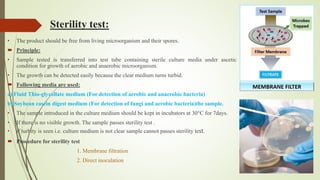
Sterility test:
• The product should be free from living microorganism and their spores.
 Principle:
• Sample tested is transferred into test tube containing sterile culture media under ascetic
condition for growth of aerobic and anaerobic microorganism.
• The growth can be detected easily because the clear medium turns turbid.
 Following media are used:
a) Fluid Thio-glycollate medium (For detection of aerobic and anaerobic bacteria)
b) Soybean casein digest medium (For detection of fungi and aerobic bacteria)the sample.
• The sample introduced in the culture medium should be kept in incubators at 30°C for 7days.
• If there is no visible growth. The sample passes sterility test .
• if turbity is seen i.e. culture medium is not clear sample cannot passes sterility test.
 Procedure for sterility test
1. Membrane filtration
2. Direct inoculation
Continue…
 Leaker test:
 Principal: An ampoule is sealed by fusion method. It is done to see sealing is proper or not.
 It is performed in a vacuum chamber. The ampoule is dipped entirely in colored dye solution. A
 1%Methylene blue solution is usually used .After releasing the vacuum ampoule is checked to see if dye
 has entered the parenteral preparation.
 Clarity Test:
 Principal: the parenteral sample is injected for particular matter like dust particle.
 Any ampoule bottle or vial can be seen under light against black and white background by the naked
 eyes. To perform this test the neck of filled container can be held against strongly illuminated screen. If
 some particles are visible the sample is rejected.

4.sterile manufacturing.pptx

  • 1.
    Sterile manufacture Prepare by: Yannawar P.D ( M.pharm) DCOP, Latur
  • 2.
    Content  Types ofparenteral:  Facilities requirement  Layout of sterile product area:  Additives used in parenteral or formulation of parenteral  Production planning and processing:  Tests for quality control:
  • 3.
    Sterile products  Sterileproduct are dosage form which are free from viable micro-organism.  It includes parenteral and ophthalmic preparation and irrigating fluids.  Parenteral  Parenteral are liquid preparation which is sterile, non-pyrogenic and isotonic with blood plasma and administered directly into blood plasma rather than taken by oral route.
  • 4.
    Types of parenteral PARENTERAL Smallvolume parenteral: Large volume parenteral: less than 50 or 100 ml quantity. more than 500 ml.(commonly available 250 ml, 500 ml and 1000 ml.) Ex: ampoules, syringes, vial needles. Ex; glass, plastic container
  • 5.
     Facility requirement Environmental control  Traffic control  Housekeeping  Surface disinfection  Air control  Laminar air flow 1. Horizontal air flow- use for filling of parental. 2. Vertical air flow-use for sterility testing procedure.
  • 6.
    Laminar air flow Definition: • It provides unidirectional flow of air, which sweeps away dust, dirt, fibers, and microorganism & • gives clean air moving with uniform velocity along with parallel line. • It contains HEPA filters- Which filter air & remove particles up to 0.3 micron with an efficiency of 99.97%. • It is used to carry out sterility testing, filling process & microbiological testing like bio-assay.  HEPA Filter: • HEPA is the 'High Efficiency Particulate Air Filter, the air in the aseptic area should be free from • fibers, dust and microbes. This can be achieved by the use of HEPA filter. • The HEPA filters are used in the 'laminar air flow in which the air flows either horizontally or • vertically along parallel lines.
  • 7.
    Layout of sterileproduct area:  The sterile area can be divided into following categories: 1) Clean up area 2) Compounding or preparation area 3) Aseptic area 4) Quarantine area 5) Packaging & labeling area
  • 8.
    Additives used inparenteral or Formulation of Parenteral 1. Vehicles 2. Anti-microbial agent 3. Antioxidant 4. Buffer 5. Preservatives 6. Tonicity contributors
  • 9.
    . Additives Description Example VehicleThere are two types of vehicles are Aqueous vehicle Non-aqueous vehicle Aqueous V- WFI, Sterile WFI Non aqueous V-oil and alcohol Anti microbial agent To prevent microbial growth Cresol, chlorocresol, benzyl alcohol Anti-oxidant To prevent oxidative degradation of parenteral products Ascorbic acid, thiourea, acetone, BHA,BHT, tocopherol buffers Used to resist change in pH or to maintain pH Citrate, phosphate & acetate of sodium, potassium Preservative These agents preserve the drugs and make product stable. Benzalconium chloride -0.001% Chlorobutanol--0.5%, Tonicity adjustifire Some injection need to be isotonic with the blood or other body fluid Dextrose, sodium chloride. Suspenind, emulsifying, wetting agent To maintain particle size and prevent flocculation and caking Wetting agent: tween 80, sorbiton trioleate Suspending agent: PVP, methyl cellulose, acacia Emulsifying agent: lecithin
  • 10.
    Production planning andprocessing: 1. Cleaning the equipment 2. Cleaning the containers and closure 3. Preparation of solution and suspension 4. Filling of product in ampoules/vials 5. Sealing 6. Sterilization 7. Test for quality control
  • 11.
    . Production planning andprocessing Description Cleaning the equipment Dichromate solution is used for glassware rubber tubing followed by rinsing with distilled water. Cleaning the containers and closure Closures are agited vigorously in hot solution of 0.5% sodium pyrophosphate rinsed several times with water and finally distilled water. Preparation of solution and suspension Solution prepared under aseptic condition. filtration Seitz filter, sintered glass filter and membrane filter. Filing of product in ampoules/vials The filtered product is fill in the ampoules with the help of semi-automatic automatic machine under aseptic condition. Sealing Sealing should be done immediately after filling under aseptic condition only. Sealing of ampoules is done by two methods. i) Tip sealing ii) Pull sealing Sterilization Sterilization is done by various methods depends upon nature of preparation. Drugs sterilization is carried out either autoclave at temperature 121° C for 15 to 20 minute.
  • 12.
    Filling of product: During filling product contamination is avoided as product is exposed to environment and equipment, hence it should be done under aseptic area.  Two types of units are used 1. Blow fill seal (BFS) 2. Form fill seal( FFS) this both technique are used to manufacture sterile pharmaceutical products.it is used to reduce contamination by forming container and, filling and sealing the container. Form fill seal ( FFS) Blow Fill seal( BFS) FFS are automated machine, in which through one continuous operation container are formed from thermoplastic granules BFS are machines in which container are molded( Preformed) by non continuous operation
  • 13.
    Sealing  Sealing offilled container should be done immediately to prevent product contamination  The ampoules are sealed by melting portion of glass neck with jet of flame ( oxygen flame) this is done by 2 methods:  Tip seal (bead seal) and pull seal  The vials and bottles are sealed by rubber closure (stopper) Tip seal Pull seal Tip of ampoule neck is heated to form bead which closes the opening Littlie below tip ampoule is heated The tip is grasped firmly and pulled quickly with rotation of ampoule neck It is fast but not sure, excessive heating may cause bubble on tip It is slow but more sure.
  • 14.
  • 15.
    Equipment for parenteral Storage equipment for ampoules, vials, bottles, closures,  washing and drying equipment,  water stills, storage for distilled water,  mixing equipment,  hot air oven, autoclave, cold storage & refrigeration unit,  sintered glass funnel, filter press, filtering equipment,  equipment for evaluation and quality control, labelling and packaging  filling and sealing unit  laminar air flow bench with HEPA filters, ultraviolet ray tubes, air blowers with fresh air.
  • 16.
    Test for QCor evaluation of parenteral Sterility test Pyrogen test Clarity test Leakage test
  • 17.
    Pyrogen test : Pyorgens are metabolic waste product of microorganism mostly gram negative bacteria  Chemically pyrogens are lipopolysaccharide and this are fever producing agent.  Pyrogen testing is defined as process used by drug manufacturer to determine if bacterial toxins are present in drug which causes increase in fever.  Fever response to pyrogen in rabbit is basis for official pyrogen test  New Zealand or Belgian white rabbit breads are used for testing.  Following are pyrogen test: 1.a) SHAM test – (preliminary test) b) Rabbit test- (main test ) both are old method and in vivo test 2. LAL test- ( Limulus Amebocyte Lysate test)- new method and invitro test For procedure and limit of sham and rabbit test refer experiment no.3.
  • 18.
    LAL test- (Limulus Amebocyte Lysate test)-  Another test for detection of pyrogen the sample solution to be tested is combined with lysate of blood cells ( amebocytes ) of horseshoe crab.  If pryogens are present in the sample then blood are coagulated with protein of the blood cells and result in the formation of gel.
  • 19.
    Sterility test: • Theproduct should be free from living microorganism and their spores.  Principle: • Sample tested is transferred into test tube containing sterile culture media under ascetic condition for growth of aerobic and anaerobic microorganism. • The growth can be detected easily because the clear medium turns turbid.  Following media are used: a) Fluid Thio-glycollate medium (For detection of aerobic and anaerobic bacteria) b) Soybean casein digest medium (For detection of fungi and aerobic bacteria)the sample. • The sample introduced in the culture medium should be kept in incubators at 30°C for 7days. • If there is no visible growth. The sample passes sterility test . • if turbity is seen i.e. culture medium is not clear sample cannot passes sterility test.  Procedure for sterility test 1. Membrane filtration 2. Direct inoculation
  • 20.
    Continue…  Leaker test: Principal: An ampoule is sealed by fusion method. It is done to see sealing is proper or not.  It is performed in a vacuum chamber. The ampoule is dipped entirely in colored dye solution. A  1%Methylene blue solution is usually used .After releasing the vacuum ampoule is checked to see if dye  has entered the parenteral preparation.  Clarity Test:  Principal: the parenteral sample is injected for particular matter like dust particle.  Any ampoule bottle or vial can be seen under light against black and white background by the naked  eyes. To perform this test the neck of filled container can be held against strongly illuminated screen. If  some particles are visible the sample is rejected.