
Formal Methods in
Software
Lecture 1. Introduction
Vlad Patryshev
SCU
2014
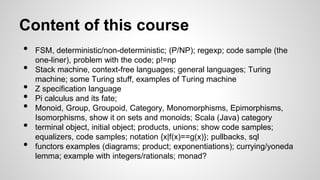
Content of this course
• FSM, deterministic/non-deterministic; (P/NP); regexp; code sample (the
one-liner), problem with the code; p!=np
• Stack machine, context-free languages; general languages; Turing
machine; some Turing stuff, examples of Turing machine
• Z specification language
• Pi calculus and its fate;
• Monoid, Group, Groupoid, Category, Monomorphisms, Epimorphisms,
Isomorphisms, show it on sets and monoids; Scala (Java) category
• terminal object, initial object; products, unions; show code samples;
equalizers, code samples; notation {x|f(x)==g(x)}; pullbacks, sql
• functors examples (diagrams; product; exponentiations); currying/yoneda
lemma; example with integers/rationals; monad?
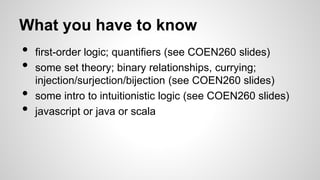
What you have to know
• first-order logic; quantifiers (see COEN260 slides)
• some set theory; binary relationships, currying;
injection/surjection/bijection (see COEN260 slides)
• some intro to intuitionistic logic (see COEN260 slides)
• javascript or java or scala
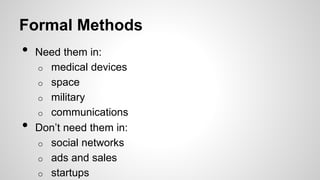
Formal Methods
• Need them in:
o medical devices
o space
o military
o communications
• Don’t need them in:
o social networks
o ads and sales
o startups
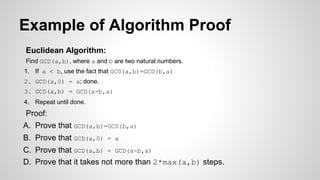
Example of Algorithm Proof
Euclidean Algorithm:
Find GCD(a,b), where a and b are two natural numbers.
1. If a < b, use the fact that GCD(a,b)=GCD(b,a)
2. GCD(a,0) = a; done.
3. GCD(a,b) = GCD(a-b,a)
4. Repeat until done.
Proof:
A. Prove that GCD(a,b)=GCD(b,a)
B. Prove that GCD(a,0) = a
C. Prove that GCD(a,b) = GCD(a-b,a)
D. Prove that it takes not more than 2*max(a,b) steps.
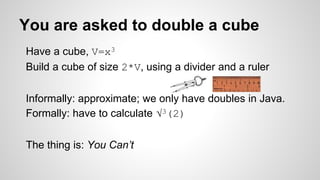
You are asked to double a cube
Have a cube, V=x3
Build a cube of size 2*V, using a divider and a ruler
Informally: approximate; we only have doubles in Java.
Formally: have to calculate √3(2)
The thing is: You Can’t
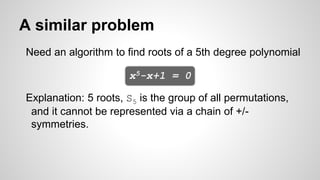
A similar problem
Need an algorithm to find roots of a 5th degree polynomial
Explanation: 5 roots, S5 is the group of all permutations,
and it cannot be represented via a chain of +/-
symmetries.
x5-x+1 = 0
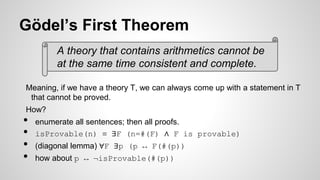
Gödel’s First Theorem
Meaning, if we have a theory T, we can always come up with a statement in T
that cannot be proved.
How?
• enumerate all sentences; then all proofs.
• isProvable(n) ≡ ∃F (n=#(F) ∧ F is provable)
• (diagonal lemma) ∀F ∃p (p ↔ F(#(p))
• how about p ↔ ¬isProvable(#(p))
A theory that contains arithmetics cannot be
at the same time consistent and complete.
Entscheidungsproblem
Is there an algorithm that, given a first-order theory, takes a statement
and checks whether the statement is true?
(The essence of the proof of program validity.)
The answer is: NO
Church proved that there is no computable function which decides for two
given λ calculus expressions whether they are equivalent or not.
Turing proved that it reduces to Halting Problem
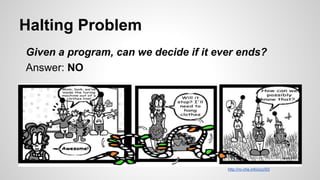
Halting Problem
Given a program, can we decide if it ever ends?
Answer: NO
http://ro-che.info/ccc/03
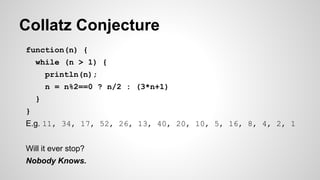
Collatz Conjecture
function(n) {
while (n > 1) {
println(n);
n = n%2==0 ? n/2 : (3*n+1)
}
}
E.g. 11, 34, 17, 52, 26, 13, 40, 20, 10, 5, 16, 8, 4, 2, 1
Will it ever stop?
Nobody Knows.
So, what can we do?
• limit ourselves by only provable algorithms
• count on the finiteness of the universe (is it finite?)
• count on the finiteness of time (is it finite?)
• write some unittests and pray (is it a formal method?!)
Unittests
• You cannot prove the program is right, but you can find errors
• Can cover main and corner cases
• Can check behavior independently from environment
• Can feel safe doing refactorings
Some people tried to formalize unittest creation (agitar.com) (see e.g. halting
problem)
Question: can you write a unittest for random numbers generator?
Formal methods   1 - introduction

Formal methods 1 - introduction

  • 1.
    Formal Methods in Software Lecture1. Introduction Vlad Patryshev SCU 2014
  • 2.
    Content of thiscourse • FSM, deterministic/non-deterministic; (P/NP); regexp; code sample (the one-liner), problem with the code; p!=np • Stack machine, context-free languages; general languages; Turing machine; some Turing stuff, examples of Turing machine • Z specification language • Pi calculus and its fate; • Monoid, Group, Groupoid, Category, Monomorphisms, Epimorphisms, Isomorphisms, show it on sets and monoids; Scala (Java) category • terminal object, initial object; products, unions; show code samples; equalizers, code samples; notation {x|f(x)==g(x)}; pullbacks, sql • functors examples (diagrams; product; exponentiations); currying/yoneda lemma; example with integers/rationals; monad?
  • 3.
    What you haveto know • first-order logic; quantifiers (see COEN260 slides) • some set theory; binary relationships, currying; injection/surjection/bijection (see COEN260 slides) • some intro to intuitionistic logic (see COEN260 slides) • javascript or java or scala
  • 4.
    Formal Methods • Needthem in: o medical devices o space o military o communications • Don’t need them in: o social networks o ads and sales o startups
  • 5.
    Example of AlgorithmProof Euclidean Algorithm: Find GCD(a,b), where a and b are two natural numbers. 1. If a < b, use the fact that GCD(a,b)=GCD(b,a) 2. GCD(a,0) = a; done. 3. GCD(a,b) = GCD(a-b,a) 4. Repeat until done. Proof: A. Prove that GCD(a,b)=GCD(b,a) B. Prove that GCD(a,0) = a C. Prove that GCD(a,b) = GCD(a-b,a) D. Prove that it takes not more than 2*max(a,b) steps.
  • 6.
    You are askedto double a cube Have a cube, V=x3 Build a cube of size 2*V, using a divider and a ruler Informally: approximate; we only have doubles in Java. Formally: have to calculate √3(2) The thing is: You Can’t
  • 7.
    A similar problem Needan algorithm to find roots of a 5th degree polynomial Explanation: 5 roots, S5 is the group of all permutations, and it cannot be represented via a chain of +/- symmetries. x5-x+1 = 0
  • 8.
    Gödel’s First Theorem Meaning,if we have a theory T, we can always come up with a statement in T that cannot be proved. How? • enumerate all sentences; then all proofs. • isProvable(n) ≡ ∃F (n=#(F) ∧ F is provable) • (diagonal lemma) ∀F ∃p (p ↔ F(#(p)) • how about p ↔ ¬isProvable(#(p)) A theory that contains arithmetics cannot be at the same time consistent and complete.
  • 9.
    Entscheidungsproblem Is there analgorithm that, given a first-order theory, takes a statement and checks whether the statement is true? (The essence of the proof of program validity.) The answer is: NO Church proved that there is no computable function which decides for two given λ calculus expressions whether they are equivalent or not. Turing proved that it reduces to Halting Problem
  • 10.
    Halting Problem Given aprogram, can we decide if it ever ends? Answer: NO http://ro-che.info/ccc/03
  • 11.
    Collatz Conjecture function(n) { while(n > 1) { println(n); n = n%2==0 ? n/2 : (3*n+1) } } E.g. 11, 34, 17, 52, 26, 13, 40, 20, 10, 5, 16, 8, 4, 2, 1 Will it ever stop? Nobody Knows.
  • 12.
    So, what canwe do? • limit ourselves by only provable algorithms • count on the finiteness of the universe (is it finite?) • count on the finiteness of time (is it finite?) • write some unittests and pray (is it a formal method?!)
  • 13.
    Unittests • You cannotprove the program is right, but you can find errors • Can cover main and corner cases • Can check behavior independently from environment • Can feel safe doing refactorings Some people tried to formalize unittest creation (agitar.com) (see e.g. halting problem) Question: can you write a unittest for random numbers generator?