Truth, Deduction,
Computation
Lecture E
Quantifiers, part 4 (final)
Vlad Patryshev
SCU
2013
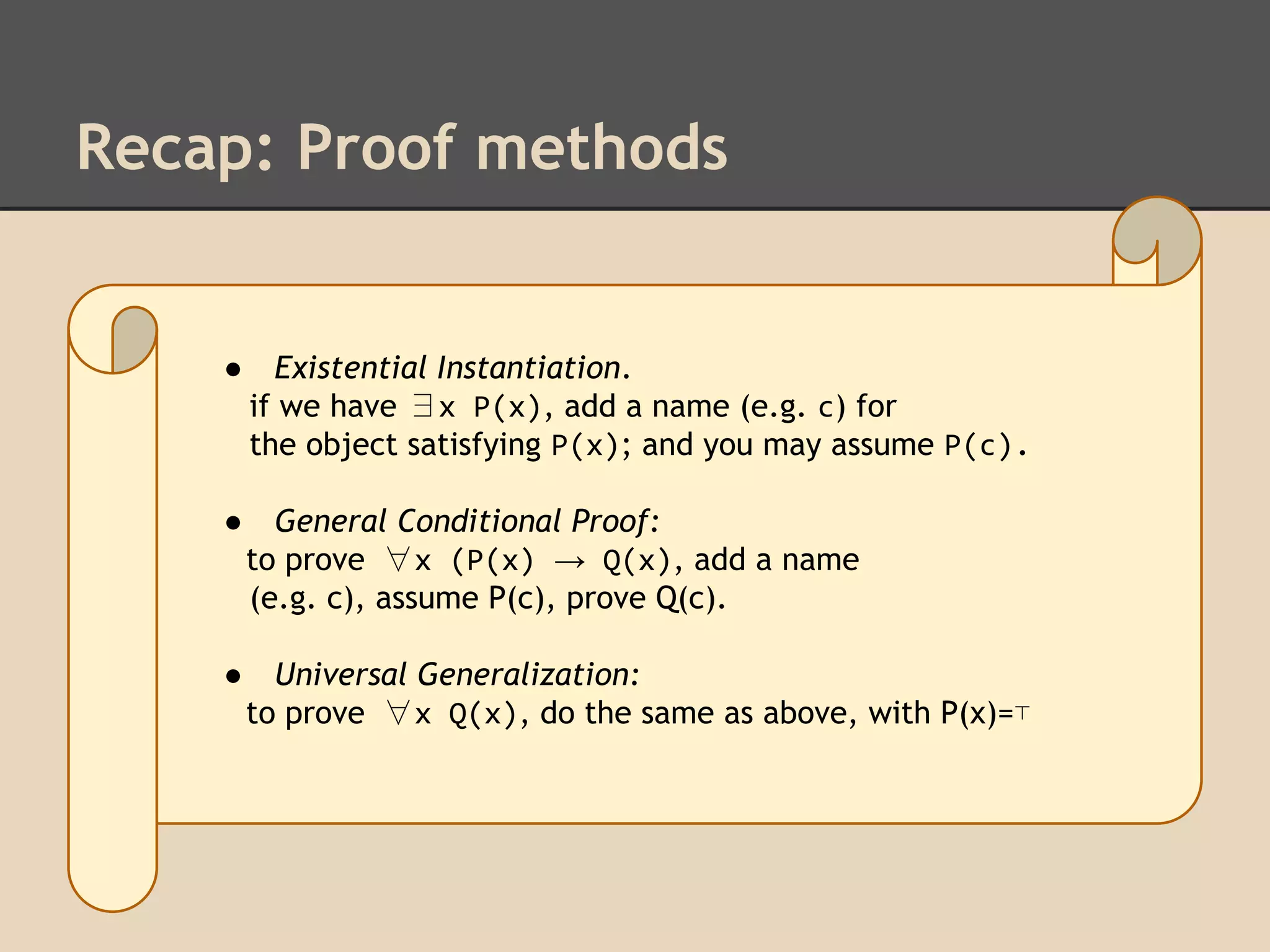
Recap: Proof methods

●

Existential Instantiation.
if we have ∃x P(x), add a name (e.g. c) for
the object satisfying P(x); and you may assume P(c).

●

General Conditional Proof:
to prove ∀x (P(x) → Q(x), add a name
(e.g. c), assume P(c), prove Q(c).

●

Universal Generalization:
to prove ∀x Q(x), do the same as above, with P(x)=⊤
Samples
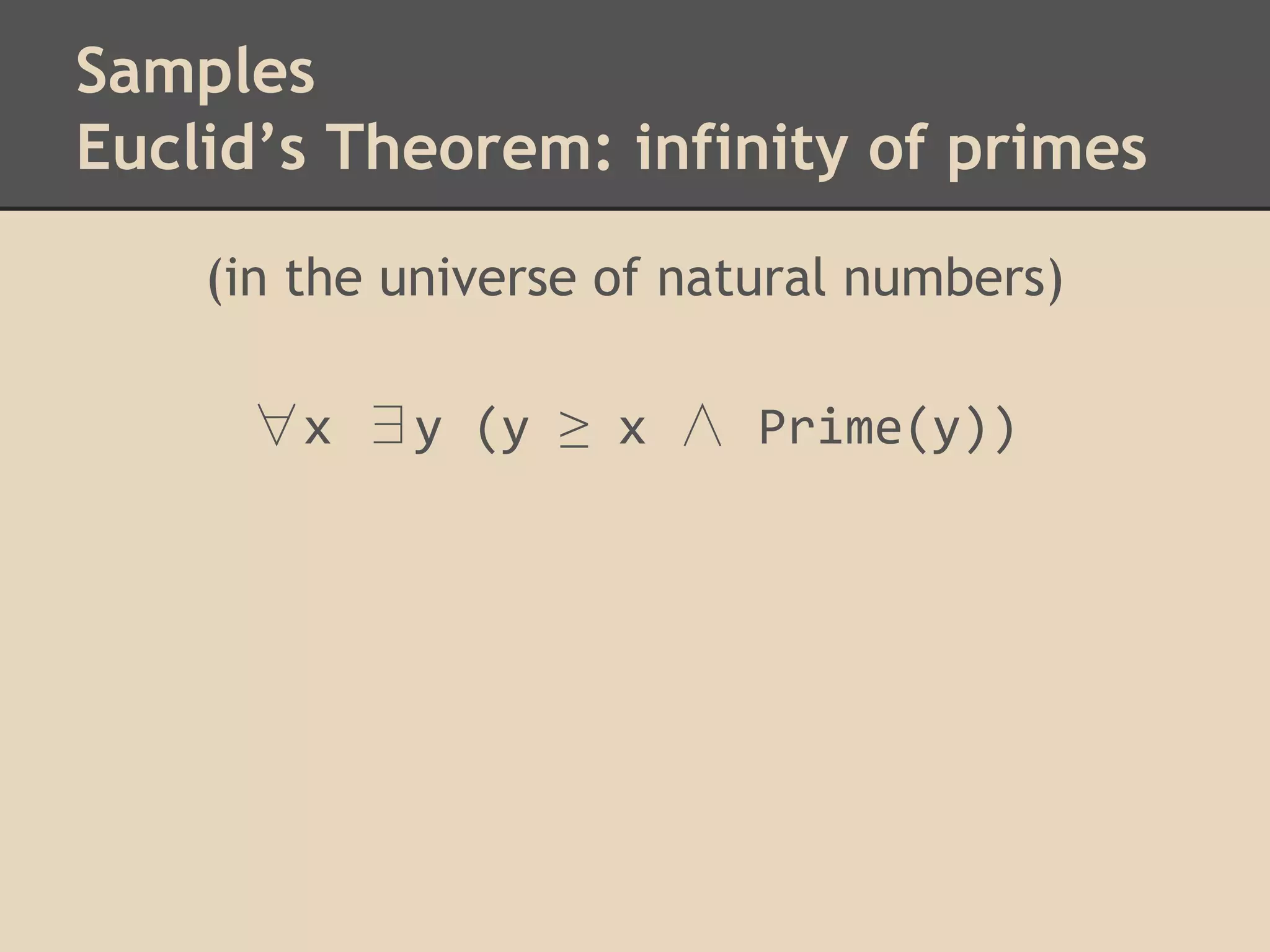
Euclid’s Theorem: infinity of primes
(in the universe of natural numbers)
∀x ∃y (y ≥ x ∧ Prime(y))
Samples
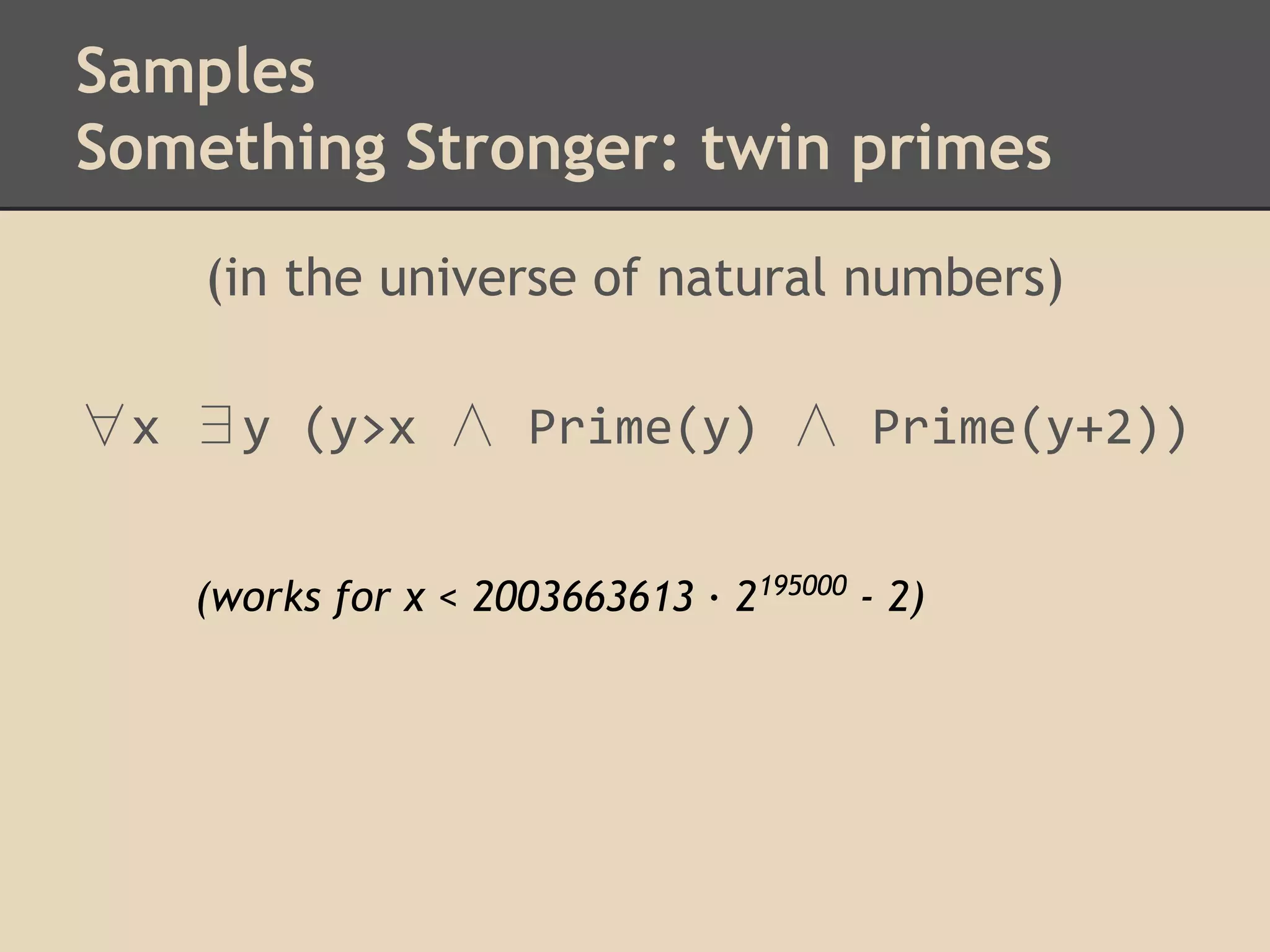
Something Stronger: twin primes
(in the universe of natural numbers)
∀x ∃y (y>x ∧ Prime(y) ∧ Prime(y+2))
(works for x < 2003663613 · 2195000 - 2)
Samples
Something Wronger
(in the universe of humans and towns)
∃z ∃x (BarberOf(x, z) ∧ ∀y (ManOf(y, z) →
(Shaves(x, y) ↔ ¬Shaves(y, y))))
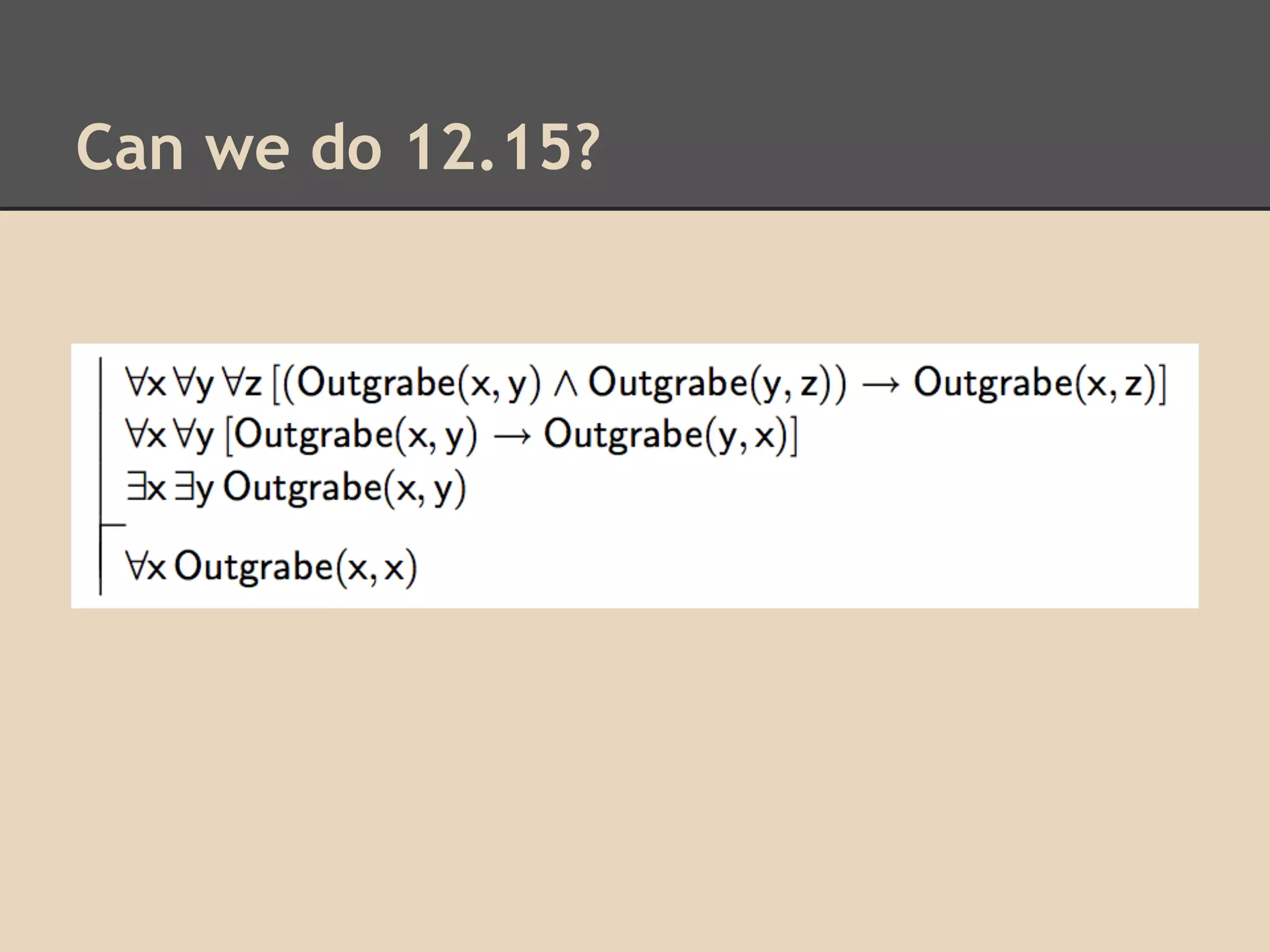
Can we do 12.15?
Add Axioms to Shape World
Basic Shape Axioms:
1.
2.
3.
4.

¬∃x(Cube(x)∧Tet(x))
¬∃x(Tet(x)∧Dodec(x))
¬∃x(Dodec(x)∧Cube(x))
∀x(Tet(x)∨Dodec(x)∨Cube(x))
Is this system Complete?
The book says yes.
“We say that a set of axioms is complete if, whenever an argument is intuitively
valid (given the meanings of the predicates and the intended range of
circumstances), its conclusion is a first-order consequence of its premises
taken together with the axioms in question.”

E.g. ∃x Cube(x)
E.g.∀x CanGiveToMyDog(x)
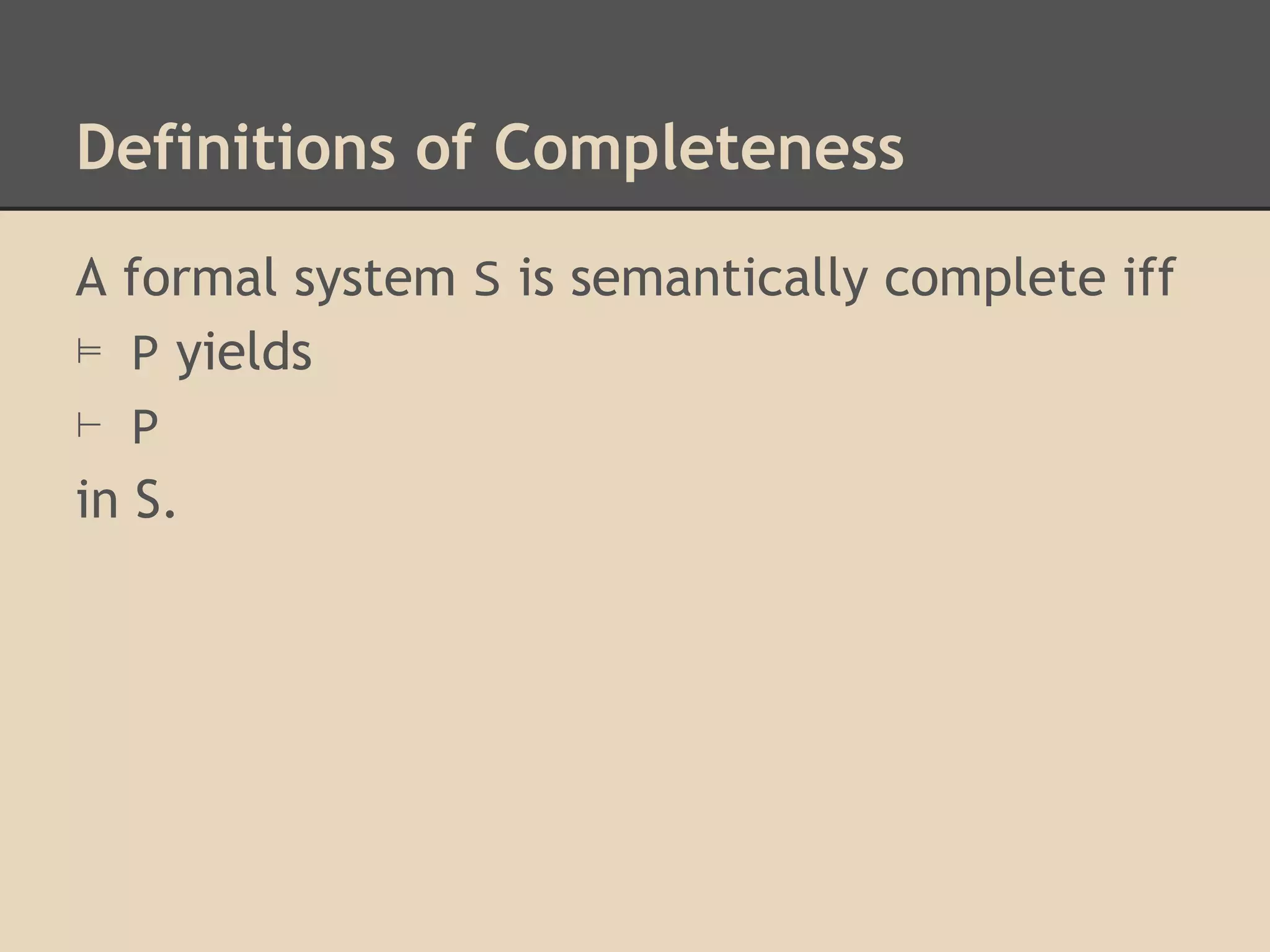
Definitions of Completeness
A formal system S is semantically complete iff
⊨ P yields
⊢ P
in S.
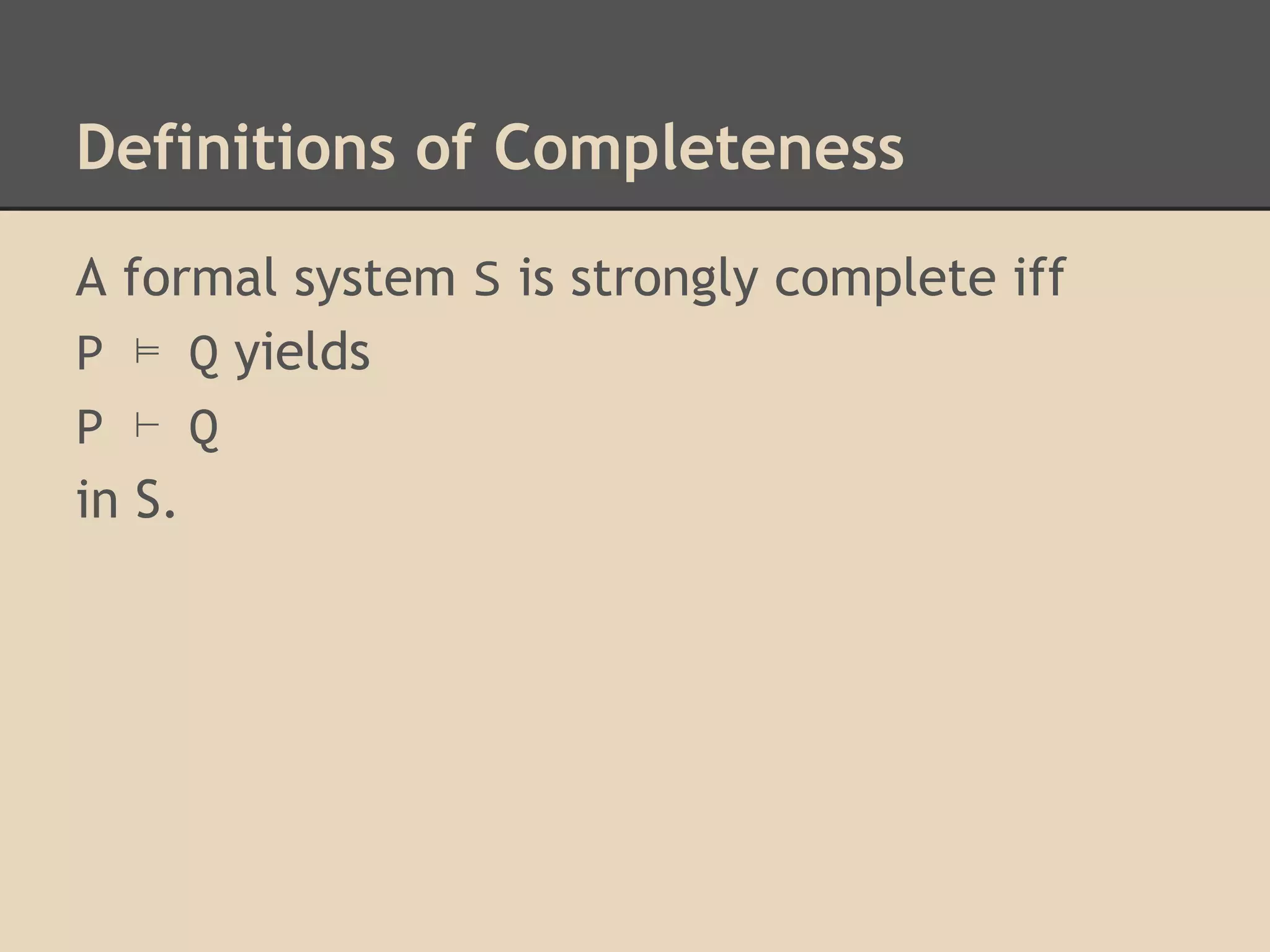
Definitions of Completeness
A formal system S is strongly complete iff
P ⊨ Q yields
P ⊢ Q
in S.
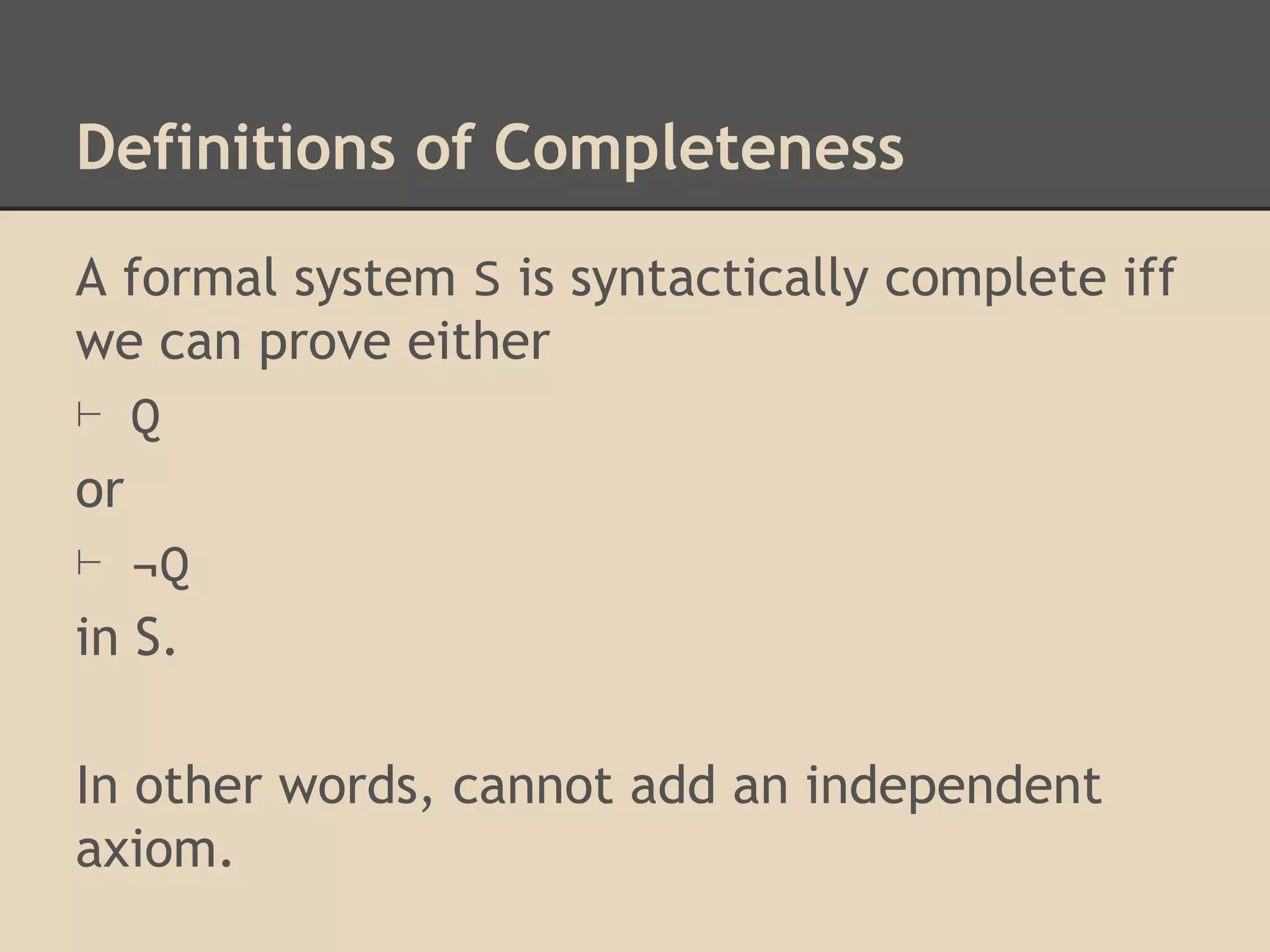
Definitions of Completeness
A formal system S is syntactically complete iff
we can prove either
⊢ Q
or
⊢ ¬Q
in S.
In other words, cannot add an independent
axiom.
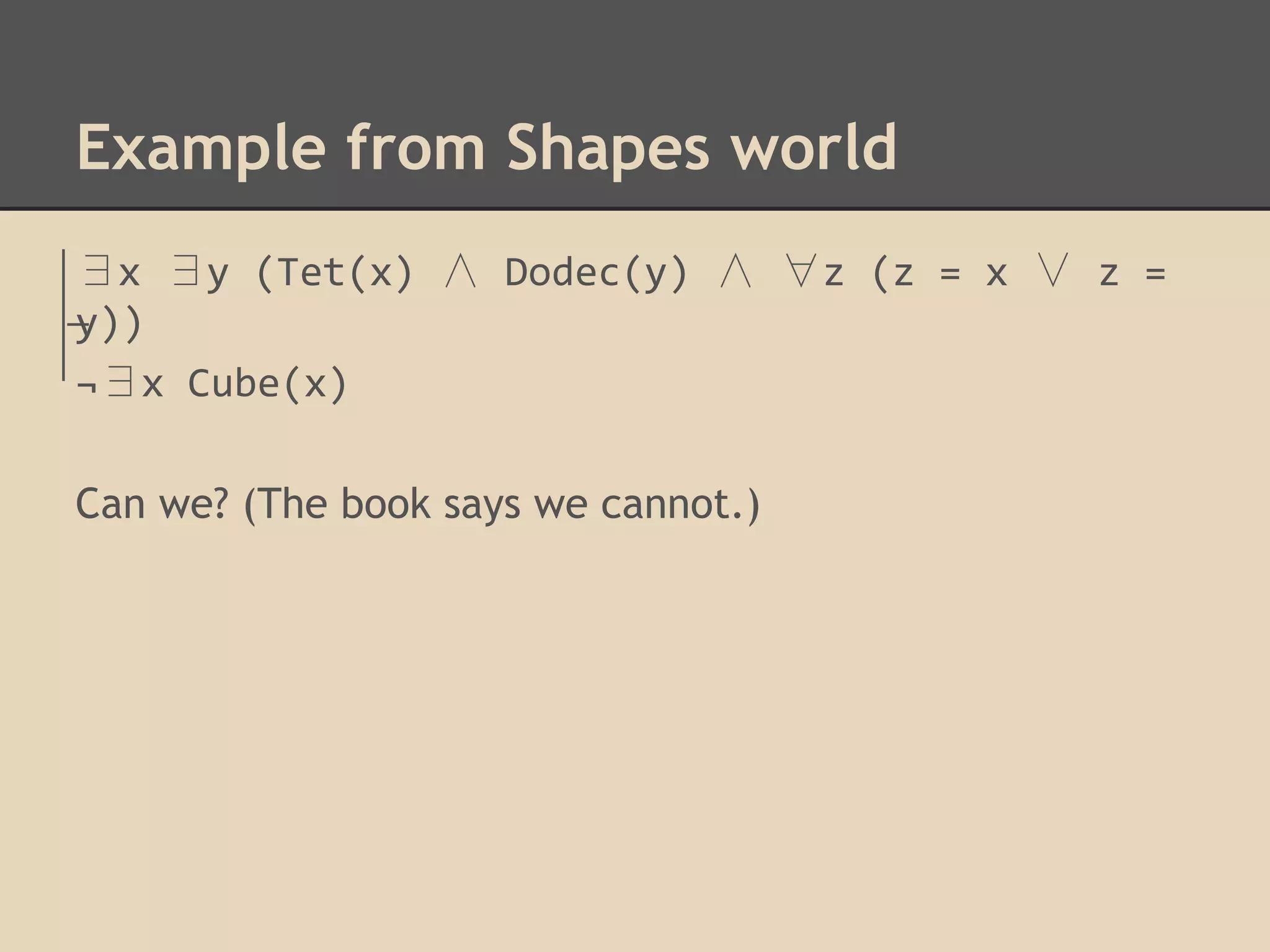
Example from Shapes world
∃x ∃y (Tet(x) ∧ Dodec(y) ∧ ∀z (z = x ∨ z =
y))
¬∃x Cube(x)
Can we? (The book says we cannot.)
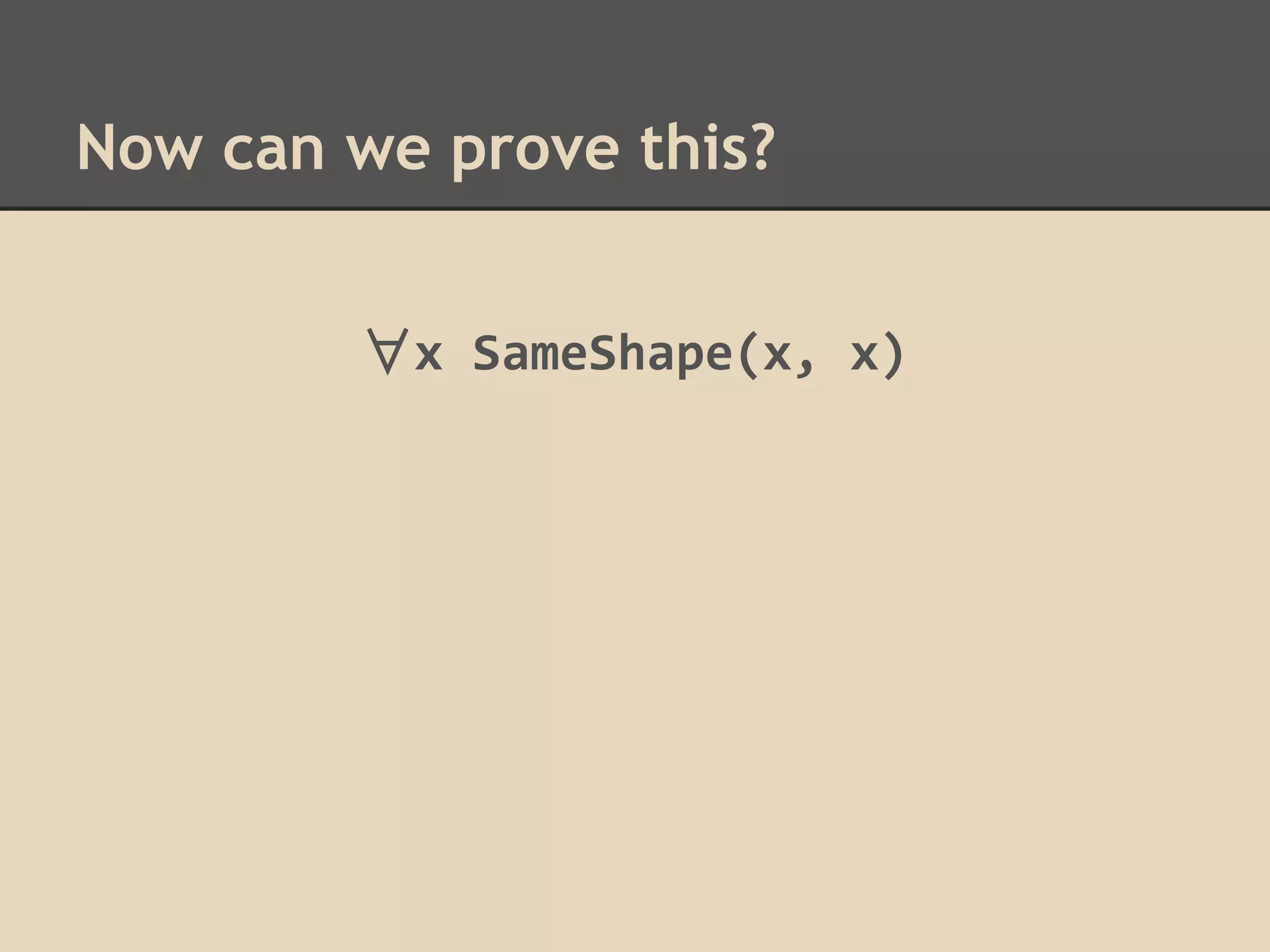
Now can we prove this?
∀x SameShape(x, x)
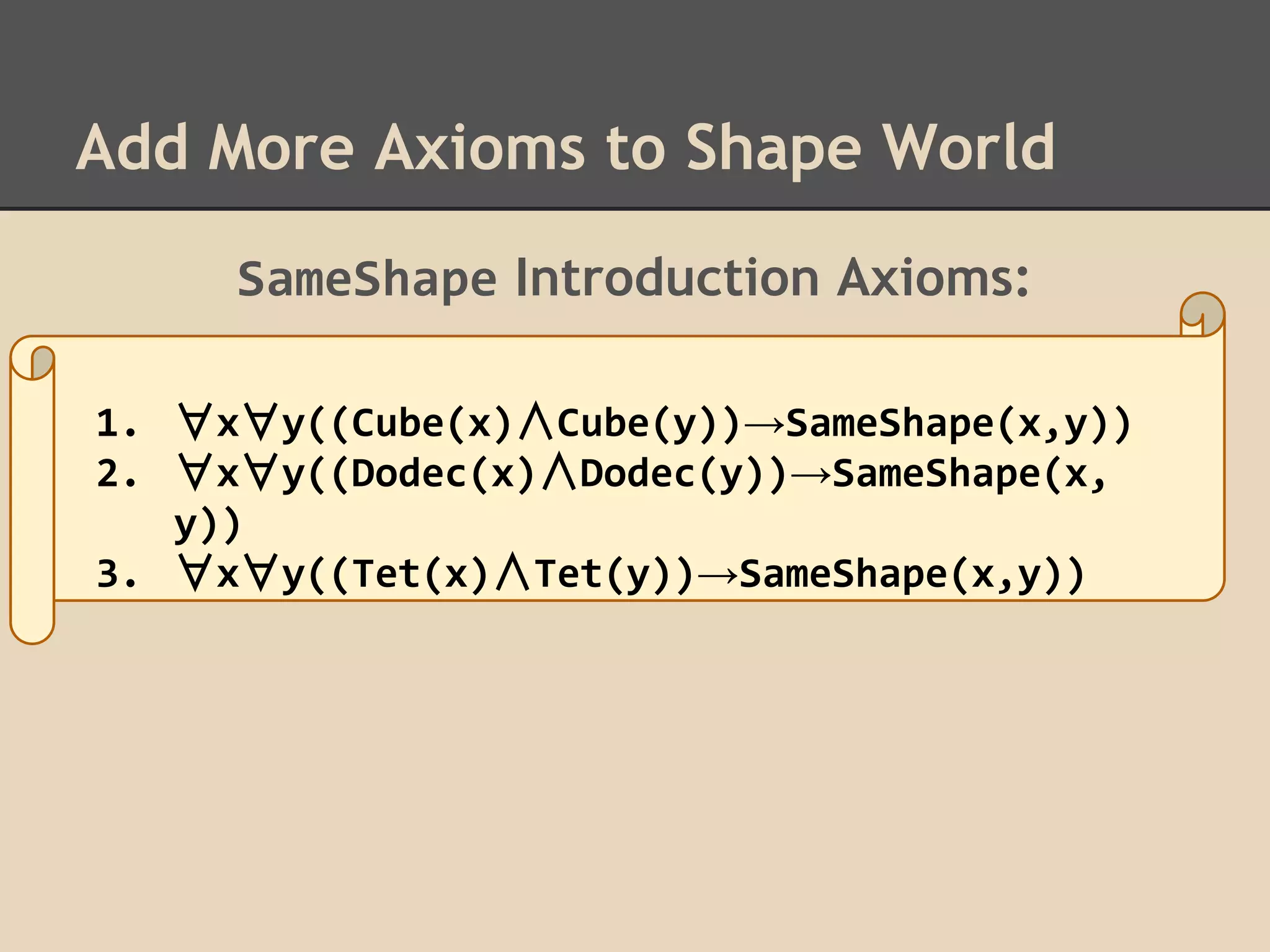
Add More Axioms to Shape World
SameShape Introduction Axioms:
1. ∀x∀y((Cube(x)∧Cube(y))→SameShape(x,y))
2. ∀x∀y((Dodec(x)∧Dodec(y))→SameShape(x,
y))
3. ∀x∀y((Tet(x)∧Tet(y))→SameShape(x,y))
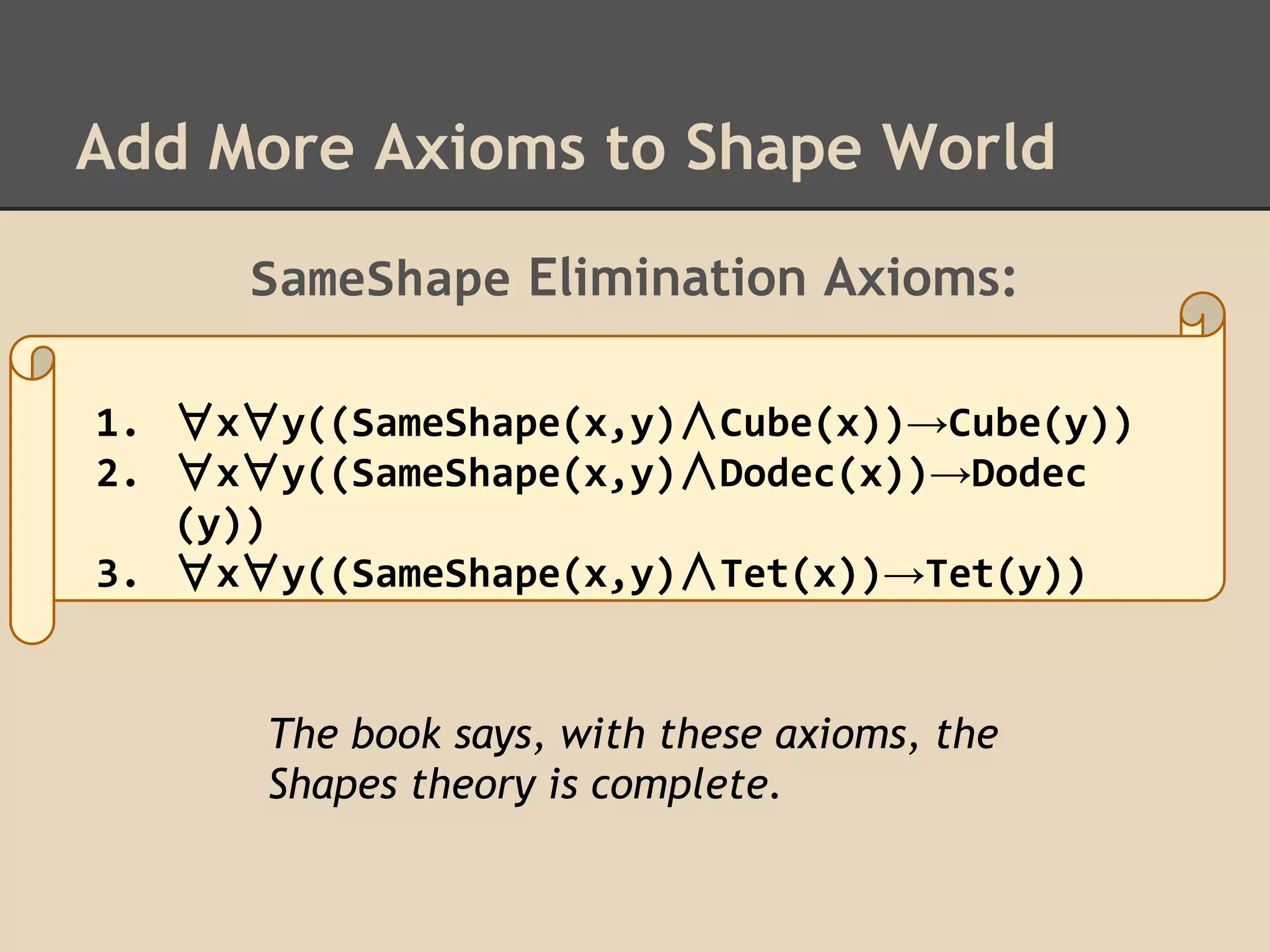
Add More Axioms to Shape World
SameShape Elimination Axioms:
1. ∀x∀y((SameShape(x,y)∧Cube(x))→Cube(y))
2. ∀x∀y((SameShape(x,y)∧Dodec(x))→Dodec
(y))
3. ∀x∀y((SameShape(x,y)∧Tet(x))→Tet(y))

The book says, with these axioms, the
Shapes theory is complete.
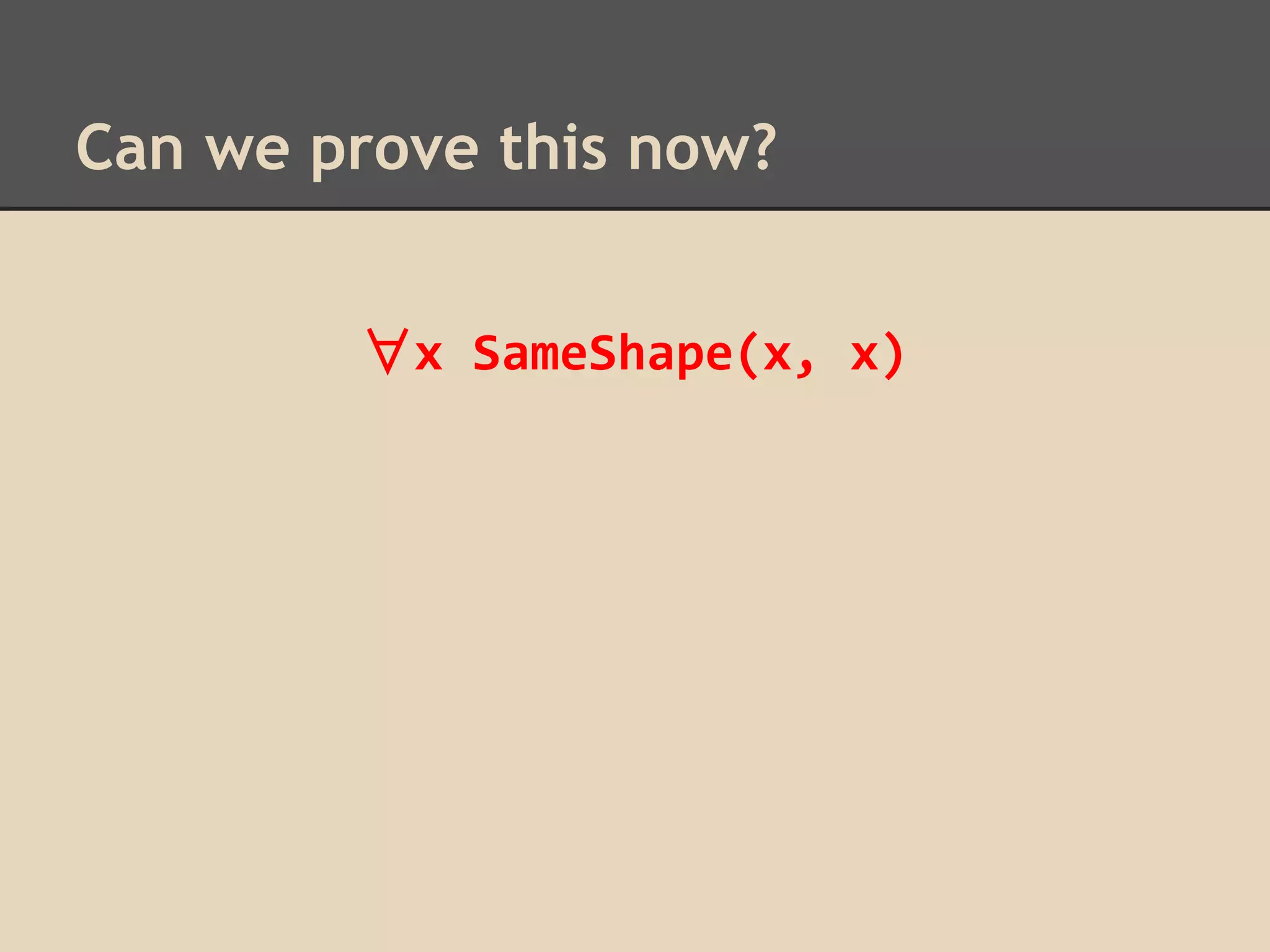
Can we prove this now?
∀x SameShape(x, x)
Truth, Deduction,
Computation
Lecture F part 2
Quantifiers, Formal Proofs
Vlad Patryshev
SCU
2013
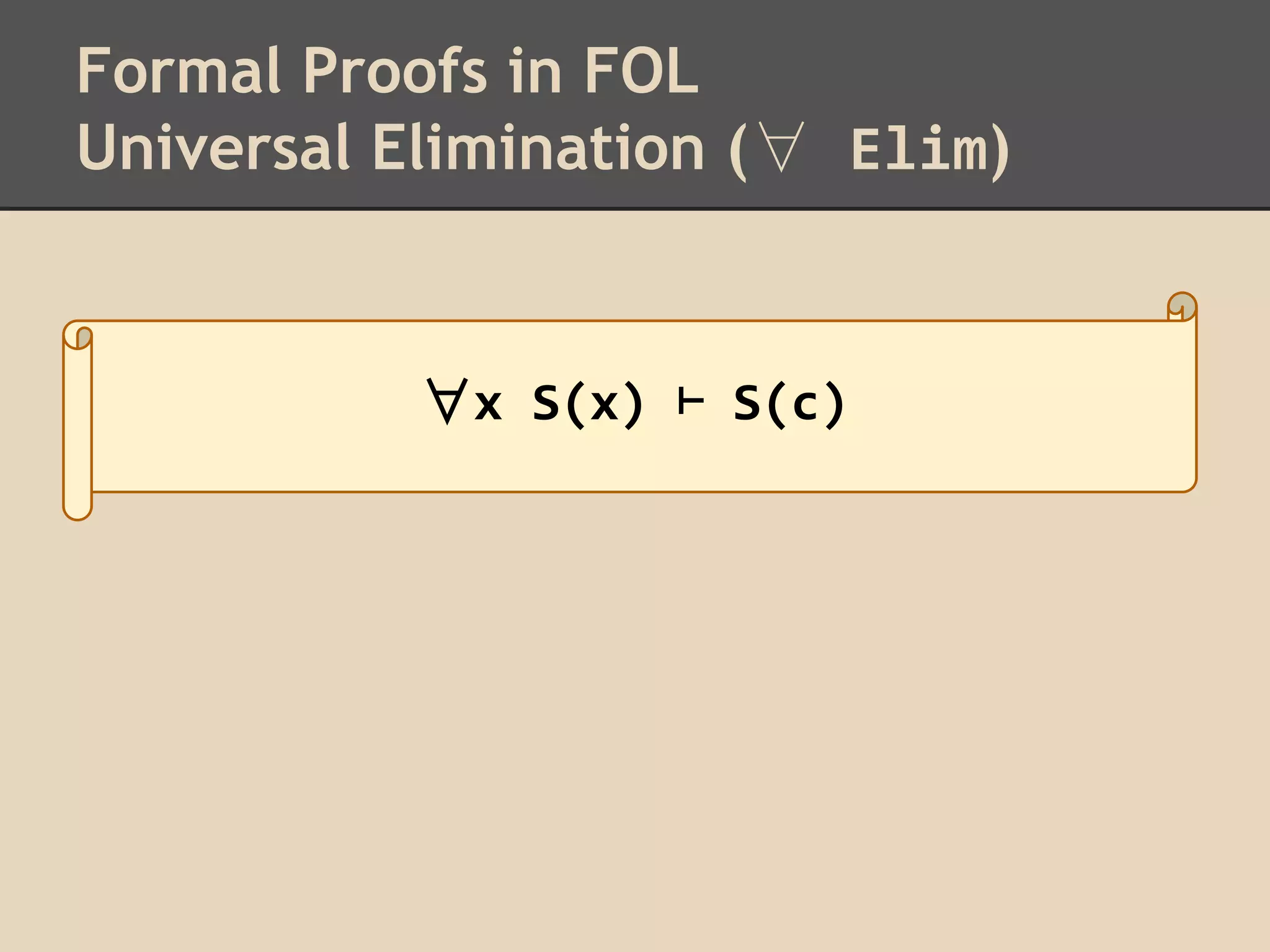
Formal Proofs in FOL
Universal Elimination (∀ Elim)

∀x S(x) ⊢ S(c)
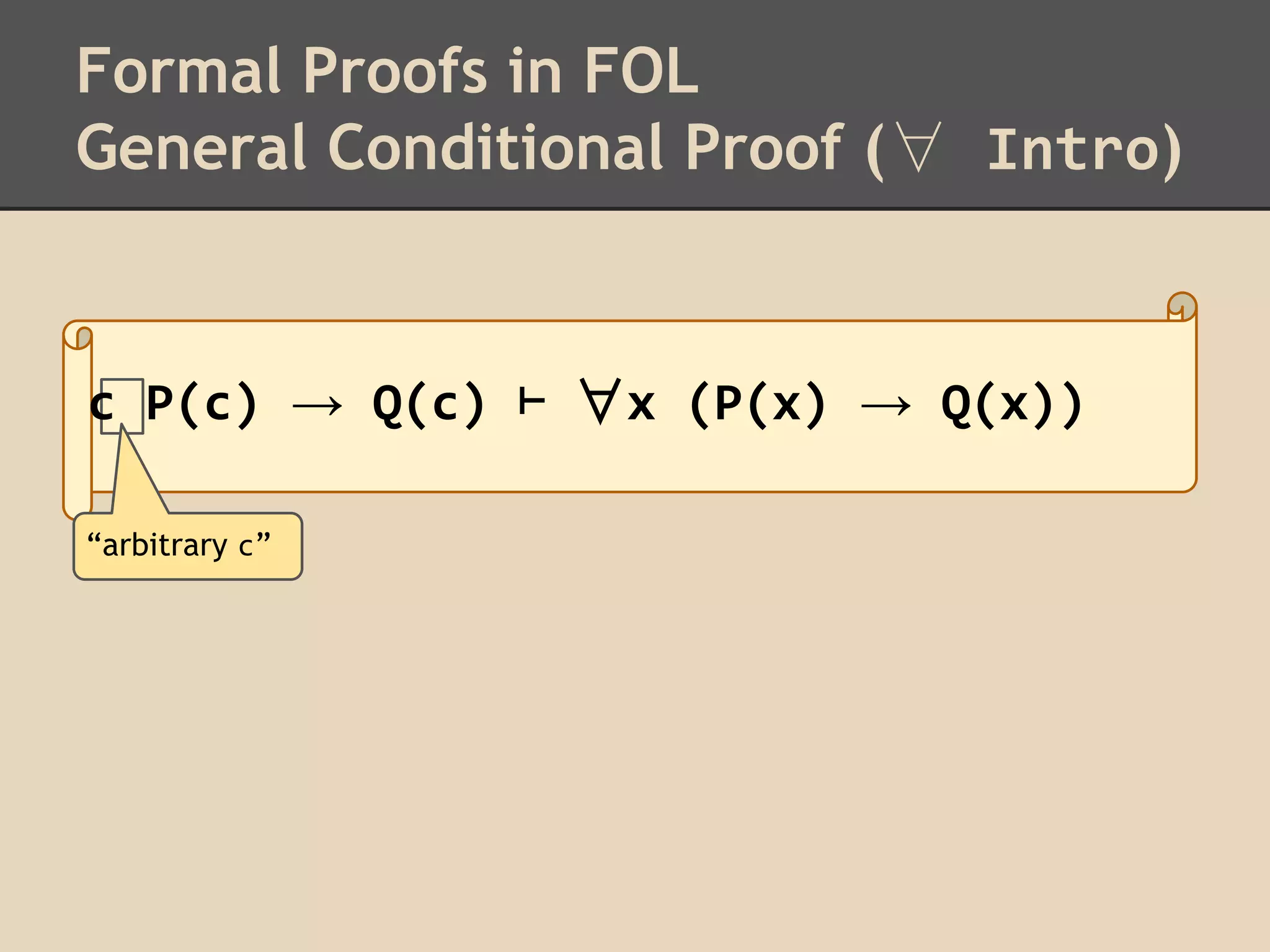
Formal Proofs in FOL
General Conditional Proof (∀ Intro)

c P(c) → Q(c) ⊢ ∀x (P(x) → Q(x))
“arbitrary c”
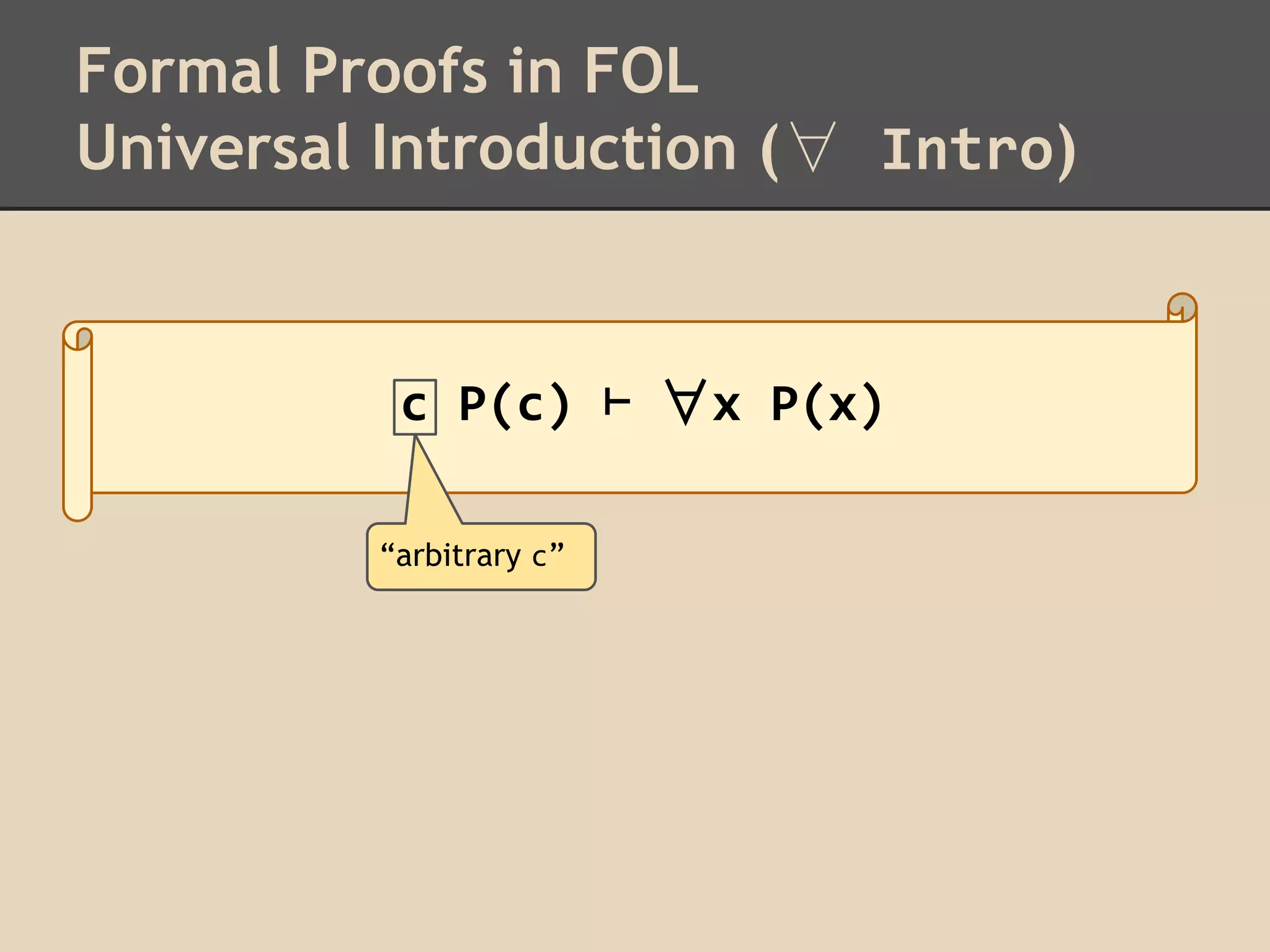
Formal Proofs in FOL
Universal Introduction (∀ Intro)

c P(c) ⊢ ∀x P(x)
“arbitrary c”
Formal Proofs in FOL
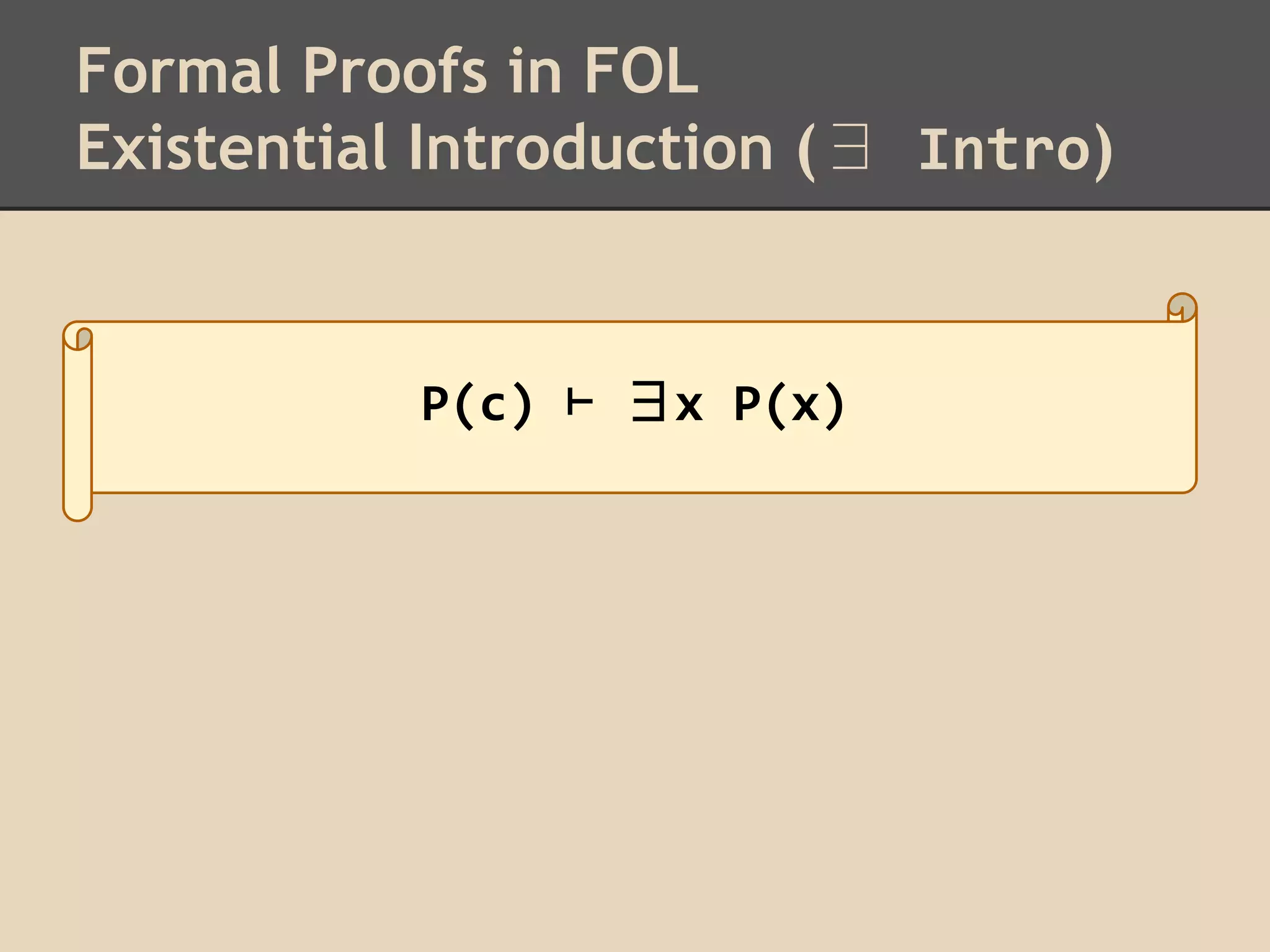
Existential Introduction (∃ Intro)

P(c) ⊢ ∃x P(x)
Formal Proofs in FOL
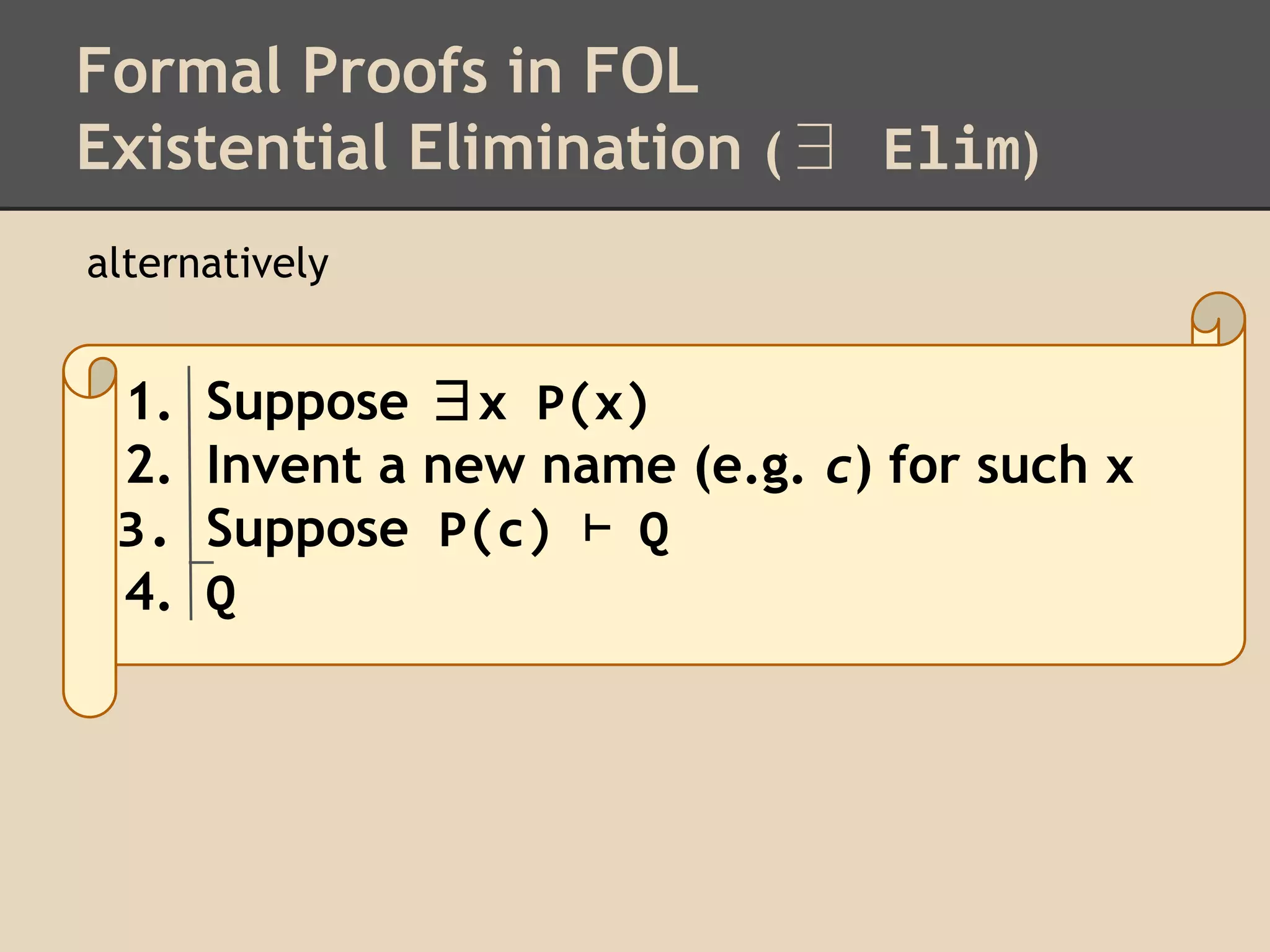
Existential Elimination (∃ Elim)
alternatively

1.
2.
3.
4.

Suppose ∃x P(x)
Invent a new name (e.g. c) for such x
Suppose P(c) ⊢ Q
Q
Words of Wisdom
That’s it for today

Truth, deduction, computation lecture e

  • 1.
    Truth, Deduction, Computation Lecture E Quantifiers,part 4 (final) Vlad Patryshev SCU 2013
  • 2.
    Recap: Proof methods ● ExistentialInstantiation. if we have ∃x P(x), add a name (e.g. c) for the object satisfying P(x); and you may assume P(c). ● General Conditional Proof: to prove ∀x (P(x) → Q(x), add a name (e.g. c), assume P(c), prove Q(c). ● Universal Generalization: to prove ∀x Q(x), do the same as above, with P(x)=⊤
  • 3.
    Samples Euclid’s Theorem: infinityof primes (in the universe of natural numbers) ∀x ∃y (y ≥ x ∧ Prime(y))
  • 4.
    Samples Something Stronger: twinprimes (in the universe of natural numbers) ∀x ∃y (y>x ∧ Prime(y) ∧ Prime(y+2)) (works for x < 2003663613 · 2195000 - 2)
  • 5.
    Samples Something Wronger (in theuniverse of humans and towns) ∃z ∃x (BarberOf(x, z) ∧ ∀y (ManOf(y, z) → (Shaves(x, y) ↔ ¬Shaves(y, y))))
  • 6.
    Can we do12.15?
  • 7.
    Add Axioms toShape World Basic Shape Axioms: 1. 2. 3. 4. ¬∃x(Cube(x)∧Tet(x)) ¬∃x(Tet(x)∧Dodec(x)) ¬∃x(Dodec(x)∧Cube(x)) ∀x(Tet(x)∨Dodec(x)∨Cube(x))
  • 8.
    Is this systemComplete? The book says yes. “We say that a set of axioms is complete if, whenever an argument is intuitively valid (given the meanings of the predicates and the intended range of circumstances), its conclusion is a first-order consequence of its premises taken together with the axioms in question.” E.g. ∃x Cube(x) E.g.∀x CanGiveToMyDog(x)
  • 9.
    Definitions of Completeness Aformal system S is semantically complete iff ⊨ P yields ⊢ P in S.
  • 10.
    Definitions of Completeness Aformal system S is strongly complete iff P ⊨ Q yields P ⊢ Q in S.
  • 11.
    Definitions of Completeness Aformal system S is syntactically complete iff we can prove either ⊢ Q or ⊢ ¬Q in S. In other words, cannot add an independent axiom.
  • 12.
    Example from Shapesworld ∃x ∃y (Tet(x) ∧ Dodec(y) ∧ ∀z (z = x ∨ z = y)) ¬∃x Cube(x) Can we? (The book says we cannot.)
  • 13.
    Now can weprove this? ∀x SameShape(x, x)
  • 14.
    Add More Axiomsto Shape World SameShape Introduction Axioms: 1. ∀x∀y((Cube(x)∧Cube(y))→SameShape(x,y)) 2. ∀x∀y((Dodec(x)∧Dodec(y))→SameShape(x, y)) 3. ∀x∀y((Tet(x)∧Tet(y))→SameShape(x,y))
  • 15.
    Add More Axiomsto Shape World SameShape Elimination Axioms: 1. ∀x∀y((SameShape(x,y)∧Cube(x))→Cube(y)) 2. ∀x∀y((SameShape(x,y)∧Dodec(x))→Dodec (y)) 3. ∀x∀y((SameShape(x,y)∧Tet(x))→Tet(y)) The book says, with these axioms, the Shapes theory is complete.
  • 16.
    Can we provethis now? ∀x SameShape(x, x)
  • 17.
    Truth, Deduction, Computation Lecture Fpart 2 Quantifiers, Formal Proofs Vlad Patryshev SCU 2013
  • 18.
    Formal Proofs inFOL Universal Elimination (∀ Elim) ∀x S(x) ⊢ S(c)
  • 19.
    Formal Proofs inFOL General Conditional Proof (∀ Intro) c P(c) → Q(c) ⊢ ∀x (P(x) → Q(x)) “arbitrary c”
  • 20.
    Formal Proofs inFOL Universal Introduction (∀ Intro) c P(c) ⊢ ∀x P(x) “arbitrary c”
  • 21.
    Formal Proofs inFOL Existential Introduction (∃ Intro) P(c) ⊢ ∃x P(x)
  • 22.
    Formal Proofs inFOL Existential Elimination (∃ Elim) alternatively 1. 2. 3. 4. Suppose ∃x P(x) Invent a new name (e.g. c) for such x Suppose P(c) ⊢ Q Q
  • 23.
  • 24.