Formal Methods in
Software
Lecture 8. Category Theory
Vlad Patryshev
SCU
2014
In This Lecture
● functors and examples (diagrams; product; exponentiations);
● currying/yoneda lemma;
● example with integers/rationals;
● monad
Example: Parametric Class
trait List[A] extends Iterable[A] {
def map[A](f:A=>B):List[B]
}
Functor
Given categories A and B, a functor F: A → B
consists of mappings F: Obj(A) → Obj(B)
and F: Fun(A) → Fun(B) ,
so that
F(idX
)=idF(X)
and F(f∘g)=F(f)∘F(g)
More Examples
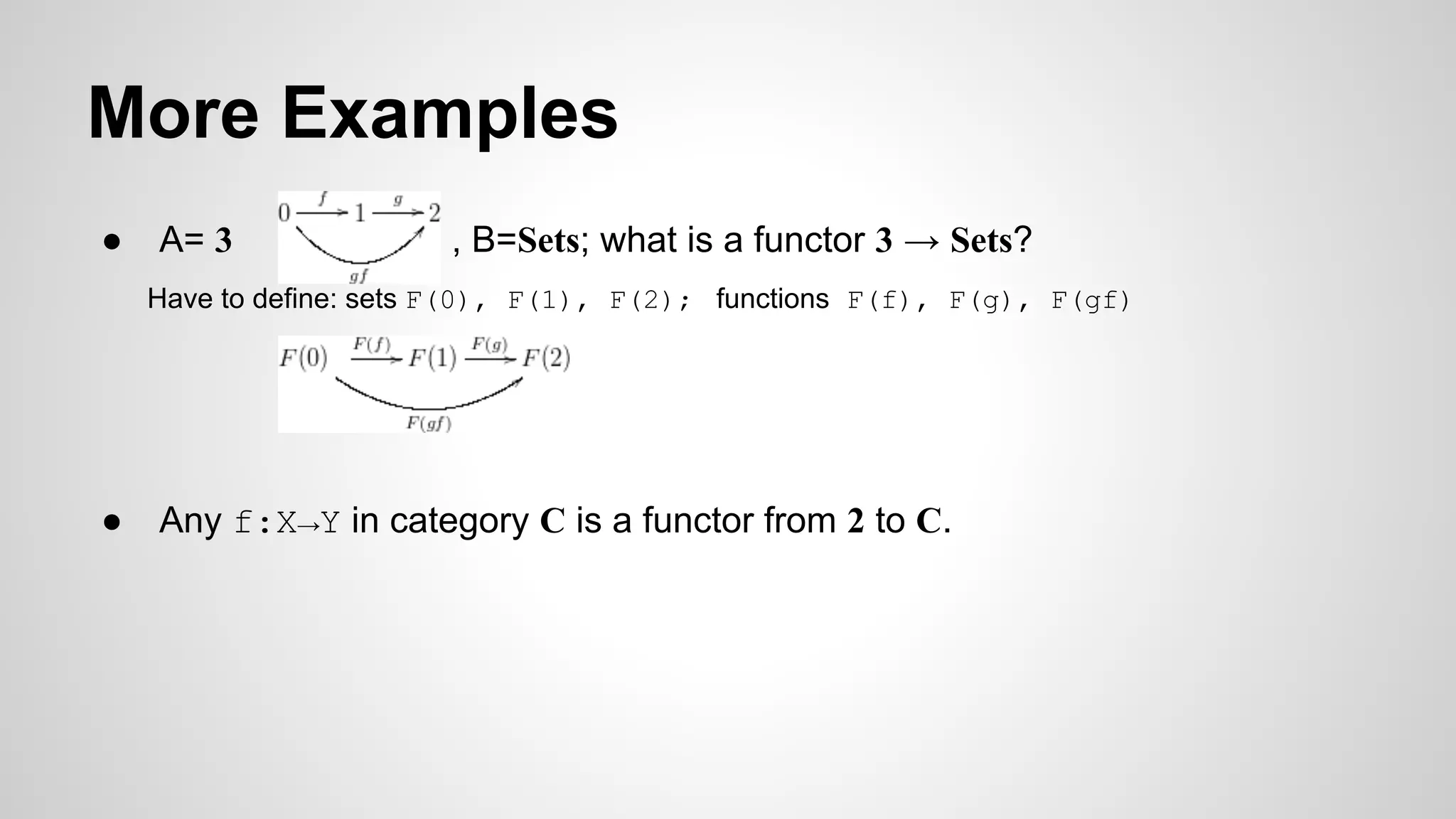
● A= 3 , B=Sets; what is a functor 3 → Sets?
Have to define: sets F(0), F(1), F(2); functions F(f), F(g), F(gf)
● Any f:X→Y in category C is a functor from 2 to C.
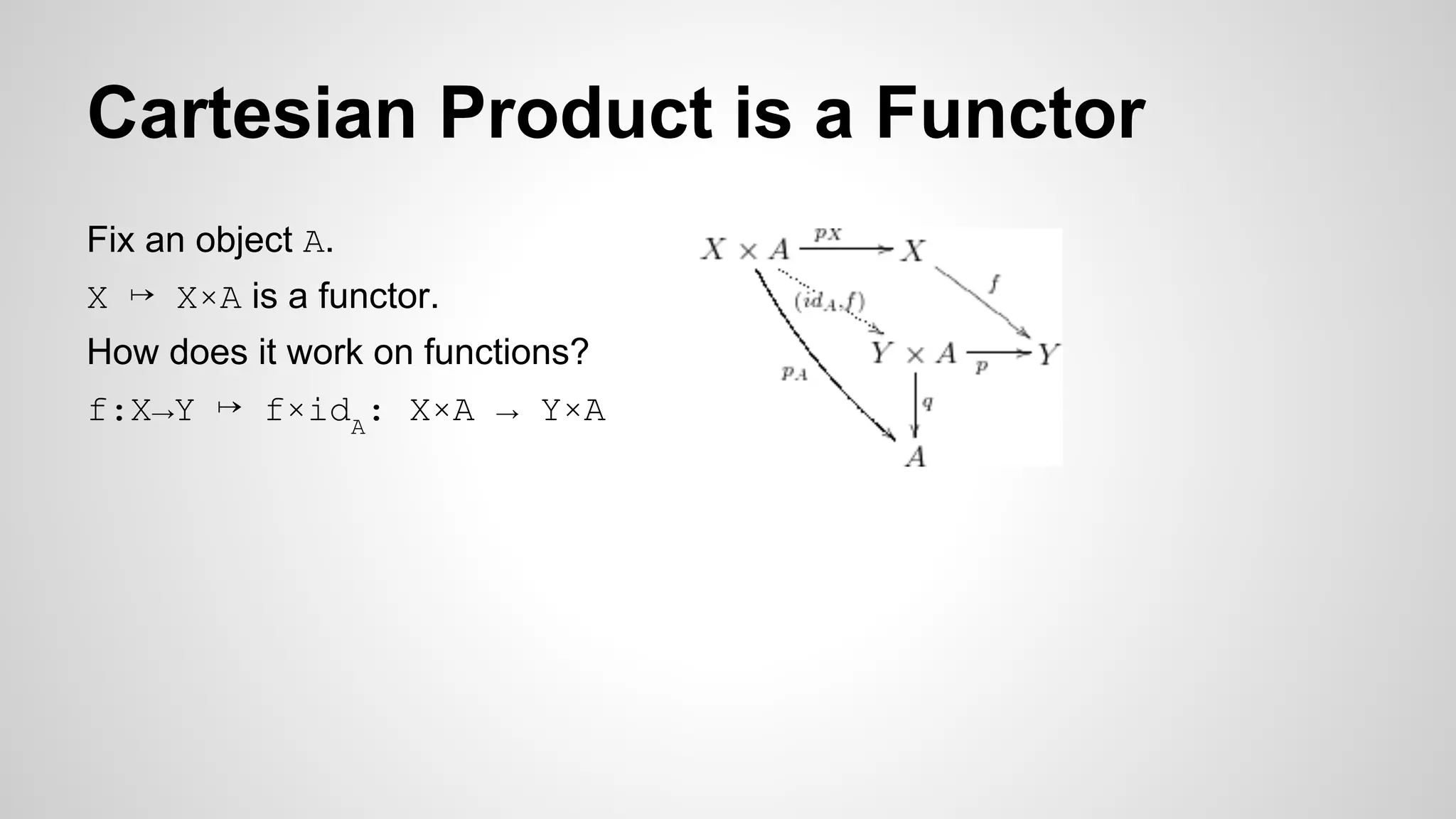
Cartesian Product is a Functor
Fix an object A.
X ↦ X×A is a functor.
How does it work on functions?
f:X→Y ↦ f×idA
: X×A → Y×A
+1 is a Functor
In Sets, take X ↦ X+1. f: X→Y ↦ (f+1): X+1 → Y+1
This functor is called Option[T].
Category of Categories
Take functors F:A→B, G:B→C; their composition H=G∘F is also a functor.
H(idX
) = G(F(idX
)) = G(idF(X)
) = idG(F(X))
H(p∘q) = G(F(p∘q)) = G(F(p)∘F(q)) = G(F(p)) ∘G(F(q)) = H(p) ∘H(q)
Identity functor IdA
:A→A Id(f) = f
Cat - a category of all categories.
No barber problems, nobody shaves nobody.
Exponential Functor
A, B - objects in category C. BA
- an object of functions from A to B, if such
exists.
E.g. in Set, {f:A→B}.
In Scala In Java (Guava) (https://code.google.com/p/guava-
libraries/wiki/FunctionalExplained)
trait Function[X,Y] {
def apply(x:X): Y
}
interface Function<X,Y> {
Y apply(X x);
}
val len:Function[String, Int] = _.length Function<String, Integer> lengthFunction = new
Function<String, Integer>() {
public Integer apply(String string) {
return string.length();
}
};
Define Exponential via Currying
In Set, f:A→CB
≡ f’:A×B→C
f(x)(b) = f’(x,b)
Very similar to P⊢(Q→R) ≡ P∧Q ⊢ R
Actually… it’s the same thing.
Take posets, for example, Boolean lattice,
where a×b ≡ min(a,b) /*see lecture 7*/ ≡ a∧b
a∧b ≤ c ≡ a ≤ (b→c)
Currying: Yoneda Lemma
Fun(A×B, C) ≡ Fun(A, CB
)
(Caveat: what is Fun? A set? It’s not always available as a set)
Example with Numbers
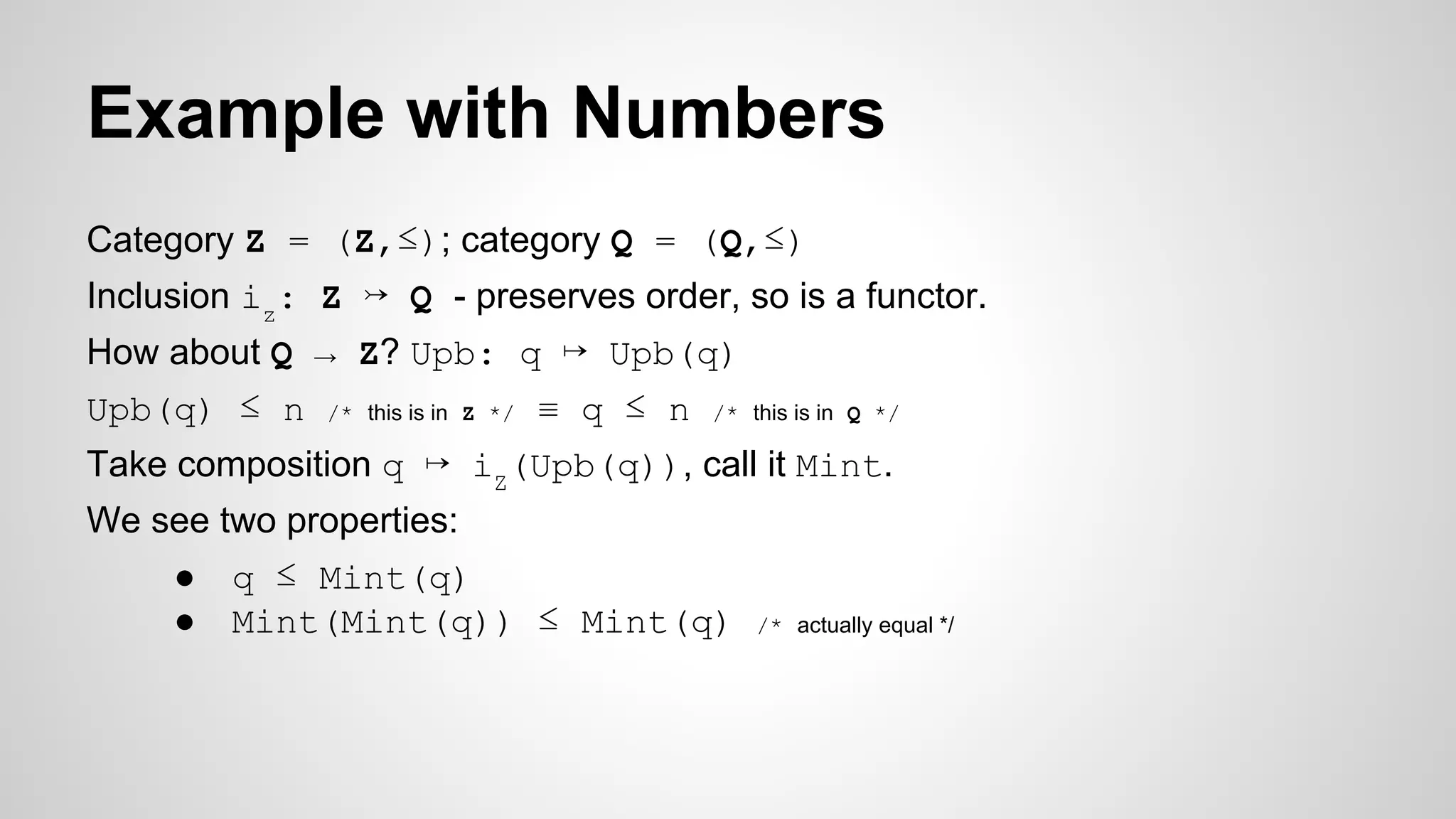
Category Z = (Z,≤); category Q = (Q,≤)
Inclusion iz
: Z ↣ Q - preserves order, so is a functor.
How about Q → Z? Upb: q ↦ Upb(q)
Upb(q) ≤ n /* this is in Z */ ≡ q ≤ n /* this is in Q */
Take composition q ↦ iZ
(Upb(q)), call it Mint.
We see two properties:
● q ≤ Mint(q)
● Mint(Mint(q)) ≤ Mint(q) /* actually equal */
Example with Lists
Category Scala
Take functor List.
We see two properties:
● singleton: X → List[X]
● flatten: List[List[X]] → List[X]
Do you see similarity?
Monad
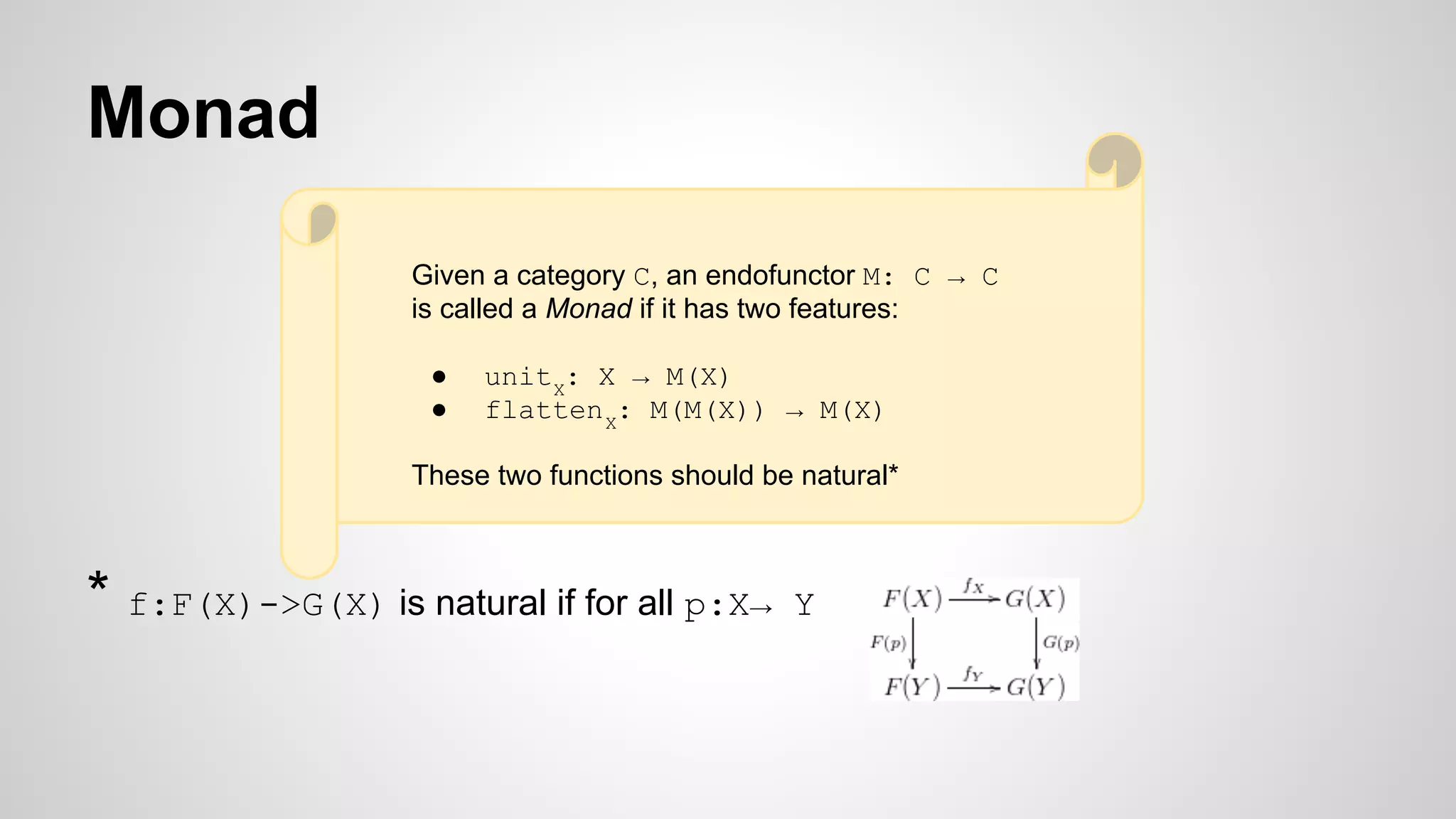
* f:F(X)->G(X) is natural if for all p:X→ Y
Given a category C, an endofunctor M: C → C
is called a Monad if it has two features:
● unitX
: X → M(X)
● flattenX
: M(M(X)) → M(X)
These two functions should be natural*
References
http://www.amazon.com/Category-Computer-Scientists-Foundations-Computing/dp/0262660717
http://fundeps.com/tables/FromSemigroupToMonads.pdf
Wikipedia
Formal methods   8 - category theory (last one)

Formal methods 8 - category theory (last one)

  • 1.
    Formal Methods in Software Lecture8. Category Theory Vlad Patryshev SCU 2014
  • 2.
    In This Lecture ●functors and examples (diagrams; product; exponentiations); ● currying/yoneda lemma; ● example with integers/rationals; ● monad
  • 3.
    Example: Parametric Class traitList[A] extends Iterable[A] { def map[A](f:A=>B):List[B] }
  • 4.
    Functor Given categories Aand B, a functor F: A → B consists of mappings F: Obj(A) → Obj(B) and F: Fun(A) → Fun(B) , so that F(idX )=idF(X) and F(f∘g)=F(f)∘F(g)
  • 5.
    More Examples ● A=3 , B=Sets; what is a functor 3 → Sets? Have to define: sets F(0), F(1), F(2); functions F(f), F(g), F(gf) ● Any f:X→Y in category C is a functor from 2 to C.
  • 6.
    Cartesian Product isa Functor Fix an object A. X ↦ X×A is a functor. How does it work on functions? f:X→Y ↦ f×idA : X×A → Y×A
  • 7.
    +1 is aFunctor In Sets, take X ↦ X+1. f: X→Y ↦ (f+1): X+1 → Y+1 This functor is called Option[T].
  • 8.
    Category of Categories Takefunctors F:A→B, G:B→C; their composition H=G∘F is also a functor. H(idX ) = G(F(idX )) = G(idF(X) ) = idG(F(X)) H(p∘q) = G(F(p∘q)) = G(F(p)∘F(q)) = G(F(p)) ∘G(F(q)) = H(p) ∘H(q) Identity functor IdA :A→A Id(f) = f Cat - a category of all categories. No barber problems, nobody shaves nobody.
  • 9.
    Exponential Functor A, B- objects in category C. BA - an object of functions from A to B, if such exists. E.g. in Set, {f:A→B}. In Scala In Java (Guava) (https://code.google.com/p/guava- libraries/wiki/FunctionalExplained) trait Function[X,Y] { def apply(x:X): Y } interface Function<X,Y> { Y apply(X x); } val len:Function[String, Int] = _.length Function<String, Integer> lengthFunction = new Function<String, Integer>() { public Integer apply(String string) { return string.length(); } };
  • 10.
    Define Exponential viaCurrying In Set, f:A→CB ≡ f’:A×B→C f(x)(b) = f’(x,b) Very similar to P⊢(Q→R) ≡ P∧Q ⊢ R Actually… it’s the same thing. Take posets, for example, Boolean lattice, where a×b ≡ min(a,b) /*see lecture 7*/ ≡ a∧b a∧b ≤ c ≡ a ≤ (b→c)
  • 11.
    Currying: Yoneda Lemma Fun(A×B,C) ≡ Fun(A, CB ) (Caveat: what is Fun? A set? It’s not always available as a set)
  • 12.
    Example with Numbers CategoryZ = (Z,≤); category Q = (Q,≤) Inclusion iz : Z ↣ Q - preserves order, so is a functor. How about Q → Z? Upb: q ↦ Upb(q) Upb(q) ≤ n /* this is in Z */ ≡ q ≤ n /* this is in Q */ Take composition q ↦ iZ (Upb(q)), call it Mint. We see two properties: ● q ≤ Mint(q) ● Mint(Mint(q)) ≤ Mint(q) /* actually equal */
  • 13.
    Example with Lists CategoryScala Take functor List. We see two properties: ● singleton: X → List[X] ● flatten: List[List[X]] → List[X] Do you see similarity?
  • 14.
    Monad * f:F(X)->G(X) isnatural if for all p:X→ Y Given a category C, an endofunctor M: C → C is called a Monad if it has two features: ● unitX : X → M(X) ● flattenX : M(M(X)) → M(X) These two functions should be natural*
  • 16.