Dr.M.Bindhu
Associate Professor/ECE
Saveetha Engineering
College
OUTLINE
Machine Learning (AI) –Learning Rules
Sequential Covering Algorithm
Learn One Rule
Why Learn First Order Rules?
 First Order Logic: Terminology
 The FOIL Algorithm
 Why Combine Inductive And Analytical Learning?
 Kbann: Prior Knowledge To Initialize The Hypothesis
 Tangentprop, EBNN: Prior Knowledge Alters Search
Objective
 FOCL Algorithm : Prior Knowledge Alters Search
Operators
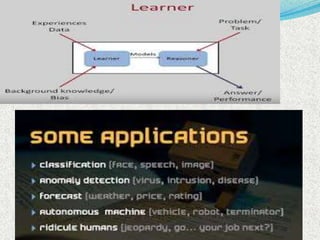
Machine Learning (AI)
A key aspect of intelligence is the ability to
learn knowledge over time.
Vast majority of machine learning algorithm
have been developed to learn knowledge
that is inherently propositional, where the
domain of interest is encoded in terms of a
fixed set of variables.
 Subfield of symbolic artificial
intelligence which uses logic programming as
a uniform representation for examples,
background knowledge and hypotheses
 https://youtu.be/ad79nYk2keg
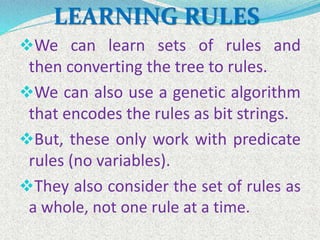
We can learn sets of rules and
then converting the tree to rules.
We can also use a genetic algorithm
that encodes the rules as bit strings.
But, these only work with predicate
rules (no variables).
They also consider the set of rules as
a whole, not one rule at a time.
LEARNING RULES
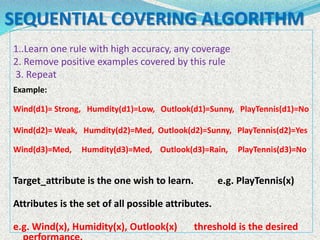
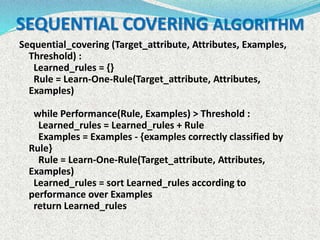
SEQUENTIAL COVERING ALGORITHM
1..Learn one rule with high accuracy, any coverage
2. Remove positive examples covered by this rule
3. Repeat
Example:
Wind(d1)= Strong, Humdity(d1)=Low, Outlook(d1)=Sunny, PlayTennis(d1)=No
Wind(d2)= Weak, Humdity(d2)=Med, Outlook(d2)=Sunny, PlayTennis(d2)=Yes
Wind(d3)=Med, Humdity(d3)=Med, Outlook(d3)=Rain, PlayTennis(d3)=No
Target_attribute is the one wish to learn. e.g. PlayTennis(x)
Attributes is the set of all possible attributes.
e.g. Wind(x), Humidity(x), Outlook(x) threshold is the desired
SEQUENTIAL COVERING ALGORITHM
Sequential_covering (Target_attribute, Attributes, Examples,
Threshold) :
Learned_rules = {}
Rule = Learn-One-Rule(Target_attribute, Attributes,
Examples)
while Performance(Rule, Examples) > Threshold :
Learned_rules = Learned_rules + Rule
Examples = Examples - {examples correctly classified by
Rule}
Rule = Learn-One-Rule(Target_attribute, Attributes,
Examples)
Learned_rules = sort Learned_rules according to
performance over Examples
return Learned_rules
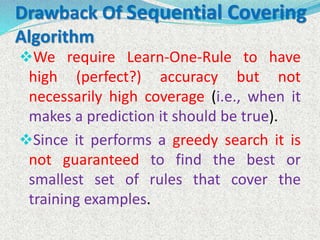
Drawback Of Sequential Covering
Algorithm
We require Learn-One-Rule to have
high (perfect?) accuracy but not
necessarily high coverage (i.e., when it
makes a prediction it should be true).
Since it performs a greedy search it is
not guaranteed to find the best or
smallest set of rules that cover the
training examples.
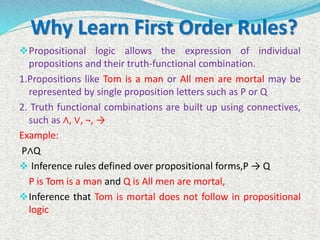
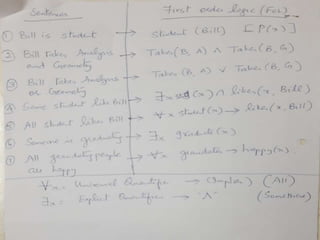
Why Learn First Order Rules?
Propositional logic allows the expression of individual
propositions and their truth-functional combination.
1.Propositions like Tom is a man or All men are mortal may be
represented by single proposition letters such as P or Q
2. Truth functional combinations are built up using connectives,
such as ∧, ∨, ¬, →
Example:
P∧Q
 Inference rules defined over propositional forms,P → Q
P is Tom is a man and Q is All men are mortal,
Inference that Tom is mortal does not follow in propositional
logic
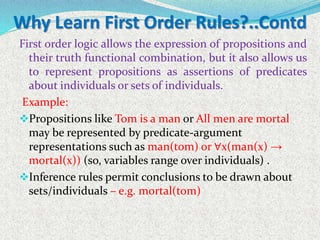
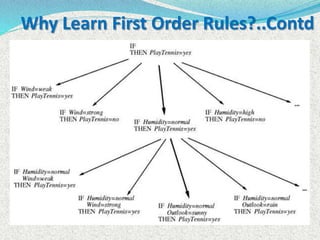
Why Learn First Order Rules?..Contd
First order logic allows the expression of propositions and
their truth functional combination, but it also allows us
to represent propositions as assertions of predicates
about individuals or sets of individuals.
Example:
Propositions like Tom is a man or All men are mortal
may be represented by predicate-argument
representations such as man(tom) or ∀x(man(x) →
mortal(x)) (so, variables range over individuals) .
Inference rules permit conclusions to be drawn about
sets/individuals – e.g. mortal(tom)
Why Learn First Order Rules?..Contd
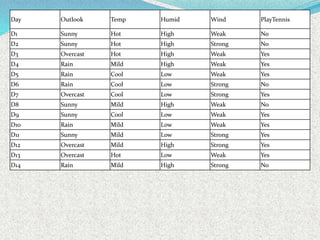
Day Outlook Temp Humid Wind PlayTennis
D1 Sunny Hot High Weak No
D2 Sunny Hot High Strong No
D3 Overcast Hot High Weak Yes
D4 Rain Mild High Weak Yes
D5 Rain Cool Low Weak Yes
D6 Rain Cool Low Strong No
D7 Overcast Cool Low Strong Yes
D8 Sunny Mild High Weak No
D9 Sunny Cool Low Weak Yes
D10 Rain Mild Low Weak Yes
D11 Sunny Mild Low Strong Yes
D12 Overcast Mild High Strong Yes
D13 Overcast Hot Low Weak Yes
D14 Rain Mild High Strong No
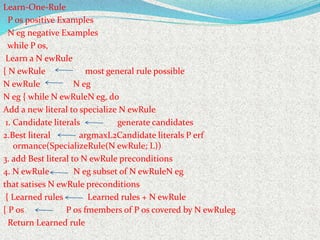
Learn-One-Rule
P os positive Examples
N eg negative Examples
while P os,
Learn a N ewRule
{ N ewRule most general rule possible
N ewRule N eg
N eg { while N ewRuleN eg, do
Add a new literal to specialize N ewRule
1. Candidate literals generate candidates
2.Best literal argmaxL2Candidate literals P erf
ormance(SpecializeRule(N ewRule; L))
3. add Best literal to N ewRule preconditions
4. N ewRule N eg subset of N ewRuleN eg
that satises N ewRule preconditions
{ Learned rules Learned rules + N ewRule
{ P os P os fmembers of P os covered by N ewRuleg
Return Learned rule
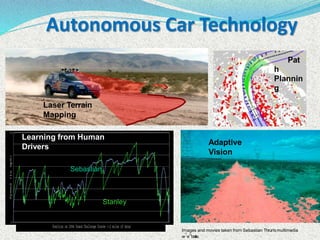
Autonomous Car Technology
Laser Terrain
Mapping
Stanley
Learning from Human
Drivers
Sebastian
Adaptive
Vision
Pat
h
Plannin
g
Images and movies taken from Sebastian Thrun’smultimedia
w1e4bsite.
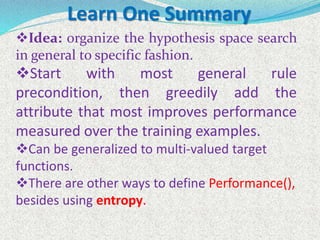
Idea: organize the hypothesis space search
in general to specific fashion.
Start with most general rule
precondition, then greedily add the
attribute that most improves performance
measured over the training examples.
Can be generalized to multi-valued target
functions.
There are other ways to define Performance(),
besides using entropy.
Learn One Summary
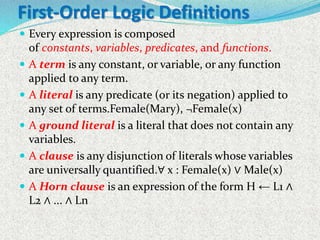
First-Order Logic Definitions
 Every expression is composed
of constants, variables, predicates, and functions.
 A term is any constant, or variable, or any function
applied to any term.
 A literal is any predicate (or its negation) applied to
any set of terms.Female(Mary), ¬Female(x)
 A ground literal is a literal that does not contain any
variables.
 A clause is any disjunction of literals whose variables
are universally quantified.∀ x : Female(x) ∨ Male(x)
 A Horn clause is an expression of the form H ← L1 ∧
L2 ∧ ... ∧ Ln
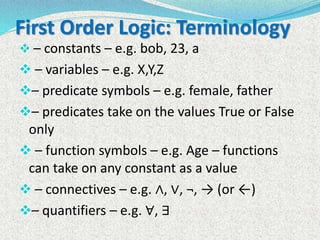
First Order Logic: Terminology
 – constants – e.g. bob, 23, a
 – variables – e.g. X,Y,Z
– predicate symbols – e.g. female, father
– predicates take on the values True or False
only
 – function symbols – e.g. Age – functions
can take on any constant as a value
 – connectives – e.g. ∧, ∨, ¬, → (or ←)
– quantifiers – e.g. ∀, ∃
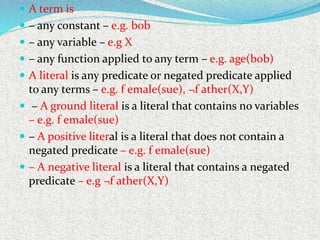
 A term is
 – any constant – e.g. bob
 – any variable – e.g X
 – any function applied to any term – e.g. age(bob)
 A literal is any predicate or negated predicate applied
to any terms – e.g. f emale(sue), ¬f ather(X,Y)
 – A ground literal is a literal that contains no variables
– e.g. f emale(sue)
 – A positive literal is a literal that does not contain a
negated predicate – e.g. f emale(sue)
 – A negative literal is a literal that contains a negated
predicate – e.g ¬f ather(X,Y)
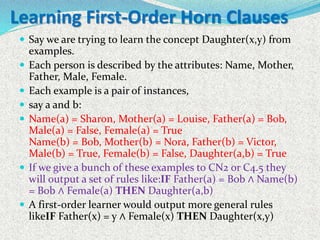
Learning First-Order Horn Clauses
 Say we are trying to learn the concept Daughter(x,y) from
examples.
 Each person is described by the attributes: Name, Mother,
Father, Male, Female.
 Each example is a pair of instances,
 say a and b:
 Name(a) = Sharon, Mother(a) = Louise, Father(a) = Bob,
Male(a) = False, Female(a) = True
Name(b) = Bob, Mother(b) = Nora, Father(b) = Victor,
Male(b) = True, Female(b) = False, Daughter(a,b) = True
 If we give a bunch of these examples to CN2 or C4.5 they
will output a set of rules like:IF Father(a) = Bob ∧ Name(b)
= Bob ∧ Female(a) THEN Daughter(a,b)
 A first-order learner would output more general rules
likeIF Father(x) = y ∧ Female(x) THEN Daughter(x,y)
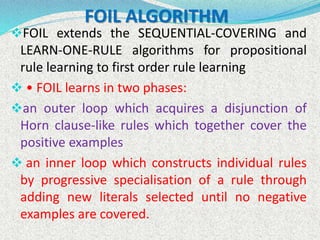
FOIL ALGORITHM
FOIL extends the SEQUENTIAL-COVERING and
LEARN-ONE-RULE algorithms for propositional
rule learning to first order rule learning
 • FOIL learns in two phases:
an outer loop which acquires a disjunction of
Horn clause-like rules which together cover the
positive examples
 an inner loop which constructs individual rules
by progressive specialisation of a rule through
adding new literals selected until no negative
examples are covered.
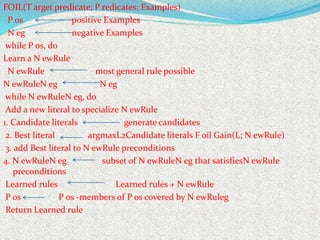
FOIL(T arget predicate; P redicates; Examples)
P os positive Examples
N eg negative Examples
while P os, do
Learn a N ewRule
N ewRule most general rule possible
N ewRuleN eg N eg
while N ewRuleN eg, do
Add a new literal to specialize N ewRule
1. Candidate literals generate candidates
2. Best literal argmaxL2Candidate literals F oil Gain(L; N ewRule)
3. add Best literal to N ewRule preconditions
4. N ewRuleN eg subset of N ewRuleN eg that satisfiesN ewRule
preconditions
Learned rules Learned rules + N ewRule
P os P os -members of P os covered by N ewRuleg
Return Learned rule
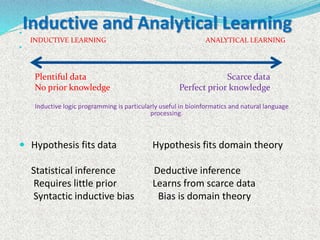
Inductive and Analytical Learning
INDUCTIVE LEARNING ANALYTICAL LEARNING

Inductive logic programming is particularly useful in bioinformatics and natural language
processing.
 Hypothesis fits data Hypothesis fits domain theory
Statistical inference Deductive inference
Requires little prior Learns from scarce data
Syntactic inductive bias Bias is domain theory
Plentiful data
No prior knowledge
Scarce data
Perfect prior knowledge
25
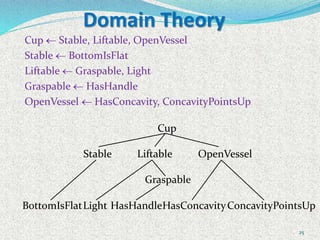
Domain Theory
Cup  Stable, Liftable, OpenVessel
Stable  BottomIsFlat
Liftable  Graspable, Light
Graspable  HasHandle
OpenVessel  HasConcavity, ConcavityPointsUp
Cup
Stable Liftable OpenVessel
Graspable
BottomIsFlatLight HasConcavityConcavityPointsUpHasHandle
26
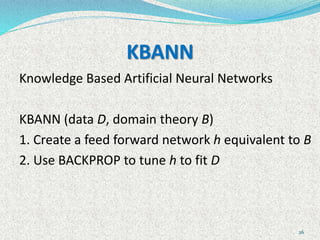
KBANN
Knowledge Based Artificial Neural Networks
KBANN (data D, domain theory B)
1. Create a feed forward network h equivalent to B
2. Use BACKPROP to tune h to fit D
CS 5751 Machine Learning Chapter 12 Comb. Inductive/Analytical 27
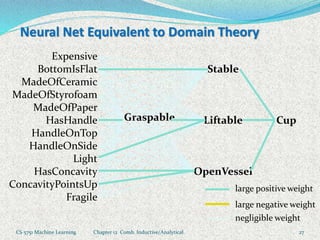
Neural Net Equivalent to Domain Theory
Expensive
BottomIsFlat
MadeOfCeramic
MadeOfStyrofoam
MadeOfPaper
HasHandle
HandleOnTop
HandleOnSide
Light
HasConcavity
ConcavityPointsUp
Fragile
Stable
Liftable
OpenVessel
CupGraspable
large positive weight
large negative weight
negligible weight
28
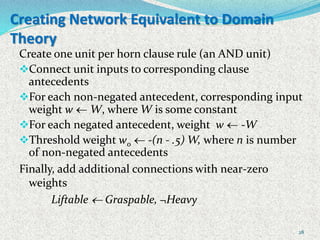
Creating Network Equivalent to Domain
Theory
Create one unit per horn clause rule (an AND unit)
Connect unit inputs to corresponding clause
antecedents
For each non-negated antecedent, corresponding input
weight w  W, where W is some constant
For each negated antecedent, weight w  -W
Threshold weight w0  -(n - .5) W, where n is number
of non-negated antecedents
Finally, add additional connections with near-zero
weights
Liftable  Graspable, ¬Heavy
29
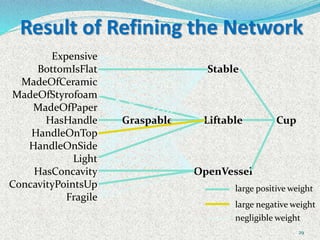
Result of Refining the Network
Expensive
BottomIsFlat
MadeOfCeramic
MadeOfStyrofoam
MadeOfPaper
HasHandle
HandleOnTop
HandleOnSide
Light
HasConcavity
ConcavityPointsUp
Fragile
Stable
Liftable
OpenVessel
CupGraspable
large positive weight
large negative weight
negligible weight
30
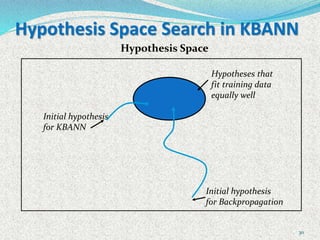
Hypothesis Space Search in KBANN
Hypotheses that
fit training data
equally well
Initial hypothesis
for KBANN
Initial hypothesis
for Backpropagation
Hypothesis Space
31
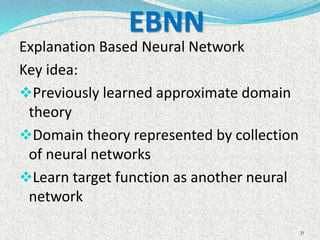
EBNN
Explanation Based Neural Network
Key idea:
Previously learned approximate domain
theory
Domain theory represented by collection
of neural networks
Learn target function as another neural
network
32
Expensive
BottomIsFlat
MadeOfCeramic
MadeOfStyrofoam
MadeOfPaper
HasHandle
HandleOnTop
HandleOnSide
Light
HasConcavity
ConcavityPointsUp
Fragile
Stable
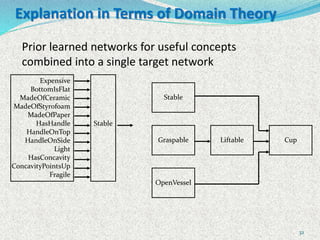
Explanation in Terms of Domain Theory
Prior learned networks for useful concepts
combined into a single target network
Graspable
Stable
OpenVessel
Liftable Cup
33
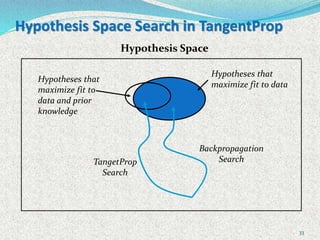
Hypothesis Space Search in TangentProp
Hypotheses that
maximize fit to data
TangetProp
Search
Backpropagation
Search
Hypothesis Space
Hypotheses that
maximize fit to
data and prior
knowledge
34
FOCL algorithm (First Order Combined
Learner)
Adaptation of FOIL that uses domain theory
When adding a literal to a rule, not only consider
adding single terms, but also think about adding terms
from domain theory
Most importantly a potentially incorrect hypothesis is
allowed as an initial approximation to the predicate
to be learned. The main goal of FOCL is to incorporate
the methods of explanation-based learning (EBL)
35
Search in FOCL
Cup  HasHandle
[2+,3-]
Cup 
Cup  ¬HasHandle
[2+,3-]
Cup  Fragile
[2+,4-]
Cup  BottomIsFlat,
Light,
HasConcavity,
ConcavityPointsUp
[4+,2-]
...
Cup  BottomIsFlat,
Light,
HasConcavity,
ConcavityPointsUp,
HandleOnTop
[0+,2-]
Cup  BottomIsFlat,
Light,
HasConcavity,
ConcavityPointsUp,
¬ HandleOnTop
[4+,0-]
Cup  BottomIsFlat,
Light,
HasConcavity,
ConcavityPointsUp,
HandleOnSide
[2+,0-]
...
36
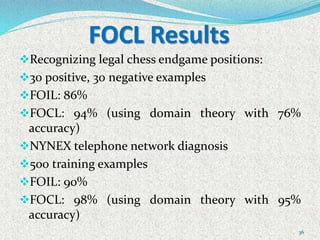
FOCL Results
Recognizing legal chess endgame positions:
30 positive, 30 negative examples
FOIL: 86%
FOCL: 94% (using domain theory with 76%
accuracy)
NYNEX telephone network diagnosis
500 training examples
FOIL: 90%
FOCL: 98% (using domain theory with 95%
accuracy)
VIDEO LINK
 https://www.youtube.com/watch?v=rVlN0ZCYmtI
 https://www.youtube.com/watch?v=SSrD02pdE78
RECAP
Sequential Covering Algorithm
Learn One Rule
The FOIL Algorithm
 FOCL Algorithm
http://jmvidal.cse.sc.edu/talks/learningrules/allslides.xml
http://www.cs.cmu.edu/afs/cs.cmu.edu/project/theo-
20/www/mlbook/ch10.pdf
https://bcssp10.files.wordpress.com/2013/02/lecture151.pdf
REFERENCES
Machine learnning ---Tom Mitchell (1998):
HEARTFUL
THANK YOU

MACHINE LEARNING-LEARNING RULE

  • 1.
  • 2.
    OUTLINE Machine Learning (AI)–Learning Rules Sequential Covering Algorithm Learn One Rule Why Learn First Order Rules?  First Order Logic: Terminology  The FOIL Algorithm  Why Combine Inductive And Analytical Learning?  Kbann: Prior Knowledge To Initialize The Hypothesis  Tangentprop, EBNN: Prior Knowledge Alters Search Objective  FOCL Algorithm : Prior Knowledge Alters Search Operators
  • 3.
    Machine Learning (AI) Akey aspect of intelligence is the ability to learn knowledge over time. Vast majority of machine learning algorithm have been developed to learn knowledge that is inherently propositional, where the domain of interest is encoded in terms of a fixed set of variables.  Subfield of symbolic artificial intelligence which uses logic programming as a uniform representation for examples, background knowledge and hypotheses
  • 5.
  • 6.
    We can learnsets of rules and then converting the tree to rules. We can also use a genetic algorithm that encodes the rules as bit strings. But, these only work with predicate rules (no variables). They also consider the set of rules as a whole, not one rule at a time. LEARNING RULES
  • 7.
    SEQUENTIAL COVERING ALGORITHM 1..Learnone rule with high accuracy, any coverage 2. Remove positive examples covered by this rule 3. Repeat Example: Wind(d1)= Strong, Humdity(d1)=Low, Outlook(d1)=Sunny, PlayTennis(d1)=No Wind(d2)= Weak, Humdity(d2)=Med, Outlook(d2)=Sunny, PlayTennis(d2)=Yes Wind(d3)=Med, Humdity(d3)=Med, Outlook(d3)=Rain, PlayTennis(d3)=No Target_attribute is the one wish to learn. e.g. PlayTennis(x) Attributes is the set of all possible attributes. e.g. Wind(x), Humidity(x), Outlook(x) threshold is the desired
  • 8.
    SEQUENTIAL COVERING ALGORITHM Sequential_covering(Target_attribute, Attributes, Examples, Threshold) : Learned_rules = {} Rule = Learn-One-Rule(Target_attribute, Attributes, Examples) while Performance(Rule, Examples) > Threshold : Learned_rules = Learned_rules + Rule Examples = Examples - {examples correctly classified by Rule} Rule = Learn-One-Rule(Target_attribute, Attributes, Examples) Learned_rules = sort Learned_rules according to performance over Examples return Learned_rules
  • 9.
    Drawback Of SequentialCovering Algorithm We require Learn-One-Rule to have high (perfect?) accuracy but not necessarily high coverage (i.e., when it makes a prediction it should be true). Since it performs a greedy search it is not guaranteed to find the best or smallest set of rules that cover the training examples.
  • 10.
    Why Learn FirstOrder Rules? Propositional logic allows the expression of individual propositions and their truth-functional combination. 1.Propositions like Tom is a man or All men are mortal may be represented by single proposition letters such as P or Q 2. Truth functional combinations are built up using connectives, such as ∧, ∨, ¬, → Example: P∧Q  Inference rules defined over propositional forms,P → Q P is Tom is a man and Q is All men are mortal, Inference that Tom is mortal does not follow in propositional logic
  • 11.
    Why Learn FirstOrder Rules?..Contd First order logic allows the expression of propositions and their truth functional combination, but it also allows us to represent propositions as assertions of predicates about individuals or sets of individuals. Example: Propositions like Tom is a man or All men are mortal may be represented by predicate-argument representations such as man(tom) or ∀x(man(x) → mortal(x)) (so, variables range over individuals) . Inference rules permit conclusions to be drawn about sets/individuals – e.g. mortal(tom)
  • 12.
    Why Learn FirstOrder Rules?..Contd
  • 13.
    Day Outlook TempHumid Wind PlayTennis D1 Sunny Hot High Weak No D2 Sunny Hot High Strong No D3 Overcast Hot High Weak Yes D4 Rain Mild High Weak Yes D5 Rain Cool Low Weak Yes D6 Rain Cool Low Strong No D7 Overcast Cool Low Strong Yes D8 Sunny Mild High Weak No D9 Sunny Cool Low Weak Yes D10 Rain Mild Low Weak Yes D11 Sunny Mild Low Strong Yes D12 Overcast Mild High Strong Yes D13 Overcast Hot Low Weak Yes D14 Rain Mild High Strong No
  • 14.
    Learn-One-Rule P os positiveExamples N eg negative Examples while P os, Learn a N ewRule { N ewRule most general rule possible N ewRule N eg N eg { while N ewRuleN eg, do Add a new literal to specialize N ewRule 1. Candidate literals generate candidates 2.Best literal argmaxL2Candidate literals P erf ormance(SpecializeRule(N ewRule; L)) 3. add Best literal to N ewRule preconditions 4. N ewRule N eg subset of N ewRuleN eg that satises N ewRule preconditions { Learned rules Learned rules + N ewRule { P os P os fmembers of P os covered by N ewRuleg Return Learned rule
  • 15.
    Autonomous Car Technology LaserTerrain Mapping Stanley Learning from Human Drivers Sebastian Adaptive Vision Pat h Plannin g Images and movies taken from Sebastian Thrun’smultimedia w1e4bsite.
  • 16.
    Idea: organize thehypothesis space search in general to specific fashion. Start with most general rule precondition, then greedily add the attribute that most improves performance measured over the training examples. Can be generalized to multi-valued target functions. There are other ways to define Performance(), besides using entropy. Learn One Summary
  • 18.
    First-Order Logic Definitions Every expression is composed of constants, variables, predicates, and functions.  A term is any constant, or variable, or any function applied to any term.  A literal is any predicate (or its negation) applied to any set of terms.Female(Mary), ¬Female(x)  A ground literal is a literal that does not contain any variables.  A clause is any disjunction of literals whose variables are universally quantified.∀ x : Female(x) ∨ Male(x)  A Horn clause is an expression of the form H ← L1 ∧ L2 ∧ ... ∧ Ln
  • 19.
    First Order Logic:Terminology  – constants – e.g. bob, 23, a  – variables – e.g. X,Y,Z – predicate symbols – e.g. female, father – predicates take on the values True or False only  – function symbols – e.g. Age – functions can take on any constant as a value  – connectives – e.g. ∧, ∨, ¬, → (or ←) – quantifiers – e.g. ∀, ∃
  • 20.
     A termis  – any constant – e.g. bob  – any variable – e.g X  – any function applied to any term – e.g. age(bob)  A literal is any predicate or negated predicate applied to any terms – e.g. f emale(sue), ¬f ather(X,Y)  – A ground literal is a literal that contains no variables – e.g. f emale(sue)  – A positive literal is a literal that does not contain a negated predicate – e.g. f emale(sue)  – A negative literal is a literal that contains a negated predicate – e.g ¬f ather(X,Y)
  • 21.
    Learning First-Order HornClauses  Say we are trying to learn the concept Daughter(x,y) from examples.  Each person is described by the attributes: Name, Mother, Father, Male, Female.  Each example is a pair of instances,  say a and b:  Name(a) = Sharon, Mother(a) = Louise, Father(a) = Bob, Male(a) = False, Female(a) = True Name(b) = Bob, Mother(b) = Nora, Father(b) = Victor, Male(b) = True, Female(b) = False, Daughter(a,b) = True  If we give a bunch of these examples to CN2 or C4.5 they will output a set of rules like:IF Father(a) = Bob ∧ Name(b) = Bob ∧ Female(a) THEN Daughter(a,b)  A first-order learner would output more general rules likeIF Father(x) = y ∧ Female(x) THEN Daughter(x,y)
  • 22.
    FOIL ALGORITHM FOIL extendsthe SEQUENTIAL-COVERING and LEARN-ONE-RULE algorithms for propositional rule learning to first order rule learning  • FOIL learns in two phases: an outer loop which acquires a disjunction of Horn clause-like rules which together cover the positive examples  an inner loop which constructs individual rules by progressive specialisation of a rule through adding new literals selected until no negative examples are covered.
  • 23.
    FOIL(T arget predicate;P redicates; Examples) P os positive Examples N eg negative Examples while P os, do Learn a N ewRule N ewRule most general rule possible N ewRuleN eg N eg while N ewRuleN eg, do Add a new literal to specialize N ewRule 1. Candidate literals generate candidates 2. Best literal argmaxL2Candidate literals F oil Gain(L; N ewRule) 3. add Best literal to N ewRule preconditions 4. N ewRuleN eg subset of N ewRuleN eg that satisfiesN ewRule preconditions Learned rules Learned rules + N ewRule P os P os -members of P os covered by N ewRuleg Return Learned rule
  • 24.
    Inductive and AnalyticalLearning INDUCTIVE LEARNING ANALYTICAL LEARNING  Inductive logic programming is particularly useful in bioinformatics and natural language processing.  Hypothesis fits data Hypothesis fits domain theory Statistical inference Deductive inference Requires little prior Learns from scarce data Syntactic inductive bias Bias is domain theory Plentiful data No prior knowledge Scarce data Perfect prior knowledge
  • 25.
    25 Domain Theory Cup Stable, Liftable, OpenVessel Stable  BottomIsFlat Liftable  Graspable, Light Graspable  HasHandle OpenVessel  HasConcavity, ConcavityPointsUp Cup Stable Liftable OpenVessel Graspable BottomIsFlatLight HasConcavityConcavityPointsUpHasHandle
  • 26.
    26 KBANN Knowledge Based ArtificialNeural Networks KBANN (data D, domain theory B) 1. Create a feed forward network h equivalent to B 2. Use BACKPROP to tune h to fit D
  • 27.
    CS 5751 MachineLearning Chapter 12 Comb. Inductive/Analytical 27 Neural Net Equivalent to Domain Theory Expensive BottomIsFlat MadeOfCeramic MadeOfStyrofoam MadeOfPaper HasHandle HandleOnTop HandleOnSide Light HasConcavity ConcavityPointsUp Fragile Stable Liftable OpenVessel CupGraspable large positive weight large negative weight negligible weight
  • 28.
    28 Creating Network Equivalentto Domain Theory Create one unit per horn clause rule (an AND unit) Connect unit inputs to corresponding clause antecedents For each non-negated antecedent, corresponding input weight w  W, where W is some constant For each negated antecedent, weight w  -W Threshold weight w0  -(n - .5) W, where n is number of non-negated antecedents Finally, add additional connections with near-zero weights Liftable  Graspable, ¬Heavy
  • 29.
    29 Result of Refiningthe Network Expensive BottomIsFlat MadeOfCeramic MadeOfStyrofoam MadeOfPaper HasHandle HandleOnTop HandleOnSide Light HasConcavity ConcavityPointsUp Fragile Stable Liftable OpenVessel CupGraspable large positive weight large negative weight negligible weight
  • 30.
    30 Hypothesis Space Searchin KBANN Hypotheses that fit training data equally well Initial hypothesis for KBANN Initial hypothesis for Backpropagation Hypothesis Space
  • 31.
    31 EBNN Explanation Based NeuralNetwork Key idea: Previously learned approximate domain theory Domain theory represented by collection of neural networks Learn target function as another neural network
  • 32.
    32 Expensive BottomIsFlat MadeOfCeramic MadeOfStyrofoam MadeOfPaper HasHandle HandleOnTop HandleOnSide Light HasConcavity ConcavityPointsUp Fragile Stable Explanation in Termsof Domain Theory Prior learned networks for useful concepts combined into a single target network Graspable Stable OpenVessel Liftable Cup
  • 33.
    33 Hypothesis Space Searchin TangentProp Hypotheses that maximize fit to data TangetProp Search Backpropagation Search Hypothesis Space Hypotheses that maximize fit to data and prior knowledge
  • 34.
    34 FOCL algorithm (FirstOrder Combined Learner) Adaptation of FOIL that uses domain theory When adding a literal to a rule, not only consider adding single terms, but also think about adding terms from domain theory Most importantly a potentially incorrect hypothesis is allowed as an initial approximation to the predicate to be learned. The main goal of FOCL is to incorporate the methods of explanation-based learning (EBL)
  • 35.
    35 Search in FOCL Cup HasHandle [2+,3-] Cup  Cup  ¬HasHandle [2+,3-] Cup  Fragile [2+,4-] Cup  BottomIsFlat, Light, HasConcavity, ConcavityPointsUp [4+,2-] ... Cup  BottomIsFlat, Light, HasConcavity, ConcavityPointsUp, HandleOnTop [0+,2-] Cup  BottomIsFlat, Light, HasConcavity, ConcavityPointsUp, ¬ HandleOnTop [4+,0-] Cup  BottomIsFlat, Light, HasConcavity, ConcavityPointsUp, HandleOnSide [2+,0-] ...
  • 36.
    36 FOCL Results Recognizing legalchess endgame positions: 30 positive, 30 negative examples FOIL: 86% FOCL: 94% (using domain theory with 76% accuracy) NYNEX telephone network diagnosis 500 training examples FOIL: 90% FOCL: 98% (using domain theory with 95% accuracy)
  • 37.
    VIDEO LINK  https://www.youtube.com/watch?v=rVlN0ZCYmtI https://www.youtube.com/watch?v=SSrD02pdE78
  • 38.
    RECAP Sequential Covering Algorithm LearnOne Rule The FOIL Algorithm  FOCL Algorithm
  • 39.
  • 43.