FORM AND MEANING What is translation? Dictionary definition of translation: changing from one state or form to another, to turn into one’s own or another’s language. (Merriam-Webster Dictionary) Translation is basically a change of form.
When we speak of the form of a language, we are referring to actual words, phrases, clauses, sentences, paragraphs, etc which are spoken or written.  These forms are referred to as the  surface structure  of a language. In translation, the form of the source language is replaced by the form of the receptor (target) language.
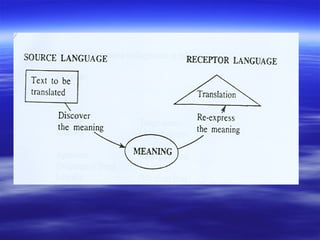
Translation consists of transferring  the meaning  of the source language into the receptor language.  This is done by going from the form of the first language to the form of a second language by way of  semantic structure. (deep structure) It is meaning which is being transferred and must be held constant. Only the form changes.
Definition of translation by different authors
Nida and Taber (1982:12) say that translating consists in reproducing in the receptor language the closest natural equivalence of a source language, firstly in terms of meaning and secondly in terms of style.  Wills (1982:112) says that translation is a procedure which leads from a written source language text to an optimally equivalent target language text and requires the syntactic, semantic, stylistic, and text pragmatic comprehension by the translator of the original text.
Larson (1984:3) says that translation consists of translating the meaning of the source language into the receptor language. This is done by going from the form of the first language to the form of a second language by way of semantic structure. It is meaning which is being transferred and must be held constant. Only the form changes.
Malinowski (1965:11-2) quoted by Tou (1999:31) says that translation must always be the re-creation of the original into something profoundly different. On the other hand, it is never substitution of word for word but invariably the translation of whole contexts. Catford (1965:20) states that translation may be defined as follows: the replacement of textual material in one language (SL) by equivalent textual material in another language (TL).
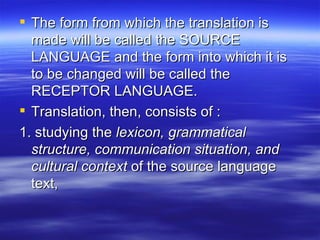
The form from which the translation is made will be called the SOURCE LANGUAGE and the form into which it is to be changed will be called the RECEPTOR LANGUAGE. Translation, then, consists of : 1. studying the  lexicon, grammatical structure, communication situation, and cultural context  of the source language text,
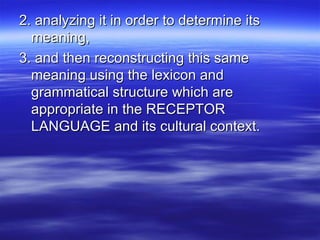
2. analyzing it in order to determine its meaning,  3. and then reconstructing this same meaning using the lexicon and grammatical structure which are appropriate in the RECEPTOR LANGUAGE and its cultural context.
 
 
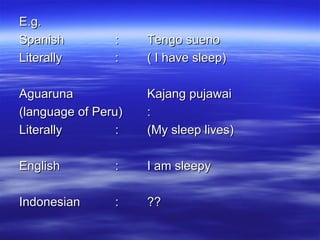
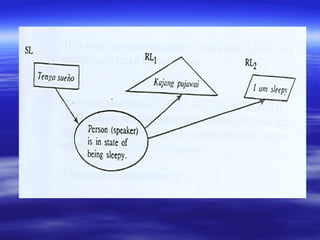
E.g. Spanish : Tengo sueno Literally : ( I have sleep) Aguaruna Kajang pujawai (language of Peru) : Literally : (My sleep lives) English : I am sleepy Indonesian : ??
Different grammatical forms, different lexical selections to signal the same meaning.
 
I cut my finger. How would you translate this sentence?
“ Please, can I be the captain?” asked Milo. “ Aku ingin menjadi kapten…!” pinta Milo ? -> non question, taken from my son’s children book
Persons who know both the SOURCE LANGUAGE and RECEPTOR LANGUAGE well can often make the transfer from one form to the other very rapidly. They must be equally fluent in the two languages. They are mother-tongue speakers of the two languages.
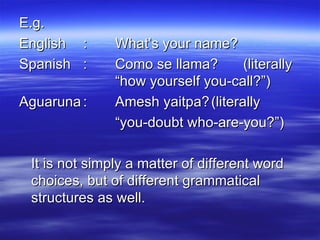
E.g. English : What’s your name? Spanish : Como se llama? (literally  “how yourself you-call?”) Aguaruna : Amesh yaitpa? (literally  “ you-doubt who-are-you?”) It is not simply a matter of different word choices, but of different grammatical structures as well.
Another example: English :  I have money Japanese & Latin :  me there is money (literally) Arabic & Russian :  with me there is money (literally) Aguaruna & Turkish :  my money exists (literally)
However, for complicated texts, and when the translators may not be equally fluent in the two languages (if they are mother-tongue speakers of only one), the study of the principles will enable them to make a more adequate translation.
The best translation is the one which uses the normal language forms of the receptor language communicates, as much as possible, to the receptor language speaker the same meaning that was understood by the speakers of the source language maintains the dynamics of the original source language text

Form And Meaning

  • 1.
    FORM AND MEANINGWhat is translation? Dictionary definition of translation: changing from one state or form to another, to turn into one’s own or another’s language. (Merriam-Webster Dictionary) Translation is basically a change of form.
  • 2.
    When we speakof the form of a language, we are referring to actual words, phrases, clauses, sentences, paragraphs, etc which are spoken or written. These forms are referred to as the surface structure of a language. In translation, the form of the source language is replaced by the form of the receptor (target) language.
  • 3.
    Translation consists oftransferring the meaning of the source language into the receptor language. This is done by going from the form of the first language to the form of a second language by way of semantic structure. (deep structure) It is meaning which is being transferred and must be held constant. Only the form changes.
  • 4.
    Definition of translationby different authors
  • 5.
    Nida and Taber(1982:12) say that translating consists in reproducing in the receptor language the closest natural equivalence of a source language, firstly in terms of meaning and secondly in terms of style. Wills (1982:112) says that translation is a procedure which leads from a written source language text to an optimally equivalent target language text and requires the syntactic, semantic, stylistic, and text pragmatic comprehension by the translator of the original text.
  • 6.
    Larson (1984:3) saysthat translation consists of translating the meaning of the source language into the receptor language. This is done by going from the form of the first language to the form of a second language by way of semantic structure. It is meaning which is being transferred and must be held constant. Only the form changes.
  • 7.
    Malinowski (1965:11-2) quotedby Tou (1999:31) says that translation must always be the re-creation of the original into something profoundly different. On the other hand, it is never substitution of word for word but invariably the translation of whole contexts. Catford (1965:20) states that translation may be defined as follows: the replacement of textual material in one language (SL) by equivalent textual material in another language (TL).
  • 8.
    The form fromwhich the translation is made will be called the SOURCE LANGUAGE and the form into which it is to be changed will be called the RECEPTOR LANGUAGE. Translation, then, consists of : 1. studying the lexicon, grammatical structure, communication situation, and cultural context of the source language text,
  • 9.
    2. analyzing itin order to determine its meaning, 3. and then reconstructing this same meaning using the lexicon and grammatical structure which are appropriate in the RECEPTOR LANGUAGE and its cultural context.
  • 10.
  • 11.
  • 12.
    E.g. Spanish :Tengo sueno Literally : ( I have sleep) Aguaruna Kajang pujawai (language of Peru) : Literally : (My sleep lives) English : I am sleepy Indonesian : ??
  • 13.
    Different grammatical forms,different lexical selections to signal the same meaning.
  • 14.
  • 15.
    I cut myfinger. How would you translate this sentence?
  • 16.
    “ Please, canI be the captain?” asked Milo. “ Aku ingin menjadi kapten…!” pinta Milo ? -> non question, taken from my son’s children book
  • 17.
    Persons who knowboth the SOURCE LANGUAGE and RECEPTOR LANGUAGE well can often make the transfer from one form to the other very rapidly. They must be equally fluent in the two languages. They are mother-tongue speakers of the two languages.
  • 18.
    E.g. English :What’s your name? Spanish : Como se llama? (literally “how yourself you-call?”) Aguaruna : Amesh yaitpa? (literally “ you-doubt who-are-you?”) It is not simply a matter of different word choices, but of different grammatical structures as well.
  • 19.
    Another example: English: I have money Japanese & Latin : me there is money (literally) Arabic & Russian : with me there is money (literally) Aguaruna & Turkish : my money exists (literally)
  • 20.
    However, for complicatedtexts, and when the translators may not be equally fluent in the two languages (if they are mother-tongue speakers of only one), the study of the principles will enable them to make a more adequate translation.
  • 21.
    The best translationis the one which uses the normal language forms of the receptor language communicates, as much as possible, to the receptor language speaker the same meaning that was understood by the speakers of the source language maintains the dynamics of the original source language text