The Role of the context in interpretation
Discourse Analysis
Lecture 6
The context of an idea or event is the
general situation that relates to it, and
which helps it to be understood
(Collins Co-build Dictionary, 1995)
Discourse analyst has to take account of the
context in which a piece of discourse occur.
Linguistic elements which require contextual
information
e.g here, now, I, you, then and that
The discourse analyst is investigating the use
of the language in context by a speaker/
writer
The relationship between the speaker and
the utterance, on the particular occasion of
use, tan with he potential relationship of one
sentence to another, regardless of their use.
Interpreting reference, presupposition,
implicature and inference
A: my uncle's coming home from Canada on
Sunday + he's due in
B: how long has he been away for or has he
just been away?
A: Oh no they lived in Canada eh he was
married to my mother's sister + + well she's
been dead for a number of years now +
the notion of presupposition required in
discourse analysis is pragmatic
presupposition, that is, 'defined in terms
of assumptions the speaker makes about
what the hearer is likely to accept without
challenge' (Givbn, 1979a: 50)
Keenan (1971) A sentence S logically
presupposes a sentence S' just in case S
logically implies St and the negation of S, -
S, also logically implies S
a. My uncle is coming home from Canada.
b. My uncle isn't coming home from Canada.
c. I have an uncle.
However, it seems rather unnecessary to
introduce the negative sentence (b) into a
consideration of the relationship between (a)
and (c)
The introduction of the negative sentence into a
consideration of creates an additional problem.
For example, it has been suggested ( Kempson,
1975) that a sentence such as (d) is a perfectly
reasonable sentence of English and undermines
the argument for logical presupposition, as it is
defined above.
(d) My uncle isn't coming home from Canada
because I don't have an uncle.
The speakers, we may suggest, would have
different presuppositions, in the two
situations.
‘Implied meaning’ which is indicating truth.
The term 'implicature' is used by Grice (1975)
to account for what a speaker can imply,
suggest, or mean, as distinct from what the
speaker literally says.
Conventional Implicatures
Conversational Implicatures
conventional implicatures which are,
according to Grice, determined by 'the
conventional meaning of the words used'
He is an Englishman, he is, therefore, brave.
Conversational implicature which is derived
from a general principle of conversation plus
a number of maxims which speakers
normally obey.
The general principle is called the
Cooperative Principle: "Make your
contribution such as it is required, at the
stage at which it occurs, by the accepted
purpose or direction of the talk exchange in
which you are engaged.“ (Grice)
Listeners and speakers must speak
cooperatively and mutually accept one
another to be understood in a particular way.
The cooperative principle describes how
effective communication in conversation is
achieved in common social situations.
Conversational maxims:
Quantity: Make your contribution as informative
as is required (for the current purposes of the
exchange). Do not make your contribution more
informative than is required.
Quality: Do not say what you believe to be
false. DO not say that for which you lack
adequate evidence.
Relation: Be relevant.
Manner: Be perspicuous. Avoid obscurity of
expression. Avoid ambiguity. Be brief (avoid
unnecessary prolixity). Be orderly.
by providing a description of the norms
speakers operate with in conversation, Grice
makes it possible to describe what types of
meaning a speaker can convey by 'flouting'
one of these maxims.
This flouting of a maxim results in the
speaker conveying, in addition to the literal
meaning of his utterance, an additional
meaning, which is a conversational
implicature
A: I am out of petrol.
B: There is a garage round the corner.
A discourse analyst would like to emphasise the
fact that implicatures are pragmatic aspects of
meaning and have certain identifiable
characteristics. They are partially derived from
the conventional or literal meaning of an
utterance, produced in a specific context which
is shared by the speaker and the hearer, and
depend on a recognition by the speaker and the
hearer of the Cooperative Principle and its
maxims.
Since the discourse analyst, like the hearer,
has no direct access to a speaker's intended
meaning in producing an utterance, he often
has to rely on a process of inference to
arrive at an interpretation for utterances or
for the connections between utterances.
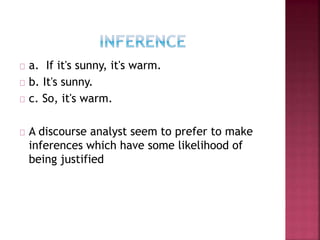
a. If it's sunny, it's warm.
b. It's sunny.
c. So, it's warm.
A discourse analyst seem to prefer to make
inferences which have some likelihood of
being justified
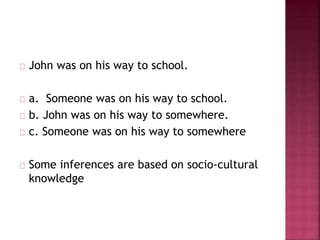
John was on his way to school.
a. Someone was on his way to school.
b. John was on his way to somewhere.
c. Someone was on his way to somewhere
Some inferences are based on socio-cultural
knowledge
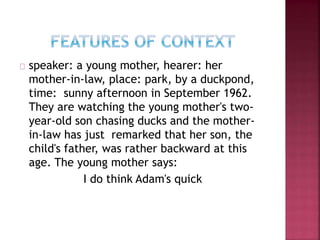
speaker: a young mother, hearer: her
mother-in-law, place: park, by a duckpond,
time: sunny afternoon in September 1962.
They are watching the young mother's two-
year-old son chasing ducks and the mother-
in-law has just remarked that her son, the
child's father, was rather backward at this
age. The young mother says:
I do think Adam's quick
we shall simplistically assume that the
referents of I and Adam are fixed by spatio-
temporal co-ordinates. This 'Adam' is being
compared (or contrasted), favourably, with
his father. Quick, may be interpreted, in the
context of backward, as meaning something
like 'quick in developing'.
speaker: a student, hearers: a set of
students, place: sitting round a coffee table
in the refectory, time: evening in March
1980. John, one of the group, has just told a
joke. Everyone laughs except Adam. Then
Adam laughs. One of the students says:
I do think Adam's quick
different referents for I and Adam are fixed
spatio-temporally. This 'Adam' is being
compared (or contrasted) not with his father
and favourably, but with the set of other
students unfavourably. In this case quick
must be interpreted as meaning something
like 'quick to understand I react I see the
joke'.
intending to tell an untruth, but to be
implicating the opposite of what is said.
Context: ‘someone speaking to someone
somewhere’
Firth’s outline of context contains the
following elements:
A. The relevant features of participants:
persons, personalities.
(i) The verbal action of the participants.
(ii) The non-verbal action of the participants.
B. The relevant objects.
C. The effect of the verbal action.
an ethnographic view of communicative
events within communities
The use of a linguistic form identifies a range
of meanings. A context can support a range
of meanings. When a form is used in a
context it eliminates the meanings possible
to that context other than those the form
can signal: the context eliminates from
consideration the meanings possible to the
form other than those the context can
support. (Hymes)
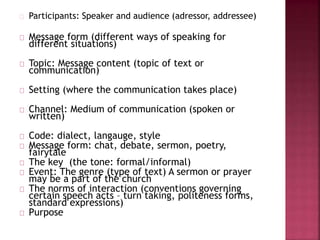
Participants: Speaker and audience (adressor, addressee)
Message form (different ways of speaking for
different situations)
Topic: Message content (topic of text or
communication)
Setting (where the communication takes place)
Channel: Medium of communication (spoken or
written)
Code: dialect, langauge, style
Message form: chat, debate, sermon, poetry,
fairytale
The key (the tone: formal/informal)
Event: The genre (type of text) A sermon or prayer
may be a part of the church
The norms of interaction (conventions governing
certain speech acts – turn taking, politeness forms,
standard expressions)
Purpose
Hymes' features constitute essentially a
checklist to check off the detail of the
nature of the communicative event.
The Role of context (Discourse Analysis)

The Role of context (Discourse Analysis)

  • 1.
    The Role ofthe context in interpretation Discourse Analysis Lecture 6
  • 2.
    The context ofan idea or event is the general situation that relates to it, and which helps it to be understood (Collins Co-build Dictionary, 1995)
  • 3.
    Discourse analyst hasto take account of the context in which a piece of discourse occur. Linguistic elements which require contextual information e.g here, now, I, you, then and that
  • 4.
    The discourse analystis investigating the use of the language in context by a speaker/ writer The relationship between the speaker and the utterance, on the particular occasion of use, tan with he potential relationship of one sentence to another, regardless of their use. Interpreting reference, presupposition, implicature and inference
  • 5.
    A: my uncle'scoming home from Canada on Sunday + he's due in B: how long has he been away for or has he just been away? A: Oh no they lived in Canada eh he was married to my mother's sister + + well she's been dead for a number of years now +
  • 6.
    the notion ofpresupposition required in discourse analysis is pragmatic presupposition, that is, 'defined in terms of assumptions the speaker makes about what the hearer is likely to accept without challenge' (Givbn, 1979a: 50)
  • 7.
    Keenan (1971) Asentence S logically presupposes a sentence S' just in case S logically implies St and the negation of S, - S, also logically implies S a. My uncle is coming home from Canada. b. My uncle isn't coming home from Canada. c. I have an uncle.
  • 8.
    However, it seemsrather unnecessary to introduce the negative sentence (b) into a consideration of the relationship between (a) and (c) The introduction of the negative sentence into a consideration of creates an additional problem. For example, it has been suggested ( Kempson, 1975) that a sentence such as (d) is a perfectly reasonable sentence of English and undermines the argument for logical presupposition, as it is defined above. (d) My uncle isn't coming home from Canada because I don't have an uncle.
  • 9.
    The speakers, wemay suggest, would have different presuppositions, in the two situations.
  • 10.
    ‘Implied meaning’ whichis indicating truth. The term 'implicature' is used by Grice (1975) to account for what a speaker can imply, suggest, or mean, as distinct from what the speaker literally says. Conventional Implicatures Conversational Implicatures
  • 11.
    conventional implicatures whichare, according to Grice, determined by 'the conventional meaning of the words used' He is an Englishman, he is, therefore, brave.
  • 12.
    Conversational implicature whichis derived from a general principle of conversation plus a number of maxims which speakers normally obey. The general principle is called the Cooperative Principle: "Make your contribution such as it is required, at the stage at which it occurs, by the accepted purpose or direction of the talk exchange in which you are engaged.“ (Grice)
  • 13.
    Listeners and speakersmust speak cooperatively and mutually accept one another to be understood in a particular way. The cooperative principle describes how effective communication in conversation is achieved in common social situations.
  • 14.
    Conversational maxims: Quantity: Makeyour contribution as informative as is required (for the current purposes of the exchange). Do not make your contribution more informative than is required. Quality: Do not say what you believe to be false. DO not say that for which you lack adequate evidence. Relation: Be relevant. Manner: Be perspicuous. Avoid obscurity of expression. Avoid ambiguity. Be brief (avoid unnecessary prolixity). Be orderly.
  • 15.
    by providing adescription of the norms speakers operate with in conversation, Grice makes it possible to describe what types of meaning a speaker can convey by 'flouting' one of these maxims. This flouting of a maxim results in the speaker conveying, in addition to the literal meaning of his utterance, an additional meaning, which is a conversational implicature
  • 16.
    A: I amout of petrol. B: There is a garage round the corner. A discourse analyst would like to emphasise the fact that implicatures are pragmatic aspects of meaning and have certain identifiable characteristics. They are partially derived from the conventional or literal meaning of an utterance, produced in a specific context which is shared by the speaker and the hearer, and depend on a recognition by the speaker and the hearer of the Cooperative Principle and its maxims.
  • 17.
    Since the discourseanalyst, like the hearer, has no direct access to a speaker's intended meaning in producing an utterance, he often has to rely on a process of inference to arrive at an interpretation for utterances or for the connections between utterances.
  • 18.
    a. If it'ssunny, it's warm. b. It's sunny. c. So, it's warm. A discourse analyst seem to prefer to make inferences which have some likelihood of being justified
  • 19.
    John was onhis way to school. a. Someone was on his way to school. b. John was on his way to somewhere. c. Someone was on his way to somewhere Some inferences are based on socio-cultural knowledge
  • 20.
    speaker: a youngmother, hearer: her mother-in-law, place: park, by a duckpond, time: sunny afternoon in September 1962. They are watching the young mother's two- year-old son chasing ducks and the mother- in-law has just remarked that her son, the child's father, was rather backward at this age. The young mother says: I do think Adam's quick
  • 21.
    we shall simplisticallyassume that the referents of I and Adam are fixed by spatio- temporal co-ordinates. This 'Adam' is being compared (or contrasted), favourably, with his father. Quick, may be interpreted, in the context of backward, as meaning something like 'quick in developing'.
  • 22.
    speaker: a student,hearers: a set of students, place: sitting round a coffee table in the refectory, time: evening in March 1980. John, one of the group, has just told a joke. Everyone laughs except Adam. Then Adam laughs. One of the students says: I do think Adam's quick
  • 23.
    different referents forI and Adam are fixed spatio-temporally. This 'Adam' is being compared (or contrasted) not with his father and favourably, but with the set of other students unfavourably. In this case quick must be interpreted as meaning something like 'quick to understand I react I see the joke'. intending to tell an untruth, but to be implicating the opposite of what is said.
  • 24.
    Context: ‘someone speakingto someone somewhere’
  • 25.
    Firth’s outline ofcontext contains the following elements: A. The relevant features of participants: persons, personalities. (i) The verbal action of the participants. (ii) The non-verbal action of the participants. B. The relevant objects. C. The effect of the verbal action.
  • 26.
    an ethnographic viewof communicative events within communities The use of a linguistic form identifies a range of meanings. A context can support a range of meanings. When a form is used in a context it eliminates the meanings possible to that context other than those the form can signal: the context eliminates from consideration the meanings possible to the form other than those the context can support. (Hymes)
  • 27.
    Participants: Speaker andaudience (adressor, addressee) Message form (different ways of speaking for different situations) Topic: Message content (topic of text or communication) Setting (where the communication takes place) Channel: Medium of communication (spoken or written) Code: dialect, langauge, style Message form: chat, debate, sermon, poetry, fairytale The key (the tone: formal/informal) Event: The genre (type of text) A sermon or prayer may be a part of the church The norms of interaction (conventions governing certain speech acts – turn taking, politeness forms, standard expressions) Purpose
  • 28.
    Hymes' features constituteessentially a checklist to check off the detail of the nature of the communicative event.