FORGING

Forging is plastic deformation of heated
metal between two dies to achieve desired
shape

Forged parts have good directional
strength

improves in mechanical properties of
forged components such as tensile
strength, ductility, impact toughness,
fracture toughness, fatigue strength

free from internal voids and porosity

maximizes dynamic properties like impact
toughness, fracture toughness, fatigue
strength

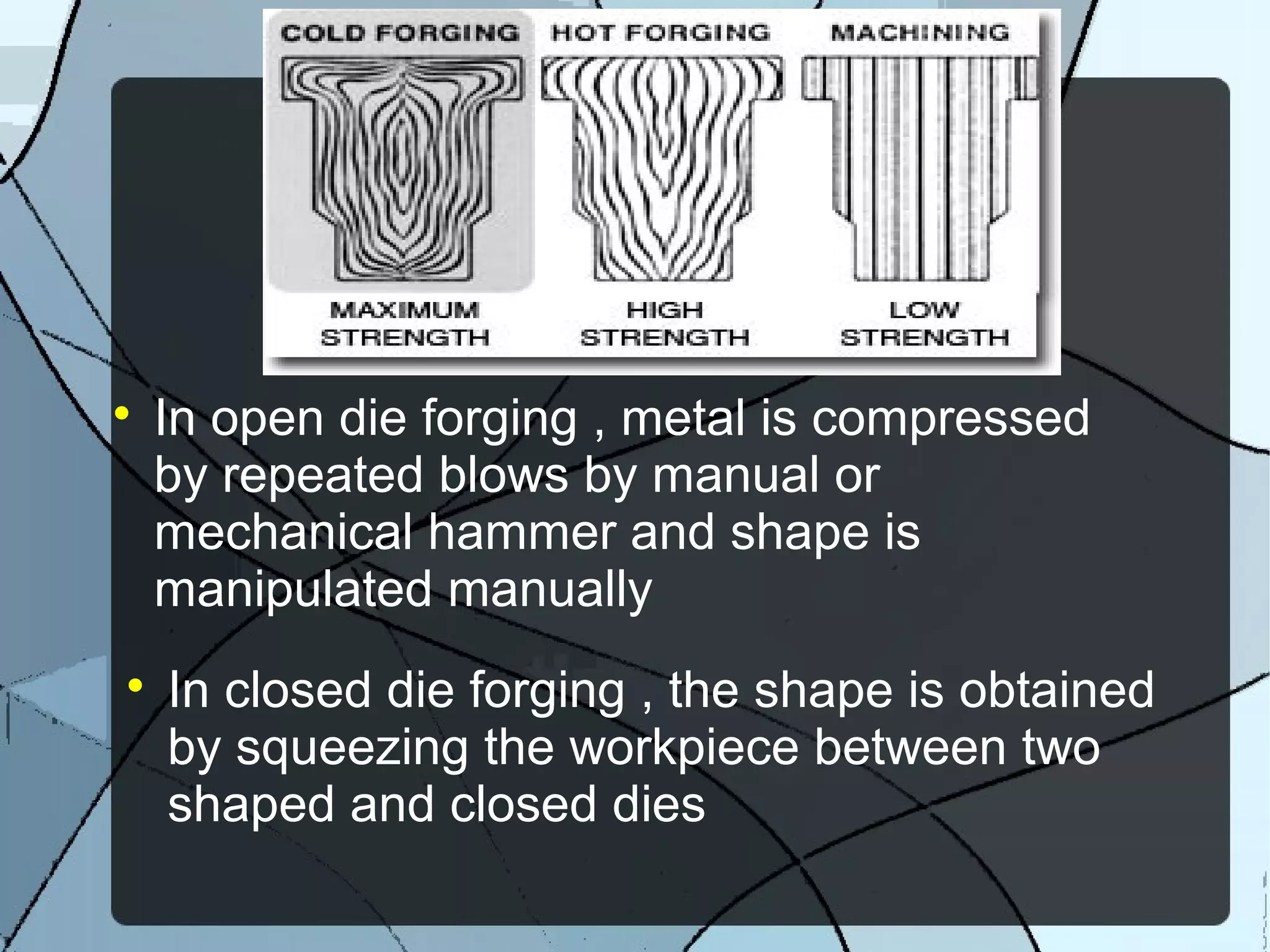
In open die forging , metal is compressed
by repeated blows by manual or
mechanical hammer and shape is
manipulated manually

In closed die forging , the shape is obtained
by squeezing the workpiece between two
shaped and closed dies
Material used

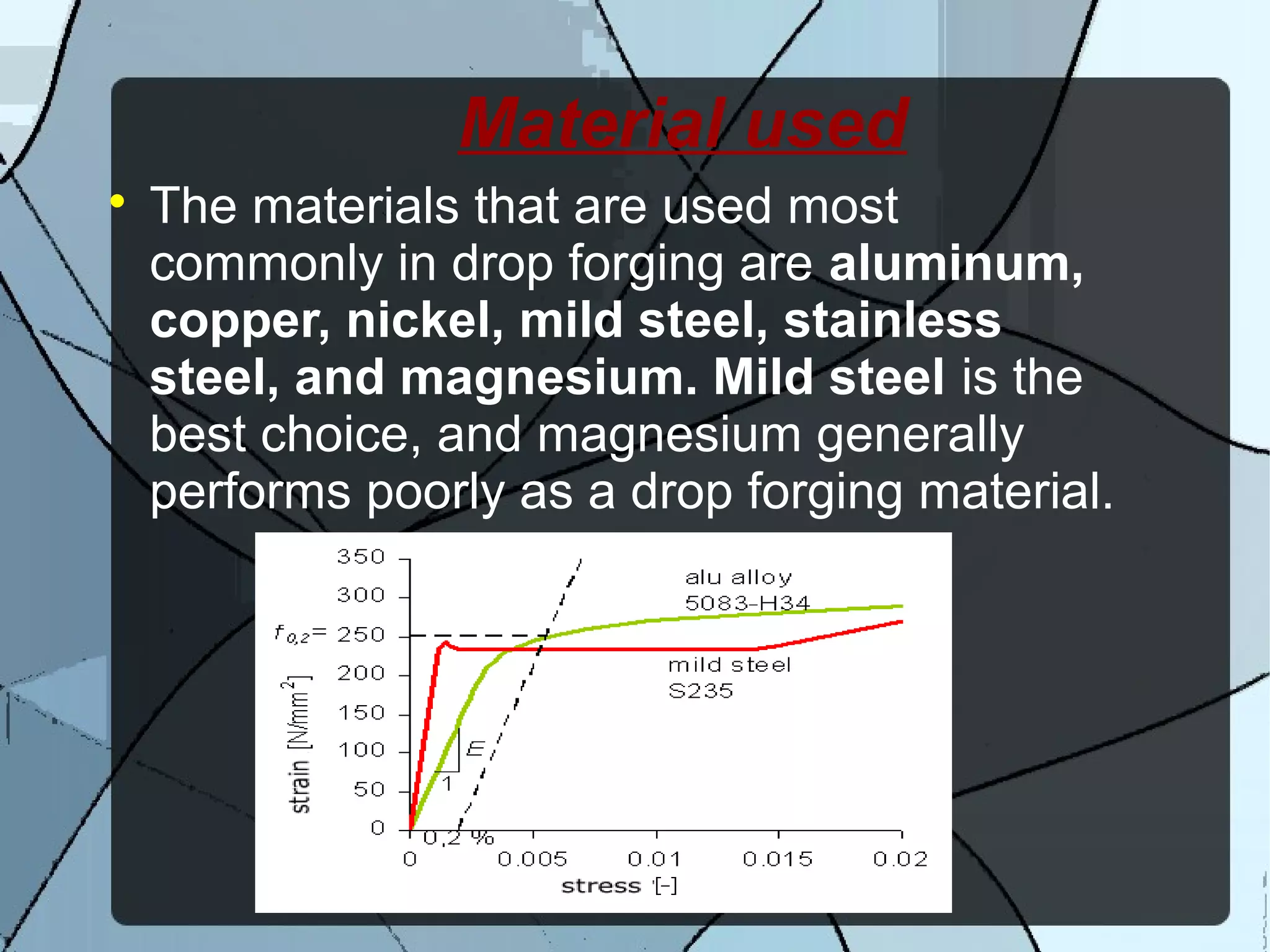
The materials that are used most
commonly in drop forging are aluminum,
copper, nickel, mild steel, stainless
steel, and magnesium. Mild steel is the
best choice, and magnesium generally
performs poorly as a drop forging material.
Types of forging

1.Smith forging

2.Drop forging

3.Machine or upset forging

4.Press forging
1.Smith forging

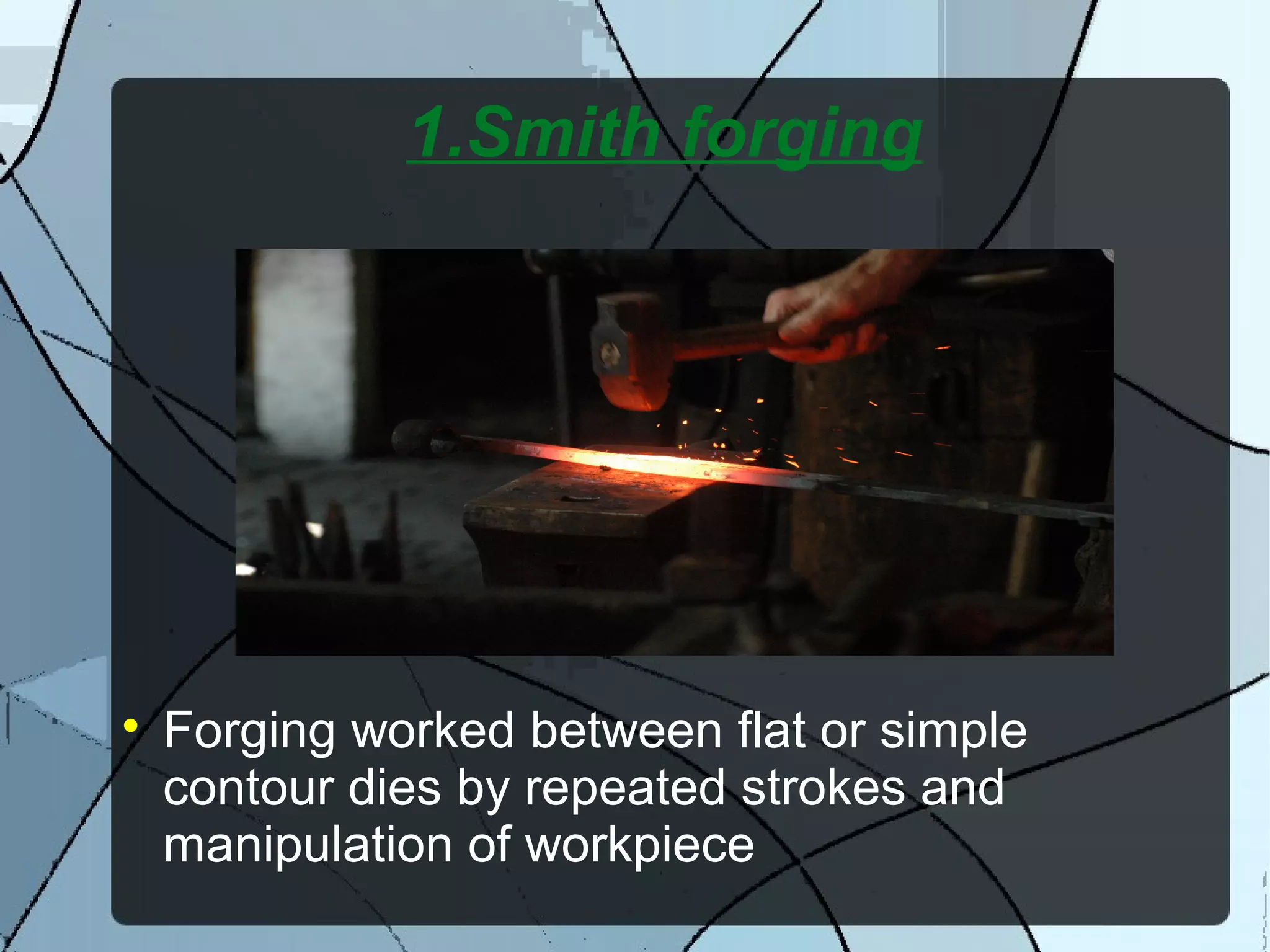
Forging worked between flat or simple
contour dies by repeated strokes and
manipulation of workpiece
2.Drop forging

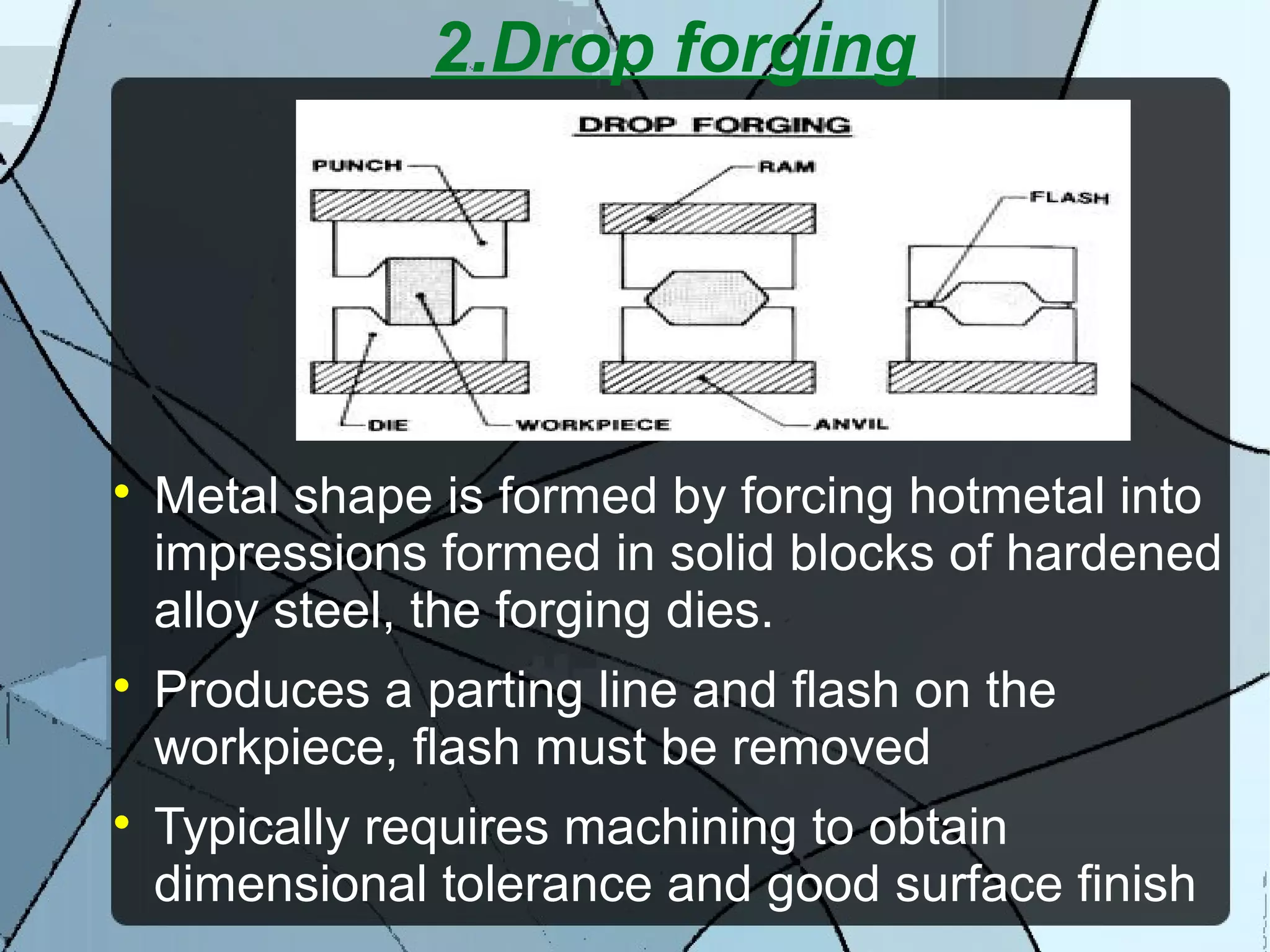
Metal shape is formed by forcing hotmetal into
impressions formed in solid blocks of hardened
alloy steel, the forging dies.

Produces a parting line and flash on the
workpiece, flash must be removed

Typically requires machining to obtain
dimensional tolerance and good surface finish
3.Machine or upset forging
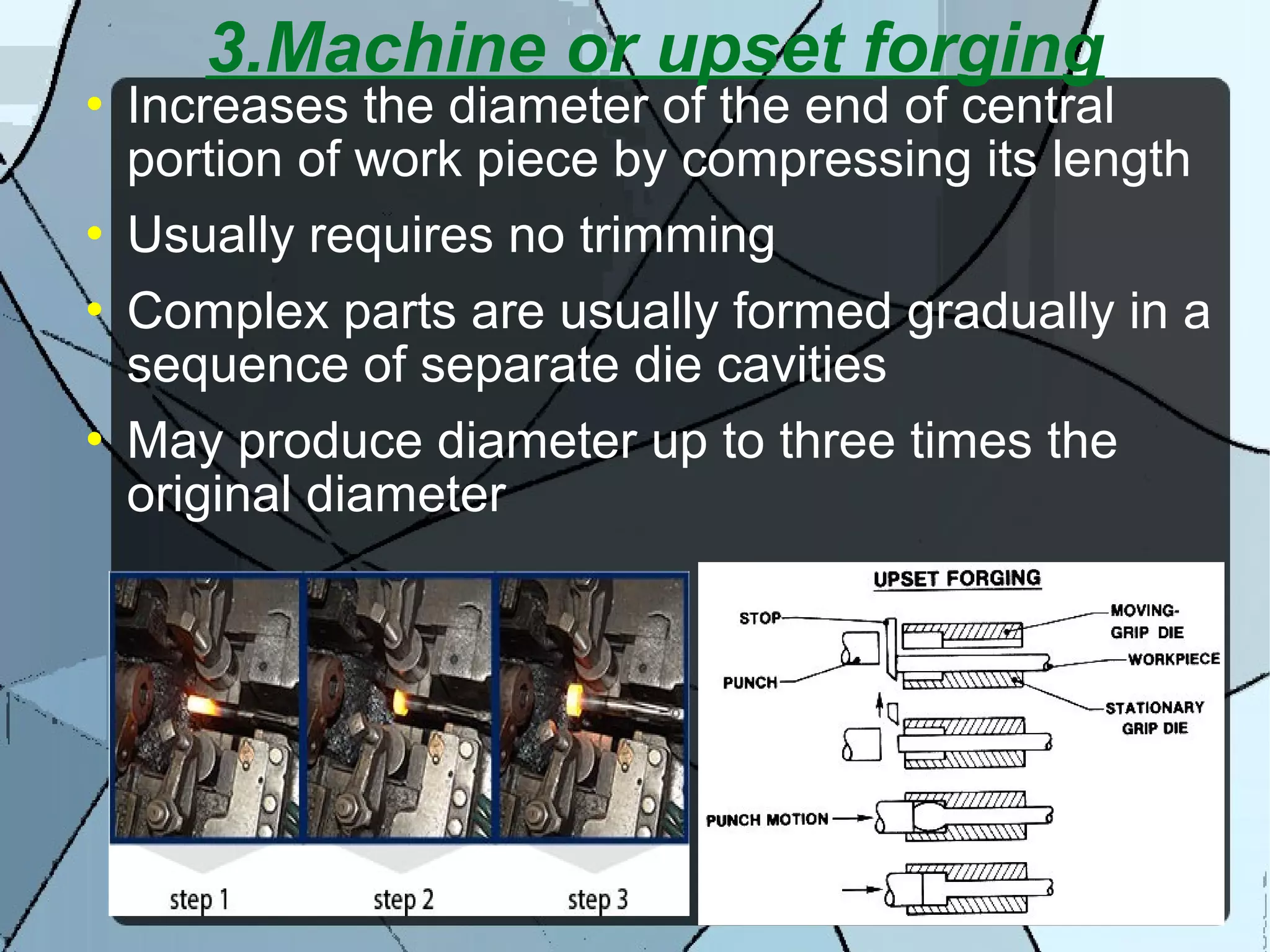
 Increases the diameter of the end of central
portion of work piece by compressing its length
 Usually requires no trimming
 Complex parts are usually formed gradually in a
sequence of separate die cavities
 May produce diameter up to three times the
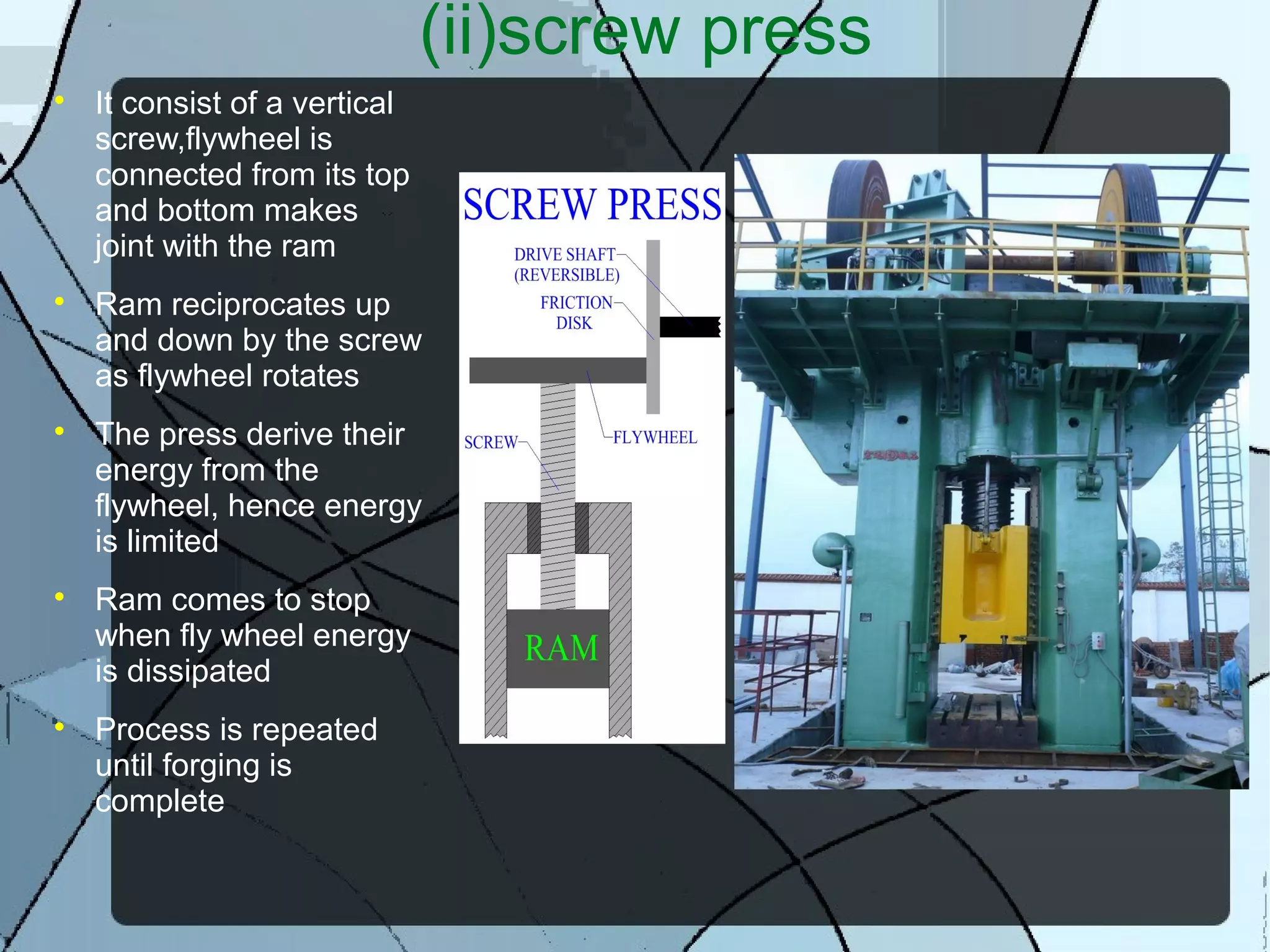
original diameter
4.Press forging

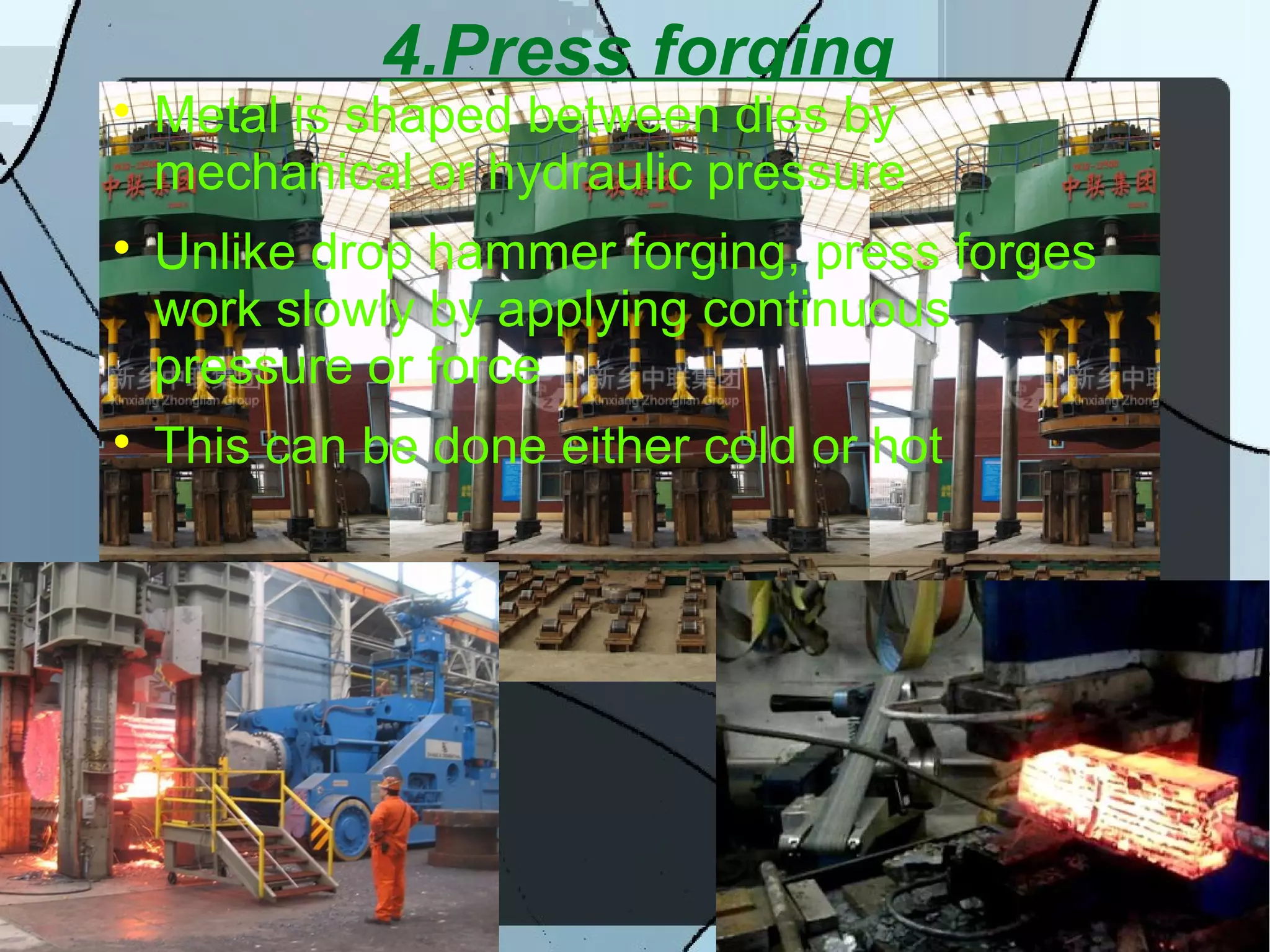
Metal is shaped between dies by
mechanical or hydraulic pressure

Unlike drop hammer forging, press forges
work slowly by applying continuous
pressure or force

This can be done either cold or hot
Classification of forging
processes

1.Open die forging

2.Close die or impression die forging

3.Flashless forging

4.Cold forging

5.Warm forging
1.Open die forging

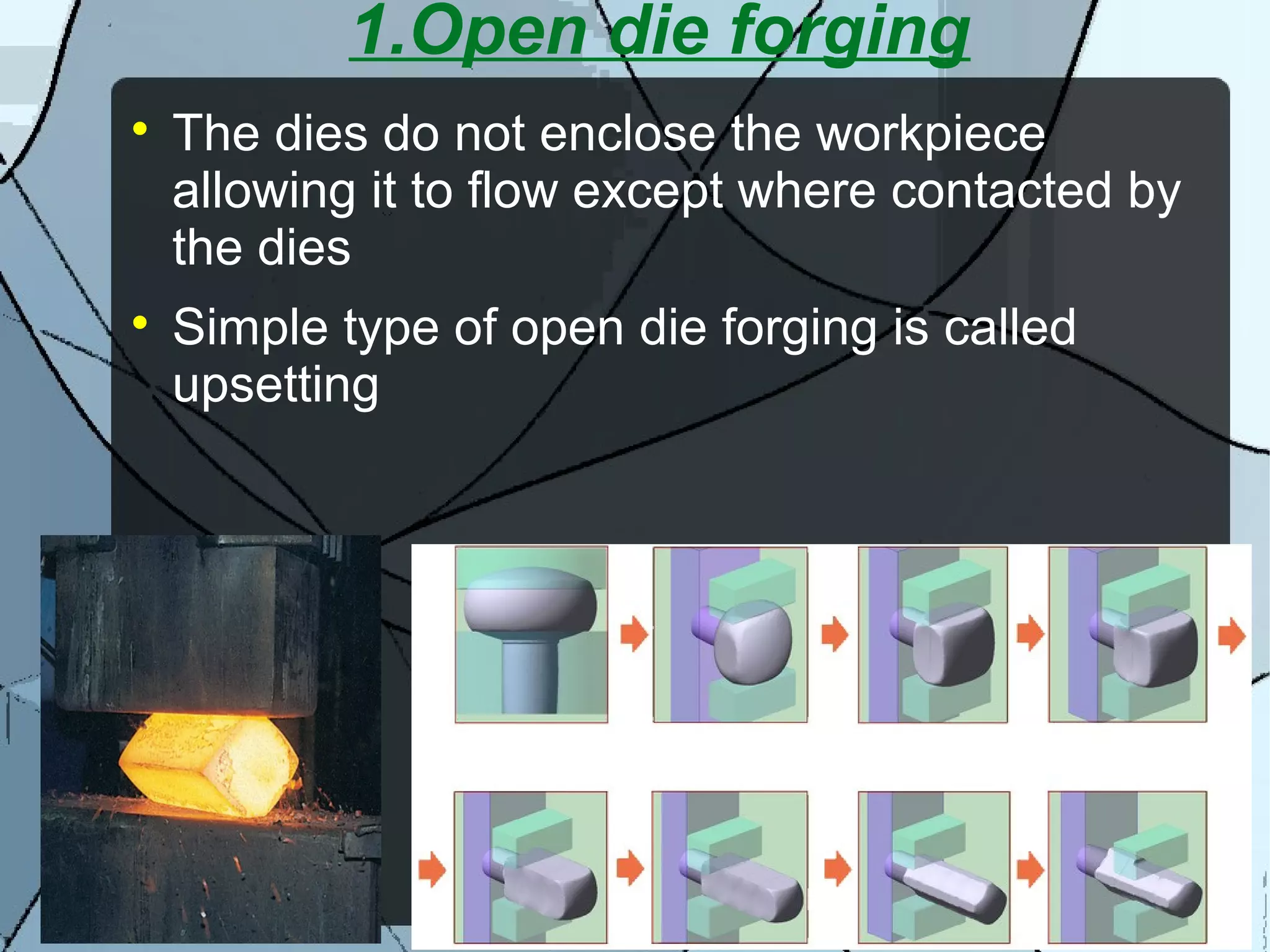
The dies do not enclose the workpiece
allowing it to flow except where contacted by
the dies

Simple type of open die forging is called
upsetting
Open die forging categorized in 3
methods

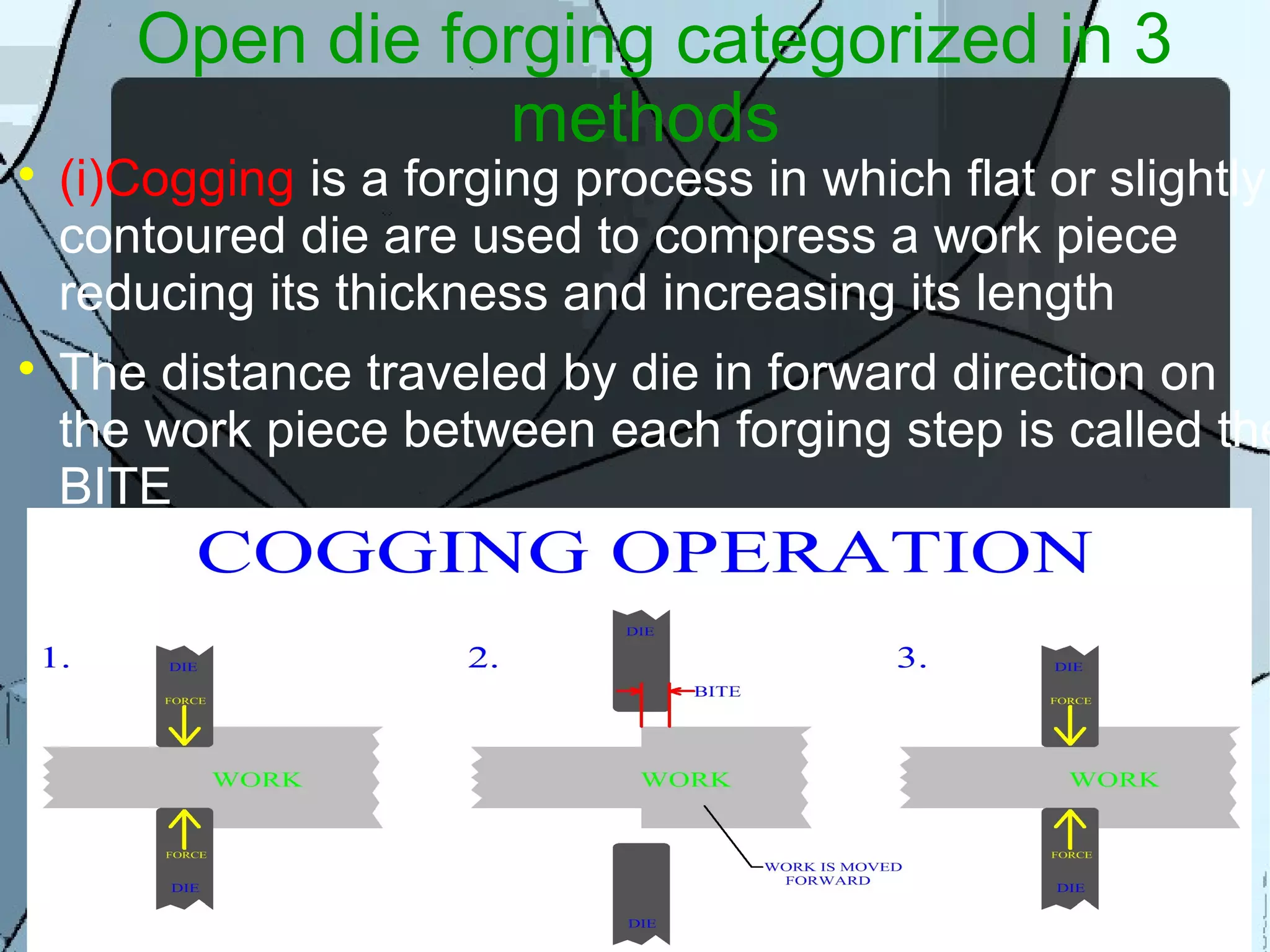
(i)Cogging is a forging process in which flat or slightly
contoured die are used to compress a work piece
reducing its thickness and increasing its length

The distance traveled by die in forward direction on
the work piece between each forging step is called the
BITE
(ii)Fullering

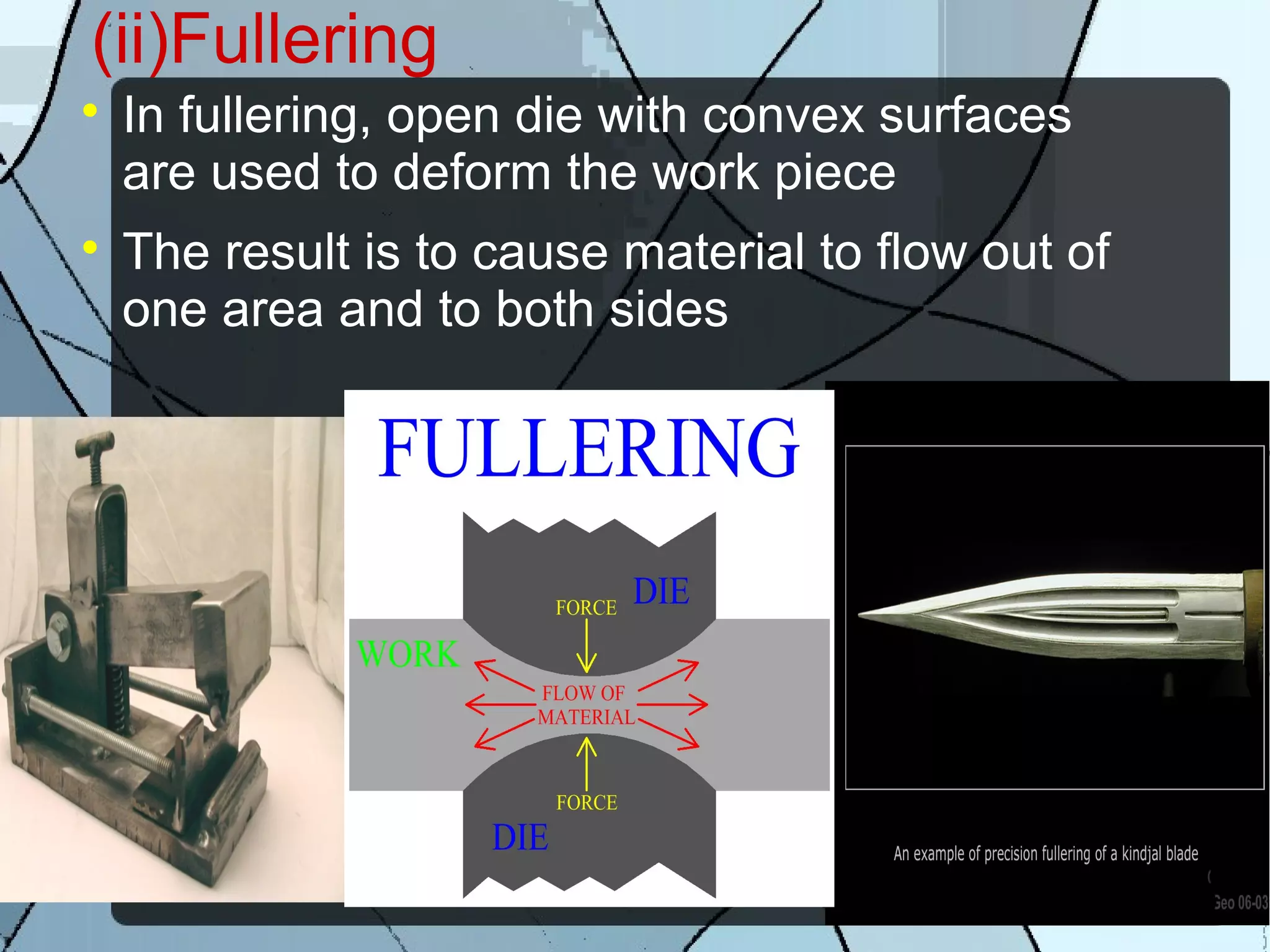
In fullering, open die with convex surfaces
are used to deform the work piece

The result is to cause material to flow out of
one area and to both sides
2.Close die or impression
forging

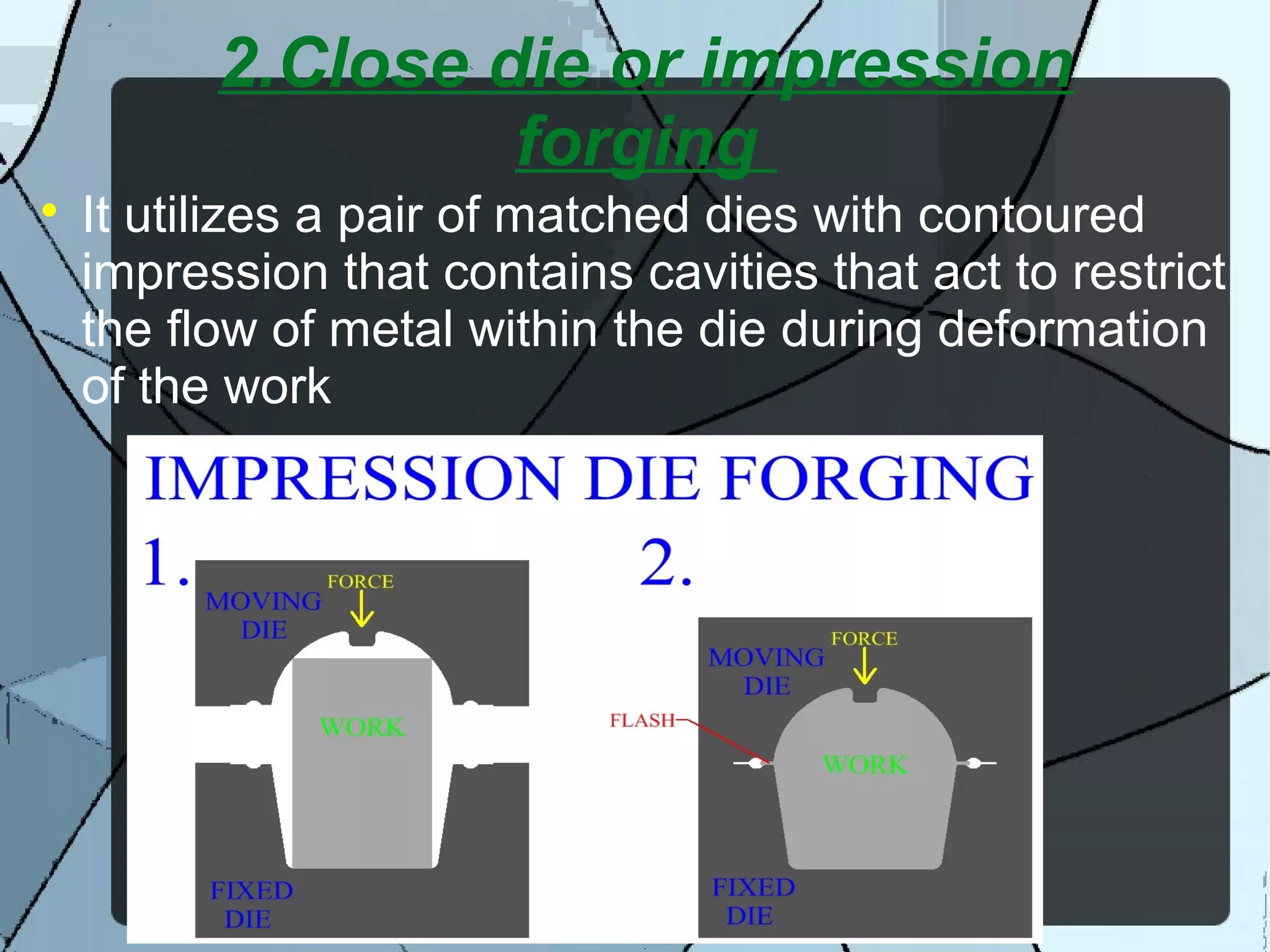
It utilizes a pair of matched dies with contoured
impression that contains cavities that act to restrict
the flow of metal within the die during deformation
of the work
3.Flashless forging

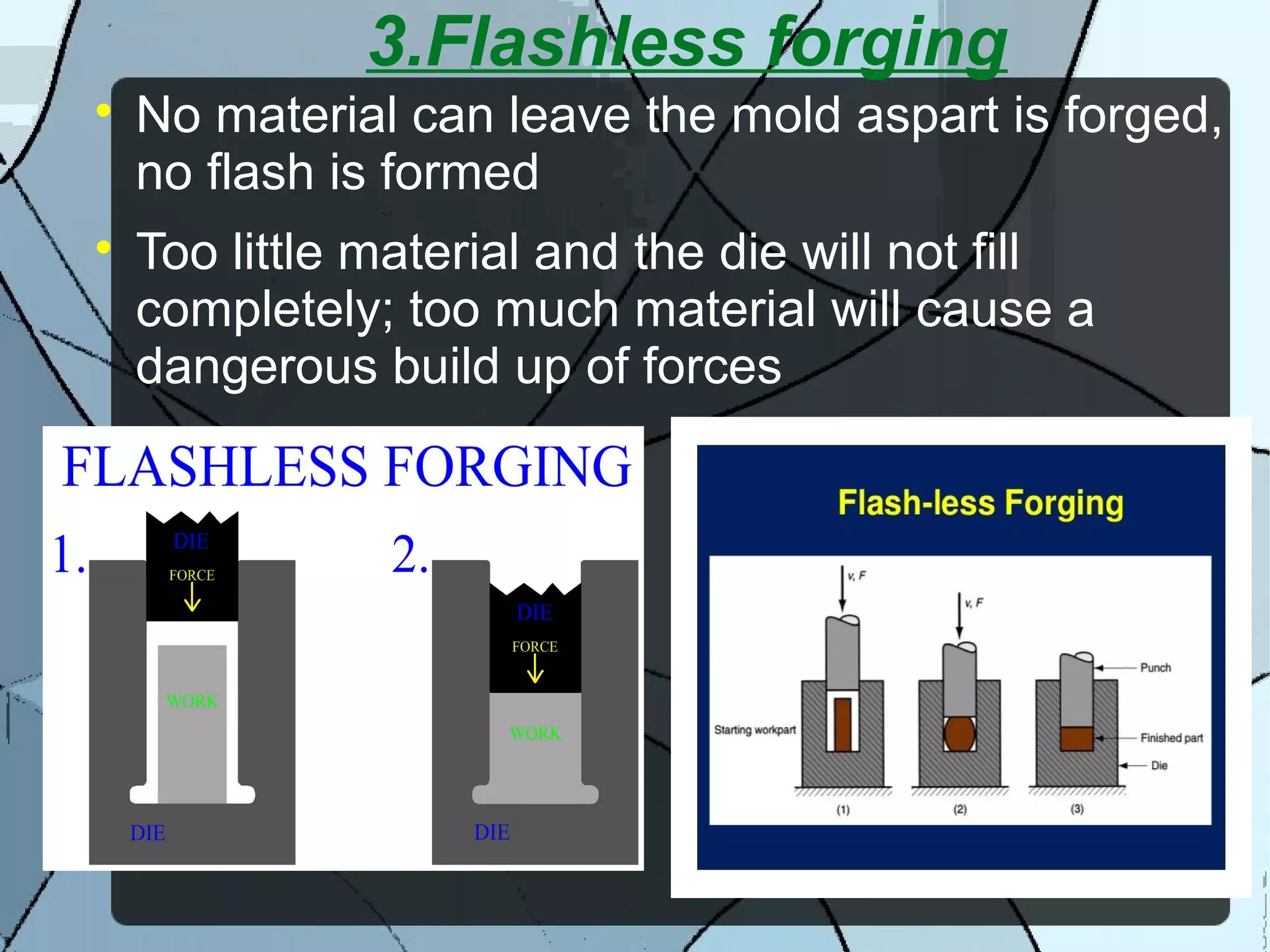
No material can leave the mold aspart is forged,
no flash is formed

Too little material and the die will not fill
completely; too much material will cause a
dangerous build up of forces
4.Cold forging

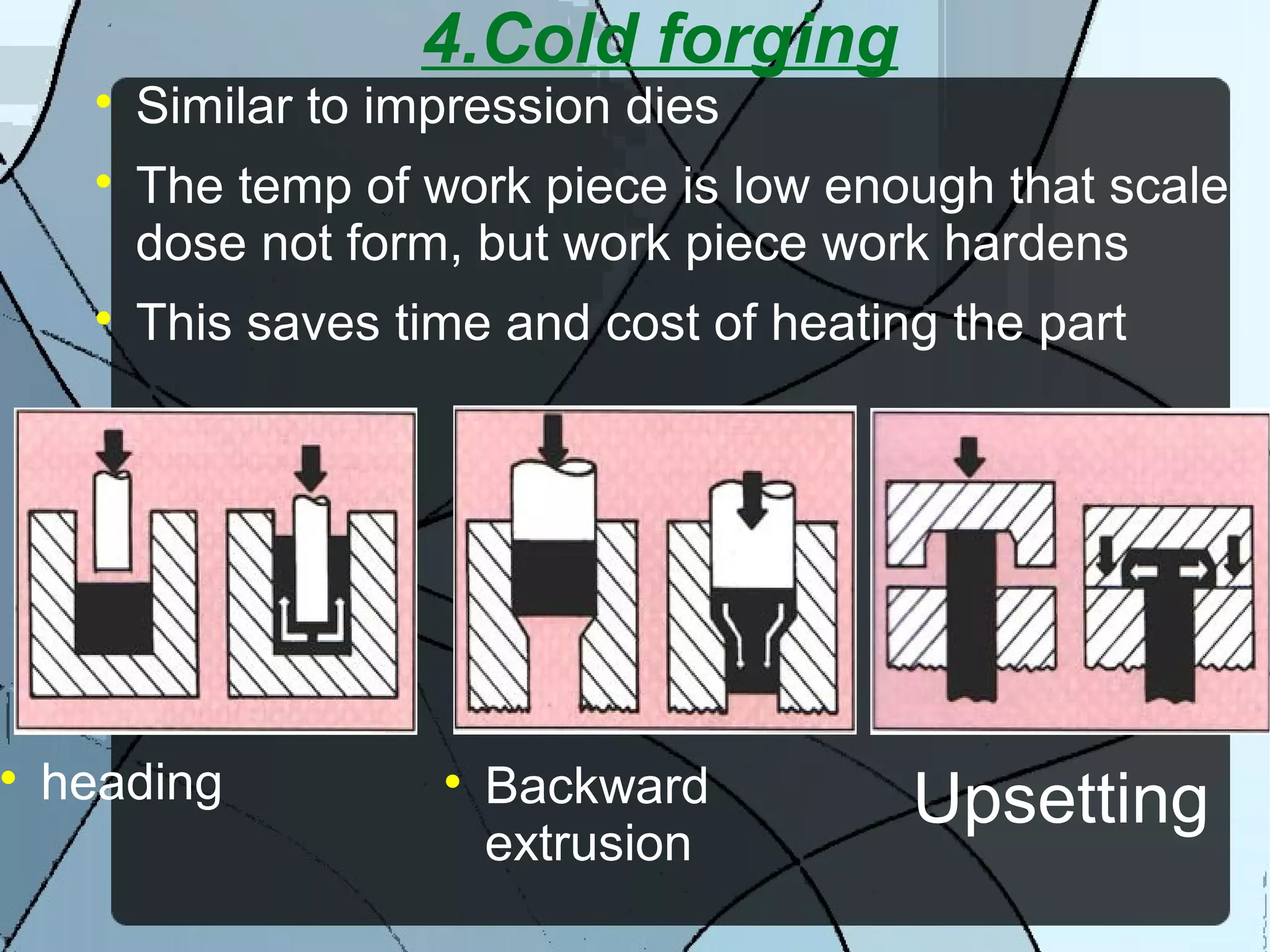
Similar to impression dies

The temp of work piece is low enough that scale
dose not form, but work piece work hardens

This saves time and cost of heating the part

heading 
Backward
extrusion
Upsetting
5.Warm forging

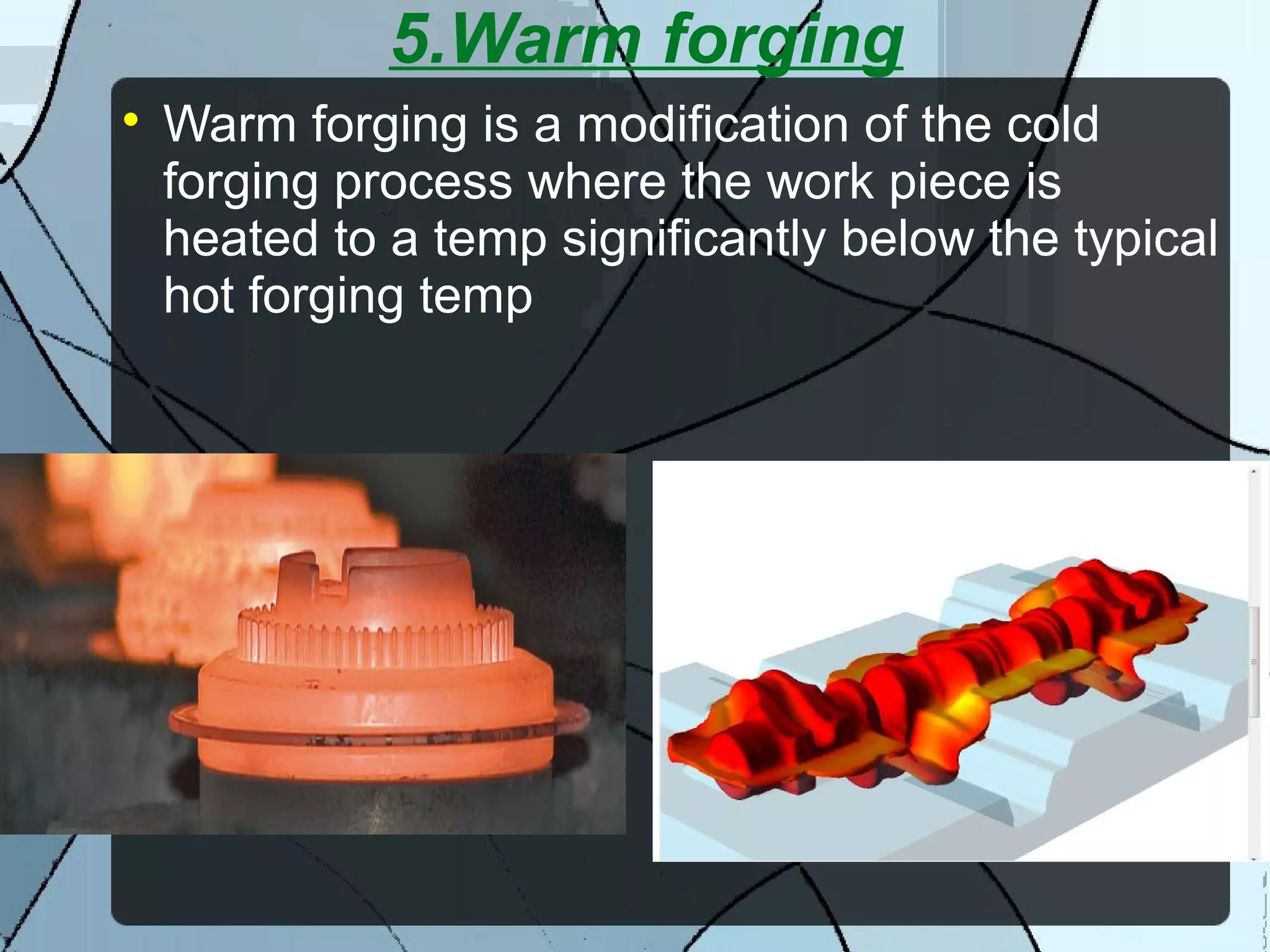
Warm forging is a modification of the cold
forging process where the work piece is
heated to a temp significantly below the typical
hot forging temp
Guideline for selection of
forging processes

When forgings are very large, when very few are
required, or when delivery times are very short,
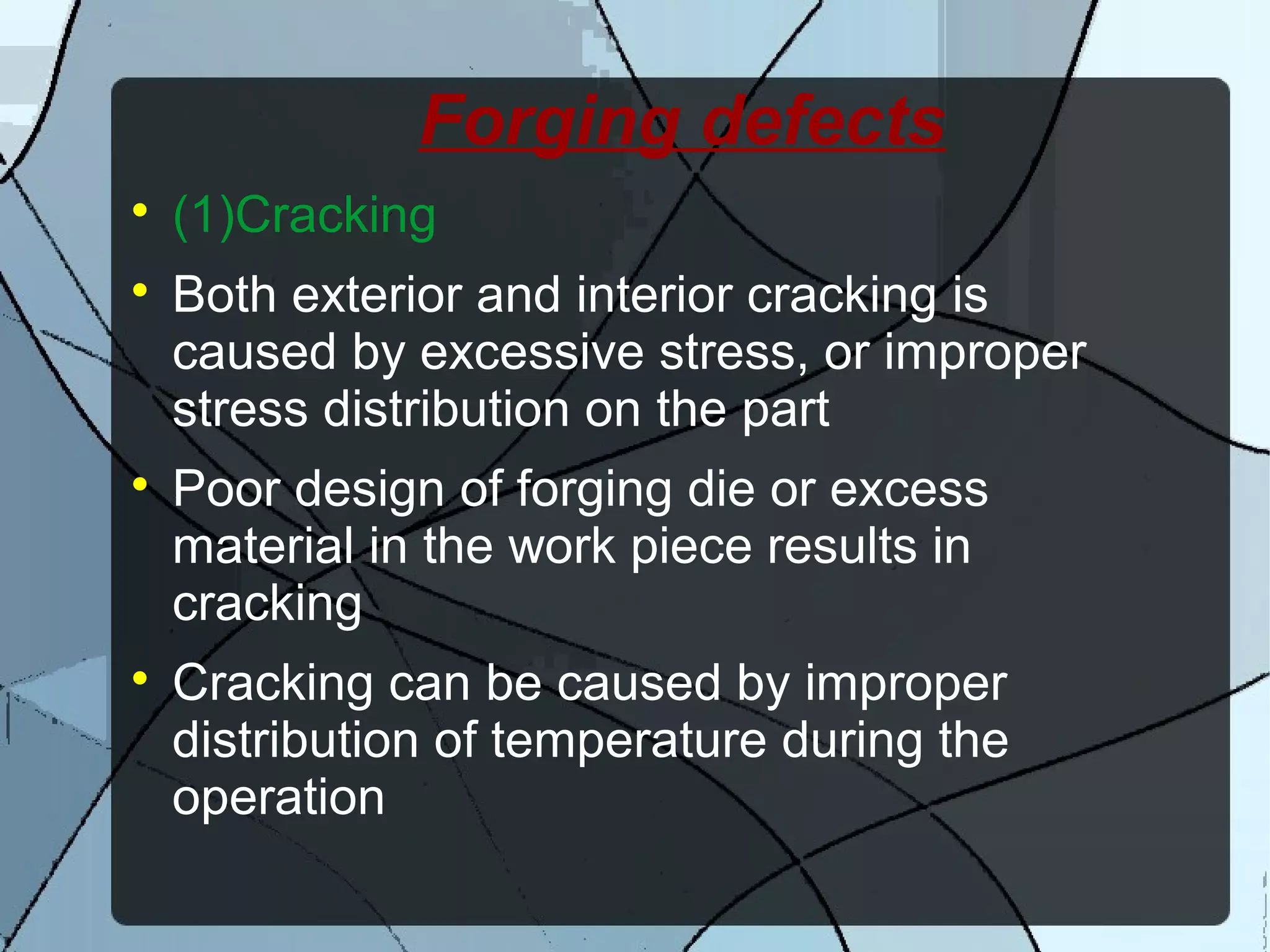
open die forging is the typical choice

As shape becomes more complex, ad production
quantities increases, impression die forging
becomes the process of choice

Shaft like forgings with details on the ends or
along the length, upset forging is used

Relatively small components that are rotationally
symmetrical or asymmetric, requires high strength
and high precision, and are produced in larger
quantities are candidates for cold forging
Forging operations

1.Upsetting

2.Fullering

3.Edging

4.Bending

5.Punching and Drifting

6.Forged Welding

7.Flating and Setting Down

8.Swaging
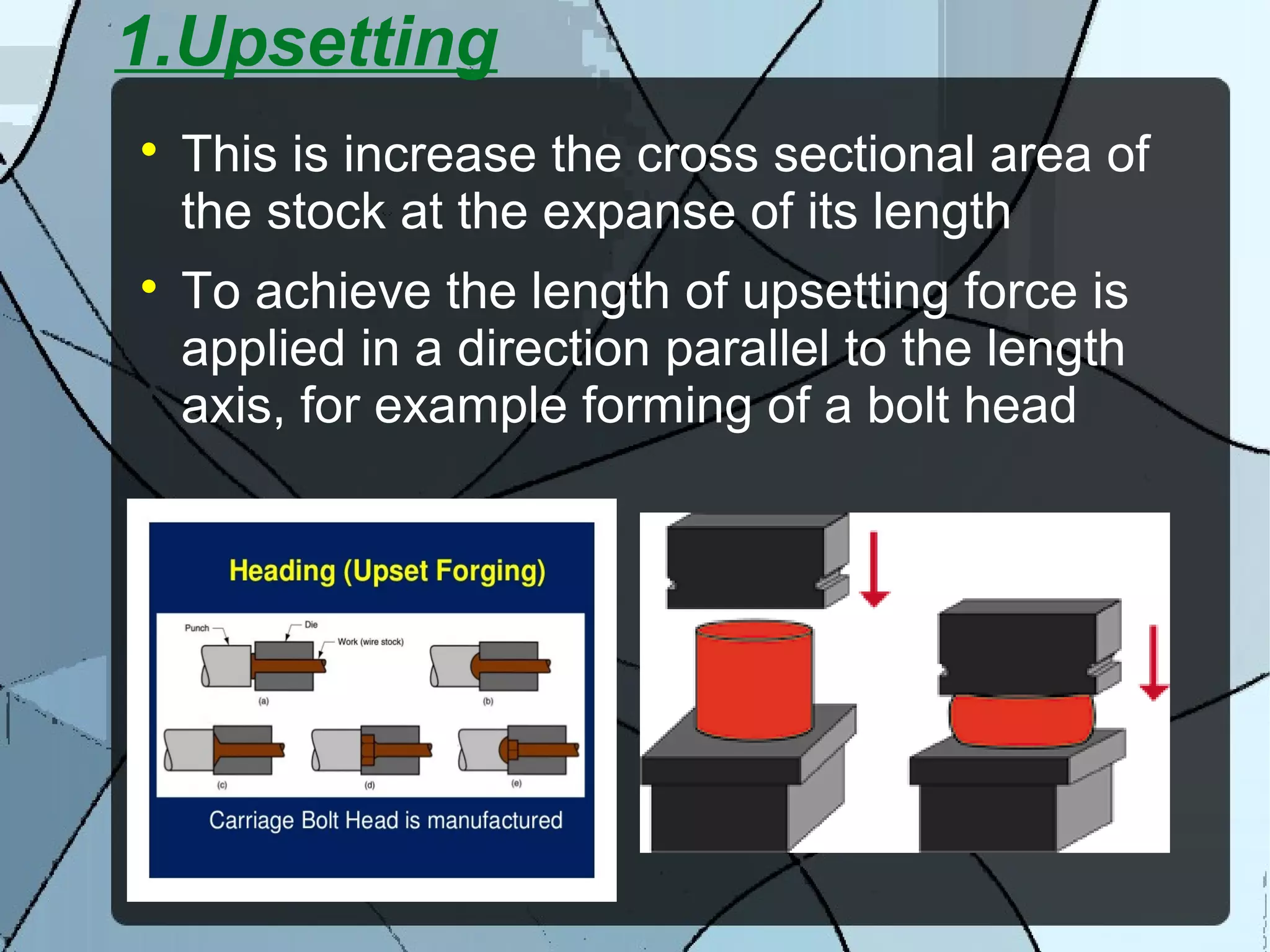
1.Upsetting

This is increase the cross sectional area of
the stock at the expanse of its length

To achieve the length of upsetting force is
applied in a direction parallel to the length
axis, for example forming of a bolt head
2.Fullering

In fullering, open die with convex surfaces
are used to deform the work piece

The result is to cause material to flow out of
one area and to both sides

Fullering is mostly used as an earlier step
to prepare the work piece for further forging
processes
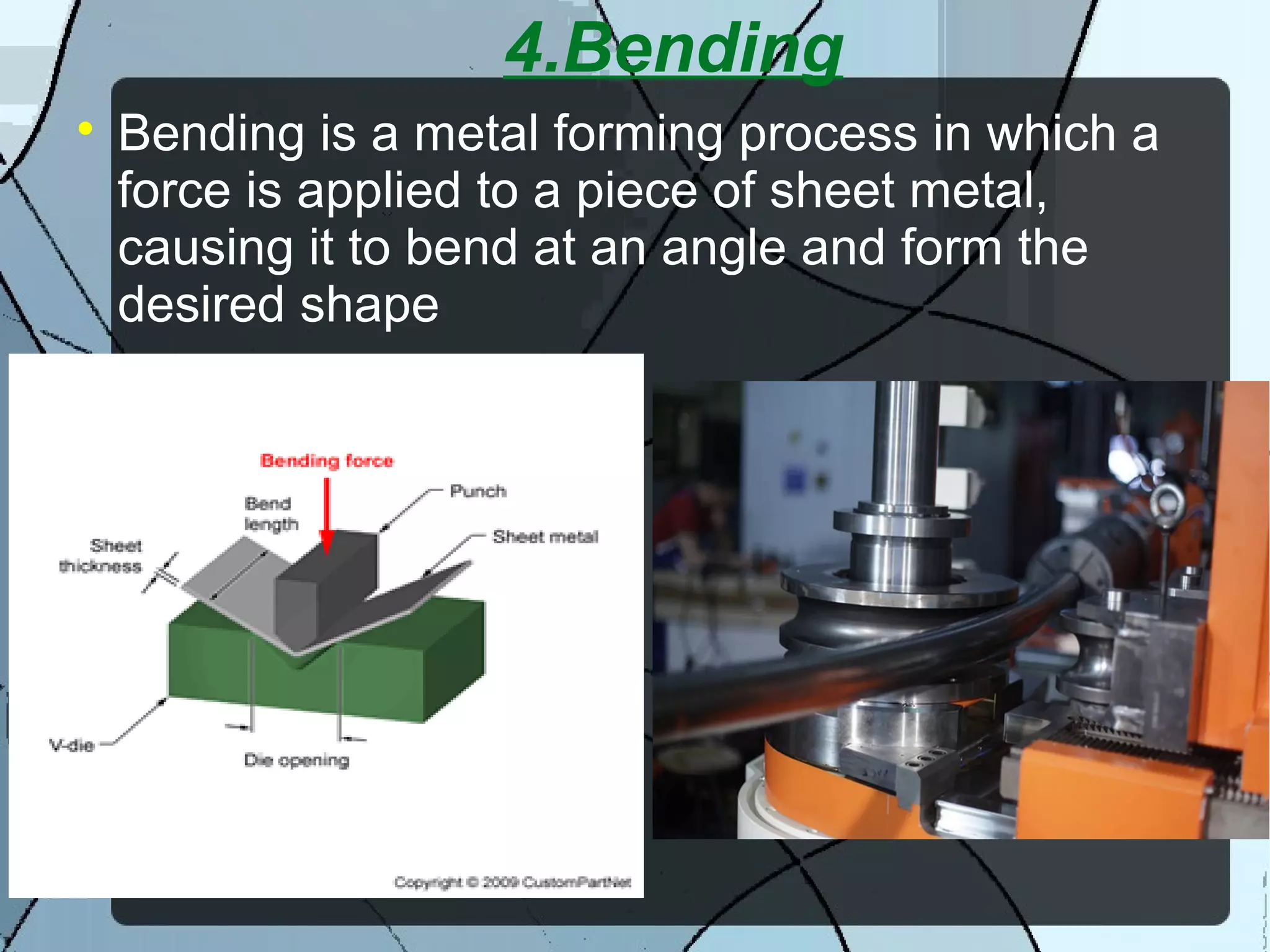
4.Bending

Bending is a metal forming process in which a
force is applied to a piece of sheet metal,
causing it to bend at an angle and form the
desired shape
5.Punching and Drifting

To produce various types of
holes in metal sheet

The job is heated, kept on the
anvil and a punch is forced to
about half of the depth of the
job by hammering

The job is turned upside
down and punch is forced
from the other side, this time
through

Punching is usually followed
by drifting i.e, forcing a drift in
the punched hole through
produces better hole
6.Forged Welding
It is a process of joining two metal
pieces to increase the length of job

Heating two ends to white
heat(1050'c-1150'c)

Then two ends are brought together
having previously been given light
convex shape to the surface under
joining

The hammering is started from cente
of the convex surface and it
progresses to the ends

This results in the slag being
squeezed out of the joint. The
surfaces are cleaned of scale
7.Flating and Setting Down

To remove hammer marks and corrugation
and to obtain a smooth surface on the job, a
flatter or set hammer is used

Setting down is the operation by which the
rounding of a corner is removed to make it
square by hammer

Finishing is the operation where the uneven
surface of forginng is smoothened out with
use of flatter or set hammer and round stems
are finished to size with the use of swages
8.Swaging

It is done to reduce and finish work for
desired size and shape, usually either
round or hexagonal

For small jobs top to bottom swage pair is
employed

Whereas for large work swage block can
be used
Types of hammers and presses

Hammers

1.Gravity drop hammers or broad hammers

2.Power drop hammers or steam hammers

3.Counterblow hammers

Presses

1.Hydraulic presses

2.Mechanical presses

(i)Crank press

(ii)Screw press
1.Gravity drop hammers or board
hammers
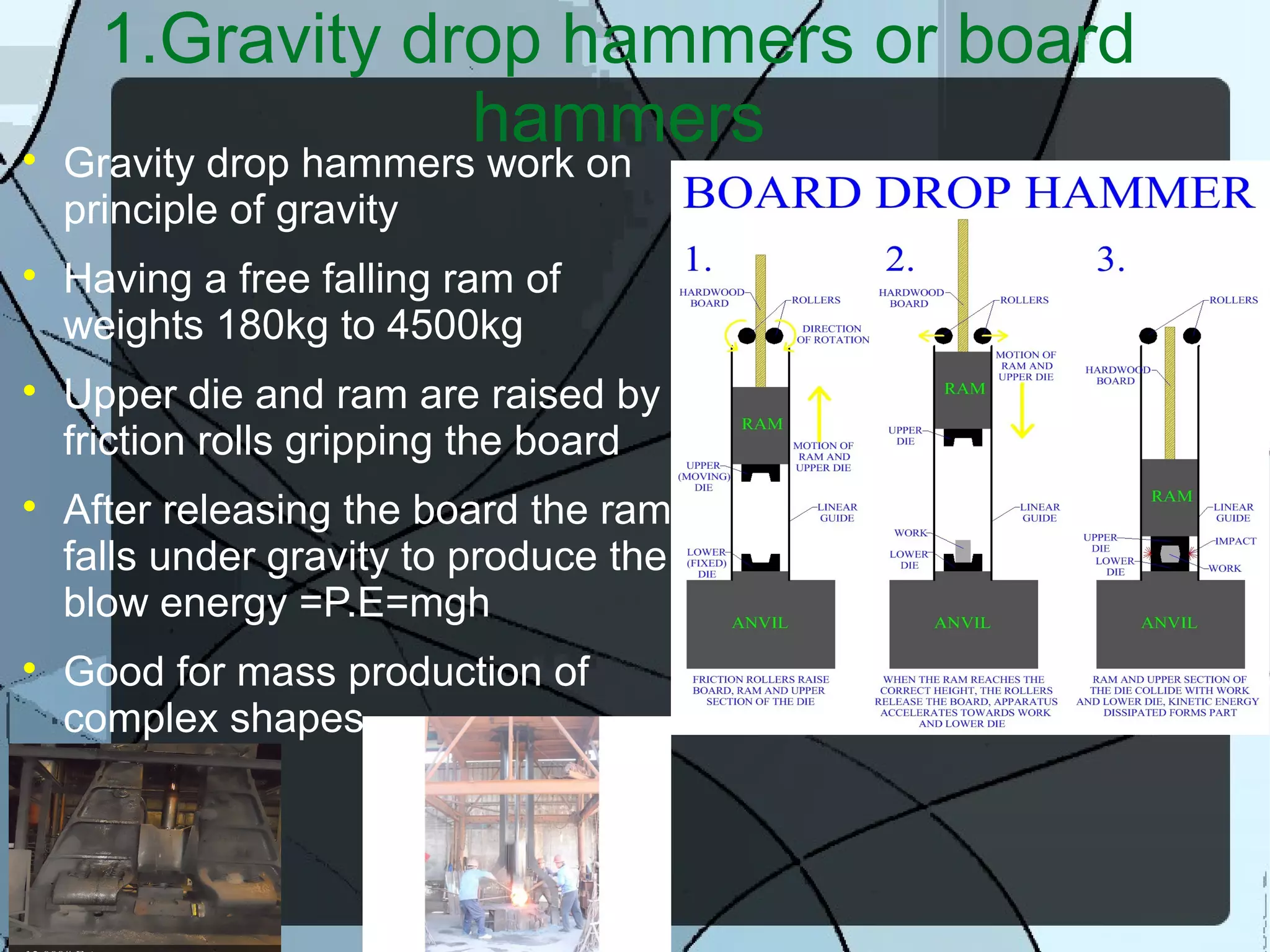
Gravity drop hammers work on
principle of gravity

Having a free falling ram of
weights 180kg to 4500kg

Upper die and ram are raised by
friction rolls gripping the board

After releasing the board the ram
falls under gravity to produce the
blow energy =P.E=mgh

Good for mass production of
complex shapes
2.Power drop hammers or steam
hammers

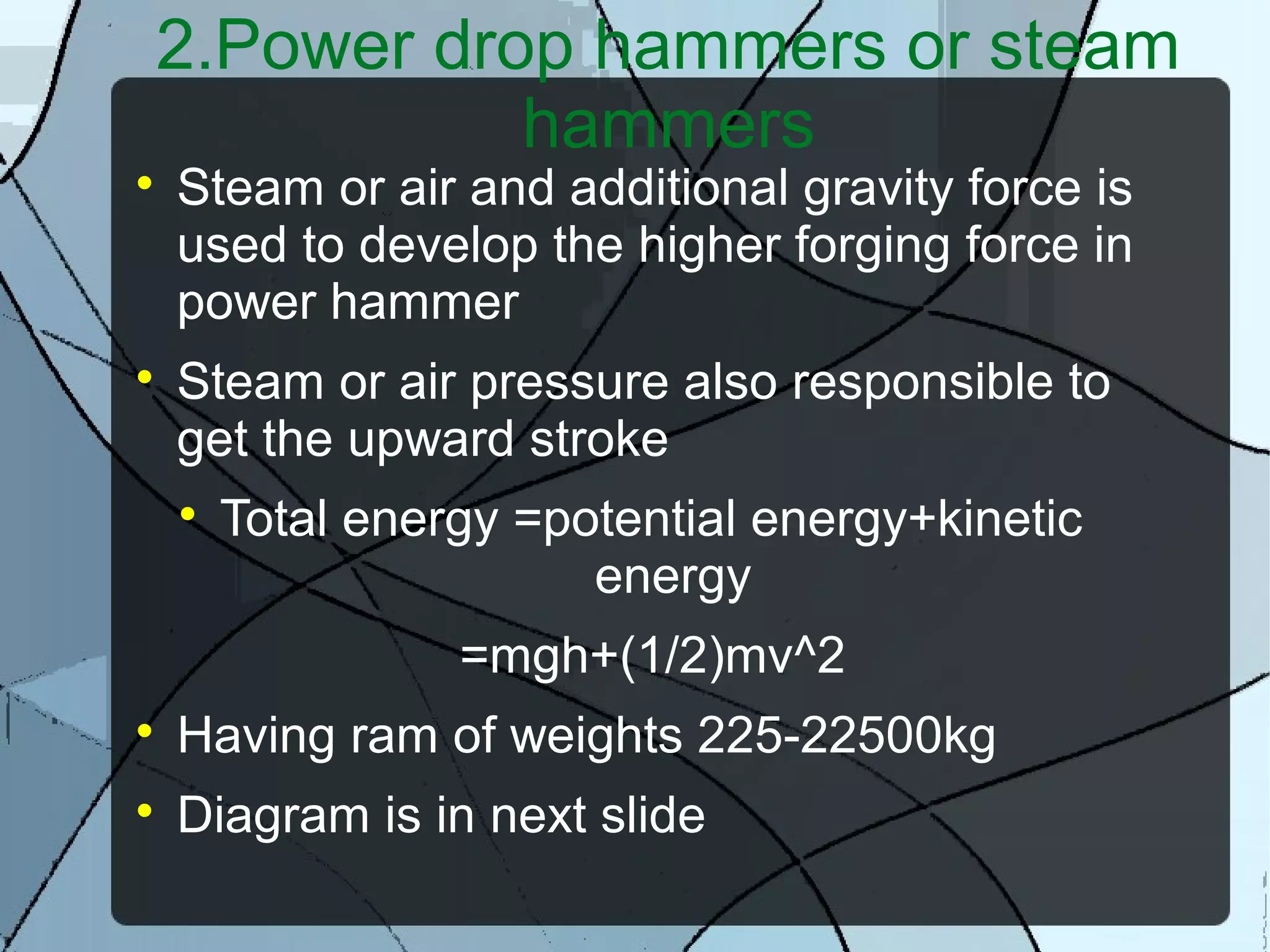
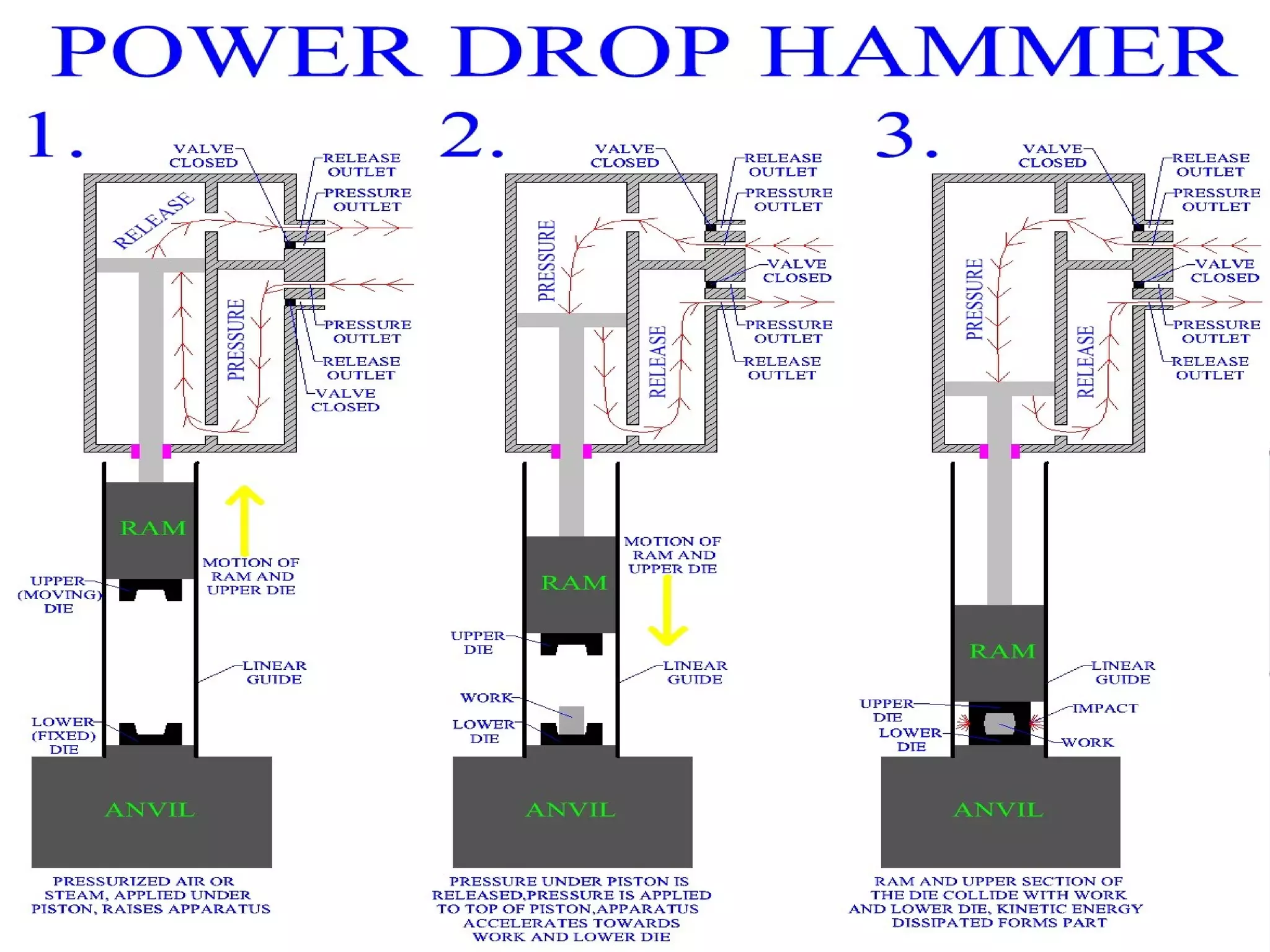
Steam or air and additional gravity force is
used to develop the higher forging force in
power hammer

Steam or air pressure also responsible to
get the upward stroke

Total energy =potential energy+kinetic
energy
=mgh+(1/2)mv^2

Having ram of weights 225-22500kg

Diagram is in next slide
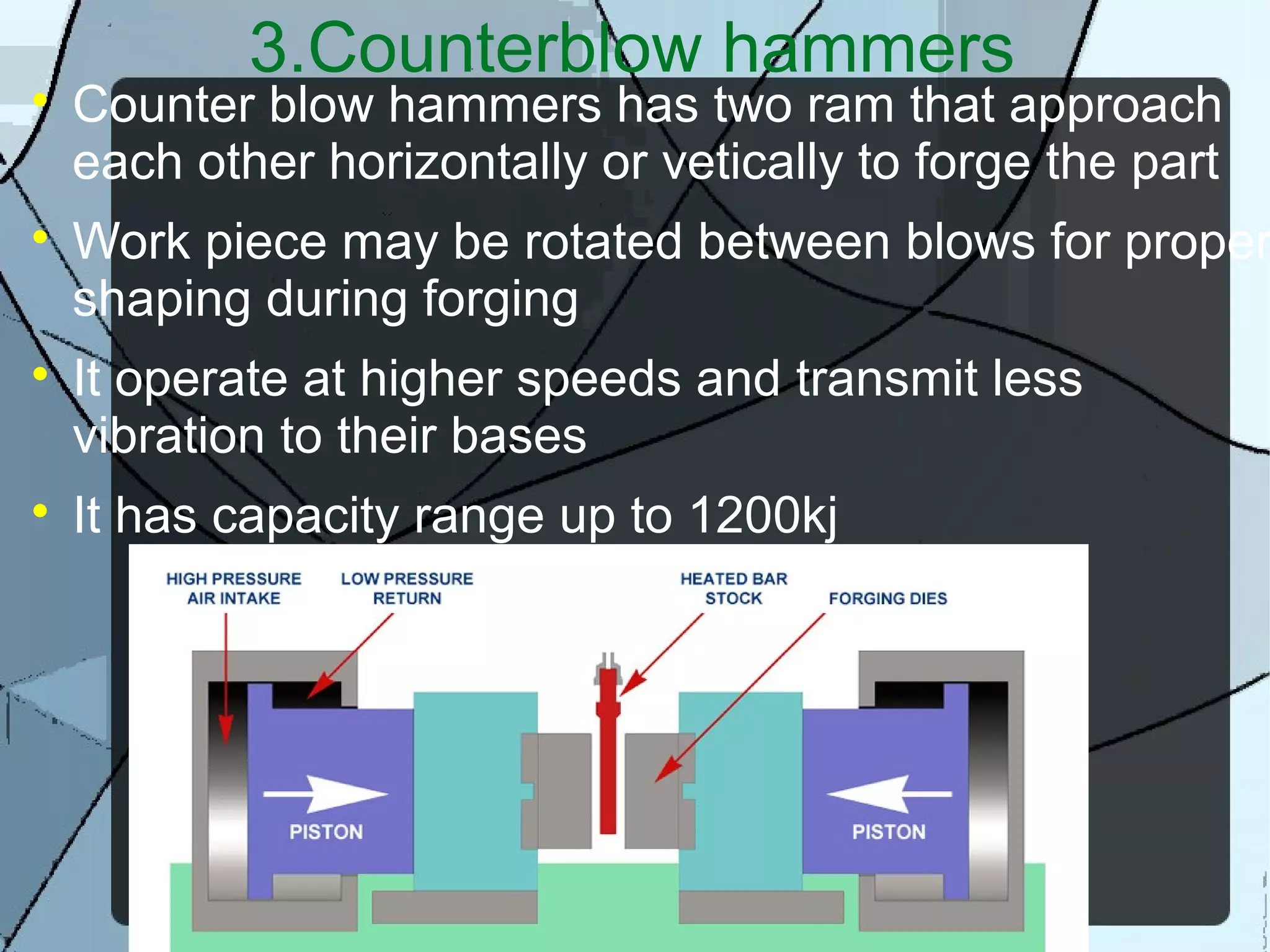
3.Counterblow hammers

Counter blow hammers has two ram that approach
each other horizontally or vetically to forge the part

Work piece may be rotated between blows for proper
shaping during forging

It operate at higher speeds and transmit less
vibration to their bases

It has capacity range up to 1200kj
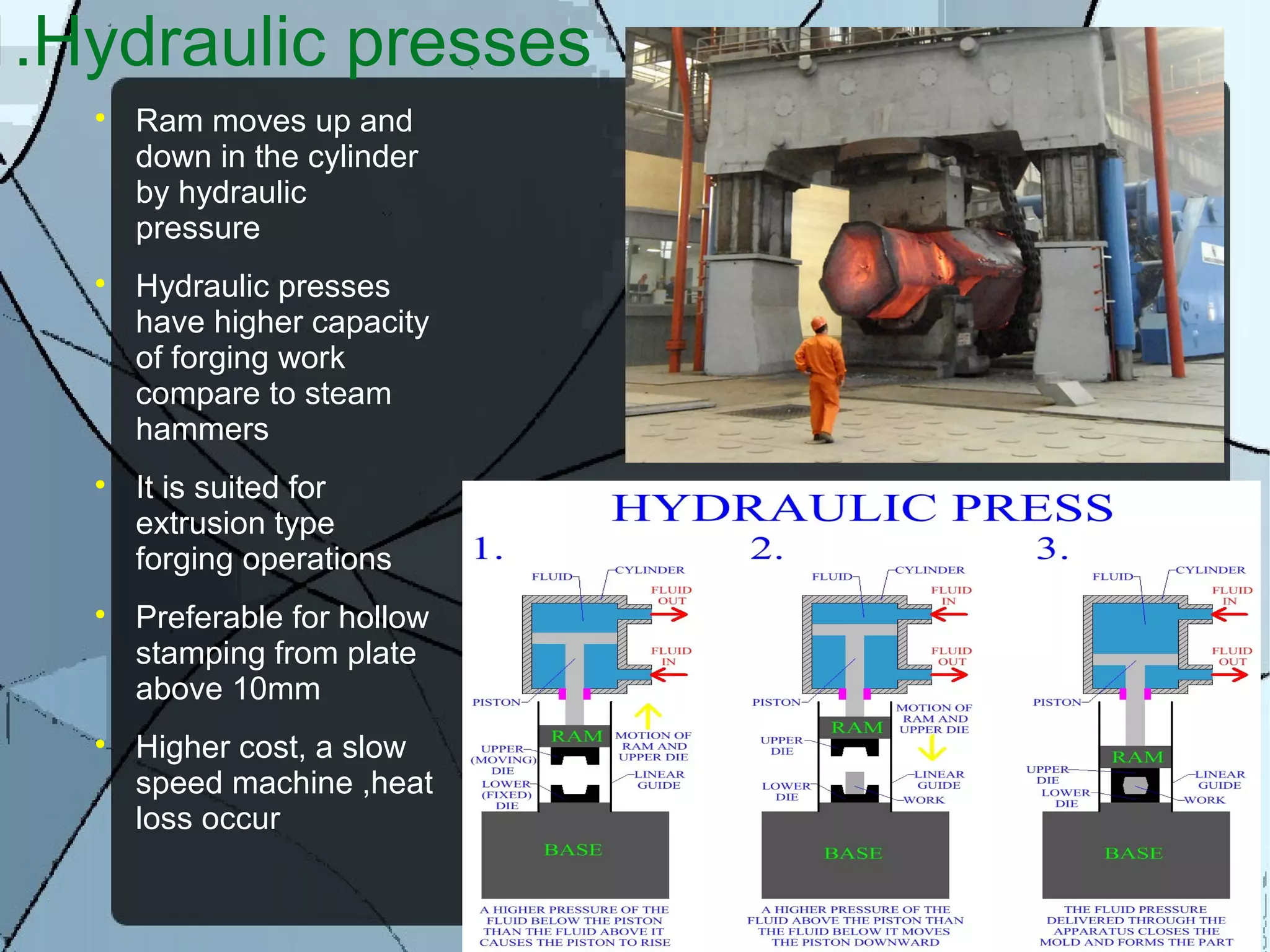
1.Hydraulic presses

Ram moves up and
down in the cylinder
by hydraulic
pressure

Hydraulic presses
have higher capacity
of forging work
compare to steam
hammers

It is suited for
extrusion type
forging operations

Preferable for hollow
stamping from plate
above 10mm

Higher cost, a slow
speed machine ,heat
loss occur
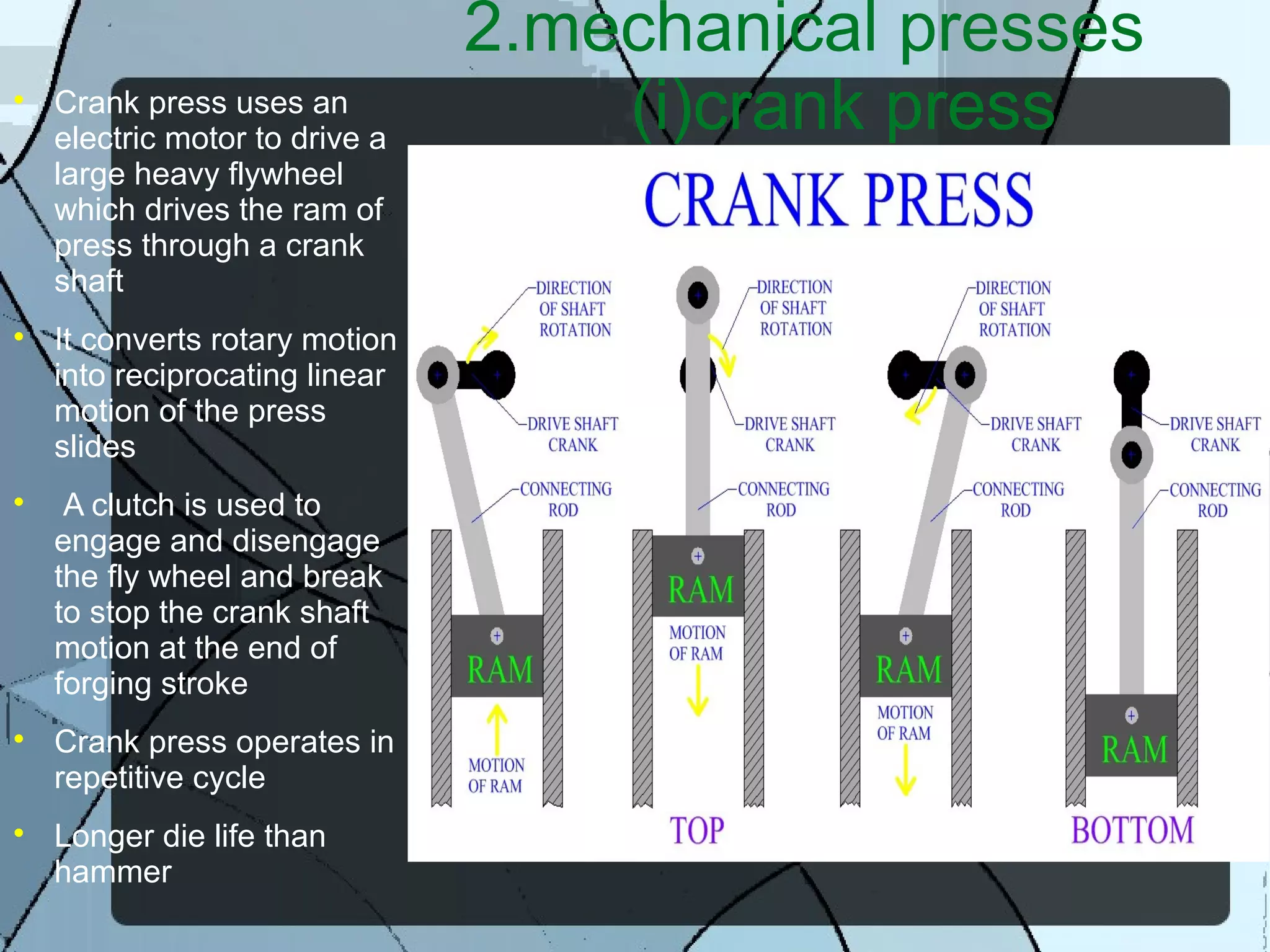
2.mechanical presses
(i)crank press
Crank press uses an
electric motor to drive a
large heavy flywheel
which drives the ram of
press through a crank
shaft

It converts rotary motion
into reciprocating linear
motion of the press
slides

A clutch is used to
engage and disengage
the fly wheel and break
to stop the crank shaft
motion at the end of
forging stroke

Crank press operates in
repetitive cycle

Longer die life than
hammer
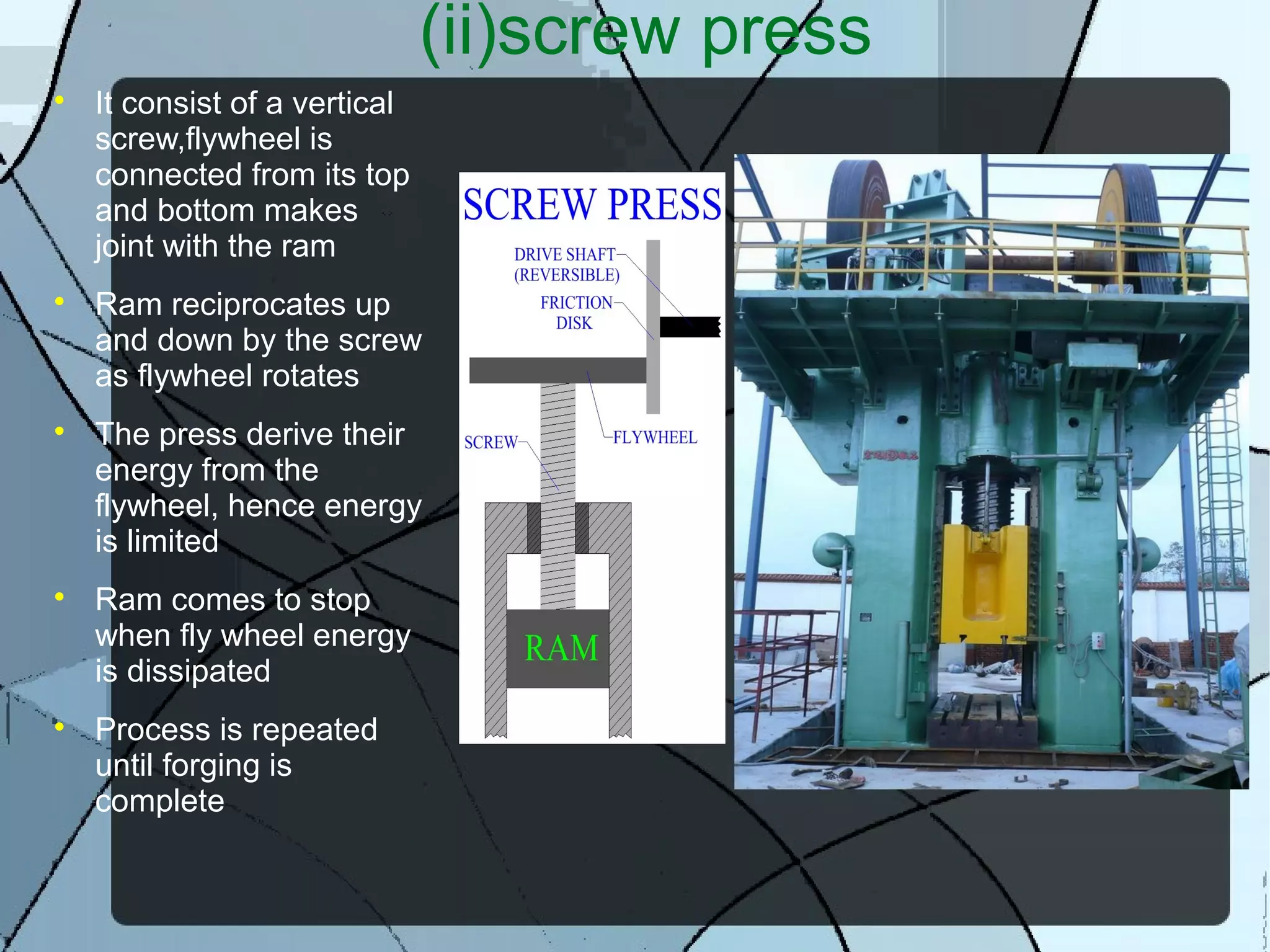
(ii)screw press

It consist of a vertical
screw,flywheel is
connected from its top
and bottom makes
joint with the ram

Ram reciprocates up
and down by the screw
as flywheel rotates

The press derive their
energy from the
flywheel, hence energy
is limited

Ram comes to stop
when fly wheel energy
is dissipated

Process is repeated
until forging is
complete
(ii)screw press

It consist of a vertical
screw,flywheel is
connected from its top
and bottom makes
joint with the ram

Ram reciprocates up
and down by the screw
as flywheel rotates

The press derive their
energy from the
flywheel, hence energy
is limited

Ram comes to stop
when fly wheel energy
is dissipated

Process is repeated
until forging is
complete
Forging defects

(1)Cracking

Both exterior and interior cracking is
caused by excessive stress, or improper
stress distribution on the part

Poor design of forging die or excess
material in the work piece results in
cracking

Cracking can be caused by improper
distribution of temperature during the
operation

(2)Laps or Folds

Caused by buckling of the part and not enough material in
the work piece

(3)Cold shuts

Occurs when metal flows of different temperatures meet;
they do not combine smoothly, a boundary layer forms at
their intersection

(4)Warping

It can happen when thinner sections cool faster than the rest
of forging

(5)Improperly formed sections and dead zones

It can be result of too little metal in the work piece or flawed
forging die design resulting in incorrect material distribution
during the process

(6)Unfilled section

Some section of die cavity are not completely filled by the
flowing metal

It is caused by improper design of forging die design

(7)Scale pits

This is seen as irregular depurations on the surface of the
forging

Improper cleaning of the stock used for forging

The oxide and scale gets embedded into the finish forging
surface

(8)Die shift

This is caused by the miss alignment of the die halve,
making the two halve of the forging to be improper shape

(9)Flakes

Caused by rapid cooling which make exterior to
cool quickly causing internal fractures

General defects can be controlled by
rectifying the right material distribution, right
material flow

Die cavity geometry and corner radius play a
larger role in the action of the metal

Made by :Sandeep singh vasir

C-2, Roll no:178

Guided by:

Forging

  • 1.
    FORGING  Forging is plasticdeformation of heated metal between two dies to achieve desired shape  Forged parts have good directional strength  improves in mechanical properties of forged components such as tensile strength, ductility, impact toughness, fracture toughness, fatigue strength  free from internal voids and porosity  maximizes dynamic properties like impact toughness, fracture toughness, fatigue strength
  • 2.
     In open dieforging , metal is compressed by repeated blows by manual or mechanical hammer and shape is manipulated manually  In closed die forging , the shape is obtained by squeezing the workpiece between two shaped and closed dies
  • 3.
    Material used  The materialsthat are used most commonly in drop forging are aluminum, copper, nickel, mild steel, stainless steel, and magnesium. Mild steel is the best choice, and magnesium generally performs poorly as a drop forging material.
  • 4.
    Types of forging  1.Smithforging  2.Drop forging  3.Machine or upset forging  4.Press forging
  • 5.
    1.Smith forging  Forging workedbetween flat or simple contour dies by repeated strokes and manipulation of workpiece
  • 6.
    2.Drop forging  Metal shapeis formed by forcing hotmetal into impressions formed in solid blocks of hardened alloy steel, the forging dies.  Produces a parting line and flash on the workpiece, flash must be removed  Typically requires machining to obtain dimensional tolerance and good surface finish
  • 7.
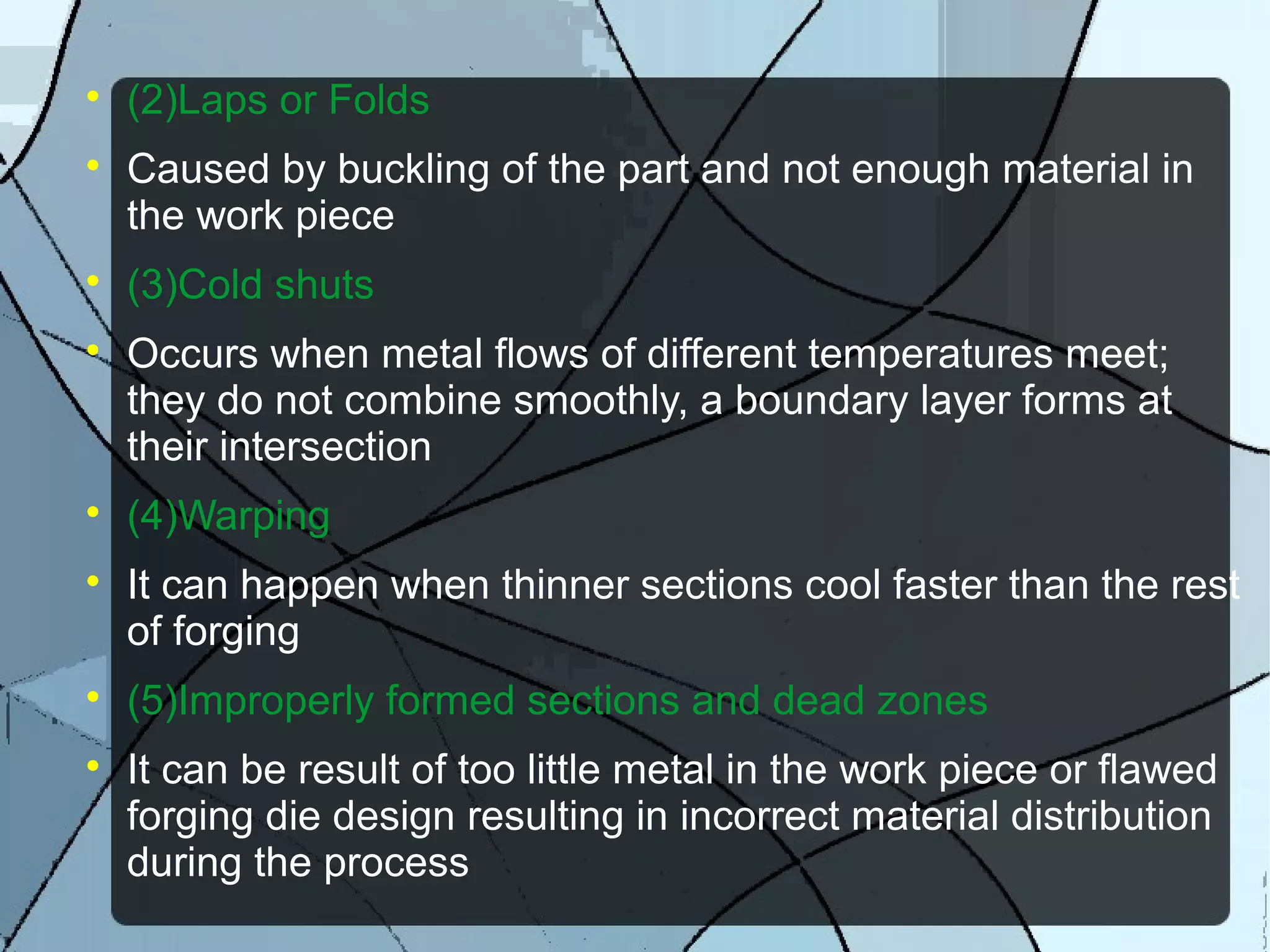
    3.Machine or upsetforging  Increases the diameter of the end of central portion of work piece by compressing its length  Usually requires no trimming  Complex parts are usually formed gradually in a sequence of separate die cavities  May produce diameter up to three times the original diameter
  • 8.
    4.Press forging  Metal isshaped between dies by mechanical or hydraulic pressure  Unlike drop hammer forging, press forges work slowly by applying continuous pressure or force  This can be done either cold or hot
  • 9.
    Classification of forging processes  1.Opendie forging  2.Close die or impression die forging  3.Flashless forging  4.Cold forging  5.Warm forging
  • 10.
    1.Open die forging  Thedies do not enclose the workpiece allowing it to flow except where contacted by the dies  Simple type of open die forging is called upsetting
  • 11.
    Open die forgingcategorized in 3 methods  (i)Cogging is a forging process in which flat or slightly contoured die are used to compress a work piece reducing its thickness and increasing its length  The distance traveled by die in forward direction on the work piece between each forging step is called the BITE
  • 12.
    (ii)Fullering  In fullering, opendie with convex surfaces are used to deform the work piece  The result is to cause material to flow out of one area and to both sides
  • 13.
    2.Close die orimpression forging  It utilizes a pair of matched dies with contoured impression that contains cavities that act to restrict the flow of metal within the die during deformation of the work
  • 14.
    3.Flashless forging  No materialcan leave the mold aspart is forged, no flash is formed  Too little material and the die will not fill completely; too much material will cause a dangerous build up of forces
  • 15.
    4.Cold forging  Similar toimpression dies  The temp of work piece is low enough that scale dose not form, but work piece work hardens  This saves time and cost of heating the part  heading  Backward extrusion Upsetting
  • 16.
    5.Warm forging  Warm forgingis a modification of the cold forging process where the work piece is heated to a temp significantly below the typical hot forging temp
  • 17.
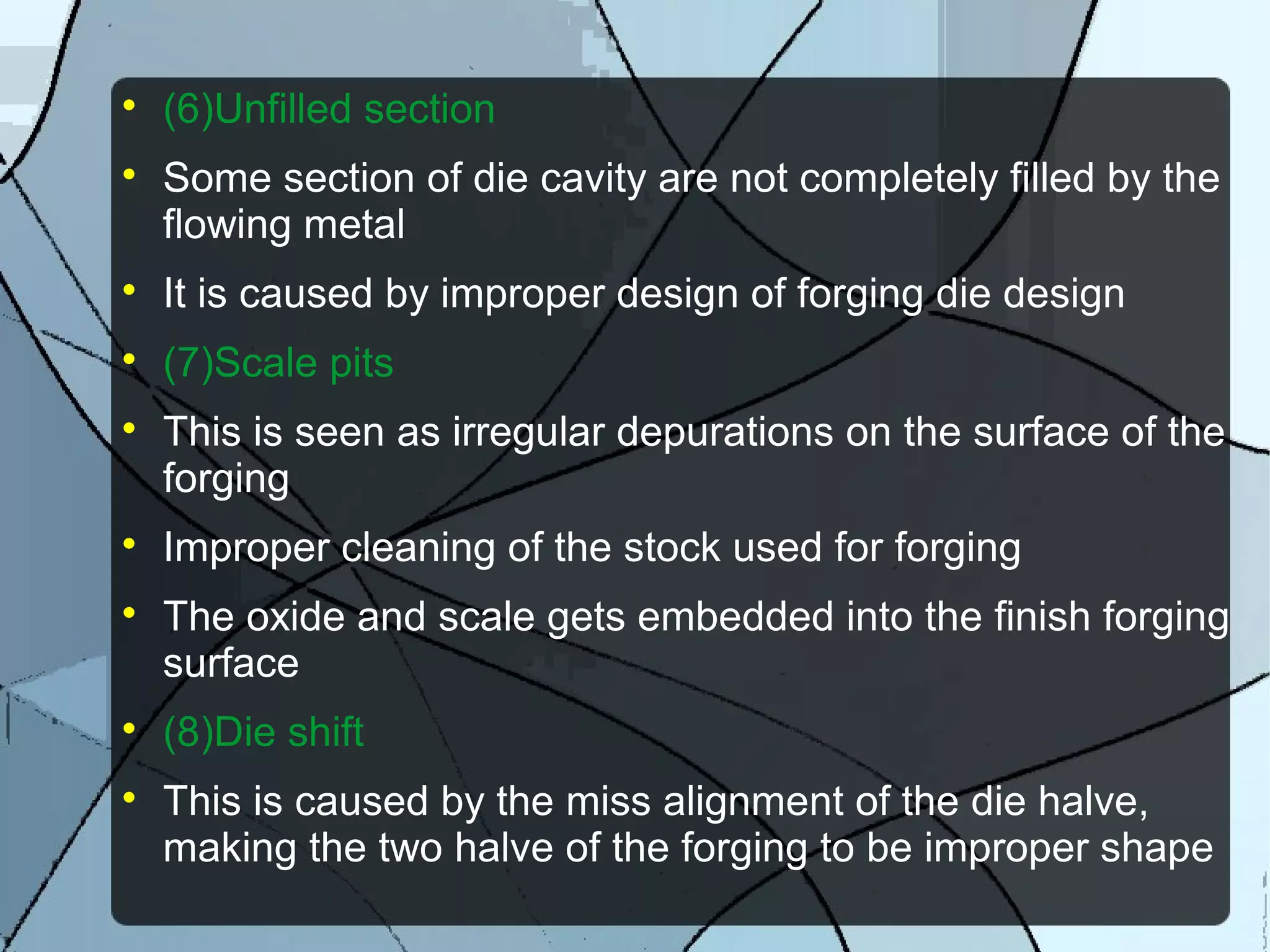
    Guideline for selectionof forging processes  When forgings are very large, when very few are required, or when delivery times are very short, open die forging is the typical choice  As shape becomes more complex, ad production quantities increases, impression die forging becomes the process of choice  Shaft like forgings with details on the ends or along the length, upset forging is used  Relatively small components that are rotationally symmetrical or asymmetric, requires high strength and high precision, and are produced in larger quantities are candidates for cold forging
  • 18.
    Forging operations  1.Upsetting  2.Fullering  3.Edging  4.Bending  5.Punching andDrifting  6.Forged Welding  7.Flating and Setting Down  8.Swaging
  • 19.
    1.Upsetting  This is increasethe cross sectional area of the stock at the expanse of its length  To achieve the length of upsetting force is applied in a direction parallel to the length axis, for example forming of a bolt head
  • 20.
    2.Fullering  In fullering, opendie with convex surfaces are used to deform the work piece  The result is to cause material to flow out of one area and to both sides  Fullering is mostly used as an earlier step to prepare the work piece for further forging processes
  • 21.
    4.Bending  Bending is ametal forming process in which a force is applied to a piece of sheet metal, causing it to bend at an angle and form the desired shape
  • 22.
    5.Punching and Drifting  Toproduce various types of holes in metal sheet  The job is heated, kept on the anvil and a punch is forced to about half of the depth of the job by hammering  The job is turned upside down and punch is forced from the other side, this time through  Punching is usually followed by drifting i.e, forcing a drift in the punched hole through produces better hole
  • 23.
    6.Forged Welding It isa process of joining two metal pieces to increase the length of job  Heating two ends to white heat(1050'c-1150'c)  Then two ends are brought together having previously been given light convex shape to the surface under joining  The hammering is started from cente of the convex surface and it progresses to the ends  This results in the slag being squeezed out of the joint. The surfaces are cleaned of scale
  • 24.
    7.Flating and SettingDown  To remove hammer marks and corrugation and to obtain a smooth surface on the job, a flatter or set hammer is used  Setting down is the operation by which the rounding of a corner is removed to make it square by hammer  Finishing is the operation where the uneven surface of forginng is smoothened out with use of flatter or set hammer and round stems are finished to size with the use of swages
  • 25.
    8.Swaging  It is doneto reduce and finish work for desired size and shape, usually either round or hexagonal  For small jobs top to bottom swage pair is employed  Whereas for large work swage block can be used
  • 26.
    Types of hammersand presses  Hammers  1.Gravity drop hammers or broad hammers  2.Power drop hammers or steam hammers  3.Counterblow hammers  Presses  1.Hydraulic presses  2.Mechanical presses  (i)Crank press  (ii)Screw press
  • 27.
    1.Gravity drop hammersor board hammers Gravity drop hammers work on principle of gravity  Having a free falling ram of weights 180kg to 4500kg  Upper die and ram are raised by friction rolls gripping the board  After releasing the board the ram falls under gravity to produce the blow energy =P.E=mgh  Good for mass production of complex shapes
  • 28.
    2.Power drop hammersor steam hammers  Steam or air and additional gravity force is used to develop the higher forging force in power hammer  Steam or air pressure also responsible to get the upward stroke  Total energy =potential energy+kinetic energy =mgh+(1/2)mv^2  Having ram of weights 225-22500kg  Diagram is in next slide
  • 30.
    3.Counterblow hammers  Counter blowhammers has two ram that approach each other horizontally or vetically to forge the part  Work piece may be rotated between blows for proper shaping during forging  It operate at higher speeds and transmit less vibration to their bases  It has capacity range up to 1200kj
  • 31.
    1.Hydraulic presses  Ram movesup and down in the cylinder by hydraulic pressure  Hydraulic presses have higher capacity of forging work compare to steam hammers  It is suited for extrusion type forging operations  Preferable for hollow stamping from plate above 10mm  Higher cost, a slow speed machine ,heat loss occur
  • 32.
    2.mechanical presses (i)crank press Crankpress uses an electric motor to drive a large heavy flywheel which drives the ram of press through a crank shaft  It converts rotary motion into reciprocating linear motion of the press slides  A clutch is used to engage and disengage the fly wheel and break to stop the crank shaft motion at the end of forging stroke  Crank press operates in repetitive cycle  Longer die life than hammer
  • 33.
    (ii)screw press  It consistof a vertical screw,flywheel is connected from its top and bottom makes joint with the ram  Ram reciprocates up and down by the screw as flywheel rotates  The press derive their energy from the flywheel, hence energy is limited  Ram comes to stop when fly wheel energy is dissipated  Process is repeated until forging is complete
  • 34.
    (ii)screw press  It consistof a vertical screw,flywheel is connected from its top and bottom makes joint with the ram  Ram reciprocates up and down by the screw as flywheel rotates  The press derive their energy from the flywheel, hence energy is limited  Ram comes to stop when fly wheel energy is dissipated  Process is repeated until forging is complete
  • 35.
    Forging defects  (1)Cracking  Both exteriorand interior cracking is caused by excessive stress, or improper stress distribution on the part  Poor design of forging die or excess material in the work piece results in cracking  Cracking can be caused by improper distribution of temperature during the operation
  • 36.
     (2)Laps or Folds  Causedby buckling of the part and not enough material in the work piece  (3)Cold shuts  Occurs when metal flows of different temperatures meet; they do not combine smoothly, a boundary layer forms at their intersection  (4)Warping  It can happen when thinner sections cool faster than the rest of forging  (5)Improperly formed sections and dead zones  It can be result of too little metal in the work piece or flawed forging die design resulting in incorrect material distribution during the process
  • 37.
     (6)Unfilled section  Some sectionof die cavity are not completely filled by the flowing metal  It is caused by improper design of forging die design  (7)Scale pits  This is seen as irregular depurations on the surface of the forging  Improper cleaning of the stock used for forging  The oxide and scale gets embedded into the finish forging surface  (8)Die shift  This is caused by the miss alignment of the die halve, making the two halve of the forging to be improper shape
  • 38.
     (9)Flakes  Caused by rapidcooling which make exterior to cool quickly causing internal fractures  General defects can be controlled by rectifying the right material distribution, right material flow  Die cavity geometry and corner radius play a larger role in the action of the metal  Made by :Sandeep singh vasir  C-2, Roll no:178  Guided by: