www.forestadaptation.org
Maria Janowiak, mjanowiak02@fs.fed.us
ADAPTING FORESTS TO
CLIMATE CHANGE
Approaches for Action
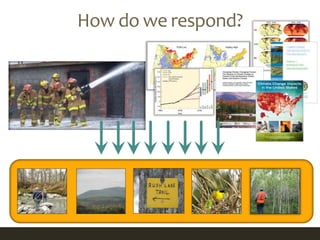
How do we respond?
Responding to Climate Change
If you want a single ā€œanswerā€ for how
to respond to climate change, it’s:
ā€œIt dependsā€
It depends on where you are working
and what you’re trying to achieve.
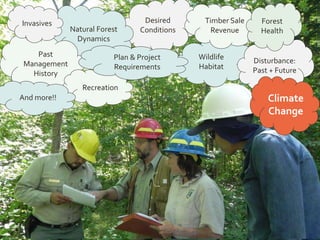
Desired
ConditionsNatural Forest
Dynamics
Wildlife
Habitat
Past
Management
History
Invasives Timber Sale
Revenue
Disturbance:
Past + Future
Recreation
Forest
Health
And more!! Climate
Change
Plan & Project
Requirements
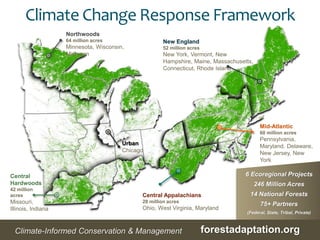
6 Ecoregional Projects
246 Million Acres
14 National Forests
75+ Partners
(Federal, State, Tribal, Private)
Northwoods
64 million acres
Minnesota, Wisconsin,
Michigan
Central
Hardwoods
42 million
acres
Missouri,
Illinois, Indiana
Central Appalachians
28 million acres
Ohio, West Virginia, Maryland
New England
52 million acres
New York, Vermont, New
Hampshire, Maine, Massachusetts,
Connecticut, Rhode Island
Mid-Atlantic
60 million acres
Pennsylvania,
Maryland, Delaware,
New Jersey, New
York
Urban
Chicago
forestadaptation.orgClimate-Informed Conservation & Management
Climate Change Response Framework
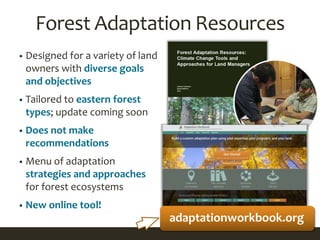
Forest Adaptation Resources
ļ‚§ Designed for a variety of land
owners with diverse goals
and objectives
ļ‚§ Tailored to eastern forest
types; update coming soon
ļ‚§ Does not make
recommendations
ļ‚§ Menu of adaptation
strategies and approaches
for forest ecosystems
ļ‚§ New online tool!
adaptationworkbook.org
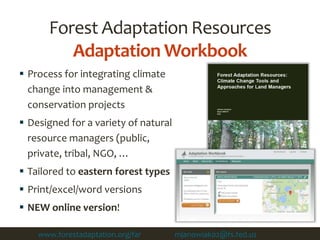
Forest Adaptation Resources
Adaptation Workbook
ļ‚§ Process for integrating climate
change into management &
conservation projects
ļ‚§ Designed for a variety of natural
resource managers (public,
private, tribal, NGO, …
ļ‚§ Tailored to eastern forest types
ļ‚§ Print/excel/word versions
ļ‚§ NEW online version!
www.forestadaptation.org/far ; Contact mjanowiak02@fs.fed.us to use online tool
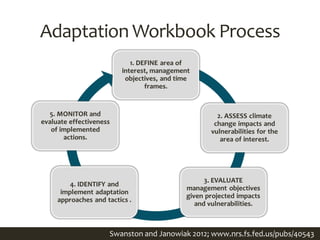
Adaptation Workbook Process
Swanston and Janowiak 2012; www.nrs.fs.fed.us/pubs/40543
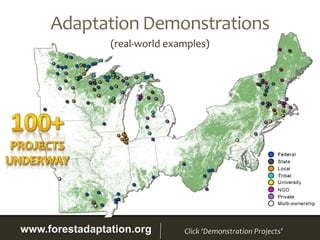
www.forestadaptation.org Click ā€˜Demonstration Projects’
Adaptation Demonstrations
(real-world examples)
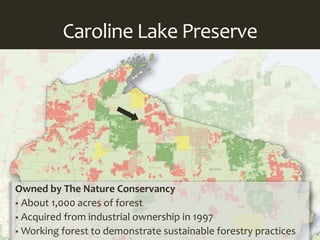
Caroline Lake Preserve
Owned by The Nature Conservancy
ļ‚§ About 1,000 acres of forest
ļ‚§ Acquired from industrial ownership in 1997
ļ‚§ Working forest to demonstrate sustainable forestry practices
1
2
34
5 Step 1: DEFINE area of interest, management goals
and objectives, and time frames.
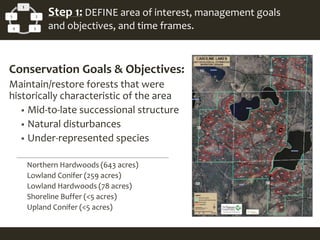
Conservation Goals & Objectives:
Maintain/restore forests that were
historically characteristic of the area
ļ‚§ Mid-to-late successional structure
ļ‚§ Natural disturbances
ļ‚§ Under-represented species
Northern Hardwoods (643 acres)
Lowland Conifer (259 acres)
Lowland Hardwoods (78 acres)
Shoreline Buffer (<5 acres)
Upland Conifer (<5 acres)
1
2
34
5 Step 2: ASSESS climate change impacts and
vulnerabilities for the area of interest.
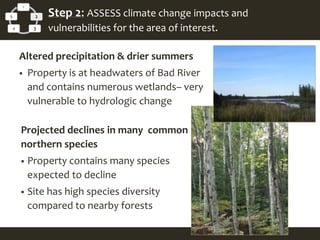
Altered precipitation & drier summers
ļ‚§ Property is at headwaters of Bad River
and contains numerous wetlands– very
vulnerable to hydrologic change
Projected declines in many common
northern species
ļ‚§ Property contains many species
expected to decline
ļ‚§ Site has high species diversity
compared to nearby forests
1
2
34
5 Step 3: EVALUATE management objectives given
projected impacts and vulnerabilities.
Challenges
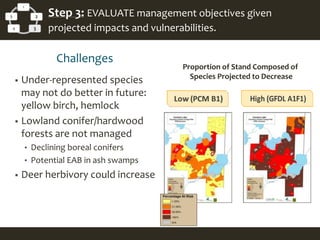
ļ‚§ Under-represented species
may not do better in future:
yellow birch, hemlock
ļ‚§ Lowland conifer/hardwood
forests are not managed
• Declining boreal conifers
• Potential EAB in ash swamps
ļ‚§ Deer herbivory could increase
Proportion of Stand Composed of
Species Projected to Decrease
1
2
34
5 Step 3: EVALUATE management objectives given
projected impacts and vulnerabilities.
Challenges Opportunities
ļ‚§ Some species (white pine
and red oak) may fare
same or better in future
ļ‚§ Small- or medium-sized
disturbances increase
structure
ļ‚§ Unique site and location
may offer opportunities for
refugia
ļ‚§ Under-represented species
may not do better in future:
yellow birch, hemlock
ļ‚§ Lowland conifer/hardwood
forests are not managed
• Declining boreal conifers
• Potential EAB in ash swamps
ļ‚§ Deer herbivory could increase
1
2
34
5 Step 4: IDENTIFY and adaptation approaches and
tactics for implementation.
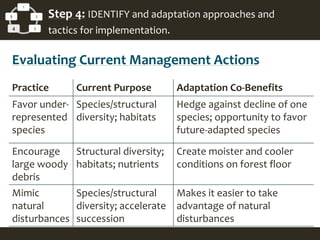
Evaluating Current Management Actions
Practice Current Purpose Adaptation Co-Benefits
Favor under-
represented
species
Species/structural
diversity; habitats
Hedge against decline of one
species; opportunity to favor
future-adapted species
Encourage
large woody
debris
Structural diversity;
habitats; nutrients
Create moister and cooler
conditions on forest floor
Mimic
natural
disturbances
Species/structural
diversity; accelerate
succession
Makes it easier to take
advantage of natural
disturbances
1
2
34
5 Step 4: IDENTIFY and adaptation approaches and
tactics for implementation.
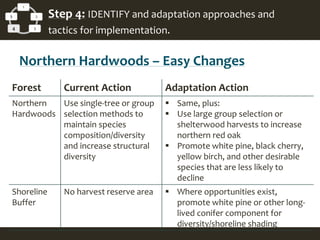
Northern Hardwoods – Easy Changes
Forest Current Action Adaptation Action
Northern
Hardwoods
Use single-tree or group
selection methods to
maintain species
composition/diversity
and increase structural
diversity
ļ‚§ Same, plus:
ļ‚§ Use large group selection or
shelterwood harvests to increase
northern red oak
ļ‚§ Promote white pine, black cherry,
yellow birch, and other desirable
species that are less likely to
decline
Shoreline
Buffer
No harvest reserve area ļ‚§ Where opportunities exist,
promote white pine or other long-
lived conifer component for
diversity/shoreline shading
1
2
34
5 Step 4: IDENTIFY and adaptation approaches and
tactics for implementation.
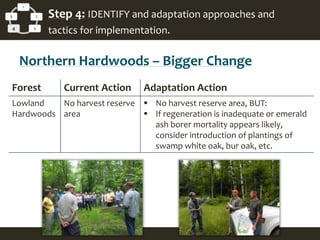
Northern Hardwoods – Bigger Change
Forest Current Action Adaptation Action
Lowland
Hardwoods
No harvest reserve
area
ļ‚§ No harvest reserve area, BUT:
ļ‚§ If regeneration is inadequate or emerald
ash borer mortality appears likely,
consider introduction of plantings of
swamp white oak, bur oak, etc.
1
2
34
5 Step 5: MONITOR and evaluate effectiveness of
implemented actions.
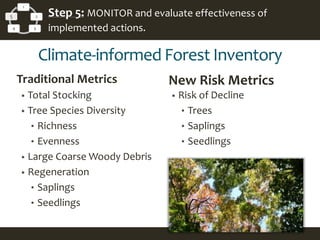
Climate-informed Forest Inventory
Traditional Metrics New Risk Metrics
ļ‚§ Total Stocking
ļ‚§ Tree Species Diversity
• Richness
• Evenness
ļ‚§ Large Coarse Woody Debris
ļ‚§ Regeneration
• Saplings
• Seedlings
ļ‚§ Risk of Decline
• Trees
• Saplings
• Seedlings
Adaptation Demonstrations
www.forestadaptation.org Click ā€˜Demonstration Projects’
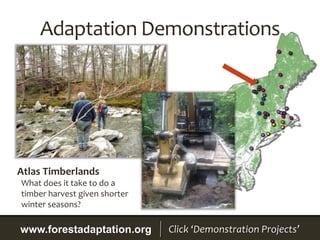
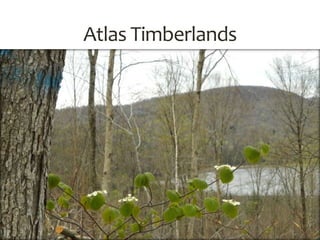
Atlas Timberlands
What does it take to do a
timber harvest given shorter
winter seasons?
Adaptation Demonstrations
www.forestadaptation.org Click ā€˜Demonstration Projects’
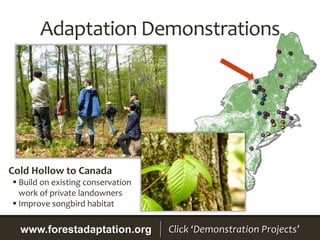
Cold Hollow to Canada
ļ‚§ Build on existing conservation
work of private landowners
ļ‚§ Improve songbird habitat
Adaptation Demonstrations
www.forestadaptation.org Click ā€˜Demonstration Projects’
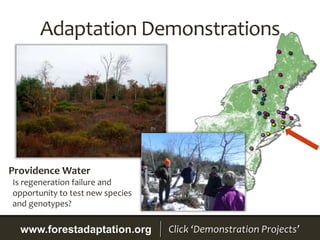
Providence Water
Is regeneration failure and
opportunity to test new species
and genotypes?
Adaptation Demonstrations
www.forestadaptation.org Click ā€˜Demonstration Projects’
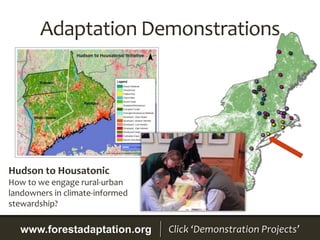
Hudson to Housatonic
How to we engage rural-urban
landowners in climate-informed
stewardship?
Uncertainty is guaranteed.
Management will be most effective if it integrates
uncertainty, rather than pushing against it.
There is not a shiny new tool for climate change.
Rather, we have the same old tools but will need to
use them in new ways.
Final thoughts
Next time you’re in the woods
Take a look around & think about:
What’s important here?
How might it change?
What am I already doing to help?
What else can I do to help?
www.forestadaptation.org
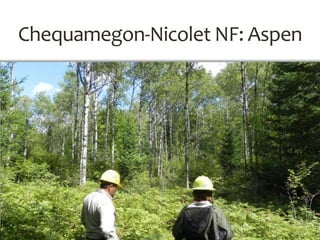
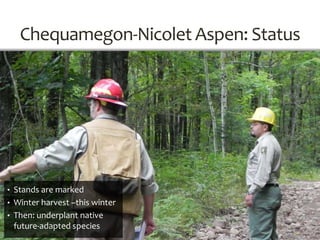
Chequamegon-Nicolet NF: Aspen
1
2
34
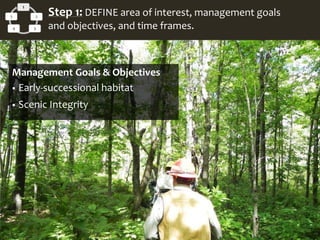
5 Step 1: DEFINE area of interest, management goals
and objectives, and time frames.
Management Goals & Objectives
ļ‚§ Early-successional habitat
ļ‚§ Scenic Integrity
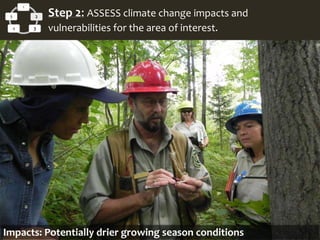
Impacts: Potentially drier growing season conditions
1
2
34
5 Step 2: ASSESS climate change impacts and
vulnerabilities for the area of interest.
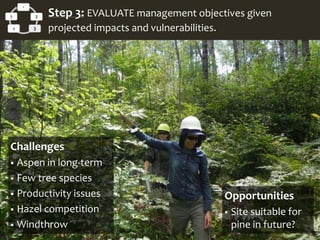
Challenges
ļ‚§ Aspen in long-term
ļ‚§ Few tree species
ļ‚§ Productivity issues
ļ‚§ Hazel competition
ļ‚§ Windthrow
1
2
34
5 Step 3: EVALUATE management objectives given
projected impacts and vulnerabilities.
Opportunities
ļ‚§ Site suitable for
pine in future?
1
2
34
5 Step 4: IDENTIFY and adaptation approaches and
tactics for implementation.
Overall Approach: Enhance future options
within existing management trajectory
ļ‚§ Aspen will regenerate now, but is likely to fare
poorly over the long term.
ļ‚§ Maintain plans for clearcut for aspen regeneration
ļ‚§ Additional actions to promote diversity and provide
future options: plant red oak and white pine
ļ‚§ Pro-active on invasives and disturbance planning
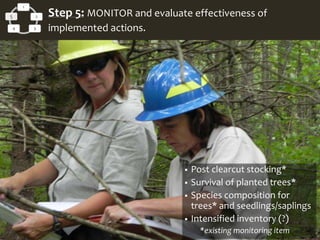
ļ‚§ Post clearcut stocking*
ļ‚§ Survival of planted trees*
ļ‚§ Species composition for
trees* and seedlings/saplings
ļ‚§ Intensified inventory (?)
*existing monitoring item
1
2
34
5 Step 5: MONITOR and evaluate effectiveness of
implemented actions.
Chequamegon-Nicolet Aspen: Status
• Stands are marked
• Winter harvest –this winter
• Then: underplant native
future-adapted species
Atlas Timberlands
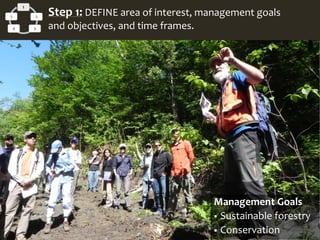
Management Goals
ļ‚§ Sustainable forestry
ļ‚§ Conservation
1
2
34
5 Step 1: DEFINE area of interest, management goals
and objectives, and time frames.
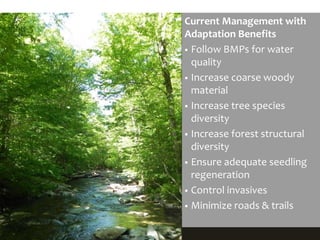
Current Management with
Adaptation Benefits
ļ‚§ Follow BMPs for water
quality
ļ‚§ Increase coarse woody
material
ļ‚§ Increase tree species
diversity
ļ‚§ Increase forest structural
diversity
ļ‚§ Ensure adequate seedling
regeneration
ļ‚§ Control invasives
ļ‚§ Minimize roads & trails
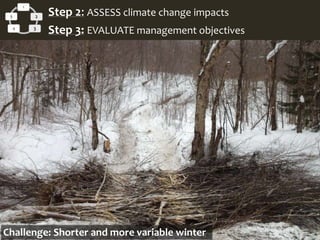
Challenge: Shorter and more variable winter
1
2
34
5 Step 2: ASSESS climate change impacts
Step 3: EVALUATE management objectives
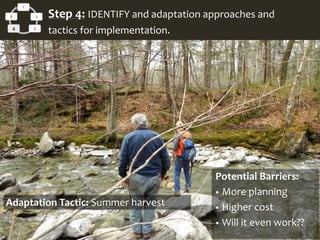
Potential Barriers:
ļ‚§ More planning
ļ‚§ Higher cost
ļ‚§ Will it even work??
Adaptation Tactic: Summer harvest
1
2
34
5 Step 4: IDENTIFY and adaptation approaches and
tactics for implementation.
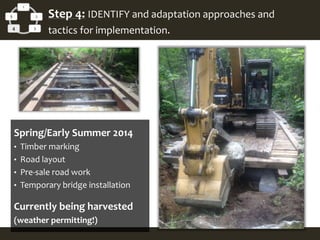
Spring/Early Summer 2014
• Timber marking
• Road layout
• Pre-sale road work
• Temporary bridge installation
Currently being harvested
(weather permitting!)
1
2
34
5 Step 4: IDENTIFY and adaptation approaches and
tactics for implementation.
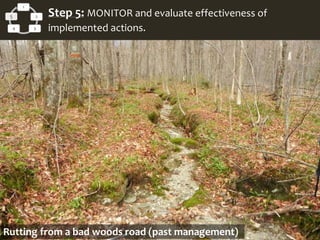
Rutting from a bad woods road (past management)
1
2
34
5 Step 5: MONITOR and evaluate effectiveness of
implemented actions.

Forest Adaptation

  • 1.
    www.forestadaptation.org Maria Janowiak, mjanowiak02@fs.fed.us ADAPTINGFORESTS TO CLIMATE CHANGE Approaches for Action
  • 2.
    How do werespond?
  • 3.
  • 4.
    If you wanta single ā€œanswerā€ for how to respond to climate change, it’s: ā€œIt dependsā€ It depends on where you are working and what you’re trying to achieve.
  • 5.
    Desired ConditionsNatural Forest Dynamics Wildlife Habitat Past Management History Invasives TimberSale Revenue Disturbance: Past + Future Recreation Forest Health And more!! Climate Change Plan & Project Requirements
  • 6.
    6 Ecoregional Projects 246Million Acres 14 National Forests 75+ Partners (Federal, State, Tribal, Private) Northwoods 64 million acres Minnesota, Wisconsin, Michigan Central Hardwoods 42 million acres Missouri, Illinois, Indiana Central Appalachians 28 million acres Ohio, West Virginia, Maryland New England 52 million acres New York, Vermont, New Hampshire, Maine, Massachusetts, Connecticut, Rhode Island Mid-Atlantic 60 million acres Pennsylvania, Maryland, Delaware, New Jersey, New York Urban Chicago forestadaptation.orgClimate-Informed Conservation & Management Climate Change Response Framework
  • 7.
    Forest Adaptation Resources ļ‚§Designed for a variety of land owners with diverse goals and objectives ļ‚§ Tailored to eastern forest types; update coming soon ļ‚§ Does not make recommendations ļ‚§ Menu of adaptation strategies and approaches for forest ecosystems ļ‚§ New online tool! adaptationworkbook.org
  • 8.
    Forest Adaptation Resources AdaptationWorkbook ļ‚§ Process for integrating climate change into management & conservation projects ļ‚§ Designed for a variety of natural resource managers (public, private, tribal, NGO, … ļ‚§ Tailored to eastern forest types ļ‚§ Print/excel/word versions ļ‚§ NEW online version! www.forestadaptation.org/far ; Contact mjanowiak02@fs.fed.us to use online tool
  • 9.
    Adaptation Workbook Process Swanstonand Janowiak 2012; www.nrs.fs.fed.us/pubs/40543
  • 10.
    www.forestadaptation.org Click ā€˜DemonstrationProjects’ Adaptation Demonstrations (real-world examples)
  • 11.
    Caroline Lake Preserve Ownedby The Nature Conservancy ļ‚§ About 1,000 acres of forest ļ‚§ Acquired from industrial ownership in 1997 ļ‚§ Working forest to demonstrate sustainable forestry practices
  • 12.
    1 2 34 5 Step 1:DEFINE area of interest, management goals and objectives, and time frames. Conservation Goals & Objectives: Maintain/restore forests that were historically characteristic of the area ļ‚§ Mid-to-late successional structure ļ‚§ Natural disturbances ļ‚§ Under-represented species Northern Hardwoods (643 acres) Lowland Conifer (259 acres) Lowland Hardwoods (78 acres) Shoreline Buffer (<5 acres) Upland Conifer (<5 acres)
  • 13.
    1 2 34 5 Step 2:ASSESS climate change impacts and vulnerabilities for the area of interest. Altered precipitation & drier summers ļ‚§ Property is at headwaters of Bad River and contains numerous wetlands– very vulnerable to hydrologic change Projected declines in many common northern species ļ‚§ Property contains many species expected to decline ļ‚§ Site has high species diversity compared to nearby forests
  • 14.
    1 2 34 5 Step 3:EVALUATE management objectives given projected impacts and vulnerabilities. Challenges ļ‚§ Under-represented species may not do better in future: yellow birch, hemlock ļ‚§ Lowland conifer/hardwood forests are not managed • Declining boreal conifers • Potential EAB in ash swamps ļ‚§ Deer herbivory could increase Proportion of Stand Composed of Species Projected to Decrease
  • 15.
    1 2 34 5 Step 3:EVALUATE management objectives given projected impacts and vulnerabilities. Challenges Opportunities ļ‚§ Some species (white pine and red oak) may fare same or better in future ļ‚§ Small- or medium-sized disturbances increase structure ļ‚§ Unique site and location may offer opportunities for refugia ļ‚§ Under-represented species may not do better in future: yellow birch, hemlock ļ‚§ Lowland conifer/hardwood forests are not managed • Declining boreal conifers • Potential EAB in ash swamps ļ‚§ Deer herbivory could increase
  • 16.
    1 2 34 5 Step 4:IDENTIFY and adaptation approaches and tactics for implementation. Evaluating Current Management Actions Practice Current Purpose Adaptation Co-Benefits Favor under- represented species Species/structural diversity; habitats Hedge against decline of one species; opportunity to favor future-adapted species Encourage large woody debris Structural diversity; habitats; nutrients Create moister and cooler conditions on forest floor Mimic natural disturbances Species/structural diversity; accelerate succession Makes it easier to take advantage of natural disturbances
  • 17.
    1 2 34 5 Step 4:IDENTIFY and adaptation approaches and tactics for implementation. Northern Hardwoods – Easy Changes Forest Current Action Adaptation Action Northern Hardwoods Use single-tree or group selection methods to maintain species composition/diversity and increase structural diversity ļ‚§ Same, plus: ļ‚§ Use large group selection or shelterwood harvests to increase northern red oak ļ‚§ Promote white pine, black cherry, yellow birch, and other desirable species that are less likely to decline Shoreline Buffer No harvest reserve area ļ‚§ Where opportunities exist, promote white pine or other long- lived conifer component for diversity/shoreline shading
  • 18.
    1 2 34 5 Step 4:IDENTIFY and adaptation approaches and tactics for implementation. Northern Hardwoods – Bigger Change Forest Current Action Adaptation Action Lowland Hardwoods No harvest reserve area ļ‚§ No harvest reserve area, BUT: ļ‚§ If regeneration is inadequate or emerald ash borer mortality appears likely, consider introduction of plantings of swamp white oak, bur oak, etc.
  • 19.
    1 2 34 5 Step 5:MONITOR and evaluate effectiveness of implemented actions. Climate-informed Forest Inventory Traditional Metrics New Risk Metrics ļ‚§ Total Stocking ļ‚§ Tree Species Diversity • Richness • Evenness ļ‚§ Large Coarse Woody Debris ļ‚§ Regeneration • Saplings • Seedlings ļ‚§ Risk of Decline • Trees • Saplings • Seedlings
  • 20.
    Adaptation Demonstrations www.forestadaptation.org Clickā€˜Demonstration Projects’ Atlas Timberlands What does it take to do a timber harvest given shorter winter seasons?
  • 21.
    Adaptation Demonstrations www.forestadaptation.org Clickā€˜Demonstration Projects’ Cold Hollow to Canada ļ‚§ Build on existing conservation work of private landowners ļ‚§ Improve songbird habitat
  • 22.
    Adaptation Demonstrations www.forestadaptation.org Clickā€˜Demonstration Projects’ Providence Water Is regeneration failure and opportunity to test new species and genotypes?
  • 23.
    Adaptation Demonstrations www.forestadaptation.org Clickā€˜Demonstration Projects’ Hudson to Housatonic How to we engage rural-urban landowners in climate-informed stewardship?
  • 24.
    Uncertainty is guaranteed. Managementwill be most effective if it integrates uncertainty, rather than pushing against it. There is not a shiny new tool for climate change. Rather, we have the same old tools but will need to use them in new ways. Final thoughts
  • 25.
    Next time you’rein the woods Take a look around & think about: What’s important here? How might it change? What am I already doing to help? What else can I do to help? www.forestadaptation.org
  • 26.
  • 27.
    1 2 34 5 Step 1:DEFINE area of interest, management goals and objectives, and time frames. Management Goals & Objectives ļ‚§ Early-successional habitat ļ‚§ Scenic Integrity
  • 28.
    Impacts: Potentially driergrowing season conditions 1 2 34 5 Step 2: ASSESS climate change impacts and vulnerabilities for the area of interest.
  • 29.
    Challenges ļ‚§ Aspen inlong-term ļ‚§ Few tree species ļ‚§ Productivity issues ļ‚§ Hazel competition ļ‚§ Windthrow 1 2 34 5 Step 3: EVALUATE management objectives given projected impacts and vulnerabilities. Opportunities ļ‚§ Site suitable for pine in future?
  • 30.
    1 2 34 5 Step 4:IDENTIFY and adaptation approaches and tactics for implementation. Overall Approach: Enhance future options within existing management trajectory ļ‚§ Aspen will regenerate now, but is likely to fare poorly over the long term. ļ‚§ Maintain plans for clearcut for aspen regeneration ļ‚§ Additional actions to promote diversity and provide future options: plant red oak and white pine ļ‚§ Pro-active on invasives and disturbance planning
  • 31.
    ļ‚§ Post clearcutstocking* ļ‚§ Survival of planted trees* ļ‚§ Species composition for trees* and seedlings/saplings ļ‚§ Intensified inventory (?) *existing monitoring item 1 2 34 5 Step 5: MONITOR and evaluate effectiveness of implemented actions.
  • 32.
    Chequamegon-Nicolet Aspen: Status •Stands are marked • Winter harvest –this winter • Then: underplant native future-adapted species
  • 33.
  • 34.
    Management Goals ļ‚§ Sustainableforestry ļ‚§ Conservation 1 2 34 5 Step 1: DEFINE area of interest, management goals and objectives, and time frames.
  • 35.
    Current Management with AdaptationBenefits ļ‚§ Follow BMPs for water quality ļ‚§ Increase coarse woody material ļ‚§ Increase tree species diversity ļ‚§ Increase forest structural diversity ļ‚§ Ensure adequate seedling regeneration ļ‚§ Control invasives ļ‚§ Minimize roads & trails
  • 36.
    Challenge: Shorter andmore variable winter 1 2 34 5 Step 2: ASSESS climate change impacts Step 3: EVALUATE management objectives
  • 37.
    Potential Barriers: ļ‚§ Moreplanning ļ‚§ Higher cost ļ‚§ Will it even work?? Adaptation Tactic: Summer harvest 1 2 34 5 Step 4: IDENTIFY and adaptation approaches and tactics for implementation.
  • 38.
    Spring/Early Summer 2014 •Timber marking • Road layout • Pre-sale road work • Temporary bridge installation Currently being harvested (weather permitting!) 1 2 34 5 Step 4: IDENTIFY and adaptation approaches and tactics for implementation.
  • 39.
    Rutting from abad woods road (past management) 1 2 34 5 Step 5: MONITOR and evaluate effectiveness of implemented actions.

Editor's Notes

  • #5Ā If you want a single answer…..ā€it dependsā€ā€¦. Well bummer right? I’m sure many of you were hoping for a perfect premeditated guidebook particular for your program and focus areas at APHIS. Sorry! Much like this desire, we’re faced with the facts. There isn’t a one-sized-fits-all answer for responding to climate change, because it really does depend on where you are working, and what you are trying to achieve, these are the differences that make us distinct from each other. Your goals likely differ greatly from even your counterpart in another region. Regional differences matter, especially if it’s the difference between a region likely to experience drought (like the west), and a region projected to become wetter (like the east).
  • #6Ā What do we do? We work with natural resource professionals and forest owners to integrate climate change into their work. We work with National Forests, federal agencies (such as NPS and BIA), state agencies, local governments, tribes, conservation organizations, and individual family forest owners.
  • #7Ā The Framework began as a pilot project in 2009 in N. Wi with the Chequamegon-Nicolet National Forest, since then we’ve grown to 6 ecoregional projects across 19 states and 14 national forests! As I mentioned previously the Framework is the applied tier of our climate projects at NIACS, where managers are put adaptation to practice using their lands, goals and objectives. Our approach is designed to provide important information about the interactions of climate change and forests, while also providing resources, tools and support that a manager may need when considering climate informed conservation for themselves.
  • #11Ā Rapidly growing… hard to keep a current list…
  • #12Ā The first step of the Adaptation Workbook is … [read slide] In this step, we are honing in on the specific place and management goals/objectives for that place. This information is generally provided in forest plans or other documents.
  • #21Ā Building a network of adaptation demonstration projects across the eastern US. Diversity of forest types, organizations and landowners, mgmt goals ALSO – designed to help foresters learn by doing, provide an opportunity to learn from your neighbors. What is a demonstration project????? What ties all these examples together? They all used the adaptation workbook – common thought process, many different outcomes.
  • #22Ā Building a network of adaptation demonstration projects across the eastern US. Diversity of forest types, organizations and landowners, mgmt goals ALSO – designed to help foresters learn by doing, provide an opportunity to learn from your neighbors. What is a demonstration project????? What ties all these examples together? They all used the adaptation workbook – common thought process, many different outcomes.
  • #23Ā Building a network of adaptation demonstration projects across the eastern US. Diversity of forest types, organizations and landowners, mgmt goals ALSO – designed to help foresters learn by doing, provide an opportunity to learn from your neighbors. What is a demonstration project????? What ties all these examples together? They all used the adaptation workbook – common thought process, many different outcomes.
  • #24Ā Building a network of adaptation demonstration projects across the eastern US. Diversity of forest types, organizations and landowners, mgmt goals ALSO – designed to help foresters learn by doing, provide an opportunity to learn from your neighbors. What is a demonstration project????? What ties all these examples together? They all used the adaptation workbook – common thought process, many different outcomes.
  • #27Ā The first step of the Adaptation Workbook is … [read slide] In this step, we are honing in on the specific place and management goals/objectives for that place. This information is generally provided in forest plans or other documents.
  • #34Ā The first step of the Adaptation Workbook is … [read slide] In this step, we are honing in on the specific place and management goals/objectives for that place. This information is generally provided in forest plans or other documents.
  • #39Ā The first step of the Adaptation Workbook is … [read slide] In this step, we are honing in on the specific place and management goals/objectives for that place. This information is generally provided in forest plans or other documents.