Si Balch, advisor & consultant
Managing Climate Change
Risk in the Forest
“Trying to effect as many
forest acres as possible”
• Not a certification system
• Not a government program
• Not a funding source or a money sink
• Not a source of all answers to
everything
• Not a source of bland generalizations
• Not politically active
• Does not say “should” or “aught”
What the CSLN is NOT
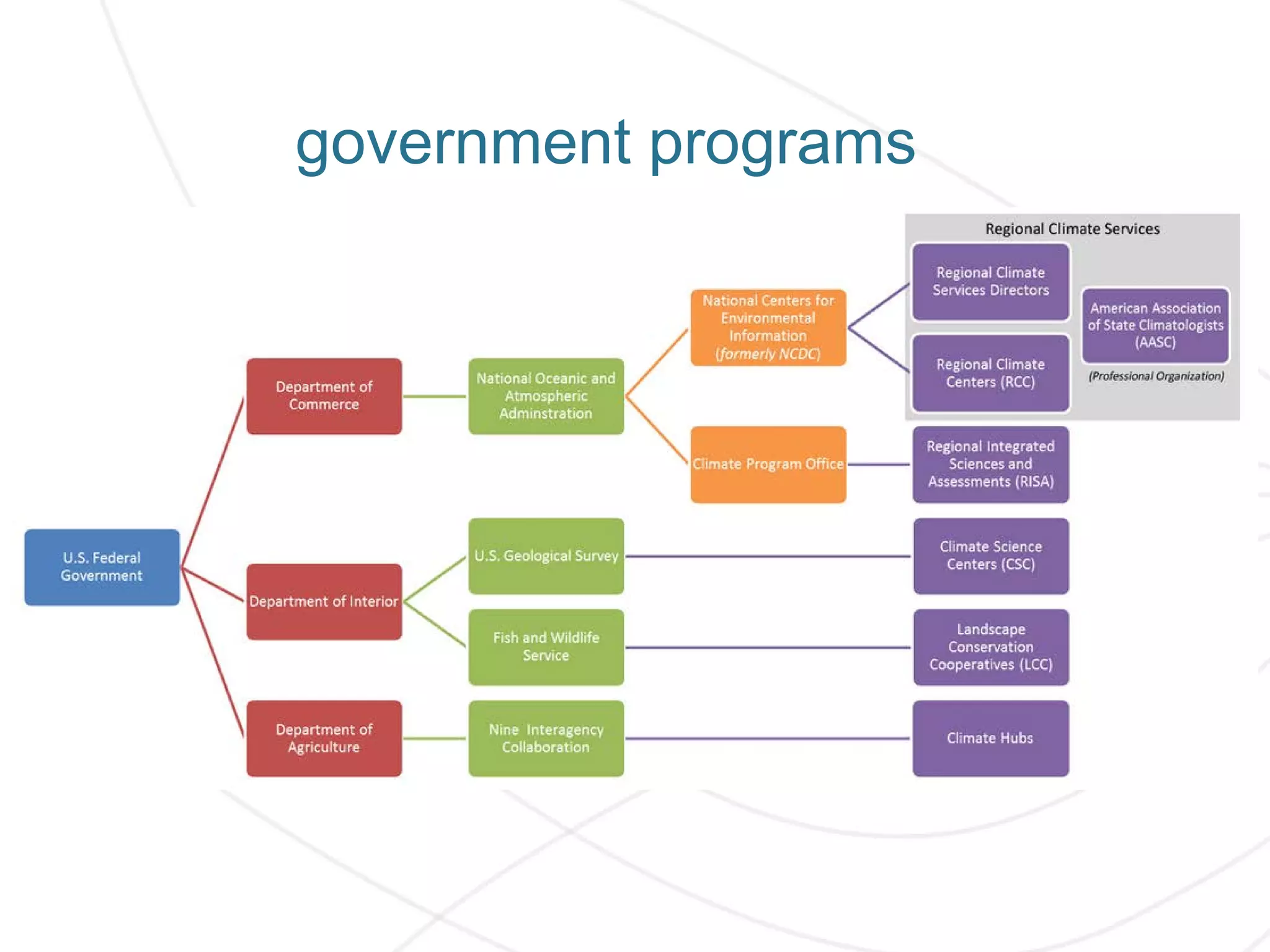
government programs
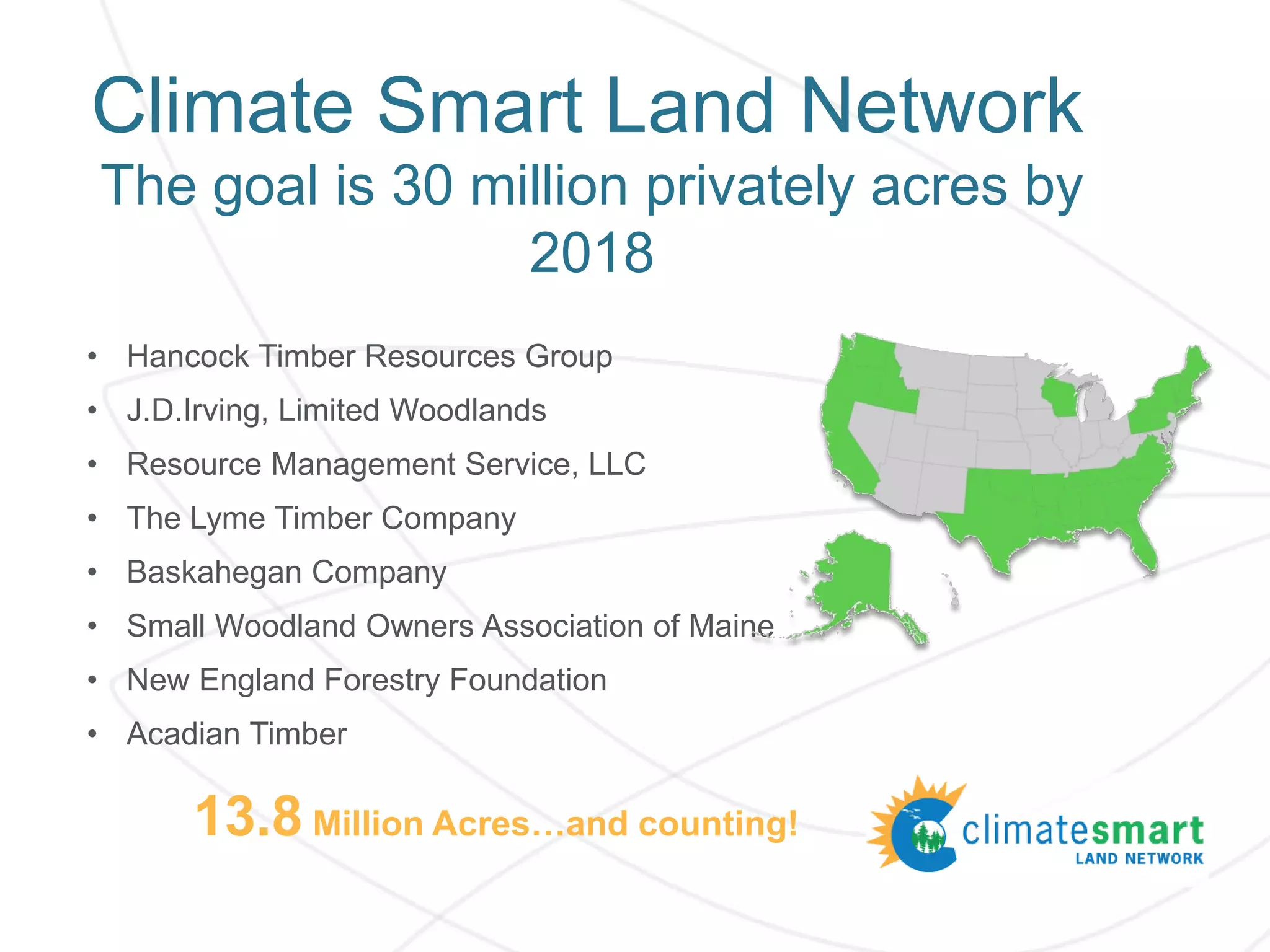
Climate Smart Land Network
The goal is 30 million privately acres by
2018
• Hancock Timber Resources Group
• J.D.Irving, Limited Woodlands
• Resource Management Service, LLC
• The Lyme Timber Company
• Baskahegan Company
• Small Woodland Owners Association of Maine
• New England Forestry Foundation
• Acadian Timber
13.8 Million Acres…and counting!
Climate Smart Land Network
• A network of landowners and managers throughout the U.S. & Canada
• Bridging the gap between climate science and on-the-ground application
• Helping members…
• Stay up-to-date on the latest research
• Assess their climate-related risk
• Develop simple & pragmatic strategies to minimize that risk and
incorporation climate change into planning
• Constant communication
• Monthly bulletins
• Regular phone check-ins
• Site-visits
• Other resources and information as needed
• Opportunities for peer-to-peer learning
What We Know
• Greenhouse gases are warming the planet
• Other pollutants are cooling the planet
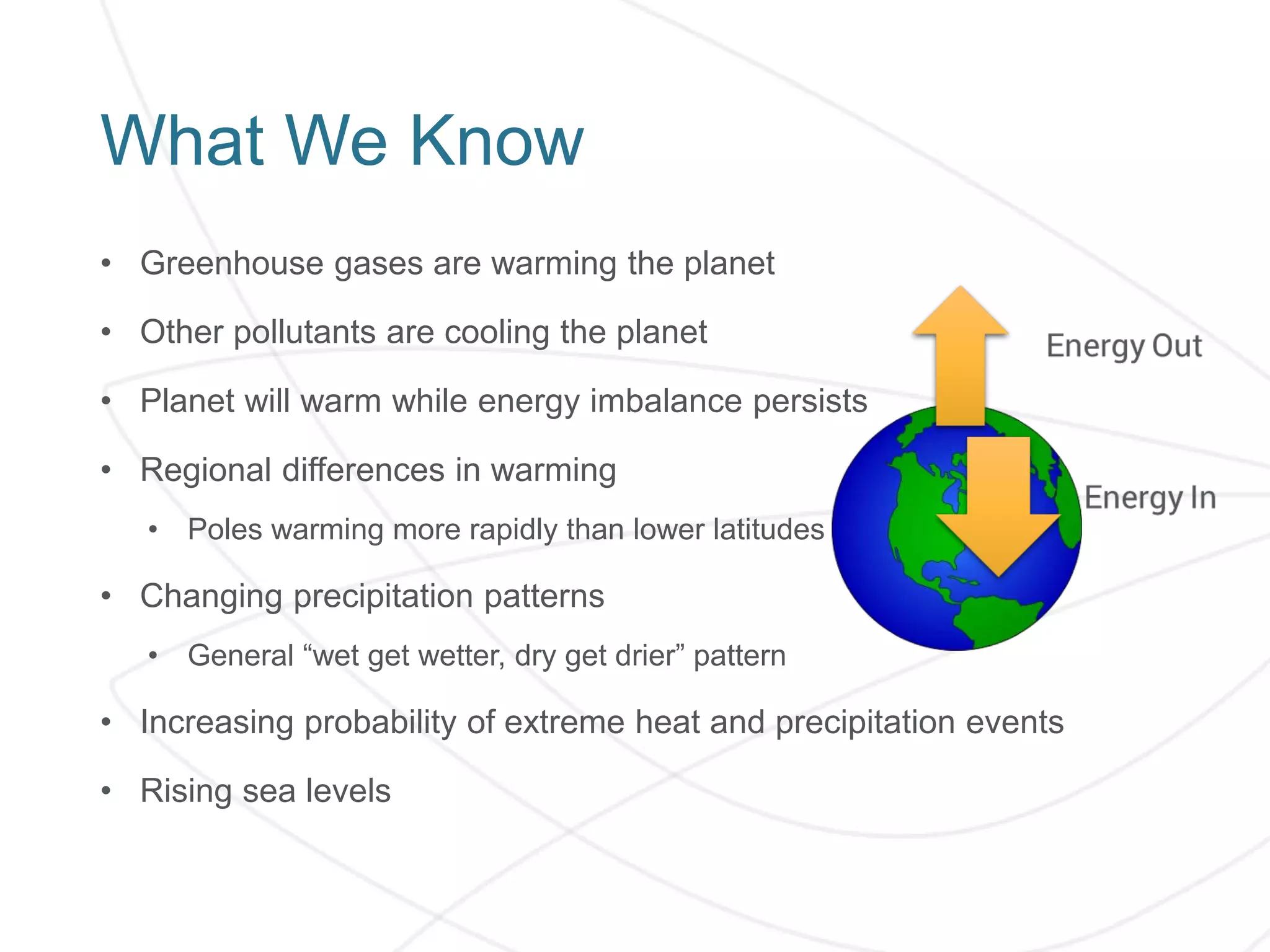
• Planet will warm while energy imbalance persists
• Regional differences in warming
• Poles warming more rapidly than lower latitudes
• Changing precipitation patterns
• General “wet get wetter, dry get drier” pattern
• Increasing probability of extreme heat and precipitation events
• Rising sea levels
• Faster chemical reactions
• Faster plant growth
• Longer growing seasons
• Shorter winters & less frozen ground
• More road washouts
• More tree wind and ice damage
• Increase in organisms kept in check by cold
weather
• Arthropods; Diseases; Invasive plants;
Animals
what will result?
Some things we don’t
know about climate
• Emission levels
• Tipping Points
• Local variations
• Feedbacks
Some things we don’t
know about
the forest response
• Impacts of higher ambient CO2?
• Genetics and epigentics?
• Niches, why do trees grow where they do?
• Insect & disease response?
• Influence of extreme events?
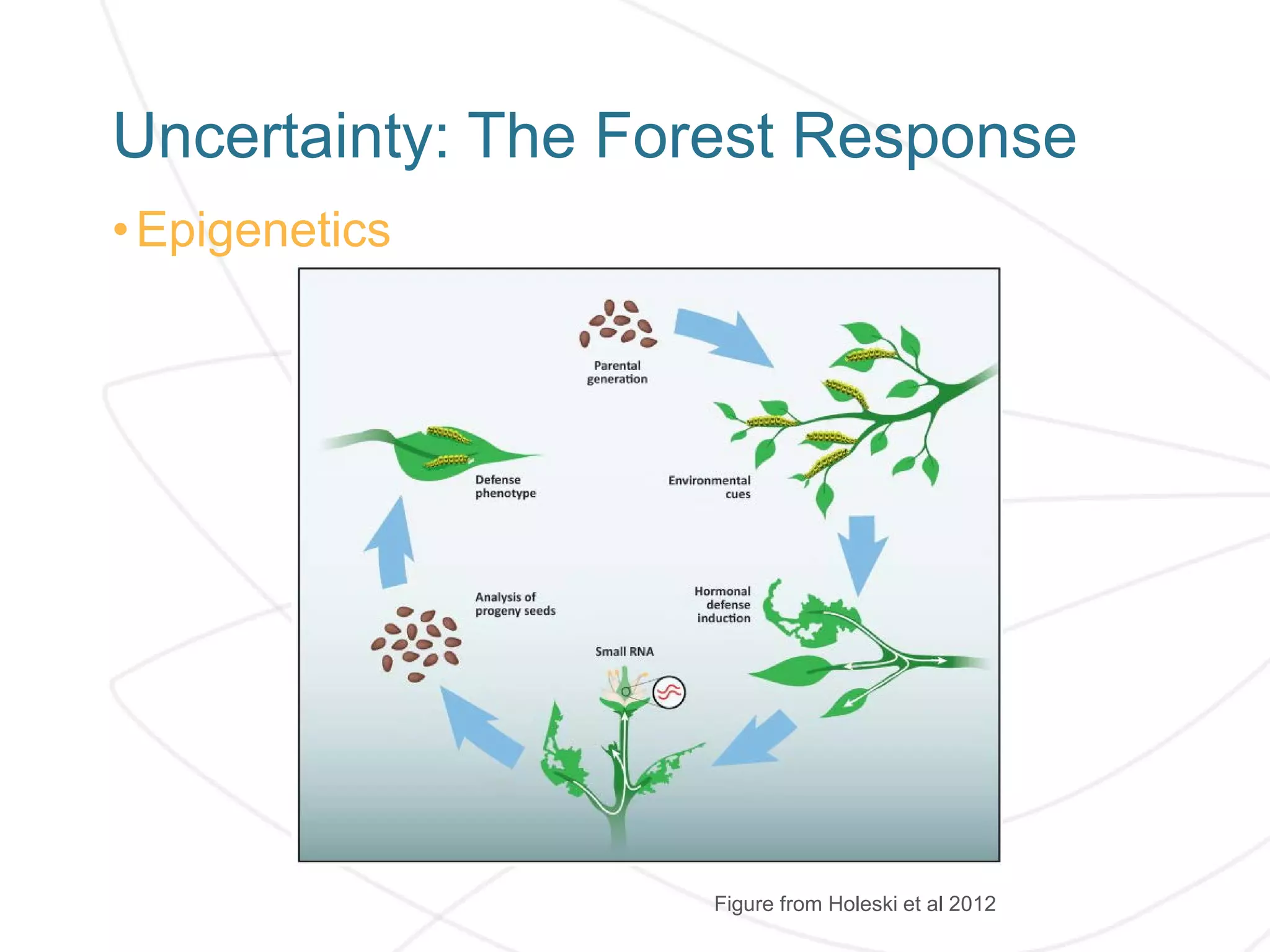
Uncertainty: The Forest Response
•Epigenetics
Figure from Holeski et al 2012
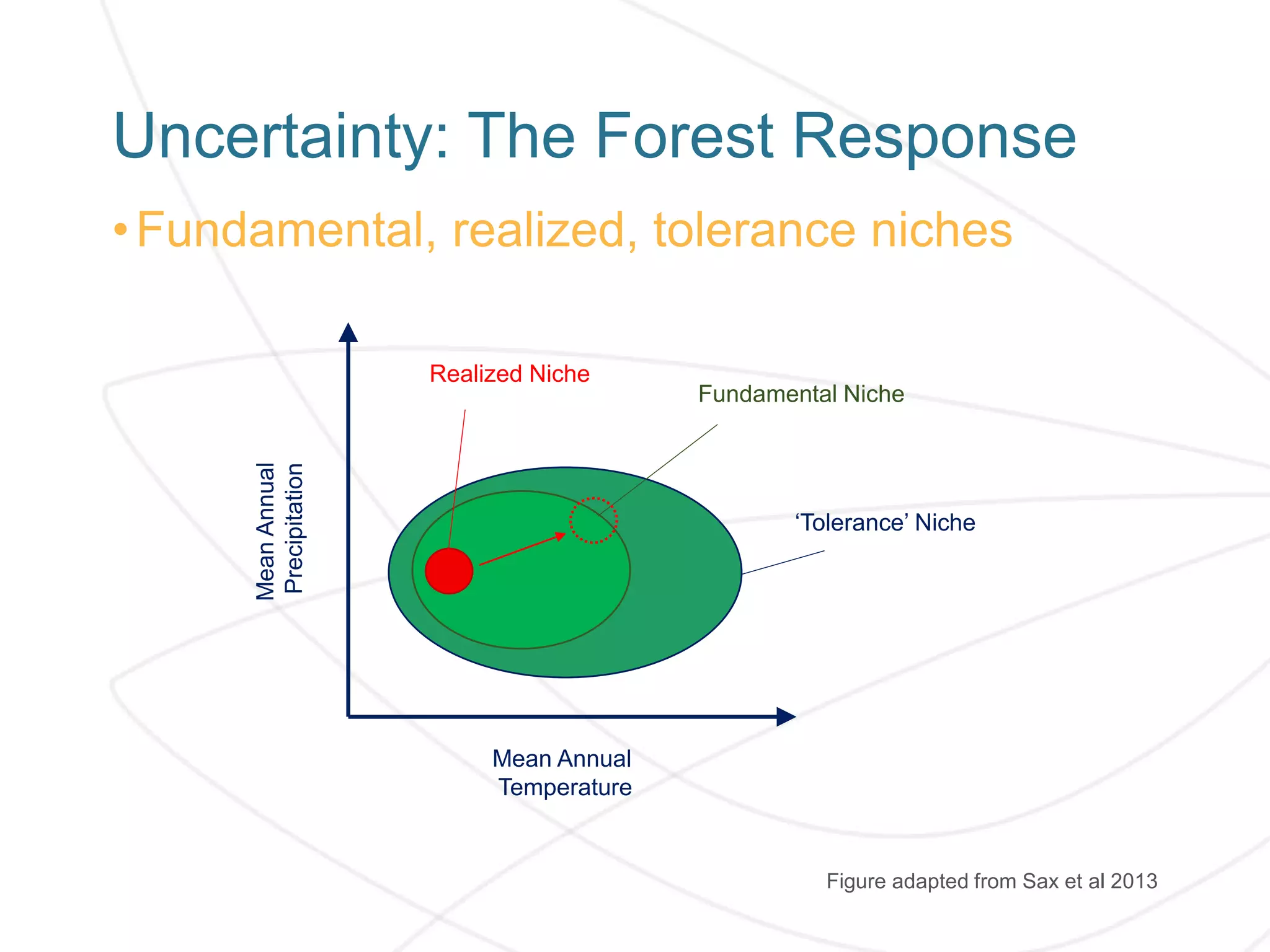
‘Tolerance’ Niche
Uncertainty: The Forest Response
•Fundamental, realized, tolerance niches
Figure adapted from Sax et al 2013
Mean Annual
Temperature
MeanAnnual
Precipitation
Fundamental Niche
Realized Niche
Niches
1. Puzzle pieces – Botany et al – Brian McGill
• Viable seed
• Successful growth of planted individuals
• Successful competition/survival in a forest environment
• Successful natural regeneration
3. Paleo pollen records – Jacquilyn Gill
• Indicates that competition is a very important factor
• Indicates that it often takes to two significant stressors to impact
species presence.
Uncertainty: The Forest Response
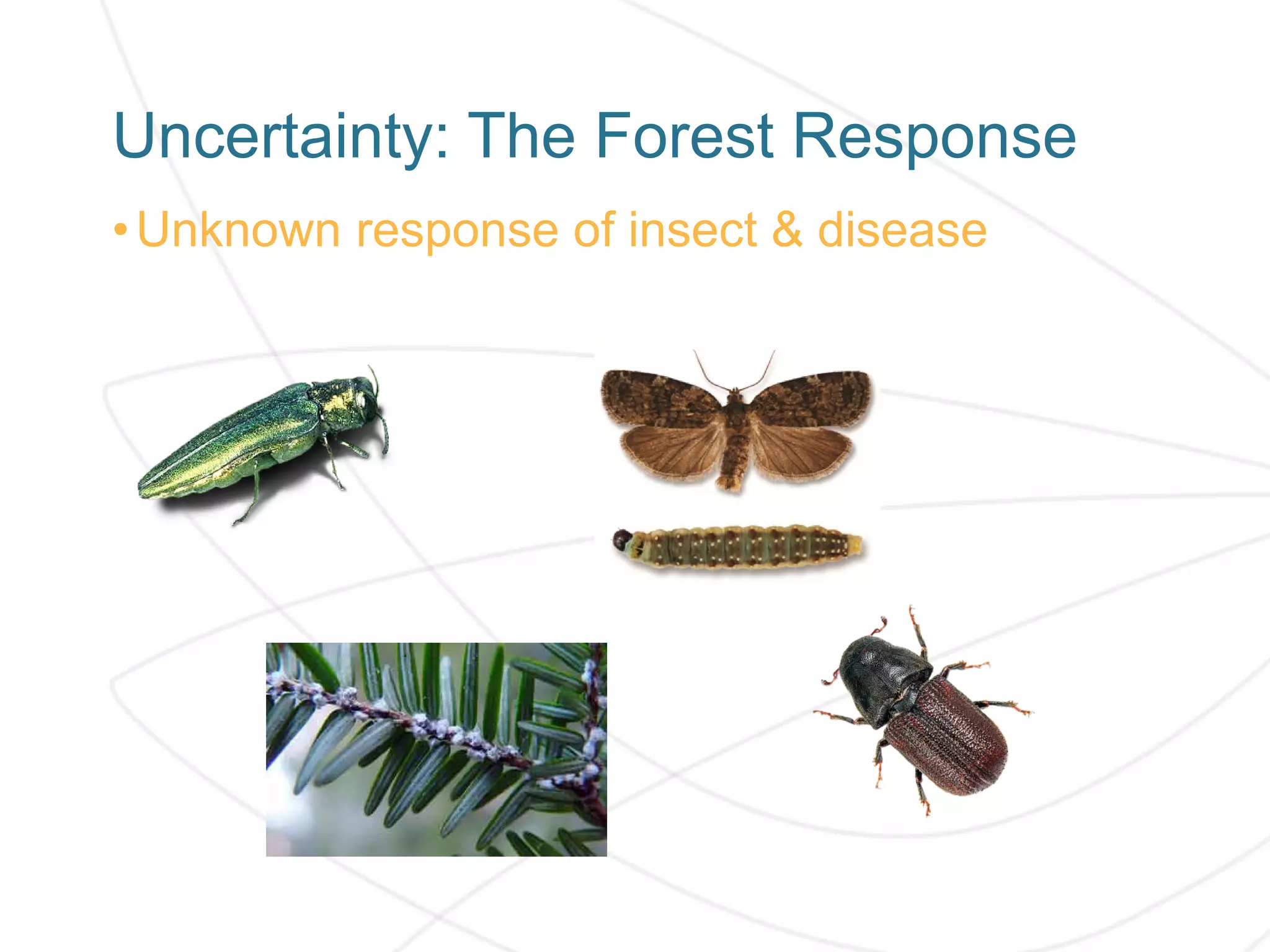
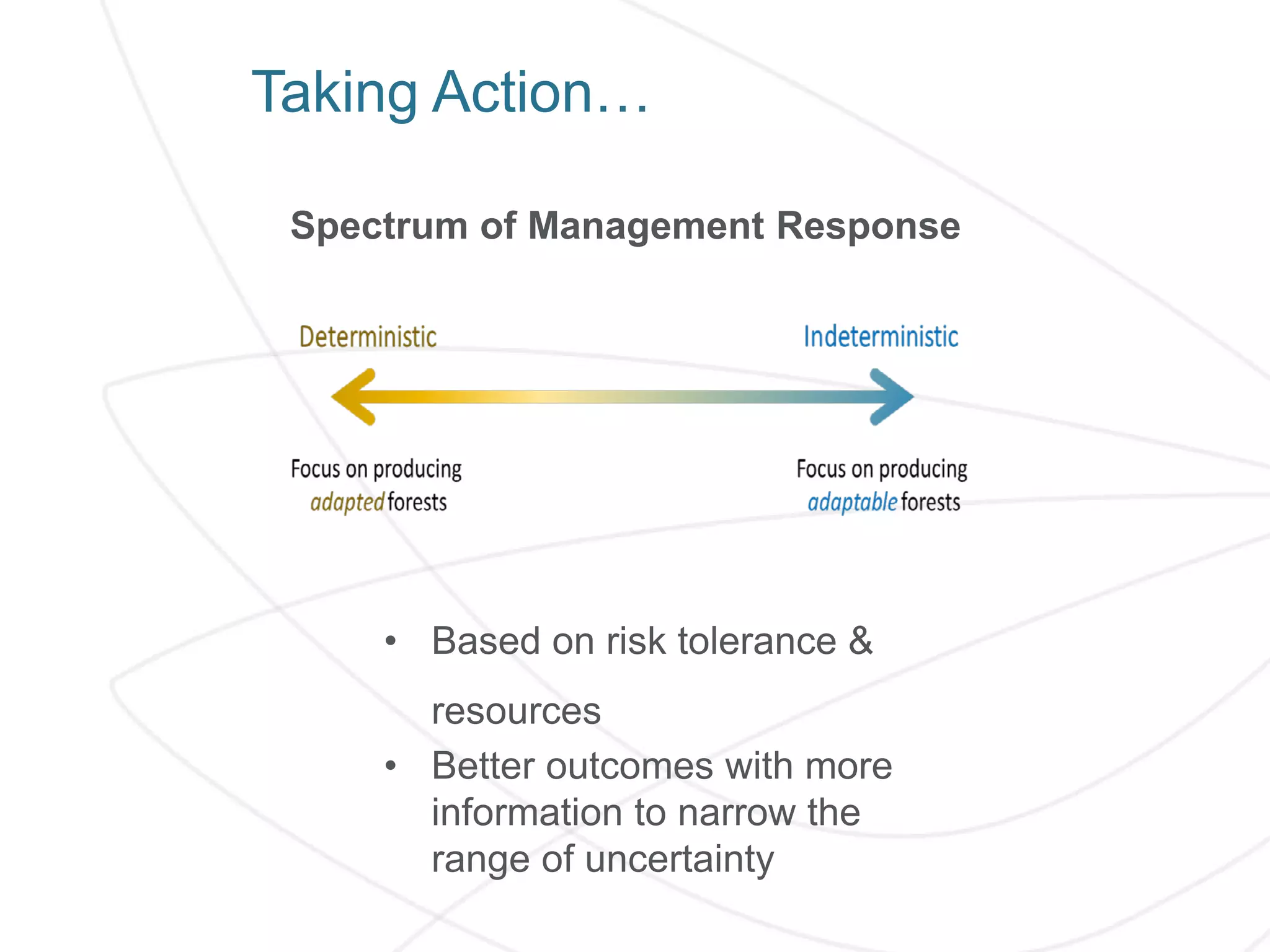
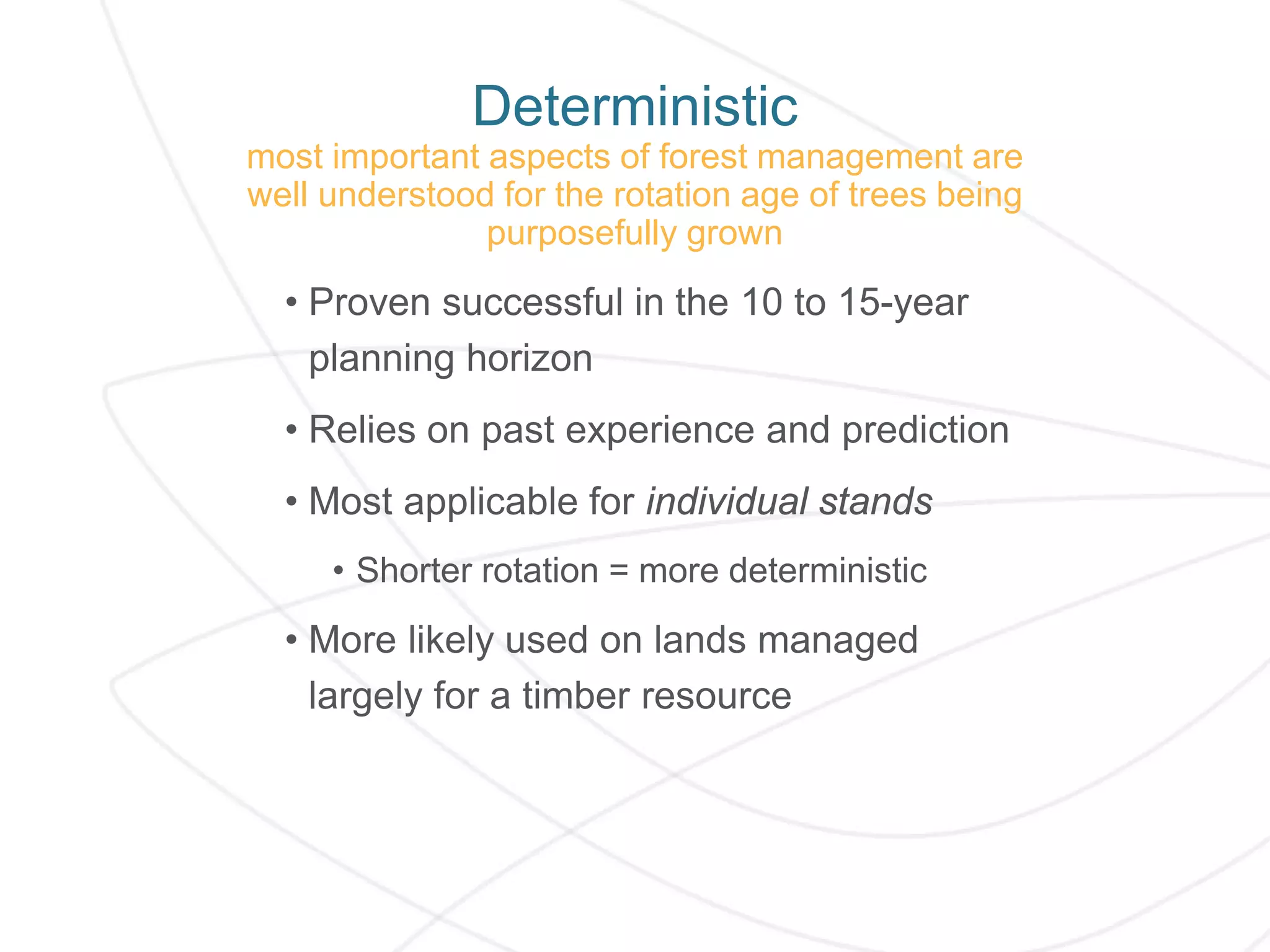
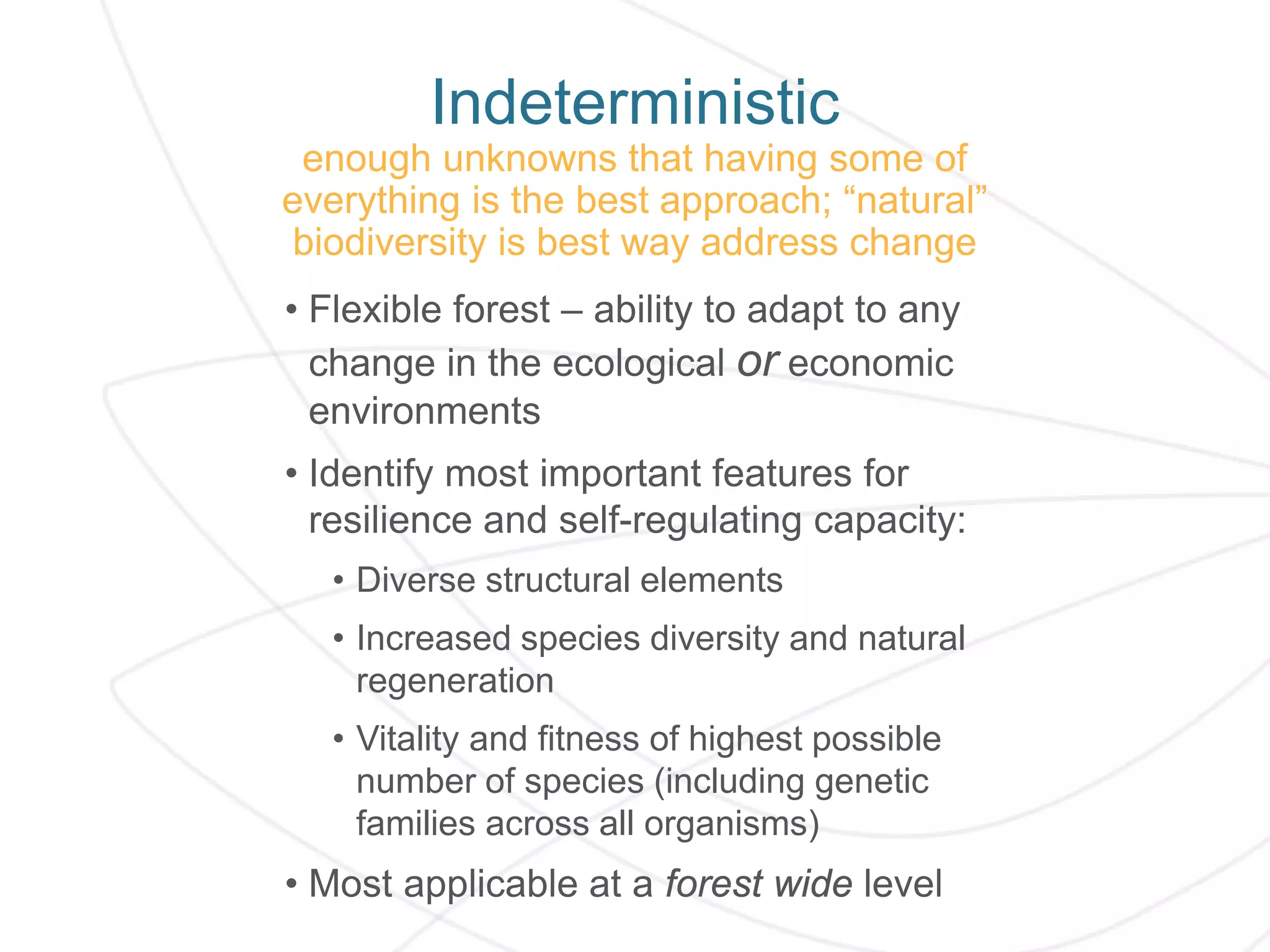
•Unknown response of insect & disease
Taking Action…
• Based on risk tolerance &
resources
• Better outcomes with more
information to narrow the
range of uncertainty
Spectrum of Management Response
Deterministic
most important aspects of forest management are
well understood for the rotation age of trees being
purposefully grown
• Proven successful in the 10 to 15-year
planning horizon
• Relies on past experience and prediction
• Most applicable for individual stands
• Shorter rotation = more deterministic
• More likely used on lands managed
largely for a timber resource
Indeterministic
enough unknowns that having some of
everything is the best approach; “natural”
biodiversity is best way address change
• Flexible forest – ability to adapt to any
change in the ecological or economic
environments
• Identify most important features for
resilience and self-regulating capacity:
• Diverse structural elements
• Increased species diversity and natural
regeneration
• Vitality and fitness of highest possible
number of species (including genetic
families across all organisms)
• Most applicable at a forest wide level
What are CSLN members doing do adapt
to changing conditions?
• Joining our network and increasing their useful knowledge
• Distributing our bulletins throughout their organizations
• Asking us questions and sharing answers
• Protecting themselves against ticks
•Improved their roads with bigger/better water crossings (50+ year
flows). USGS streamstats program.
• Adjusting their logging to new seasons
•Thinning stands to improve growth and wind firmness
• Monitoring their lands to detect change.
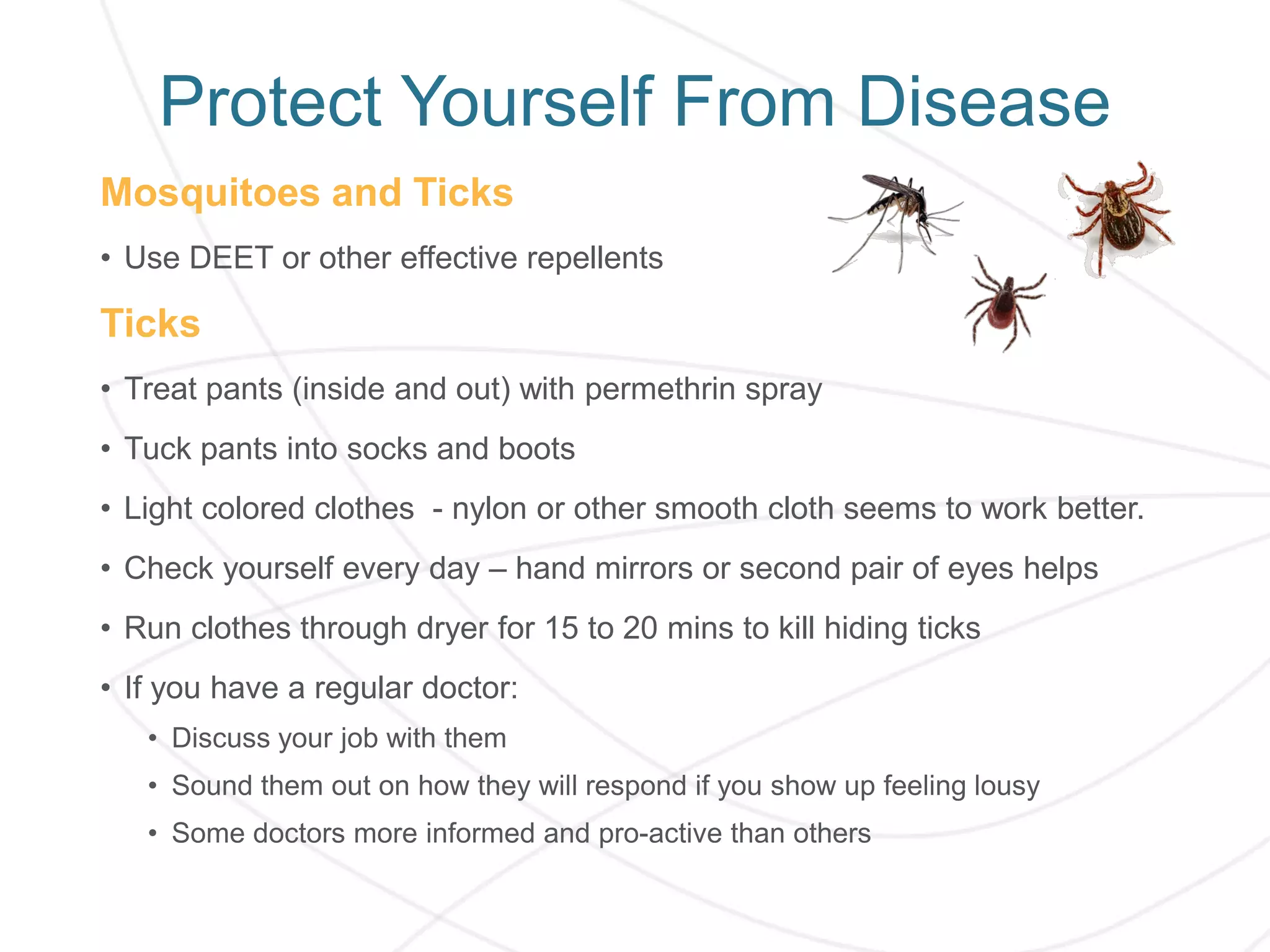
Protect Yourself From Disease
Mosquitoes and Ticks
• Use DEET or other effective repellents
Ticks
• Treat pants (inside and out) with permethrin spray
• Tuck pants into socks and boots
• Light colored clothes - nylon or other smooth cloth seems to work better.
• Check yourself every day – hand mirrors or second pair of eyes helps
• Run clothes through dryer for 15 to 20 mins to kill hiding ticks
• If you have a regular doctor:
• Discuss your job with them
• Sound them out on how they will respond if you show up feeling lousy
• Some doctors more informed and pro-active than others
Water Control
Minimizing risk and costs associated with stream crossings:
• Using temporary structures where feasible
• Reduce flooding exposure
• Eliminate long-term maintenance and stream impacts
• Designing new (or upgrading old) structures to address changing
precipitation patterns and ecosystem function
• Minimize structure failure and the need to rebuild prematurely
Tools & Information:
• MFS
• Maine Audubon (http://maineaudubon.org/wp-
content/uploads/2012/04/StreamSmart-How-To-TechnicalGuidance.pdf)
• USGS – Stream Stats tool – Maine
(http://ssdev.cr.usgs.gov/v3_beta/viewer.aspx?stabbr=ME)
Silviculture
Once a tree is established it will likely grow satisfactorily
• Regenerate – the regen phase in when species have the best
opportunity to express adaptation to new climate conditions
• Planting does give direct control.
• Thin early and often = more wind firm, healthier and more valuable
• height:diameter ratios = from 40 to 70
• Harvest trees that:
• Are likely to be at greater risk from insects or storms
• Have reached their peak grade
• Possibly shorten rotations to accelerate adaptation opportunities
• Retain some un-harvested patches to act as biodiversity refugia
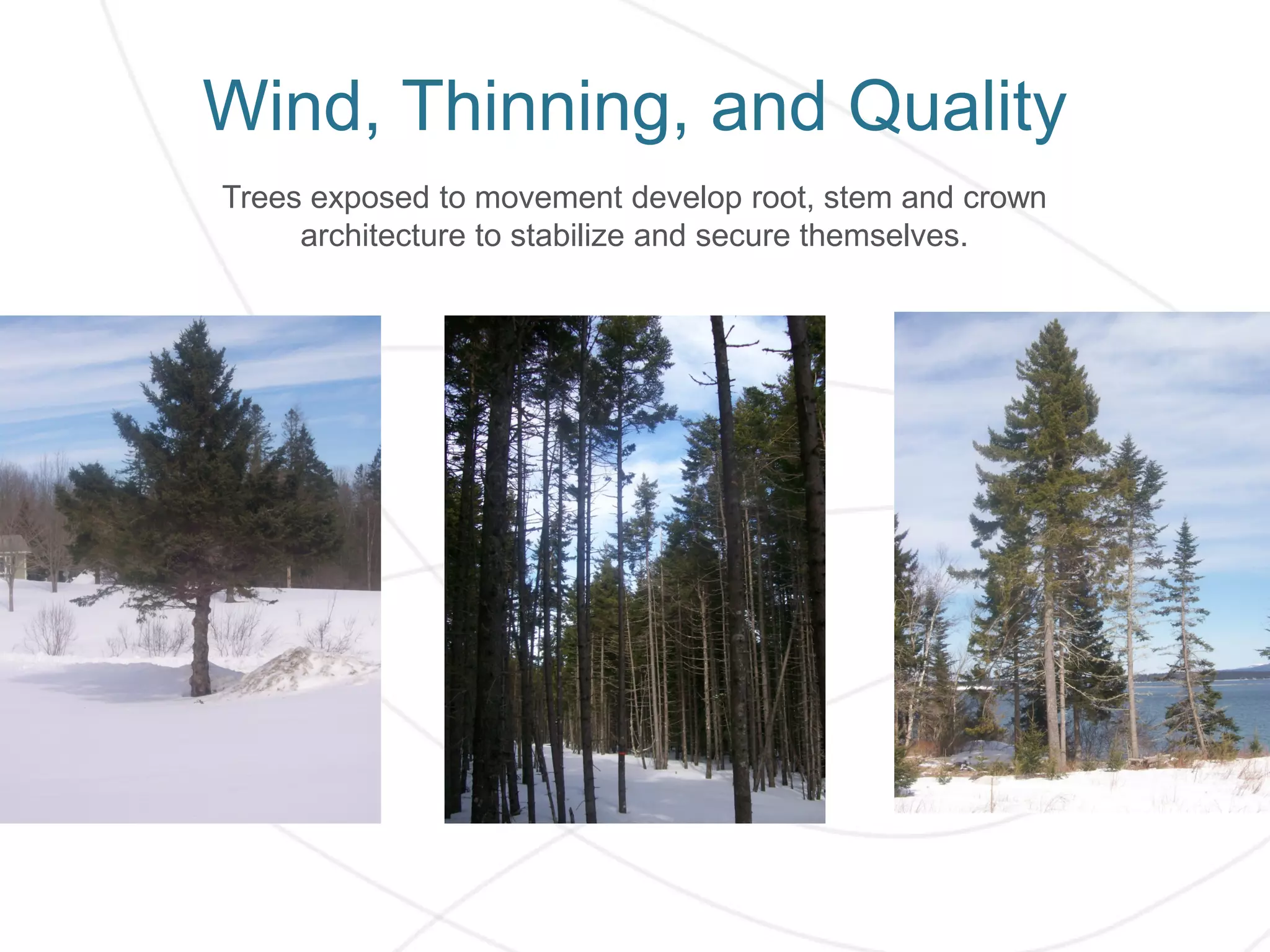
Wind, Thinning, and Quality
Trees exposed to movement develop root, stem and crown
architecture to stabilize and secure themselves.
Practices in Older Stands
• Very hard to develop windfirmness in existing canopy trees
• Approach:
• Light harvests to…
• Free crop tree crowns
• Remove at-risk trees (forked, butt rot, etc.)
• Five-year period of increased vulnerability
• Leave understory trees
• Taller Tree Paradox
• Less vulnerable because of more wind exposure
BUT
• More vulnerable because of height and basic physics
• Note: You can recognize more stable trees already exposed to
wind (edges and outcrops)
Practices in younger stands
• Choose young trees (saplings up to large poles)
• Conifers at 10-15‘ tall, Hardwoods 25-30‘ tall
• Leave understory, non-crown competing trees around crop trees.
• Managed Height:Diameter ratios between 40 and 70
• Maintain crown ratios at 50%
• You will grow healthier, more windfirm, bigger and more valuable
trees. The physical bending of the tree by the wind increases growth
at “stress” points.
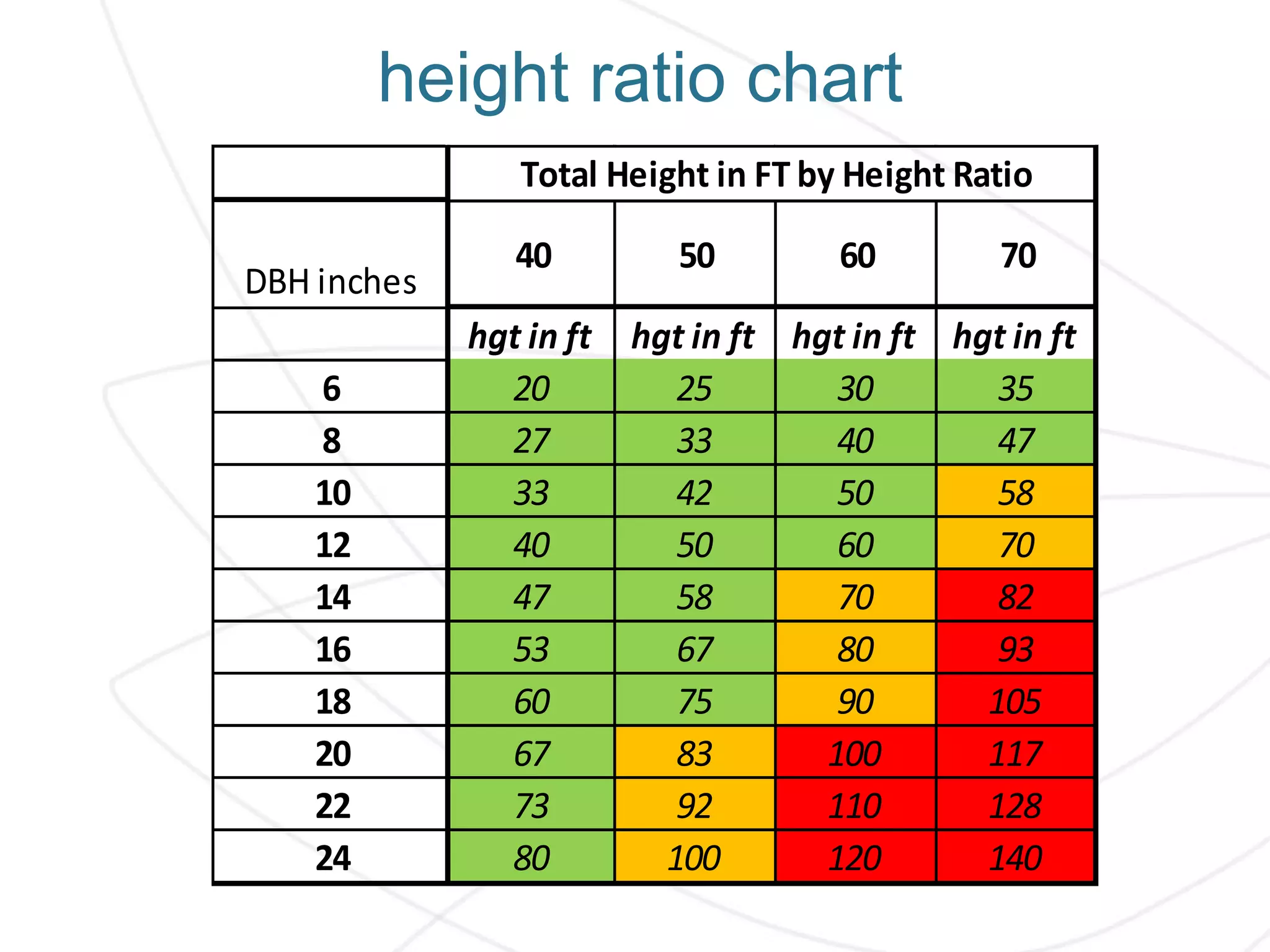
height ratio chart
DBH inches
40 50 60 70
hgt in ft hgt in ft hgt in ft hgt in ft
6 20 25 30 35
8 27 33 40 47
10 33 42 50 58
12 40 50 60 70
14 47 58 70 82
16 53 67 80 93
18 60 75 90 105
20 67 83 100 117
22 73 92 110 128
24 80 100 120 140
Total Height in FT by Height Ratio
Monitoring & Threat Control
Biological Threats
• Be ready to:
• Control deer – open the land and encourage hunting
• Invasive plants – Buckthorn and others
• Deal with new diseases and insects
• Salvage trees dying from storms, insects or diseases
Monitoring
• Establish baseline, then watch for changes related to:
• Insect, disease and invasive species
• Results of forest management actions
• Characteristics indicative of climate change
Greenhouse Gas Management
Increase amount of carbon stored
• Produce a high % of logs for solid wood products (stores CO2)
• Convert older stands (into a % of solid wood products) to
younger, faster growing stands.
OR
• Extend rotation lengths, thus increasing biomass
• Grow species less susceptible to insect and disease epidemics
(i.e. less likely to die and rot)
Note: Generally can’t increase biomass through more intensive
management, unless you extend rotations or account for product fate
Reduce GHG emissions
• Forest Operations
• Reduced truck and other equipment idling time.
• Convert to higher MPG vehicles
• Convert from petroleum to natural gas or propane vehicles
• Buildings
• Heating systems
• Solar panels
• Lighting with CFL or LED bulbs
• Hot water on demand systems
Greenhouse Gas Management
Stay Alert and Keep Learning

Managing Climate Change Risk in the Forest

  • 1.
    Si Balch, advisor& consultant Managing Climate Change Risk in the Forest “Trying to effect as many forest acres as possible”
  • 2.
    • Not acertification system • Not a government program • Not a funding source or a money sink • Not a source of all answers to everything • Not a source of bland generalizations • Not politically active • Does not say “should” or “aught” What the CSLN is NOT
  • 3.
  • 4.
    Climate Smart LandNetwork The goal is 30 million privately acres by 2018 • Hancock Timber Resources Group • J.D.Irving, Limited Woodlands • Resource Management Service, LLC • The Lyme Timber Company • Baskahegan Company • Small Woodland Owners Association of Maine • New England Forestry Foundation • Acadian Timber 13.8 Million Acres…and counting!
  • 5.
    Climate Smart LandNetwork • A network of landowners and managers throughout the U.S. & Canada • Bridging the gap between climate science and on-the-ground application • Helping members… • Stay up-to-date on the latest research • Assess their climate-related risk • Develop simple & pragmatic strategies to minimize that risk and incorporation climate change into planning • Constant communication • Monthly bulletins • Regular phone check-ins • Site-visits • Other resources and information as needed • Opportunities for peer-to-peer learning
  • 6.
    What We Know •Greenhouse gases are warming the planet • Other pollutants are cooling the planet • Planet will warm while energy imbalance persists • Regional differences in warming • Poles warming more rapidly than lower latitudes • Changing precipitation patterns • General “wet get wetter, dry get drier” pattern • Increasing probability of extreme heat and precipitation events • Rising sea levels
  • 7.
    • Faster chemicalreactions • Faster plant growth • Longer growing seasons • Shorter winters & less frozen ground • More road washouts • More tree wind and ice damage • Increase in organisms kept in check by cold weather • Arthropods; Diseases; Invasive plants; Animals what will result?
  • 8.
    Some things wedon’t know about climate • Emission levels • Tipping Points • Local variations • Feedbacks
  • 9.
    Some things wedon’t know about the forest response • Impacts of higher ambient CO2? • Genetics and epigentics? • Niches, why do trees grow where they do? • Insect & disease response? • Influence of extreme events?
  • 10.
    Uncertainty: The ForestResponse •Epigenetics Figure from Holeski et al 2012
  • 11.
    ‘Tolerance’ Niche Uncertainty: TheForest Response •Fundamental, realized, tolerance niches Figure adapted from Sax et al 2013 Mean Annual Temperature MeanAnnual Precipitation Fundamental Niche Realized Niche
  • 12.
    Niches 1. Puzzle pieces– Botany et al – Brian McGill • Viable seed • Successful growth of planted individuals • Successful competition/survival in a forest environment • Successful natural regeneration 3. Paleo pollen records – Jacquilyn Gill • Indicates that competition is a very important factor • Indicates that it often takes to two significant stressors to impact species presence.
  • 13.
    Uncertainty: The ForestResponse •Unknown response of insect & disease
  • 14.
    Taking Action… • Basedon risk tolerance & resources • Better outcomes with more information to narrow the range of uncertainty Spectrum of Management Response
  • 15.
    Deterministic most important aspectsof forest management are well understood for the rotation age of trees being purposefully grown • Proven successful in the 10 to 15-year planning horizon • Relies on past experience and prediction • Most applicable for individual stands • Shorter rotation = more deterministic • More likely used on lands managed largely for a timber resource
  • 16.
    Indeterministic enough unknowns thathaving some of everything is the best approach; “natural” biodiversity is best way address change • Flexible forest – ability to adapt to any change in the ecological or economic environments • Identify most important features for resilience and self-regulating capacity: • Diverse structural elements • Increased species diversity and natural regeneration • Vitality and fitness of highest possible number of species (including genetic families across all organisms) • Most applicable at a forest wide level
  • 17.
    What are CSLNmembers doing do adapt to changing conditions? • Joining our network and increasing their useful knowledge • Distributing our bulletins throughout their organizations • Asking us questions and sharing answers • Protecting themselves against ticks •Improved their roads with bigger/better water crossings (50+ year flows). USGS streamstats program. • Adjusting their logging to new seasons •Thinning stands to improve growth and wind firmness • Monitoring their lands to detect change.
  • 18.
    Protect Yourself FromDisease Mosquitoes and Ticks • Use DEET or other effective repellents Ticks • Treat pants (inside and out) with permethrin spray • Tuck pants into socks and boots • Light colored clothes - nylon or other smooth cloth seems to work better. • Check yourself every day – hand mirrors or second pair of eyes helps • Run clothes through dryer for 15 to 20 mins to kill hiding ticks • If you have a regular doctor: • Discuss your job with them • Sound them out on how they will respond if you show up feeling lousy • Some doctors more informed and pro-active than others
  • 19.
    Water Control Minimizing riskand costs associated with stream crossings: • Using temporary structures where feasible • Reduce flooding exposure • Eliminate long-term maintenance and stream impacts • Designing new (or upgrading old) structures to address changing precipitation patterns and ecosystem function • Minimize structure failure and the need to rebuild prematurely Tools & Information: • MFS • Maine Audubon (http://maineaudubon.org/wp- content/uploads/2012/04/StreamSmart-How-To-TechnicalGuidance.pdf) • USGS – Stream Stats tool – Maine (http://ssdev.cr.usgs.gov/v3_beta/viewer.aspx?stabbr=ME)
  • 20.
    Silviculture Once a treeis established it will likely grow satisfactorily • Regenerate – the regen phase in when species have the best opportunity to express adaptation to new climate conditions • Planting does give direct control. • Thin early and often = more wind firm, healthier and more valuable • height:diameter ratios = from 40 to 70 • Harvest trees that: • Are likely to be at greater risk from insects or storms • Have reached their peak grade • Possibly shorten rotations to accelerate adaptation opportunities • Retain some un-harvested patches to act as biodiversity refugia
  • 21.
    Wind, Thinning, andQuality Trees exposed to movement develop root, stem and crown architecture to stabilize and secure themselves.
  • 22.
    Practices in OlderStands • Very hard to develop windfirmness in existing canopy trees • Approach: • Light harvests to… • Free crop tree crowns • Remove at-risk trees (forked, butt rot, etc.) • Five-year period of increased vulnerability • Leave understory trees • Taller Tree Paradox • Less vulnerable because of more wind exposure BUT • More vulnerable because of height and basic physics • Note: You can recognize more stable trees already exposed to wind (edges and outcrops)
  • 23.
    Practices in youngerstands • Choose young trees (saplings up to large poles) • Conifers at 10-15‘ tall, Hardwoods 25-30‘ tall • Leave understory, non-crown competing trees around crop trees. • Managed Height:Diameter ratios between 40 and 70 • Maintain crown ratios at 50% • You will grow healthier, more windfirm, bigger and more valuable trees. The physical bending of the tree by the wind increases growth at “stress” points.
  • 24.
    height ratio chart DBHinches 40 50 60 70 hgt in ft hgt in ft hgt in ft hgt in ft 6 20 25 30 35 8 27 33 40 47 10 33 42 50 58 12 40 50 60 70 14 47 58 70 82 16 53 67 80 93 18 60 75 90 105 20 67 83 100 117 22 73 92 110 128 24 80 100 120 140 Total Height in FT by Height Ratio
  • 25.
    Monitoring & ThreatControl Biological Threats • Be ready to: • Control deer – open the land and encourage hunting • Invasive plants – Buckthorn and others • Deal with new diseases and insects • Salvage trees dying from storms, insects or diseases Monitoring • Establish baseline, then watch for changes related to: • Insect, disease and invasive species • Results of forest management actions • Characteristics indicative of climate change
  • 26.
    Greenhouse Gas Management Increaseamount of carbon stored • Produce a high % of logs for solid wood products (stores CO2) • Convert older stands (into a % of solid wood products) to younger, faster growing stands. OR • Extend rotation lengths, thus increasing biomass • Grow species less susceptible to insect and disease epidemics (i.e. less likely to die and rot) Note: Generally can’t increase biomass through more intensive management, unless you extend rotations or account for product fate
  • 27.
    Reduce GHG emissions •Forest Operations • Reduced truck and other equipment idling time. • Convert to higher MPG vehicles • Convert from petroleum to natural gas or propane vehicles • Buildings • Heating systems • Solar panels • Lighting with CFL or LED bulbs • Hot water on demand systems Greenhouse Gas Management
  • 28.
    Stay Alert andKeep Learning